Electricity Billing
Calculation of energy consumed
3
• Electrical energy is most useful form of energy because it can be most conveniently
transformed into other forms of energy like heat light, mechanical energy that we
require in our day to day life.
• But electricity is not readily available and is required to be produced (generated) in a
factory called power station.
• Like any other manufacturing process, the production (generation) of electricity also
need some cost to be incurred - Plants and Equipment, Inputs (water, fuel etc.), Ash
smoke disposal systems, Personnel
• Cost of Transmission and Distribution to the large number of consumers of various
categories (viz. domestic, commercial, industrial, agricultural etc.)
• All these costs when added together constitutes the total cost of electricity which in
the consumers have to share according to the quantum of electricity consumed
taking into account the nature and time of use of electricity by each category of
consumers.
INTRODUCTION
4
The basic difference between power and energy –
Power –
It is the capacity to Generate or consume electricity. The term “Power” specifies the capacity of
generation or consumption in terms of Kilowatt (KW) or Megawatt (MW). One Megawatt as we know
in one thousand Kilowatt.
Energy –
It is the Power Generated or Consumed by utilizing the capacity for a duration of time. If one kilowatt
Power has been generated or distributed continuously for one hour, it is said that an energy of One
Kilowatt hour has been generated or used. Similarly if Five kilowatt of Power is generated or
consumed for Two hours, an energy of 10 ( = 5 X 2) kilowatt hour has been generated or consumed
and so on.
INTRODUCTION ……(contd.)
Electric Power, AC, and DC Electricity
Key Question:
How much does electricity
cost and what do you
pay for?
Electric Power, AC, and DC Electricity
• The watt (W) is a unit of power.
• Power is the rate at which energy
moves or is used.
• Since energy is measured in joules,
power is measured in joules per
second.
• One joule per second is equal to
one watt.
Power in electric circuits
• One watt is a pretty small amount of power.
• In everyday use, larger units are more convenient to
use.
• A kilowatt (kW) is equal to 1,000 watts.
• The other common unit of power often seen on
electric motors is the horsepower.
• One horsepower is 746 watts.
Power
P =VI Current (amps)
Voltage (volts)
Power (watts)
Calculate power
• A light bulb with a
resistance of 3Ω is
connected to a 1.5-volt
battery in the circuit shown
at right.
• Calculate the power used by
the light bulb.
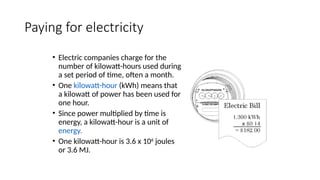
Paying for electricity
• Electric companies charge for the
number of kilowatt-hours used during
a set period of time, often a month.
• One kilowatt-hour (kWh) means that
a kilowatt of power has been used for
one hour.
• Since power multiplied by time is
energy, a kilowatt-hour is a unit of
energy.
• One kilowatt-hour is 3.6 x 10⁶
joules
or 3.6 MJ.
Calculate power
• Your electric company charges 14 cents per kilowatt-hour.
Your coffee maker has a power rating of 1,050 watts.
• How much does it cost to use the coffee maker one hour
per day for a month?
Power in AC circuits
• For a circuit containing a motor,
the power calculation is a little
different from that for a simple
resistance like a light bulb.
• Because motors store energy
and act like generators, the
current and voltage are not in
phase with each other.
• The current is always a little
behind the voltage.
Power for AC circuits
• Electrical engineers use a power factor (pf) to calculate power
for AC circuits with motors
P =VI x pf
Avg. current (amps)
Avg. voltage
(volts)
Power (watts)
power factor
0-100%
Application: Wiring in Homes and Buildings
The amount of Electricity used is measured in units
To calculate the amount used we use the following formula
Units used = PRESENT reading - PREVIOUS reading
Meter Reading
Present Previous
32514 32347
Meter Reading
Present Previous
60134 59929
Units used = 32514 - 32347
= 167
Units used = 60134 - 59929
= 205
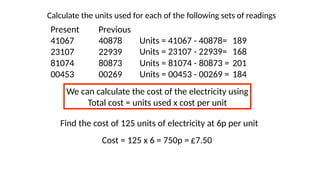
Calculate the units used for each of the following sets of readings
Present Previous
41067 40878
23107 22939
81074 80873
00453 00269
Units = 41067 - 40878= 189
Units = 23107 - 22939=
Units = 81074 - 80873 =
Units = 00453 - 00269 =
168
201
184
We can calculate the cost of the electricity using
Total cost = units used x cost per unit
Find the cost of 125 units of electricity at 6p per unit
Cost = 125 x 6 = 750p = £7.50
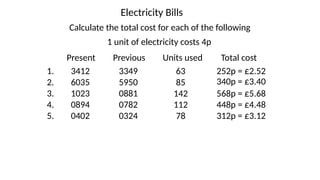
Electricity Bills
Calculate the total cost for each of the following
1. 3412 3349
2. 6035 5950
3. 1023 0881
4. 0894 0782
5. 0402 0324
Present Previous
1 unit of electricity costs 4p
Units used Total cost
63
85
142
112
78
252p = £2.52
340p = £3.40
568p = £5.68
448p = £4.48
312p = £3.12
Other costs on an electricity bill
Standing charge - this is a fixed amont of money paid
even if no electricity is used
VAT is paid on the total electricity bill
Bright Spark Electricity
House H. Old, 3 This Street 11/09/96 - 14/12/96
Meter Reading Charges Amount
Present Previous
2065 1876 units at 8p
Standing charge
Sub-total
VAT at 17.5%
Total Due
£12.50
189 £15.12
£27.62
£4.83
£32.45
Power factor correction
Power factor. Ratio of useful power to total
power drawn from AC supply
Inductive devices use reactive power.
Motors, welding sets, induction heaters,
fluorescent lights.
Power Factor Correction (PFC)
• Uses capacitors
• Reduces power consumption
• Leads to increased supply capacity
• Increases life expectance of electrical
equipment
Image source: Power factor correction, An introduction to
technology and techniques. Carbon Trust
Image source: http://electrical-engineering-portal.com/beer-mug-
and-power-factor
Why household wiring is done using parallel
connection
• Houses are generally wired in parallel rather than series circuits for a
couple of reasons. Think of the series circuits on old Christmas tree
lights. If one light bulb doesn't work, none of the lights will come on,
because all the electricity has to flow through each light bulb in
sequence. A broken filament in one bulb creates an open circuit
and the electricity can't flow.
• Another problem with series wiring is that as we extend the circuit,
adding more lights, each light we add makes the other lights dimmer.
That's because we're increasing the total linear resistance in the circuit.
The voltage is fixed, so as the resistance increases, the current flow
must decrease. Neither of these are desirable situations and, therefore,
our houses are wired in parallel
• Electricity has several paths it can follow from the energy source to
ground. Even with several light fixtures controlled by one switch, the
light fixtures are in parallel. If one light bulb burns out, electricity still
flows through the other bulbs.
• The other feature of parallel circuits is that adding another light or
resistor of any kind will not cause the others that are already working to
get dimmer or draw less current. If you think of a simple circuit with a 60-
watt light bulb, a 120-volt power supply seeing a 60-watt light bulb will
have a resultant current of 1 /2 amp (I=P/V=60/120=1/2). Any place in
this circuit where we measure the current, we have 1 /2 amp flowing. If
we add a second 60-watt light bulb in parallel, the circuit has a second
branch. In each leg of the branch, the current flow would be 1/2 amp.
Before the branch splits, and after it comes back together, the current
would be 1 amp. However, when the second light is added, the first light
still sees the 1/2 amp current flow and does not change in brightness.
• If this seems like magic to you, you'll just have to accept that this is the way
electricity works. Incidentally, you can extend this picture. If you put a third
branch in with another 60-watt light bulb, it too, would draw 1/2 amp, and the
total current drawn in the common parts of the circuit would be 1 1/2 amps.
There are three parallel paths, each carrying 1/2 amp.
• You can see that if you put in thirty 60-watt light bulbs, you are going to draw 15-
amps (I=P/V=30x60/120=15). Fifteen amps flowing through a conventional
household wire is close to the point where you'll blow the fuse or trip the
breaker.
• This is the threshold of an overload situation. A general design limitation is to
restrict a 15-amp circuit to 80% of its rated capacity. This limits the circuit to 12
amps, maximum.
• Assuming your ECG bill for the month of September 2016 was GH₵
135. Calculate the units you consumed for the month if ECG charges
30 GHp/unit and the service charge is GH₵ 15.

Electricity billing distribution system1

  • 1.
  • 3.
    3 • Electrical energyis most useful form of energy because it can be most conveniently transformed into other forms of energy like heat light, mechanical energy that we require in our day to day life. • But electricity is not readily available and is required to be produced (generated) in a factory called power station. • Like any other manufacturing process, the production (generation) of electricity also need some cost to be incurred - Plants and Equipment, Inputs (water, fuel etc.), Ash smoke disposal systems, Personnel • Cost of Transmission and Distribution to the large number of consumers of various categories (viz. domestic, commercial, industrial, agricultural etc.) • All these costs when added together constitutes the total cost of electricity which in the consumers have to share according to the quantum of electricity consumed taking into account the nature and time of use of electricity by each category of consumers. INTRODUCTION
  • 4.
    4 The basic differencebetween power and energy – Power – It is the capacity to Generate or consume electricity. The term “Power” specifies the capacity of generation or consumption in terms of Kilowatt (KW) or Megawatt (MW). One Megawatt as we know in one thousand Kilowatt. Energy – It is the Power Generated or Consumed by utilizing the capacity for a duration of time. If one kilowatt Power has been generated or distributed continuously for one hour, it is said that an energy of One Kilowatt hour has been generated or used. Similarly if Five kilowatt of Power is generated or consumed for Two hours, an energy of 10 ( = 5 X 2) kilowatt hour has been generated or consumed and so on. INTRODUCTION ……(contd.)
  • 5.
    Electric Power, AC,and DC Electricity Key Question: How much does electricity cost and what do you pay for?
  • 6.
    Electric Power, AC,and DC Electricity • The watt (W) is a unit of power. • Power is the rate at which energy moves or is used. • Since energy is measured in joules, power is measured in joules per second. • One joule per second is equal to one watt.
  • 7.
    Power in electriccircuits • One watt is a pretty small amount of power. • In everyday use, larger units are more convenient to use. • A kilowatt (kW) is equal to 1,000 watts. • The other common unit of power often seen on electric motors is the horsepower. • One horsepower is 746 watts.
  • 8.
    Power P =VI Current(amps) Voltage (volts) Power (watts)
  • 9.
    Calculate power • Alight bulb with a resistance of 3Ω is connected to a 1.5-volt battery in the circuit shown at right. • Calculate the power used by the light bulb.
  • 10.
    Paying for electricity •Electric companies charge for the number of kilowatt-hours used during a set period of time, often a month. • One kilowatt-hour (kWh) means that a kilowatt of power has been used for one hour. • Since power multiplied by time is energy, a kilowatt-hour is a unit of energy. • One kilowatt-hour is 3.6 x 10⁶ joules or 3.6 MJ.
  • 11.
    Calculate power • Yourelectric company charges 14 cents per kilowatt-hour. Your coffee maker has a power rating of 1,050 watts. • How much does it cost to use the coffee maker one hour per day for a month?
  • 12.
    Power in ACcircuits • For a circuit containing a motor, the power calculation is a little different from that for a simple resistance like a light bulb. • Because motors store energy and act like generators, the current and voltage are not in phase with each other. • The current is always a little behind the voltage.
  • 13.
    Power for ACcircuits • Electrical engineers use a power factor (pf) to calculate power for AC circuits with motors P =VI x pf Avg. current (amps) Avg. voltage (volts) Power (watts) power factor 0-100%
  • 14.
    Application: Wiring inHomes and Buildings
  • 15.
    Application: Wiring inHomes and Buildings
  • 16.
    The amount ofElectricity used is measured in units To calculate the amount used we use the following formula Units used = PRESENT reading - PREVIOUS reading Meter Reading Present Previous 32514 32347 Meter Reading Present Previous 60134 59929 Units used = 32514 - 32347 = 167 Units used = 60134 - 59929 = 205
  • 17.
    Calculate the unitsused for each of the following sets of readings Present Previous 41067 40878 23107 22939 81074 80873 00453 00269 Units = 41067 - 40878= 189 Units = 23107 - 22939= Units = 81074 - 80873 = Units = 00453 - 00269 = 168 201 184 We can calculate the cost of the electricity using Total cost = units used x cost per unit Find the cost of 125 units of electricity at 6p per unit Cost = 125 x 6 = 750p = £7.50
  • 18.
    Electricity Bills Calculate thetotal cost for each of the following 1. 3412 3349 2. 6035 5950 3. 1023 0881 4. 0894 0782 5. 0402 0324 Present Previous 1 unit of electricity costs 4p Units used Total cost 63 85 142 112 78 252p = £2.52 340p = £3.40 568p = £5.68 448p = £4.48 312p = £3.12
  • 19.
    Other costs onan electricity bill Standing charge - this is a fixed amont of money paid even if no electricity is used VAT is paid on the total electricity bill
  • 20.
    Bright Spark Electricity HouseH. Old, 3 This Street 11/09/96 - 14/12/96 Meter Reading Charges Amount Present Previous 2065 1876 units at 8p Standing charge Sub-total VAT at 17.5% Total Due £12.50 189 £15.12 £27.62 £4.83 £32.45
  • 21.
    Power factor correction Powerfactor. Ratio of useful power to total power drawn from AC supply Inductive devices use reactive power. Motors, welding sets, induction heaters, fluorescent lights. Power Factor Correction (PFC) • Uses capacitors • Reduces power consumption • Leads to increased supply capacity • Increases life expectance of electrical equipment Image source: Power factor correction, An introduction to technology and techniques. Carbon Trust Image source: http://electrical-engineering-portal.com/beer-mug- and-power-factor
  • 22.
    Why household wiringis done using parallel connection • Houses are generally wired in parallel rather than series circuits for a couple of reasons. Think of the series circuits on old Christmas tree lights. If one light bulb doesn't work, none of the lights will come on, because all the electricity has to flow through each light bulb in sequence. A broken filament in one bulb creates an open circuit and the electricity can't flow.
  • 23.
    • Another problemwith series wiring is that as we extend the circuit, adding more lights, each light we add makes the other lights dimmer. That's because we're increasing the total linear resistance in the circuit. The voltage is fixed, so as the resistance increases, the current flow must decrease. Neither of these are desirable situations and, therefore, our houses are wired in parallel • Electricity has several paths it can follow from the energy source to ground. Even with several light fixtures controlled by one switch, the light fixtures are in parallel. If one light bulb burns out, electricity still flows through the other bulbs.
  • 24.
    • The otherfeature of parallel circuits is that adding another light or resistor of any kind will not cause the others that are already working to get dimmer or draw less current. If you think of a simple circuit with a 60- watt light bulb, a 120-volt power supply seeing a 60-watt light bulb will have a resultant current of 1 /2 amp (I=P/V=60/120=1/2). Any place in this circuit where we measure the current, we have 1 /2 amp flowing. If we add a second 60-watt light bulb in parallel, the circuit has a second branch. In each leg of the branch, the current flow would be 1/2 amp. Before the branch splits, and after it comes back together, the current would be 1 amp. However, when the second light is added, the first light still sees the 1/2 amp current flow and does not change in brightness.
  • 25.
    • If thisseems like magic to you, you'll just have to accept that this is the way electricity works. Incidentally, you can extend this picture. If you put a third branch in with another 60-watt light bulb, it too, would draw 1/2 amp, and the total current drawn in the common parts of the circuit would be 1 1/2 amps. There are three parallel paths, each carrying 1/2 amp. • You can see that if you put in thirty 60-watt light bulbs, you are going to draw 15- amps (I=P/V=30x60/120=15). Fifteen amps flowing through a conventional household wire is close to the point where you'll blow the fuse or trip the breaker. • This is the threshold of an overload situation. A general design limitation is to restrict a 15-amp circuit to 80% of its rated capacity. This limits the circuit to 12 amps, maximum.
  • 26.
    • Assuming yourECG bill for the month of September 2016 was GH₵ 135. Calculate the units you consumed for the month if ECG charges 30 GHp/unit and the service charge is GH₵ 15.

Editor's Notes

  • #9 1) You are asked to find the power used by the light bulb. 2) You are given the voltage of the battery and the bulb’s resistance. 3) Use Ohm’s law, I = V/R, to calculate the current; then use the power equation, P=VI, to calculate the power. 4) Solve: I = 1.5V ÷ 1.5Ω = 1A P = 1.5V × 1A = 1.5 W; the bulb uses 1.5 watts of electric power.
  • #11 1) You are asked to find the cost of using the coffee maker. 2) You are given the power in watts and the time. 3) Use the power formula P = VI and the fact that 1 kWh = 1kW x 1h. 4) Solve: Find the number of kilowatts of power that the coffee maker uses. 1,050 W × 1 kW/1,000 W = 1.05 kW Find the kilowatt-hours used by the coffee maker each month. 1.05 kW × 1 hr/day x 30 days/month = 31.5 kWh per month. Find the cost of using the coffee maker. 31.5 kWh/month × $0.14/kWh = $4.41 per month.
  • #21 Re-active power Apparent power (kVA) includes useful power (kW) and re-active power (kvar) Useful power (kW) is used for the task (e.g. lighting) Re-active power does not contribute to achieving the task (generates magnetic fields required for inductive loads) Customer pays for the total apparent power