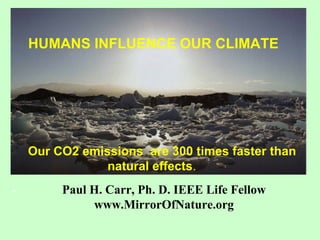
HUMANS INFLUENCE OUR CLIMATE
Our CO2 emissions are 300 times faster than
natural effects.
- Paul H. Carr, Ph. D. IEEE Life Fellow
www.MirrorOfNature.org
The EXPLODING POPULATION OF 7 B IS INFLUENCING
OUR CLIMATE BY BURNING FOSSIL FUELS THAT EMIT
CARBON DIOXIDE, CO2.
1. THE HUMAN INFLUENCE ON WARMING
Emissions of the greenhouse gas CO2 are increasing at a
rate of 2.5 ppm per year.
2. CONTRAST THIS WITH SLOWER NATURAL
PROCESSES
18K – 10K years ago, C02 increased at a rate 1/300th
slower.
3. THE IMPACT OF CONTINUING CLIMATE CHANGE
Melting of the Arctic is increasing our winter climate extremes.
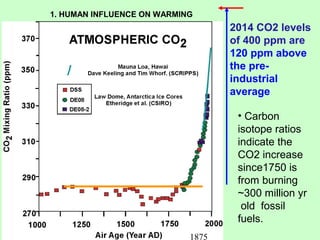
2014 CO2 levels
of 400 ppm are
120 ppm above
the pre-
industrial
average
1875
• Carbon
isotope ratios
indicate the
CO2 increase
since1750 is
from burning
~300 million yr
old fossil
fuels.
1. HUMAN INFLUENCE ON WARMING
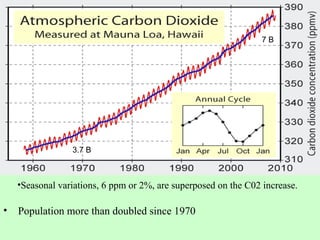
•Seasonal variations, 6 ppm or 2%, are superposed on the C02 increase.
• Population more than doubled since 1970
3.7 B
7 B
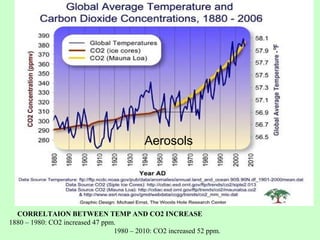
CORRELTAION BETWEEN TEMP AND CO2 INCREASE
1880 – 1980: CO2 increased 47 ppm.
1980 – 2010: CO2 increased 52 ppm.
Aerosols
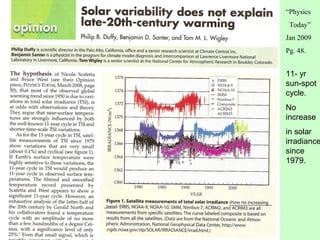
“Physics
Today”
Jan 2009
Pg. 48.
11- yr
sun-spot
cycle.
No
increase
in solar
irradiance
since
1979.
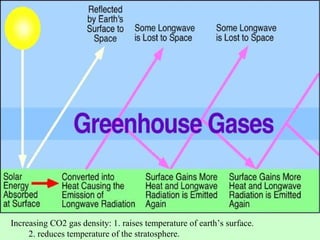
Increasing CO2 gas density: 1. raises temperature of earth’s surface.
2. reduces temperature of the stratosphere.
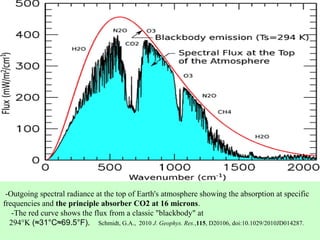
-Outgoing spectral radiance at the top of Earth's atmosphere showing the absorption at specific
frequencies and the principle absorber CO2 at 16 microns.
-The red curve shows the flux from a classic "blackbody" at
294°K (≈31°C≈69.5°F).  Schmidt, G.A., 2010 J. Geophys. Res.,115, D20106, doi:10.1029/2010JD014287.
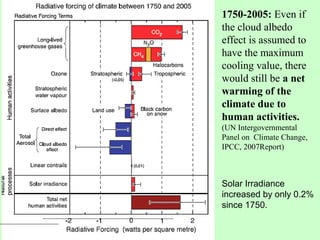
1750-2005: Even if
the cloud albedo
effect is assumed to
have the maximum
cooling value, there
would still be a net
warming of the
climate due to
human activities.
(UN Intergovernmental
Panel on Climate Change,
IPCC, 2007Report)
Solar Irradiance 
increased by only 0.2% 
since 1750. 
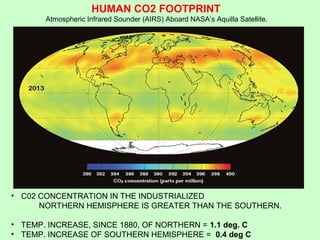
• C02 CONCENTRATION IN THE INDUSTRIALIZED                                            
        NORTHERN HEMISPHERE IS GREATER THAN THE SOUTHERN.
• TEMP. INCREASE, SINCE 1880, OF NORTHERN = 1.1 deg. C
• TEMP. INCREASE OF SOUTHERN HEMISPHERE =  0.4 deg C
HUMAN CO2 FOOTPRINT
 Atmospheric Infrared Sounder (AIRS) Aboard NASA’s Aquilla Satellite.
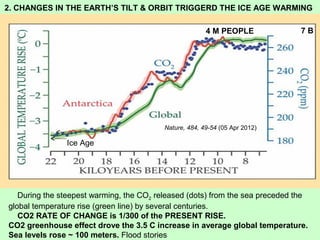
During the steepest warming, the CO2 released (dots) from the sea preceded the 
global temperature rise (green line) by several centuries.                                               
    CO2 RATE OF CHANGE is 1/300 of the PRESENT RISE.
CO2 greenhouse effect drove the 3.5 C increase in average global temperature.
Sea levels rose ~ 100 meters. Flood stories  
4 M PEOPLE      7 B
     Ice Age
Nature, 484, 49-54 (05 Apr 2012)
2. CHANGES IN THE EARTH’S TILT & ORBIT TRIGGERD THE ICE AGE WARMING
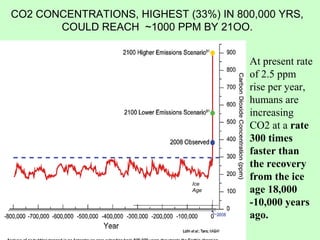
At present rate
of 2.5 ppm
rise per year,
humans are
increasing
CO2 at a rate
300 times
faster than
the recovery
from the ice
age 18,000
-10,000 years
ago.
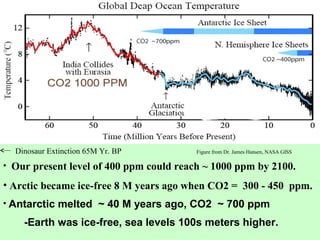
CO2 CONCENTRATIONS, HIGHEST (33%) IN 800,000 YRS, 
COULD REACH  ~1000 PPM BY 21OO.
Ice
Age
• Our present level of 400 ppm could reach ~ 1000 ppm by 2100.
• Arctic became ice-free 8 M years ago when CO2 = 300 - 450 ppm.
• Antarctic melted ~ 40 M years ago, CO2 ~ 700 ppm
-Earth was ice-free, sea levels 100s meters higher.
Dinosaur Extinction 65M Yr. BP Figure from Dr. James Hansen, NASA GISS
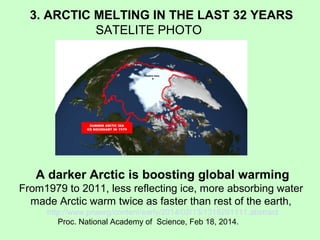
A darker Arctic is boosting global warming
From1979 to 2011, less reflecting ice, more absorbing water
made Arctic warm twice as faster than rest of the earth,
http://www.pnaorg/content/early/2014/02/13/1318201111.abstract
Proc. National Academy of Science, Feb 18, 2014.
3. ARCTIC MELTING IN THE LAST 32 YEARS
SATELITE PHOTO
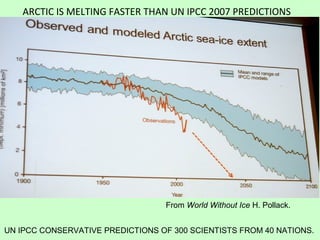
ARCTIC IS MELTING FASTER THAN UN IPCC 2007 PREDICTIONS
PREDICTEDPREDICTIONS
UN IPCC CONSERVATIVE PREDICTIONS OF 300 SCIENTISTS FROM 40 NATIONS.
From World Without Ice H. Pollack.
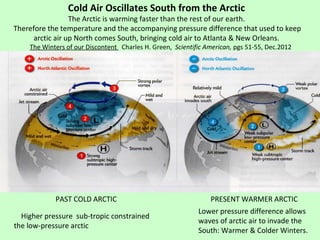
PAST COLD ARCTIC PRESENT WARMER ARCTIC
Higher pressure sub-tropic constrained
the low-pressure arctic
Lower pressure difference allows
waves of arctic air to invade the
South: Warmer & Colder Winters.
Cold Air Oscillates South from the Arctic
The Arctic is warming faster than the rest of our earth.
Therefore the temperature and the accompanying pressure difference that used to keep
arctic air up North comes South, bringing cold air to Atlanta & New Orleans.
The Winters of our Discontent Charles H. Green, Scientific American, pgs 51-55, Dec.2012
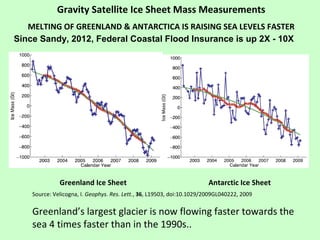
Gravity Satellite Ice Sheet Mass Measurements
MELTING OF GREENLAND & ANTARCTICA IS RAISING SEA LEVELS FASTER
Greenland Ice Sheet Antarctic Ice Sheet
Source: Velicogna, I. Geophys. Res. Lett., 36, L19503, doi:10.1029/2009GL040222, 2009
Greenland’s largest glacier is now flowing faster towards the
sea 4 times faster than in the 1990s..
Since Sandy, 2012, Federal Coastal Flood Insurance is up 2X - 10X
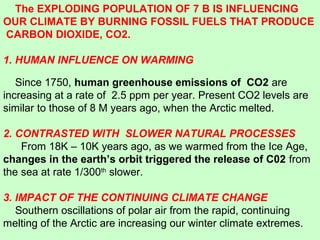
The EXPLODING POPULATION OF 7 B IS INFLUENCING
OUR CLIMATE BY BURNING FOSSIL FUELS THAT PRODUCE
CARBON DIOXIDE, CO2.
1. HUMAN INFLUENCE ON WARMING
Since 1750, human greenhouse emissions of CO2 are
increasing at a rate of 2.5 ppm per year. Present CO2 levels are
similar to those of 8 M years ago, when the Arctic melted.
2. CONTRASTED WITH SLOWER NATURAL PROCESSES
From 18K – 10K years ago, as we warmed from the Ice Age,
changes in the earth’s orbit triggered the release of C02 from
the sea at rate 1/300th
slower.
3. IMPACT OF THE CONTINUING CLIMATE CHANGE
Southern oscillations of polar air from the rapid, continuing
melting of the Arctic are increasing our winter climate extremes.
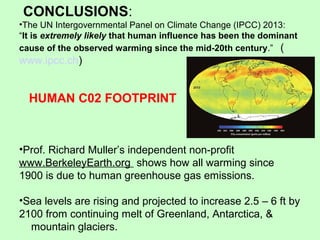
CONCLUSIONS:
•The UN Intergovernmental Panel on Climate Change (IPCC) 2013:
“It is extremely likely that human influence has been the dominant
cause of the observed warming since the mid-20th century.” (
www.ipcc.ch)
•Prof. Richard Muller’s independent non-profit
www.BerkeleyEarth.org shows how all warming since
1900 is due to human greenhouse gas emissions.
•Sea levels are rising and projected to increase 2.5 – 6 ft by
2100 from continuing melt of Greenland, Antarctica, &
mountain glaciers.
HUMAN C02 FOOTPRINT
At the 2002 Sigma Xi Research
Symposium I asked Prof. Molina: “What do
you think about global warming ?”
Prof. Mario J. Molina shared the 1995
Nobel Prize in Chemistry for his work in
atmospheric chemistry showing that the
human generation of CFC were making a
hole in ozone layer.
He answered that global weather
forecasting and predicting are complex and
difficult.
However if your question is,
“Should we do something about global
warming?”
My answer is: “YES!”
We must
reduce our
CO2
emissions.
•www.ipcc.ch The United Nations Intergovermental Panel on Climate Change
CLIMATE CHANGE 2013:The Physical Science Basis.
http://www.ipcc.ch/report/ar5/wg1/
•www.BerkeleyEarth.org Prof. Richard Muller’s independent non-profit research group.
Funders include the Gates Foundation and the Koch Brothers.
• Earth Will Cross the Climate Danger Threshold by 2036
The rate of global temperature rise may have hit a “faux pause”, but a climate crisis still
looms in the near future.
By Michael E. Mann, Scientific American, vol 310, Issue 4, April 2014
http://www.scientificamerican.com/article/earth-will-cross-the-climate-danger-threshold-
by-2036/
•Small influence of solar variability on climate over the past millennium
Over the past 1,000 years volcanic eruptions and changes in greenhouse gas
concentrations seem to be the most important influence. Andrew P. Schurer et. al.
NATURE GEOSCIENCE, VOL 7, FEBRUARY 2014. www.nature.com/naturegeoscience
DOI: 10.1038/NGEO2040
REFERENCES
REFERENCES:
•Reconciling warming trends
Volcanic, aerosol, and La Nina cooling together with slightly lower solar emissions
explain recent decreased warming. Significant warming trends are likely to resume,
because the dominant long-term warming effect of greenhouse gases continues to
rise. Asian aerosol pollution levels are likely to stabilize and perhaps decrease,
Gavin A. Schmidt et. al. NATURE GEOSCIENCE | VOL 7 | pgs. 158-160. MARCH
2014 | www.nature.com/naturegeoscience
•Edx MIT Free Course GLOBAL WARMING SCIENCE
https://www.edx.org/course/mitx/mitx-12-340x-global-warming-science-
1244#.U0K5S_ldWSo
Reconciling anthropogenic climate change with observed
temperature 1998–2008
by Robert K. Kaufmann et al. Proc. National Academy of Sciences 2011
http://www.pnas.org/content/early/2011/06/27/1102467108
•China more than doubled its consumption/burning of coal
from 2004 to 2007.
•Sulfur aerosol emissions created by burning coal tend to
have a net cooling effect on the atmosphere.
• The cooling effects of sulfur aerosols has essentially
countered any global temperature rise caused by increased
levels of carbon dioxide.
•This balancing act between sulfur and carbon dioxide, along
with the slight decrease in solar energy during the solar
minimum and the cool La Nina, meant there was essentially no
statistically meaningful change in the global temperature from
1998 to 2008.

Humans Influence Our Climate

  • 1.
    HUMANS INFLUENCE OURCLIMATE Our CO2 emissions are 300 times faster than natural effects. - Paul H. Carr, Ph. D. IEEE Life Fellow www.MirrorOfNature.org
  • 2.
    The EXPLODING POPULATIONOF 7 B IS INFLUENCING OUR CLIMATE BY BURNING FOSSIL FUELS THAT EMIT CARBON DIOXIDE, CO2. 1. THE HUMAN INFLUENCE ON WARMING Emissions of the greenhouse gas CO2 are increasing at a rate of 2.5 ppm per year. 2. CONTRAST THIS WITH SLOWER NATURAL PROCESSES 18K – 10K years ago, C02 increased at a rate 1/300th slower. 3. THE IMPACT OF CONTINUING CLIMATE CHANGE Melting of the Arctic is increasing our winter climate extremes.
  • 3.
    2014 CO2 levels of400 ppm are 120 ppm above the pre- industrial average 1875 • Carbon isotope ratios indicate the CO2 increase since1750 is from burning ~300 million yr old fossil fuels. 1. HUMAN INFLUENCE ON WARMING
  • 4.
    •Seasonal variations, 6ppm or 2%, are superposed on the C02 increase. • Population more than doubled since 1970 3.7 B 7 B
  • 5.
    CORRELTAION BETWEEN TEMPAND CO2 INCREASE 1880 – 1980: CO2 increased 47 ppm. 1980 – 2010: CO2 increased 52 ppm. Aerosols
  • 6.
    “Physics Today” Jan 2009 Pg. 48. 11-yr sun-spot cycle. No increase in solar irradiance since 1979.
  • 7.
    Increasing CO2 gasdensity: 1. raises temperature of earth’s surface. 2. reduces temperature of the stratosphere.
  • 8.
    -Outgoing spectral radianceat the top of Earth's atmosphere showing the absorption at specific frequencies and the principle absorber CO2 at 16 microns. -The red curve shows the flux from a classic "blackbody" at 294°K (≈31°C≈69.5°F).  Schmidt, G.A., 2010 J. Geophys. Res.,115, D20106, doi:10.1029/2010JD014287.
  • 9.
    1750-2005: Even if thecloud albedo effect is assumed to have the maximum cooling value, there would still be a net warming of the climate due to human activities. (UN Intergovernmental Panel on Climate Change, IPCC, 2007Report) Solar Irradiance  increased by only 0.2%  since 1750. 
  • 10.
  • 11.
    During the steepest warming, the CO2 released (dots) from the sea preceded the  global temperature rise (green line) by several centuries.                                                    CO2 RATE OFCHANGE is 1/300 of the PRESENT RISE. CO2 greenhouse effect drove the 3.5 C increase in average global temperature. Sea levels rose ~ 100 meters. Flood stories   4 M PEOPLE      7 B      Ice Age Nature, 484, 49-54 (05 Apr 2012) 2. CHANGES IN THE EARTH’S TILT & ORBIT TRIGGERD THE ICE AGE WARMING
  • 12.
    At present rate of2.5 ppm rise per year, humans are increasing CO2 at a rate 300 times faster than the recovery from the ice age 18,000 -10,000 years ago. CO2 CONCENTRATIONS, HIGHEST (33%) IN 800,000 YRS,  COULD REACH  ~1000 PPM BY 21OO. Ice Age
  • 13.
    • Our presentlevel of 400 ppm could reach ~ 1000 ppm by 2100. • Arctic became ice-free 8 M years ago when CO2 = 300 - 450 ppm. • Antarctic melted ~ 40 M years ago, CO2 ~ 700 ppm -Earth was ice-free, sea levels 100s meters higher. Dinosaur Extinction 65M Yr. BP Figure from Dr. James Hansen, NASA GISS
  • 14.
    A darker Arcticis boosting global warming From1979 to 2011, less reflecting ice, more absorbing water made Arctic warm twice as faster than rest of the earth, http://www.pnaorg/content/early/2014/02/13/1318201111.abstract Proc. National Academy of Science, Feb 18, 2014. 3. ARCTIC MELTING IN THE LAST 32 YEARS SATELITE PHOTO
  • 15.
    ARCTIC IS MELTINGFASTER THAN UN IPCC 2007 PREDICTIONS PREDICTEDPREDICTIONS UN IPCC CONSERVATIVE PREDICTIONS OF 300 SCIENTISTS FROM 40 NATIONS. From World Without Ice H. Pollack.
  • 16.
    PAST COLD ARCTICPRESENT WARMER ARCTIC Higher pressure sub-tropic constrained the low-pressure arctic Lower pressure difference allows waves of arctic air to invade the South: Warmer & Colder Winters. Cold Air Oscillates South from the Arctic The Arctic is warming faster than the rest of our earth. Therefore the temperature and the accompanying pressure difference that used to keep arctic air up North comes South, bringing cold air to Atlanta & New Orleans. The Winters of our Discontent Charles H. Green, Scientific American, pgs 51-55, Dec.2012
  • 17.
    Gravity Satellite IceSheet Mass Measurements MELTING OF GREENLAND & ANTARCTICA IS RAISING SEA LEVELS FASTER Greenland Ice Sheet Antarctic Ice Sheet Source: Velicogna, I. Geophys. Res. Lett., 36, L19503, doi:10.1029/2009GL040222, 2009 Greenland’s largest glacier is now flowing faster towards the sea 4 times faster than in the 1990s.. Since Sandy, 2012, Federal Coastal Flood Insurance is up 2X - 10X
  • 18.
    The EXPLODING POPULATIONOF 7 B IS INFLUENCING OUR CLIMATE BY BURNING FOSSIL FUELS THAT PRODUCE CARBON DIOXIDE, CO2. 1. HUMAN INFLUENCE ON WARMING Since 1750, human greenhouse emissions of CO2 are increasing at a rate of 2.5 ppm per year. Present CO2 levels are similar to those of 8 M years ago, when the Arctic melted. 2. CONTRASTED WITH SLOWER NATURAL PROCESSES From 18K – 10K years ago, as we warmed from the Ice Age, changes in the earth’s orbit triggered the release of C02 from the sea at rate 1/300th slower. 3. IMPACT OF THE CONTINUING CLIMATE CHANGE Southern oscillations of polar air from the rapid, continuing melting of the Arctic are increasing our winter climate extremes.
  • 19.
    CONCLUSIONS: •The UN IntergovernmentalPanel on Climate Change (IPCC) 2013: “It is extremely likely that human influence has been the dominant cause of the observed warming since the mid-20th century.” ( www.ipcc.ch) •Prof. Richard Muller’s independent non-profit www.BerkeleyEarth.org shows how all warming since 1900 is due to human greenhouse gas emissions. •Sea levels are rising and projected to increase 2.5 – 6 ft by 2100 from continuing melt of Greenland, Antarctica, & mountain glaciers. HUMAN C02 FOOTPRINT
  • 20.
    At the 2002Sigma Xi Research Symposium I asked Prof. Molina: “What do you think about global warming ?” Prof. Mario J. Molina shared the 1995 Nobel Prize in Chemistry for his work in atmospheric chemistry showing that the human generation of CFC were making a hole in ozone layer. He answered that global weather forecasting and predicting are complex and difficult. However if your question is, “Should we do something about global warming?” My answer is: “YES!” We must reduce our CO2 emissions.
  • 21.
    •www.ipcc.ch The UnitedNations Intergovermental Panel on Climate Change CLIMATE CHANGE 2013:The Physical Science Basis. http://www.ipcc.ch/report/ar5/wg1/ •www.BerkeleyEarth.org Prof. Richard Muller’s independent non-profit research group. Funders include the Gates Foundation and the Koch Brothers. • Earth Will Cross the Climate Danger Threshold by 2036 The rate of global temperature rise may have hit a “faux pause”, but a climate crisis still looms in the near future. By Michael E. Mann, Scientific American, vol 310, Issue 4, April 2014 http://www.scientificamerican.com/article/earth-will-cross-the-climate-danger-threshold- by-2036/ •Small influence of solar variability on climate over the past millennium Over the past 1,000 years volcanic eruptions and changes in greenhouse gas concentrations seem to be the most important influence. Andrew P. Schurer et. al. NATURE GEOSCIENCE, VOL 7, FEBRUARY 2014. www.nature.com/naturegeoscience DOI: 10.1038/NGEO2040 REFERENCES
  • 22.
    REFERENCES: •Reconciling warming trends Volcanic,aerosol, and La Nina cooling together with slightly lower solar emissions explain recent decreased warming. Significant warming trends are likely to resume, because the dominant long-term warming effect of greenhouse gases continues to rise. Asian aerosol pollution levels are likely to stabilize and perhaps decrease, Gavin A. Schmidt et. al. NATURE GEOSCIENCE | VOL 7 | pgs. 158-160. MARCH 2014 | www.nature.com/naturegeoscience •Edx MIT Free Course GLOBAL WARMING SCIENCE https://www.edx.org/course/mitx/mitx-12-340x-global-warming-science- 1244#.U0K5S_ldWSo
  • 23.
    Reconciling anthropogenic climatechange with observed temperature 1998–2008 by Robert K. Kaufmann et al. Proc. National Academy of Sciences 2011 http://www.pnas.org/content/early/2011/06/27/1102467108 •China more than doubled its consumption/burning of coal from 2004 to 2007. •Sulfur aerosol emissions created by burning coal tend to have a net cooling effect on the atmosphere. • The cooling effects of sulfur aerosols has essentially countered any global temperature rise caused by increased levels of carbon dioxide. •This balancing act between sulfur and carbon dioxide, along with the slight decrease in solar energy during the solar minimum and the cool La Nina, meant there was essentially no statistically meaningful change in the global temperature from 1998 to 2008.

Editor's Notes

  • #6 The temperature increase curve coincides with the temperature increase.