- R.Shyam Prasad
Syllabus
Unit - IV
Power - The sources of power - Authority Line, staff
and functional authority - Difference between
Authority and
power - delegation - Advantages of Delegation,
Barriers to
Delegation - Guidelines for Effective Delegation
Decentralization - Advantages and Disadvantages -
Responsibility.
Meaning of Power
The term power considered as synonymous to
authority.
But there is difference between the two.
Power refers to the ability or capacity to influence the
behavior of other individuals.
Authority is positional & given by the institution
while power is stems from personal capacity
The sources of power
Five bases of power
Positional power – CEO, Manager
It is the power of an individual which arises from the
relative position and duties of the holder of the
position within an organization.
Referent power – MK.Gandhi
It's based on the charisma and interpersonal skills of
the power holder. A person may be admired because
of specific personal trait, and this admiration creates
the opportunity for interpersonal influence.
The sources of power
Expert power – Technical Manager, Treasurer.
Expert power is an individual's power deriving from
the skills or expertise of the person and the
organization's needs for those skills and expertise.
Reward power
Reward power depends on the ability of the power
wielder to confer valued material rewards, it refers to
the degree to which the individual can give others a
reward of some kind such as benefits, time off,
desired gifts, promotions or increases in pay or
responsibility.
The sources of power
Coercive power
Coercive power is the application of negative
influences. It includes the ability to demote or to
withhold other rewards. The desire for valued rewards
or the fear of having them withheld that ensures the
obedience of those under power.
Delegation
It refers to the process where a manager divides his
assigned work into 2 parts, one part which he alone
does, & the other part which are done by others for
him.
Merits:
Manager can focus on important issues
Allows sub-ordinates to learn
Helps in succession
Delegation
Demerits:
Lack of uniformity in delegating work
Difficulty in coordination
Incapacity of sub-ordinate to carry o duty.
Process of Delegation
Determination of results expected
Assignment of duty
Granting of authority
Creating Accountability
Guidelines for effective
Delegation
Establishment of definite goals
Clear definition of authority
Proper Motivation
Appropriate Environment
Proper training
Effective control mechanism
Proper Communication
Decentralization
It refers to the disposal of authority i.e. the authority
to take decision lies with persons at various levels
Advantages:
Relief to top executives of taking decision
Motivates sub ordinates to take decision
Effect. supervision & control as more time is avb.
Better decision can be taken as people closer to reality
take decision.
Centralization
According to henry fayol ”Everything which goes to
increase the importance of the sub ordinates role is
decentralization, everything which goes to reduce it is
centralization”.
Advantages:
Helps to research & forecasting uncertain things.
Utilizing Top management talent
Uniformity of policies & procedures
Duplication of work avoided
Organizational Structure
An organizational structure consists of activities such
as task allocation, coordination and supervision,
which are directed towards the achievement of
organizational aims.
It can also be considered as the viewing glass or
perspective through which individuals see their
organization and its environment.
Types of Organizational Structure
Line Structure
Line & Staff Structure
Functional structure
Matrix structure
Task Force
Committee
Types of Organizational Structure
Line Structure
Has a very specific line of command.
The approvals and orders in this kind of structure come
from top to bottom in a line
This kind of structure is suitable for smaller organizations
like small accounting firms and law offices.
This is the sort of structure that allows for easy decision-
making and is also very informal in nature.
They have fewer departments, which makes the entire
organization a very decentralized one.
It is not effective for larger companies.
Line Structure
Line and Staff Structure
Line and Staff Structure
In the line structure, information and approvals come
from top to bottom, with staff departments for support
and specialization.
Line and staff organizational structures are more
centralized.
Here line and staff have authority over their subordinates,
but staff managers have no authority over line managers
and their subordinates.
The decision-making process becomes slower in this type
of organizational structure because of the layers and
guidelines that are typical to it. Also, let's not forget the
formality involved.
Line and Staff Structure
S.No Line Authority Staff Authority
1 Right to decide and command Right to provide advice, assistance
and information
2 Contributes directly to the
accomplishment of Organisational
objectives
Assist line in the effective
accomplishment of Organisation
objectives
3 Relatively unlimited and general Relatively restricted to a particular
function
4 Flow downward from a superior to
subordinate
May flow in any direction
depending upon the need of advice
5 Creates superior and subordinate
relation
Extension of line and support line
6 Exercise control Investigates and reports
7 Makes operating decision Provides idea for decision
8 Bears final responsibility for results Does not bear final responsibility
9 Doing functions Thinking function
10 Provides channel of communication No channel of communication is
created
Difference between Line and Staff Authority
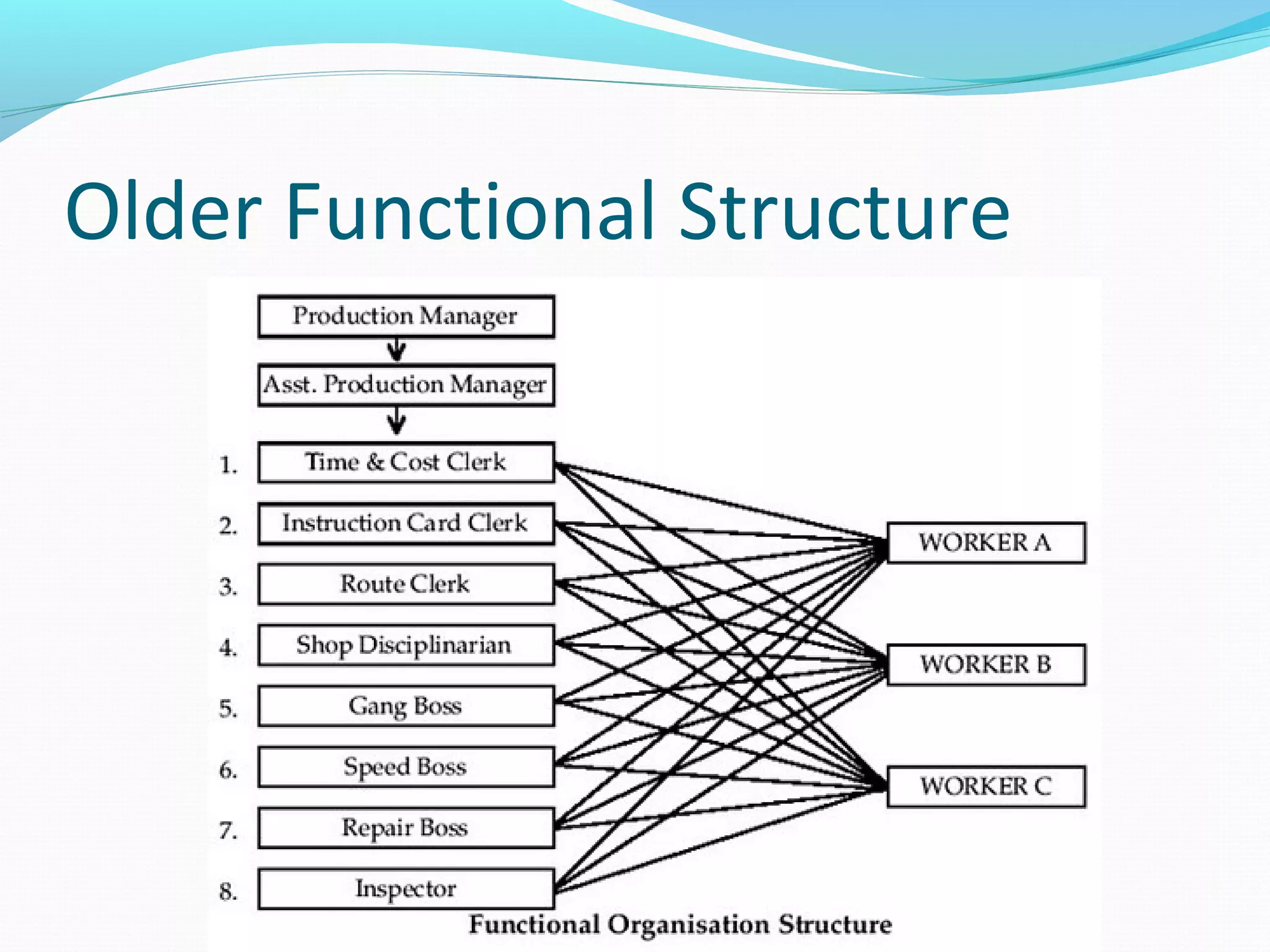
Functional Structure
This concept is based on functional foremanship by
FW Taylor
The org. is divided into a number of functional areas.
Each area is managed by an expert
People are classified according to the function they
perform in the organization.
An individual receives orders from several functional
heads.
This leads to operational efficiencies.
Functional Structure
This is best suited for a producer of standardized
goods and services at large volume and low cost.
Coordination and specialization of tasks are
centralized in a functional structure.
However it could also lead to a lack of
communication between the functional groups within
an organization, making the organization slow and
inflexible.
Older Functional Structure
Responsibility
According tp Terry “It is the obligation of an
individual to carry the assigned activities to the best
of one’s ability”
According to Louis. A Allen “It refers to the mental &
physical activities which must be performed to carry
out a task or duty. That means every person who
performs any kind of mental & physical efforts as an
assigned task has responsibility ”

Power & delegation

  • 1.
  • 2.
    Syllabus Unit - IV Power- The sources of power - Authority Line, staff and functional authority - Difference between Authority and power - delegation - Advantages of Delegation, Barriers to Delegation - Guidelines for Effective Delegation Decentralization - Advantages and Disadvantages - Responsibility.
  • 3.
    Meaning of Power Theterm power considered as synonymous to authority. But there is difference between the two. Power refers to the ability or capacity to influence the behavior of other individuals. Authority is positional & given by the institution while power is stems from personal capacity
  • 4.
    The sources ofpower Five bases of power Positional power – CEO, Manager It is the power of an individual which arises from the relative position and duties of the holder of the position within an organization. Referent power – MK.Gandhi It's based on the charisma and interpersonal skills of the power holder. A person may be admired because of specific personal trait, and this admiration creates the opportunity for interpersonal influence.
  • 5.
    The sources ofpower Expert power – Technical Manager, Treasurer. Expert power is an individual's power deriving from the skills or expertise of the person and the organization's needs for those skills and expertise. Reward power Reward power depends on the ability of the power wielder to confer valued material rewards, it refers to the degree to which the individual can give others a reward of some kind such as benefits, time off, desired gifts, promotions or increases in pay or responsibility.
  • 6.
    The sources ofpower Coercive power Coercive power is the application of negative influences. It includes the ability to demote or to withhold other rewards. The desire for valued rewards or the fear of having them withheld that ensures the obedience of those under power.
  • 7.
    Delegation It refers tothe process where a manager divides his assigned work into 2 parts, one part which he alone does, & the other part which are done by others for him. Merits: Manager can focus on important issues Allows sub-ordinates to learn Helps in succession
  • 8.
    Delegation Demerits: Lack of uniformityin delegating work Difficulty in coordination Incapacity of sub-ordinate to carry o duty. Process of Delegation Determination of results expected Assignment of duty Granting of authority Creating Accountability
  • 9.
    Guidelines for effective Delegation Establishmentof definite goals Clear definition of authority Proper Motivation Appropriate Environment Proper training Effective control mechanism Proper Communication
  • 10.
    Decentralization It refers tothe disposal of authority i.e. the authority to take decision lies with persons at various levels Advantages: Relief to top executives of taking decision Motivates sub ordinates to take decision Effect. supervision & control as more time is avb. Better decision can be taken as people closer to reality take decision.
  • 11.
    Centralization According to henryfayol ”Everything which goes to increase the importance of the sub ordinates role is decentralization, everything which goes to reduce it is centralization”. Advantages: Helps to research & forecasting uncertain things. Utilizing Top management talent Uniformity of policies & procedures Duplication of work avoided
  • 12.
    Organizational Structure An organizationalstructure consists of activities such as task allocation, coordination and supervision, which are directed towards the achievement of organizational aims. It can also be considered as the viewing glass or perspective through which individuals see their organization and its environment.
  • 13.
    Types of OrganizationalStructure Line Structure Line & Staff Structure Functional structure Matrix structure Task Force Committee
  • 14.
    Types of OrganizationalStructure Line Structure Has a very specific line of command. The approvals and orders in this kind of structure come from top to bottom in a line This kind of structure is suitable for smaller organizations like small accounting firms and law offices. This is the sort of structure that allows for easy decision- making and is also very informal in nature. They have fewer departments, which makes the entire organization a very decentralized one. It is not effective for larger companies.
  • 15.
  • 16.
    Line and StaffStructure Line and Staff Structure In the line structure, information and approvals come from top to bottom, with staff departments for support and specialization. Line and staff organizational structures are more centralized. Here line and staff have authority over their subordinates, but staff managers have no authority over line managers and their subordinates. The decision-making process becomes slower in this type of organizational structure because of the layers and guidelines that are typical to it. Also, let's not forget the formality involved.
  • 17.
    Line and StaffStructure
  • 18.
    S.No Line AuthorityStaff Authority 1 Right to decide and command Right to provide advice, assistance and information 2 Contributes directly to the accomplishment of Organisational objectives Assist line in the effective accomplishment of Organisation objectives 3 Relatively unlimited and general Relatively restricted to a particular function 4 Flow downward from a superior to subordinate May flow in any direction depending upon the need of advice 5 Creates superior and subordinate relation Extension of line and support line 6 Exercise control Investigates and reports 7 Makes operating decision Provides idea for decision 8 Bears final responsibility for results Does not bear final responsibility 9 Doing functions Thinking function 10 Provides channel of communication No channel of communication is created Difference between Line and Staff Authority
  • 19.
    Functional Structure This conceptis based on functional foremanship by FW Taylor The org. is divided into a number of functional areas. Each area is managed by an expert People are classified according to the function they perform in the organization. An individual receives orders from several functional heads. This leads to operational efficiencies.
  • 20.
    Functional Structure This isbest suited for a producer of standardized goods and services at large volume and low cost. Coordination and specialization of tasks are centralized in a functional structure. However it could also lead to a lack of communication between the functional groups within an organization, making the organization slow and inflexible.
  • 21.
  • 22.
    Responsibility According tp Terry“It is the obligation of an individual to carry the assigned activities to the best of one’s ability” According to Louis. A Allen “It refers to the mental & physical activities which must be performed to carry out a task or duty. That means every person who performs any kind of mental & physical efforts as an assigned task has responsibility ”