Technician Training: Power Basics
Power Basics
o Terminology – Voltage, Power, Current, Phase & Hertz
o Control Panels – Basics, Single or Dual Power
o Pumps – Basics, Phases & Types
o Dual & Single Power Sources
o Sensors & Instrumentation – Signals & Safety
o Valves – Actuated & Solenoid
Terminology
o Voltage - Alternating Current
 Typically 120, 208-240, 480 VAC
o Voltage - Direct Current
 Typically 24 VDC
o Voltage AC Phase – Single or Three Phase (1 PH / 3 PH)
o Voltage AC Hertz – 60 HZ (US) and 50 HZ (INTL)
o Power – US is Horsepower (HP), INTL is Watts (W)
o Current – Amps or Milliamps (A, mA)
Control Power
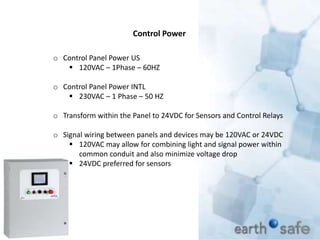
o Control Panel Power US
 120VAC – 1Phase – 60HZ
o Control Panel Power INTL
 230VAC – 1 Phase – 50 HZ
o Transform within the Panel to 24VDC for Sensors and Control Relays
o Signal wiring between panels and devices may be 120VAC or 24VDC
 120VAC may allow for combining light and signal power within
common conduit and also minimize voltage drop
 24VDC preferred for sensors
Control Panel
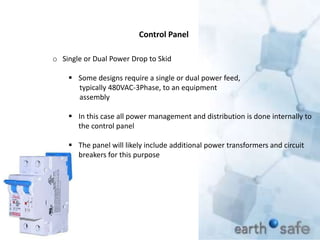
o Single or Dual Power Drop to Skid
 Some designs require a single or dual power feed,
typically 480VAC-3Phase, to an equipment
assembly
 In this case all power management and distribution is done internally to
the control panel
 The panel will likely include additional power transformers and circuit
breakers for this purpose
Pump Power
o Pump Power US Standards
 < 1 HP is 120VAC/1 Phase/60Hz
 > 1 HP is 480VAC/3 Phase/60Hz
 Submersible Pumps is 208VAC/1 Phase/60Hz
 If 3 Phase is not available, 208VAC/1 Phase/60Hz
Sometimes there is an alternate 3 Phase, 208 to 230VAC/3 Phase/60Hz
o Pump Power International Standards
 < 1 HP is 230VAC/1 Phase/50Hz
 > 1 HP is 480VAC/3 Phase/50Hz
Dual Power Source
o Most critical fuel systems have dual power sources for redundancy
o It is important to manage these sources so that they are independent from
each other
 Monitored with control panels by auto-switching, if A fails then B
engages – typically without any effect on the controllers
o Valve & Pump Control for Dual Power Source
 Some systems are designed to allow for either of two redundant control
panels to operate a single device such as a valve or motor starter
o These are important difference from Service Station systems which often
allow for the assumption that control devices share a common power source
Sensors and Instrumentation
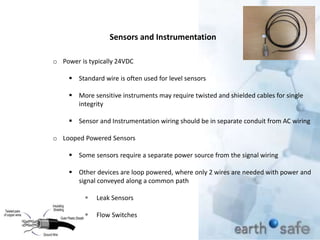
o Power is typically 24VDC
 Standard wire is often used for level sensors
 More sensitive instruments may require twisted and shielded cables for single
integrity
 Sensor and Instrumentation wiring should be in separate conduit from AC wiring
o Looped Powered Sensors
 Some sensors require a separate power source from the signal wiring
 Other devices are loop powered, where only 2 wires are needed with power and
signal conveyed along a common path
 Leak Sensors
 Flow Switches
Sensors – Signal Type
o ON-OFF signals are typically 24VDC with a small amperage determined by the
load
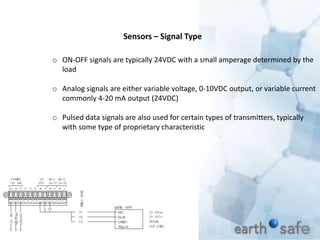
o Analog signals are either variable voltage, 0-10VDC output, or variable current
commonly 4-20 mA output (24VDC)
o Pulsed data signals are also used for certain types of transmitters, typically
with some type of proprietary characteristic
Sensors – Intrinsic Safety
o Sensors used in hazardous electrical areas may be either explosion-proof or
intrinsically safe
 Explosion proof – designed to contain the energy of an explosion or a
flammable liquid/vapor
 Intrinsically Safe – Limit the energy within the hazardous area to an
amount insufficient to cause a spark
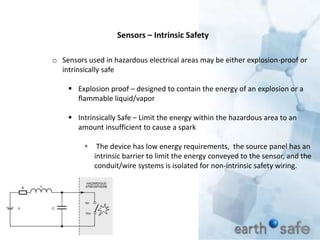
 The device has low energy requirements, the source panel has an
intrinsic barrier to limit the energy conveyed to the sensor, and the
conduit/wire systems is isolated for non-intrinsic safety wiring.
Valves
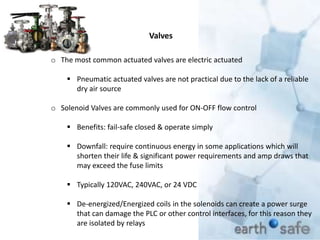
o The most common actuated valves are electric actuated
 Pneumatic actuated valves are not practical due to the lack of a reliable
dry air source
o Solenoid Valves are commonly used for ON-OFF flow control
 Benefits: fail-safe closed & operate simply
 Downfall: require continuous energy in some applications which will
shorten their life & significant power requirements and amp draws that
may exceed the fuse limits
 Typically 120VAC, 240VAC, or 24 VDC
 De-energized/Energized coils in the solenoids can create a power surge
that can damage the PLC or other control interfaces, for this reason they
are isolated by relays
Valves (cont.)
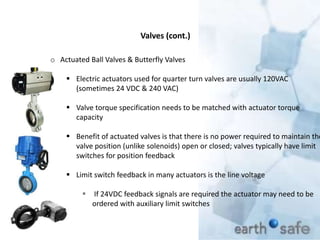
o Actuated Ball Valves & Butterfly Valves
 Electric actuators used for quarter turn valves are usually 120VAC
(sometimes 24 VDC & 240 VAC)
 Valve torque specification needs to be matched with actuator torque
capacity
 Benefit of actuated valves is that there is no power required to maintain the
valve position (unlike solenoids) open or closed; valves typically have limit
switches for position feedback
 Limit switch feedback in many actuators is the line voltage
 If 24VDC feedback signals are required the actuator may need to be
ordered with auxiliary limit switches

Technician Training: Power Basics

  • 1.
  • 2.
    Power Basics o Terminology– Voltage, Power, Current, Phase & Hertz o Control Panels – Basics, Single or Dual Power o Pumps – Basics, Phases & Types o Dual & Single Power Sources o Sensors & Instrumentation – Signals & Safety o Valves – Actuated & Solenoid
  • 3.
    Terminology o Voltage -Alternating Current  Typically 120, 208-240, 480 VAC o Voltage - Direct Current  Typically 24 VDC o Voltage AC Phase – Single or Three Phase (1 PH / 3 PH) o Voltage AC Hertz – 60 HZ (US) and 50 HZ (INTL) o Power – US is Horsepower (HP), INTL is Watts (W) o Current – Amps or Milliamps (A, mA)
  • 4.
    Control Power o ControlPanel Power US  120VAC – 1Phase – 60HZ o Control Panel Power INTL  230VAC – 1 Phase – 50 HZ o Transform within the Panel to 24VDC for Sensors and Control Relays o Signal wiring between panels and devices may be 120VAC or 24VDC  120VAC may allow for combining light and signal power within common conduit and also minimize voltage drop  24VDC preferred for sensors
  • 5.
    Control Panel o Singleor Dual Power Drop to Skid  Some designs require a single or dual power feed, typically 480VAC-3Phase, to an equipment assembly  In this case all power management and distribution is done internally to the control panel  The panel will likely include additional power transformers and circuit breakers for this purpose
  • 6.
    Pump Power o PumpPower US Standards  < 1 HP is 120VAC/1 Phase/60Hz  > 1 HP is 480VAC/3 Phase/60Hz  Submersible Pumps is 208VAC/1 Phase/60Hz  If 3 Phase is not available, 208VAC/1 Phase/60Hz Sometimes there is an alternate 3 Phase, 208 to 230VAC/3 Phase/60Hz o Pump Power International Standards  < 1 HP is 230VAC/1 Phase/50Hz  > 1 HP is 480VAC/3 Phase/50Hz
  • 7.
    Dual Power Source oMost critical fuel systems have dual power sources for redundancy o It is important to manage these sources so that they are independent from each other  Monitored with control panels by auto-switching, if A fails then B engages – typically without any effect on the controllers o Valve & Pump Control for Dual Power Source  Some systems are designed to allow for either of two redundant control panels to operate a single device such as a valve or motor starter o These are important difference from Service Station systems which often allow for the assumption that control devices share a common power source
  • 8.
    Sensors and Instrumentation oPower is typically 24VDC  Standard wire is often used for level sensors  More sensitive instruments may require twisted and shielded cables for single integrity  Sensor and Instrumentation wiring should be in separate conduit from AC wiring o Looped Powered Sensors  Some sensors require a separate power source from the signal wiring  Other devices are loop powered, where only 2 wires are needed with power and signal conveyed along a common path  Leak Sensors  Flow Switches
  • 9.
    Sensors – SignalType o ON-OFF signals are typically 24VDC with a small amperage determined by the load o Analog signals are either variable voltage, 0-10VDC output, or variable current commonly 4-20 mA output (24VDC) o Pulsed data signals are also used for certain types of transmitters, typically with some type of proprietary characteristic
  • 10.
    Sensors – IntrinsicSafety o Sensors used in hazardous electrical areas may be either explosion-proof or intrinsically safe  Explosion proof – designed to contain the energy of an explosion or a flammable liquid/vapor  Intrinsically Safe – Limit the energy within the hazardous area to an amount insufficient to cause a spark  The device has low energy requirements, the source panel has an intrinsic barrier to limit the energy conveyed to the sensor, and the conduit/wire systems is isolated for non-intrinsic safety wiring.
  • 11.
    Valves o The mostcommon actuated valves are electric actuated  Pneumatic actuated valves are not practical due to the lack of a reliable dry air source o Solenoid Valves are commonly used for ON-OFF flow control  Benefits: fail-safe closed & operate simply  Downfall: require continuous energy in some applications which will shorten their life & significant power requirements and amp draws that may exceed the fuse limits  Typically 120VAC, 240VAC, or 24 VDC  De-energized/Energized coils in the solenoids can create a power surge that can damage the PLC or other control interfaces, for this reason they are isolated by relays
  • 12.
    Valves (cont.) o ActuatedBall Valves & Butterfly Valves  Electric actuators used for quarter turn valves are usually 120VAC (sometimes 24 VDC & 240 VAC)  Valve torque specification needs to be matched with actuator torque capacity  Benefit of actuated valves is that there is no power required to maintain the valve position (unlike solenoids) open or closed; valves typically have limit switches for position feedback  Limit switch feedback in many actuators is the line voltage  If 24VDC feedback signals are required the actuator may need to be ordered with auxiliary limit switches