BASICS OF MANUFACTURING
PROCESSES
Amritansh Manthapurwar
SEC-A, Roll No.-09
III-SEMESTER, MECH DEPT.
TAE-II
Powder Metallurgy
POWDER METTALURGY: INTRODUCTION
• Powder metallurgy (PM) is a term covering a
wide range of ways in which materials or
components are made from metal powders.
• PM processes can avoid, or greatly reduce, the
need to use metal removal processes, thereby
drastically reducing yield losses in manufacture
and often resulting in lower costs.
• Powder metallurgy is also used to make unique
materials impossible to get from melting or forming
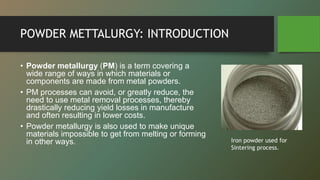
in other ways. Iron powder used for
Sintering process.
STEPS IN POWDER METALLURGY
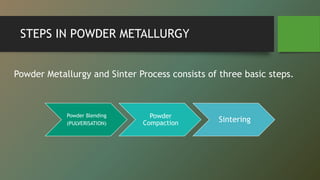
Powder Metallurgy and Sinter Process consists of three basic steps.
Powder Blending
(PULVERISATION)
Powder
Compaction Sintering
PULVERISATION
• “Pulverisation” is the process of applying an external force to a
(solid) material of a certain size to destroy it and reduce it into
pieces that are smaller than the original size.
• Several techniques have been developed which permit large
production rates of powdered particles, often with considerable
control over the size ranges of the final grain population.
• Powders may be prepared by crushing, grinding, chemical
reactions, or electrolytic deposition. The most commonly used
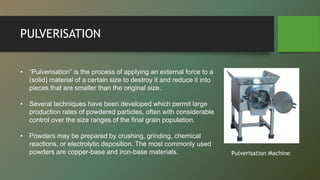
powders are copper-base and iron-base materials. Pulverisation Machine
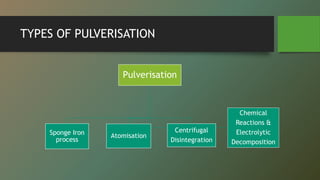
TYPES OF PULVERISATION
Pulverisation
Sponge Iron
process
Atomisation
Centrifugal
Disintegration
Chemical
Reactions &
Electrolytic
Decomposition
Powder Compaction
• Powder compaction is the process of compacting metal powder
in a die through the application of high pressures.
• Typically the tools are held in the vertical orientation with the
punch tool forming the bottom of the cavity.
• The powder is then compacted into a shape and then ejected
from the die cavity.
• Better workpiece materials can be obtained by repressing and
re-sintering.
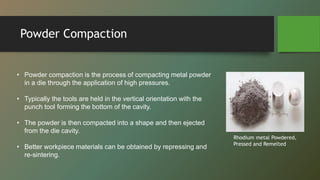
Rhodium metal Powdered,
Pressed and Remelted
Sintering
 After compaction, powdered materials are heated in a controlled
atmosphere in a process known as sintering. During this process, the
surfaces of the particles are bonded and desirable properties are
achieved.
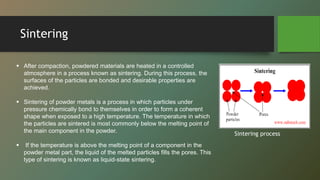
 Sintering of powder metals is a process in which particles under
pressure chemically bond to themselves in order to form a coherent
shape when exposed to a high temperature. The temperature in which
the particles are sintered is most commonly below the melting point of
the main component in the powder.
 If the temperature is above the melting point of a component in the
powder metal part, the liquid of the melted particles fills the pores. This
type of sintering is known as liquid-state sintering.
Sintering process
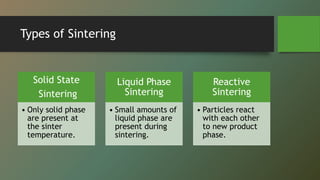
Types of Sintering
Solid State
Sintering
• Only solid phase
are present at
the sinter
temperature.
Liquid Phase
Sintering
• Small amounts of
liquid phase are
present during
sintering.
Reactive
Sintering
• Particles react
with each other
to new product
phase.
THANK YOU

Powder Metallurgy - Manufacturing Process

  • 1.
    BASICS OF MANUFACTURING PROCESSES AmritanshManthapurwar SEC-A, Roll No.-09 III-SEMESTER, MECH DEPT. TAE-II Powder Metallurgy
  • 2.
    POWDER METTALURGY: INTRODUCTION •Powder metallurgy (PM) is a term covering a wide range of ways in which materials or components are made from metal powders. • PM processes can avoid, or greatly reduce, the need to use metal removal processes, thereby drastically reducing yield losses in manufacture and often resulting in lower costs. • Powder metallurgy is also used to make unique materials impossible to get from melting or forming in other ways. Iron powder used for Sintering process.
  • 3.
    STEPS IN POWDERMETALLURGY Powder Metallurgy and Sinter Process consists of three basic steps. Powder Blending (PULVERISATION) Powder Compaction Sintering
  • 4.
    PULVERISATION • “Pulverisation” isthe process of applying an external force to a (solid) material of a certain size to destroy it and reduce it into pieces that are smaller than the original size. • Several techniques have been developed which permit large production rates of powdered particles, often with considerable control over the size ranges of the final grain population. • Powders may be prepared by crushing, grinding, chemical reactions, or electrolytic deposition. The most commonly used powders are copper-base and iron-base materials. Pulverisation Machine
  • 5.
    TYPES OF PULVERISATION Pulverisation SpongeIron process Atomisation Centrifugal Disintegration Chemical Reactions & Electrolytic Decomposition
  • 6.
    Powder Compaction • Powdercompaction is the process of compacting metal powder in a die through the application of high pressures. • Typically the tools are held in the vertical orientation with the punch tool forming the bottom of the cavity. • The powder is then compacted into a shape and then ejected from the die cavity. • Better workpiece materials can be obtained by repressing and re-sintering. Rhodium metal Powdered, Pressed and Remelted
  • 7.
    Sintering  After compaction,powdered materials are heated in a controlled atmosphere in a process known as sintering. During this process, the surfaces of the particles are bonded and desirable properties are achieved.  Sintering of powder metals is a process in which particles under pressure chemically bond to themselves in order to form a coherent shape when exposed to a high temperature. The temperature in which the particles are sintered is most commonly below the melting point of the main component in the powder.  If the temperature is above the melting point of a component in the powder metal part, the liquid of the melted particles fills the pores. This type of sintering is known as liquid-state sintering. Sintering process
  • 8.
    Types of Sintering SolidState Sintering • Only solid phase are present at the sinter temperature. Liquid Phase Sintering • Small amounts of liquid phase are present during sintering. Reactive Sintering • Particles react with each other to new product phase.
  • 9.