BASICS OF
MANUFACTURING
PROCESSES
Amritansh Manthapurwar
II-Year, Mech Dept.
III-SEM, Sec-A, Roll no-09
Introduction to Casting Process
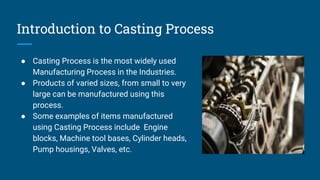
● Casting Process is the most widely used
Manufacturing Process in the Industries.
● Products of varied sizes, from small to very
large can be manufactured using this
process.
● Some examples of items manufactured
using Casting Process include Engine
blocks, Machine tool bases, Cylinder heads,
Pump housings, Valves, etc.
Pattern in Casting Process
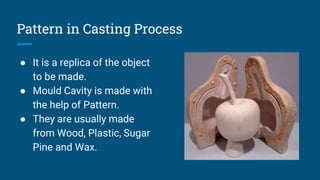
● It is a replica of the object
to be made.
● Mould Cavity is made with
the help of Pattern.
● They are usually made
from Wood, Plastic, Sugar
Pine and Wax.
Types of Pattern
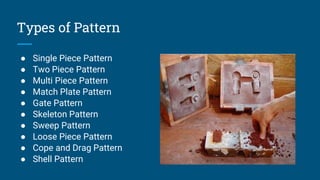
● Single Piece Pattern
● Two Piece Pattern
● Multi Piece Pattern
● Match Plate Pattern
● Gate Pattern
● Skeleton Pattern
● Sweep Pattern
● Loose Piece Pattern
● Cope and Drag Pattern
● Shell Pattern
Pattern Allowances
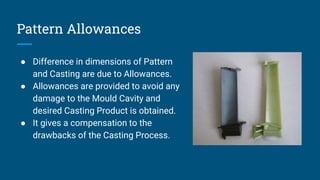
● Difference in dimensions of Pattern
and Casting are due to Allowances.
● Allowances are provided to avoid any
damage to the Mould Cavity and
desired Casting Product is obtained.
● It gives a compensation to the
drawbacks of the Casting Process.
Types of Pattern Allowances
● Shrinkage Allowance
● Draft Allowance
● Machining Allowance
● Distortion Allowance
● Rapping Allowance
Core in Casting Process
● Cores are compact mass of core sand used to produce hollowness in
casting.
● The core is placed inside the mould cavity, at the right location and
proper alignment.
● It can also be used to strengthen the mould.
● Cores are placed on the extra projections on the pattern called the
Core Prints.
● Sometimes cores are placed with Chaplets that provide adequate
support to and avoid it from sagging. These Chaplets are made from
same material as that of the Casting.
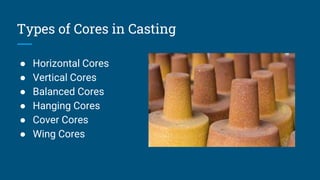
Types of Cores in Casting
● Horizontal Cores
● Vertical Cores
● Balanced Cores
● Hanging Cores
● Cover Cores
● Wing Cores
Classification of Casting
Casting Processes
Expendable Mould
Casting
Permanent Mould
Casting (e.g Die casting,
Centrifugal casting, Continuous
casting)
Permanent Core
(Metal core)
Semi-Permanent
Core
(Sand core)
Expandable
Pattern
(e.g Investment
casting)
Permanent Pattern
(e.g Sand casting)
Gating Systems
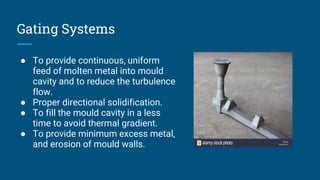
● To provide continuous, uniform
feed of molten metal into mould
cavity and to reduce the turbulence
flow.
● Proper directional solidification.
● To fill the mould cavity in a less
time to avoid thermal gradient.
● To provide minimum excess metal,
and erosion of mould walls.
Elements of Gating System
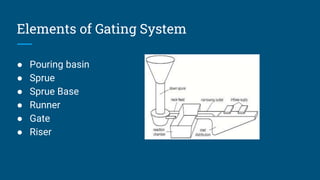
● Pouring basin
● Sprue
● Sprue Base
● Runner
● Gate
● Riser
Elements of Gating System
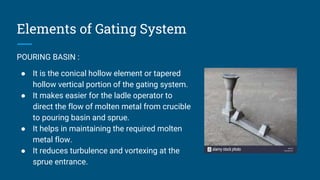
POURING BASIN :
● It is the conical hollow element or tapered
hollow vertical portion of the gating system.
● It makes easier for the ladle operator to
direct the flow of molten metal from crucible
to pouring basin and sprue.
● It helps in maintaining the required molten
metal flow.
● It reduces turbulence and vortexing at the
sprue entrance.
Casting Defects
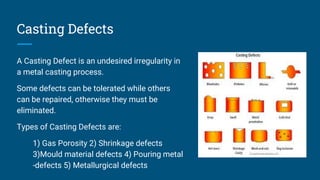
A Casting Defect is an undesired irregularity in
a metal casting process.
Some defects can be tolerated while others
can be repaired, otherwise they must be
eliminated.
Types of Casting Defects are:
1) Gas Porosity 2) Shrinkage defects
3)Mould material defects 4) Pouring metal
-defects 5) Metallurgical defects
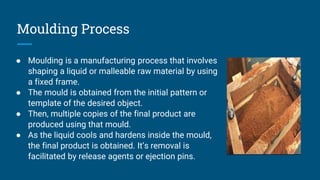
Moulding Process
● Moulding is a manufacturing process that involves
shaping a liquid or malleable raw material by using
a fixed frame.
● The mould is obtained from the initial pattern or
template of the desired object.
● Then, multiple copies of the final product are
produced using that mould.
● As the liquid cools and hardens inside the mould,
the final product is obtained. It’s removal is
facilitated by release agents or ejection pins.
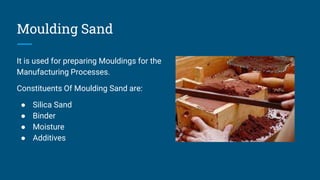
Moulding Sand
It is used for preparing Mouldings for the
Manufacturing Processes.
Constituents Of Moulding Sand are:
● Silica Sand
● Binder
● Moisture
● Additives
Properties of Moulding Sand
● Refractoriness
● Permeability
● Cohesiveness
● Green Strength
● Dry Strength
● Flowability or Plasticity
● Adhesiveness
● Collapsibility
Types of Moulding Sand
● Green Sand
● Dry Sand
● Facing Sand
● Backing Sand
● Parting Sand
● Core Sand
Thank You

Casting Manufacturing Processes

  • 1.
  • 2.
    Introduction to CastingProcess ● Casting Process is the most widely used Manufacturing Process in the Industries. ● Products of varied sizes, from small to very large can be manufactured using this process. ● Some examples of items manufactured using Casting Process include Engine blocks, Machine tool bases, Cylinder heads, Pump housings, Valves, etc.
  • 3.
    Pattern in CastingProcess ● It is a replica of the object to be made. ● Mould Cavity is made with the help of Pattern. ● They are usually made from Wood, Plastic, Sugar Pine and Wax.
  • 4.
    Types of Pattern ●Single Piece Pattern ● Two Piece Pattern ● Multi Piece Pattern ● Match Plate Pattern ● Gate Pattern ● Skeleton Pattern ● Sweep Pattern ● Loose Piece Pattern ● Cope and Drag Pattern ● Shell Pattern
  • 5.
    Pattern Allowances ● Differencein dimensions of Pattern and Casting are due to Allowances. ● Allowances are provided to avoid any damage to the Mould Cavity and desired Casting Product is obtained. ● It gives a compensation to the drawbacks of the Casting Process.
  • 6.
    Types of PatternAllowances ● Shrinkage Allowance ● Draft Allowance ● Machining Allowance ● Distortion Allowance ● Rapping Allowance
  • 7.
    Core in CastingProcess ● Cores are compact mass of core sand used to produce hollowness in casting. ● The core is placed inside the mould cavity, at the right location and proper alignment. ● It can also be used to strengthen the mould. ● Cores are placed on the extra projections on the pattern called the Core Prints. ● Sometimes cores are placed with Chaplets that provide adequate support to and avoid it from sagging. These Chaplets are made from same material as that of the Casting.
  • 8.
    Types of Coresin Casting ● Horizontal Cores ● Vertical Cores ● Balanced Cores ● Hanging Cores ● Cover Cores ● Wing Cores
  • 9.
    Classification of Casting CastingProcesses Expendable Mould Casting Permanent Mould Casting (e.g Die casting, Centrifugal casting, Continuous casting) Permanent Core (Metal core) Semi-Permanent Core (Sand core) Expandable Pattern (e.g Investment casting) Permanent Pattern (e.g Sand casting)
  • 10.
    Gating Systems ● Toprovide continuous, uniform feed of molten metal into mould cavity and to reduce the turbulence flow. ● Proper directional solidification. ● To fill the mould cavity in a less time to avoid thermal gradient. ● To provide minimum excess metal, and erosion of mould walls.
  • 11.
    Elements of GatingSystem ● Pouring basin ● Sprue ● Sprue Base ● Runner ● Gate ● Riser
  • 12.
    Elements of GatingSystem POURING BASIN : ● It is the conical hollow element or tapered hollow vertical portion of the gating system. ● It makes easier for the ladle operator to direct the flow of molten metal from crucible to pouring basin and sprue. ● It helps in maintaining the required molten metal flow. ● It reduces turbulence and vortexing at the sprue entrance.
  • 13.
    Casting Defects A CastingDefect is an undesired irregularity in a metal casting process. Some defects can be tolerated while others can be repaired, otherwise they must be eliminated. Types of Casting Defects are: 1) Gas Porosity 2) Shrinkage defects 3)Mould material defects 4) Pouring metal -defects 5) Metallurgical defects
  • 14.
    Moulding Process ● Mouldingis a manufacturing process that involves shaping a liquid or malleable raw material by using a fixed frame. ● The mould is obtained from the initial pattern or template of the desired object. ● Then, multiple copies of the final product are produced using that mould. ● As the liquid cools and hardens inside the mould, the final product is obtained. It’s removal is facilitated by release agents or ejection pins.
  • 15.
    Moulding Sand It isused for preparing Mouldings for the Manufacturing Processes. Constituents Of Moulding Sand are: ● Silica Sand ● Binder ● Moisture ● Additives
  • 16.
    Properties of MouldingSand ● Refractoriness ● Permeability ● Cohesiveness ● Green Strength ● Dry Strength ● Flowability or Plasticity ● Adhesiveness ● Collapsibility
  • 17.
    Types of MouldingSand ● Green Sand ● Dry Sand ● Facing Sand ● Backing Sand ● Parting Sand ● Core Sand
  • 18.