Abhay Srivastava
B.COMLLB(H)
1805150001
Poverty
Concepts, Meaning and
definition
INTRODUCTION
POVERTY: VIOLATION OF HUMAN DIGNITY
Poverty is scarcity, dearth, or the state of one who
lacks a certain amount of material possessions or
money. It includes low incomes and the inability t
o acquire the basic goods and services necessary f
or survival with dignity.
Poverty has various dimensions
Income poverty
Security poverty
Education poverty
Health – Nutrition Poverty
Multiple deprivation
Poor people’s perception of poverty level
Poverty is “welfare level below a reasonabl
e minimum.”
What is Poverty?
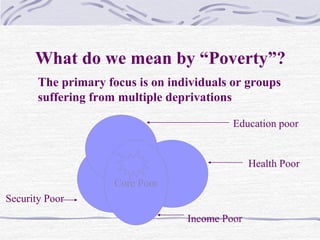
What do we mean by “Poverty”?
The primary focus is on individuals or groups
suffering from multiple deprivations
Core Poor
Education poor
Health Poor
Security Poor
Income Poor
Types of poverty
Absolute poverty
Relative poverty
Poverty : Absolute vs. Relative
Absolute poverty refers to a threshold income (c
onsumption) level defined in absolute terms. Per
sons below a pre-defined threshold income are
called poor.
Relative poverty defined in relative terms with ref
erence to level of living of another person; or, in
relation to an income distribution parameter.
Poverty Lines and Poverty Me
asurement
Two Issues in Generating Poverty Estim
ates
Fixing a poverty line: Identification
Measuring poverty: Aggregation
Poverty Threshold
The poverty threshold or poverty line is
the minimum level of income deemed adequate
in a particular country.
Determining the poverty line is usually done by
finding the total cost of all the essential resourc
es that an average human adult consumes in o
ne year.
 Rapidly Rising Population:
The population during the last 45 years has increased at t
he rate of 2.2% per annum. On average 17 million people
are added every year to its population which raises the de
mand for consumption goods.
Low Productivity in Agriculture:
The level of productivity in agriculture is low due to sub
divided and fragmented holdings, lack of capital, use of t
raditional methods of cultivation, illiteracy etc. This is th
e main cause of poverty in the country.
Causes of Poverty
Under Utilized Resources:
The existence of under employment and disguised unemp
loyment of human resources and under utilization of reso
urces has resulted in low production in agricultural sector.
This brought a down fall in their standard of living.
Low Rate of Economic Development:
The rate of economic development in India has been belo
w the required level. Therefore, there persists a gap betwe
en level of availability and requirements of goods and ser
vices. The net result is poverty.
Price Rise:
The continuous and steep price rise has added to the miseri
es of poor. It has benefited a few people in the society and t
he persons in lower income group find it difficult to get the
ir minimum needs.
Unemployment:
The continuously expanding army of unemployed is anothe
r cause of poverty. The job seeker is increasing in number a
t a higher rate than the expansion in employment opportuni
ties.
Shortage of Capital and Able Entrepreneurship:
Capital and able entrepreneurship have important role in ac
celerating the growth. But these are in short supply making
it difficult to increase production significantly.
Social Factors:
The social set up is still backward and is not conducive to f
aster development. Laws of inheritance, caste system, tradi
tions and customs are putting hindrances in the way of fast
er development.
Political Factors:
The Britishers started lopsided development in India and
reduced Indian economy to a colonial state. They exploit
ed the natural resources to suit their interests and weaken
the industrial base of Indian economy.
In independent India, the development plans have been g
uided by political interests. Hence, the planning a failure
to tackle the problems of poverty and unemployment.
14
Concluding remarks
Reducing poverty takes a commitment of
resources.
Improve opportunities
Invest in education from early childhood throu
gh access to college
Encourage work and supplement income:
Further expansions of the EITC
Provide the necessary work supports (child
care)

PPT on Poverty 1805150001.pptx

  • 1.
  • 2.
    INTRODUCTION POVERTY: VIOLATION OFHUMAN DIGNITY Poverty is scarcity, dearth, or the state of one who lacks a certain amount of material possessions or money. It includes low incomes and the inability t o acquire the basic goods and services necessary f or survival with dignity.
  • 3.
    Poverty has variousdimensions Income poverty Security poverty Education poverty Health – Nutrition Poverty Multiple deprivation Poor people’s perception of poverty level Poverty is “welfare level below a reasonabl e minimum.” What is Poverty?
  • 4.
    What do wemean by “Poverty”? The primary focus is on individuals or groups suffering from multiple deprivations Core Poor Education poor Health Poor Security Poor Income Poor
  • 5.
    Types of poverty Absolutepoverty Relative poverty
  • 6.
    Poverty : Absolutevs. Relative Absolute poverty refers to a threshold income (c onsumption) level defined in absolute terms. Per sons below a pre-defined threshold income are called poor. Relative poverty defined in relative terms with ref erence to level of living of another person; or, in relation to an income distribution parameter.
  • 7.
    Poverty Lines andPoverty Me asurement Two Issues in Generating Poverty Estim ates Fixing a poverty line: Identification Measuring poverty: Aggregation
  • 8.
    Poverty Threshold The povertythreshold or poverty line is the minimum level of income deemed adequate in a particular country. Determining the poverty line is usually done by finding the total cost of all the essential resourc es that an average human adult consumes in o ne year.
  • 9.
     Rapidly RisingPopulation: The population during the last 45 years has increased at t he rate of 2.2% per annum. On average 17 million people are added every year to its population which raises the de mand for consumption goods. Low Productivity in Agriculture: The level of productivity in agriculture is low due to sub divided and fragmented holdings, lack of capital, use of t raditional methods of cultivation, illiteracy etc. This is th e main cause of poverty in the country. Causes of Poverty
  • 10.
    Under Utilized Resources: Theexistence of under employment and disguised unemp loyment of human resources and under utilization of reso urces has resulted in low production in agricultural sector. This brought a down fall in their standard of living. Low Rate of Economic Development: The rate of economic development in India has been belo w the required level. Therefore, there persists a gap betwe en level of availability and requirements of goods and ser vices. The net result is poverty.
  • 11.
    Price Rise: The continuousand steep price rise has added to the miseri es of poor. It has benefited a few people in the society and t he persons in lower income group find it difficult to get the ir minimum needs. Unemployment: The continuously expanding army of unemployed is anothe r cause of poverty. The job seeker is increasing in number a t a higher rate than the expansion in employment opportuni ties.
  • 12.
    Shortage of Capitaland Able Entrepreneurship: Capital and able entrepreneurship have important role in ac celerating the growth. But these are in short supply making it difficult to increase production significantly. Social Factors: The social set up is still backward and is not conducive to f aster development. Laws of inheritance, caste system, tradi tions and customs are putting hindrances in the way of fast er development.
  • 13.
    Political Factors: The Britishersstarted lopsided development in India and reduced Indian economy to a colonial state. They exploit ed the natural resources to suit their interests and weaken the industrial base of Indian economy. In independent India, the development plans have been g uided by political interests. Hence, the planning a failure to tackle the problems of poverty and unemployment.
  • 14.
    14 Concluding remarks Reducing povertytakes a commitment of resources. Improve opportunities Invest in education from early childhood throu gh access to college Encourage work and supplement income: Further expansions of the EITC Provide the necessary work supports (child care)