Potential contribution of
biofortification & other nutrition
interventions to the adequacy & the
cost of diets in rural Zimbabwe
Frédéric Baudron, Jill E. Cairns, Thokozile Ndhlela, Isaiah Nyagumbo,
Kirsty L. Hassall, Steve P. McGrath, Stephan M. Haefele
16th February 2023, Harare, Zimbabwe
Objectives of the study
• To assess the nutrient adequacy
of the diets of the diversity of
households in rural Zimbabwe
• To estimate the impact of large-
scale adoption of pro-vitamin A
(PVA) enriched maize
• To model the cost of a nutrient
adequate diet
Murehwa as a study site (increase
in stunting between 2010 & 2018)
Understanding farm diversity
• 306 farms surveyed in Ward 4 and
Ward 27 (two contrasted districts in
terms of soil, elevation, etc)
• General information, demographics,
household composition, capital &
land, livestock management
• Homefield maize, outfield maize
• Food sources, food security, dietary
diversity, knowledge and experience
with PVA maize
• Income sources, disruptions due to
COVID-19
4 farm types delineated
• (7) Structural variables (age of the HHH, family size, total cropped area, cattle ownership, sheep & goats ownership, female-headed
HH, and education of the HHH higher than primary level)
• (8) Functional variables (total maize produced, total area cultivated to maize, total quantity of fertilizer applied to maize during the
2019-20 season, own production as main source of food, crop sales as main source of income, use of intercropping, and use of
manure)
• (5) Variables related to nutrition (total number of months during which food security was assessed as medium or high over the 12
months preceding the interview, household dietary diversity score, consumption of plant-based vitamin A rich food, consumption of
animal-based vitamin A rich food, and consumption of iron rich food in the 24 hours preceding the interview)
4 farm types delineated
• Type 1: larger farms, larger
herds, crop sale as main
source of income, higher
food security, higher dietary
diversity
• Type 2: intermediate farm
size, intermediate herd size,
higher food security, lower
dietary diversity
• Type 3: predominance of
female-headed households,
intermediate farm size,
intermediate herd size, lower
food security, intermediate
dietary diversity
• Type 4: younger heads of
household, smaller farms,
smaller herds, lower food
security, lower dietary
diversity
Meal monitoring
• Stratified sample of 30 households
• Each food item consumed as a meal or
snack recorded & weighed during one entire
week in April & in October
• Household members consuming each meal
or snack recorded
• 4,543 single food items recorded &
measured
• 912 single food items calibrated
• Intakes of all major nutrients, vitamins and
minerals were calculated using the food
composition tables published by the South
African Medical Research Council (SAMRC,
2017)
• Minimum requirements were calculated
using recommended dietary allowances
published by the National Institutes of Health
(Otten et al., 2006)
Market survey
564 market prices (289 during the wet season, 275 during the dry season)
Assessing the nutrient adequacy of the diets of
the diversity of households
Inadequacy of vitamin A intake year
round, regardless of farm type
Daily requirement: 900 µg RAE
Small contribution of snacks… but
shouldn’t be ignored
Daily requirement: 900 µg RAE
Own production as the main source of
vitamin A
Daily requirement: 900 µg RAE
Critical role of dark green leafy
vegetables
Daily requirement: 900 µg RAE
Diets are inadequate for multiple
vitamins & minerals (wet season)
Diets are inadequate for multiple
vitamins & minerals (dry season)
13 problematic elements
Cereals, legumes, dark green vegetables
& eggs: critical food groups (wet season)
Cereals, legumes, dark green vegetables
& eggs: critical food groups (dry season)
Estimating the impact of large-scale adoption of
pro-vitamin A (PVA) enriched maize
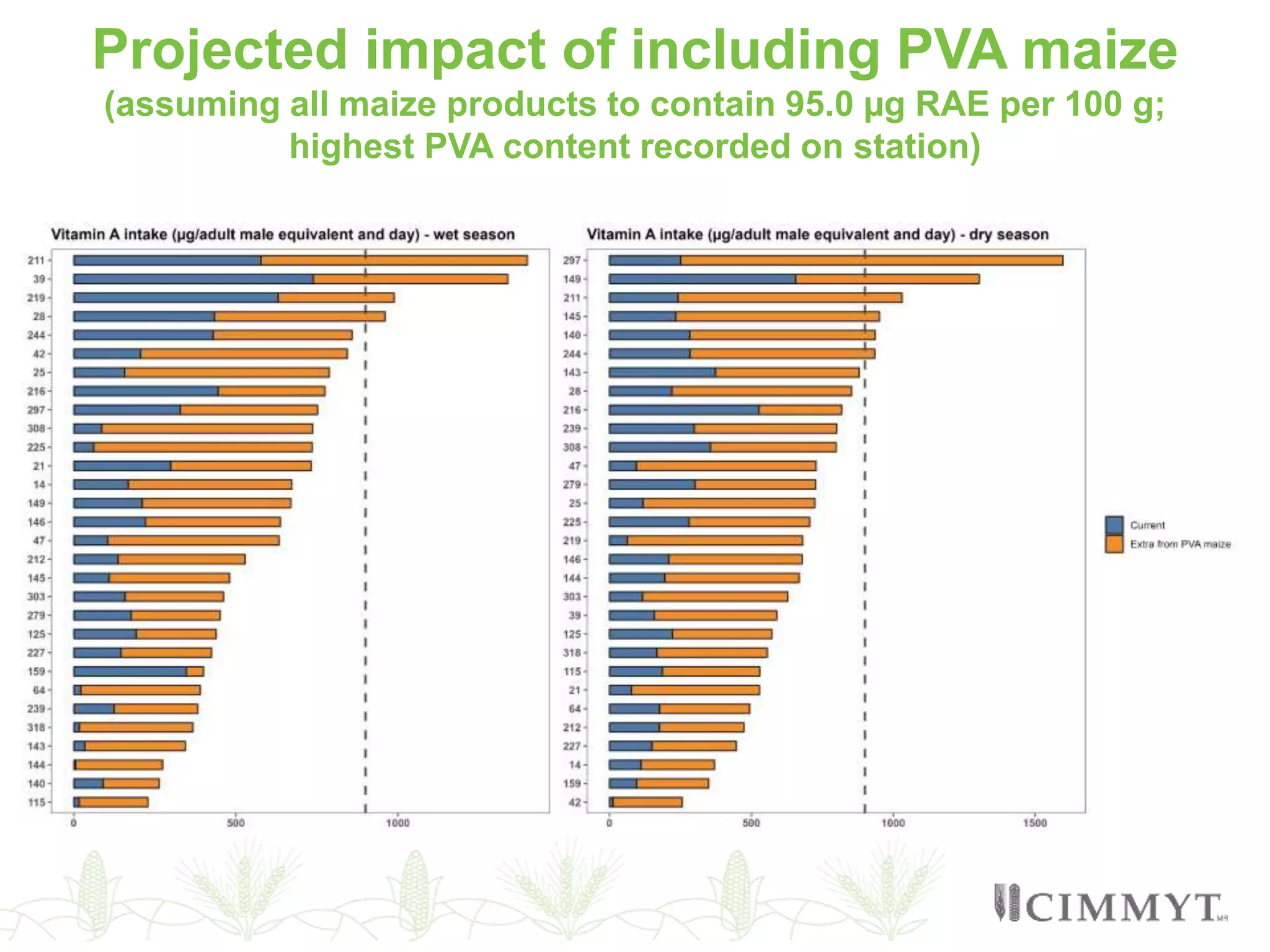
Projected impact of including PVA maize
(assuming all maize products to contain 95.0 µg RAE per 100 g;
highest PVA content recorded on station)
Projected impact of including PVA maize
(assuming all maize products to contain 40.4 µg RAE per 100 g;
highest PVA content recorded on farm)
Projected impact of including PVA maize
(assuming all maize products to contain 28.3 µg RAE per 100 g;
mean PVA content recorded on farm)
Modeling the cost of a nutrient adequate diet
Cost of vitamin A-rich food
Cost of current diets
(1.4 ± 0.5 US$ during the wet season;
1.0 ± 0.5 US$ during the dry season)
Optimization: cheapest nutrient
adequate diet
Energy (kJ) >= 12,134
Vitamin A, RAE (µg) >= 900
Protein (g) >= 56
Vitamin C, total ascorbic acid (mg) >= 90
Vitamin D (D2 + D3) (µg) >= 15
Vitamin E (alpha-tocopherol) (mg) >= 15
Riboflavin (mg) >= 1.3
Folate, DFE (µg) >= 400
Vitamin B-12 (µg) >= 2.4
Pantothenic acid (mg) >= 5
Choline, total (mg) >= 550
Calcium, Ca (mg) >= 1,000
Iron, Fe (mg) >= 8
Magnesium, Mg (mg) >= 420
Manganese, Mn (mg) >= 2.3
Phosphorus, P (mg) >= 700
Zinc, Zn (mg) >= 11
Potassium, K (mg) >= 4,700
Carbohydrate, by difference (g) >= 130
Fiber, total dietary (g) >= 38
Cost (US$) MINIMUM
A nutrient adequate diet would raise the
cost of the diet for the majority of HHs
Current vs. optimized diet composition
Current vs. optimized cost contribution
Conclusion
• This study confirms that diets in rural Zimbabwe tend to be
inadequate in vitamin A (and a number of other vitamins
and minerals)
• Scaling up PVA maize, maize being the staple food, can
contribute to alleviate the problem, but the diet of most
households will only be adequate in vitamin A if
biofortifcation is combined with other nutrition interventions.
• Interventions to lower the cost of nutrient-dense food and
nutrition education could promote a diverse and nutrient
adequate diet.
Thank you
for your
interest!
f.baudron@cgiar.org
@FBaudron

Potential contribution of biofortification & other nutrition interventions to the adequacy & the cost of diets in rural Zimbabwe

  • 1.
    Potential contribution of biofortification& other nutrition interventions to the adequacy & the cost of diets in rural Zimbabwe Frédéric Baudron, Jill E. Cairns, Thokozile Ndhlela, Isaiah Nyagumbo, Kirsty L. Hassall, Steve P. McGrath, Stephan M. Haefele 16th February 2023, Harare, Zimbabwe
  • 2.
    Objectives of thestudy • To assess the nutrient adequacy of the diets of the diversity of households in rural Zimbabwe • To estimate the impact of large- scale adoption of pro-vitamin A (PVA) enriched maize • To model the cost of a nutrient adequate diet Murehwa as a study site (increase in stunting between 2010 & 2018)
  • 3.
    Understanding farm diversity •306 farms surveyed in Ward 4 and Ward 27 (two contrasted districts in terms of soil, elevation, etc) • General information, demographics, household composition, capital & land, livestock management • Homefield maize, outfield maize • Food sources, food security, dietary diversity, knowledge and experience with PVA maize • Income sources, disruptions due to COVID-19
  • 4.
    4 farm typesdelineated • (7) Structural variables (age of the HHH, family size, total cropped area, cattle ownership, sheep & goats ownership, female-headed HH, and education of the HHH higher than primary level) • (8) Functional variables (total maize produced, total area cultivated to maize, total quantity of fertilizer applied to maize during the 2019-20 season, own production as main source of food, crop sales as main source of income, use of intercropping, and use of manure) • (5) Variables related to nutrition (total number of months during which food security was assessed as medium or high over the 12 months preceding the interview, household dietary diversity score, consumption of plant-based vitamin A rich food, consumption of animal-based vitamin A rich food, and consumption of iron rich food in the 24 hours preceding the interview)
  • 5.
    4 farm typesdelineated • Type 1: larger farms, larger herds, crop sale as main source of income, higher food security, higher dietary diversity • Type 2: intermediate farm size, intermediate herd size, higher food security, lower dietary diversity • Type 3: predominance of female-headed households, intermediate farm size, intermediate herd size, lower food security, intermediate dietary diversity • Type 4: younger heads of household, smaller farms, smaller herds, lower food security, lower dietary diversity
  • 6.
    Meal monitoring • Stratifiedsample of 30 households • Each food item consumed as a meal or snack recorded & weighed during one entire week in April & in October • Household members consuming each meal or snack recorded • 4,543 single food items recorded & measured • 912 single food items calibrated • Intakes of all major nutrients, vitamins and minerals were calculated using the food composition tables published by the South African Medical Research Council (SAMRC, 2017) • Minimum requirements were calculated using recommended dietary allowances published by the National Institutes of Health (Otten et al., 2006)
  • 7.
    Market survey 564 marketprices (289 during the wet season, 275 during the dry season)
  • 8.
    Assessing the nutrientadequacy of the diets of the diversity of households
  • 9.
    Inadequacy of vitaminA intake year round, regardless of farm type Daily requirement: 900 µg RAE
  • 10.
    Small contribution ofsnacks… but shouldn’t be ignored Daily requirement: 900 µg RAE
  • 11.
    Own production asthe main source of vitamin A Daily requirement: 900 µg RAE
  • 12.
    Critical role ofdark green leafy vegetables Daily requirement: 900 µg RAE
  • 13.
    Diets are inadequatefor multiple vitamins & minerals (wet season)
  • 14.
    Diets are inadequatefor multiple vitamins & minerals (dry season)
  • 15.
  • 16.
    Cereals, legumes, darkgreen vegetables & eggs: critical food groups (wet season)
  • 17.
    Cereals, legumes, darkgreen vegetables & eggs: critical food groups (dry season)
  • 18.
    Estimating the impactof large-scale adoption of pro-vitamin A (PVA) enriched maize
  • 19.
    Projected impact ofincluding PVA maize (assuming all maize products to contain 95.0 µg RAE per 100 g; highest PVA content recorded on station)
  • 20.
    Projected impact ofincluding PVA maize (assuming all maize products to contain 40.4 µg RAE per 100 g; highest PVA content recorded on farm)
  • 21.
    Projected impact ofincluding PVA maize (assuming all maize products to contain 28.3 µg RAE per 100 g; mean PVA content recorded on farm)
  • 22.
    Modeling the costof a nutrient adequate diet
  • 23.
    Cost of vitaminA-rich food
  • 24.
    Cost of currentdiets (1.4 ± 0.5 US$ during the wet season; 1.0 ± 0.5 US$ during the dry season)
  • 25.
    Optimization: cheapest nutrient adequatediet Energy (kJ) >= 12,134 Vitamin A, RAE (µg) >= 900 Protein (g) >= 56 Vitamin C, total ascorbic acid (mg) >= 90 Vitamin D (D2 + D3) (µg) >= 15 Vitamin E (alpha-tocopherol) (mg) >= 15 Riboflavin (mg) >= 1.3 Folate, DFE (µg) >= 400 Vitamin B-12 (µg) >= 2.4 Pantothenic acid (mg) >= 5 Choline, total (mg) >= 550 Calcium, Ca (mg) >= 1,000 Iron, Fe (mg) >= 8 Magnesium, Mg (mg) >= 420 Manganese, Mn (mg) >= 2.3 Phosphorus, P (mg) >= 700 Zinc, Zn (mg) >= 11 Potassium, K (mg) >= 4,700 Carbohydrate, by difference (g) >= 130 Fiber, total dietary (g) >= 38 Cost (US$) MINIMUM
  • 26.
    A nutrient adequatediet would raise the cost of the diet for the majority of HHs
  • 27.
    Current vs. optimizeddiet composition
  • 28.
    Current vs. optimizedcost contribution
  • 29.
    Conclusion • This studyconfirms that diets in rural Zimbabwe tend to be inadequate in vitamin A (and a number of other vitamins and minerals) • Scaling up PVA maize, maize being the staple food, can contribute to alleviate the problem, but the diet of most households will only be adequate in vitamin A if biofortifcation is combined with other nutrition interventions. • Interventions to lower the cost of nutrient-dense food and nutrition education could promote a diverse and nutrient adequate diet.
  • 30.