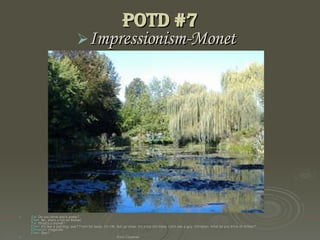
PoTD #7 Impressionism-Monet Tai : Do you think she's pretty?  Cher : No, she's a full-on Monet.  Tai : What's a monet?  Cher : It's like a painting, see? From far away, it's OK, but up close, it's a big old mess. Let's ask a guy. Christian, what do you think of Amber?  Christian : Hagsville.  Cher : See?  -from Clueless
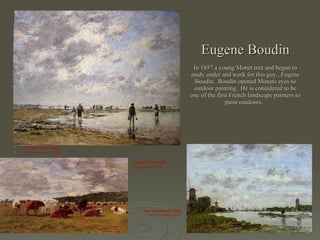
Eugene Boudin In 1857 a young Monet met and began to study under and work for this guy...Eugene Boudin.  Boudin opened Monets eyes to outdoor painting.  He is considered to be one of the first French landscape painters to paint outdoors.  Figures on the Beach  Oil on Canvas (1886) Pasture At Deaxville   Oil on panel (1878) View of Dordrecht(1884) Oil on Canvas 9x13”
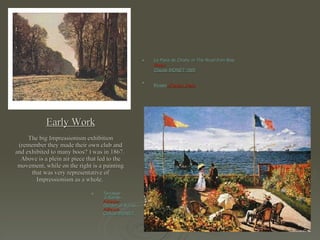
Early Work The big Impressionism exhibition (remember they made their own club and and exhibited to many boos? ) was in 1867.  Above is a plein air piece that led to the movement, while on the right is a painting that was very representative of Impressionism as a whole.   Terrasse  à Sainte- Adresse Garden at Sainte  Adresse Claude MONET 1867Metropolitan Museum of Art, New York   Le Pave de  Chailly  or The Road from Bas- Breau Claude MONET 1865 Musée  d'Orsay, Paris
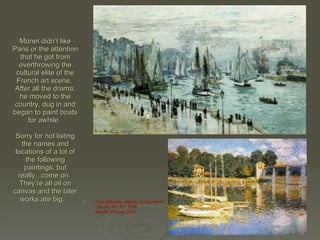
Monet didn’t like Paris or the attention that he got from overthrowing the cultural elite of the French art scene.  After all the drama, he moved to the country, dug in and began to paint boats for awhile.  Sorry for not listing the names and locations of a lot of the following paintings, but really...come on.  They’re all oil on canvas and the later works are big.  "Les Barques, régates à Argenteuil" Claude MONET 1874 Musée d'Orsay, Paris   "Le Pont d'Argenteuil" Claude MONET 1874 Musée d'Orsay, Paris
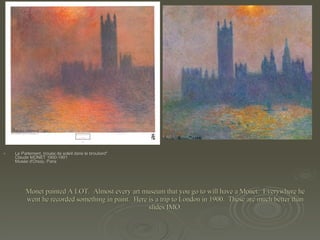
Monet painted A LOT.  Almost every art museum that you go to will have a Monet.  Everywhere he went he recorded something in paint.  Here is a trip to London in 1900.  These are much better than slides IMO. Le Parlement, trouée de soleil dans le brouilard" Claude MONET 1900-1901 Musée d'Orsay, Paris  "Londres, le Parlement, effet de soleil dans le brouillard" Claude MONET 1900-1901 Private collection
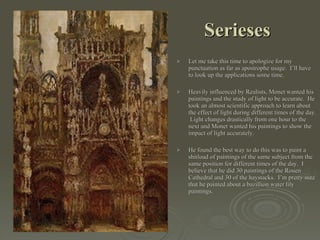
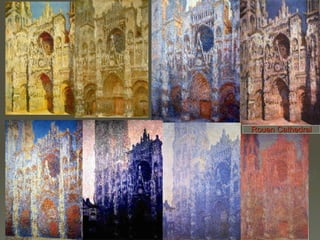
Serieses Let me take this time to apologize for my punctuation as far as apostrophe usage.  I’ll have to look up the applications some time. Heavily influenced by Realists, Monet wanted his paintings and the study of light to be accurate.  He took an almost scientific approach to learn about the effect of light during different times of the day.  Light changes drastically from one hour to the next and Monet wanted his paintings to show the impact of light accurately. He found the best way to do this was to paint a shitload of paintings of the same subject from the same position for different times of the day.  I believe that he did 30 paintings of the Rouen Cathedral and 30 of the haystacks.  I’m pretty sure that he painted about a bazillion water lily paintings.
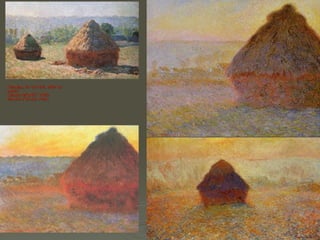
"Meules, fin de l'été, effet du matin" Claude MONET 1890 Musée d'Orsay, Paris
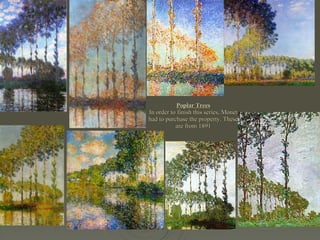
Poplar Trees In order to finish this series, Monet had to purchase the property. These are from 1891
92-94 Rouen   Cathedral
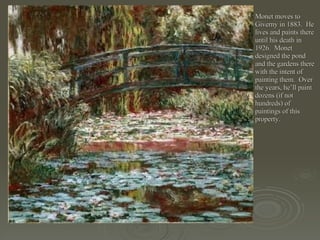
Monet moves to Giverny in 1883.  He lives and paints there until his death in 1926.  Monet designed the pond and the gardens there with the intent of painting them.  Over the years, he’ll paint dozens (if not hundreds) of paintings of this property.
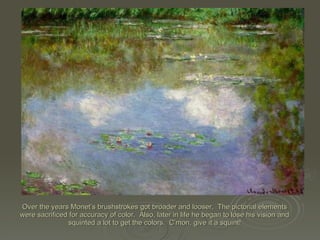
Over the years Monet’s brushstrokes got broader and looser.  The pictorial elements were sacrificed for accuracy of color.  Also, later in life he began to lose his vision and squinted a lot to get the colors.  C’mon, give it a squint!
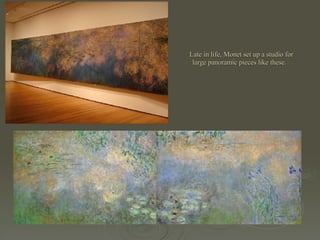
Late in life, Monet set up a studio for large panoramic pieces like these.
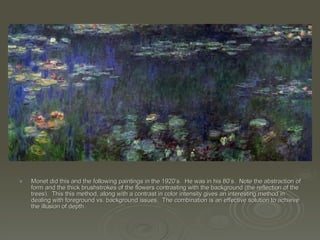
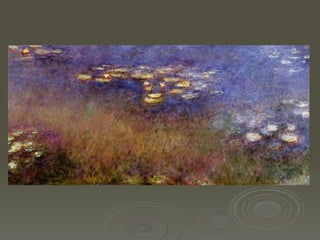
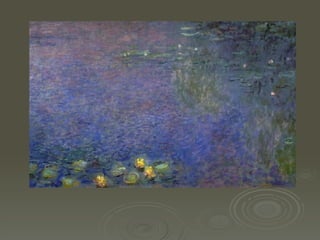
Monet did this and the following paintings in the 1920’s.  He was in his 80’s.  Note the abstraction of form and the thick brushstrokes of the flowers contrasting with the background (the reflection of the trees).  This this method, along with a contrast in color intensity gives an interesting method in dealing with foreground vs. background issues.  The combination is an effective solution to achieve the illusion of depth.
 
 
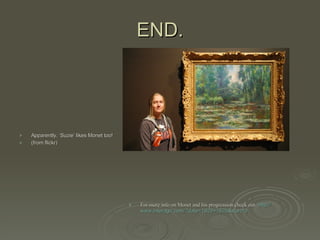
END. Apparently, ‘Suzie’ likes Monet too! (from flickr) For more info on Monet and his progression check out-   http:// www.interagir.com /?date=1920+1926&start=0

Potd8 Impressionism2 Monet

  • 1.
    PoTD #7 Impressionism-MonetTai : Do you think she's pretty? Cher : No, she's a full-on Monet. Tai : What's a monet? Cher : It's like a painting, see? From far away, it's OK, but up close, it's a big old mess. Let's ask a guy. Christian, what do you think of Amber? Christian : Hagsville. Cher : See? -from Clueless
  • 2.
    Eugene Boudin In1857 a young Monet met and began to study under and work for this guy...Eugene Boudin. Boudin opened Monets eyes to outdoor painting. He is considered to be one of the first French landscape painters to paint outdoors. Figures on the Beach Oil on Canvas (1886) Pasture At Deaxville Oil on panel (1878) View of Dordrecht(1884) Oil on Canvas 9x13”
  • 3.
    Early Work Thebig Impressionism exhibition (remember they made their own club and and exhibited to many boos? ) was in 1867. Above is a plein air piece that led to the movement, while on the right is a painting that was very representative of Impressionism as a whole. Terrasse à Sainte- Adresse Garden at Sainte Adresse Claude MONET 1867Metropolitan Museum of Art, New York Le Pave de Chailly or The Road from Bas- Breau Claude MONET 1865 Musée d'Orsay, Paris
  • 4.
    Monet didn’t likeParis or the attention that he got from overthrowing the cultural elite of the French art scene. After all the drama, he moved to the country, dug in and began to paint boats for awhile. Sorry for not listing the names and locations of a lot of the following paintings, but really...come on. They’re all oil on canvas and the later works are big. "Les Barques, régates à Argenteuil" Claude MONET 1874 Musée d'Orsay, Paris "Le Pont d'Argenteuil" Claude MONET 1874 Musée d'Orsay, Paris
  • 5.
    Monet painted ALOT. Almost every art museum that you go to will have a Monet. Everywhere he went he recorded something in paint. Here is a trip to London in 1900. These are much better than slides IMO. Le Parlement, trouée de soleil dans le brouilard" Claude MONET 1900-1901 Musée d'Orsay, Paris "Londres, le Parlement, effet de soleil dans le brouillard" Claude MONET 1900-1901 Private collection
  • 6.
    Serieses Let metake this time to apologize for my punctuation as far as apostrophe usage. I’ll have to look up the applications some time. Heavily influenced by Realists, Monet wanted his paintings and the study of light to be accurate. He took an almost scientific approach to learn about the effect of light during different times of the day. Light changes drastically from one hour to the next and Monet wanted his paintings to show the impact of light accurately. He found the best way to do this was to paint a shitload of paintings of the same subject from the same position for different times of the day. I believe that he did 30 paintings of the Rouen Cathedral and 30 of the haystacks. I’m pretty sure that he painted about a bazillion water lily paintings.
  • 7.
    "Meules, fin del'été, effet du matin" Claude MONET 1890 Musée d'Orsay, Paris
  • 8.
    Poplar Trees Inorder to finish this series, Monet had to purchase the property. These are from 1891
  • 9.
    92-94 Rouen Cathedral
  • 10.
    Monet moves toGiverny in 1883. He lives and paints there until his death in 1926. Monet designed the pond and the gardens there with the intent of painting them. Over the years, he’ll paint dozens (if not hundreds) of paintings of this property.
  • 11.
    Over the yearsMonet’s brushstrokes got broader and looser. The pictorial elements were sacrificed for accuracy of color. Also, later in life he began to lose his vision and squinted a lot to get the colors. C’mon, give it a squint!
  • 12.
    Late in life,Monet set up a studio for large panoramic pieces like these.
  • 13.
    Monet did thisand the following paintings in the 1920’s. He was in his 80’s. Note the abstraction of form and the thick brushstrokes of the flowers contrasting with the background (the reflection of the trees). This this method, along with a contrast in color intensity gives an interesting method in dealing with foreground vs. background issues. The combination is an effective solution to achieve the illusion of depth.
  • 14.
  • 15.
  • 16.
    END. Apparently, ‘Suzie’likes Monet too! (from flickr) For more info on Monet and his progression check out- http:// www.interagir.com /?date=1920+1926&start=0