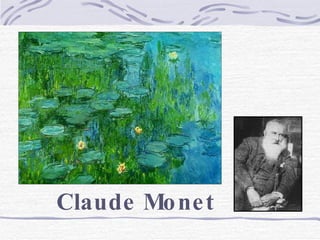
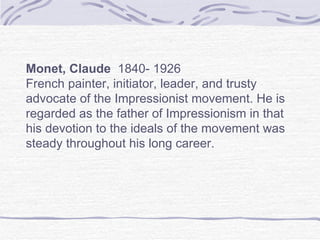
Claude Monet
Monet, Claude   1840- 1926 French painter, initiator, leader, and trusty advocate of the Impressionist movement. He is regarded as the father of Impressionism in that his devotion to the ideals of the movement was steady throughout his long career.
Claude Monet was born in Paris on November 14, 1840  but all his impressions as a child and teenager are related  to the city of Le Havre where his family moved in 1845.  There his father held a trade of colonial articles .
He developed a reputation as a caricature artist by the time  he was 15. In 1958, the young artist met landscape painter  Eugène Boudin, a mentor who first introduced him to  outdoor painting. Monet was reluctant to leave the studio  and the familiarity of indoor scenes, but plain air painting  eventually became the basis for his life’s work. Against his parents’ wishes, Claude Monet left home for Paris  in 1859 to pursue a career in painting. Claude Monet took a  brief hiatus from his artistic pursuits to serve in the military in  Algeria from 1860 to 1862. Upon his return to Paris, he picked  up where he left off, studying art, experimenting with new styles,  traveling, and forming important friendships with fellow painters.
In 1870, Claude Monet married his  wife, Camille, and the two traveled  to London and eventually settled at  Argenteuil.  Monet regularly exhibited his  paintings in the private Impressionist  group shows, which first took place in  1874. During that first show his painting  Impression: Sunrise (1872)  inspired a  hostile newspaper critic to call all the  artists "Impressionists," a name that  persists to characterize the artistic  movement today.
Impressionist painters used color and  brushstrokes in a new way.   While traditional landscape artists painted what they saw in their  mind, Claude Monet, sought to paint the world exactly how he saw  it, not how he knew it should look.  So rather than painting a myriad  of separate leaves, he depicted  splashes of constantly changing  light and color.  In 1883 Claude Monet moved  to Giverny. Monet gradually  gained critical and financial  success during the late 1880s  and the 1890s.
There are almost never any outlines in Impressionist Art!  The whole painting is just blobs and smears of color!
" I have no other wish than to mingle more closely with nature, and I aspire to no other destiny than to work and live in harmony with her laws, as Goethe prescribed. Nature is greatness, power, and immortality ; compared with her a creature is nothing but a miserable atom.” "When I began I was like the others ; I thought that two canvases were enough, one by dark weather and another one by sunshine."
During the 1890s, Claude Monet devoted himself to his serial paintings, including his celebrated poplars (1890-91), haystacks (1891), House of Parliament and the facades of Rouen Cathedral (1892-1894). The paintings feature his subjects in more or less the same physical position, with the only changing aspect being the natural light, season, and weather. This technique reflects Monet’s continuing exploration and study of the visible world and its fleeting qualities. In essence, the series paintings make the subject matter almost irrelevant, but rather emphasize the atmospheric moods and changes. For that reason, Monet’s art established an important precedent for the development of abstract painting.
Monet painted the tall poplars on the banks of the river Epte near his house at Giverny under varying weather and seasons in 1890 and again in 1891. A row of tall vertical stems backed by a receding line of other poplars provided the basic arrangement which he observed from his boat.  He began his series of Haystacks before he had finished with the Poplars, a distant line of trees often forming a background. In both series he took enormous pains to wait for the exact light each picture demanded, causing him to take out not one but a whole set of canvases to the chosen site on which he could work one at a time as a particular phase of light allowed. Painting the poplars exactly as they appear came to matter less and capturing the natural beauty mattered more.
The slenderness of the poplars seemed to take on something of the exaggerated elegance. The color scheme became more made up with heightened contrast between blues and purples, oranges and yellows.  With the public the series were a great success, the Haystacks especially. Fifteen of them exhibited at Durand-Ruel's were all sold within a few days at 3,000 to 4,000 francs each.
Color Characteristics Light and Color Perception Color is a product of light.  Color changes with light.  Colors are different during different times of the day. Color Constancy  or  Constancy Effect  As humans we want to think of an object as being a particular color.  However, objects change color with light, season, and weather.
Poplars
Poplars
Poplars
Haystacks
Rouen Cathedral
House of Parliament
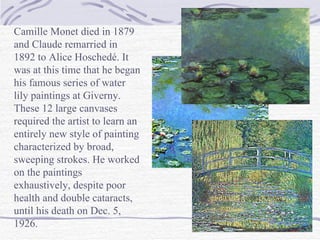
Camille Monet died in 1879 and Claude remarried in 1892 to Alice Hoschedé. It was at this time that he began his famous series of water lily paintings at Giverny. These 12 large canvases required the artist to learn an entirely new style of painting characterized by broad, sweeping strokes. He worked on the paintings exhaustively, despite poor health and double cataracts, until his death on Dec. 5, 1926.
 

Monet 3 26

  • 1.
  • 2.
    Monet, Claude 1840- 1926 French painter, initiator, leader, and trusty advocate of the Impressionist movement. He is regarded as the father of Impressionism in that his devotion to the ideals of the movement was steady throughout his long career.
  • 3.
    Claude Monet wasborn in Paris on November 14, 1840 but all his impressions as a child and teenager are related to the city of Le Havre where his family moved in 1845. There his father held a trade of colonial articles .
  • 4.
    He developed areputation as a caricature artist by the time he was 15. In 1958, the young artist met landscape painter Eugène Boudin, a mentor who first introduced him to outdoor painting. Monet was reluctant to leave the studio and the familiarity of indoor scenes, but plain air painting eventually became the basis for his life’s work. Against his parents’ wishes, Claude Monet left home for Paris in 1859 to pursue a career in painting. Claude Monet took a brief hiatus from his artistic pursuits to serve in the military in Algeria from 1860 to 1862. Upon his return to Paris, he picked up where he left off, studying art, experimenting with new styles, traveling, and forming important friendships with fellow painters.
  • 5.
    In 1870, ClaudeMonet married his wife, Camille, and the two traveled to London and eventually settled at Argenteuil. Monet regularly exhibited his paintings in the private Impressionist group shows, which first took place in 1874. During that first show his painting Impression: Sunrise (1872) inspired a hostile newspaper critic to call all the artists "Impressionists," a name that persists to characterize the artistic movement today.
  • 6.
    Impressionist painters usedcolor and brushstrokes in a new way. While traditional landscape artists painted what they saw in their mind, Claude Monet, sought to paint the world exactly how he saw it, not how he knew it should look. So rather than painting a myriad of separate leaves, he depicted splashes of constantly changing light and color. In 1883 Claude Monet moved to Giverny. Monet gradually gained critical and financial success during the late 1880s and the 1890s.
  • 7.
    There are almostnever any outlines in Impressionist Art! The whole painting is just blobs and smears of color!
  • 8.
    " I haveno other wish than to mingle more closely with nature, and I aspire to no other destiny than to work and live in harmony with her laws, as Goethe prescribed. Nature is greatness, power, and immortality ; compared with her a creature is nothing but a miserable atom.” "When I began I was like the others ; I thought that two canvases were enough, one by dark weather and another one by sunshine."
  • 9.
    During the 1890s,Claude Monet devoted himself to his serial paintings, including his celebrated poplars (1890-91), haystacks (1891), House of Parliament and the facades of Rouen Cathedral (1892-1894). The paintings feature his subjects in more or less the same physical position, with the only changing aspect being the natural light, season, and weather. This technique reflects Monet’s continuing exploration and study of the visible world and its fleeting qualities. In essence, the series paintings make the subject matter almost irrelevant, but rather emphasize the atmospheric moods and changes. For that reason, Monet’s art established an important precedent for the development of abstract painting.
  • 10.
    Monet painted thetall poplars on the banks of the river Epte near his house at Giverny under varying weather and seasons in 1890 and again in 1891. A row of tall vertical stems backed by a receding line of other poplars provided the basic arrangement which he observed from his boat. He began his series of Haystacks before he had finished with the Poplars, a distant line of trees often forming a background. In both series he took enormous pains to wait for the exact light each picture demanded, causing him to take out not one but a whole set of canvases to the chosen site on which he could work one at a time as a particular phase of light allowed. Painting the poplars exactly as they appear came to matter less and capturing the natural beauty mattered more.
  • 11.
    The slenderness ofthe poplars seemed to take on something of the exaggerated elegance. The color scheme became more made up with heightened contrast between blues and purples, oranges and yellows. With the public the series were a great success, the Haystacks especially. Fifteen of them exhibited at Durand-Ruel's were all sold within a few days at 3,000 to 4,000 francs each.
  • 12.
    Color Characteristics Lightand Color Perception Color is a product of light. Color changes with light. Colors are different during different times of the day. Color Constancy or Constancy Effect As humans we want to think of an object as being a particular color. However, objects change color with light, season, and weather.
  • 13.
  • 14.
  • 15.
  • 16.
  • 17.
  • 18.
  • 19.
    Camille Monet diedin 1879 and Claude remarried in 1892 to Alice Hoschedé. It was at this time that he began his famous series of water lily paintings at Giverny. These 12 large canvases required the artist to learn an entirely new style of painting characterized by broad, sweeping strokes. He worked on the paintings exhaustively, despite poor health and double cataracts, until his death on Dec. 5, 1926.
  • 20.