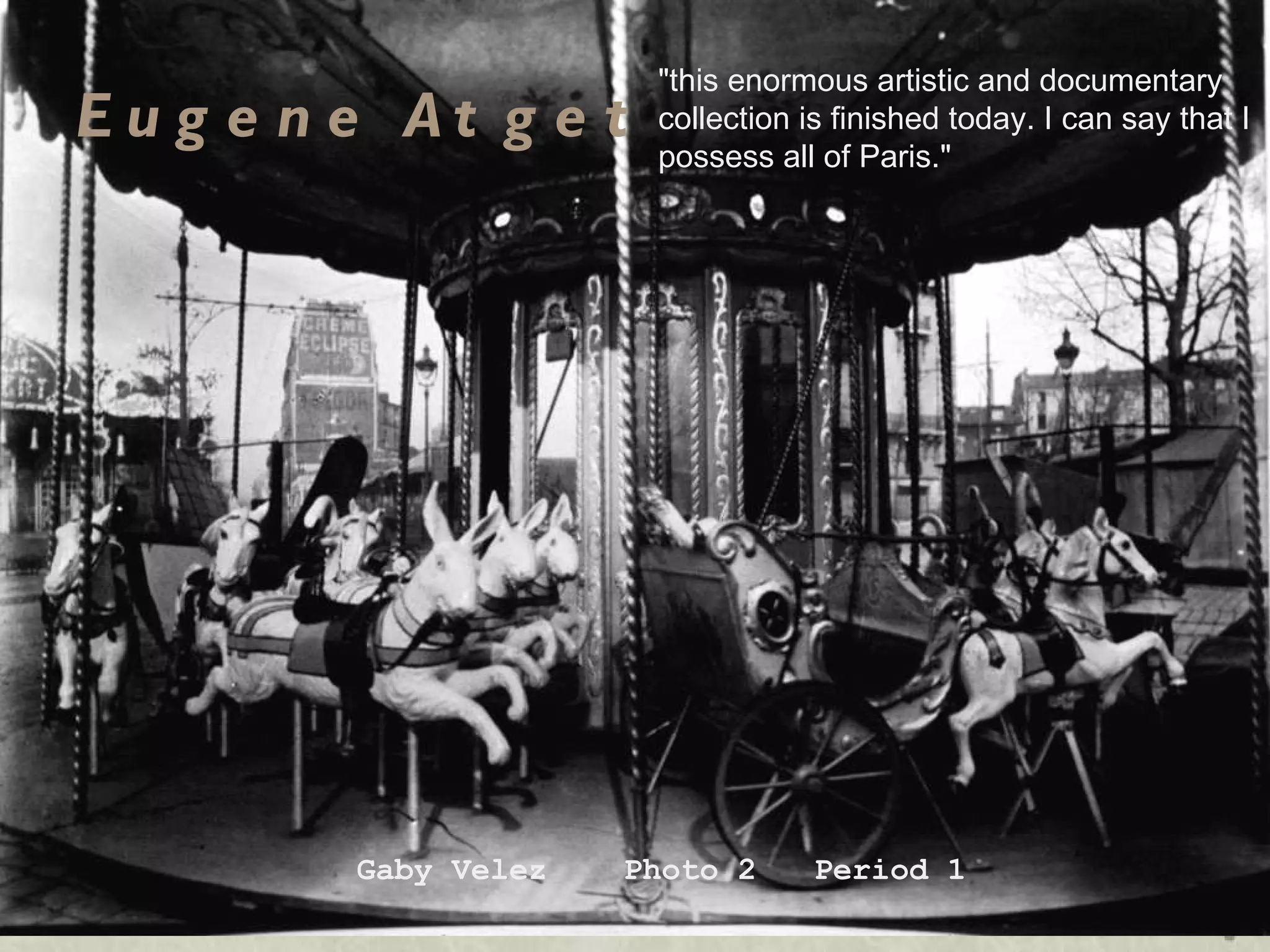
Eugene Atget Gaby Velez  Photo 2  Period 1 "this enormous artistic and documentary collection is finished today. I can say that I possess all of Paris."
Historical Background (February 12, 1857 – August 4, 1927) Born outside of the French city Bordeaux.  He was raised by his uncle at the age of seven when he became an orphan.  Worked as a sailor during his youth He was an actor most of his life and then experimented with painting and finally found his true passion for photography. Settled in Paris in the 1890s  He was noted for his photographs documenting the architecture and street scenes of Paris. His preferred medium was silver gelatin prints
More Facts! Eugene was seen at times a typical commercial photographer. He was not a progressive photographer but worked at pace that was comfortable for him. He didn’t find any movements or followers but made unique photographs that captured the culture of his home country France. He successfully understood and interpreted the visual complex task of photography.Eugene was a photographer of such authority and originality in his work. Atget took his photographs with a large-format wooden bellows camera with a rapid rectilinear lens. He wandered the haunted Parisian streets like a ghost, and somehow found through his camera the remains of a grand culture that lingered in the ancient streets of Paris.
L’Eclipse, avril 1912, April 1912, toned silver gelatin print, 18.0 x 21.9 cm.
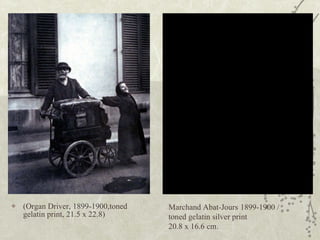
(Organ Driver, 1899-1900,toned gelatin print, 21.5 x 22.8) Marchand Abat-Jours   1899-1900 /  toned gelatin silver print 20.8 x 16.6 cm.
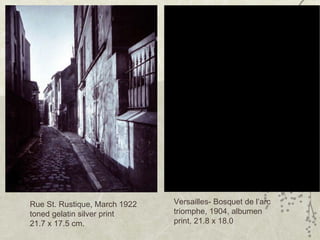
Rue St. Rustique, March 1922 toned gelatin silver print 21.7 x 17.5 cm.  Versailles- Bosquet de l’arc triomphe, 1904, albumen print, 21.8 x 18.0
 
Saint-Cloud 1915-1919 / printed 1956 by Berenice Abbott from Atget's negative toned gelatin silver print 16.8 x 21.5 cm.  Versailles - (coin de parc), 1902,albumen print 17.2 x 21.5 cm Credit Lines Le Perreux - Tour de Marne 1903, albumen print, 17.7 x 22.0 cm. Les Bords du Marne au Perreux (Seine), 1903, albumen print, 17.7 x 22.2 cm.
Interesting Facts He was said to have been eccentric and short-tempered. In his 50s stopped eating anything except bread, milk and sugar. Advertised his photos as “documents for artists” which was common practice for painters to paint scenes from photos. Around the mid-1890s, he bought his first camera and took over 10,000 images of the sights and people of Paris. Between 1897 and 1927, he captured the old parts of Paris by showing the historic narrow lanes, historic buildings, and magnificent palaces that were soon to be demolished before the French Revolution. He liked to take pictures in the early morning hours when few people were out. Eugene’s photos attracted the attention of well-known painters such as Henri Matisse, Man Ray, Andre Derain, and Picasso in the 1920s. Berenice Abbott was the key that unlocked the perspective of Paris for the rest of the world to see his photos.
Prostitute, Paris,1920s The Moulin Rouge, 86 Boulevard de Clichi,  1910, gelatin print,
Tuileries - l’Aurore (Magnier) (1e arr) 1907,albumen print, 21.7 x 18.0 cm. Rue Asseline, 1924-25 silver printing-out  paper print, 22.5 x 17.8 cm


Description In this photo, there is a single figure/statue standing to the right of the photo, it is outside, and there are many trees all moving in the same direction with a pathway leading in a linear perspective. Sepia photo with a soft layer to it.
Analysis In this photo, there is use of line with the pathway down the middle of the photo, light and value for the strong contrasts, the trees form a rhythm in the picture and harmonize the composition of the photo. Also there is a sense of movement with the trees that allows your eyes to move to the end of the pathway.
Interpretation I interpret this photograph as a very emotional piece, the elements and principles that are used help to capture the viewers eyes and create a soft, calming image showing the beauty of nature during his time.
Judgement When I first saw this photo, it really caught my eye because of the soft and dark values and the unique addition of the sculpture in the photograph. I think the trees and the figure balance each other out creating a unified composition.
Where is Eugene Atget from? A. England B. Italy C. France D. Spain E. none of the above
Correct Answer: C. France
What was Eugene’s first job? A. Painter B. Photographer C. Librarian D. Actor
Correct Answer: D. Actor
Bibliography http://www.art.com/products/p14178449-sa-i2956254/eugene-atget-the-moulin-rouge-in-paris-1921.html http://www.atgetphotography.com/The-Photographers/Eugene-Atget.html http://www.iphotocentral.com/showcase/showcase_descrp.php/8/1/1/0 http://www.geh.org/fm/atget/htmlsrc/atget_sld00001.html http://www.flickr.com/photos/george_eastman_house/sets/72157621011255003/?page=2 http://photographyhistory.blogspot.com/2008/03/atget.html http://www.google.com/images?hl=en&rlz=1G1GGLQ_ENUS311&q=eugene+atget+nature+photos&um=1&ie=UTF-8&source=univ&ei=LKtITe3TKoOclgf_reH1BA&sa=X&oi=image_result_group&ct=title&resnum=1&ved=0CCgQsAQwAA&biw=1266&bih=563

Eugene atget 1

  • 1.
    Eugene Atget GabyVelez Photo 2 Period 1 "this enormous artistic and documentary collection is finished today. I can say that I possess all of Paris."
  • 2.
    Historical Background (February12, 1857 – August 4, 1927) Born outside of the French city Bordeaux. He was raised by his uncle at the age of seven when he became an orphan. Worked as a sailor during his youth He was an actor most of his life and then experimented with painting and finally found his true passion for photography. Settled in Paris in the 1890s He was noted for his photographs documenting the architecture and street scenes of Paris. His preferred medium was silver gelatin prints
  • 3.
    More Facts! Eugenewas seen at times a typical commercial photographer. He was not a progressive photographer but worked at pace that was comfortable for him. He didn’t find any movements or followers but made unique photographs that captured the culture of his home country France. He successfully understood and interpreted the visual complex task of photography.Eugene was a photographer of such authority and originality in his work. Atget took his photographs with a large-format wooden bellows camera with a rapid rectilinear lens. He wandered the haunted Parisian streets like a ghost, and somehow found through his camera the remains of a grand culture that lingered in the ancient streets of Paris.
  • 4.
    L’Eclipse, avril 1912,April 1912, toned silver gelatin print, 18.0 x 21.9 cm.
  • 5.
    (Organ Driver, 1899-1900,tonedgelatin print, 21.5 x 22.8) Marchand Abat-Jours 1899-1900 / toned gelatin silver print 20.8 x 16.6 cm.
  • 6.
    Rue St. Rustique,March 1922 toned gelatin silver print 21.7 x 17.5 cm. Versailles- Bosquet de l’arc triomphe, 1904, albumen print, 21.8 x 18.0
  • 7.
  • 8.
    Saint-Cloud 1915-1919 /printed 1956 by Berenice Abbott from Atget's negative toned gelatin silver print 16.8 x 21.5 cm. Versailles - (coin de parc), 1902,albumen print 17.2 x 21.5 cm Credit Lines Le Perreux - Tour de Marne 1903, albumen print, 17.7 x 22.0 cm. Les Bords du Marne au Perreux (Seine), 1903, albumen print, 17.7 x 22.2 cm.
  • 9.
    Interesting Facts Hewas said to have been eccentric and short-tempered. In his 50s stopped eating anything except bread, milk and sugar. Advertised his photos as “documents for artists” which was common practice for painters to paint scenes from photos. Around the mid-1890s, he bought his first camera and took over 10,000 images of the sights and people of Paris. Between 1897 and 1927, he captured the old parts of Paris by showing the historic narrow lanes, historic buildings, and magnificent palaces that were soon to be demolished before the French Revolution. He liked to take pictures in the early morning hours when few people were out. Eugene’s photos attracted the attention of well-known painters such as Henri Matisse, Man Ray, Andre Derain, and Picasso in the 1920s. Berenice Abbott was the key that unlocked the perspective of Paris for the rest of the world to see his photos.
  • 10.
    Prostitute, Paris,1920s TheMoulin Rouge, 86 Boulevard de Clichi, 1910, gelatin print,
  • 11.
    Tuileries - l’Aurore(Magnier) (1e arr) 1907,albumen print, 21.7 x 18.0 cm. Rue Asseline, 1924-25 silver printing-out paper print, 22.5 x 17.8 cm
  • 12.
  • 13.
  • 14.
  • 15.
  • 16.
    Description In thisphoto, there is a single figure/statue standing to the right of the photo, it is outside, and there are many trees all moving in the same direction with a pathway leading in a linear perspective. Sepia photo with a soft layer to it.
  • 17.
    Analysis In thisphoto, there is use of line with the pathway down the middle of the photo, light and value for the strong contrasts, the trees form a rhythm in the picture and harmonize the composition of the photo. Also there is a sense of movement with the trees that allows your eyes to move to the end of the pathway.
  • 18.
    Interpretation I interpretthis photograph as a very emotional piece, the elements and principles that are used help to capture the viewers eyes and create a soft, calming image showing the beauty of nature during his time.
  • 19.
    Judgement When Ifirst saw this photo, it really caught my eye because of the soft and dark values and the unique addition of the sculpture in the photograph. I think the trees and the figure balance each other out creating a unified composition.
  • 20.
    Where is EugeneAtget from? A. England B. Italy C. France D. Spain E. none of the above
  • 21.
  • 22.
    What was Eugene’sfirst job? A. Painter B. Photographer C. Librarian D. Actor
  • 23.
  • 24.
    Bibliography http://www.art.com/products/p14178449-sa-i2956254/eugene-atget-the-moulin-rouge-in-paris-1921.html http://www.atgetphotography.com/The-Photographers/Eugene-Atget.htmlhttp://www.iphotocentral.com/showcase/showcase_descrp.php/8/1/1/0 http://www.geh.org/fm/atget/htmlsrc/atget_sld00001.html http://www.flickr.com/photos/george_eastman_house/sets/72157621011255003/?page=2 http://photographyhistory.blogspot.com/2008/03/atget.html http://www.google.com/images?hl=en&rlz=1G1GGLQ_ENUS311&q=eugene+atget+nature+photos&um=1&ie=UTF-8&source=univ&ei=LKtITe3TKoOclgf_reH1BA&sa=X&oi=image_result_group&ct=title&resnum=1&ved=0CCgQsAQwAA&biw=1266&bih=563