BARLEY YELLOW DWARF DISEASE
STUDENT COURSE TEACHER
Mr. Manikandan R Dr. Parthasarathy S
2015021076 Asst.Prof.,(Plant Pathology)
Disease name: Barley yellow dwarf disease
Pathogen name: Barley yellow dwarf virus, Cereal yellow dwarf
virus
Hosts: Barley, oats, wheat, maize, rice and other grasses
Systematic position
Domain: Virus
Group: Group IV ( ss(+)RNA )
Family: Luteoviridae
Genus: Luteovirus
Species: Barely yellow dwarf virus
History
 In 1890 a mysterious disease of oats was seen from New
England south to Georgia and west to Indiana and Illinois in
U.S.A.
 The oats were stunted, sometimes turned red, tillered poorly,
and often set little seed.
 The next epidemic struck the U.S. oat crop in 1907.
 Ohio scientist T. F. Manns study the possible relationship
between aphids and the disease.
 He conclude that the aphids did indeed spread the disease,
which he believed that was caused by a bacterium.
 Oswald and Houston study the role of insects in the disease.
 They found that five aphid species were capable of
transmitting the disease.
 Oswald and Houston attributed the disease to a virus, but
pointed out that this virus was not similar to most other plant
viruses then known.
 The yellowing symptoms, transmission by aphids, and lack of
transmission by rubbing (mechanical inoculation)
differentiated it from other plant viruses.
Economic significance
 Effect on yield is variable since it depends on viral strain, time
of infection and rate of spread.
 Most severe losses are from early infections and can be as high
as 50%.
Distribution
In world
 Asia, Europe, North America, South America, Africa, and
Oceania
In India,
 All the barely growing states.
Pathogen Characters
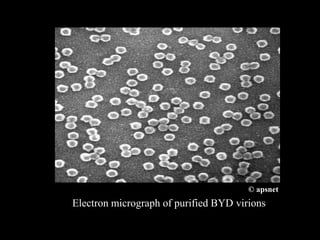
 The viruses that cause BYD are typically 25-28 nm in
diameter and hexagonal in outline.
 They are composed of two proteins (a major coat protein and a
minor "readthrough" protein) that encapsulate the single-
stranded ribonucleic acid (ssRNA) genome.
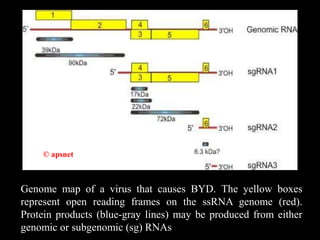
 This RNA genome serves as a messenger RNA and has five to
six genes or open reading frames (ORFs) .
 Some proteins are produced directly from the ORFs of the
genomic RNA, while others are expressed from shorter RNAs,
called subgenomic RNAs (sgRNAs).
 The viruses that cause BYD are restricted to the phloem of
host plants.
 They are seen via electron microscopy in the cytoplasm, nuclei
and vacuoles of infected sieve elements, companion and
parenchyma cells.
 Vesicles containing filaments and inclusions containing virus
particles are common cytopathological effects of virus
infection.
 The infection and subsequent death of phloem cells inhibits
translocation, slows plant growth, and induces loss of
chlorophyll, resulting in typical symptoms.
Electron micrograph of purified BYD virions
© apsnet
Genome map of a virus that causes BYD. The yellow boxes
represent open reading frames on the ssRNA genome (red).
Protein products (blue-gray lines) may be produced from either
genomic or subgenomic (sg) RNAs
© apsnet
Symptoms
 The most common symptom is stunting due to reduced
internode length.
 Root mass of infected plants is also often reduced.
 The most conspicuous symptom on infected hosts, loss of
green color in leaves, is often more prominent on older leaves.
 Discoloration typically begins 1 to 3 weeks after infection and
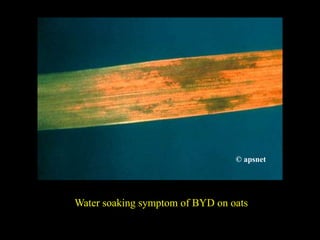
may be preceded by the development of water-soaked areas on
the leaves
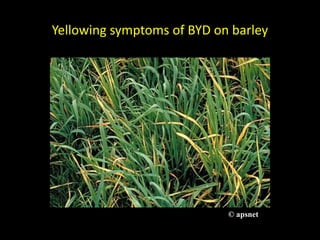
 Barley leaves often turn bright yellow ; oat leaves may become
tan, orange, red, or purple ; wheat leaves typically turn yellow
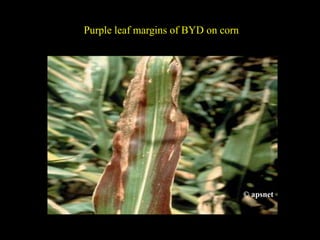
or red ; tips or edges of corn (maize) leaves turn red, purple or
yellow ; and rice leaves typically turn yellow or orange.
 Other symptoms of infection may include upright and stiff
leaves and serrated leaf borders, reduced tillering and
flowering, sterility and failure to fill kernels, which results in
fewer and smaller kernels and corresponding yield losses.
© University of Georgia
Water soaking symptom of BYD on oats
© University of Georgia © University of Georgia
© apsnet
Yellowing symptoms of BYD on barley
© University of Georgia
© apsnet
Purple leaf margins of BYD on corn
© apsnet
Disease cycle
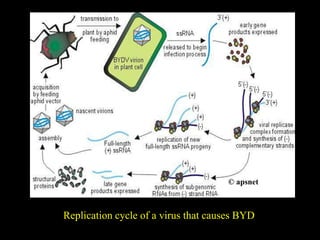
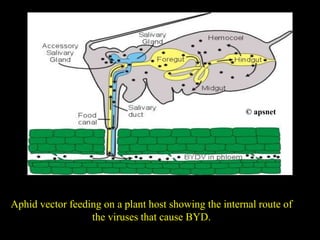
 The virus particle, or virion, is deposited in a phloem cell by
an aphid vector.
 The virus replication cycle begins when the ssRNA is released
from the virion.
 This ssRNA is a positive sense or “+ sense” RNA that serves
as a messenger RNA.
 Early gene products (proteins) are translated from the ssRNA.
 These early gene products are believed to be part of the
complex required to make copies of the viral RNA.
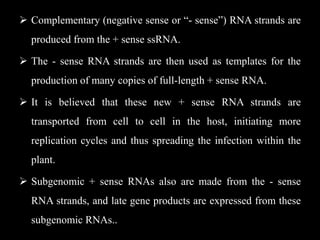
 Complementary (negative sense or “- sense”) RNA strands are
produced from the + sense ssRNA.
 The - sense RNA strands are then used as templates for the
production of many copies of full-length + sense RNA.
 It is believed that these new + sense RNA strands are
transported from cell to cell in the host, initiating more
replication cycles and thus spreading the infection within the
plant.
 Subgenomic + sense RNAs also are made from the - sense
RNA strands, and late gene products are expressed from these
subgenomic RNAs..
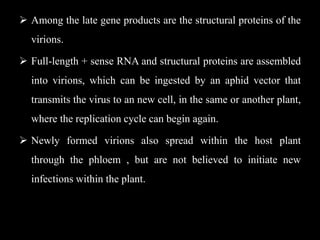
 Among the late gene products are the structural proteins of the
virions.
 Full-length + sense RNA and structural proteins are assembled
into virions, which can be ingested by an aphid vector that
transmits the virus to an new cell, in the same or another plant,
where the replication cycle can begin again.
 Newly formed virions also spread within the host plant
through the phloem , but are not believed to initiate new
infections within the plant.
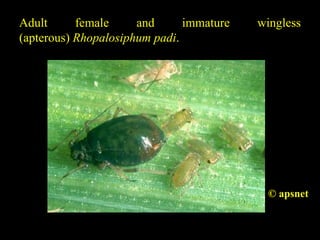
Adult female and immature wingless
(apterous) Rhopalosiphum padi.
© apsnet
Replication cycle of a virus that causes BYD
© apsnet
Aphid vector feeding on a plant host showing the internal route of
the viruses that cause BYD.
© apsnet
Favourable conditions
 High light intensity and relatively cool temperatures 15-18ºC
(59-65ºF) generally favor expression of symptoms, such as
leaf discoloration which may attract aphid vectors to virus-
infected plants.
 The reproduction rate of subsequent aphid populations is
affected by environmental conditions, as is the efficiency with
which the aphids transmit the viruses.
 For example, transmission of the BYDV by the inefficient
vectors is dramatically increased at high temperatures
(30ºC/86ºF).
 Disease symptoms usually occur about 2 weeks after infection
and symptom expression is favored by bright, sunny weather.
Management
 The first step in BYD management is accurate diagnosis of the
disease.
 The diagnostic test most commonly used to confirm infection
is a serological test called enzyme-linked immunosorbent
assay or ELISA.
Winter wheat field in Washington state naturally
infected with one or more viruses that cause BYD in the
1950s
© apsnet
Genetic resistance
 The most effective control strategies aim to prevent infection
of host plants rather than to cure plants that are already
infected. The method most widely used to reduce crop losses
due to BYD is planting tolerant or resistant cultivars.
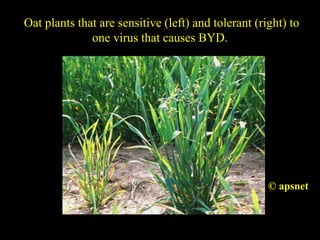
 In tolerant plants, viruses are still able to multiply, but few
symptoms are expressed.
 In resistant plants, the ability of viruses to multiply and/or
spread is impaired, resulting in a reduction of disease
symptoms.
 Genes for at least partial tolerance or resistance have been
identified in many of the crop plants infected by the viruses.
 Some plant species also have been genetically engineered to
express portions of the viral genome, and some of these
transgenic plants display high levels of tolerance to the
disease.
Oat plants that are sensitive (left) and tolerant (right) to
one virus that causes BYD.
© apsnet
Vector management
 Twenty-five aphids have been reported as vectors of BYDVs .
 The most important vectors include Rhopalosiphum padi, R.
maidis, R. rufiabdominalis, Sitobion avenae, Metopolophium
dirhodum and Schizaphis graminum.
 Aphid populations can be monitored by catching the migrating
aphids in traps.
 When aphid migration patterns are known, it is sometimes
possible to alter the planting date so that crops are older and
more resistant when the seasonal migrations occur.
 Seed treatments of imidacloprid (Gaucho and other products)
or thiamethoxam (Cruiser) can reduce aphid populations
through the fall and, therefore, reduce primary infections.

Barley yellow dwarf disease

  • 1.
    BARLEY YELLOW DWARFDISEASE STUDENT COURSE TEACHER Mr. Manikandan R Dr. Parthasarathy S 2015021076 Asst.Prof.,(Plant Pathology)
  • 2.
    Disease name: Barleyyellow dwarf disease Pathogen name: Barley yellow dwarf virus, Cereal yellow dwarf virus Hosts: Barley, oats, wheat, maize, rice and other grasses
  • 3.
    Systematic position Domain: Virus Group:Group IV ( ss(+)RNA ) Family: Luteoviridae Genus: Luteovirus Species: Barely yellow dwarf virus
  • 4.
    History  In 1890a mysterious disease of oats was seen from New England south to Georgia and west to Indiana and Illinois in U.S.A.  The oats were stunted, sometimes turned red, tillered poorly, and often set little seed.  The next epidemic struck the U.S. oat crop in 1907.  Ohio scientist T. F. Manns study the possible relationship between aphids and the disease.
  • 5.
     He concludethat the aphids did indeed spread the disease, which he believed that was caused by a bacterium.  Oswald and Houston study the role of insects in the disease.  They found that five aphid species were capable of transmitting the disease.  Oswald and Houston attributed the disease to a virus, but pointed out that this virus was not similar to most other plant viruses then known.  The yellowing symptoms, transmission by aphids, and lack of transmission by rubbing (mechanical inoculation) differentiated it from other plant viruses.
  • 6.
    Economic significance  Effecton yield is variable since it depends on viral strain, time of infection and rate of spread.  Most severe losses are from early infections and can be as high as 50%.
  • 7.
    Distribution In world  Asia,Europe, North America, South America, Africa, and Oceania In India,  All the barely growing states.
  • 8.
    Pathogen Characters  Theviruses that cause BYD are typically 25-28 nm in diameter and hexagonal in outline.  They are composed of two proteins (a major coat protein and a minor "readthrough" protein) that encapsulate the single- stranded ribonucleic acid (ssRNA) genome.  This RNA genome serves as a messenger RNA and has five to six genes or open reading frames (ORFs) .  Some proteins are produced directly from the ORFs of the genomic RNA, while others are expressed from shorter RNAs, called subgenomic RNAs (sgRNAs).
  • 9.
     The virusesthat cause BYD are restricted to the phloem of host plants.  They are seen via electron microscopy in the cytoplasm, nuclei and vacuoles of infected sieve elements, companion and parenchyma cells.  Vesicles containing filaments and inclusions containing virus particles are common cytopathological effects of virus infection.  The infection and subsequent death of phloem cells inhibits translocation, slows plant growth, and induces loss of chlorophyll, resulting in typical symptoms.
  • 10.
    Electron micrograph ofpurified BYD virions © apsnet
  • 11.
    Genome map ofa virus that causes BYD. The yellow boxes represent open reading frames on the ssRNA genome (red). Protein products (blue-gray lines) may be produced from either genomic or subgenomic (sg) RNAs © apsnet
  • 12.
    Symptoms  The mostcommon symptom is stunting due to reduced internode length.  Root mass of infected plants is also often reduced.  The most conspicuous symptom on infected hosts, loss of green color in leaves, is often more prominent on older leaves.  Discoloration typically begins 1 to 3 weeks after infection and may be preceded by the development of water-soaked areas on the leaves
  • 13.
     Barley leavesoften turn bright yellow ; oat leaves may become tan, orange, red, or purple ; wheat leaves typically turn yellow or red ; tips or edges of corn (maize) leaves turn red, purple or yellow ; and rice leaves typically turn yellow or orange.  Other symptoms of infection may include upright and stiff leaves and serrated leaf borders, reduced tillering and flowering, sterility and failure to fill kernels, which results in fewer and smaller kernels and corresponding yield losses. © University of Georgia
  • 14.
    Water soaking symptomof BYD on oats © University of Georgia © University of Georgia © apsnet
  • 15.
    Yellowing symptoms ofBYD on barley © University of Georgia © apsnet
  • 16.
    Purple leaf marginsof BYD on corn © apsnet
  • 17.
    Disease cycle  Thevirus particle, or virion, is deposited in a phloem cell by an aphid vector.  The virus replication cycle begins when the ssRNA is released from the virion.  This ssRNA is a positive sense or “+ sense” RNA that serves as a messenger RNA.  Early gene products (proteins) are translated from the ssRNA.  These early gene products are believed to be part of the complex required to make copies of the viral RNA.
  • 18.
     Complementary (negativesense or “- sense”) RNA strands are produced from the + sense ssRNA.  The - sense RNA strands are then used as templates for the production of many copies of full-length + sense RNA.  It is believed that these new + sense RNA strands are transported from cell to cell in the host, initiating more replication cycles and thus spreading the infection within the plant.  Subgenomic + sense RNAs also are made from the - sense RNA strands, and late gene products are expressed from these subgenomic RNAs..
  • 19.
     Among thelate gene products are the structural proteins of the virions.  Full-length + sense RNA and structural proteins are assembled into virions, which can be ingested by an aphid vector that transmits the virus to an new cell, in the same or another plant, where the replication cycle can begin again.  Newly formed virions also spread within the host plant through the phloem , but are not believed to initiate new infections within the plant.
  • 20.
    Adult female andimmature wingless (apterous) Rhopalosiphum padi. © apsnet
  • 21.
    Replication cycle ofa virus that causes BYD © apsnet
  • 22.
    Aphid vector feedingon a plant host showing the internal route of the viruses that cause BYD. © apsnet
  • 23.
    Favourable conditions  Highlight intensity and relatively cool temperatures 15-18ºC (59-65ºF) generally favor expression of symptoms, such as leaf discoloration which may attract aphid vectors to virus- infected plants.  The reproduction rate of subsequent aphid populations is affected by environmental conditions, as is the efficiency with which the aphids transmit the viruses.  For example, transmission of the BYDV by the inefficient vectors is dramatically increased at high temperatures (30ºC/86ºF).
  • 24.
     Disease symptomsusually occur about 2 weeks after infection and symptom expression is favored by bright, sunny weather.
  • 25.
    Management  The firststep in BYD management is accurate diagnosis of the disease.  The diagnostic test most commonly used to confirm infection is a serological test called enzyme-linked immunosorbent assay or ELISA.
  • 26.
    Winter wheat fieldin Washington state naturally infected with one or more viruses that cause BYD in the 1950s © apsnet
  • 27.
    Genetic resistance  Themost effective control strategies aim to prevent infection of host plants rather than to cure plants that are already infected. The method most widely used to reduce crop losses due to BYD is planting tolerant or resistant cultivars.  In tolerant plants, viruses are still able to multiply, but few symptoms are expressed.  In resistant plants, the ability of viruses to multiply and/or spread is impaired, resulting in a reduction of disease symptoms.  Genes for at least partial tolerance or resistance have been identified in many of the crop plants infected by the viruses.
  • 28.
     Some plantspecies also have been genetically engineered to express portions of the viral genome, and some of these transgenic plants display high levels of tolerance to the disease.
  • 29.
    Oat plants thatare sensitive (left) and tolerant (right) to one virus that causes BYD. © apsnet
  • 30.
    Vector management  Twenty-fiveaphids have been reported as vectors of BYDVs .  The most important vectors include Rhopalosiphum padi, R. maidis, R. rufiabdominalis, Sitobion avenae, Metopolophium dirhodum and Schizaphis graminum.  Aphid populations can be monitored by catching the migrating aphids in traps.  When aphid migration patterns are known, it is sometimes possible to alter the planting date so that crops are older and more resistant when the seasonal migrations occur.
  • 31.
     Seed treatmentsof imidacloprid (Gaucho and other products) or thiamethoxam (Cruiser) can reduce aphid populations through the fall and, therefore, reduce primary infections.