
INDIAN DENTAL ACADEMY
Leader in continuing dental education
www.indiandentalacademy.com

www.indiandentalacademy.com
Difficulties and problems should
make us stronger, not bitter

www.indiandentalacademy.com
Contents
•
•
•
•

Introduction
History
Definitions
Why to restore endodontically treated
teeth
• Post & core systems
• Principles of tooth preparation
www.indiandentalacademy.com
• Procedure
Post fabrication & Core fabrication
Investing and casting
Evaluation & cementation
• Removal of existing posts
• Conclusion
• References
www.indiandentalacademy.com
Introduction

www.indiandentalacademy.com
INTRODUCTION:
• The restoration of the endodontically treated tooth is
complicated
• Destruction by caries
• Previous restorations
• Trauma
• Endodontic access preparation
• The endodontically treated teeth require restoration
because of
• dehydrated dentin,
• decreased structural integrity
• impaired neurosensory feedback mechanism
www.indiandentalacademy.com
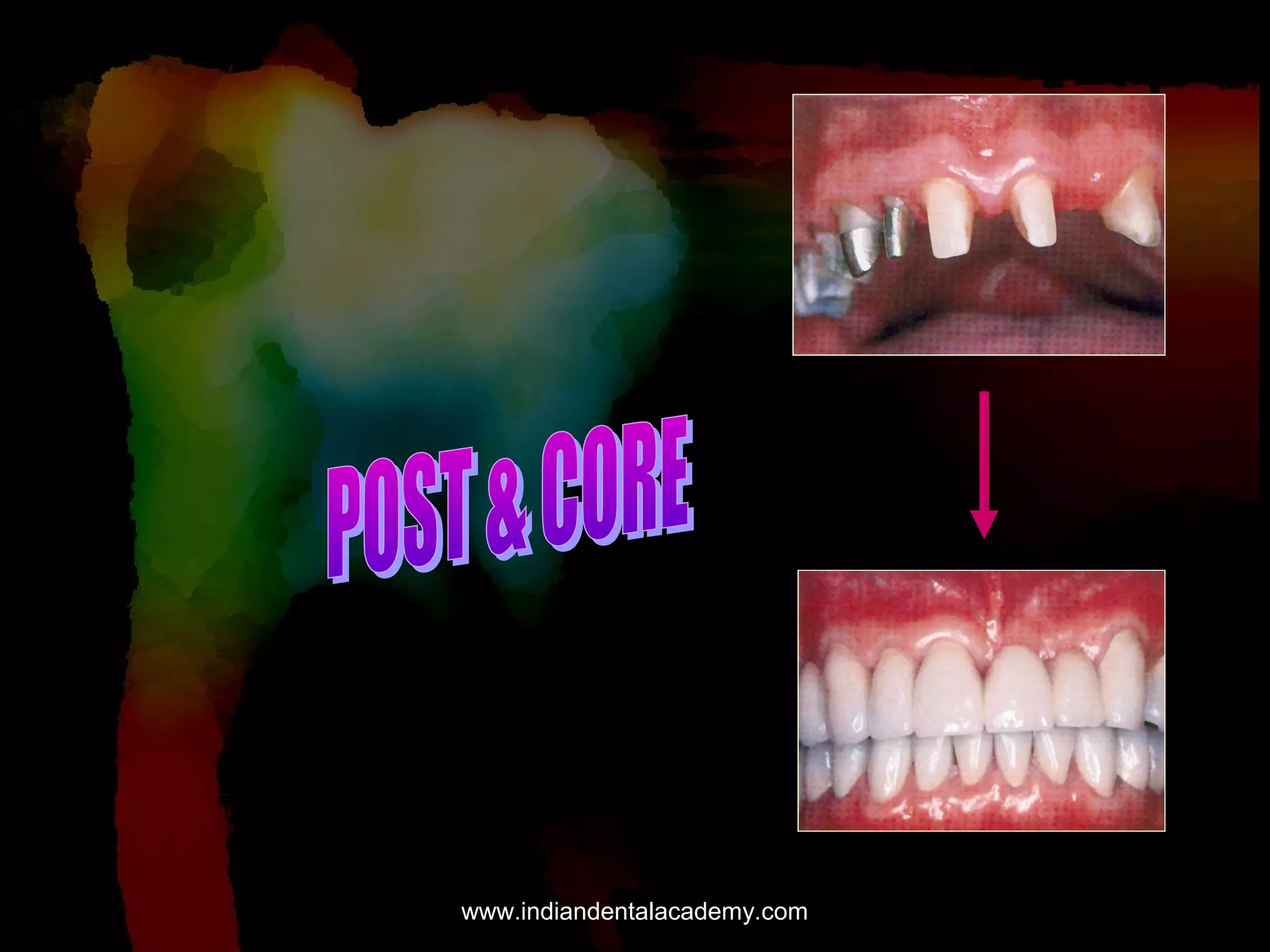
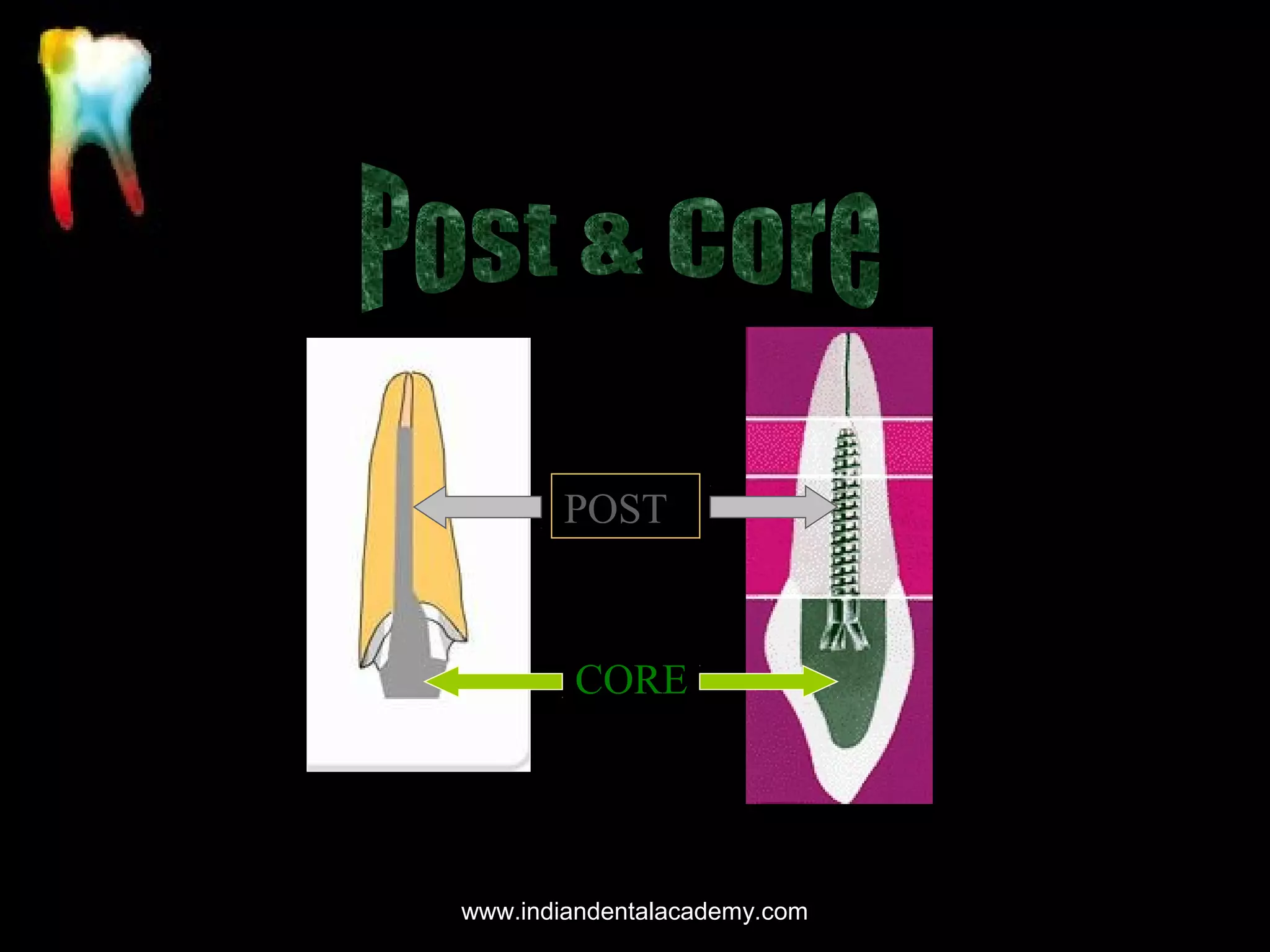
POST

CORE

www.indiandentalacademy.com
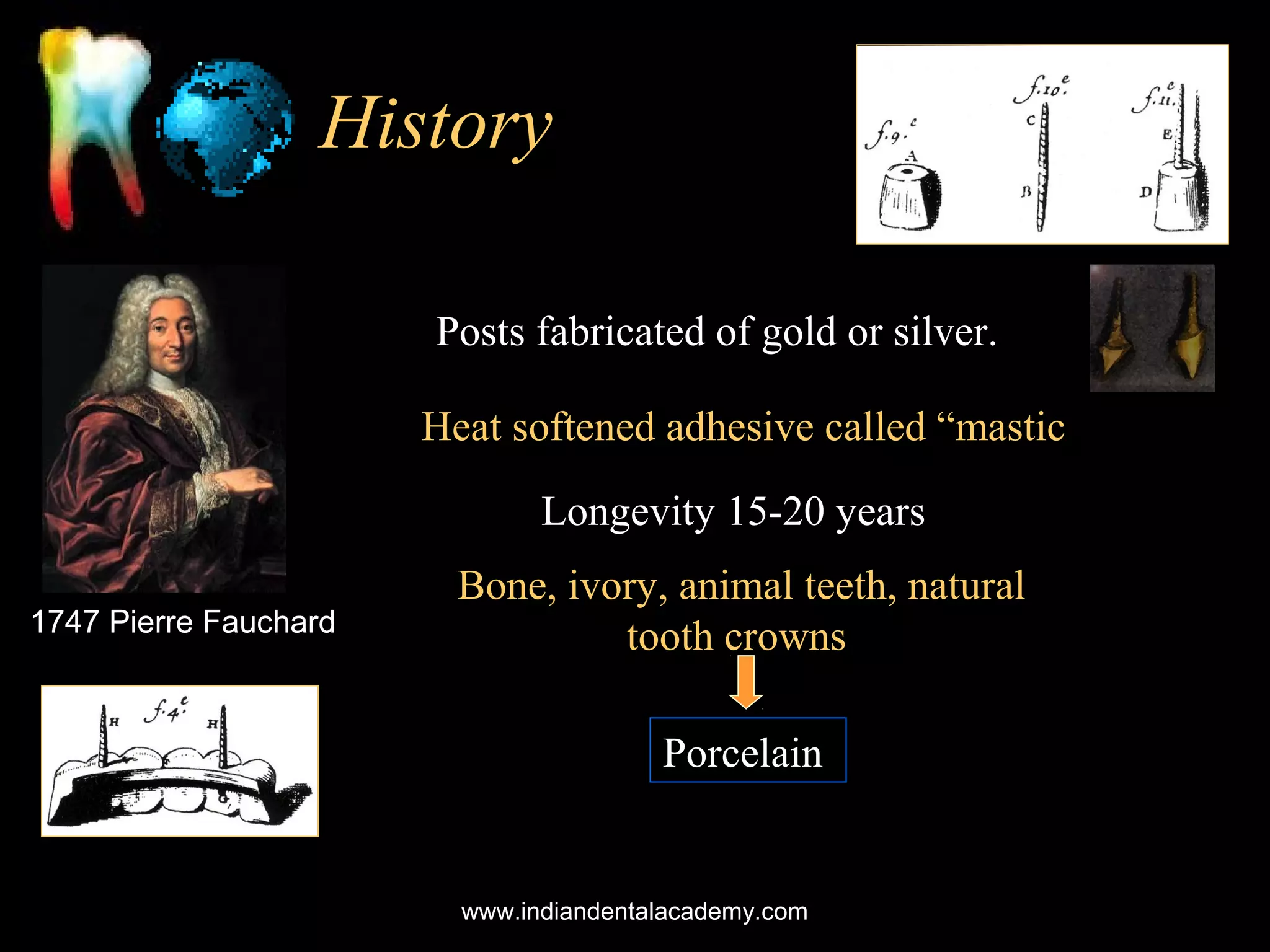
History
Posts fabricated of gold or silver.
Heat softened adhesive called “mastic
Longevity 15-20 years
1747 Pierre Fauchard

Bone, ivory, animal teeth, natural
tooth crowns
Porcelain

www.indiandentalacademy.com
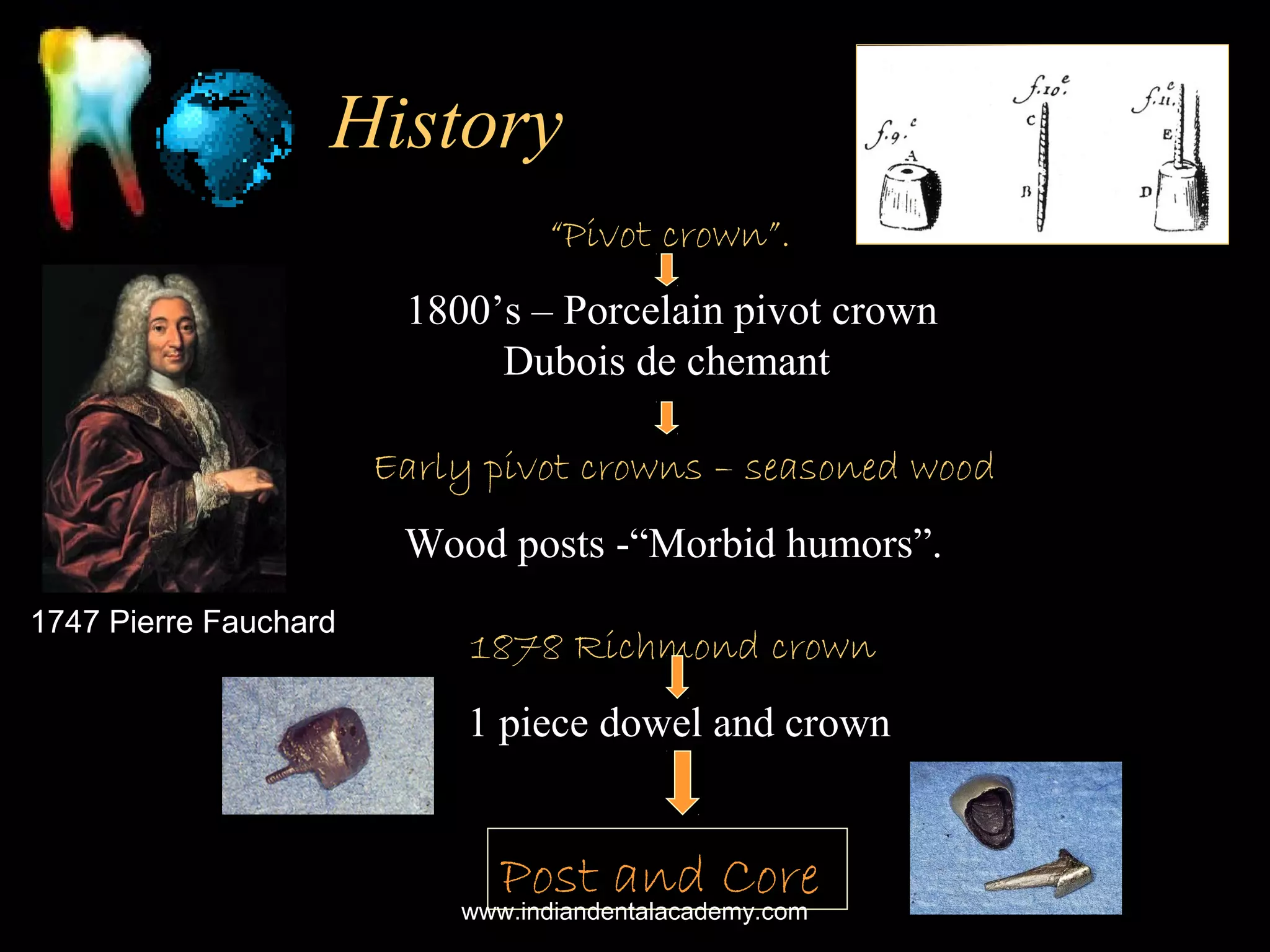
History
“Pivot crown”.
1800’s – Porcelain pivot crown
Dubois de chemant
Early pivot crowns – seasoned wood
Wood posts -“Morbid humors”.
1747 Pierre Fauchard

1878 Richmond crown
1 piece dowel and crown

Post and Core
www.indiandentalacademy.com
Definitions
• Dowel (Post):
The dowel is a metal post or other rigid
restorative material placed in the
radicular portion of a non vital tooth.
A dowel usually made of metal is fitted in to a
prepared canal of a natural tooth. When combined
with an artificial crown or core, it provides retention
and resistance for the restoration.
(Glossary of Prosthodontics)
www.indiandentalacademy.com
• Core:
Refers to properly shaped and well
substructure,
which
replaces
missing coronal structure and
retains the final restoration.
A centre or a base of a structure. The core is
designed to resemble or become the crown
preparation or crown itself.
(Glossary of Prosthodontics)
www.indiandentalacademy.com
• Ferrule (Rosenstile):
Is defined as a metal band that
encircles the external dimension of
the residual tooth.
• Ferrule (Weine) :
A ferrule is a metal ring or cap placed
around the end of a cane or tool, giving it
added strength. The ferrule around the
circumference of the tooth strengthens it by
www.indiandentalacademy.com
increasing resistance to wedging forces.
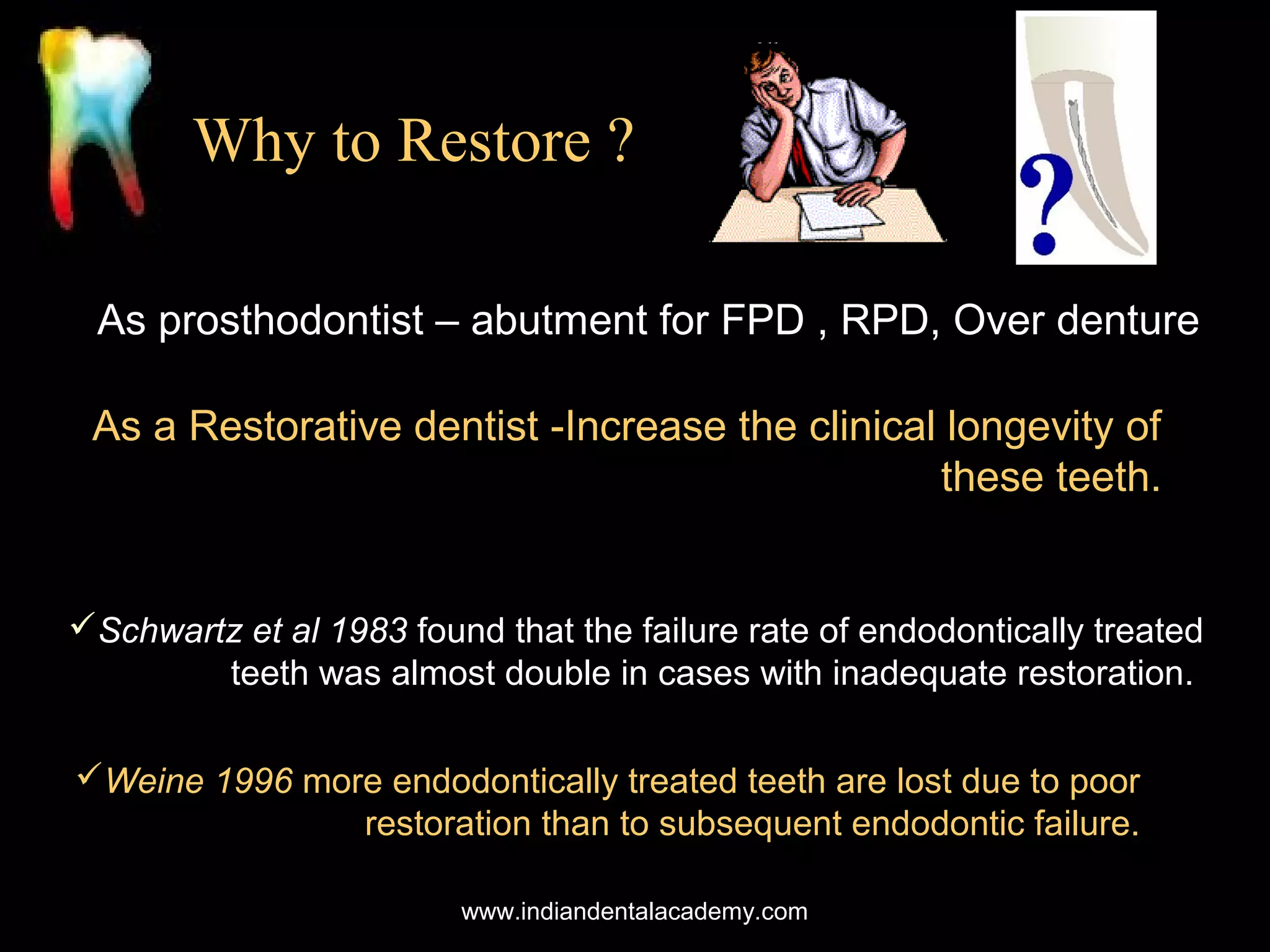
Why to Restore ?
As prosthodontist – abutment for FPD , RPD, Over denture
As a Restorative dentist -Increase the clinical longevity of
these teeth.

Schwartz et al 1983 found that the failure rate of endodontically treated
teeth was almost double in cases with inadequate restoration.
Weine 1996 more endodontically treated teeth are lost due to poor
restoration than to subsequent endodontic failure.
www.indiandentalacademy.com
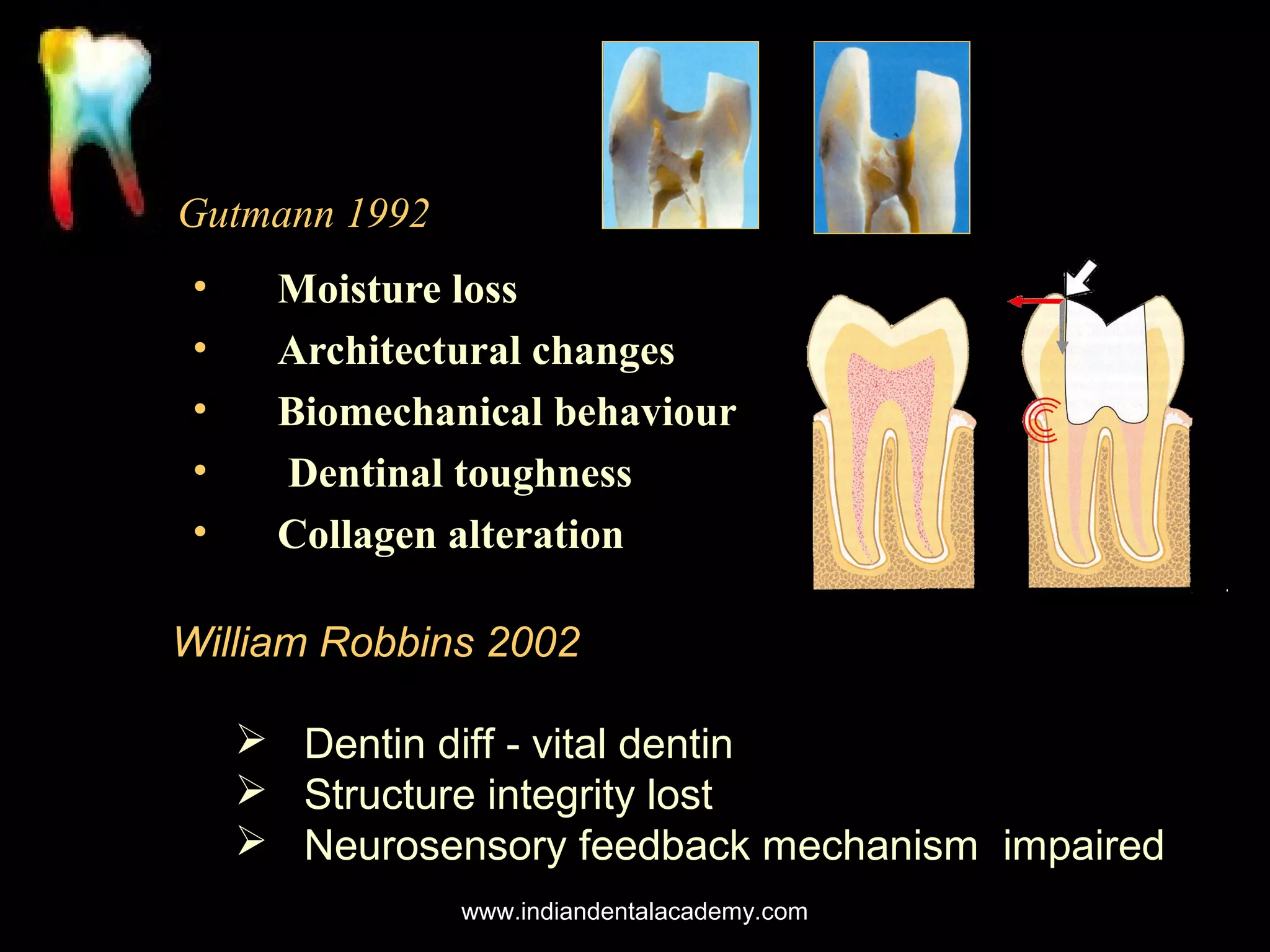
Gutmann 1992
•
•
•
•
•

Moisture loss
Architectural changes
Biomechanical behaviour
Dentinal toughness
Collagen alteration

William Robbins 2002
 Dentin diff - vital dentin
 Structure integrity lost
 Neurosensory feedback mechanism impaired
www.indiandentalacademy.com
Pre –Operative assessment

www.indiandentalacademy.com
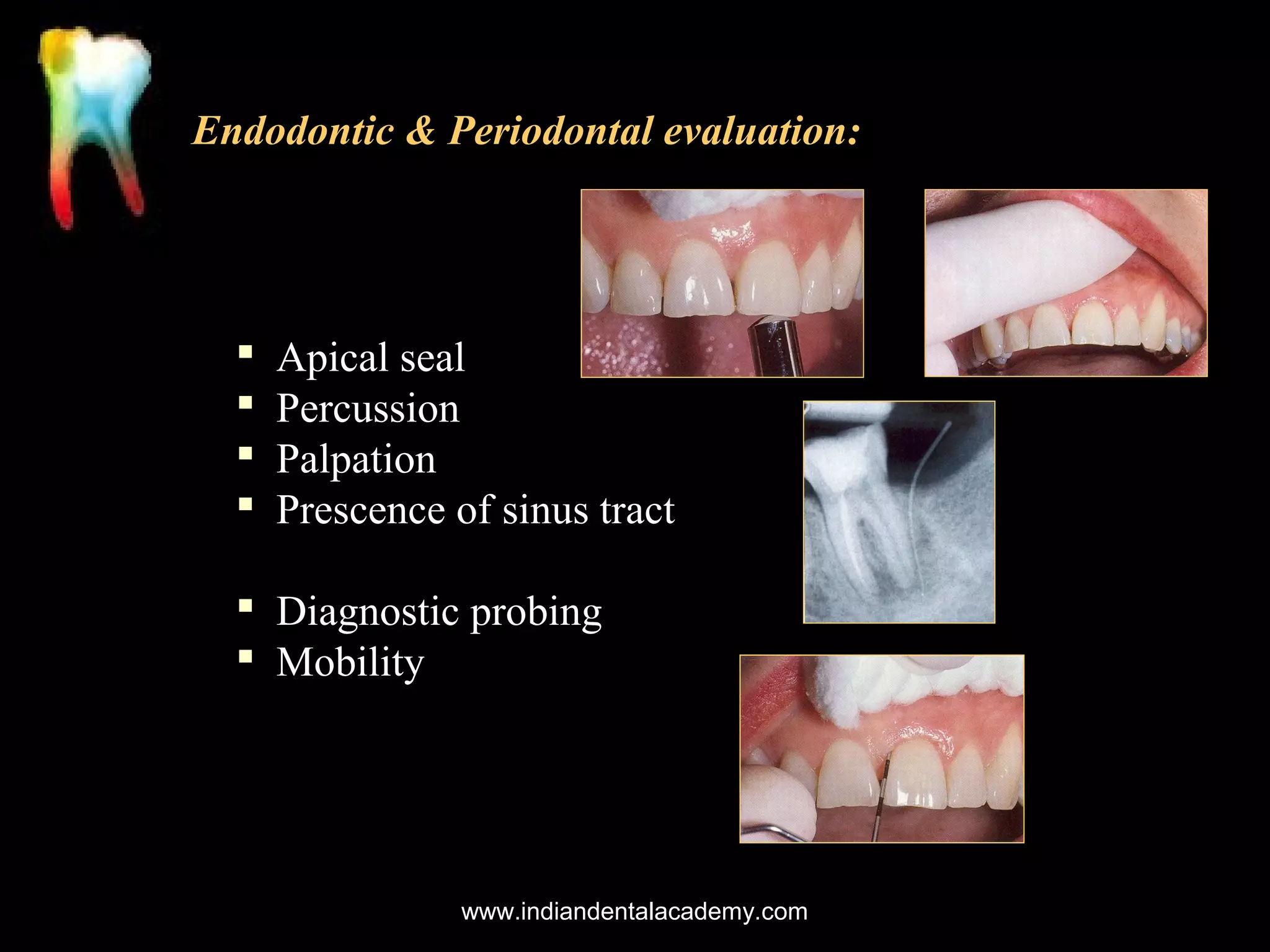
Endodontic & Periodontal evaluation:






Apical seal
Percussion
Palpation
Prescence of sinus tract

 Diagnostic probing
 Mobility

www.indiandentalacademy.com
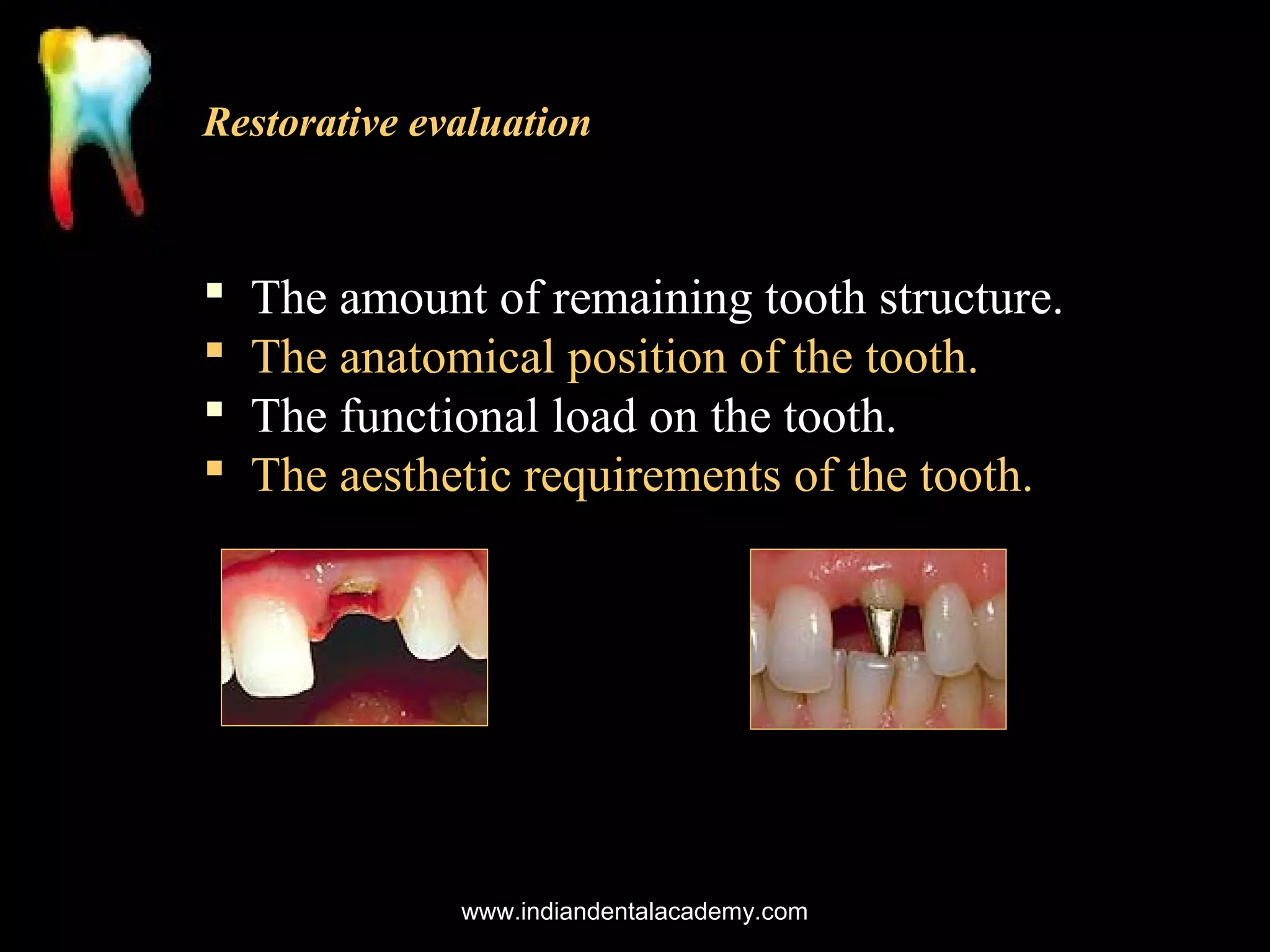
Restorative evaluation






The amount of remaining tooth structure.
The anatomical position of the tooth.
The functional load on the tooth.
The aesthetic requirements of the tooth.

www.indiandentalacademy.com
The amount of remaining tooth structure
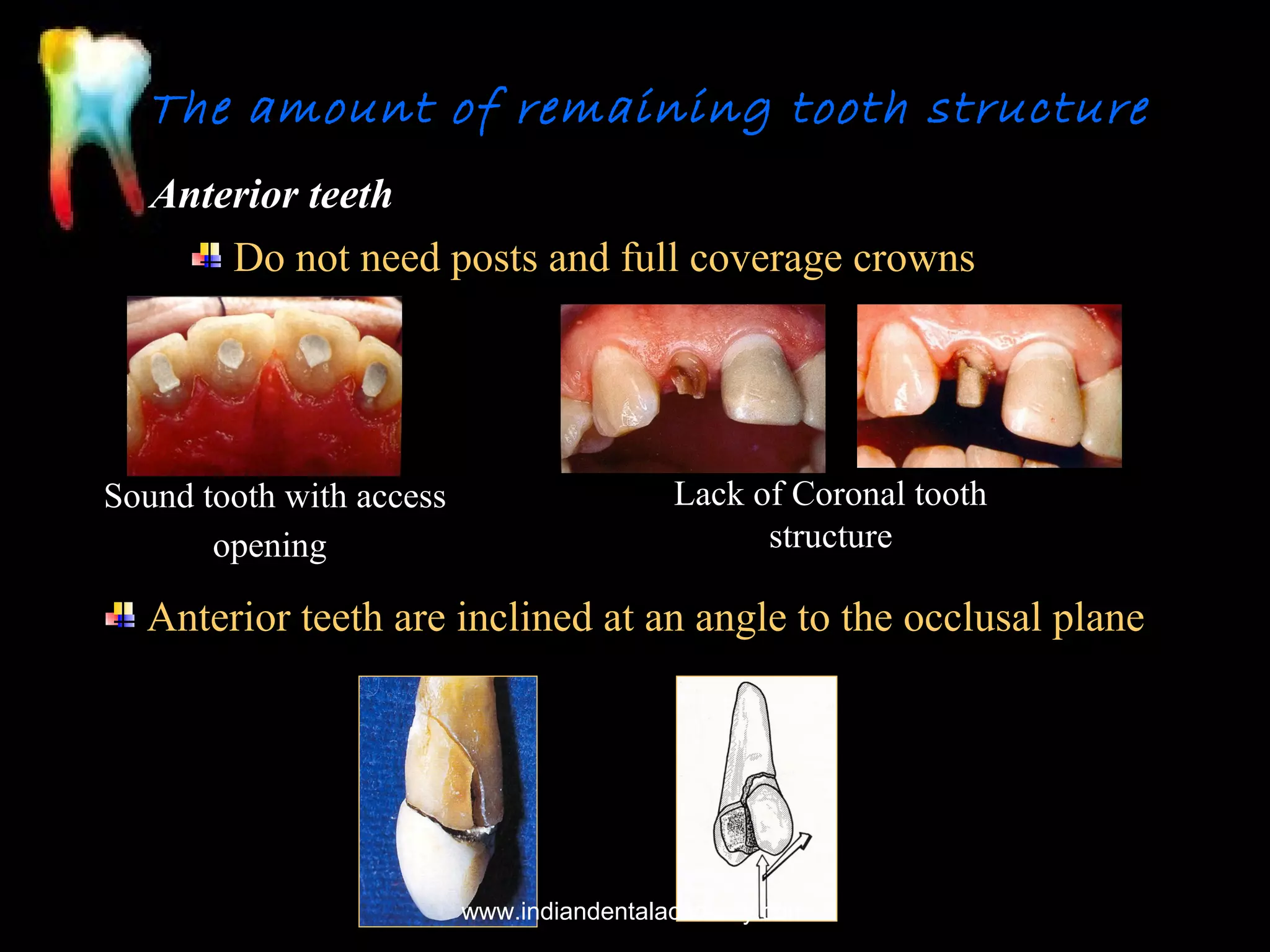
Anterior teeth
Do not need posts and full coverage crowns

Sound tooth with access
opening

Lack of Coronal tooth
structure

Anterior teeth are inclined at an angle to the occlusal plane

www.indiandentalacademy.com
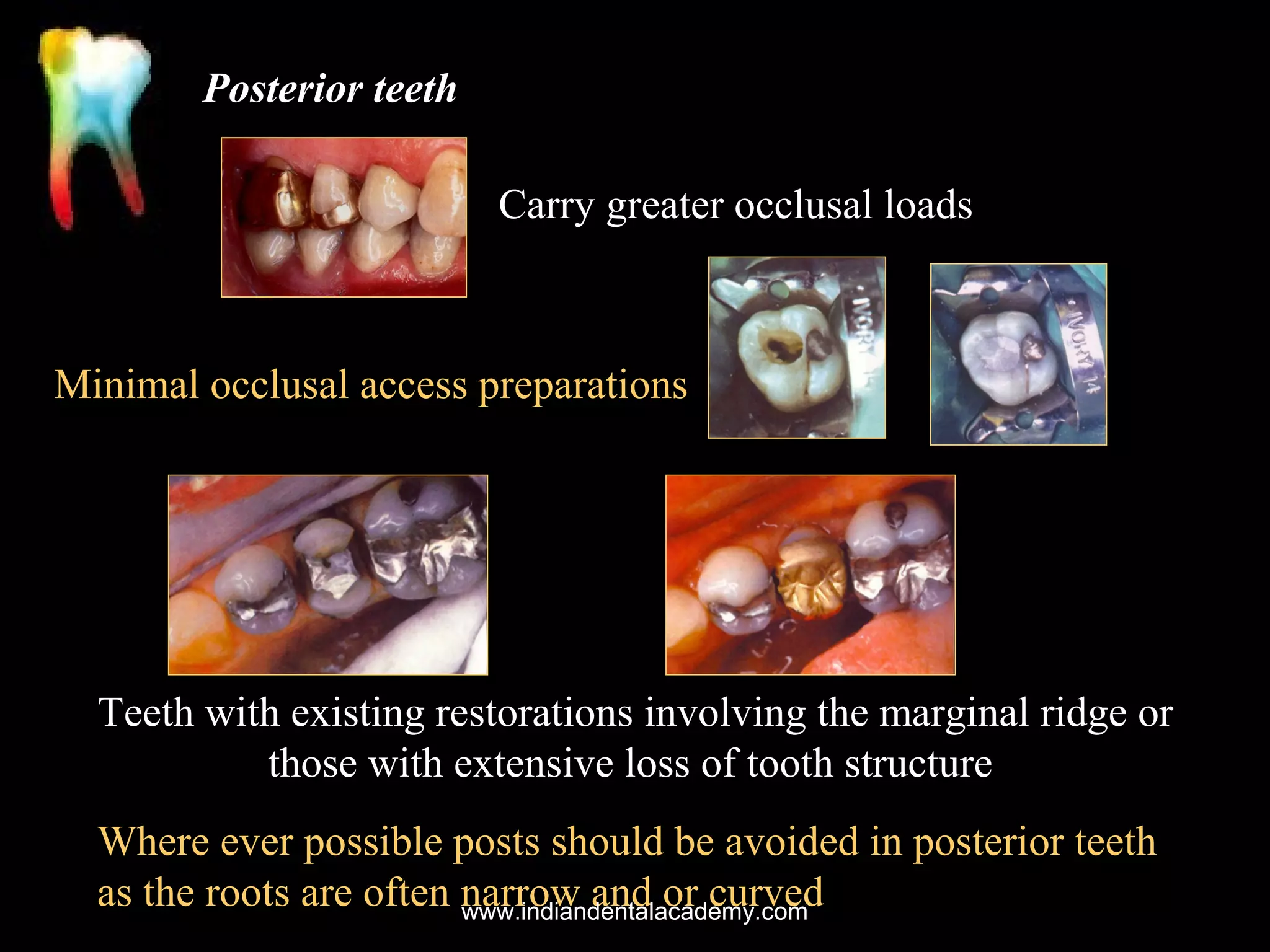
Posterior teeth
Carry greater occlusal loads

Minimal occlusal access preparations

Teeth with existing restorations involving the marginal ridge or
those with extensive loss of tooth structure
Where ever possible posts should be avoided in posterior teeth
as the roots are often narrow and or curved
www.indiandentalacademy.com
Post & Core Systems

www.indiandentalacademy.com
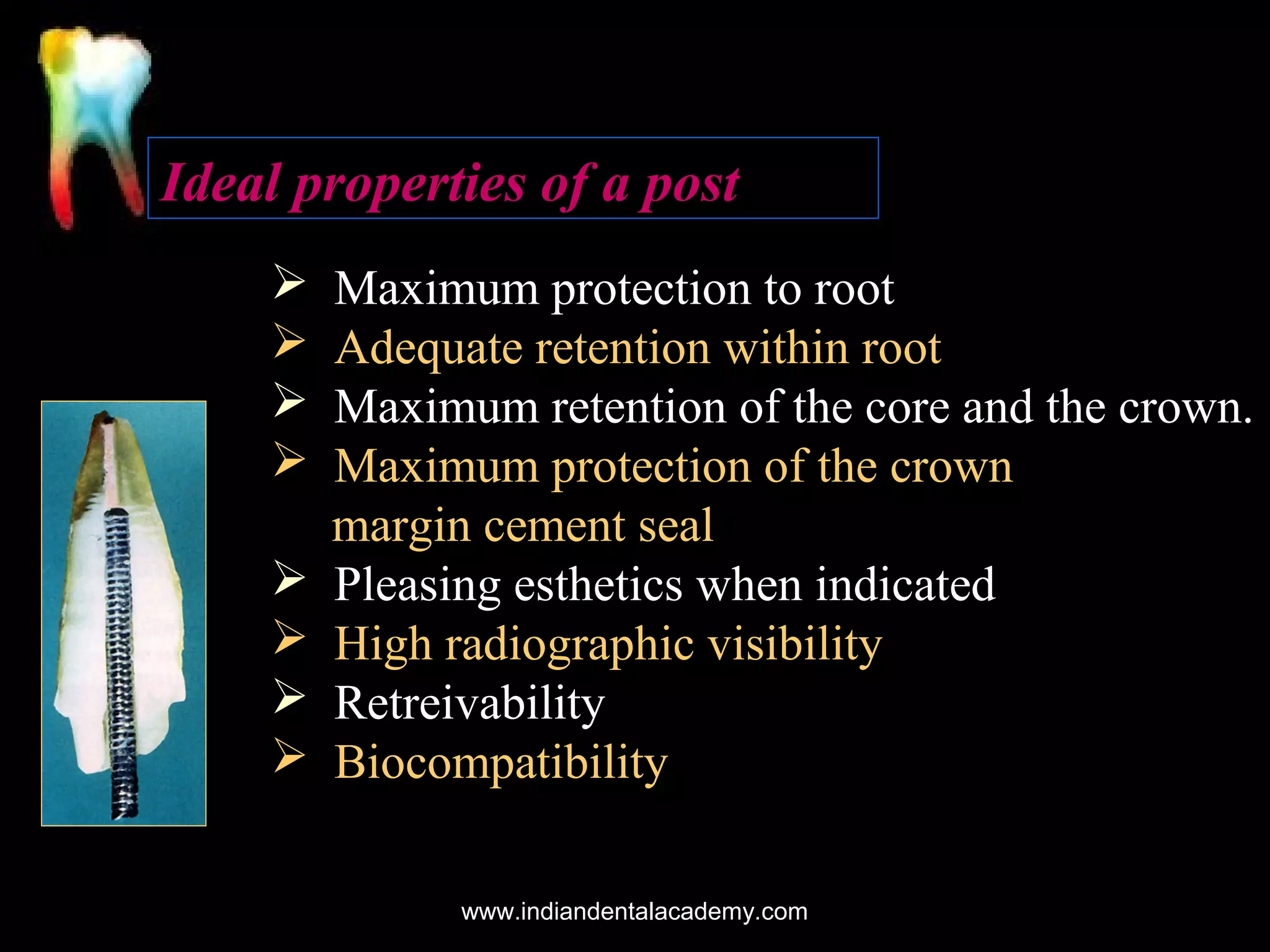
Ideal properties of a post









Maximum protection to root
Adequate retention within root
Maximum retention of the core and the crown.
Maximum protection of the crown
margin cement seal
Pleasing esthetics when indicated
High radiographic visibility
Retreivability
Biocompatibility
www.indiandentalacademy.com
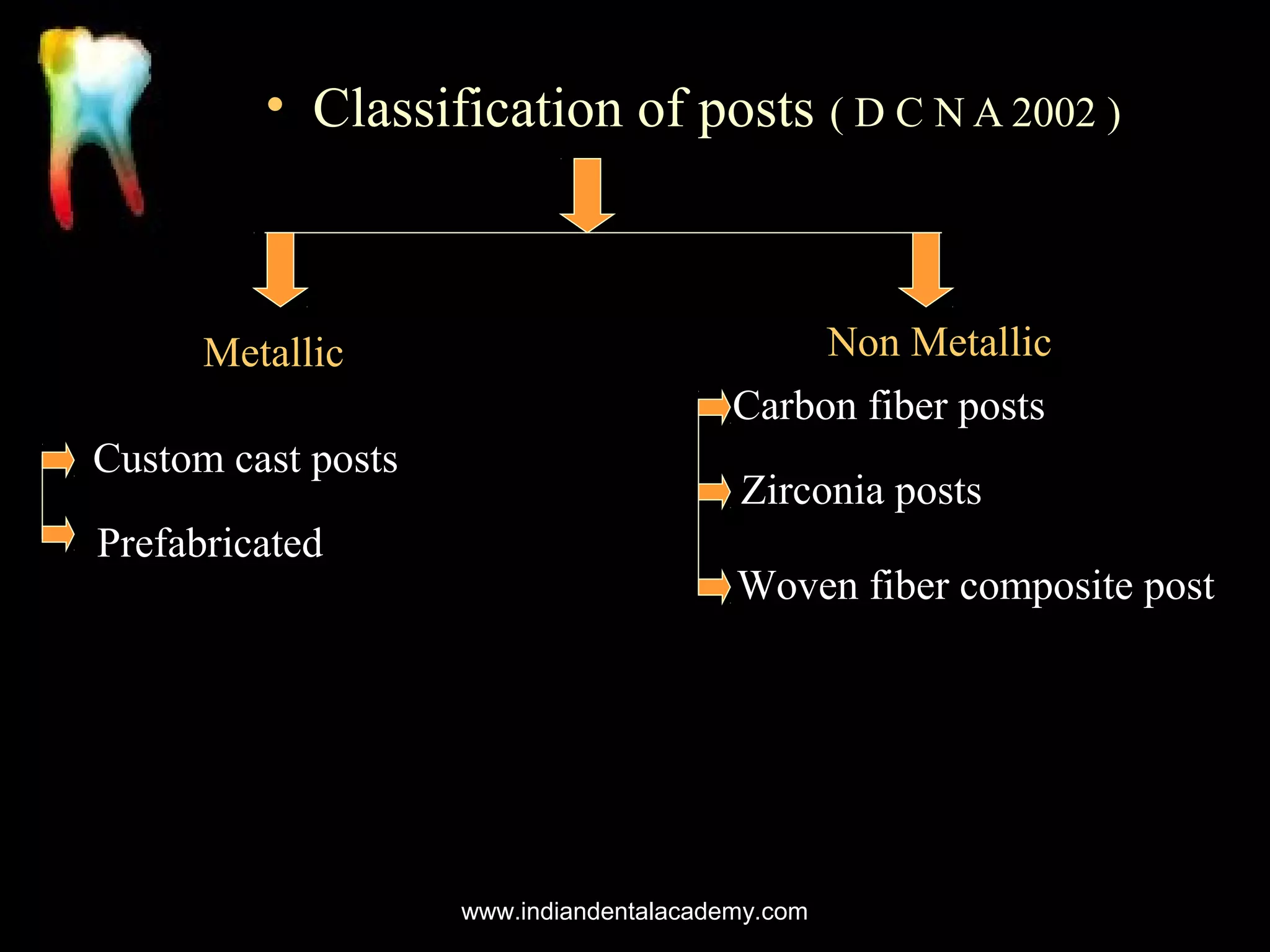
• Classification of posts ( D C N A 2002 )

Metallic
Custom cast posts
Prefabricated

Non Metallic
Carbon fiber posts
Zirconia posts
Woven fiber composite post

www.indiandentalacademy.com
• Metallic Posts
- PGP [platinum-gold- palladium]
- Nickel –chromium
- Cobalt - chromium
- Stainless steel
- Non oxidizing noble alloys
- Au-pt
- Titanium
Custom cast posts :
Indication
 Multiple cores- in the same arch
 Small teeth
 Angle of cores – to be changed
www.indiandentalacademy.com
 All – ceramic crown

combinations
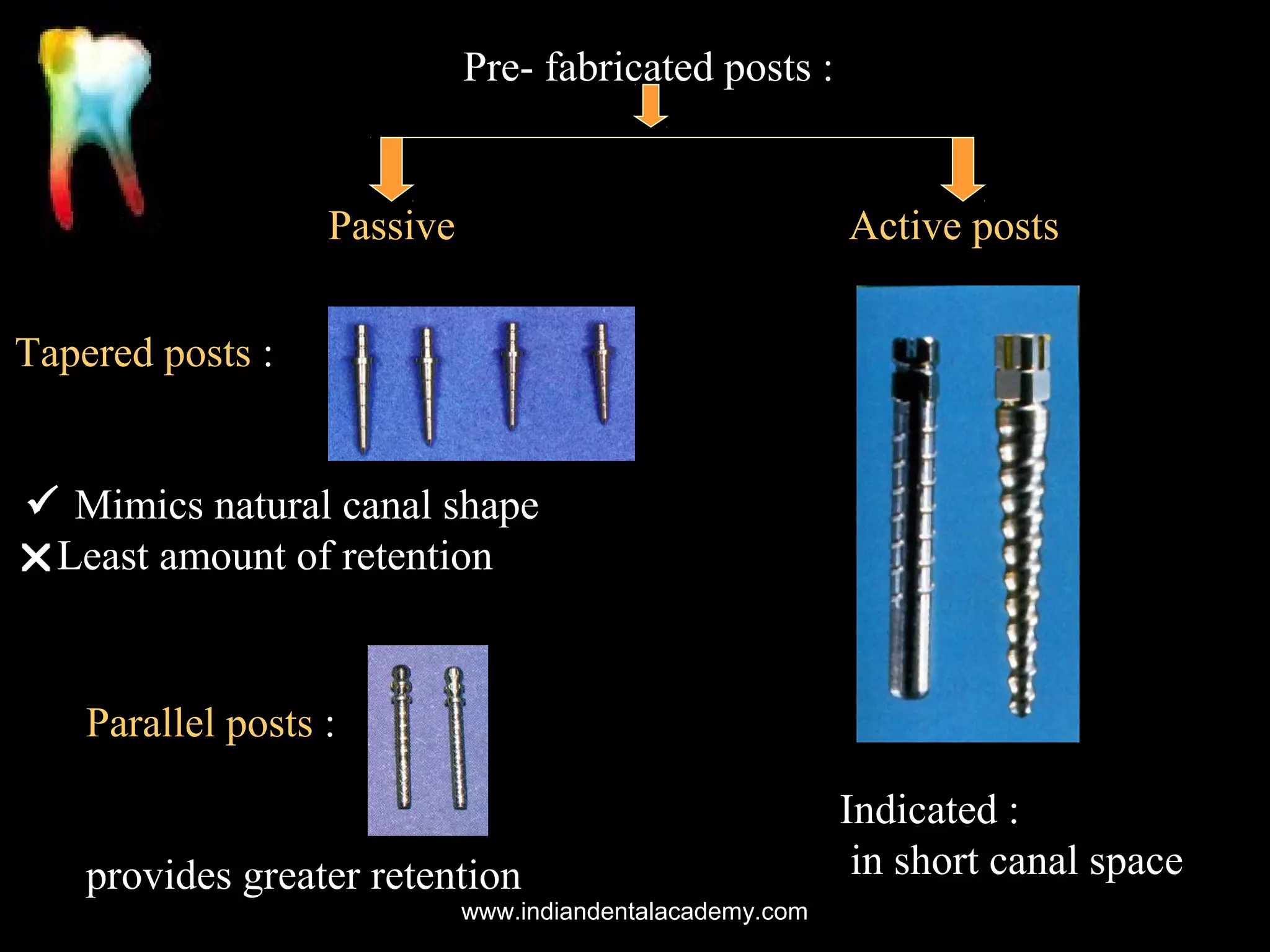
Pre- fabricated posts :

Passive

Active posts

Tapered posts :
 Mimics natural canal shape
Least amount of retention

Parallel posts :
provides greater retention

www.indiandentalacademy.com

Indicated :
in short canal space
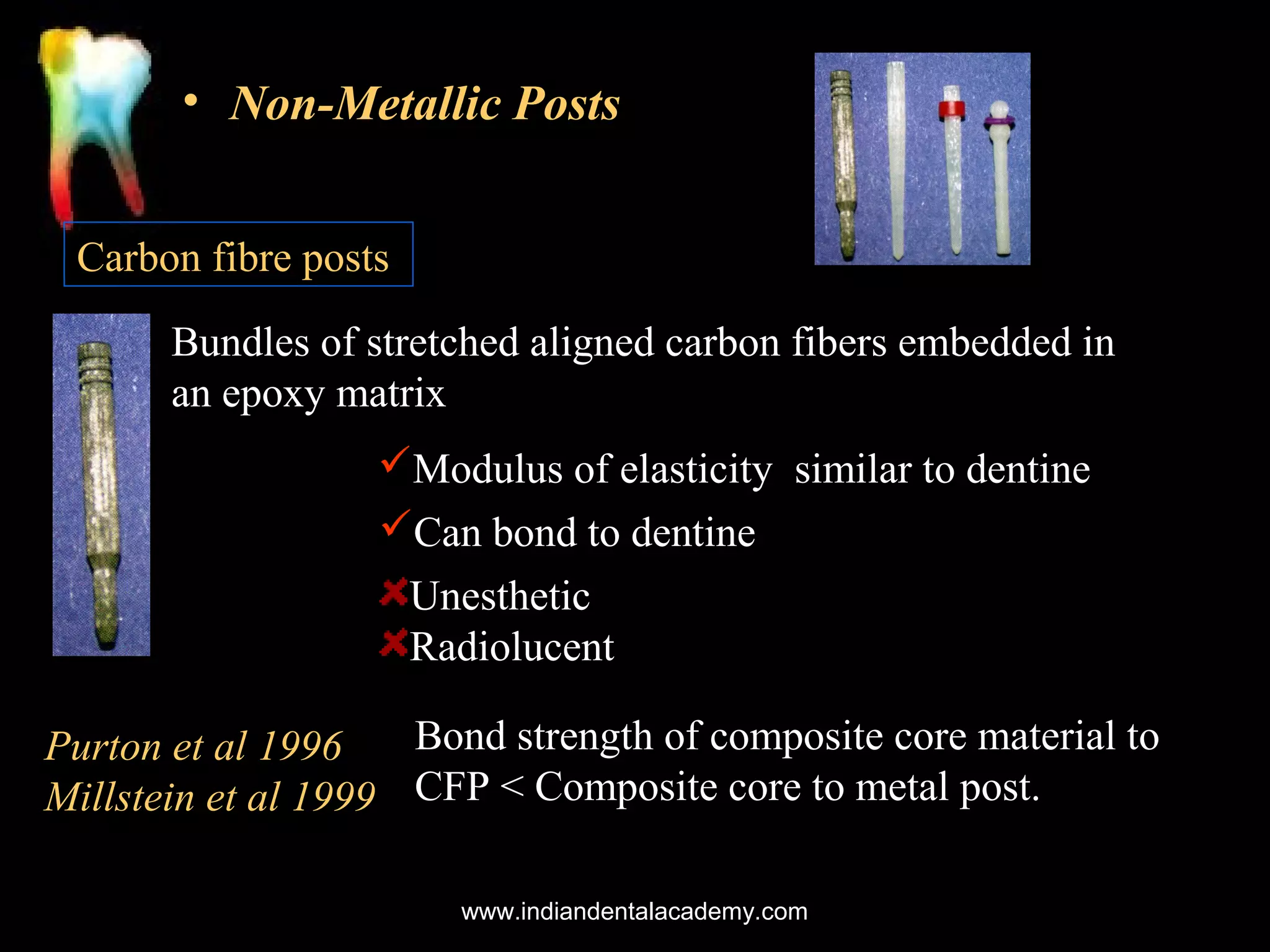
• Non-Metallic Posts
Carbon fibre posts
Bundles of stretched aligned carbon fibers embedded in
an epoxy matrix
Modulus of elasticity similar to dentine
Can bond to dentine
Unesthetic
Radiolucent
Bond strength of composite core material to
Purton et al 1996
Millstein et al 1999 CFP < Composite core to metal post.
www.indiandentalacademy.com
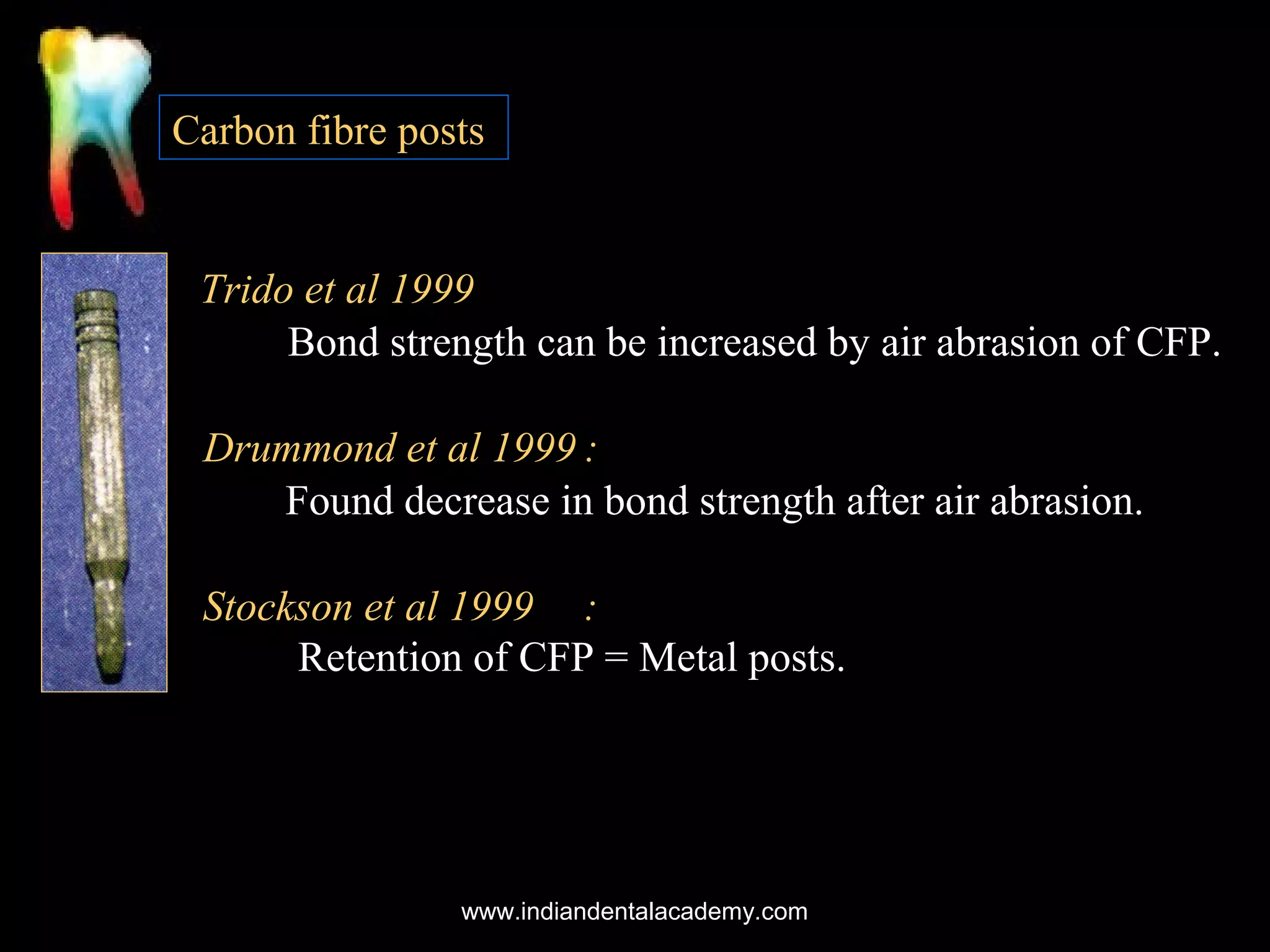
Carbon fibre posts

Trido et al 1999
Bond strength can be increased by air abrasion of CFP.
Drummond et al 1999 :
Found decrease in bond strength after air abrasion.
Stockson et al 1999 :
Retention of CFP = Metal posts.

www.indiandentalacademy.com
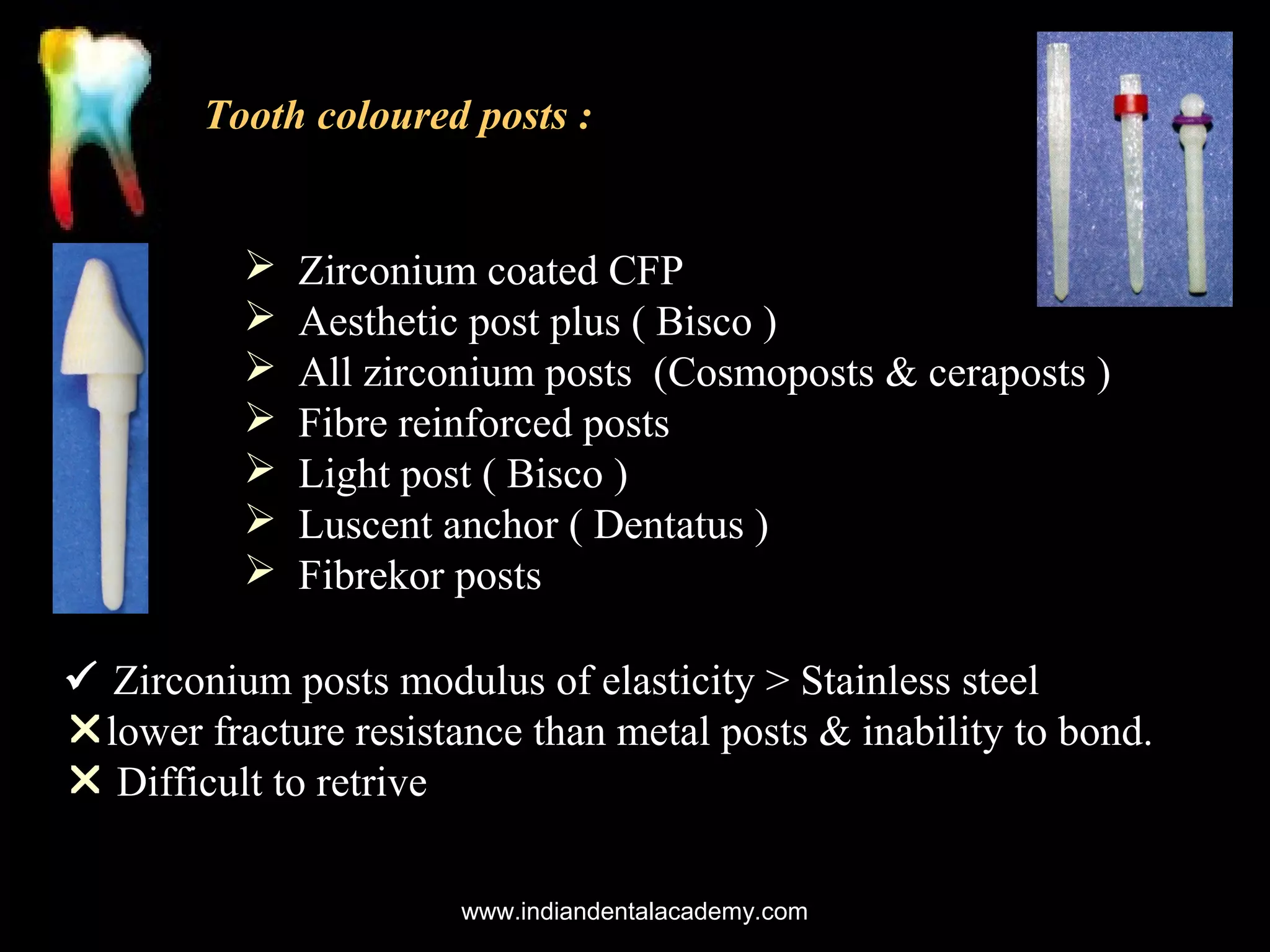
Tooth coloured posts :









Zirconium coated CFP
Aesthetic post plus ( Bisco )
All zirconium posts (Cosmoposts & ceraposts )
Fibre reinforced posts
Light post ( Bisco )
Luscent anchor ( Dentatus )
Fibrekor posts

 Zirconium posts modulus of elasticity > Stainless steel
lower fracture resistance than metal posts & inability to bond.
 Difficult to retrive
www.indiandentalacademy.com
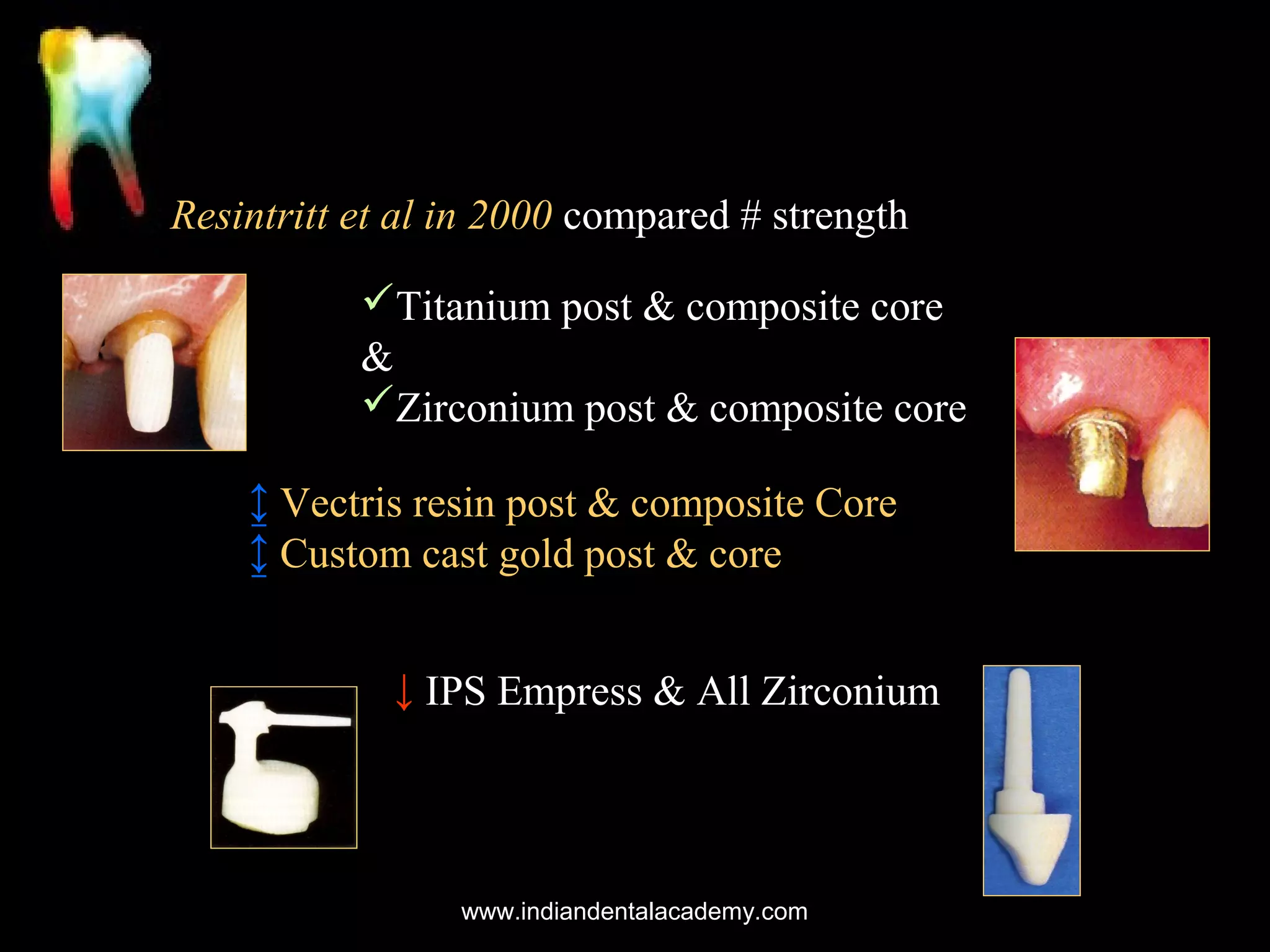
Resintritt et al in 2000 compared # strength
Titanium post & composite core
&
Zirconium post & composite core
↨ Vectris resin post & composite Core
↨ Custom cast gold post & core
↓ IPS Empress & All Zirconium

www.indiandentalacademy.com
CORE
Steven M. Morgano & Susan E. Brackett 1999
Desirable features of a core material :
Adequate compressive strength
Sufficient flexural strength
Biocompatibility
Resistance to leakage of oral fluids at the core/tooth interface.
Ease of manipulation.
Ability to bond to remaining tooth structure
Thermal co-efficient of expansion and contraction
Dimensional stability
Minimal potential for water absorption &
Inhibition of dental caries.
www.indiandentalacademy.com
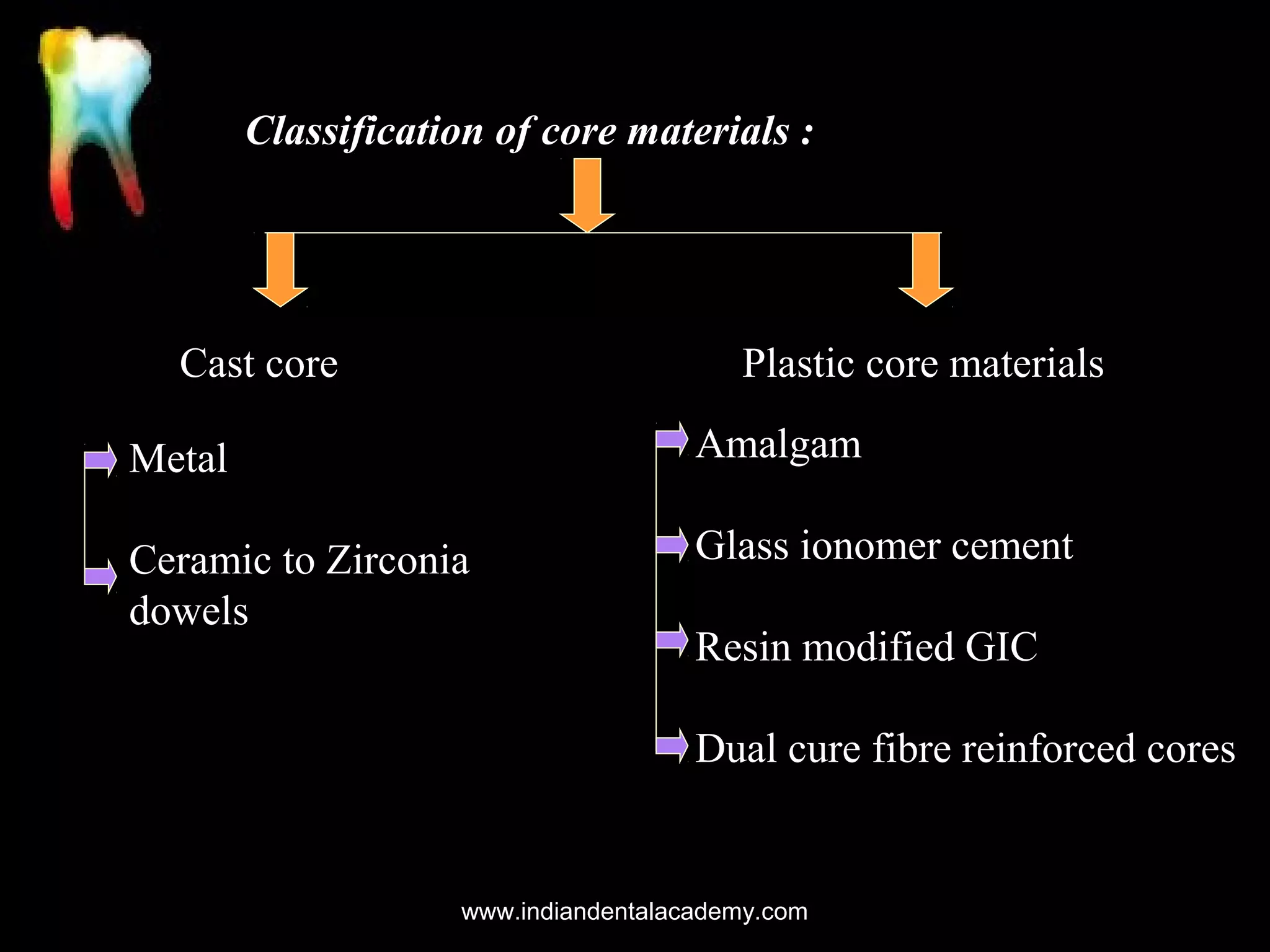
Classification of core materials :

Cast core

Plastic core materials

Metal

Amalgam

Ceramic to Zirconia
dowels

Glass ionomer cement
Resin modified GIC
Dual cure fibre reinforced cores

www.indiandentalacademy.com
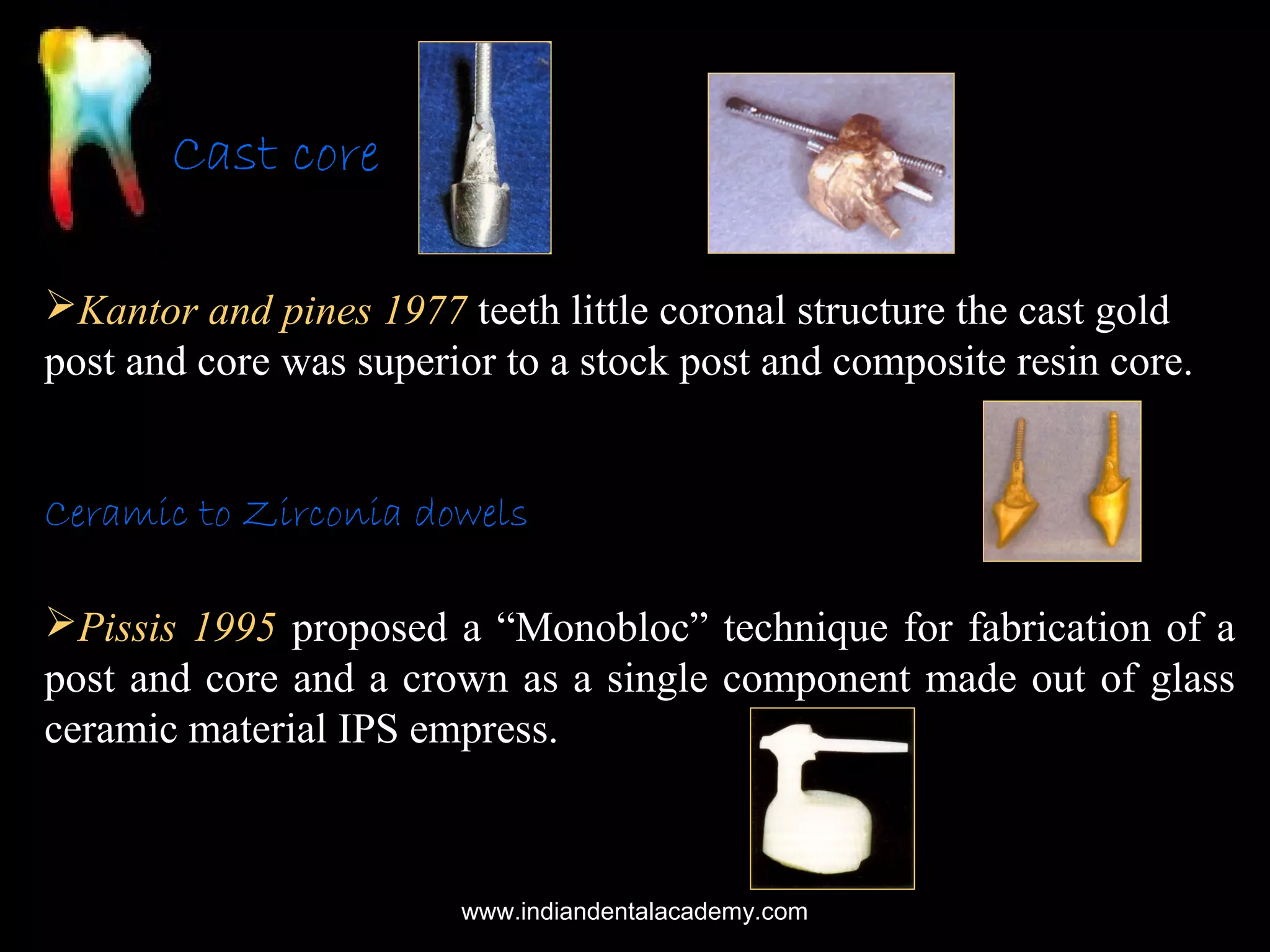
Cast core
Kantor and pines 1977 teeth little coronal structure the cast gold
post and core was superior to a stock post and composite resin core.
Ceramic to Zirconia dowels
Pissis 1995 proposed a “Monobloc” technique for fabrication of a
post and core and a crown as a single component made out of glass
ceramic material IPS empress.

www.indiandentalacademy.com
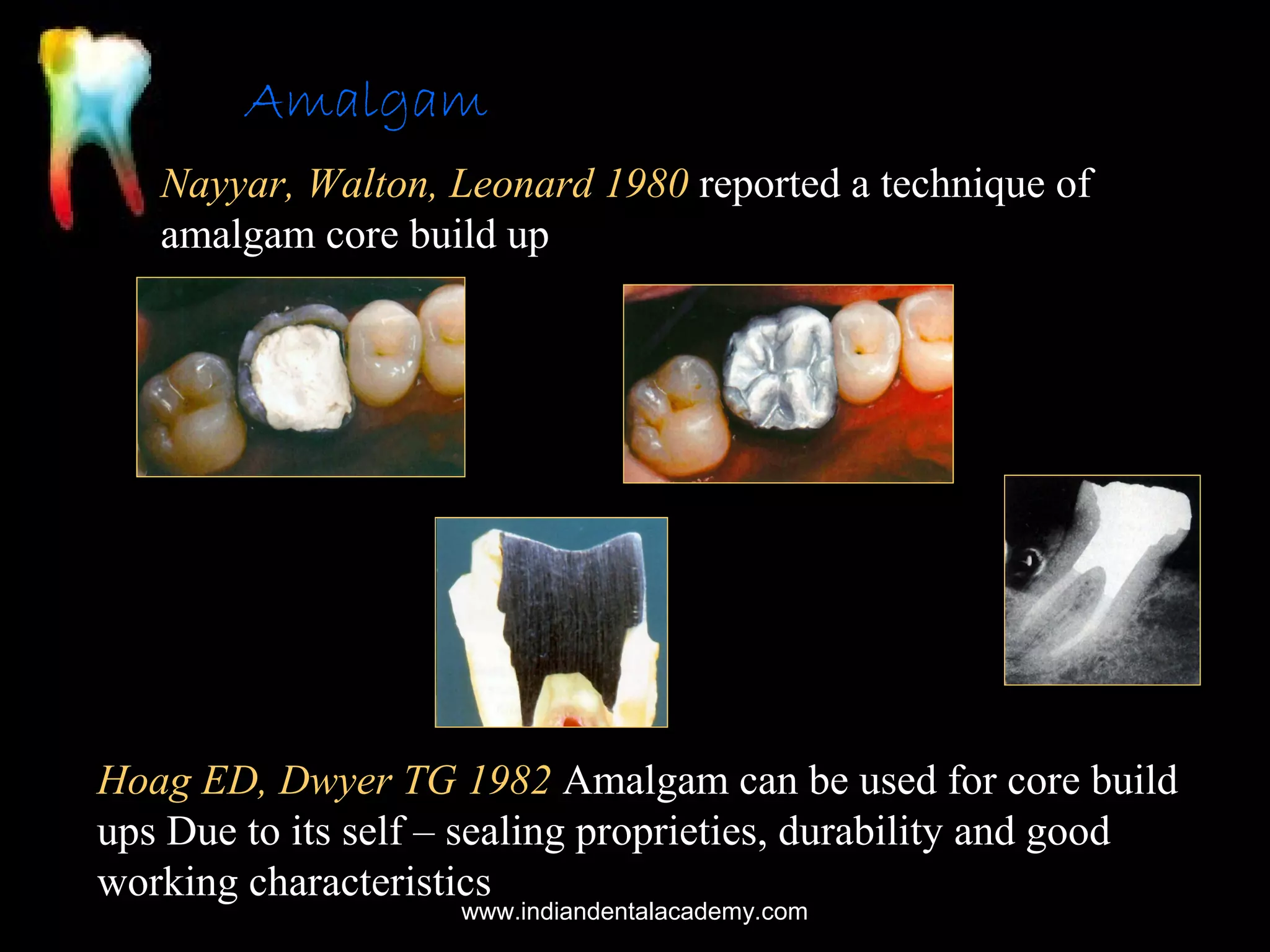
Amalgam
Nayyar, Walton, Leonard 1980 reported a technique of
amalgam core build up

Hoag ED, Dwyer TG 1982 Amalgam can be used for core build
ups Due to its self – sealing proprieties, durability and good
working characteristics
www.indiandentalacademy.com
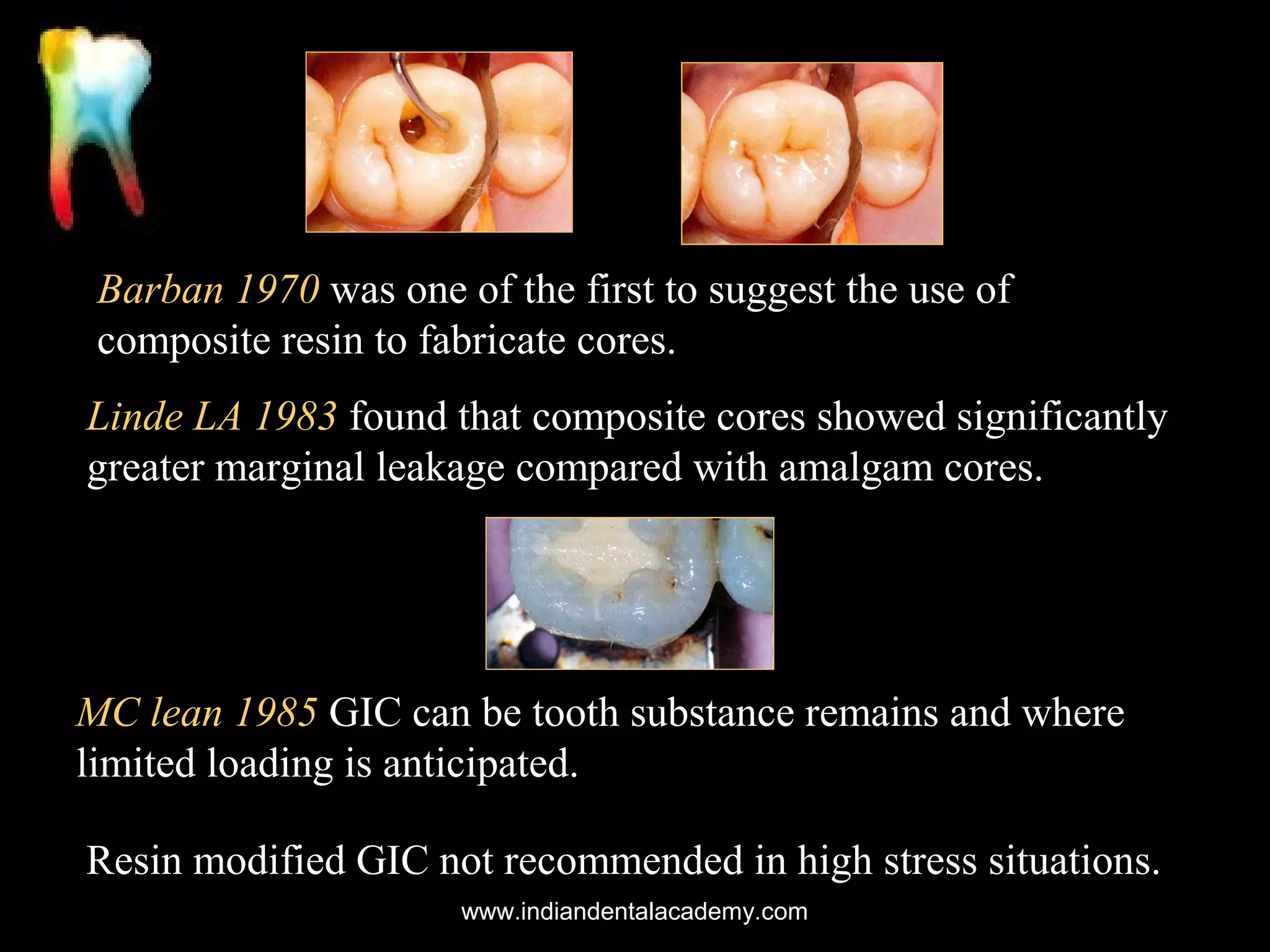
Barban 1970 was one of the first to suggest the use of
composite resin to fabricate cores.
Linde LA 1983 found that composite cores showed significantly
greater marginal leakage compared with amalgam cores.

MC lean 1985 GIC can be tooth substance remains and where
limited loading is anticipated.
Resin modified GIC not recommended in high stress situations.
www.indiandentalacademy.com
Principles of tooth preparation

www.indiandentalacademy.com
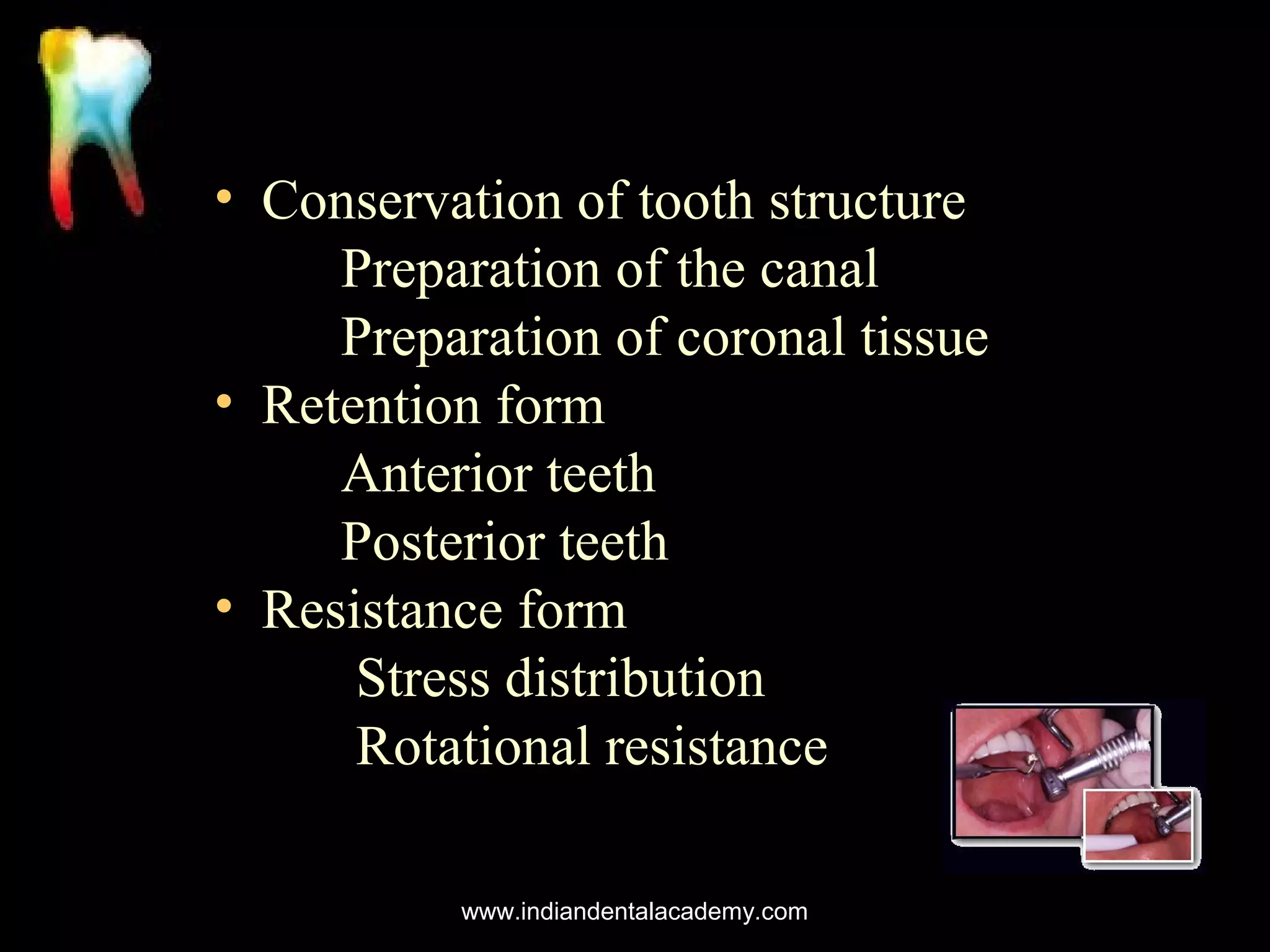
• Conservation of tooth structure
Preparation of the canal
Preparation of coronal tissue
• Retention form
Anterior teeth
Posterior teeth
• Resistance form
Stress distribution
Rotational resistance
www.indiandentalacademy.com
Conservation of tooth
structure
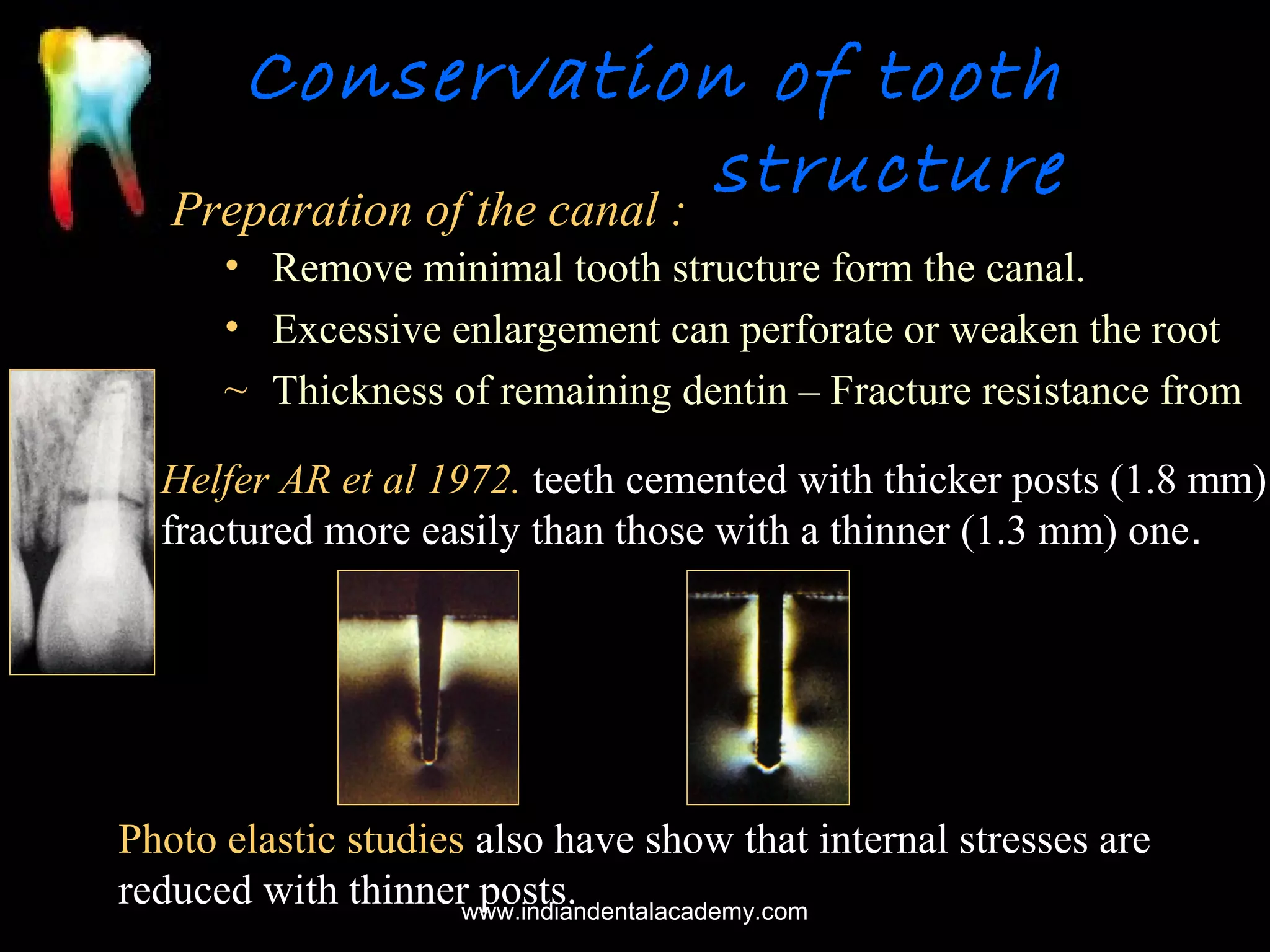
Preparation of the canal :
• Remove minimal tooth structure form the canal.
• Excessive enlargement can perforate or weaken the root
~ Thickness of remaining dentin – Fracture resistance from
Helfer AR et al 1972. teeth cemented with thicker posts (1.8 mm)
fractured more easily than those with a thinner (1.3 mm) one.

Photo elastic studies also have show that internal stresses are
reduced with thinnerwww.indiandentalacademy.com
posts.
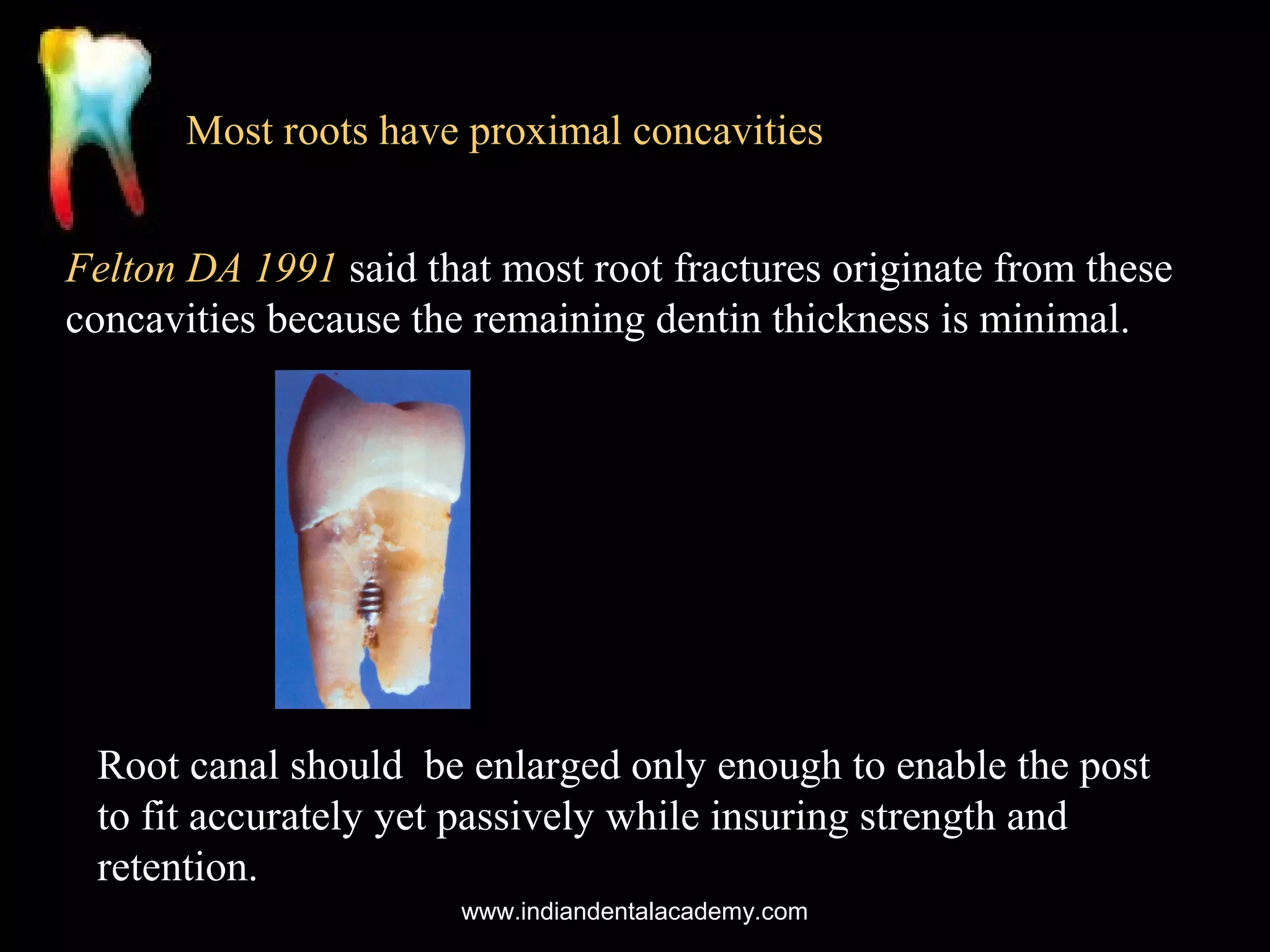
Most roots have proximal concavities
Felton DA 1991 said that most root fractures originate from these
concavities because the remaining dentin thickness is minimal.

Root canal should be enlarged only enough to enable the post
to fit accurately yet passively while insuring strength and
retention.
www.indiandentalacademy.com
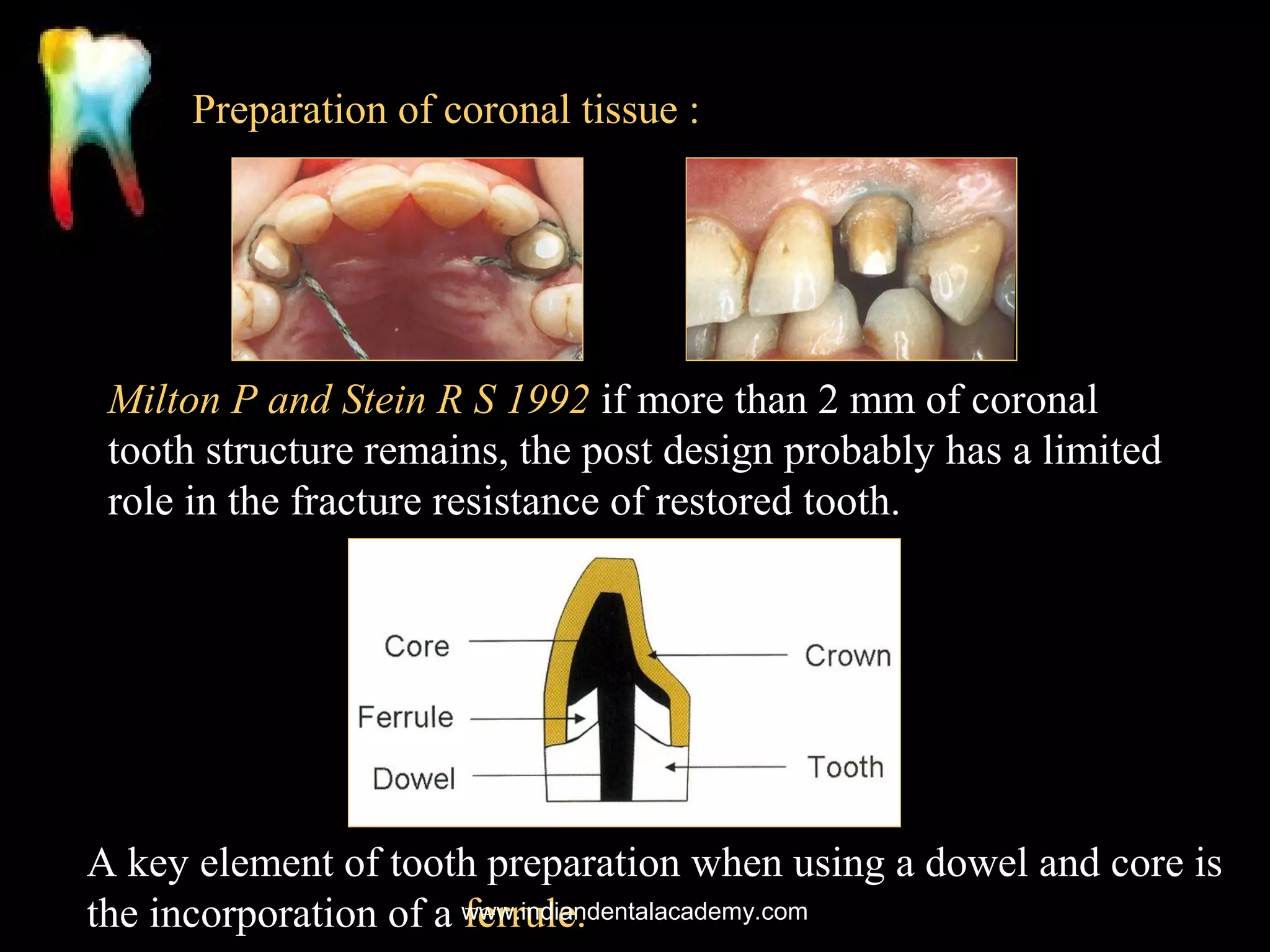
Preparation of coronal tissue :

Milton P and Stein R S 1992 if more than 2 mm of coronal
tooth structure remains, the post design probably has a limited
role in the fracture resistance of restored tooth.

A key element of tooth preparation when using a dowel and core is
the incorporation of a www.indiandentalacademy.com
ferrule.
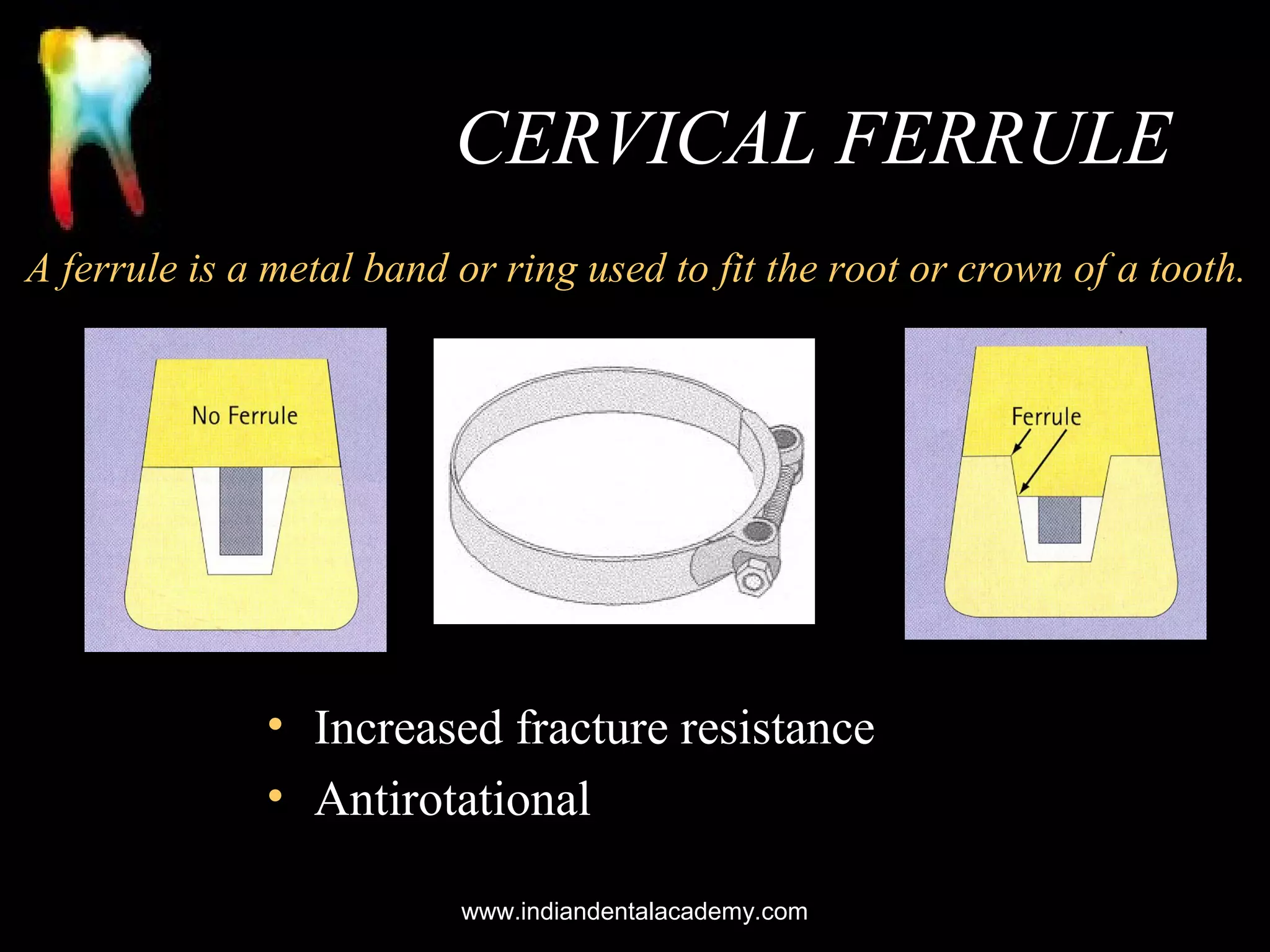
CERVICAL FERRULE
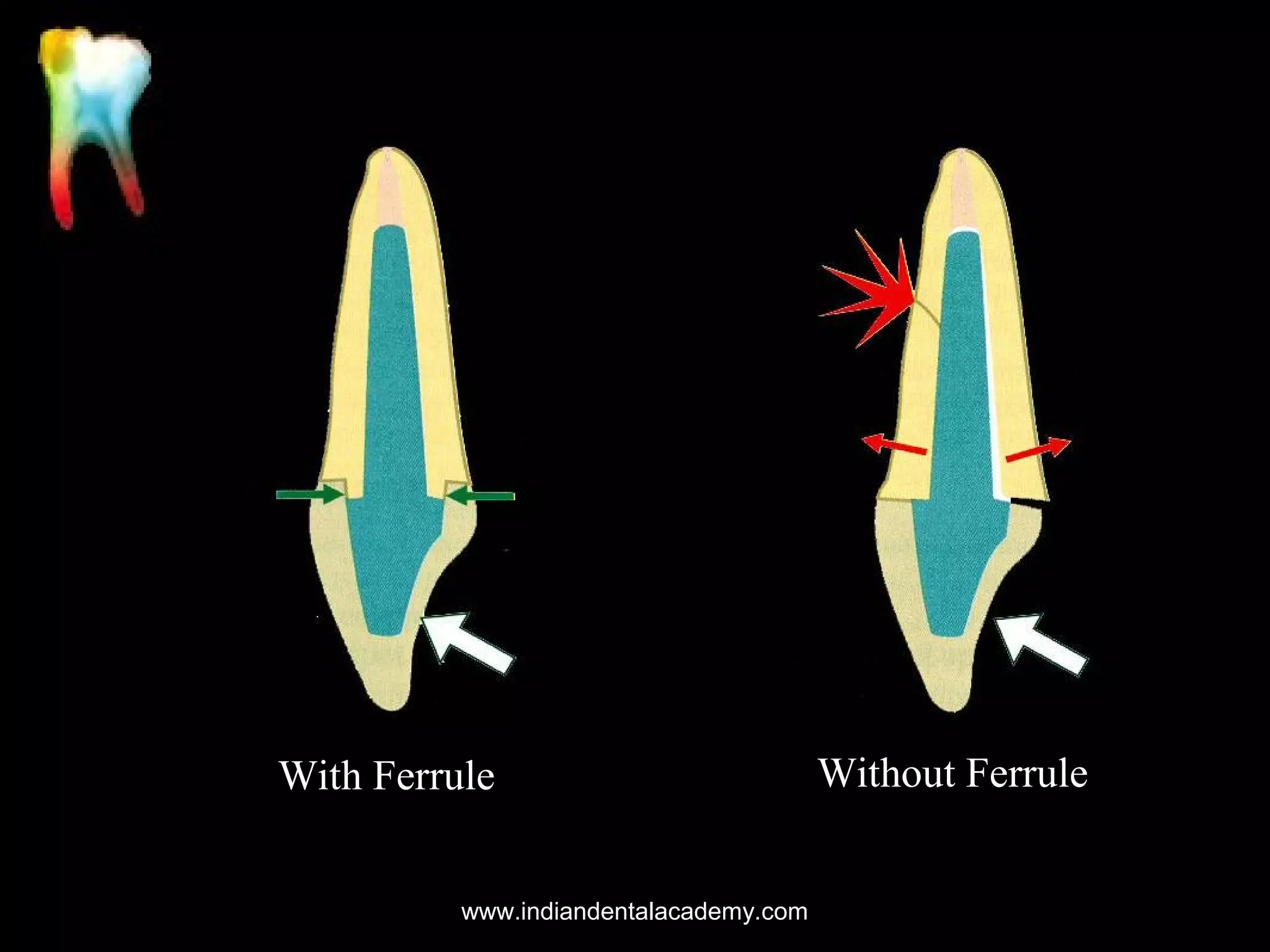
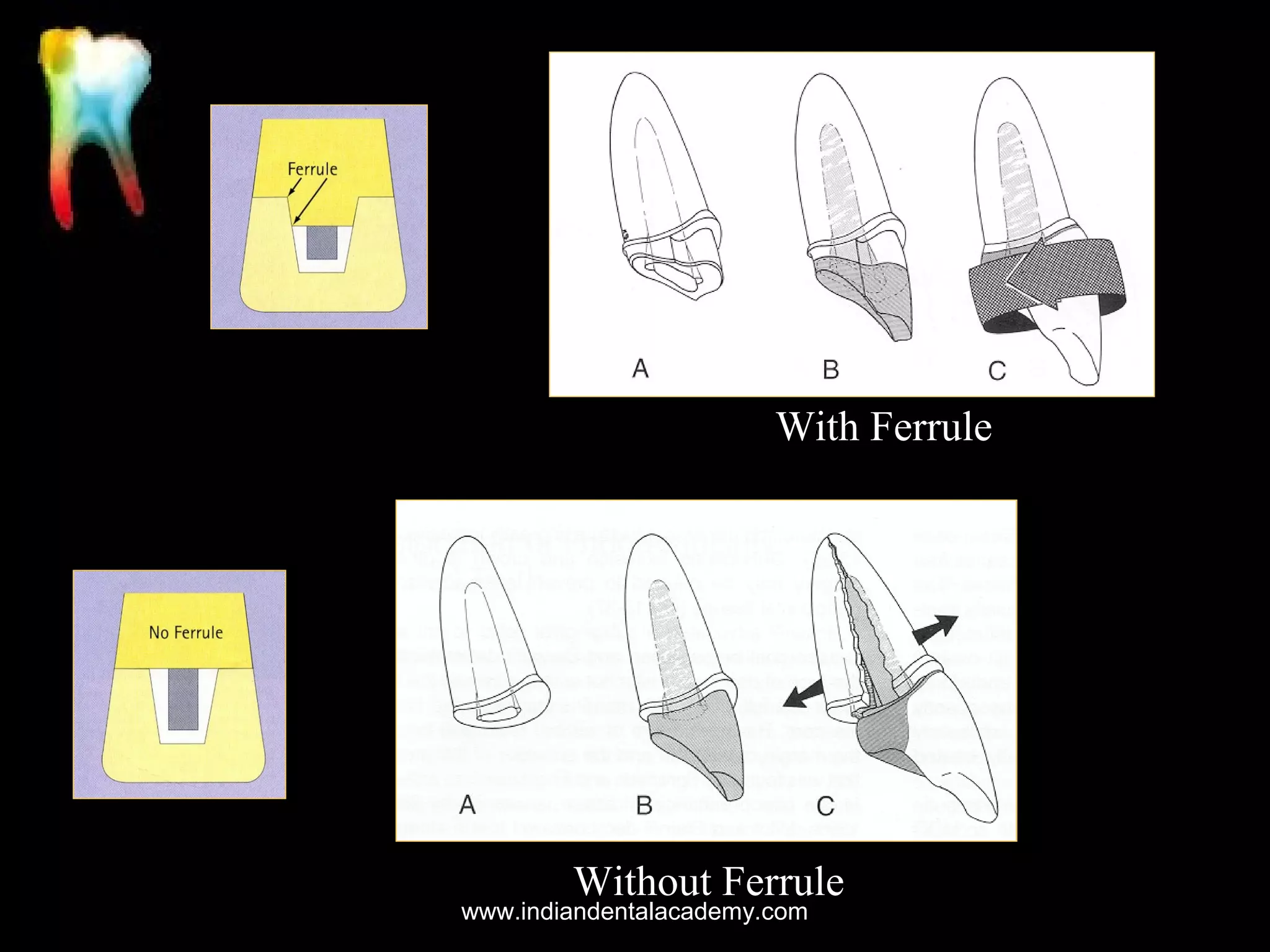
A ferrule is a metal band or ring used to fit the root or crown of a tooth.

• Increased fracture resistance
• Antirotational
www.indiandentalacademy.com
With Ferrule
www.indiandentalacademy.com

Without Ferrule
With Ferrule

Without Ferrule

www.indiandentalacademy.com
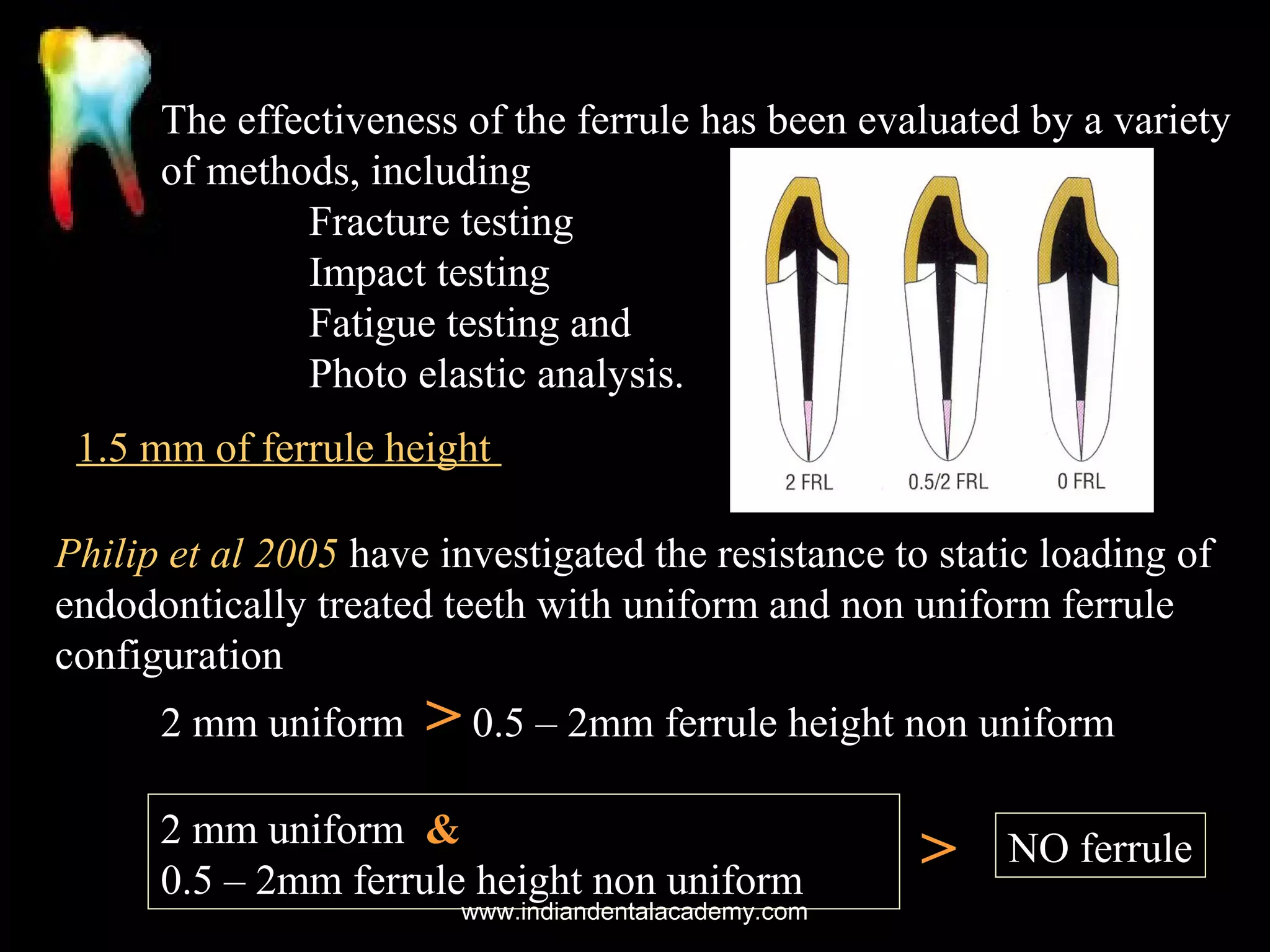
The effectiveness of the ferrule has been evaluated by a variety
of methods, including
Fracture testing
Impact testing
Fatigue testing and
Photo elastic analysis.
1.5 mm of ferrule height
Philip et al 2005 have investigated the resistance to static loading of
endodontically treated teeth with uniform and non uniform ferrule
configuration
2 mm uniform

> 0.5 – 2mm ferrule height non uniform

2 mm uniform &
0.5 – 2mm ferrule height non uniform

www.indiandentalacademy.com

>

NO ferrule
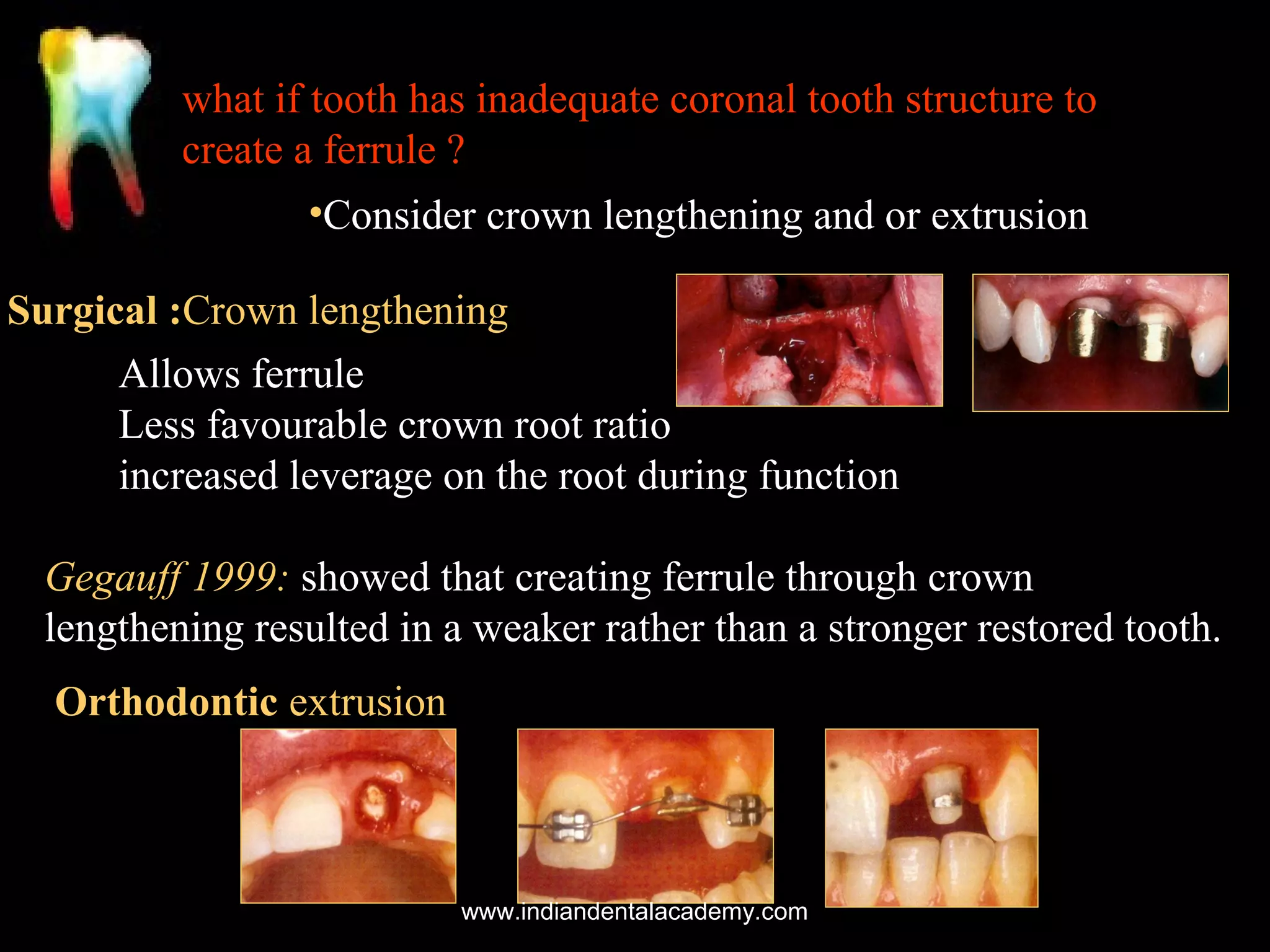
what if tooth has inadequate coronal tooth structure to
create a ferrule ?
•Consider crown lengthening and or extrusion
Surgical :Crown lengthening
Allows ferrule
Less favourable crown root ratio
increased leverage on the root during function
Gegauff 1999: showed that creating ferrule through crown
lengthening resulted in a weaker rather than a stronger restored tooth.
Orthodontic extrusion

www.indiandentalacademy.com
Retention
form

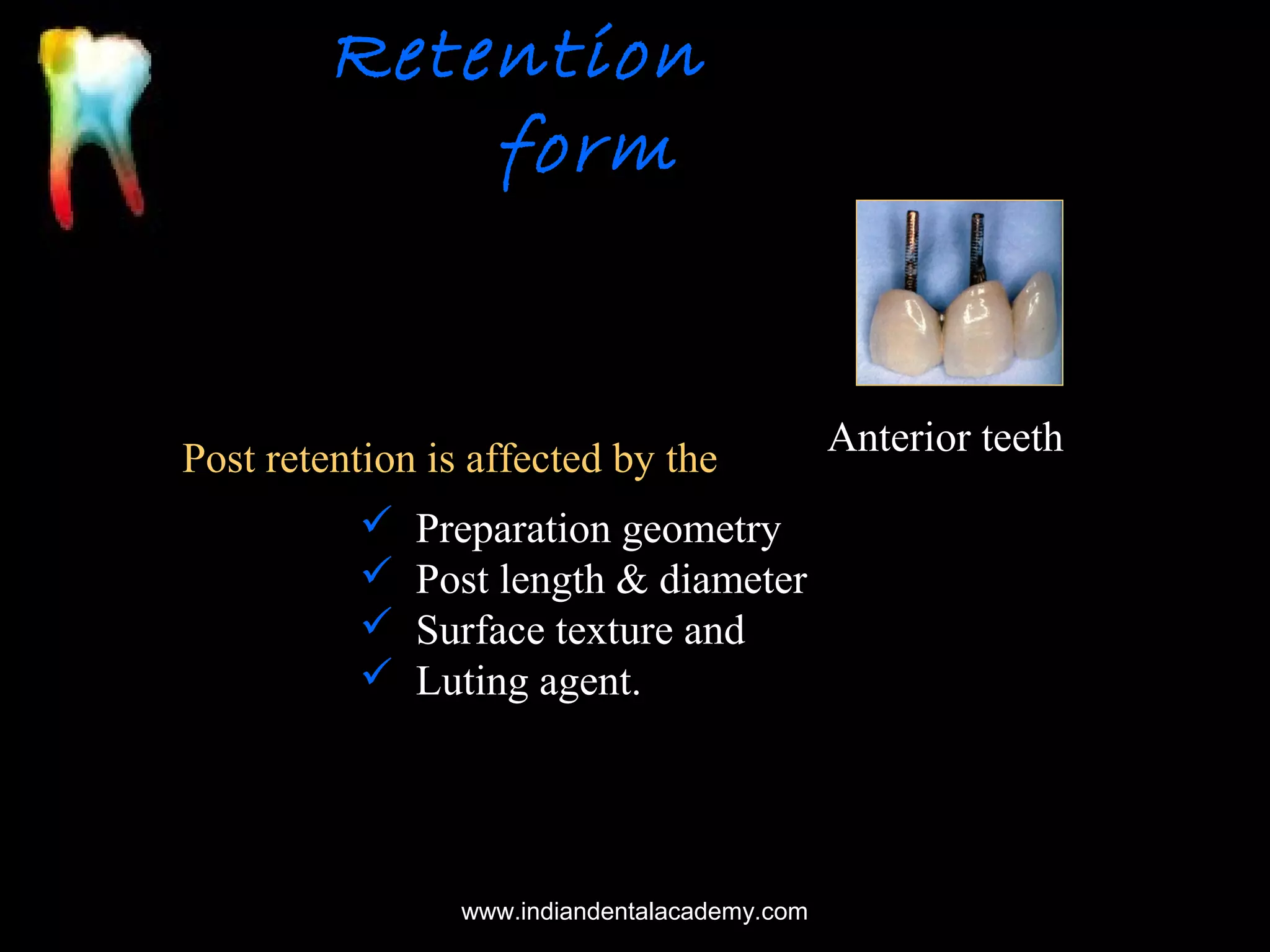
Post retention is affected by the





Preparation geometry
Post length & diameter
Surface texture and
Luting agent.

www.indiandentalacademy.com

Anterior teeth
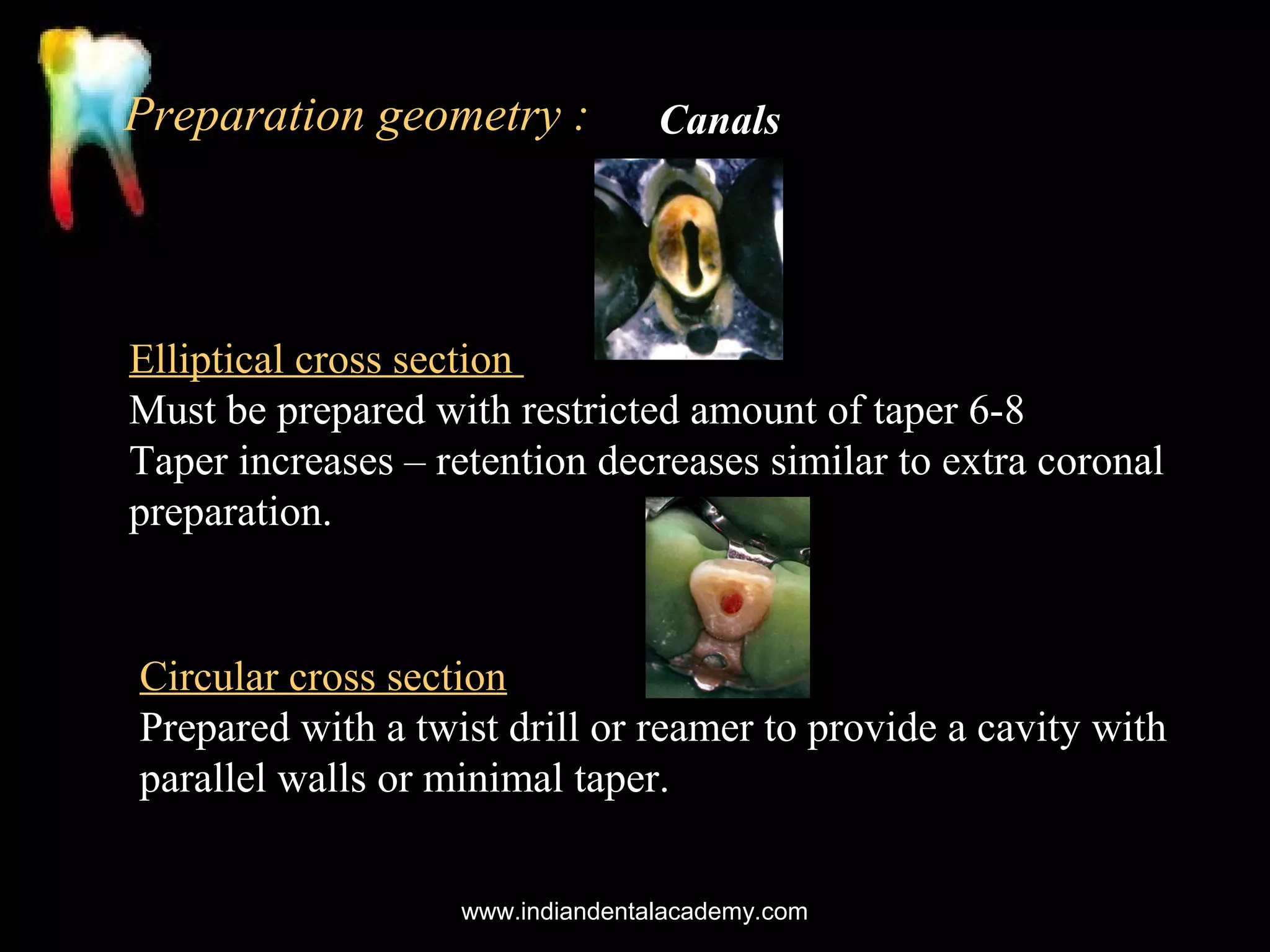
Preparation geometry :

Canals

Elliptical cross section
Must be prepared with restricted amount of taper 6-8
Taper increases – retention decreases similar to extra coronal
preparation.

Circular cross section
Prepared with a twist drill or reamer to provide a cavity with
parallel walls or minimal taper.
www.indiandentalacademy.com
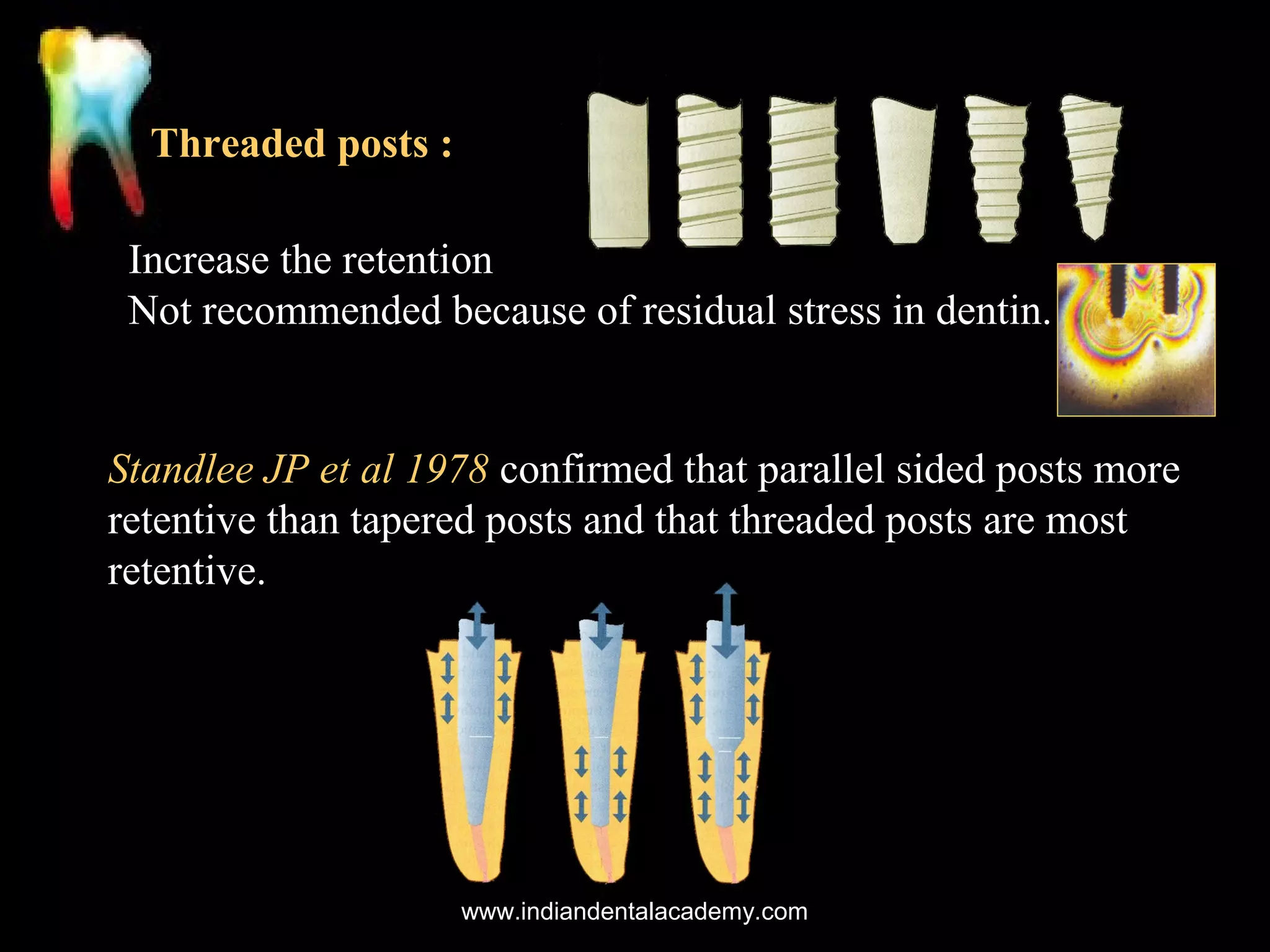
Threaded posts :
Increase the retention
Not recommended because of residual stress in dentin.

Standlee JP et al 1978 confirmed that parallel sided posts more
retentive than tapered posts and that threaded posts are most
retentive.

www.indiandentalacademy.com
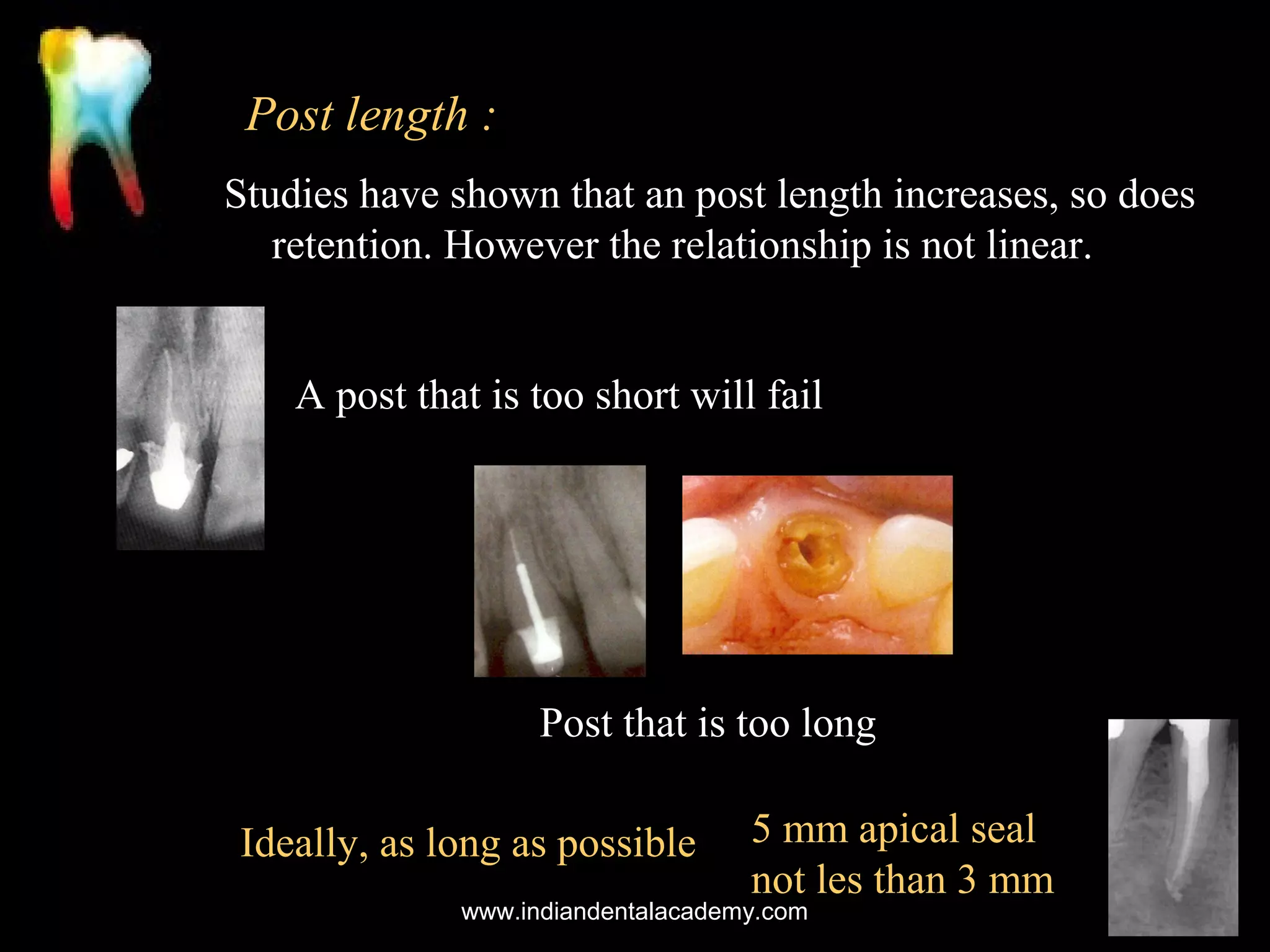
Post length :
Studies have shown that an post length increases, so does
retention. However the relationship is not linear.
A post that is too short will fail

Post that is too long
Ideally, as long as possible

5 mm apical seal
not les than 3 mm

www.indiandentalacademy.com
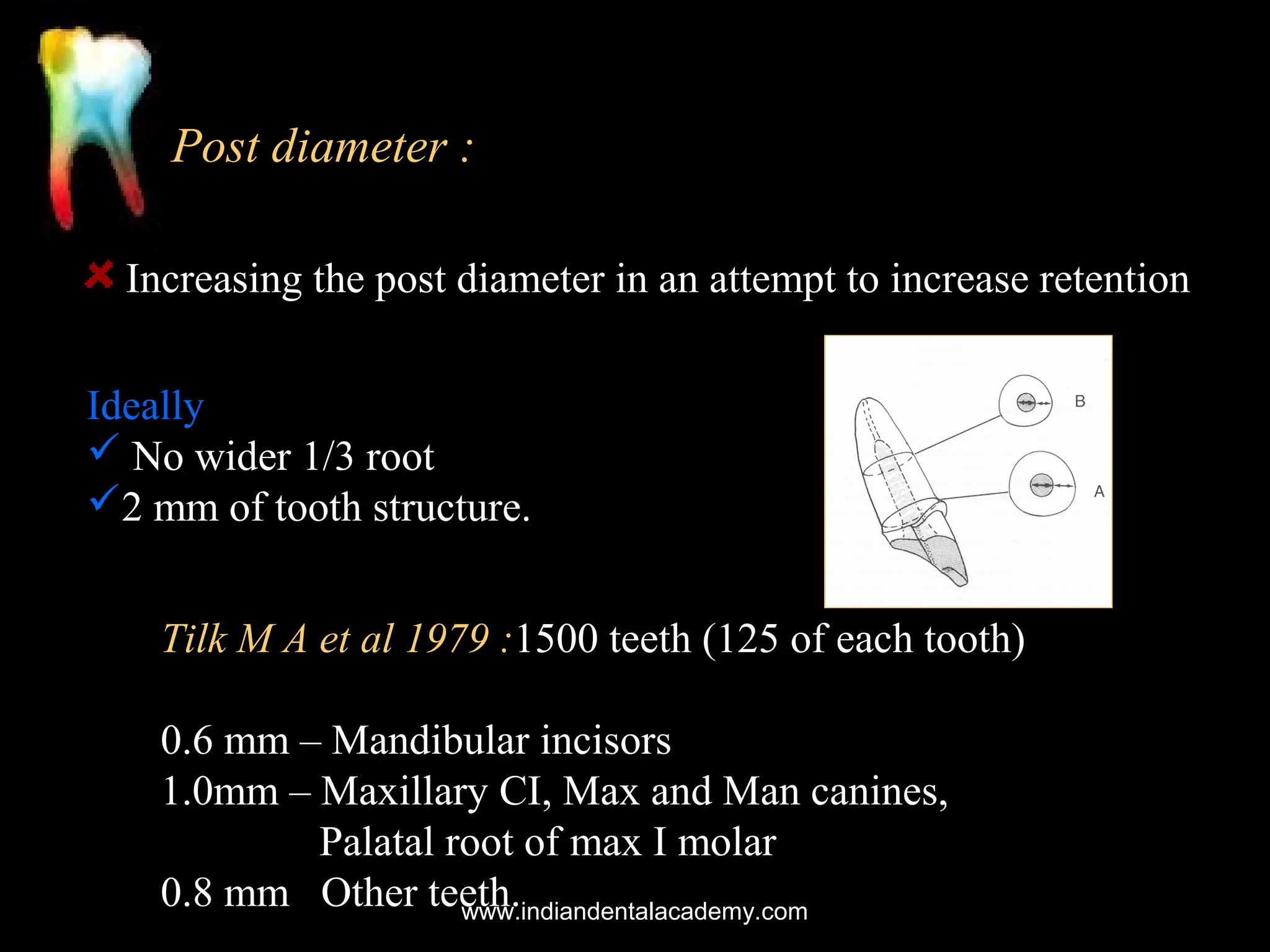
Post diameter :
Increasing the post diameter in an attempt to increase retention
Ideally
 No wider 1/3 root
2 mm of tooth structure.
Tilk M A et al 1979 :1500 teeth (125 of each tooth)
0.6 mm – Mandibular incisors
1.0mm – Maxillary CI, Max and Man canines,
Palatal root of max I molar
0.8 mm Other teeth.
www.indiandentalacademy.com
Shillingburg et al 1982 in a study of 100 teeth
0.7 mm – Mandibular CI
1.7 mm – Maxillary CI.

www.indiandentalacademy.com
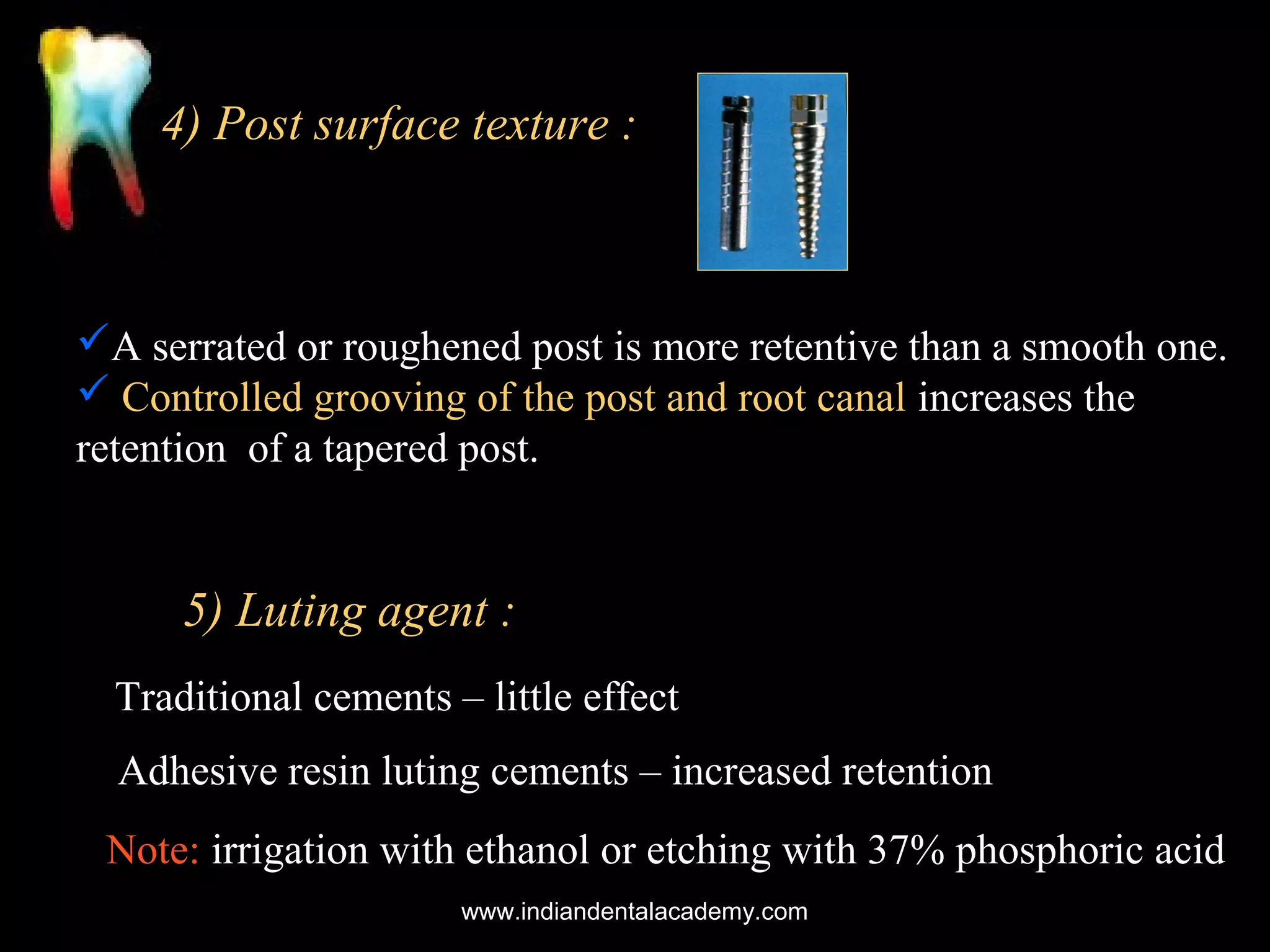
4) Post surface texture :

A serrated or roughened post is more retentive than a smooth one.
 Controlled grooving of the post and root canal increases the
retention of a tapered post.

5) Luting agent :
Traditional cements – little effect
Adhesive resin luting cements – increased retention
Note: irrigation with ethanol or etching with 37% phosphoric acid
www.indiandentalacademy.com
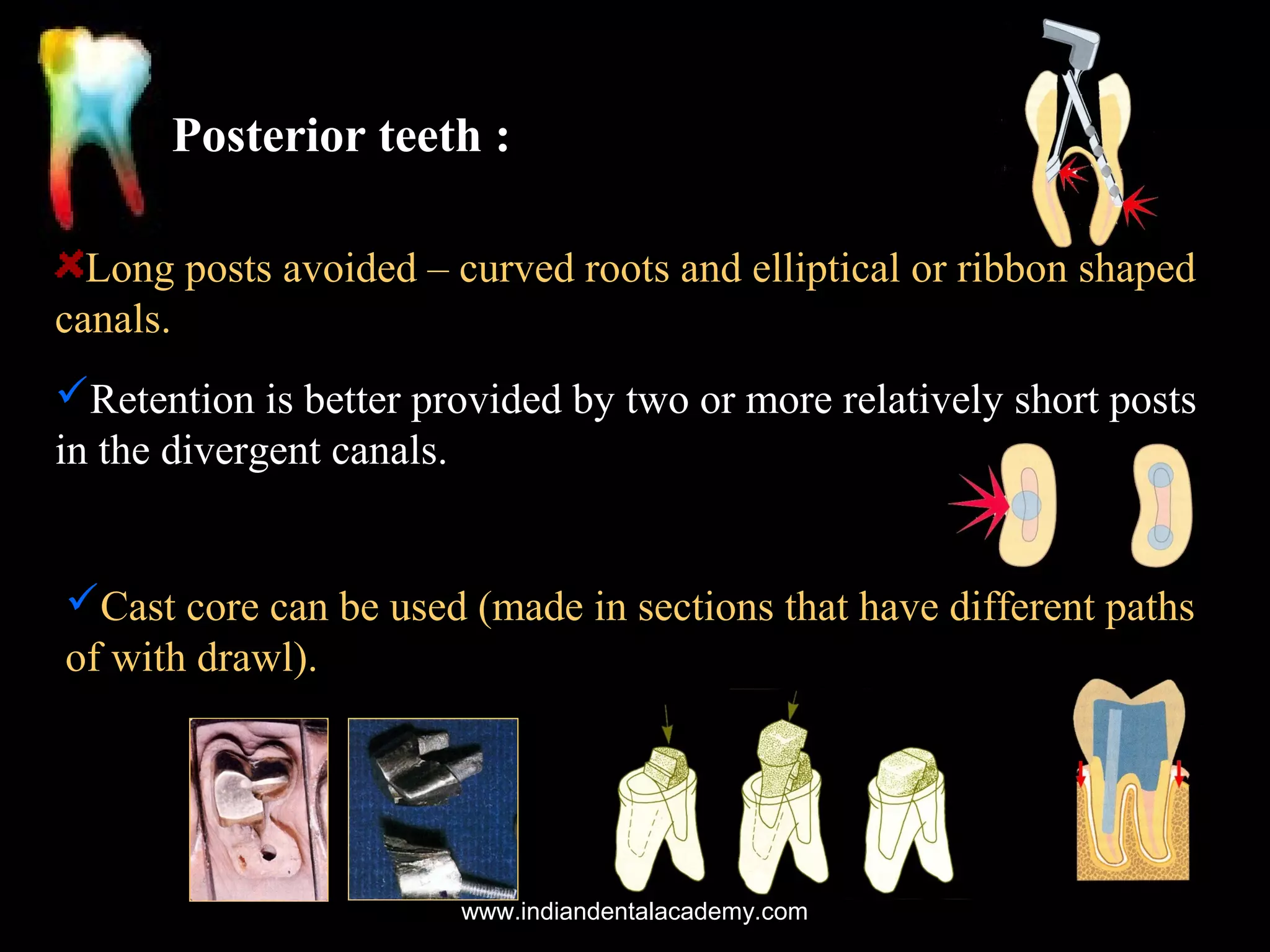
Posterior teeth :
Long posts avoided – curved roots and elliptical or ribbon shaped
canals.
Retention is better provided by two or more relatively short posts
in the divergent canals.

Cast core can be used (made in sections that have different paths
of with drawl).

www.indiandentalacademy.com
Resistance
form
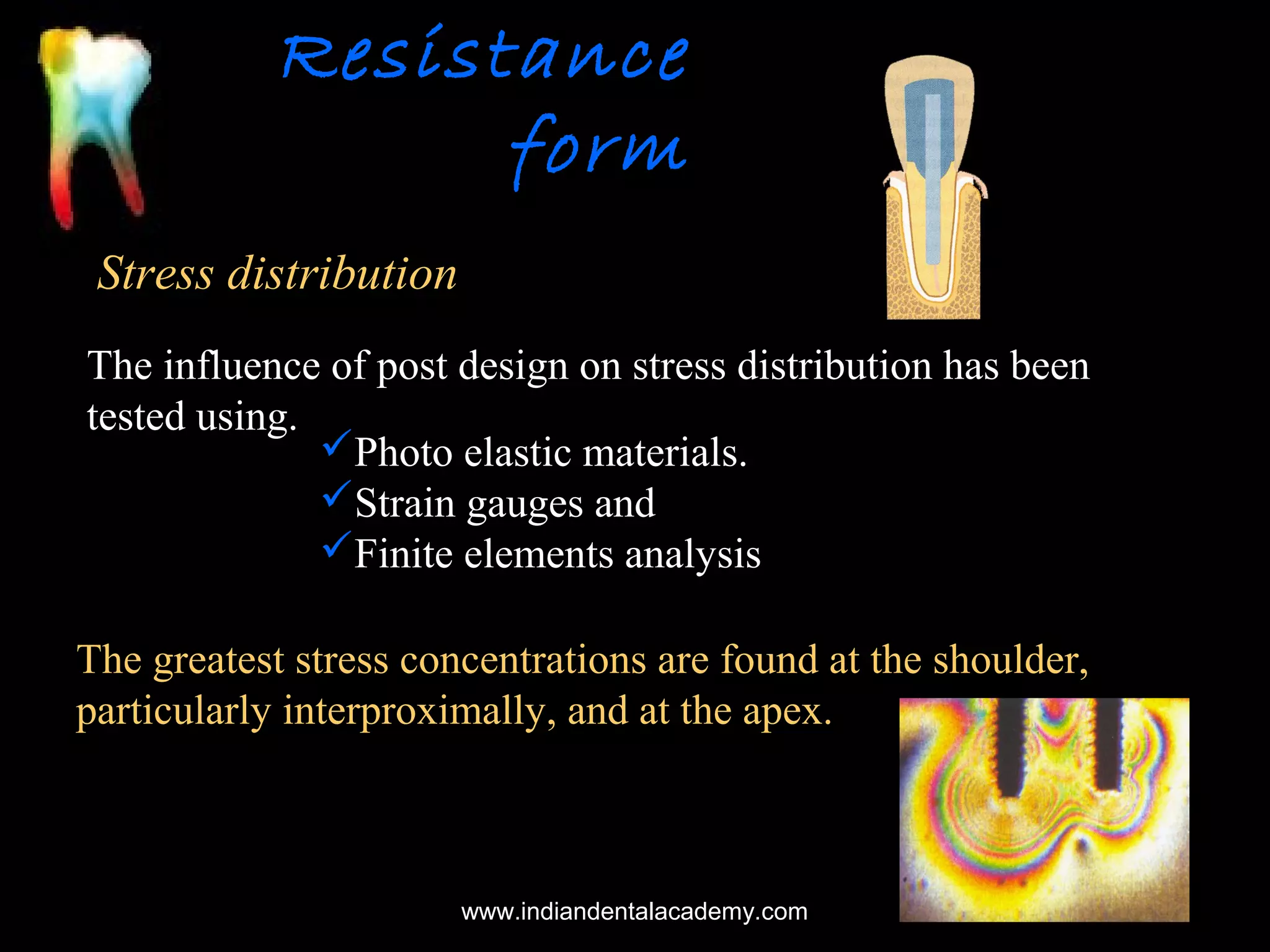
Stress distribution
The influence of post design on stress distribution has been
tested using.
Photo elastic materials.
Strain gauges and
Finite elements analysis
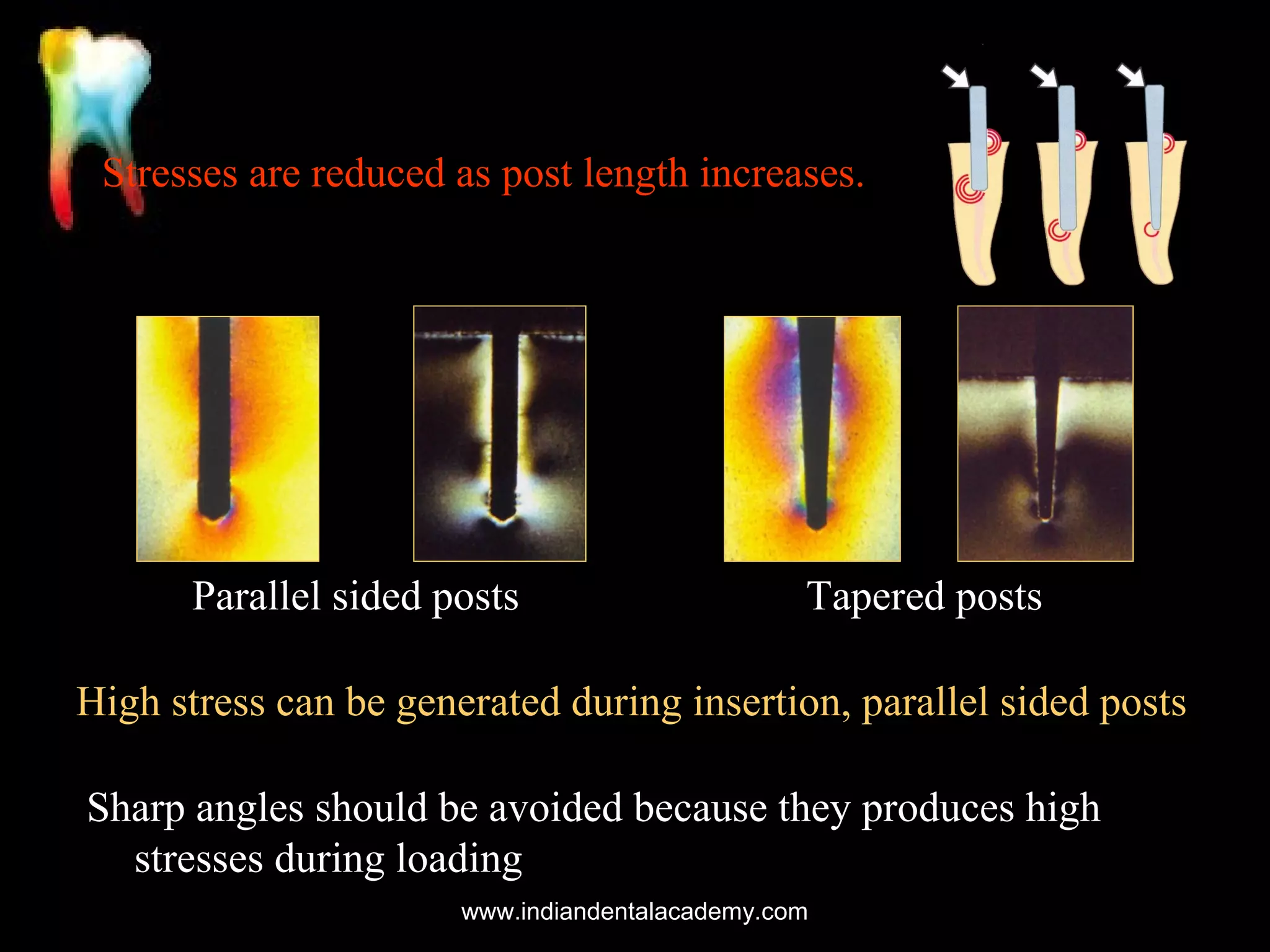
The greatest stress concentrations are found at the shoulder,
particularly interproximally, and at the apex.

www.indiandentalacademy.com
Stresses are reduced as post length increases.

Parallel sided posts

Tapered posts

High stress can be generated during insertion, parallel sided posts
Sharp angles should be avoided because they produces high
stresses during loading
www.indiandentalacademy.com
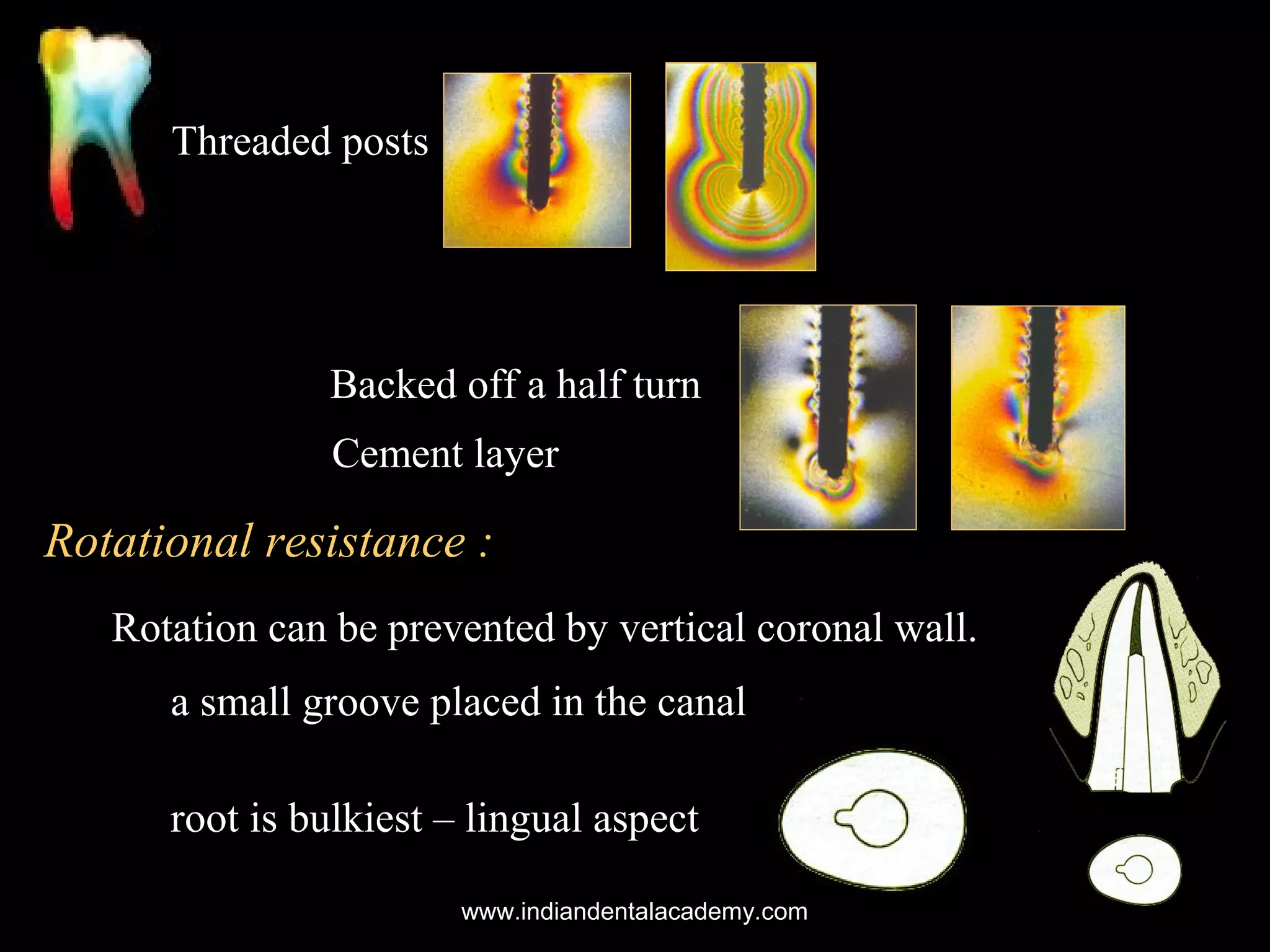
Threaded posts

Backed off a half turn
Cement layer

Rotational resistance :
Rotation can be prevented by vertical coronal wall.
a small groove placed in the canal
root is bulkiest – lingual aspect
www.indiandentalacademy.com
Procedure

www.indiandentalacademy.com
3 stage operation.
1. Removal of the root canal filling material to the appropriate depth.
2. Enlargement of the canal
3. Preparation of the coronal tooth structures

www.indiandentalacademy.com
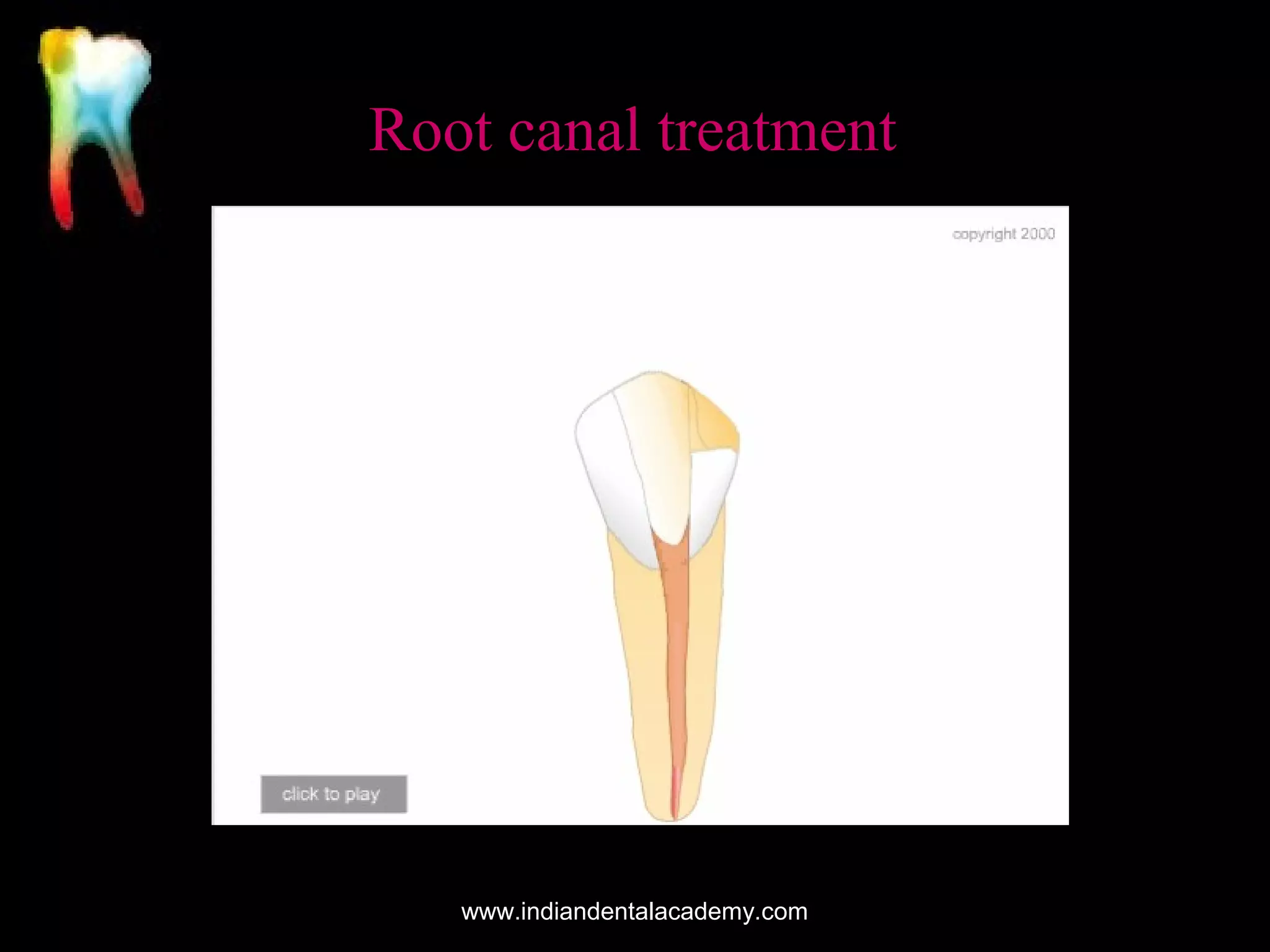
Root canal treatment

www.indiandentalacademy.com
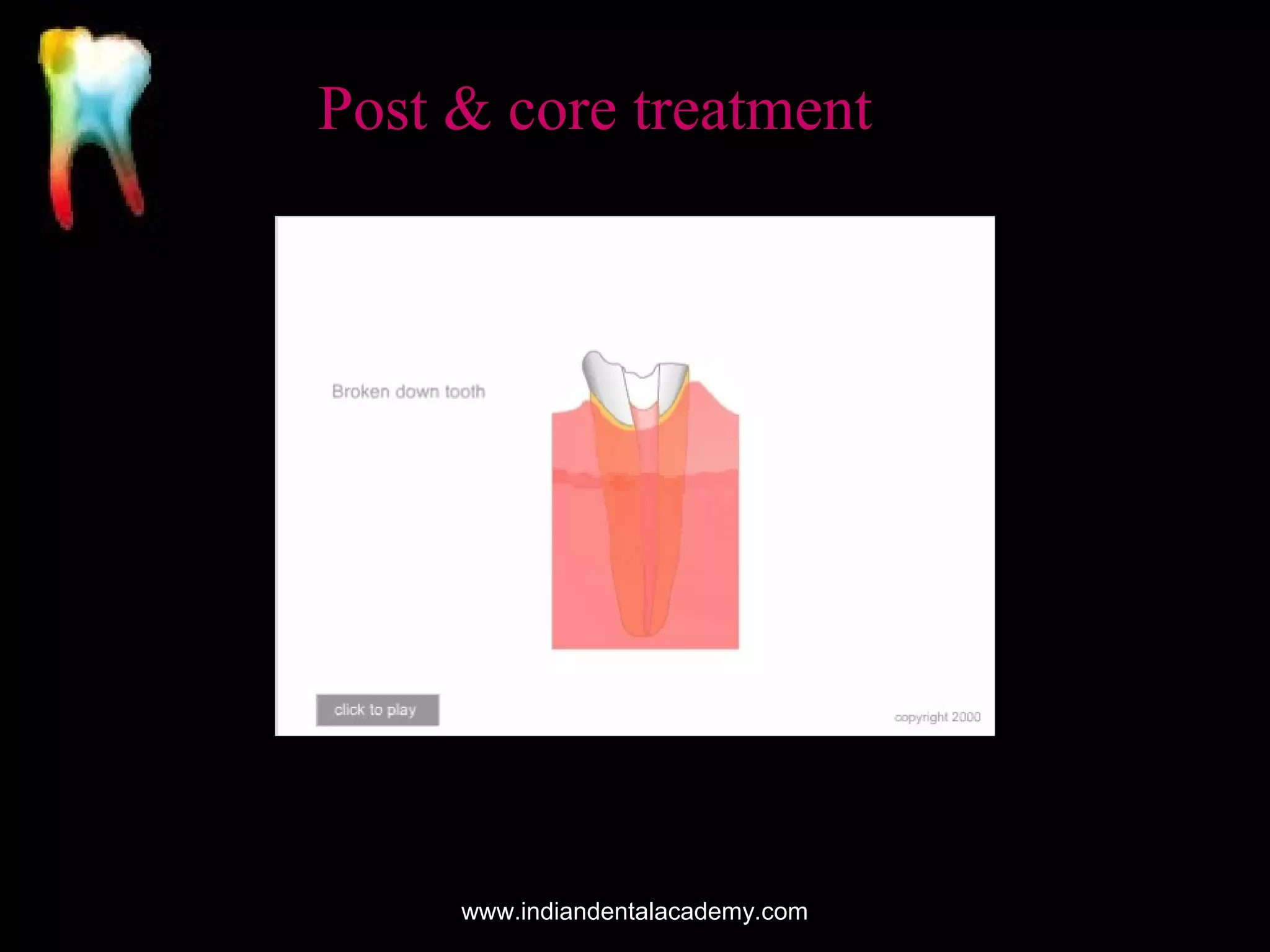
Post & core treatment

www.indiandentalacademy.com
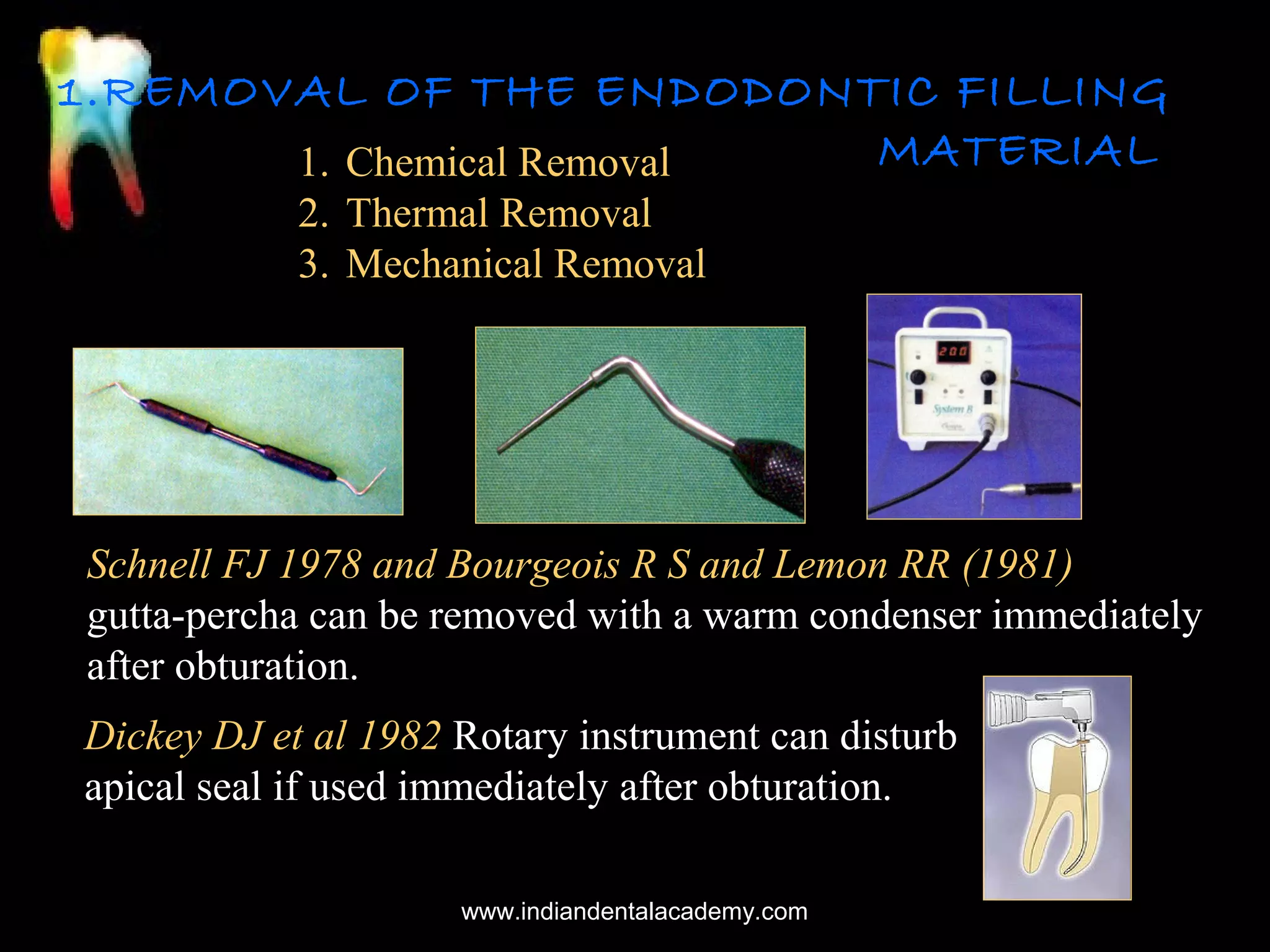
1.REMOVAL OF THE ENDODONTIC FILLING
MATERIAL
1. Chemical Removal
2. Thermal Removal
3. Mechanical Removal

Schnell FJ 1978 and Bourgeois R S and Lemon RR (1981)
gutta-percha can be removed with a warm condenser immediately
after obturation.
Dickey DJ et al 1982 Rotary instrument can disturb
apical seal if used immediately after obturation.
www.indiandentalacademy.com
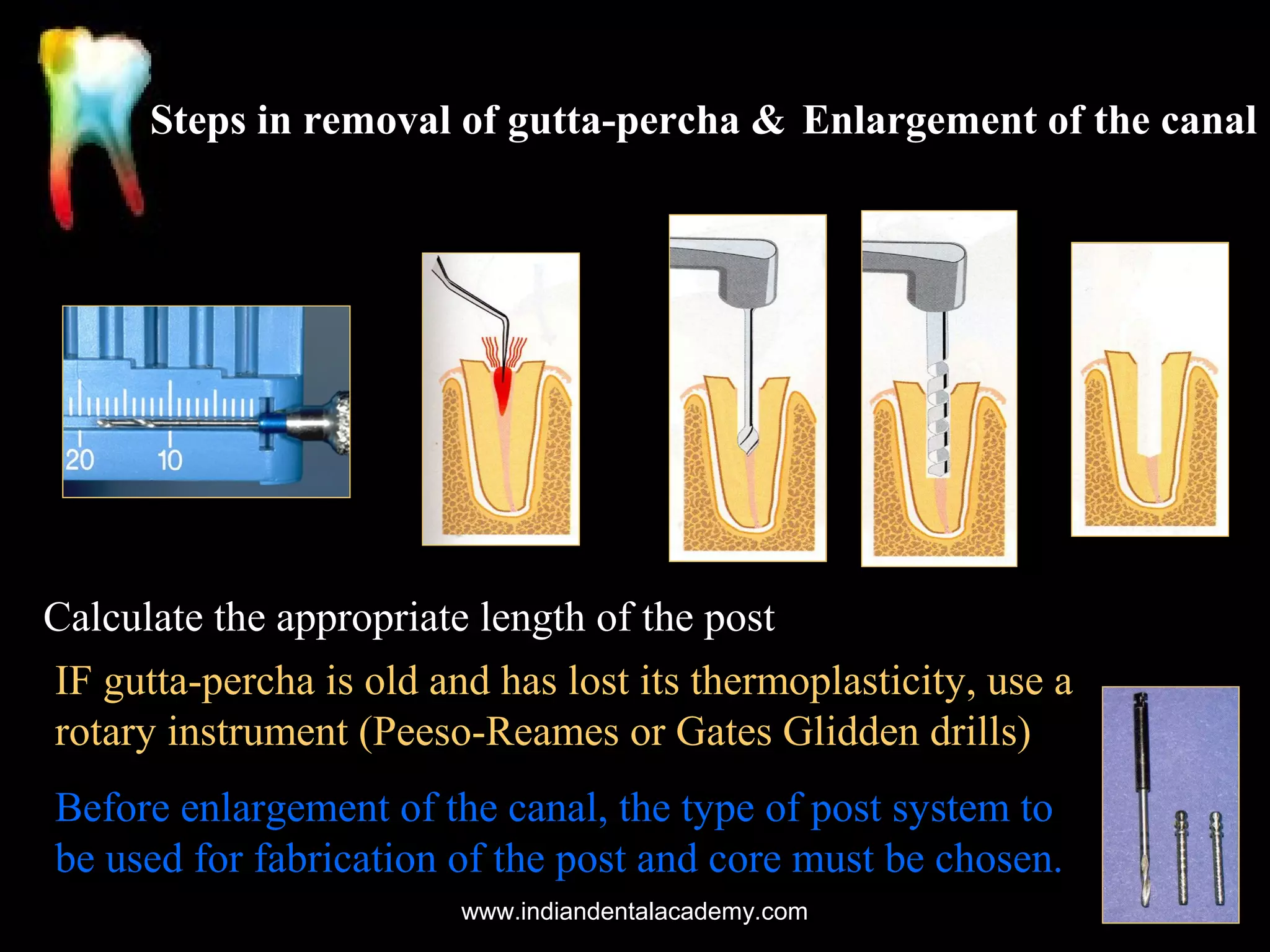
Steps in removal of gutta-percha & Enlargement of the canal

Calculate the appropriate length of the post
IF gutta-percha is old and has lost its thermoplasticity, use a
rotary instrument (Peeso-Reames or Gates Glidden drills)
Before enlargement of the canal, the type of post system to
be used for fabrication of the post and core must be chosen.
www.indiandentalacademy.com
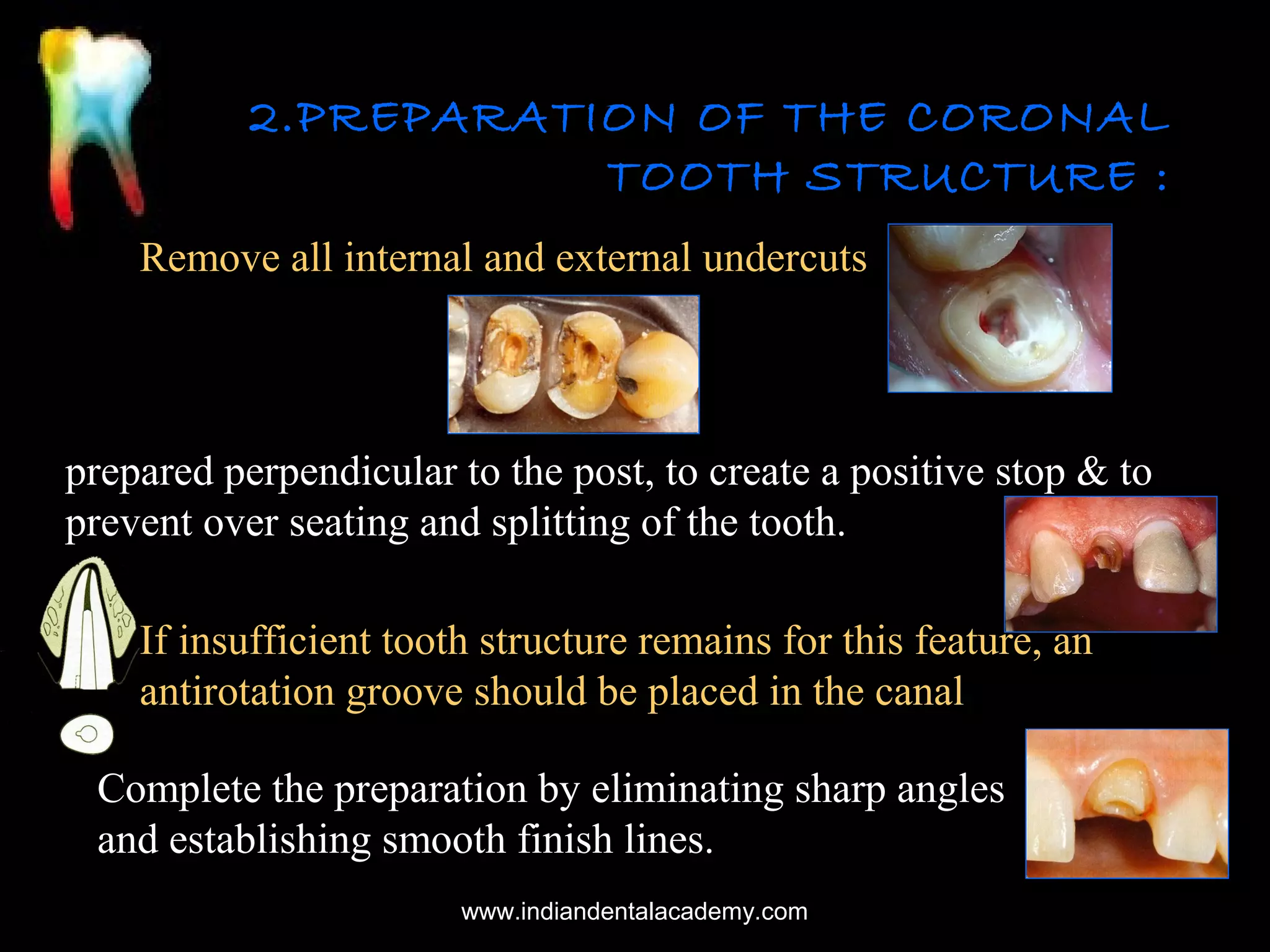
2.PREPARATION OF THE CORONAL
TOOTH STRUCTURE :
Remove all internal and external undercuts

prepared perpendicular to the post, to create a positive stop & to
prevent over seating and splitting of the tooth.
If insufficient tooth structure remains for this feature, an
antirotation groove should be placed in the canal
Complete the preparation by eliminating sharp angles
and establishing smooth finish lines.
www.indiandentalacademy.com
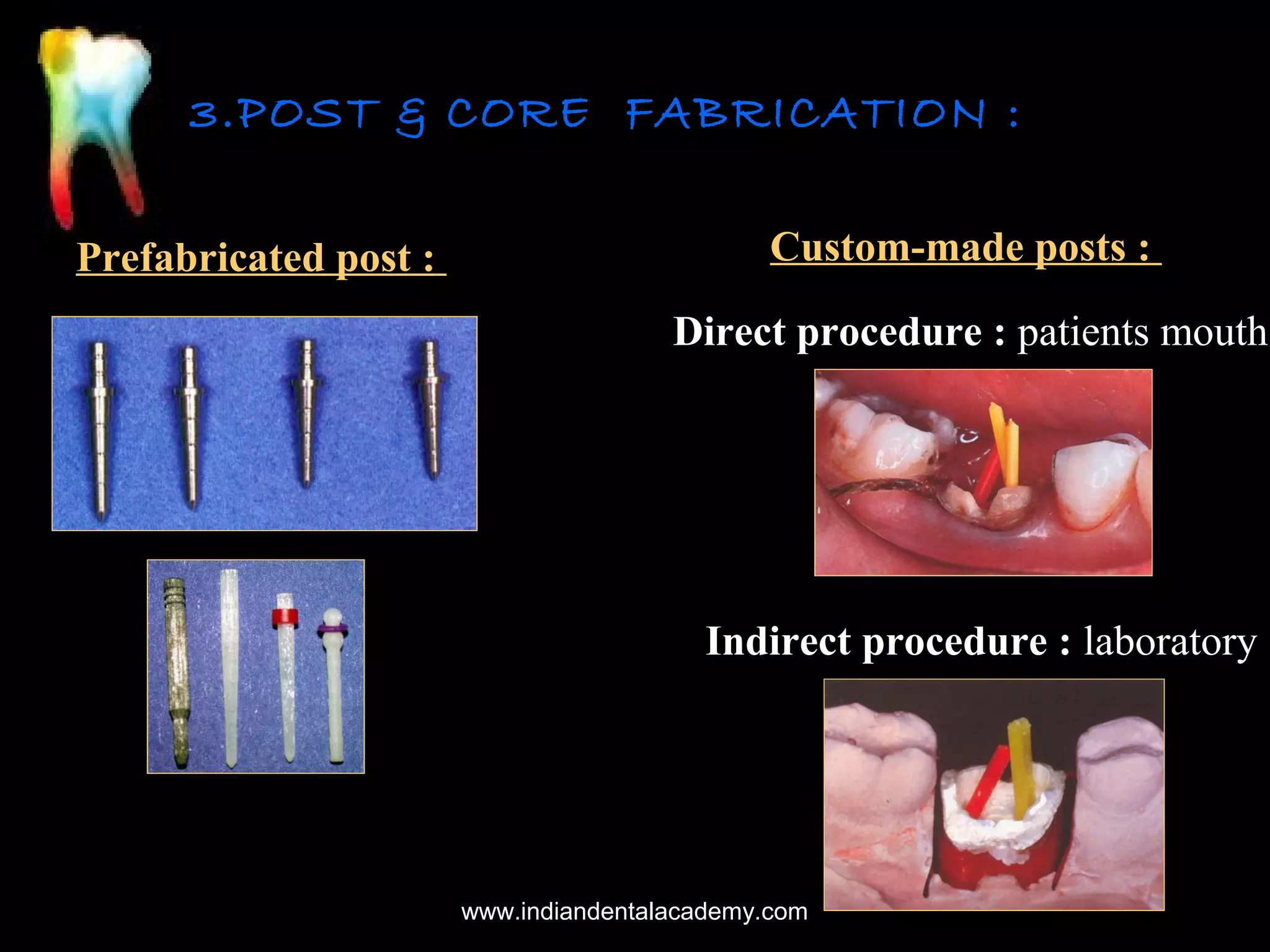
3.POST & CORE FABRICATION :
Prefabricated post :

Custom-made posts :
Direct procedure : patients mouth

Indirect procedure : laboratory

www.indiandentalacademy.com
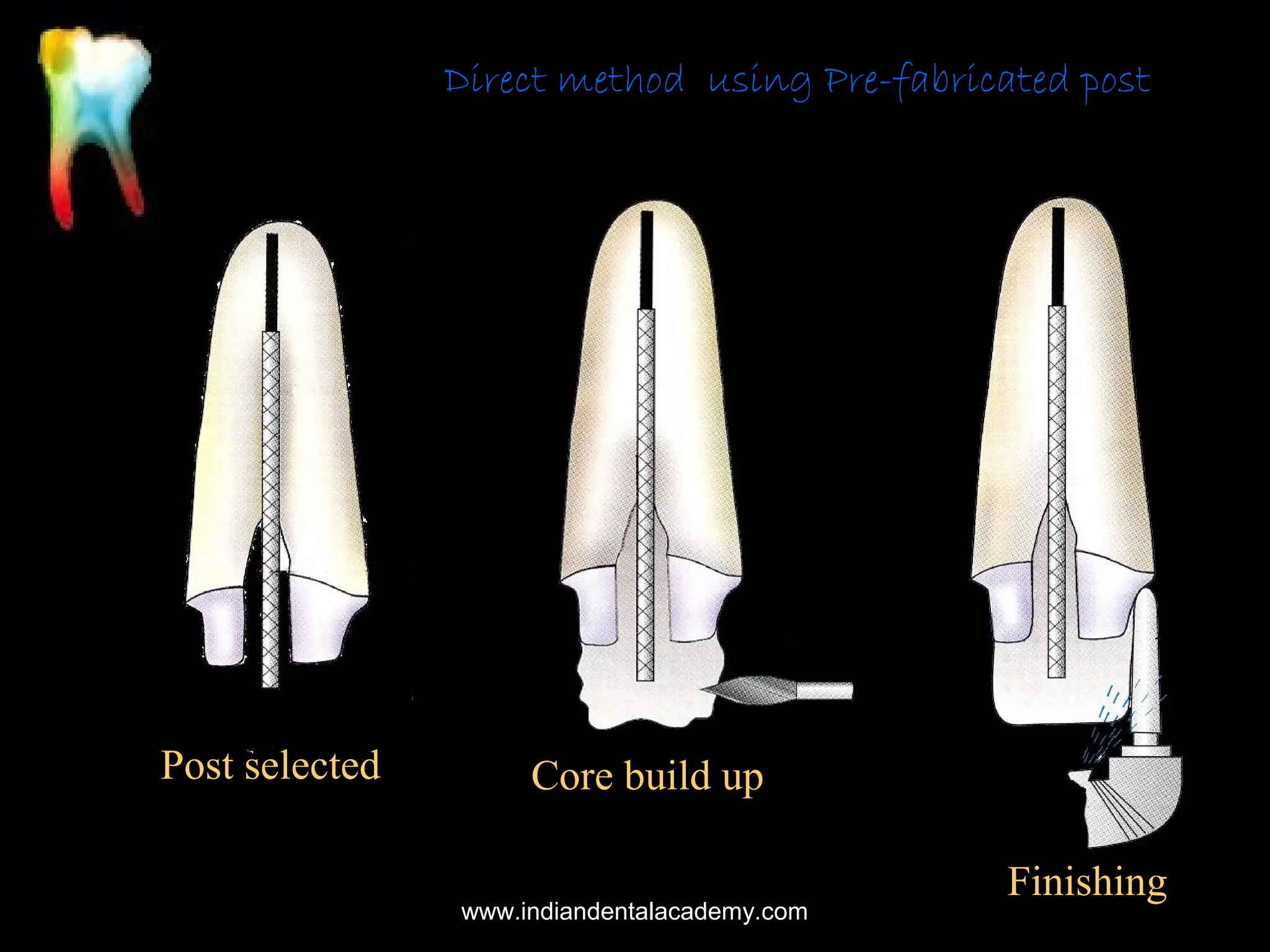
Direct method using Pre-fabricated post

Post selected

Core build up
www.indiandentalacademy.com

Finishing
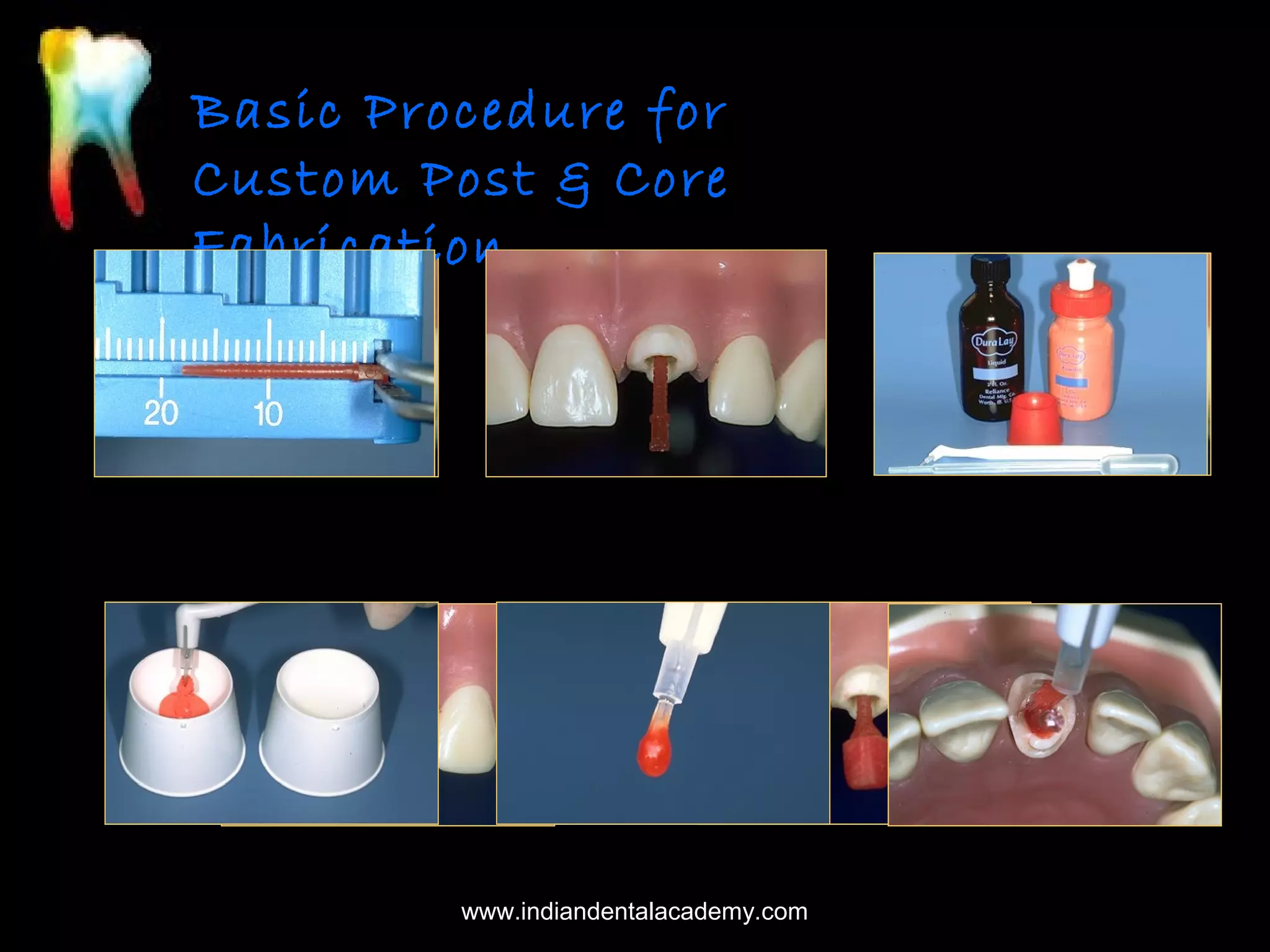
Basic Procedure for
Custom Post & Core
Fabrication

www.indiandentalacademy.com
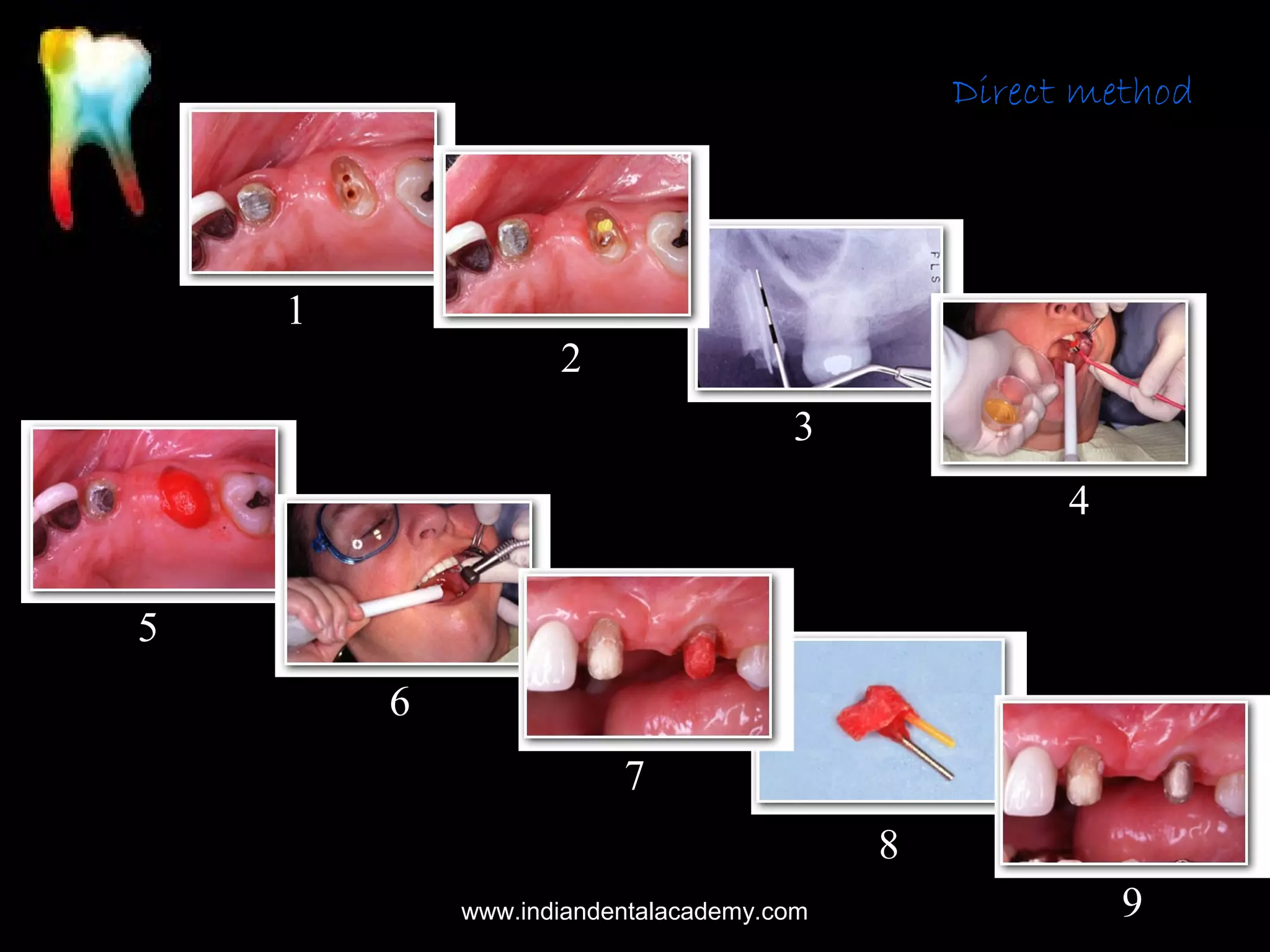
Direct method

1
2
3
4
5
6
7
8
www.indiandentalacademy.com

9
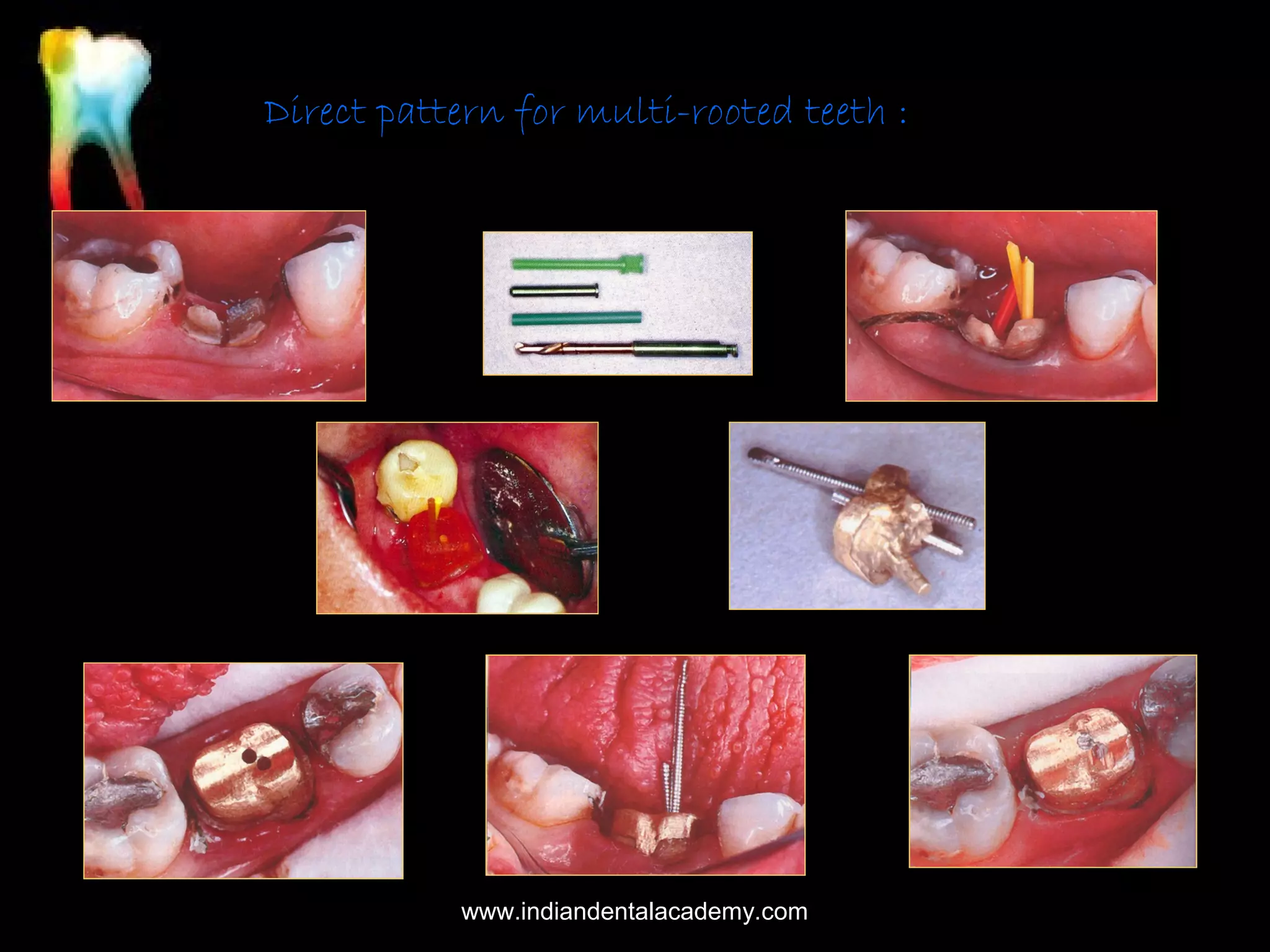
Direct pattern for multi-rooted teeth :

www.indiandentalacademy.com
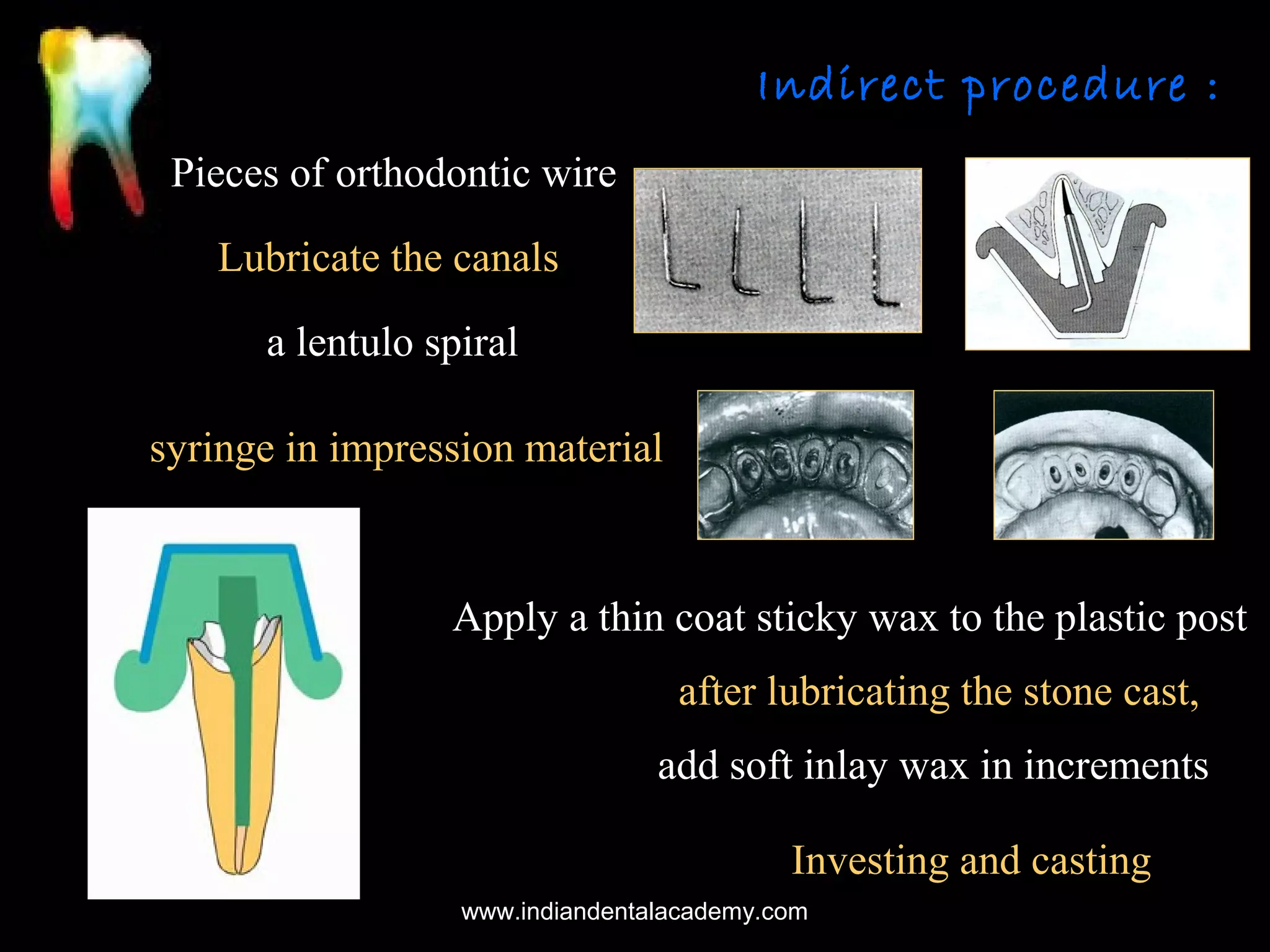
Indirect procedure :
Pieces of orthodontic wire
Lubricate the canals
a lentulo spiral
syringe in impression material

Apply a thin coat sticky wax to the plastic post
after lubricating the stone cast,
add soft inlay wax in increments
Investing and casting
www.indiandentalacademy.com
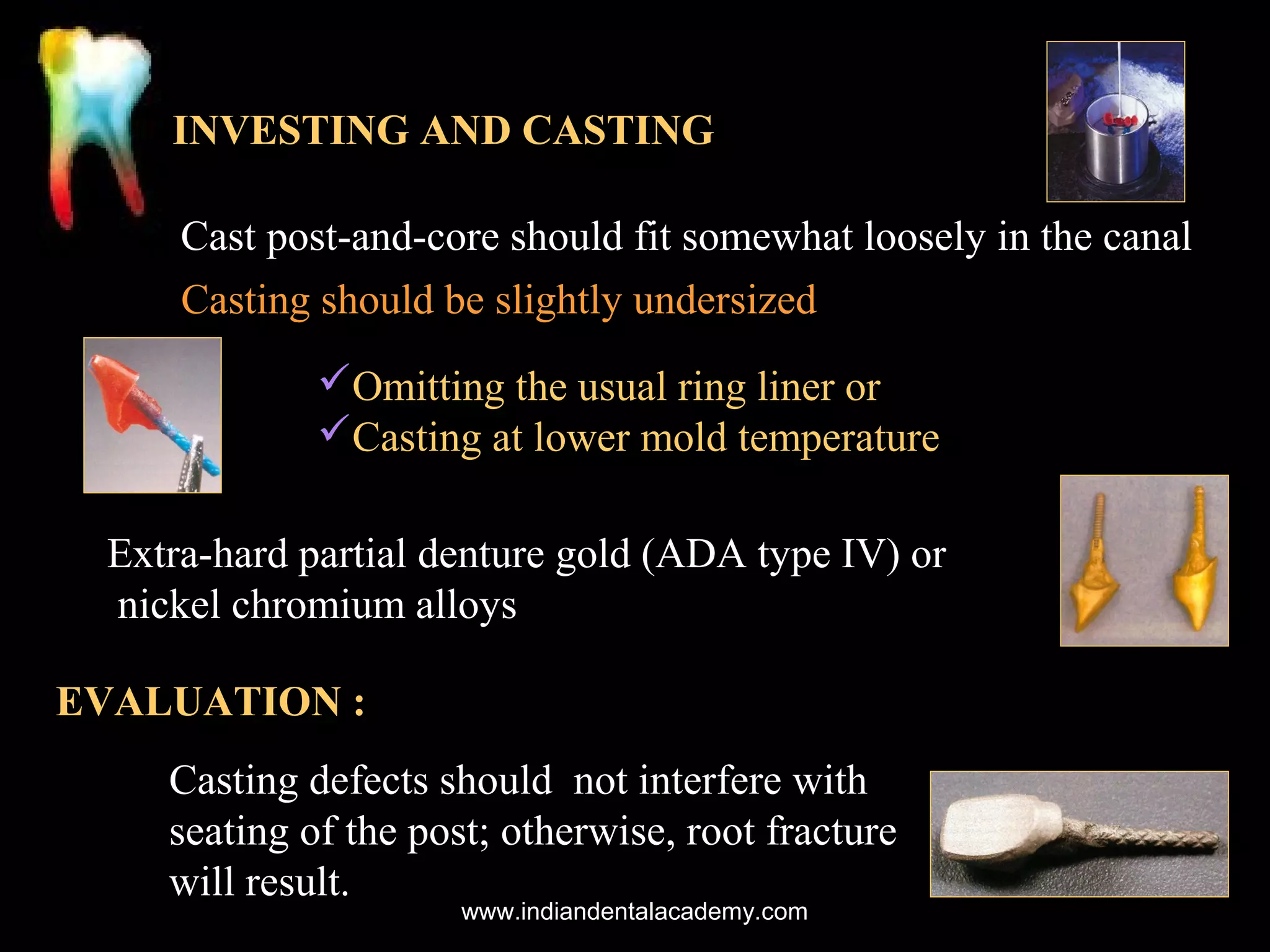
INVESTING AND CASTING
Cast post-and-core should fit somewhat loosely in the canal
Casting should be slightly undersized
Omitting the usual ring liner or
Casting at lower mold temperature
Extra-hard partial denture gold (ADA type IV) or
nickel chromium alloys
EVALUATION :
Casting defects should not interfere with
seating of the post; otherwise, root fracture
will result.
www.indiandentalacademy.com
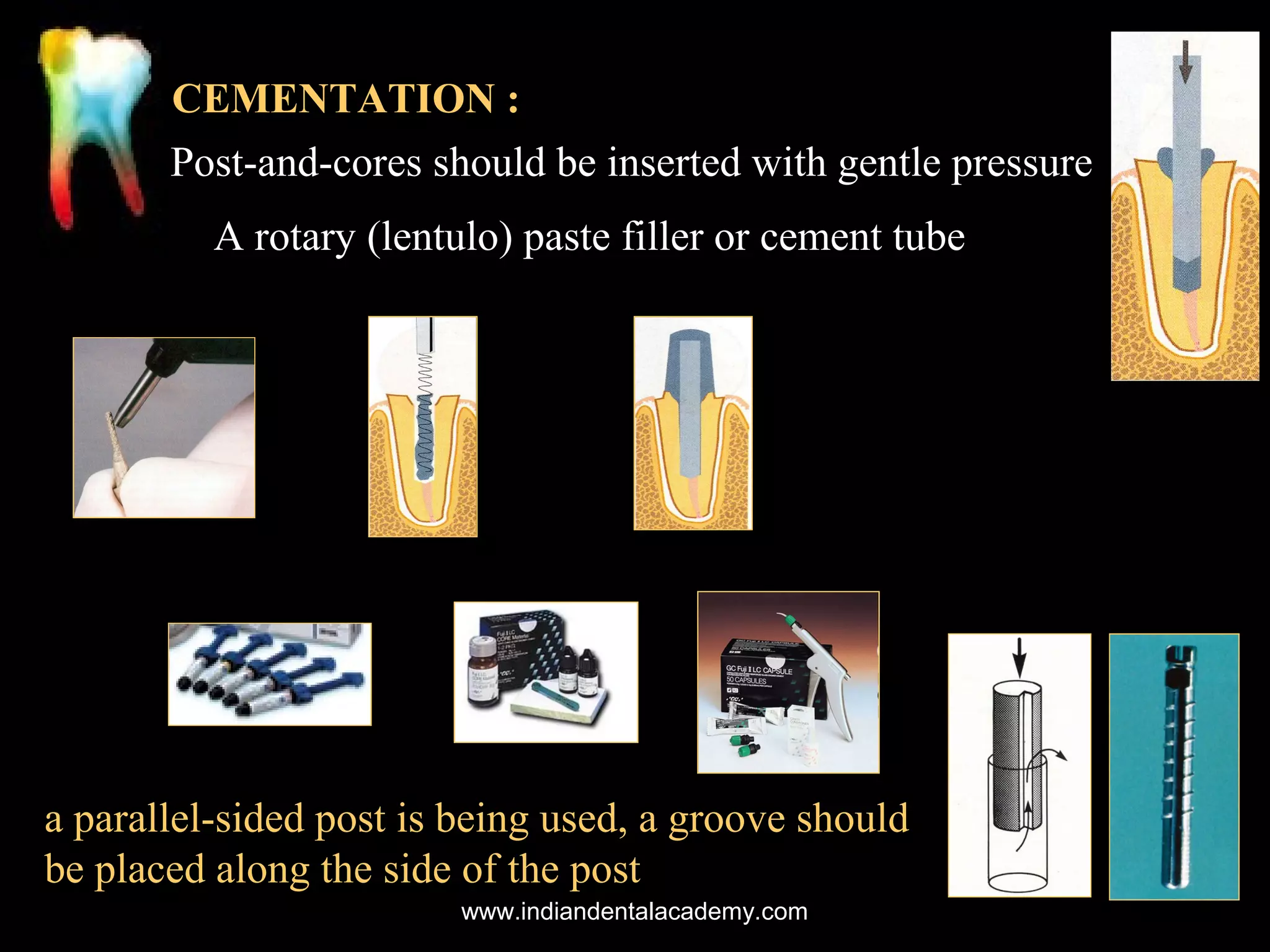
CEMENTATION :
Post-and-cores should be inserted with gentle pressure
A rotary (lentulo) paste filler or cement tube

a parallel-sided post is being used, a groove should
be placed along the side of the post
www.indiandentalacademy.com
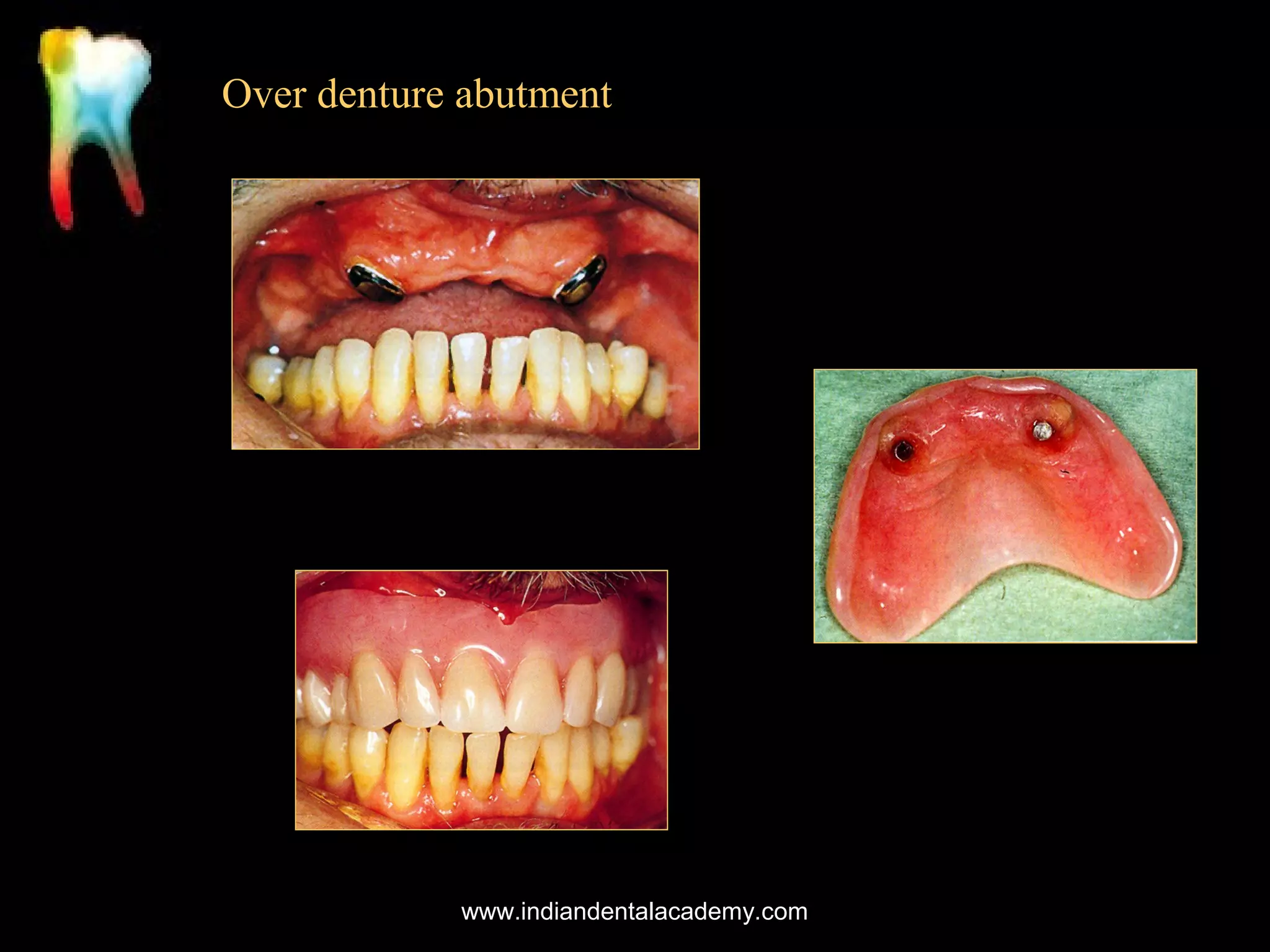
Over denture abutment

www.indiandentalacademy.com
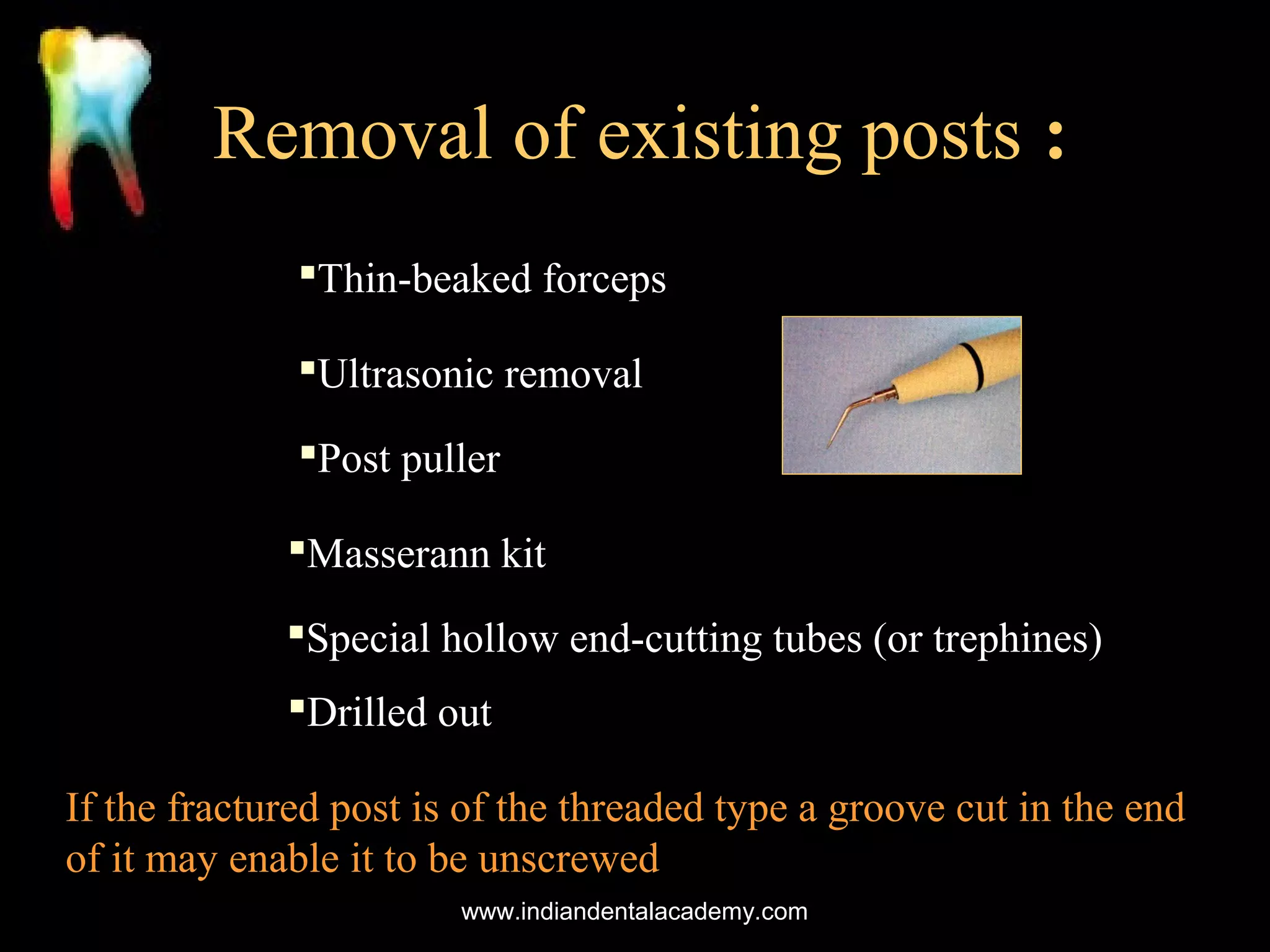
Removal of existing posts :
Thin-beaked forceps
Ultrasonic removal
Post puller
Masserann kit
Special hollow end-cutting tubes (or trephines)
Drilled out
If the fractured post is of the threaded type a groove cut in the end
of it may enable it to be unscrewed
www.indiandentalacademy.com
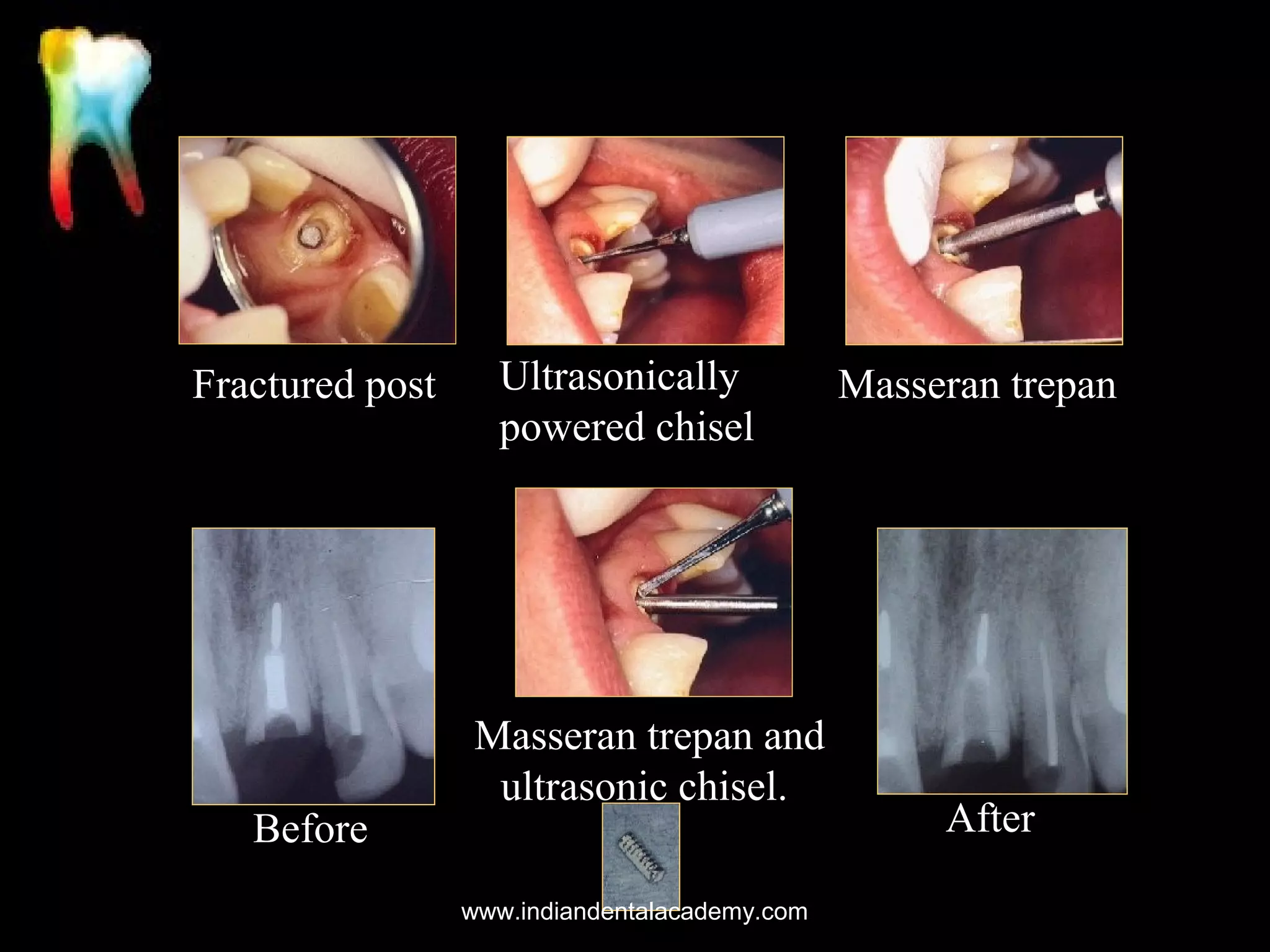
Fractured post

Before

Ultrasonically
powered chisel

Masseran trepan and
ultrasonic chisel.
www.indiandentalacademy.com

Masseran trepan

After
Conclusion

www.indiandentalacademy.com
R
E
F
E
R
E
N
C
E
S

7. Harold Gerstein, "Technique In Clinical Endodontics" 34787.
8. Pitt Ford, "Problem-solving in Clinical Practice" 149-164.
9. Gutmann, "Problem-solving in Endodontics" 3rd Edn, 32546.
10.Stephen Cohen, "Pathways of the Pulp", 8th Edn, 765-795.
11. Franklin S. Weine, "Endodontic Therapy" 4th Edn, 653698.
12. Tylman's "Theory and Practice's of Fixed Prosthodontics",
8th Edn, 407-417.
13. Herbert T. Shillingburg, "Restoration of the Endodontically
Treated Tooth" 1982Edn. .
14. Herbert Shillingburg, "Fundamental of Fixed
Prosthodontics" 3rd Edn, 194-209.
15. Herbert Shillingburg, "Fundamental of Tooth Preparation"
2nd Edn, 321-358.
16. Rosensteil, "Contemporary Fixed Prosthodontics" 3rd
Edn., 272-312.
www.indiandentalacademy.com
17. Endod Dent Traumatel1998; 14: 59-63.
www.indiandentalacademy.com

Post & core final

  • 1.
    INDIAN DENTAL ACADEMY Leaderin continuing dental education www.indiandentalacademy.com www.indiandentalacademy.com
  • 2.
  • 3.
    Difficulties and problemsshould make us stronger, not bitter www.indiandentalacademy.com
  • 4.
  • 5.
    Contents • • • • Introduction History Definitions Why to restoreendodontically treated teeth • Post & core systems • Principles of tooth preparation www.indiandentalacademy.com
  • 6.
    • Procedure Post fabrication& Core fabrication Investing and casting Evaluation & cementation • Removal of existing posts • Conclusion • References www.indiandentalacademy.com
  • 7.
  • 8.
    INTRODUCTION: • The restorationof the endodontically treated tooth is complicated • Destruction by caries • Previous restorations • Trauma • Endodontic access preparation • The endodontically treated teeth require restoration because of • dehydrated dentin, • decreased structural integrity • impaired neurosensory feedback mechanism www.indiandentalacademy.com
  • 9.
  • 10.
    History Posts fabricated ofgold or silver. Heat softened adhesive called “mastic Longevity 15-20 years 1747 Pierre Fauchard Bone, ivory, animal teeth, natural tooth crowns Porcelain www.indiandentalacademy.com
  • 11.
    History “Pivot crown”. 1800’s –Porcelain pivot crown Dubois de chemant Early pivot crowns – seasoned wood Wood posts -“Morbid humors”. 1747 Pierre Fauchard 1878 Richmond crown 1 piece dowel and crown Post and Core www.indiandentalacademy.com
  • 12.
    Definitions • Dowel (Post): Thedowel is a metal post or other rigid restorative material placed in the radicular portion of a non vital tooth. A dowel usually made of metal is fitted in to a prepared canal of a natural tooth. When combined with an artificial crown or core, it provides retention and resistance for the restoration. (Glossary of Prosthodontics) www.indiandentalacademy.com
  • 13.
    • Core: Refers toproperly shaped and well substructure, which replaces missing coronal structure and retains the final restoration. A centre or a base of a structure. The core is designed to resemble or become the crown preparation or crown itself. (Glossary of Prosthodontics) www.indiandentalacademy.com
  • 14.
    • Ferrule (Rosenstile): Isdefined as a metal band that encircles the external dimension of the residual tooth. • Ferrule (Weine) : A ferrule is a metal ring or cap placed around the end of a cane or tool, giving it added strength. The ferrule around the circumference of the tooth strengthens it by www.indiandentalacademy.com increasing resistance to wedging forces.
  • 15.
    Why to Restore? As prosthodontist – abutment for FPD , RPD, Over denture As a Restorative dentist -Increase the clinical longevity of these teeth. Schwartz et al 1983 found that the failure rate of endodontically treated teeth was almost double in cases with inadequate restoration. Weine 1996 more endodontically treated teeth are lost due to poor restoration than to subsequent endodontic failure. www.indiandentalacademy.com
  • 16.
    Gutmann 1992 • • • • • Moisture loss Architecturalchanges Biomechanical behaviour Dentinal toughness Collagen alteration William Robbins 2002  Dentin diff - vital dentin  Structure integrity lost  Neurosensory feedback mechanism impaired www.indiandentalacademy.com
  • 17.
  • 18.
    Endodontic & Periodontalevaluation:     Apical seal Percussion Palpation Prescence of sinus tract  Diagnostic probing  Mobility www.indiandentalacademy.com
  • 19.
    Restorative evaluation     The amountof remaining tooth structure. The anatomical position of the tooth. The functional load on the tooth. The aesthetic requirements of the tooth. www.indiandentalacademy.com
  • 20.
    The amount ofremaining tooth structure Anterior teeth Do not need posts and full coverage crowns Sound tooth with access opening Lack of Coronal tooth structure Anterior teeth are inclined at an angle to the occlusal plane www.indiandentalacademy.com
  • 21.
    Posterior teeth Carry greaterocclusal loads Minimal occlusal access preparations Teeth with existing restorations involving the marginal ridge or those with extensive loss of tooth structure Where ever possible posts should be avoided in posterior teeth as the roots are often narrow and or curved www.indiandentalacademy.com
  • 22.
    Post & CoreSystems www.indiandentalacademy.com
  • 23.
    Ideal properties ofa post         Maximum protection to root Adequate retention within root Maximum retention of the core and the crown. Maximum protection of the crown margin cement seal Pleasing esthetics when indicated High radiographic visibility Retreivability Biocompatibility www.indiandentalacademy.com
  • 24.
    • Classification ofposts ( D C N A 2002 ) Metallic Custom cast posts Prefabricated Non Metallic Carbon fiber posts Zirconia posts Woven fiber composite post www.indiandentalacademy.com
  • 25.
    • Metallic Posts -PGP [platinum-gold- palladium] - Nickel –chromium - Cobalt - chromium - Stainless steel - Non oxidizing noble alloys - Au-pt - Titanium Custom cast posts : Indication  Multiple cores- in the same arch  Small teeth  Angle of cores – to be changed www.indiandentalacademy.com  All – ceramic crown combinations
  • 26.
    Pre- fabricated posts: Passive Active posts Tapered posts :  Mimics natural canal shape Least amount of retention Parallel posts : provides greater retention www.indiandentalacademy.com Indicated : in short canal space
  • 27.
    • Non-Metallic Posts Carbonfibre posts Bundles of stretched aligned carbon fibers embedded in an epoxy matrix Modulus of elasticity similar to dentine Can bond to dentine Unesthetic Radiolucent Bond strength of composite core material to Purton et al 1996 Millstein et al 1999 CFP < Composite core to metal post. www.indiandentalacademy.com
  • 28.
    Carbon fibre posts Tridoet al 1999 Bond strength can be increased by air abrasion of CFP. Drummond et al 1999 : Found decrease in bond strength after air abrasion. Stockson et al 1999 : Retention of CFP = Metal posts. www.indiandentalacademy.com
  • 29.
    Tooth coloured posts:        Zirconium coated CFP Aesthetic post plus ( Bisco ) All zirconium posts (Cosmoposts & ceraposts ) Fibre reinforced posts Light post ( Bisco ) Luscent anchor ( Dentatus ) Fibrekor posts  Zirconium posts modulus of elasticity > Stainless steel lower fracture resistance than metal posts & inability to bond.  Difficult to retrive www.indiandentalacademy.com
  • 30.
    Resintritt et alin 2000 compared # strength Titanium post & composite core & Zirconium post & composite core ↨ Vectris resin post & composite Core ↨ Custom cast gold post & core ↓ IPS Empress & All Zirconium www.indiandentalacademy.com
  • 31.
    CORE Steven M. Morgano& Susan E. Brackett 1999 Desirable features of a core material : Adequate compressive strength Sufficient flexural strength Biocompatibility Resistance to leakage of oral fluids at the core/tooth interface. Ease of manipulation. Ability to bond to remaining tooth structure Thermal co-efficient of expansion and contraction Dimensional stability Minimal potential for water absorption & Inhibition of dental caries. www.indiandentalacademy.com
  • 32.
    Classification of corematerials : Cast core Plastic core materials Metal Amalgam Ceramic to Zirconia dowels Glass ionomer cement Resin modified GIC Dual cure fibre reinforced cores www.indiandentalacademy.com
  • 33.
    Cast core Kantor andpines 1977 teeth little coronal structure the cast gold post and core was superior to a stock post and composite resin core. Ceramic to Zirconia dowels Pissis 1995 proposed a “Monobloc” technique for fabrication of a post and core and a crown as a single component made out of glass ceramic material IPS empress. www.indiandentalacademy.com
  • 34.
    Amalgam Nayyar, Walton, Leonard1980 reported a technique of amalgam core build up Hoag ED, Dwyer TG 1982 Amalgam can be used for core build ups Due to its self – sealing proprieties, durability and good working characteristics www.indiandentalacademy.com
  • 35.
    Barban 1970 wasone of the first to suggest the use of composite resin to fabricate cores. Linde LA 1983 found that composite cores showed significantly greater marginal leakage compared with amalgam cores. MC lean 1985 GIC can be tooth substance remains and where limited loading is anticipated. Resin modified GIC not recommended in high stress situations. www.indiandentalacademy.com
  • 36.
    Principles of toothpreparation www.indiandentalacademy.com
  • 37.
    • Conservation oftooth structure Preparation of the canal Preparation of coronal tissue • Retention form Anterior teeth Posterior teeth • Resistance form Stress distribution Rotational resistance www.indiandentalacademy.com
  • 38.
    Conservation of tooth structure Preparationof the canal : • Remove minimal tooth structure form the canal. • Excessive enlargement can perforate or weaken the root ~ Thickness of remaining dentin – Fracture resistance from Helfer AR et al 1972. teeth cemented with thicker posts (1.8 mm) fractured more easily than those with a thinner (1.3 mm) one. Photo elastic studies also have show that internal stresses are reduced with thinnerwww.indiandentalacademy.com posts.
  • 39.
    Most roots haveproximal concavities Felton DA 1991 said that most root fractures originate from these concavities because the remaining dentin thickness is minimal. Root canal should be enlarged only enough to enable the post to fit accurately yet passively while insuring strength and retention. www.indiandentalacademy.com
  • 40.
    Preparation of coronaltissue : Milton P and Stein R S 1992 if more than 2 mm of coronal tooth structure remains, the post design probably has a limited role in the fracture resistance of restored tooth. A key element of tooth preparation when using a dowel and core is the incorporation of a www.indiandentalacademy.com ferrule.
  • 41.
    CERVICAL FERRULE A ferruleis a metal band or ring used to fit the root or crown of a tooth. • Increased fracture resistance • Antirotational www.indiandentalacademy.com
  • 42.
  • 43.
  • 44.
    The effectiveness ofthe ferrule has been evaluated by a variety of methods, including Fracture testing Impact testing Fatigue testing and Photo elastic analysis. 1.5 mm of ferrule height Philip et al 2005 have investigated the resistance to static loading of endodontically treated teeth with uniform and non uniform ferrule configuration 2 mm uniform > 0.5 – 2mm ferrule height non uniform 2 mm uniform & 0.5 – 2mm ferrule height non uniform www.indiandentalacademy.com > NO ferrule
  • 45.
    what if toothhas inadequate coronal tooth structure to create a ferrule ? •Consider crown lengthening and or extrusion Surgical :Crown lengthening Allows ferrule Less favourable crown root ratio increased leverage on the root during function Gegauff 1999: showed that creating ferrule through crown lengthening resulted in a weaker rather than a stronger restored tooth. Orthodontic extrusion www.indiandentalacademy.com
  • 46.
    Retention form Post retention isaffected by the     Preparation geometry Post length & diameter Surface texture and Luting agent. www.indiandentalacademy.com Anterior teeth
  • 47.
    Preparation geometry : Canals Ellipticalcross section Must be prepared with restricted amount of taper 6-8 Taper increases – retention decreases similar to extra coronal preparation. Circular cross section Prepared with a twist drill or reamer to provide a cavity with parallel walls or minimal taper. www.indiandentalacademy.com
  • 48.
    Threaded posts : Increasethe retention Not recommended because of residual stress in dentin. Standlee JP et al 1978 confirmed that parallel sided posts more retentive than tapered posts and that threaded posts are most retentive. www.indiandentalacademy.com
  • 49.
    Post length : Studieshave shown that an post length increases, so does retention. However the relationship is not linear. A post that is too short will fail Post that is too long Ideally, as long as possible 5 mm apical seal not les than 3 mm www.indiandentalacademy.com
  • 50.
    Post diameter : Increasingthe post diameter in an attempt to increase retention Ideally  No wider 1/3 root 2 mm of tooth structure. Tilk M A et al 1979 :1500 teeth (125 of each tooth) 0.6 mm – Mandibular incisors 1.0mm – Maxillary CI, Max and Man canines, Palatal root of max I molar 0.8 mm Other teeth. www.indiandentalacademy.com
  • 51.
    Shillingburg et al1982 in a study of 100 teeth 0.7 mm – Mandibular CI 1.7 mm – Maxillary CI. www.indiandentalacademy.com
  • 52.
    4) Post surfacetexture : A serrated or roughened post is more retentive than a smooth one.  Controlled grooving of the post and root canal increases the retention of a tapered post. 5) Luting agent : Traditional cements – little effect Adhesive resin luting cements – increased retention Note: irrigation with ethanol or etching with 37% phosphoric acid www.indiandentalacademy.com
  • 53.
    Posterior teeth : Longposts avoided – curved roots and elliptical or ribbon shaped canals. Retention is better provided by two or more relatively short posts in the divergent canals. Cast core can be used (made in sections that have different paths of with drawl). www.indiandentalacademy.com
  • 54.
    Resistance form Stress distribution The influenceof post design on stress distribution has been tested using. Photo elastic materials. Strain gauges and Finite elements analysis The greatest stress concentrations are found at the shoulder, particularly interproximally, and at the apex. www.indiandentalacademy.com
  • 55.
    Stresses are reducedas post length increases. Parallel sided posts Tapered posts High stress can be generated during insertion, parallel sided posts Sharp angles should be avoided because they produces high stresses during loading www.indiandentalacademy.com
  • 56.
    Threaded posts Backed offa half turn Cement layer Rotational resistance : Rotation can be prevented by vertical coronal wall. a small groove placed in the canal root is bulkiest – lingual aspect www.indiandentalacademy.com
  • 57.
  • 58.
    3 stage operation. 1.Removal of the root canal filling material to the appropriate depth. 2. Enlargement of the canal 3. Preparation of the coronal tooth structures www.indiandentalacademy.com
  • 59.
  • 60.
    Post & coretreatment www.indiandentalacademy.com
  • 61.
    1.REMOVAL OF THEENDODONTIC FILLING MATERIAL 1. Chemical Removal 2. Thermal Removal 3. Mechanical Removal Schnell FJ 1978 and Bourgeois R S and Lemon RR (1981) gutta-percha can be removed with a warm condenser immediately after obturation. Dickey DJ et al 1982 Rotary instrument can disturb apical seal if used immediately after obturation. www.indiandentalacademy.com
  • 62.
    Steps in removalof gutta-percha & Enlargement of the canal Calculate the appropriate length of the post IF gutta-percha is old and has lost its thermoplasticity, use a rotary instrument (Peeso-Reames or Gates Glidden drills) Before enlargement of the canal, the type of post system to be used for fabrication of the post and core must be chosen. www.indiandentalacademy.com
  • 63.
    2.PREPARATION OF THECORONAL TOOTH STRUCTURE : Remove all internal and external undercuts prepared perpendicular to the post, to create a positive stop & to prevent over seating and splitting of the tooth. If insufficient tooth structure remains for this feature, an antirotation groove should be placed in the canal Complete the preparation by eliminating sharp angles and establishing smooth finish lines. www.indiandentalacademy.com
  • 64.
    3.POST & COREFABRICATION : Prefabricated post : Custom-made posts : Direct procedure : patients mouth Indirect procedure : laboratory www.indiandentalacademy.com
  • 65.
    Direct method usingPre-fabricated post Post selected Core build up www.indiandentalacademy.com Finishing
  • 66.
    Basic Procedure for CustomPost & Core Fabrication www.indiandentalacademy.com
  • 67.
  • 68.
    Direct pattern formulti-rooted teeth : www.indiandentalacademy.com
  • 69.
    Indirect procedure : Piecesof orthodontic wire Lubricate the canals a lentulo spiral syringe in impression material Apply a thin coat sticky wax to the plastic post after lubricating the stone cast, add soft inlay wax in increments Investing and casting www.indiandentalacademy.com
  • 70.
    INVESTING AND CASTING Castpost-and-core should fit somewhat loosely in the canal Casting should be slightly undersized Omitting the usual ring liner or Casting at lower mold temperature Extra-hard partial denture gold (ADA type IV) or nickel chromium alloys EVALUATION : Casting defects should not interfere with seating of the post; otherwise, root fracture will result. www.indiandentalacademy.com
  • 71.
    CEMENTATION : Post-and-cores shouldbe inserted with gentle pressure A rotary (lentulo) paste filler or cement tube a parallel-sided post is being used, a groove should be placed along the side of the post www.indiandentalacademy.com
  • 72.
  • 73.
    Removal of existingposts : Thin-beaked forceps Ultrasonic removal Post puller Masserann kit Special hollow end-cutting tubes (or trephines) Drilled out If the fractured post is of the threaded type a groove cut in the end of it may enable it to be unscrewed www.indiandentalacademy.com
  • 74.
    Fractured post Before Ultrasonically powered chisel Masserantrepan and ultrasonic chisel. www.indiandentalacademy.com Masseran trepan After
  • 75.
  • 76.
    R E F E R E N C E S 7. Harold Gerstein,"Technique In Clinical Endodontics" 34787. 8. Pitt Ford, "Problem-solving in Clinical Practice" 149-164. 9. Gutmann, "Problem-solving in Endodontics" 3rd Edn, 32546. 10.Stephen Cohen, "Pathways of the Pulp", 8th Edn, 765-795. 11. Franklin S. Weine, "Endodontic Therapy" 4th Edn, 653698. 12. Tylman's "Theory and Practice's of Fixed Prosthodontics", 8th Edn, 407-417. 13. Herbert T. Shillingburg, "Restoration of the Endodontically Treated Tooth" 1982Edn. . 14. Herbert Shillingburg, "Fundamental of Fixed Prosthodontics" 3rd Edn, 194-209. 15. Herbert Shillingburg, "Fundamental of Tooth Preparation" 2nd Edn, 321-358. 16. Rosensteil, "Contemporary Fixed Prosthodontics" 3rd Edn., 272-312. www.indiandentalacademy.com 17. Endod Dent Traumatel1998; 14: 59-63.
  • 77.
  • 78.