Overview of AIDS Epidemic in Eastern and
Southern Africa and progress towards meeting the
HLM Targets

Pride Chigwedere, MD, PhD, Coordinator for Universal Access,
UNAIDS Regional Support Team for Eastern and Southern Africa
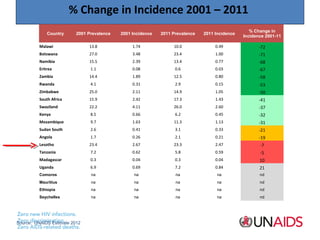
25 April 2013, Johannesburg, SA
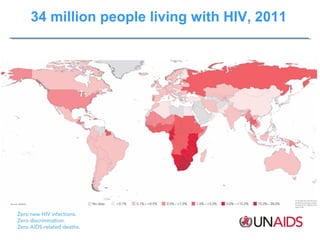
34 million people living with HIV, 2011
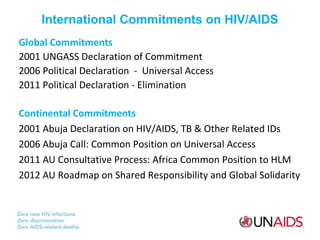
International Commitments on HIV/AIDS
Global Commitments
2001 UNGASS Declaration of Commitment
2006 Political Declaration - Universal Access
2011 Political Declaration - Elimination
Continental Commitments
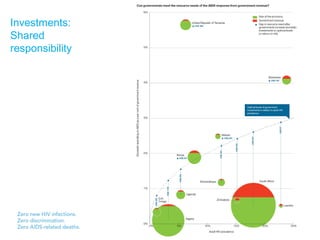
2001 Abuja Declaration on HIV/AIDS, TB & Other Related IDs
2006 Abuja Call: Common Position on Universal Access
2011 AU Consultative Process: Africa Common Position to HLM
2012 AU Roadmap on Shared Responsibility and Global Solidarity
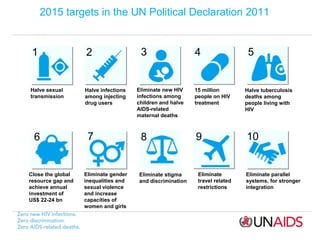
2015 targets in the UN Political Declaration 2011

1

2

Halve sexual
transmission

Halve infections
among injecting
drug users

6

Close the global
resource gap and
achieve annual
investment of
US$ 22-24 bn

7

Eliminate gender
inequalities and
sexual violence
and increase
capacities of
women and girls

3

Eliminate new HIV
infections among
children and halve
AIDS-related
maternal deaths

8

Eliminate stigma
and discrimination

4

15 million
people on HIV
treatment

9

Eliminate
travel related
restrictions

5

Halve tuberculosis
deaths among
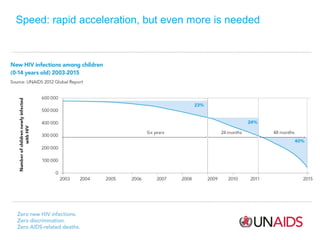
people living with
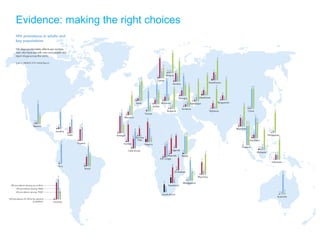
HIV

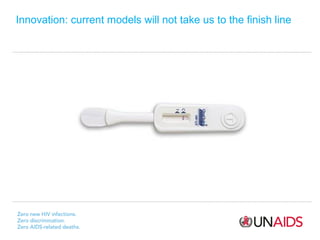
10

Eliminate parallel
systems, for stronger
integration
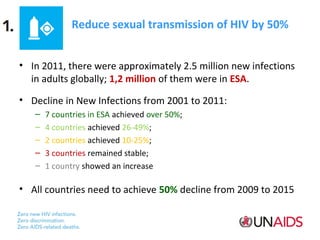
Reduce sexual transmission of HIV by 50%
• In 2011, there were approximately 2.5 million new infections
in adults globally; 1,2 million of them were in ESA.
• Decline in New Infections from 2001 to 2011:
–
–
–
–
–

7 countries in ESA achieved over 50%;
4 countries achieved 26-49%;
2 countries achieved 10-25%;
3 countries remained stable;
1 country showed an increase

• All countries need to achieve 50% decline from 2009 to 2015
% Change in Incidence 2001 – 2011
2001 Prevalence

2001 Incidence

2011 Prevalence

2011 Incidence

% Change in
Incidence 2001-11

Malawi

13.8

1.74

10.0

0.49

-72

Botswana

27.0

3.48

23.4

1.00

-71

Namibia

15.5

2.39

13.4

0.77

-68

Eritrea

1.1

0.08

0.6

0.03

-67

Zambia

14.4

1.89

12.5

0.80

-58

Rwanda

4.1

0.31

2.9

0.15

-53

Zimbabwe

25.0

2.11

14.9

1.05

-50

South Africa

15.9

2.42

17.3

1.43

-41

Swaziland

22.2

4.11

26.0

2.60

-37

Kenya

8.5

0.66

6.2

0.45

-32

Mozambique

9.7

1.63

11.3

1.13

-31

Sudan South

2.6

0.41

3.1

0.33

-21

Angola

1.7

0.26

2.1

0.21

-19

Lesotho

23.4

2.67

23.3

2.47

-7

Tanzania

7.2

0.62

5.8

0.59

-5

Madagascar

0.3

0.04

0.3

0.04

10

Uganda

6.9

0.69

7.2

0.84

21

Comoros

na

na

na

na

nd

Mauritius

na

na

na

na

nd

Ethiopia

na

na

na

na

nd

Seychelles

na

na

na

na

nd

Country

Source: UNAIDS Estimate 2012
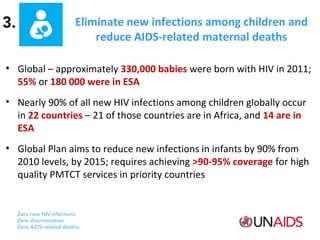
Eliminate new infections among children and
reduce AIDS-related maternal deaths
• Global – approximately 330,000 babies were born with HIV in 2011;
55% or 180 000 were in ESA
• Nearly 90% of all new HIV infections among children globally occur
in 22 countries – 21 of those countries are in Africa, and 14 are in
ESA
• Global Plan aims to reduce new infections in infants by 90% from
2010 levels, by 2015; requires achieving >90-95% coverage for high
quality PMTCT services in priority countries
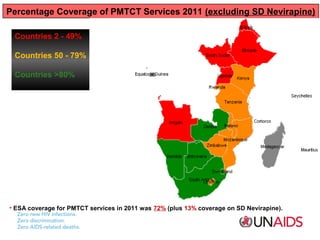
Percentage Coverage of PMTCT Services 2011 (excluding SD Nevirapine)
Countries 2 - 49%
Countries 50 - 79%
Countries >80%

• ESA coverage for PMTCT services in 2011 was 72% (plus 13% coverage on SD Nevirapine).
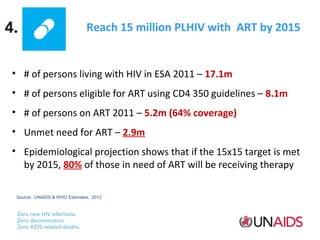
Reach 15 million PLHIV with ART by 2015

• # of persons living with HIV in ESA 2011 – 17.1m
• # of persons eligible for ART using CD4 350 guidelines – 8.1m
• # of persons on ART 2011 – 5.2m (64% coverage)
• Unmet need for ART – 2.9m
• Epidemiological projection shows that if the 15x15 target is met
by 2015, 80% of those in need of ART will be receiving therapy
Source: UNAIDS & WHO Estimates, 2012
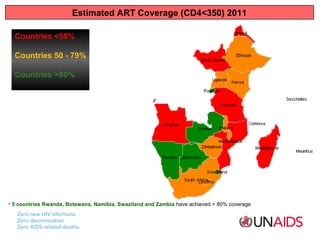
Estimated ART Coverage (CD4<350) 2011
Countries <50%
Countries 50 - 79%
Countries >80%

• 5 countries Rwanda, Botswana, Namibia, Swaziland and Zambia have achieved > 80% coverage
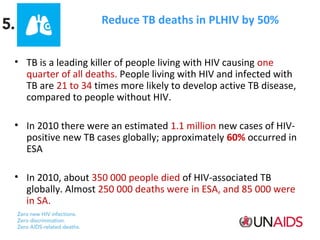
Reduce TB deaths in PLHIV by 50%
• TB is a leading killer of people living with HIV causing one
quarter of all deaths. People living with HIV and infected with
TB are 21 to 34 times more likely to develop active TB disease,
compared to people without HIV.
• In 2010 there were an estimated 1.1 million new cases of HIVpositive new TB cases globally; approximately 60% occurred in
ESA
• In 2010, about 350 000 people died of HIV-associated TB
globally. Almost 250 000 deaths were in ESA, and 85 000 were
in SA.
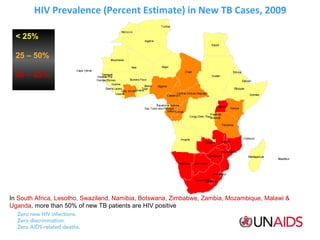
HIV Prevalence (Percent Estimate) in New TB Cases, 2009
< 25%
25 – 50%
50 – 83%

In South Africa, Lesotho, Swaziland, Namibia, Botswana, Zimbabwe, Zambia, Mozambique, Malawi &
Uganda, more than 50% of new TB patients are HIV positive
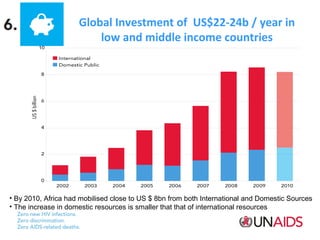
Global Investment of US$22-24b / year in
low and middle income countries

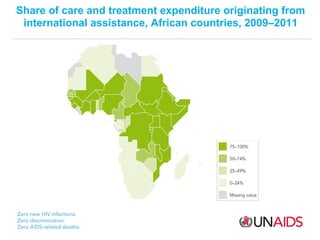
• By 2010, Africa had mobilised close to US $ 8bn from both International and Domestic Sources
• The increase in domestic resources is smaller that that of international resources
Share of care and treatment expenditure originating from
international assistance, African countries, 2009–2011
THIRD GENERATION NSPs
• Changed epidemic context: from public health emergency to
chronic disease
• Changed global economic environment: austerity measures
in donor capitals, growth in Africa, emphasis on ‘managing for
results’ and ‘value for money’.
• Scientific & technological advances: simpler testing,
treatment availability, treatment as prevention, MC, PMTCT
• Taking AIDS out of isolation: greater national and
international interest in integrating AIDS into broader health
and development efforts
• Political Declaration on HIV: Three Zeros, HLM targets and
the centrality of NSPs
Generations of NSPs
• 1st generation of NSPs: 1980s/early 90s; mainly GPA
times (Medium Term Plans); within the health sector
• 2nd generation NSPs: mid-90s; multi-sectoral; NACs;
increased availability of funding, little prioritization
and allocative efficiency
• 3rd generation NSP: post-2015 and the beginning of
the End of AIDS, challenged by signs of donor funding
slowdown
Lessons from NSP 2G
•
•
•
•

Limited focus on implementation,
Low prioritization (high levels of inclusiveness)
Large budgets dedicated to low impact interventions
Costly and complex processes (heavy on time
money & documentation)
• Weak results orientation (processes, not results)
• High costs of stand alone coordination with little
return in terms of effective management for
investment.
What is NSP-3G?
A new initiative from the UNAIDS family to:
• Foster a national planning paradigm shift in
response to the new environment
• Prioritize resource allocation and maximize return to
investment (Investment Thinking)
• Respond to country demand and ownership/
leadership (Paris/Accra/Busan)
• Drive progress towards the UNAIDS vision of the
Three Zeros & meeting the HLM targets
Universal Principles
• Country ownership, shared responsibility & global
solidarity
• Scientific evidence public health considerations are
integral
• Full engagement by CSOs and PLHIV
• Universal and equitable access to AIDS services and
eliminating marginalization
• Advancing human rights and gender justice
n Applying Investment Thinking in Lesotho
Changing environment : shifting priorities, donor fatigue, economic crisis,
national ownership vs. dependency
Business as usual is not an option:
Prioritization
Emphasis on results/ impact
Value for Money/efficiency
Return on Investment
sustainability
Investment Cases: How do we maximize the returns on the Investment
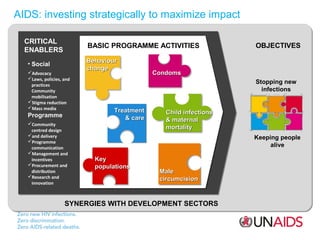
AIDS: investing strategically to maximize impact
CRITICAL
ENABLERS

BASIC PROGRAMME ACTIVITIES

• Social
Advocacy
Laws, policies, and
practices
Community
mobilisation
Stigma reduction
Mass media

Programme
Community
centred design
and delivery
Programme
communication
Management and
incentives
Procurement and
distribution
Research and
innovation

Behaviour
change

OBJECTIVES

Condoms
Stopping new
infections

Treatment
& care

Child infections
& maternal
mortality
Keeping people
alive

Key
populations

Male
circumcision

SYNERGIES WITH DEVELOPMENT SECTORS
Priority Country Actions: Sexual Transmission
• Assist countries identify who is getting infected / who is at risk of
infection (KYE/R)
• Prioritize relevant, effective, and impactful prevention strategies for
different populations (IF)
• Advocate for the scale up Basic Program Activities:
– Increase # of people on ARVs (effect on transmission)
– Scale up male circumcision as a priority
– Behavior change programmes
– Programmes for key populations (almost no data for MSM, sex
work, IDU in region)
– Condom promotion & distribution
• Make smart investments that combine programs with critical
enablers to exploit synergies
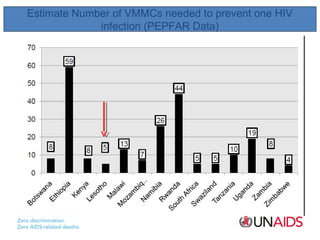
Estimate Number of VMMCs needed to prevent one HIV
infection (PEPFAR Data)
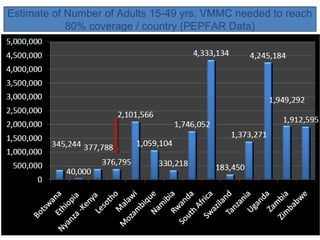
Estimate of Number of Adults 15-49 yrs. VMMC needed to reach
80% coverage / country (PEPFAR Data)
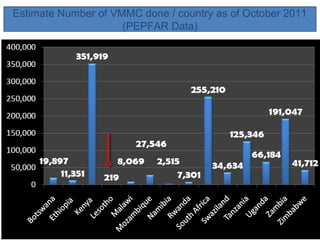
Estimate Number of VMMC done / country as of October 2011
(PEPFAR Data)
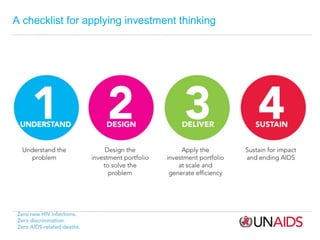
A checklist for applying investment thinking
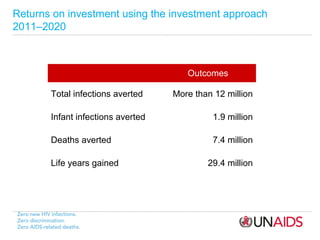
Returns on investment using the investment approach
2011–2020

Outcomes
Total infections averted

More than 12 million

Infant infections averted

1.9 million

Deaths averted

7.4 million

Life years gained

29.4 million
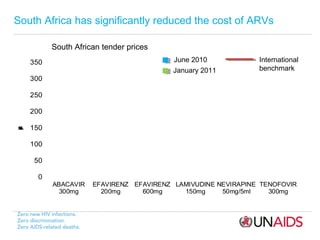
South Africa has significantly reduced the cost of ARVs
South African tender prices
June 2010
January 2011

350

International
benchmark

300
250

)
d
n
R
(
k
a
p
e
c
i
r
P

200
150
100
50
0
ABACAVIR
300mg

EFAVIRENZ EFAVIRENZ LAMIVUDINE NEVIRAPINE TENOFOVIR
200mg
600mg
150mg
50mg/5ml
300mg
Community support keeps people on treatment
CLINIC-BASED TREATMENT

70%

still receiving treatment after two years
Sub-Saharan Africa: people
receiving ART from specialist
clinics
Source: Fox MP, Rosen S. Patient retention in antiretroviral therapy programs up to three years on treatment in subSaharan Africa, 2007–2009: systematic review. Tropical Medicine and International Health, 2010, 15(Suppl. 1):1–15.

COMMUNITY TREATMENT MODEL

98%

still receiving treatment after two years
Mozambique: self-initiated
community model
Source: Decroo T et al. Distribution of antiretroviral treatment through self-forming groups of patients in Tete province,
Mozambique. Journal of Acquired Immune Deficiency Syndromes, 2010 [Epub ahead of print].
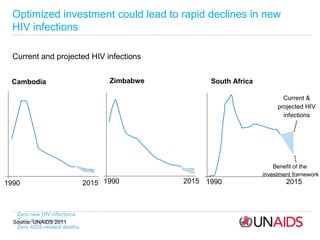
Optimized investment could lead to rapid declines in new
HIV infections
Current and projected HIV infections
Cambodia

Zimbabwe

South Africa
Current &
projected HIV
infections

1990

Source: UNAIDS 2011

2015 1990

2015 1990

Benefit of the
investment framework

2015
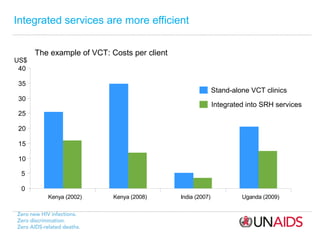
Integrated services are more efficient

US$
40

The example of VCT: Costs per client

35

Stand-alone VCT clinics

30

Integrated into SRH services

25
20
15
10
5
0
Kenya (2002)

Kenya (2008)

India (2007)

Uganda (2009)
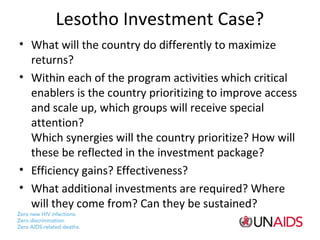
Lesotho Investment Case?
• What will the country do differently to maximize
returns?
• Within each of the program activities which critical
enablers is the country prioritizing to improve access
and scale up, which groups will receive special
attention?
Which synergies will the country prioritize? How will
these be reflected in the investment package?
• Efficiency gains? Effectiveness?
• What additional investments are required? Where
will they come from? Can they be sustained?
VISION
ZERO NEW HIV INFECTIONS.
ZERO DISCRIMINATION.

ZERO AIDS-RELATED DEATHS.

16 October 2006

UNAIDS
AIDS in the Post-2015 Development
Agenda
Brazey de Zalduondo
Sonja Tanaka
24 March 2013
UNAIDS overarching messaging

•

Investing in health. Need a fresh narrative to convince leaders to invest more –
health reduces inequality; health mobilizes people for building democratic
accountability; health cooperation can be a tool for diplomacy; offers entry point
for human rights.

•

AIDS is not over. Priority is to ensure HIV is prominently positioned in the post2015 agenda, including ambitious, measurable targets towards the end of AIDS.

•

End of AIDS. With political commitment, community mobilization, adequate
funding and the right approaches, the end of AIDS can be a shared triumph of the
post-2015 era.

•

Transforming health. Approaches from the AIDS response, including inclusive,
people-centred, multi-sectoral action, can be applied to transforming the way
countries and their partners do health and development.
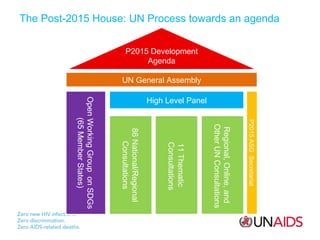
The Post-2015 House: UN Process towards an agenda
P2015 Development
Agenda

UN General Assembly

P2015 ASG Secretariat

Regional, Online, and
Other UN Consultations

11 Thematic
Consultations

86 National/Regional
Consultations

Open Working Group on SDGs
(65 Member States)

High Level Panel
UNAIDS engagement & advocacy targets
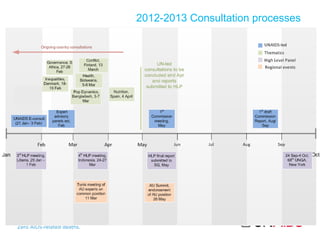
 UNAIDS engaged in 7 / 11 Thematics: Inequalities, Education, Food security and
nutrition, Governance, Conflict and fragility, Population dynamics & Health.
 Joint UNAIDS paper w Cosponsors with key messages on health, human rights and
social transformation.
 UCOs have engaged in Country Consultations (completed or underway, led by
UNCT)
 Global online conversation on worldwewant2015.org and myworld2015.org
 Civil Society Consultations
 Lancet Commission
 UN SG’s High Level Panel, chairs: President Yudhoyono (Indonesia), President
Johnson Sirleaf (Liberia) and PM Cameron (UK)
 Open Working Group on Sustainable Development Goals (incl. Algeria, Egypt,
Morocco, Tunisia; Benin, Ghana, Congo; Kenya, Tanzania, Zambia & Zimbabwe)
2012-2013 Consultation processes
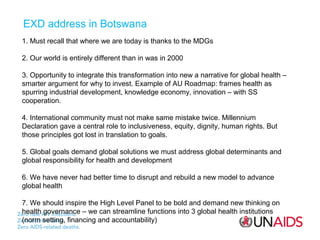
EXD address in Botswana
1. Must recall that where we are today is thanks to the MDGs
2. Our world is entirely different than in was in 2000
3. Opportunity to integrate this transformation into new a narrative for global health –
smarter argument for why to invest. Example of AU Roadmap: frames health as
spurring industrial development, knowledge economy, innovation – with SS
cooperation.
4. International community must not make same mistake twice. Millennium
Declaration gave a central role to inclusiveness, equity, dignity, human rights. But
those principles got lost in translation to goals.
5. Global goals demand global solutions we must address global determinants and
global responsibility for health and development
6. We have never had better time to disrupt and rebuild a new model to advance
global health
7. We should inspire the High Level Panel to be bold and demand new thinking on
health governance – we can streamline functions into 3 global health institutions
(norm setting, financing and accountability)
Outcomes of Botswana Health Consultation, 5 March

 Future health goals need to reflect universal realities –be
relevant in all countries (HICs as well) and address equity
(distribution) and rights
 Goals must be tracked globally but catalyse progress and
monitor success in terms of the reality that each country faces
 The MDG agenda must be accelerated to 2015 and continued
with updated targets - including through target to realise an
AIDS-free generation
Themes and concerns emerging from the consultations

 Continued relevance of the MDGs (human development agenda)
 Need also to incorporate key issues the MDGs left out – including
 Over all: universality, equity, quality
 In health – NCDs (“double burden” of IDs and NCDs)
 Address social determinants – through policies and investments
 Need to combat growing inequality – disparities within as well as
between countries
 Investment in data, and use of data, at national and sub-national
levels. Aim for data disaggregated by sex, age, geography – and
more.
 Interconnectedness of goals – be smarter, prevent “stove-piping”
 Human right are central; need national and regional mechanisms
UNAIDS and Lancet Commission: From AIDS to
Sustainable Health
 Hope that Commission will be seen to have legitimacy and influence to
drive political movement for AIDS and health
 High level political Commission with a dynamic programme to produce:
o space for systematic analysis of evidence
o sharp critique
o robust recommendations
 Co-Chairs: President Joyce Banda; Dr Nkosazana Dlamini Zuma
(Chairperson, AUC); Dr Peter Piot (Director, LSHTM)
 First meeting: Lilongwe, 28-29 June
 Outcome: Lancet special issue early 2014
Commission will address three questions

 What will it take to bring about the end of AIDS?

 How can the experience of the AIDS response serve as a
transformative force in our approach to global health?

 If we imagine a more equitable, effective and sustainable global health
paradigm, how must the national and global AIDS architecture be
similarly modernised?
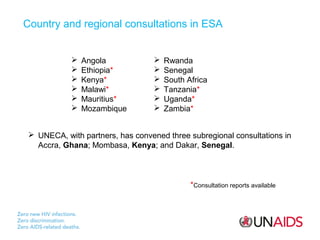
Country and regional consultations in ESA







Angola
Ethiopia*
Kenya*
Malawi*
Mauritius*
Mozambique








Rwanda
Senegal
South Africa
Tanzania*
Uganda*
Zambia*

 UNECA, with partners, has convened three subregional consultations in
Accra, Ghana; Mombasa, Kenya; and Dakar, Senegal.

*Consultation reports available
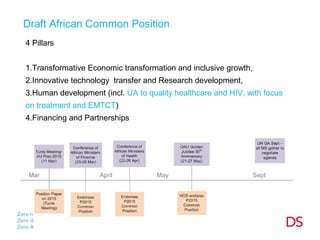
Draft African Common Position
4 Pillars
1.Transformative Economic transformation and inclusive growth,
2.Innovative technology transfer and Research development,
3.Human development (incl. UA to quality healthcare and HIV, with focus
on treatment and EMTCT)
4.Financing and Partnerships

Mar

April

May

Sept
Role of UCCs and RSTs moving forward
 ESA must be leading voice for HIV in the next development agenda
 Ultimately Member States will decide the agenda and framework
 UCCs and RSTs responsible to identify, target and support:
 Champions for UNAIDS vision and agenda
 Government and civil society focal points on P2015 at country level
 MS members of the Open Working Group
 MS delegations to Sept UNGA
 Lancet Commissioners
DISCUSSION

 UCO and RST advocacy strategies
 Connecting messaging to political priorities for regional political
institutions
 Upcoming political opportunities
 Internal communication, support from Geneva
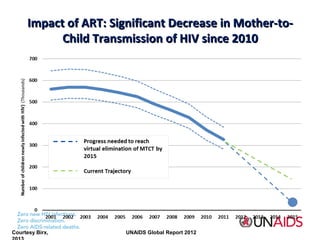
Impact of ART: Significant Decrease in Mother-toChild Transmission of HIV since 2010

Courtesy Birx,

UNAIDS Global Report 2012
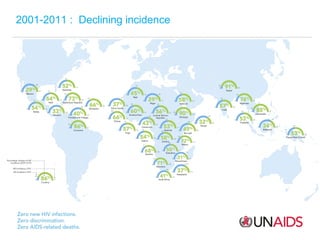
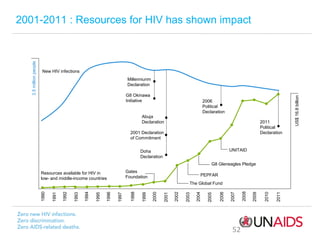
2001-2011 : Declining incidence
New HIV infections

G8 Okinawa
Initiative

2006
Political
Declaration

Abuja
Declaration

2011
Political
Declaration

2001 Declaration
of Commitment
UNITAID

Doha
Declaration

G8 Gleneagles Pledge
Gates
Foundation

PEPFAR

52

2011

2010

2009

2008

2007

2006

2005

2004

2003

2002

2001

2000

1999

1998

The Global Fund
1997

1996

1995

1994

1993

1992

1991

Resources available for HIV in
low- and middle-income countries

US$ 16.8 billion

Millenniunm
Declaration

1990

3.5 million people

2001-2011 : Resources for HIV has shown impact
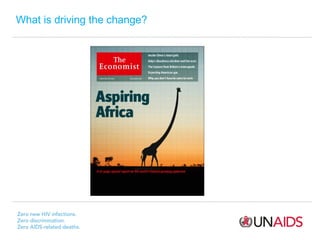
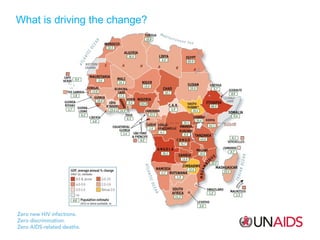
What is driving the change?
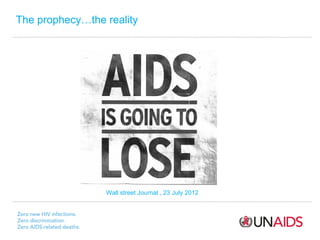
The prophecy…the reality

Wall street Journal , 23 July 2012
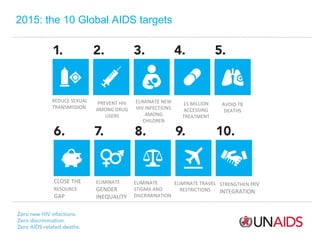
2015: the 10 Global AIDS targets

REDUCE SEXUAL
TRANSMISSION

PREVENT HIV
AMONG DRUG
USERS

CLOSE THE

ELIMINATE

RESOURCE

GENDER
INEQUALITY

GAP

ELIMINATE NEW
HIV INFECTIONS
AMONG
CHILDREN

15 MILLION
ACCESSING
TREATMENT

AVOID TB
DEATHS

ELIMINATE
ELIMINATE TRAVEL STRENGTHEN HIV
STIGMA AND
RESTRICTIONS
INTEGRATION
DISCRIMINATION
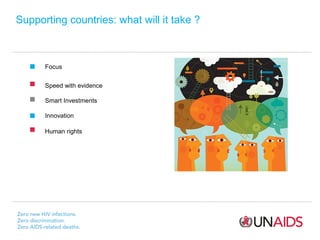
Supporting countries: what will it take ?

Focus
Speed with evidence
Smart Investments
Innovation
Human rights
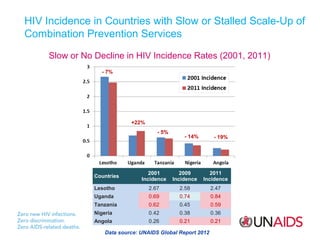
HIV Incidence in Countries with Slow or Stalled Scale-Up of
Combination Prevention Services
Slow or No Decline in HIV Incidence Rates (2001, 2011)
- 7%

+22%
- 5%

- 14%

- 19%

2001
Incidence

2009
Incidence

2011
Incidence

Lesotho

2.67

2.58

2.47

Uganda

0.69

0.74

0.84

Tanzania

0.62

0.45

0.59

Nigeria

0.42

0.38

0.36

Angola

0.26

0.21

0.21

Countries

Data source: UNAIDS Global Report 2012
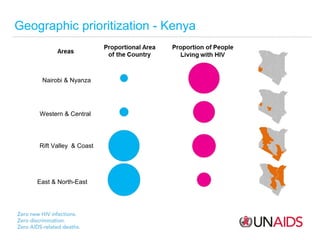
Geographic prioritization - Kenya

Nairobi & Nyanza

Western & Central

Rift Valley & Coast

East & North-East
Speed: rapid acceleration, but even more is needed
Evidence: making the right choices
Innovation: current models will not take us to the finish line
Community support keeps people on treatment
CLINIC-BASED TREATMENT

70%

still receiving treatment after two years
Sub-Saharan Africa: people
receiving ART from specialist
clinics
Source: Fox MP, Rosen S. Patient retention in antiretroviral therapy programs up to three years on treatment in subSaharan Africa, 2007–2009: systematic review. Tropical Medicine and International Health, 2010, 15(Suppl. 1):1–15.

COMMUNITY TREATMENT MODEL

98%

still receiving treatment after two years
Mozambique: self-initiated
community model
Source: Decroo T et al. Distribution of antiretroviral treatment through self-forming groups of patients in Tete province,
Mozambique. Journal of Acquired Immune Deficiency Syndromes, 2010 [Epub ahead of print].

Sources: Fox MP, Rosen S. Tropical Medicine and International Health, 2010;
Decroo T et al. Journal of Acquired Immune Deficiency Syndromes, 2010.
Investments:
Shared
responsibility
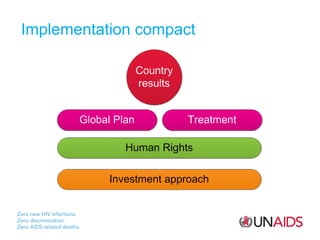
Implementation compact
Activity 3: Next 1000 Infections
• Where are your next 1000 infections likely to
come from?
– fill out the second thoughts column
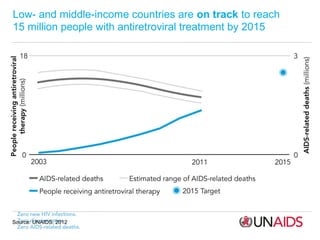
Low- and middle-income countries are on track to reach
15 million people with antiretroviral treatment by 2015

Source: UNAIDS, 2012

Post 2015 agenda & aids coordination

  • 1.
    Overview of AIDSEpidemic in Eastern and Southern Africa and progress towards meeting the HLM Targets Pride Chigwedere, MD, PhD, Coordinator for Universal Access, UNAIDS Regional Support Team for Eastern and Southern Africa 25 April 2013, Johannesburg, SA
  • 2.
    34 million peopleliving with HIV, 2011
  • 3.
    International Commitments onHIV/AIDS Global Commitments 2001 UNGASS Declaration of Commitment 2006 Political Declaration - Universal Access 2011 Political Declaration - Elimination Continental Commitments 2001 Abuja Declaration on HIV/AIDS, TB & Other Related IDs 2006 Abuja Call: Common Position on Universal Access 2011 AU Consultative Process: Africa Common Position to HLM 2012 AU Roadmap on Shared Responsibility and Global Solidarity
  • 4.
    2015 targets inthe UN Political Declaration 2011 1 2 Halve sexual transmission Halve infections among injecting drug users 6 Close the global resource gap and achieve annual investment of US$ 22-24 bn 7 Eliminate gender inequalities and sexual violence and increase capacities of women and girls 3 Eliminate new HIV infections among children and halve AIDS-related maternal deaths 8 Eliminate stigma and discrimination 4 15 million people on HIV treatment 9 Eliminate travel related restrictions 5 Halve tuberculosis deaths among people living with HIV 10 Eliminate parallel systems, for stronger integration
  • 5.
    Reduce sexual transmissionof HIV by 50% • In 2011, there were approximately 2.5 million new infections in adults globally; 1,2 million of them were in ESA. • Decline in New Infections from 2001 to 2011: – – – – – 7 countries in ESA achieved over 50%; 4 countries achieved 26-49%; 2 countries achieved 10-25%; 3 countries remained stable; 1 country showed an increase • All countries need to achieve 50% decline from 2009 to 2015
  • 6.
    % Change inIncidence 2001 – 2011 2001 Prevalence 2001 Incidence 2011 Prevalence 2011 Incidence % Change in Incidence 2001-11 Malawi 13.8 1.74 10.0 0.49 -72 Botswana 27.0 3.48 23.4 1.00 -71 Namibia 15.5 2.39 13.4 0.77 -68 Eritrea 1.1 0.08 0.6 0.03 -67 Zambia 14.4 1.89 12.5 0.80 -58 Rwanda 4.1 0.31 2.9 0.15 -53 Zimbabwe 25.0 2.11 14.9 1.05 -50 South Africa 15.9 2.42 17.3 1.43 -41 Swaziland 22.2 4.11 26.0 2.60 -37 Kenya 8.5 0.66 6.2 0.45 -32 Mozambique 9.7 1.63 11.3 1.13 -31 Sudan South 2.6 0.41 3.1 0.33 -21 Angola 1.7 0.26 2.1 0.21 -19 Lesotho 23.4 2.67 23.3 2.47 -7 Tanzania 7.2 0.62 5.8 0.59 -5 Madagascar 0.3 0.04 0.3 0.04 10 Uganda 6.9 0.69 7.2 0.84 21 Comoros na na na na nd Mauritius na na na na nd Ethiopia na na na na nd Seychelles na na na na nd Country Source: UNAIDS Estimate 2012
  • 7.
    Eliminate new infectionsamong children and reduce AIDS-related maternal deaths • Global – approximately 330,000 babies were born with HIV in 2011; 55% or 180 000 were in ESA • Nearly 90% of all new HIV infections among children globally occur in 22 countries – 21 of those countries are in Africa, and 14 are in ESA • Global Plan aims to reduce new infections in infants by 90% from 2010 levels, by 2015; requires achieving >90-95% coverage for high quality PMTCT services in priority countries
  • 8.
    Percentage Coverage ofPMTCT Services 2011 (excluding SD Nevirapine) Countries 2 - 49% Countries 50 - 79% Countries >80% • ESA coverage for PMTCT services in 2011 was 72% (plus 13% coverage on SD Nevirapine).
  • 9.
    Reach 15 millionPLHIV with ART by 2015 • # of persons living with HIV in ESA 2011 – 17.1m • # of persons eligible for ART using CD4 350 guidelines – 8.1m • # of persons on ART 2011 – 5.2m (64% coverage) • Unmet need for ART – 2.9m • Epidemiological projection shows that if the 15x15 target is met by 2015, 80% of those in need of ART will be receiving therapy Source: UNAIDS & WHO Estimates, 2012
  • 10.
    Estimated ART Coverage(CD4<350) 2011 Countries <50% Countries 50 - 79% Countries >80% • 5 countries Rwanda, Botswana, Namibia, Swaziland and Zambia have achieved > 80% coverage
  • 11.
    Reduce TB deathsin PLHIV by 50% • TB is a leading killer of people living with HIV causing one quarter of all deaths. People living with HIV and infected with TB are 21 to 34 times more likely to develop active TB disease, compared to people without HIV. • In 2010 there were an estimated 1.1 million new cases of HIVpositive new TB cases globally; approximately 60% occurred in ESA • In 2010, about 350 000 people died of HIV-associated TB globally. Almost 250 000 deaths were in ESA, and 85 000 were in SA.
  • 12.
    HIV Prevalence (PercentEstimate) in New TB Cases, 2009 < 25% 25 – 50% 50 – 83% In South Africa, Lesotho, Swaziland, Namibia, Botswana, Zimbabwe, Zambia, Mozambique, Malawi & Uganda, more than 50% of new TB patients are HIV positive
  • 13.
    Global Investment ofUS$22-24b / year in low and middle income countries • By 2010, Africa had mobilised close to US $ 8bn from both International and Domestic Sources • The increase in domestic resources is smaller that that of international resources
  • 14.
    Share of careand treatment expenditure originating from international assistance, African countries, 2009–2011
  • 15.
    THIRD GENERATION NSPs •Changed epidemic context: from public health emergency to chronic disease • Changed global economic environment: austerity measures in donor capitals, growth in Africa, emphasis on ‘managing for results’ and ‘value for money’. • Scientific & technological advances: simpler testing, treatment availability, treatment as prevention, MC, PMTCT • Taking AIDS out of isolation: greater national and international interest in integrating AIDS into broader health and development efforts • Political Declaration on HIV: Three Zeros, HLM targets and the centrality of NSPs
  • 16.
    Generations of NSPs •1st generation of NSPs: 1980s/early 90s; mainly GPA times (Medium Term Plans); within the health sector • 2nd generation NSPs: mid-90s; multi-sectoral; NACs; increased availability of funding, little prioritization and allocative efficiency • 3rd generation NSP: post-2015 and the beginning of the End of AIDS, challenged by signs of donor funding slowdown
  • 17.
    Lessons from NSP2G • • • • Limited focus on implementation, Low prioritization (high levels of inclusiveness) Large budgets dedicated to low impact interventions Costly and complex processes (heavy on time money & documentation) • Weak results orientation (processes, not results) • High costs of stand alone coordination with little return in terms of effective management for investment.
  • 18.
    What is NSP-3G? Anew initiative from the UNAIDS family to: • Foster a national planning paradigm shift in response to the new environment • Prioritize resource allocation and maximize return to investment (Investment Thinking) • Respond to country demand and ownership/ leadership (Paris/Accra/Busan) • Drive progress towards the UNAIDS vision of the Three Zeros & meeting the HLM targets
  • 19.
    Universal Principles • Countryownership, shared responsibility & global solidarity • Scientific evidence public health considerations are integral • Full engagement by CSOs and PLHIV • Universal and equitable access to AIDS services and eliminating marginalization • Advancing human rights and gender justice
  • 20.
    n Applying InvestmentThinking in Lesotho Changing environment : shifting priorities, donor fatigue, economic crisis, national ownership vs. dependency Business as usual is not an option: Prioritization Emphasis on results/ impact Value for Money/efficiency Return on Investment sustainability Investment Cases: How do we maximize the returns on the Investment
  • 21.
    AIDS: investing strategicallyto maximize impact CRITICAL ENABLERS BASIC PROGRAMME ACTIVITIES • Social Advocacy Laws, policies, and practices Community mobilisation Stigma reduction Mass media Programme Community centred design and delivery Programme communication Management and incentives Procurement and distribution Research and innovation Behaviour change OBJECTIVES Condoms Stopping new infections Treatment & care Child infections & maternal mortality Keeping people alive Key populations Male circumcision SYNERGIES WITH DEVELOPMENT SECTORS
  • 22.
    Priority Country Actions:Sexual Transmission • Assist countries identify who is getting infected / who is at risk of infection (KYE/R) • Prioritize relevant, effective, and impactful prevention strategies for different populations (IF) • Advocate for the scale up Basic Program Activities: – Increase # of people on ARVs (effect on transmission) – Scale up male circumcision as a priority – Behavior change programmes – Programmes for key populations (almost no data for MSM, sex work, IDU in region) – Condom promotion & distribution • Make smart investments that combine programs with critical enablers to exploit synergies
  • 23.
    Estimate Number ofVMMCs needed to prevent one HIV infection (PEPFAR Data)
  • 24.
    Estimate of Numberof Adults 15-49 yrs. VMMC needed to reach 80% coverage / country (PEPFAR Data)
  • 25.
    Estimate Number ofVMMC done / country as of October 2011 (PEPFAR Data)
  • 26.
    A checklist forapplying investment thinking
  • 27.
    Returns on investmentusing the investment approach 2011–2020 Outcomes Total infections averted More than 12 million Infant infections averted 1.9 million Deaths averted 7.4 million Life years gained 29.4 million
  • 28.
    South Africa hassignificantly reduced the cost of ARVs South African tender prices June 2010 January 2011 350 International benchmark 300 250 ) d n R ( k a p e c i r P 200 150 100 50 0 ABACAVIR 300mg EFAVIRENZ EFAVIRENZ LAMIVUDINE NEVIRAPINE TENOFOVIR 200mg 600mg 150mg 50mg/5ml 300mg
  • 29.
    Community support keepspeople on treatment CLINIC-BASED TREATMENT 70% still receiving treatment after two years Sub-Saharan Africa: people receiving ART from specialist clinics Source: Fox MP, Rosen S. Patient retention in antiretroviral therapy programs up to three years on treatment in subSaharan Africa, 2007–2009: systematic review. Tropical Medicine and International Health, 2010, 15(Suppl. 1):1–15. COMMUNITY TREATMENT MODEL 98% still receiving treatment after two years Mozambique: self-initiated community model Source: Decroo T et al. Distribution of antiretroviral treatment through self-forming groups of patients in Tete province, Mozambique. Journal of Acquired Immune Deficiency Syndromes, 2010 [Epub ahead of print].
  • 30.
    Optimized investment couldlead to rapid declines in new HIV infections Current and projected HIV infections Cambodia Zimbabwe South Africa Current & projected HIV infections 1990 Source: UNAIDS 2011 2015 1990 2015 1990 Benefit of the investment framework 2015
  • 31.
    Integrated services aremore efficient US$ 40 The example of VCT: Costs per client 35 Stand-alone VCT clinics 30 Integrated into SRH services 25 20 15 10 5 0 Kenya (2002) Kenya (2008) India (2007) Uganda (2009)
  • 32.
    Lesotho Investment Case? •What will the country do differently to maximize returns? • Within each of the program activities which critical enablers is the country prioritizing to improve access and scale up, which groups will receive special attention? Which synergies will the country prioritize? How will these be reflected in the investment package? • Efficiency gains? Effectiveness? • What additional investments are required? Where will they come from? Can they be sustained?
  • 33.
    VISION ZERO NEW HIVINFECTIONS. ZERO DISCRIMINATION. ZERO AIDS-RELATED DEATHS. 16 October 2006 UNAIDS
  • 34.
    AIDS in thePost-2015 Development Agenda Brazey de Zalduondo Sonja Tanaka 24 March 2013
  • 35.
    UNAIDS overarching messaging • Investingin health. Need a fresh narrative to convince leaders to invest more – health reduces inequality; health mobilizes people for building democratic accountability; health cooperation can be a tool for diplomacy; offers entry point for human rights. • AIDS is not over. Priority is to ensure HIV is prominently positioned in the post2015 agenda, including ambitious, measurable targets towards the end of AIDS. • End of AIDS. With political commitment, community mobilization, adequate funding and the right approaches, the end of AIDS can be a shared triumph of the post-2015 era. • Transforming health. Approaches from the AIDS response, including inclusive, people-centred, multi-sectoral action, can be applied to transforming the way countries and their partners do health and development.
  • 36.
    The Post-2015 House:UN Process towards an agenda P2015 Development Agenda UN General Assembly P2015 ASG Secretariat Regional, Online, and Other UN Consultations 11 Thematic Consultations 86 National/Regional Consultations Open Working Group on SDGs (65 Member States) High Level Panel
  • 37.
    UNAIDS engagement &advocacy targets  UNAIDS engaged in 7 / 11 Thematics: Inequalities, Education, Food security and nutrition, Governance, Conflict and fragility, Population dynamics & Health.  Joint UNAIDS paper w Cosponsors with key messages on health, human rights and social transformation.  UCOs have engaged in Country Consultations (completed or underway, led by UNCT)  Global online conversation on worldwewant2015.org and myworld2015.org  Civil Society Consultations  Lancet Commission  UN SG’s High Level Panel, chairs: President Yudhoyono (Indonesia), President Johnson Sirleaf (Liberia) and PM Cameron (UK)  Open Working Group on Sustainable Development Goals (incl. Algeria, Egypt, Morocco, Tunisia; Benin, Ghana, Congo; Kenya, Tanzania, Zambia & Zimbabwe)
  • 38.
  • 39.
    EXD address inBotswana 1. Must recall that where we are today is thanks to the MDGs 2. Our world is entirely different than in was in 2000 3. Opportunity to integrate this transformation into new a narrative for global health – smarter argument for why to invest. Example of AU Roadmap: frames health as spurring industrial development, knowledge economy, innovation – with SS cooperation. 4. International community must not make same mistake twice. Millennium Declaration gave a central role to inclusiveness, equity, dignity, human rights. But those principles got lost in translation to goals. 5. Global goals demand global solutions we must address global determinants and global responsibility for health and development 6. We have never had better time to disrupt and rebuild a new model to advance global health 7. We should inspire the High Level Panel to be bold and demand new thinking on health governance – we can streamline functions into 3 global health institutions (norm setting, financing and accountability)
  • 40.
    Outcomes of BotswanaHealth Consultation, 5 March  Future health goals need to reflect universal realities –be relevant in all countries (HICs as well) and address equity (distribution) and rights  Goals must be tracked globally but catalyse progress and monitor success in terms of the reality that each country faces  The MDG agenda must be accelerated to 2015 and continued with updated targets - including through target to realise an AIDS-free generation
  • 41.
    Themes and concernsemerging from the consultations  Continued relevance of the MDGs (human development agenda)  Need also to incorporate key issues the MDGs left out – including  Over all: universality, equity, quality  In health – NCDs (“double burden” of IDs and NCDs)  Address social determinants – through policies and investments  Need to combat growing inequality – disparities within as well as between countries  Investment in data, and use of data, at national and sub-national levels. Aim for data disaggregated by sex, age, geography – and more.  Interconnectedness of goals – be smarter, prevent “stove-piping”  Human right are central; need national and regional mechanisms
  • 42.
    UNAIDS and LancetCommission: From AIDS to Sustainable Health  Hope that Commission will be seen to have legitimacy and influence to drive political movement for AIDS and health  High level political Commission with a dynamic programme to produce: o space for systematic analysis of evidence o sharp critique o robust recommendations  Co-Chairs: President Joyce Banda; Dr Nkosazana Dlamini Zuma (Chairperson, AUC); Dr Peter Piot (Director, LSHTM)  First meeting: Lilongwe, 28-29 June  Outcome: Lancet special issue early 2014
  • 43.
    Commission will addressthree questions  What will it take to bring about the end of AIDS?  How can the experience of the AIDS response serve as a transformative force in our approach to global health?  If we imagine a more equitable, effective and sustainable global health paradigm, how must the national and global AIDS architecture be similarly modernised?
  • 44.
    Country and regionalconsultations in ESA       Angola Ethiopia* Kenya* Malawi* Mauritius* Mozambique       Rwanda Senegal South Africa Tanzania* Uganda* Zambia*  UNECA, with partners, has convened three subregional consultations in Accra, Ghana; Mombasa, Kenya; and Dakar, Senegal. *Consultation reports available
  • 45.
    Draft African CommonPosition 4 Pillars 1.Transformative Economic transformation and inclusive growth, 2.Innovative technology transfer and Research development, 3.Human development (incl. UA to quality healthcare and HIV, with focus on treatment and EMTCT) 4.Financing and Partnerships Mar April May Sept
  • 46.
    Role of UCCsand RSTs moving forward  ESA must be leading voice for HIV in the next development agenda  Ultimately Member States will decide the agenda and framework  UCCs and RSTs responsible to identify, target and support:  Champions for UNAIDS vision and agenda  Government and civil society focal points on P2015 at country level  MS members of the Open Working Group  MS delegations to Sept UNGA  Lancet Commissioners
  • 47.
    DISCUSSION  UCO andRST advocacy strategies  Connecting messaging to political priorities for regional political institutions  Upcoming political opportunities  Internal communication, support from Geneva
  • 48.
    Impact of ART:Significant Decrease in Mother-toChild Transmission of HIV since 2010 Courtesy Birx, UNAIDS Global Report 2012
  • 49.
  • 50.
    New HIV infections G8Okinawa Initiative 2006 Political Declaration Abuja Declaration 2011 Political Declaration 2001 Declaration of Commitment UNITAID Doha Declaration G8 Gleneagles Pledge Gates Foundation PEPFAR 52 2011 2010 2009 2008 2007 2006 2005 2004 2003 2002 2001 2000 1999 1998 The Global Fund 1997 1996 1995 1994 1993 1992 1991 Resources available for HIV in low- and middle-income countries US$ 16.8 billion Millenniunm Declaration 1990 3.5 million people 2001-2011 : Resources for HIV has shown impact
  • 51.
    What is drivingthe change?
  • 52.
    What is drivingthe change?
  • 53.
    The prophecy…the reality Wallstreet Journal , 23 July 2012
  • 54.
    2015: the 10Global AIDS targets REDUCE SEXUAL TRANSMISSION PREVENT HIV AMONG DRUG USERS CLOSE THE ELIMINATE RESOURCE GENDER INEQUALITY GAP ELIMINATE NEW HIV INFECTIONS AMONG CHILDREN 15 MILLION ACCESSING TREATMENT AVOID TB DEATHS ELIMINATE ELIMINATE TRAVEL STRENGTHEN HIV STIGMA AND RESTRICTIONS INTEGRATION DISCRIMINATION
  • 55.
    Supporting countries: whatwill it take ? Focus Speed with evidence Smart Investments Innovation Human rights
  • 56.
    HIV Incidence inCountries with Slow or Stalled Scale-Up of Combination Prevention Services Slow or No Decline in HIV Incidence Rates (2001, 2011) - 7% +22% - 5% - 14% - 19% 2001 Incidence 2009 Incidence 2011 Incidence Lesotho 2.67 2.58 2.47 Uganda 0.69 0.74 0.84 Tanzania 0.62 0.45 0.59 Nigeria 0.42 0.38 0.36 Angola 0.26 0.21 0.21 Countries Data source: UNAIDS Global Report 2012
  • 57.
    Geographic prioritization -Kenya Nairobi & Nyanza Western & Central Rift Valley & Coast East & North-East
  • 58.
    Speed: rapid acceleration,but even more is needed
  • 59.
    Evidence: making theright choices
  • 60.
    Innovation: current modelswill not take us to the finish line
  • 61.
    Community support keepspeople on treatment CLINIC-BASED TREATMENT 70% still receiving treatment after two years Sub-Saharan Africa: people receiving ART from specialist clinics Source: Fox MP, Rosen S. Patient retention in antiretroviral therapy programs up to three years on treatment in subSaharan Africa, 2007–2009: systematic review. Tropical Medicine and International Health, 2010, 15(Suppl. 1):1–15. COMMUNITY TREATMENT MODEL 98% still receiving treatment after two years Mozambique: self-initiated community model Source: Decroo T et al. Distribution of antiretroviral treatment through self-forming groups of patients in Tete province, Mozambique. Journal of Acquired Immune Deficiency Syndromes, 2010 [Epub ahead of print]. Sources: Fox MP, Rosen S. Tropical Medicine and International Health, 2010; Decroo T et al. Journal of Acquired Immune Deficiency Syndromes, 2010.
  • 62.
  • 63.
  • 64.
    Activity 3: Next1000 Infections • Where are your next 1000 infections likely to come from? – fill out the second thoughts column
  • 65.
    Low- and middle-incomecountries are on track to reach 15 million people with antiretroviral treatment by 2015 Source: UNAIDS, 2012

Editor's Notes

  • #39 Reminder – the multiple activities convened by the UN
  • #40 Thematic consultations: Hosted by UN &amp; CSOs Country/Regl Consultations funded by UNDG The High-level Panel of Eminent Persons was appointed by the Secretary-General. Convened from July 2012 to provide recommendations on possible components of a post-2015 UN development agenda, as well as to contribute to the overall political process. The Panel will deliver its report in the second quarter of 2013. Meets end January in Liberia and March in Botswana. 22 Jan – UN GA established Open Working Group tasked with developing a set of sustainable development goals – in line with Rio+20 recommendation. Considered an integral part of the post-2015 development framework. Group will produce a report to the General Assembly sometime between September 2013-September 2014. Group comprising 30 countries. The goals should address in a balanced way all three dimensions of sustainable development and be coherent with and integrated into the UN development agenda beyond 2015.
  • #41 Talk through the thematics most relevant to UNAIDS
  • #43 UNAIDS saw something of progress/victory concerning UHC, which had been promoted by WHO as overarching health goal. Necessary, yes, but not an end. Didnt address determinants, access.
  • #44 3 experts panels being convened around 3 questions to provide analytical, technical support Thanks UCCs and RSTs for support in identifying panelists and commissioners – and pushing for involvement Already a lot of excitement and confirmations for commission
  • #45 Waiting for noise of current consultations to die down Bring visibility to AIDS and to new vision for the future of health at highest political level in otherwise very crowded environment Commission seeks to be as diverse as possible
  • #46 3 experts panels being convened around 3 questions to provide analytical, technical support Thanks UCCs and RSTs for support in identifying panelists and commissioners – and pushing for involvement Already a lot of excitement and confirmations for commission
  • #50 Prompt if necessary – re UCCs and RSTs responsible to identify, target and support: Champions for UNAIDS vision and agenda Government and CS leads on P2015 at country level MS members of the Open Working Group MS delegations to Sept GA Lancet Commissioners Internal UNAIDS communication – UCOs/RST/Regional/Geneva [what do UCCs need, and what do RST and HQ need from them to work efficiently and strategically to demonstrate UNAIDS unique value added and to win needed UNGA support? - Opportunistic SI to whom in RST and HQ? Monthly top 3 bullets? Engagement strategy? ]
  • #55 Let us simply look at the GDP changes. Angola for example has seen 20% change. It is time for the Growth dollars to become health dollars And we can help that happen at country. UNAIDS with high level political leadership drive this change. There is a new opportunity to shape the health agenda with a new Africa.