• A South African non-profit organization, founded in 2001,
specializing in HIV and TB disease management
• Funded by USAID since 2002 and PEPFAR since 2004 to support
technical assistance and HIV and TB treatment service delivery in
SA
• Current Global Fund Principal Recipient together with Government
• Right to Care supports Government, Private and Community
Treatment Facilities and aims to build partner’s capacity to deliver
safe, effective and affordable antiretroviral therapy.
• Since 2004 RTC has grown to be one of the largest treatment
groups in South Africa
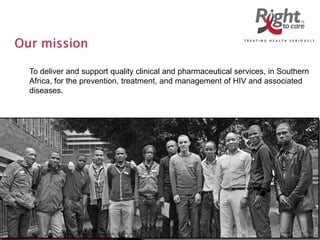
To deliver and support quality clinical and pharmaceutical services, in Southern
Africa, for the prevention, treatment, and management of HIV and associated
diseases.
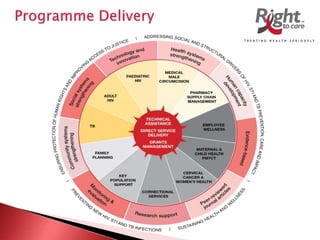
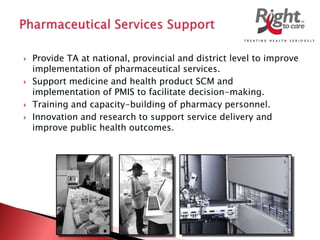
 Provide TA at national, provincial and district level to improve
implementation of pharmaceutical services.
 Support medicine and health product SCM and
implementation of PMIS to facilitate decision-making.
 Training and capacity-building of pharmacy personnel.
 Innovation and research to support service delivery and
improve public health outcomes.
 Chronic shortage of pharmacy personnel
 Long pharmacy waiting times in facilities
 Poor operational efficiencies
 Sub-optimal inventory management and medicine
stock-outs
 Inadequate counseling and monitoring
 Medication errors and medicine safety
 No offsite patient communication
 Risk to employed patients and economic impact of
missing work
 Patient costs - HE2RO study indicated average
patient spent R150/day to visit a clinic
 Patient adherence significantly compromised
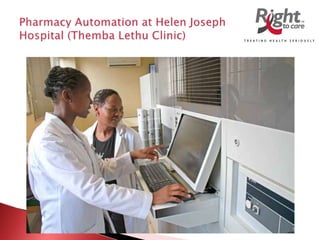
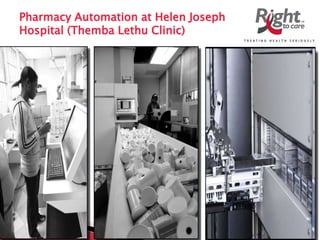
Pharmacy Automation at Helen Joseph
Hospital (Themba Lethu Clinic)
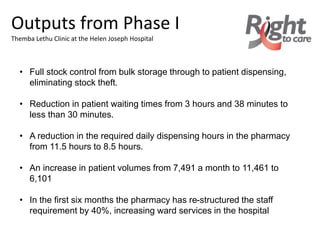
• Full stock control from bulk storage through to patient dispensing,
eliminating stock theft.
• Reduction in patient waiting times from 3 hours and 38 minutes to
less than 30 minutes.
• A reduction in the required daily dispensing hours in the pharmacy
from 11.5 hours to 8.5 hours.
• An increase in patient volumes from 7,491 a month to 11,461 to
6,101
• In the first six months the pharmacy has re-structured the staff
requirement by 40%, increasing ward services in the hospital
Outputs from Phase I
Themba Lethu Clinic at the Helen Joseph Hospital
• Improved pharmacy operational efficiencies
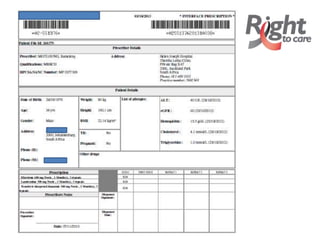
• Prescriptions are being validated
• Prescription picking is error free
• Patient satisfaction is improved
• Patient monitoring and counselling is intensified
• Newly-initiated patients given specialised attention
• Improved focus on patient medication needs
• Improved stock management and reporting
• Better forecasting
• Staff fatigue and burnout reduced
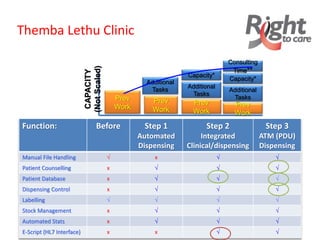
Function: Before Step 1
Automated
Dispensing
Step 2
Integrated
Clinical/dispensing
Step 3
ATM (PDU)
Dispensing
Manual File Handling √ x √ √
Patient Counselling x √ √ √
Patient Database x √ √ √
Dispensing Control x √ √ √
Labelling √ √ √ √
Stock Management x √ √ √
Automated Stats x √ √ √
E-Script (HL7 Interface) x x √ √
Themba Lethu Clinic
Additional
Tasks
Prev
Work
Prev
Work
CAPACITY
(NotScaled)
Prev
Work
Additional
Tasks
Capacity*
Prev
Work
Additional
Tasks
Capacity*
Consulting
Time**
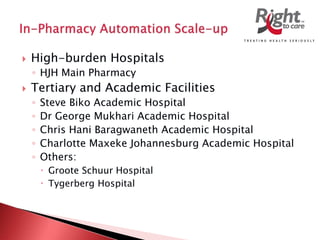
 High-burden Hospitals
◦ HJH Main Pharmacy
 Tertiary and Academic Facilities
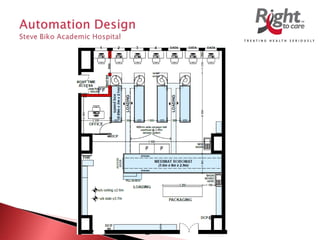
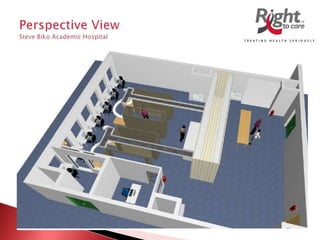
◦ Steve Biko Academic Hospital
◦ Dr George Mukhari Academic Hospital
◦ Chris Hani Baragwaneth Academic Hospital
◦ Charlotte Maxeke Johannesburg Academic Hospital
◦ Others:
 Groote Schuur Hospital
 Tygerberg Hospital
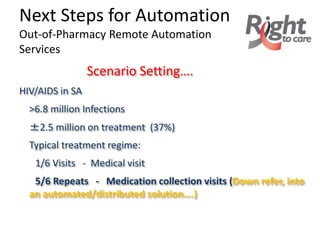
Scenario Setting….
HIV/AIDS in SA
>6.8 million Infections
±2.5 million on treatment (37%)
Typical treatment regime:
1/6 Visits - Medical visit
5/6 Repeats - Medication collection visits (Down refer, into
an automated/distributed solution….)
Next Steps for Automation
Out-of-Pharmacy Remote Automation
Services
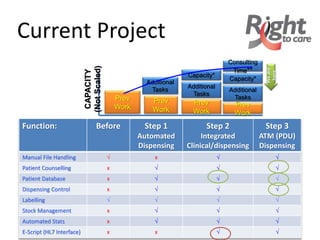
Function: Before Step 1
Automated
Dispensing
Step 2
Integrated
Clinical/dispensing
Step 3
ATM (PDU)
Dispensing
Manual File Handling √ x √ √
Patient Counselling x √ √ √
Patient Database x √ √ √
Dispensing Control x √ √ √
Labelling √ √ √ √
Stock Management x √ √ √
Automated Stats x √ √ √
E-Script (HL7 Interface) x x √ √
Current Project
Additional
Tasks
Prev
Work
Prev
Work
CAPACITY
(NotScaled)
Prev
Work
Additional
Tasks
Capacity*
Prev
Work
Additional
Tasks
Capacity*
Consulting
Time**
Weare
here
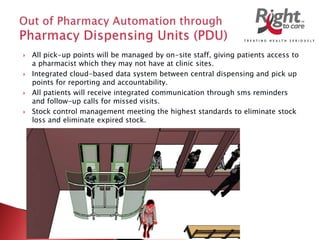
 All pick-up points will be managed by on-site staff, giving patients access to
a pharmacist which they may not have at clinic sites.
 Integrated cloud-based data system between central dispensing and pick up
points for reporting and accountability.
 All patients will receive integrated communication through sms reminders
and follow-up calls for missed visits.
 Stock control management meeting the highest standards to eliminate stock
loss and eliminate expired stock.
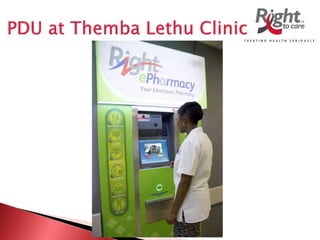
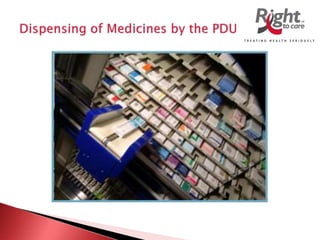
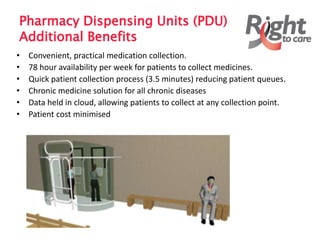
Pharmacy Dispensing Units (PDU)
Additional Benefits
• Convenient, practical medication collection.
• 78 hour availability per week for patients to collect medicines.
• Quick patient collection process (3.5 minutes) reducing patient queues.
• Chronic medicine solution for all chronic diseases
• Data held in cloud, allowing patients to collect at any collection point.
• Patient cost minimised
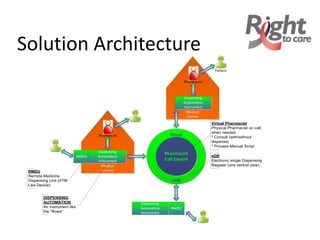
Solution Architecture
Medical
Centre
Medical
Centre
Cloud
eDR
Pharmacist
Call Centre
RMDU
Dispensing
Automation
Instrument
RMDU
Remote Medicine
Dispensing Unit (ATM
Like Device)
eDR
Electronic single Dispensing
Register (one central view)
Patient
DISPENSING
AUTOMATION
An Instrument like
the “Rowa”
RMDU
Dispensing
Automation
Instrument
Pharmacist
Patient
Patient
Dispensing
Automation
Instrument
Pharmacist
Patient
Virtual Pharmacist
Physical Pharmacist on call,
when needed
* Consult (with/without
dispense)
* Process Manual Script
• Pharmacy Act No. 53 of 1974, as amended (“Pharmacy Act”);
• Medicines and Related Substances Act (101 of 1965 as amended);
• Supported the development of minimum standards for In-Pharmacy
and Out-of-Pharmacy Automation;
• In-Pharmacy Automation standards published in November 2014;
• Framework to support electronic prescribing;
Regulatory Framework for
Automation
 Department of Health
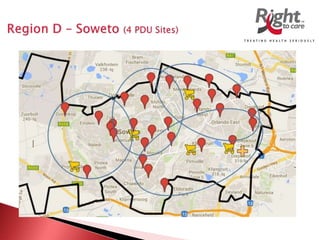
◦ Soweto (4 sub-districts), City of Johannesburg
◦ Bushbuck Ridge, Mpumalanga
◦ Mbombela, Mpumalanga
◦ White River, Mpumalanga
 Funding support:
◦ USAID/PEPFAR
◦ GIZ
◦ GFATM (Concept Note)
THANK YOU

Innovating health appropriate_technology_right_to_care

  • 2.
    • A SouthAfrican non-profit organization, founded in 2001, specializing in HIV and TB disease management • Funded by USAID since 2002 and PEPFAR since 2004 to support technical assistance and HIV and TB treatment service delivery in SA • Current Global Fund Principal Recipient together with Government • Right to Care supports Government, Private and Community Treatment Facilities and aims to build partner’s capacity to deliver safe, effective and affordable antiretroviral therapy. • Since 2004 RTC has grown to be one of the largest treatment groups in South Africa
  • 3.
    To deliver andsupport quality clinical and pharmaceutical services, in Southern Africa, for the prevention, treatment, and management of HIV and associated diseases.
  • 5.
     Provide TAat national, provincial and district level to improve implementation of pharmaceutical services.  Support medicine and health product SCM and implementation of PMIS to facilitate decision-making.  Training and capacity-building of pharmacy personnel.  Innovation and research to support service delivery and improve public health outcomes.
  • 6.
     Chronic shortageof pharmacy personnel  Long pharmacy waiting times in facilities  Poor operational efficiencies  Sub-optimal inventory management and medicine stock-outs  Inadequate counseling and monitoring  Medication errors and medicine safety  No offsite patient communication  Risk to employed patients and economic impact of missing work  Patient costs - HE2RO study indicated average patient spent R150/day to visit a clinic  Patient adherence significantly compromised
  • 9.
    Pharmacy Automation atHelen Joseph Hospital (Themba Lethu Clinic)
  • 11.
    • Full stockcontrol from bulk storage through to patient dispensing, eliminating stock theft. • Reduction in patient waiting times from 3 hours and 38 minutes to less than 30 minutes. • A reduction in the required daily dispensing hours in the pharmacy from 11.5 hours to 8.5 hours. • An increase in patient volumes from 7,491 a month to 11,461 to 6,101 • In the first six months the pharmacy has re-structured the staff requirement by 40%, increasing ward services in the hospital Outputs from Phase I Themba Lethu Clinic at the Helen Joseph Hospital
  • 12.
    • Improved pharmacyoperational efficiencies • Prescriptions are being validated • Prescription picking is error free • Patient satisfaction is improved • Patient monitoring and counselling is intensified • Newly-initiated patients given specialised attention • Improved focus on patient medication needs • Improved stock management and reporting • Better forecasting • Staff fatigue and burnout reduced
  • 13.
    Function: Before Step1 Automated Dispensing Step 2 Integrated Clinical/dispensing Step 3 ATM (PDU) Dispensing Manual File Handling √ x √ √ Patient Counselling x √ √ √ Patient Database x √ √ √ Dispensing Control x √ √ √ Labelling √ √ √ √ Stock Management x √ √ √ Automated Stats x √ √ √ E-Script (HL7 Interface) x x √ √ Themba Lethu Clinic Additional Tasks Prev Work Prev Work CAPACITY (NotScaled) Prev Work Additional Tasks Capacity* Prev Work Additional Tasks Capacity* Consulting Time**
  • 14.
     High-burden Hospitals ◦HJH Main Pharmacy  Tertiary and Academic Facilities ◦ Steve Biko Academic Hospital ◦ Dr George Mukhari Academic Hospital ◦ Chris Hani Baragwaneth Academic Hospital ◦ Charlotte Maxeke Johannesburg Academic Hospital ◦ Others:  Groote Schuur Hospital  Tygerberg Hospital
  • 17.
    Scenario Setting…. HIV/AIDS inSA >6.8 million Infections ±2.5 million on treatment (37%) Typical treatment regime: 1/6 Visits - Medical visit 5/6 Repeats - Medication collection visits (Down refer, into an automated/distributed solution….) Next Steps for Automation Out-of-Pharmacy Remote Automation Services
  • 18.
    Function: Before Step1 Automated Dispensing Step 2 Integrated Clinical/dispensing Step 3 ATM (PDU) Dispensing Manual File Handling √ x √ √ Patient Counselling x √ √ √ Patient Database x √ √ √ Dispensing Control x √ √ √ Labelling √ √ √ √ Stock Management x √ √ √ Automated Stats x √ √ √ E-Script (HL7 Interface) x x √ √ Current Project Additional Tasks Prev Work Prev Work CAPACITY (NotScaled) Prev Work Additional Tasks Capacity* Prev Work Additional Tasks Capacity* Consulting Time** Weare here
  • 21.
     All pick-uppoints will be managed by on-site staff, giving patients access to a pharmacist which they may not have at clinic sites.  Integrated cloud-based data system between central dispensing and pick up points for reporting and accountability.  All patients will receive integrated communication through sms reminders and follow-up calls for missed visits.  Stock control management meeting the highest standards to eliminate stock loss and eliminate expired stock.
  • 22.
    Pharmacy Dispensing Units(PDU) Additional Benefits • Convenient, practical medication collection. • 78 hour availability per week for patients to collect medicines. • Quick patient collection process (3.5 minutes) reducing patient queues. • Chronic medicine solution for all chronic diseases • Data held in cloud, allowing patients to collect at any collection point. • Patient cost minimised
  • 23.
    Solution Architecture Medical Centre Medical Centre Cloud eDR Pharmacist Call Centre RMDU Dispensing Automation Instrument RMDU RemoteMedicine Dispensing Unit (ATM Like Device) eDR Electronic single Dispensing Register (one central view) Patient DISPENSING AUTOMATION An Instrument like the “Rowa” RMDU Dispensing Automation Instrument Pharmacist Patient Patient Dispensing Automation Instrument Pharmacist Patient Virtual Pharmacist Physical Pharmacist on call, when needed * Consult (with/without dispense) * Process Manual Script
  • 24.
    • Pharmacy ActNo. 53 of 1974, as amended (“Pharmacy Act”); • Medicines and Related Substances Act (101 of 1965 as amended); • Supported the development of minimum standards for In-Pharmacy and Out-of-Pharmacy Automation; • In-Pharmacy Automation standards published in November 2014; • Framework to support electronic prescribing; Regulatory Framework for Automation
  • 26.
     Department ofHealth ◦ Soweto (4 sub-districts), City of Johannesburg ◦ Bushbuck Ridge, Mpumalanga ◦ Mbombela, Mpumalanga ◦ White River, Mpumalanga  Funding support: ◦ USAID/PEPFAR ◦ GIZ ◦ GFATM (Concept Note)
  • 28.

Editor's Notes

  • #4 Please display the mission statement as is and do not rewrite or paraphrase. If you wish to quote our vision, it is: “That every individual has ready access to quality medical services that prevent, treat, and manage HIV infection and associated diseases.” Picture shows MMC community mobilisation team
  • #5 Right to Care’s focus is on providing technical assistance to the Department of Health for the treating of individuals for HIV and associated diseases, in particular, TB and cervical cancer. Right to Care also has a sizeable component of direct service delivery (for HIV and associated diseases). We provide support through training, mentoring, participation in technical committees, development of best practices, on-going operational research, and by seconding staff members to work at government or NGO clinics.
  • #6 Shabir’s slide Support for medicine supply chain management (SCM) activities at national, provincial, district and facility level Training and placement of pharmacy assistants Support for implementation of pharmacy technician training Integration of clinical data systems and pharmacy management systems to streamline pharmacy operations Successful implementation of a SCM strategy for down-referred patients to providers in the private sector
  • #14 * Where Step 1 required execution of additional tasks not formally performed in the pharmacy, it did create sufficient additional free capacity for the pharmacy to run without additional staff and serving same patient volumes, but also now able to properly manage stock at patient level, building up a proper ePHR, etc. Step 2 however will create even more capacity that could be utilised by the pharmacy, but expected to be consumed by perfecting operational tasks. ** Step 3 is expected to free up even more additional capacity that could be used either as patient consulting time or moving the queues quicker
  • #19 * Where Step 1 required execution of additional tasks not formally performed in the pharmacy, it did create sufficient additional free capacity for the pharmacy to run without additional staff and serving same patient volumes, but also now able to properly manage stock at patient level, building up a proper ePHR, etc. Step 2 however will create even more capacity that could be utilised by the pharmacy, but expected to be consumed by perfecting operational tasks. ** Step 3 is expected to free up even more additional capacity that could be used either as patient consulting time or moving the queues quicker