OUR FOR-IMPACT CULTURE CODE
WHY FOR-IMPACT?
“Non-profit” is a legal
structure, not a way of
doing things.
And we don’t
believe we should
define ourselves
in the negative.
Instead, we exist to create
IMPACT.
Hence, this is our for-impact culture.
In everything we do,
we believe in proving it’s
possible to deliver high-quality,
low-cost healthcare to
the world’s poor.
Proving possibility requires
REMARKABLE results.
DEF: REMARKABLE
Worthy of remark; striking
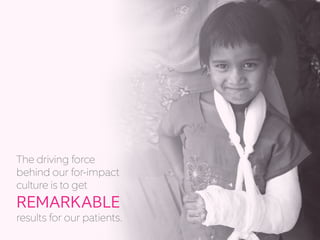
The driving force
behind our for-impact
culture is to get
REMARKABLE
results for our patients.
WHY CARE ABOUT CULTURE?
Culture IS strategy.
—Jim Collins
Great teams bring the same
entrepreneurial energy to
improving their culture as they
do to improving their product.
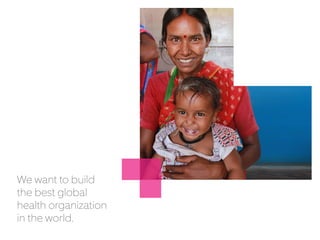
We want to build
the best global
health organization
in the world.
To do that, we need a culture
where remarkable people
produce remarkable results.
People & results.
That’s what makes
a great organization
people love and
invest in.
Here are the
11 PRINCIPLES
that drive our for-impact culture.
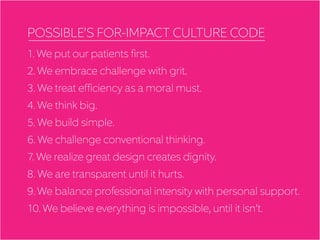
POSSIBLE’S FOR-IMPACT CULTURE CODE
1. We put our patients first.
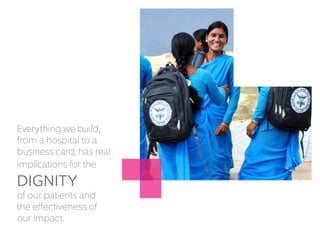
2. We embrace challenge with grit.
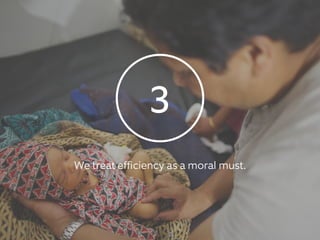
3. We treat efficiency as a moral must.
4. We think big.
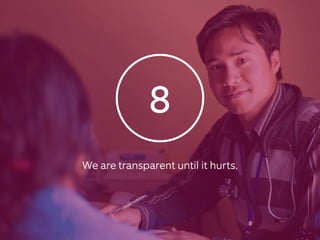
5. We build simple.
6. We challenge conventional thinking.
7. We realize great design creates dignity.
8. We are transparent until it hurts.
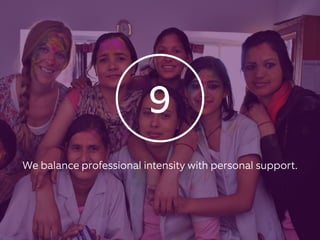
9. We balance professional intensity with personal support.
10. We make commitments with integrity.
11. We believe everything is impossible, until it isn’t.
1
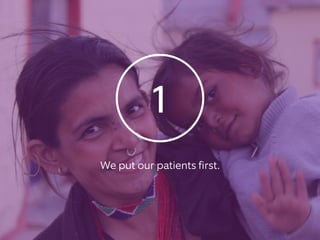
We put our patients first.
Our #1 rule:
SOLVE FOR THE PATIENT.
In every patient, we aim to
see the possibilities we see in
those we love.
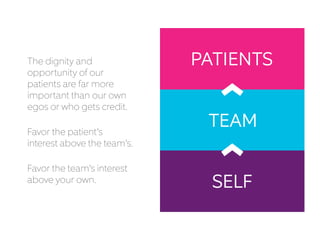
The dignity and
opportunity of our
patients are far more
important than our own
egos or who gets credit.
Favor the patient’s
interest above the team’s.
Favor the team’s interest
above your own.
PATIENTS
TEAM
SELF
2
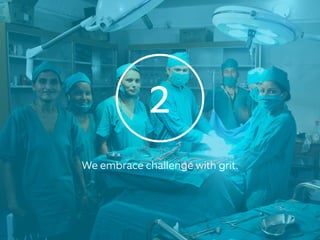
We embrace challenge with grit.
—Bhagavad Gita
We are obligated to
the battle, but not
entitled to its fruits.
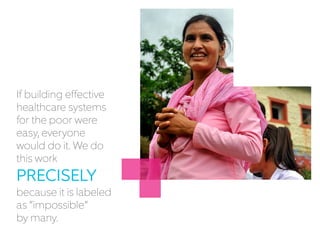
If building effective
healthcare systems
for the poor were
easy, everyone
would do it. We do
this work
PRECISELY
because it is labeled
as “impossible”
by many.
We expect failure and
tremendous degrees of adversity.
GRIT is what we deploy to get
remarkable results anyway.
DEF: GRIT
Indomitable spirit;
passion and
perseverance for
long-term goals
—Will Smith
The only thing that I see that is distinctly
different about me is I’m not afraid to die on
a treadmill. I will not be outworked, period.
You might have more talent than me, you
might be smarter than me, you might be
sexier than me, you might be all of those
things—you got it on me in nine categories.
But if we get on the treadmill together,
there’s two things: You’re getting off first, or
I’m going to die. It’s really that simple.
We seek out people with grit
because we are building a
FORMIDABLE team.
DEF: FORMIDABLE
The kind of team who “seems
like they’ll get what they
want, regardless of whatever
obstacles are in the way.”
*h/t to Paul Graham for this definition
3
We treat efficiency as a moral must.
When your outcome is impact,
TIME
is a terrible thing to waste.
And when you’re working
in the world’s most
challenging environments
under constant uncertainty,
the way to maximize
learning is to minimize the
time to try things.
It’s everyone’s job to turn
time into resources and
possibility for our patients.
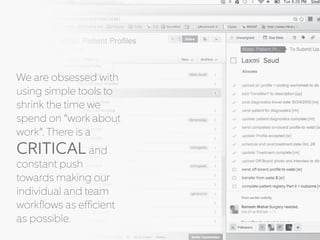
We are obsessed with
using simple tools to
shrink the time we
spend on “work about
work”. There is a
CRITICALand
constant push
towards making our
individual and team
workflows as efficient
as possible.
4
We think big.
Lions can catch, kill, and eat mice, but they will die
doing so because it’s a calorie negative endeavor.
So instead they hunt antelopes.
Like lions, we can’t afford to
hunt mice.
Nearly 1 billion
people around the
world lack access
to high-quality
healthcare.
Thinking
BIG
is balanced by focused execution.
But it’s dishonest and leads
to low-quality impact.
Spreading resources
thin to appear big is
enticing and common
in impact work.
Instead, we set goals
that are big enough to
matter and small
enough to achieve.
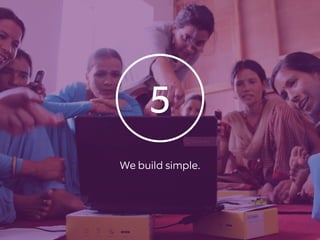
5
We build simple.
Complexity is easy.
Simplicity is hard.
People ignore complexity.
People enjoy simplicity.
Complexity makes work feel like a burden.
Simplicity makes work feel like progress.
Our goal is to minimize
complexity as we grow.
That is really hard to do.
But otherwise, complexity
and bureaucracy flourish,
great people leave, and
results suffer.
6
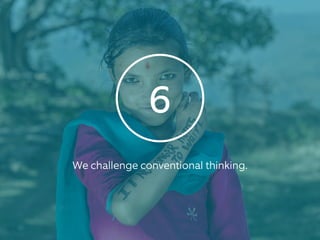
We challenge conventional thinking.
PHOTO: DEAR WORLD
Most conventional
“wisdom” says the poor
can’t have high-quality,
low-cost healthcare.
Is this the beginning of a
conversation about getting
healthcare to the poor or the
end of one?
—Dr. Paul Farmer
When confronted with that “wisdom,” we should always ask:
When challenging convention:
Don’t be angry.
Don’t be arrogant.
DO demand data to justify
conventional wisdom.
If data doesn’t exist, solve
for the patient and prove
possibility with data.
If data doesn’t exist, solve for
the patient and prove possibility
with data. It’s our job to solve for
THE PATIENT
and win debates with data—
not create enemies based on opinion.
7
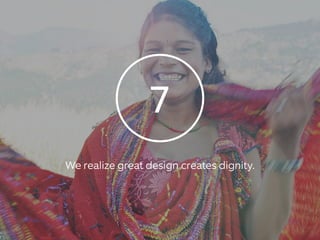
We realize great design creates dignity.
Everything we build,
from a hospital to a
business card, has real
implications for the
DIGNITY
of our patients and
the effectiveness of
our impact.
Great design isn’t a luxury—
it’s a powerful and real
priority in everything we do.
—Jonathan Ives
Design isn’t just the way something
looks. It’s the whole thing, the way
something actually works, on so many
different levels. Ultimately, of course,
design defines so much of our
experience. I think there’s a profound
and enduring beauty in simplicity, in
clarity, in efficiency. It’s about bringing
order to complexity.
8
We are transparent until it hurts.
—Louis Brandeis
Sunlight is the best
disinfectant.
At the core, we believe in
transparency because it’s
an accountability
guarantee against our
own human frailties.
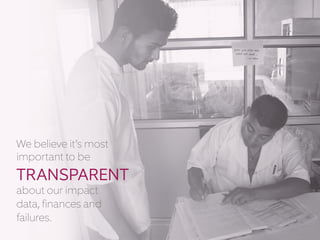
We believe it’s most
important to be
TRANSPARENT
about our impact
data, finances,
and failures.
We also work to build in
transparency as a default
state in our systems.
A few examples:
We publish Quarterly Impact Reports openly
covering all areas of the organization.
We use Asana so team members can see
everything happening across the organization.
Our strategy, areas of responsibility, milestones,
and board minutes are open within the team.
9
We balance professional intensity with personal support.
—Netflix
We’re a team, not a family.
We hire, develop and cut
smartly so we have stars in
every position.
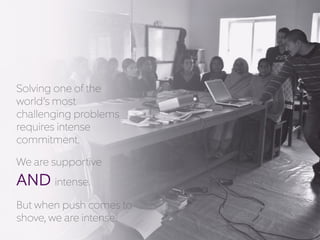
Solving one of the
world’s most
challenging problems
requires intense
commitment.
We are supportive
AND intense.
But when push comes to
shove, we are intense.
Yet our leaders constantly remind
themselves to be professionally
uncompromising and personally
supportive.
We only select leaders
who are “givers”—people
who are always looking
to add value to their
teammates’ lives inside
and outside of work.
A few ways we are personally supportive:
We use our networks to find world-class
mentors for team members.
We use a reciprocity listserve so anyone can
ask for support inside or outside of work.
We let people own their 1 on 1 meetings with
their managers so they can cover their needs.
10
We make commitments with integrity.
—Mahatma Gandhi
A small body of determined
spirits fired by an unquenchable
faith in their mission can alter
the course of history.
It’s important to our patients
we have internal consistency—
that what we think, say,
and do is aligned.
Plus, Google found that
dependability is the
2nd most important
contributing factor
to team performance.
Psychological Safety1
2
3
4
5
Team members feel safe to take risks and
be vulerable in front of each other.
Team members have clear roles,
plans, and goals.
Work is personally important
to team members.
Team members think their work matters
and creates change.
Team members get things done on time and
meet Possible’s high bar for excellence.
Dependability
Structure and Clarity
Meaning
Impact
ADAPTED FROM GOOGLE RE:WORK 2016
We have designed a globally
coordinated team that is
information-intense and relies
on remote collaboration.
The only way to create
team trust and outcomes
for our patients in this
environment is to deliver
on commitments.
—Fred Kofman
Bone healing is a great metaphor
here: If you take good care of
a fracture, the bone becomes
stronger than it was before. If you
take good care of your promises,
the relationship becomes stronger
than it was before.
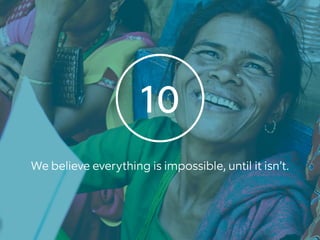
We believe everything is impossible, until it isn’t.
11
We go to work every day
determined to create a
better world—to expand
humanity’s belief about
what’s possible.
Hope is the belief in the
plausibility of the possible as
opposed to the necessity of
the probable.
—Maimonides
In our team,
HOPE
isn’t a fluffy, soft, or naïve concept.
We believe in a hard-edged
hope—one created when
possibility is earned through
execution against all odds.
Do we sound like your kind of people?
Join us to prove possibility.
JOIN US
Want to share something with us?
WRITE US
See our work.
WATCH OUR MANIFESTO
Thanks to the many exceptional teams and individuals who influence our evolving
for-impact culture. We recommend reading their work for more insights.
asana.com hubspot.com netflix.com
managementcenter.org pih.org forimpact.org
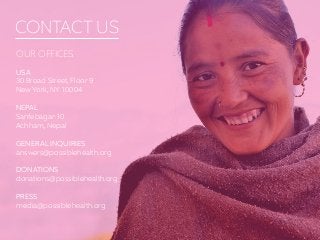
CONTACT US
OUR OFFICES
USA
30 Broad Street, Floor 9
New York, NY 10004
NEPAL
Sanfebagar-10
Achham, Nepal
GENERAL INQUIRIES
answers@possiblehealth.org
DONATIONS
donations@possiblehealth.org
PRESS
media@possiblehealth.org

Possible's For-Impact Culture Code

  • 1.
  • 2.
  • 3.
    “Non-profit” is alegal structure, not a way of doing things. And we don’t believe we should define ourselves in the negative.
  • 4.
    Instead, we existto create IMPACT. Hence, this is our for-impact culture.
  • 5.
    In everything wedo, we believe in proving it’s possible to deliver high-quality, low-cost healthcare to the world’s poor.
  • 6.
  • 7.
    DEF: REMARKABLE Worthy ofremark; striking
  • 8.
    The driving force behindour for-impact culture is to get REMARKABLE results for our patients.
  • 9.
  • 10.
  • 11.
    Great teams bringthe same entrepreneurial energy to improving their culture as they do to improving their product.
  • 12.
    We want tobuild the best global health organization in the world.
  • 13.
    To do that,we need a culture where remarkable people produce remarkable results. People & results. That’s what makes a great organization people love and invest in.
  • 14.
    Here are the 11PRINCIPLES that drive our for-impact culture.
  • 15.
    POSSIBLE’S FOR-IMPACT CULTURECODE 1. We put our patients first. 2. We embrace challenge with grit. 3. We treat efficiency as a moral must. 4. We think big. 5. We build simple. 6. We challenge conventional thinking. 7. We realize great design creates dignity. 8. We are transparent until it hurts. 9. We balance professional intensity with personal support. 10. We make commitments with integrity. 11. We believe everything is impossible, until it isn’t.
  • 16.
    1 We put ourpatients first.
  • 17.
    Our #1 rule: SOLVEFOR THE PATIENT.
  • 18.
    In every patient,we aim to see the possibilities we see in those we love.
  • 19.
    The dignity and opportunityof our patients are far more important than our own egos or who gets credit. Favor the patient’s interest above the team’s. Favor the team’s interest above your own. PATIENTS TEAM SELF
  • 20.
  • 21.
    —Bhagavad Gita We areobligated to the battle, but not entitled to its fruits.
  • 22.
    If building effective healthcaresystems for the poor were easy, everyone would do it. We do this work PRECISELY because it is labeled as “impossible” by many.
  • 23.
    We expect failureand tremendous degrees of adversity. GRIT is what we deploy to get remarkable results anyway.
  • 24.
    DEF: GRIT Indomitable spirit; passionand perseverance for long-term goals
  • 25.
    —Will Smith The onlything that I see that is distinctly different about me is I’m not afraid to die on a treadmill. I will not be outworked, period. You might have more talent than me, you might be smarter than me, you might be sexier than me, you might be all of those things—you got it on me in nine categories. But if we get on the treadmill together, there’s two things: You’re getting off first, or I’m going to die. It’s really that simple.
  • 26.
    We seek outpeople with grit because we are building a FORMIDABLE team.
  • 27.
    DEF: FORMIDABLE The kindof team who “seems like they’ll get what they want, regardless of whatever obstacles are in the way.” *h/t to Paul Graham for this definition
  • 28.
    3 We treat efficiencyas a moral must.
  • 29.
    When your outcomeis impact, TIME is a terrible thing to waste.
  • 30.
    And when you’reworking in the world’s most challenging environments under constant uncertainty, the way to maximize learning is to minimize the time to try things.
  • 31.
    It’s everyone’s jobto turn time into resources and possibility for our patients.
  • 32.
    We are obsessedwith using simple tools to shrink the time we spend on “work about work”. There is a CRITICALand constant push towards making our individual and team workflows as efficient as possible.
  • 33.
  • 34.
    Lions can catch,kill, and eat mice, but they will die doing so because it’s a calorie negative endeavor. So instead they hunt antelopes.
  • 35.
    Like lions, wecan’t afford to hunt mice. Nearly 1 billion people around the world lack access to high-quality healthcare.
  • 36.
    Thinking BIG is balanced byfocused execution.
  • 37.
    But it’s dishonestand leads to low-quality impact. Spreading resources thin to appear big is enticing and common in impact work.
  • 38.
    Instead, we setgoals that are big enough to matter and small enough to achieve.
  • 39.
  • 40.
    Complexity is easy. Simplicityis hard. People ignore complexity. People enjoy simplicity. Complexity makes work feel like a burden. Simplicity makes work feel like progress.
  • 41.
    Our goal isto minimize complexity as we grow. That is really hard to do.
  • 42.
    But otherwise, complexity andbureaucracy flourish, great people leave, and results suffer.
  • 43.
    6 We challenge conventionalthinking. PHOTO: DEAR WORLD
  • 44.
    Most conventional “wisdom” saysthe poor can’t have high-quality, low-cost healthcare.
  • 45.
    Is this thebeginning of a conversation about getting healthcare to the poor or the end of one? —Dr. Paul Farmer When confronted with that “wisdom,” we should always ask:
  • 46.
    When challenging convention: Don’tbe angry. Don’t be arrogant. DO demand data to justify conventional wisdom.
  • 47.
    If data doesn’texist, solve for the patient and prove possibility with data.
  • 48.
    If data doesn’texist, solve for the patient and prove possibility with data. It’s our job to solve for THE PATIENT and win debates with data— not create enemies based on opinion.
  • 49.
    7 We realize greatdesign creates dignity.
  • 50.
    Everything we build, froma hospital to a business card, has real implications for the DIGNITY of our patients and the effectiveness of our impact.
  • 51.
    Great design isn’ta luxury— it’s a powerful and real priority in everything we do.
  • 52.
    —Jonathan Ives Design isn’tjust the way something looks. It’s the whole thing, the way something actually works, on so many different levels. Ultimately, of course, design defines so much of our experience. I think there’s a profound and enduring beauty in simplicity, in clarity, in efficiency. It’s about bringing order to complexity.
  • 53.
    8 We are transparentuntil it hurts.
  • 54.
    —Louis Brandeis Sunlight isthe best disinfectant.
  • 55.
    At the core,we believe in transparency because it’s an accountability guarantee against our own human frailties.
  • 56.
    We believe it’smost important to be TRANSPARENT about our impact data, finances, and failures.
  • 57.
    We also workto build in transparency as a default state in our systems. A few examples:
  • 58.
    We publish QuarterlyImpact Reports openly covering all areas of the organization. We use Asana so team members can see everything happening across the organization. Our strategy, areas of responsibility, milestones, and board minutes are open within the team.
  • 59.
    9 We balance professionalintensity with personal support.
  • 60.
    —Netflix We’re a team,not a family. We hire, develop and cut smartly so we have stars in every position.
  • 61.
    Solving one ofthe world’s most challenging problems requires intense commitment. We are supportive AND intense. But when push comes to shove, we are intense.
  • 62.
    Yet our leadersconstantly remind themselves to be professionally uncompromising and personally supportive. We only select leaders who are “givers”—people who are always looking to add value to their teammates’ lives inside and outside of work.
  • 63.
    A few wayswe are personally supportive:
  • 64.
    We use ournetworks to find world-class mentors for team members. We use a reciprocity listserve so anyone can ask for support inside or outside of work. We let people own their 1 on 1 meetings with their managers so they can cover their needs.
  • 65.
    10 We make commitmentswith integrity.
  • 66.
    —Mahatma Gandhi A smallbody of determined spirits fired by an unquenchable faith in their mission can alter the course of history.
  • 67.
    It’s important toour patients we have internal consistency— that what we think, say, and do is aligned.
  • 68.
    Plus, Google foundthat dependability is the 2nd most important contributing factor to team performance. Psychological Safety1 2 3 4 5 Team members feel safe to take risks and be vulerable in front of each other. Team members have clear roles, plans, and goals. Work is personally important to team members. Team members think their work matters and creates change. Team members get things done on time and meet Possible’s high bar for excellence. Dependability Structure and Clarity Meaning Impact ADAPTED FROM GOOGLE RE:WORK 2016
  • 69.
    We have designeda globally coordinated team that is information-intense and relies on remote collaboration. The only way to create team trust and outcomes for our patients in this environment is to deliver on commitments.
  • 70.
    —Fred Kofman Bone healingis a great metaphor here: If you take good care of a fracture, the bone becomes stronger than it was before. If you take good care of your promises, the relationship becomes stronger than it was before.
  • 71.
    We believe everythingis impossible, until it isn’t. 11
  • 72.
    We go towork every day determined to create a better world—to expand humanity’s belief about what’s possible.
  • 73.
    Hope is thebelief in the plausibility of the possible as opposed to the necessity of the probable. —Maimonides
  • 74.
    In our team, HOPE isn’ta fluffy, soft, or naïve concept.
  • 75.
    We believe ina hard-edged hope—one created when possibility is earned through execution against all odds.
  • 76.
    Do we soundlike your kind of people?
  • 77.
    Join us toprove possibility. JOIN US
  • 78.
    Want to sharesomething with us? WRITE US
  • 79.
    See our work. WATCHOUR MANIFESTO
  • 80.
    Thanks to themany exceptional teams and individuals who influence our evolving for-impact culture. We recommend reading their work for more insights. asana.com hubspot.com netflix.com managementcenter.org pih.org forimpact.org
  • 81.
    CONTACT US OUR OFFICES USA 30Broad Street, Floor 9 New York, NY 10004 NEPAL Sanfebagar-10 Achham, Nepal GENERAL INQUIRIES answers@possiblehealth.org DONATIONS donations@possiblehealth.org PRESS media@possiblehealth.org