Who We Are Jennifer Rich   Director National Clearinghouse on Families & Youth Ravenna Motil-McGuire  Public Information Specialist National Clearinghouse on Families & Youth
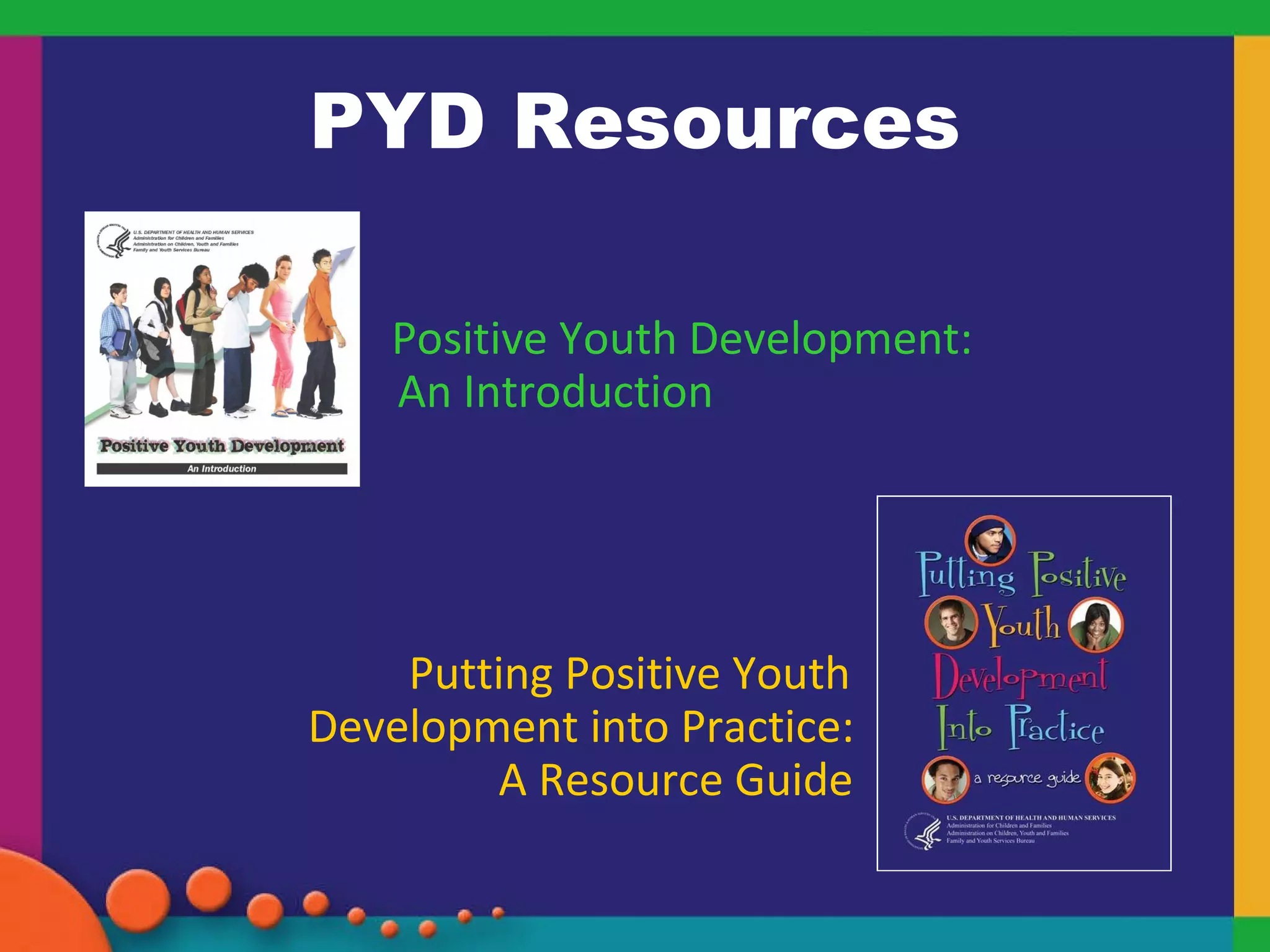
PYD Resources Positive Youth Development:  An Introduction  Putting Positive Youth  Development into Practice:  A Resource Guide
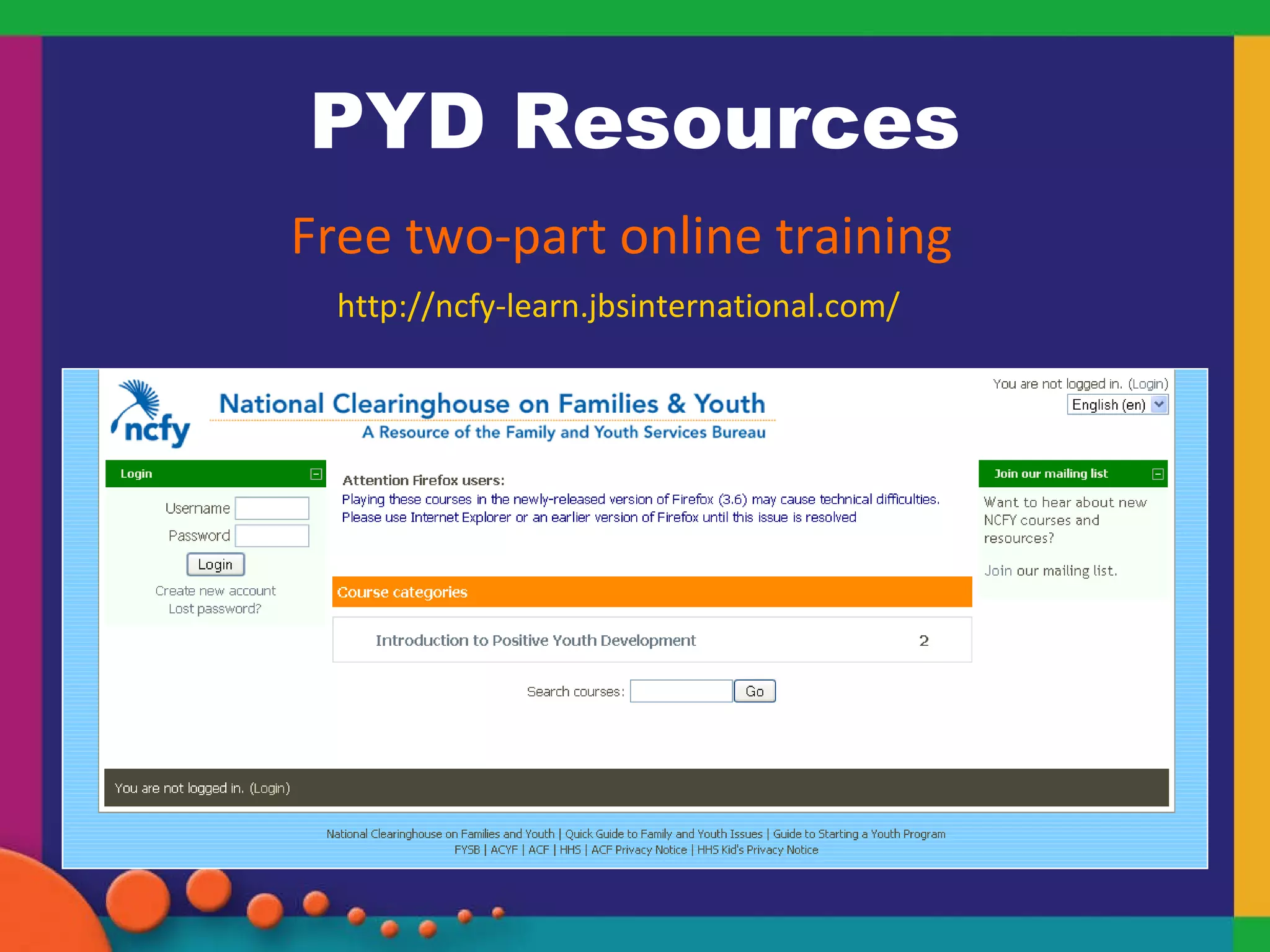
PYD Resources Free two-part online training http://ncfy-learn.jbsinternational.com/
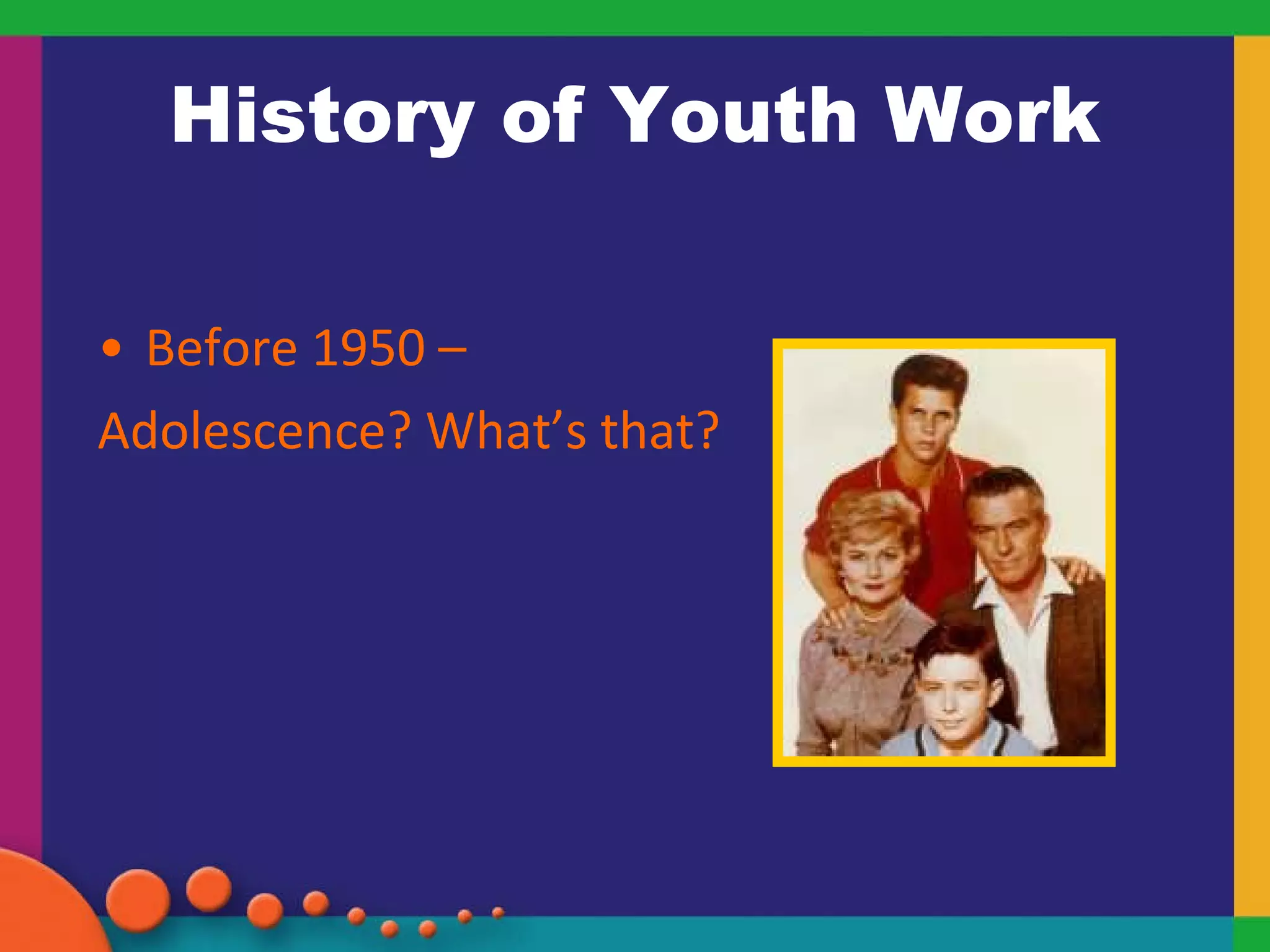
History of Youth Work Before 1950 –  Adolescence? What’s that?
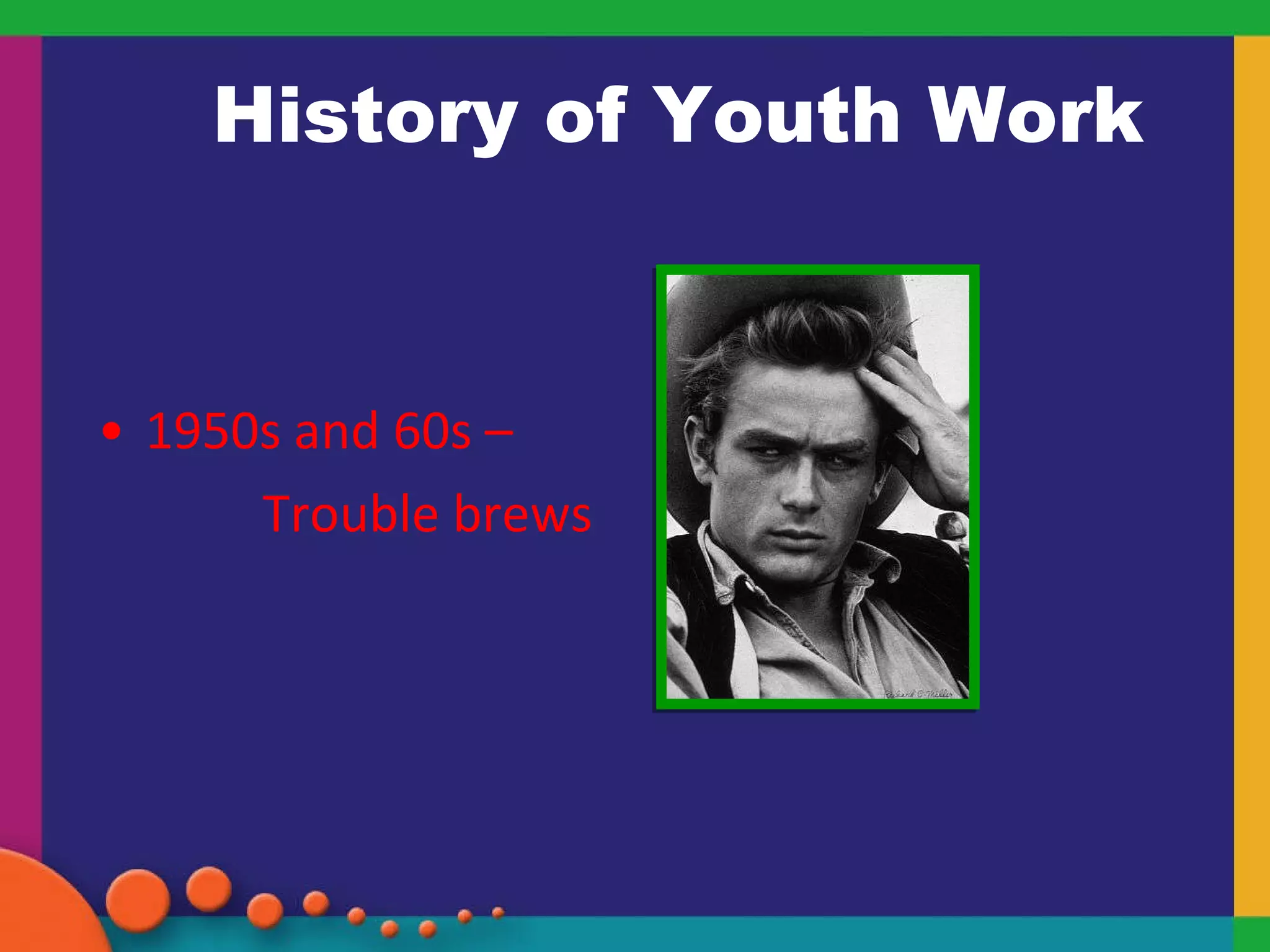
History of Youth Work 1950s and 60s –  Trouble brews
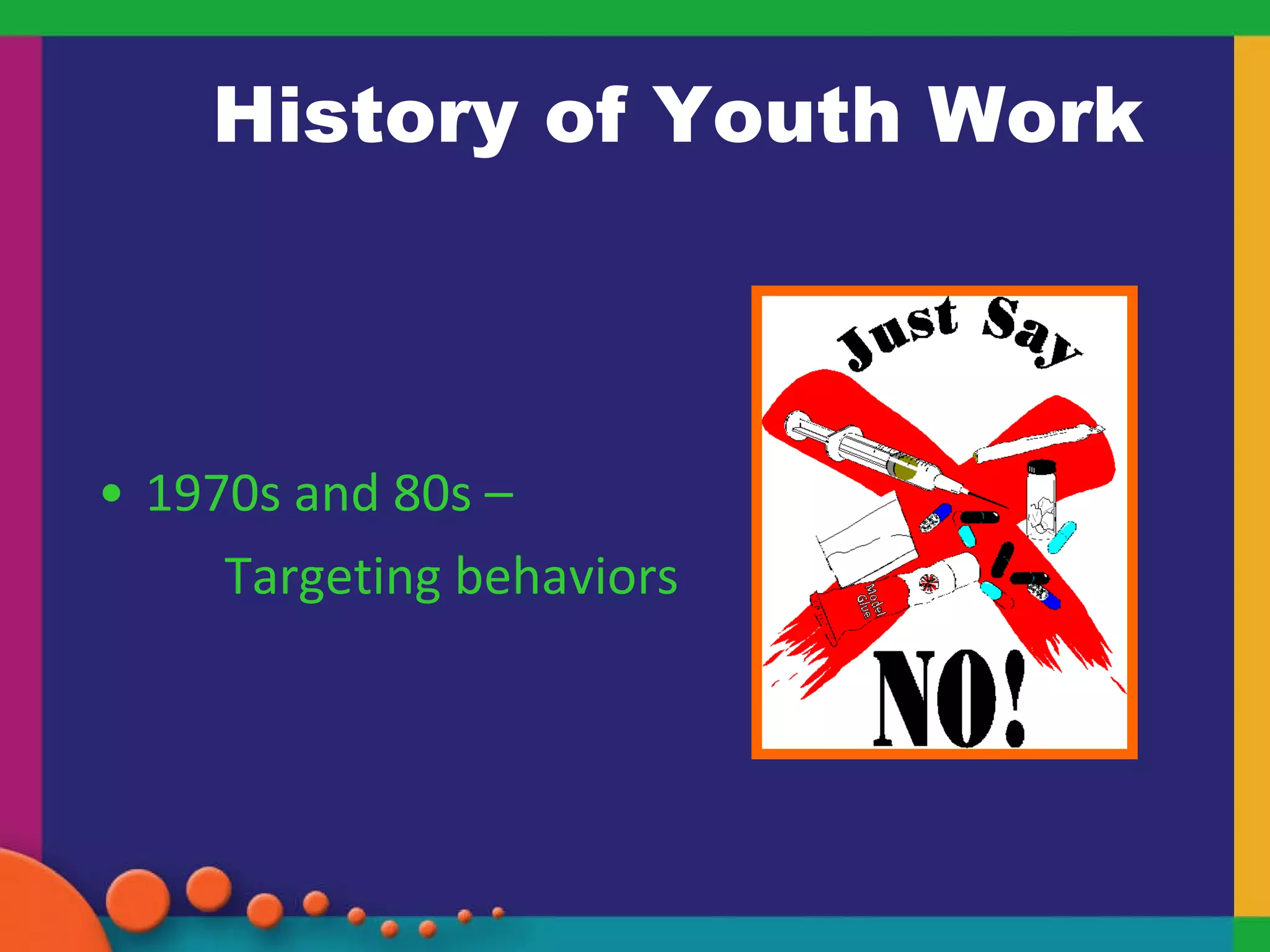
History of Youth Work 1970s and 80s –  Targeting behaviors
History of Youth Work 1980s –  Positive Youth Development  begins to germinate
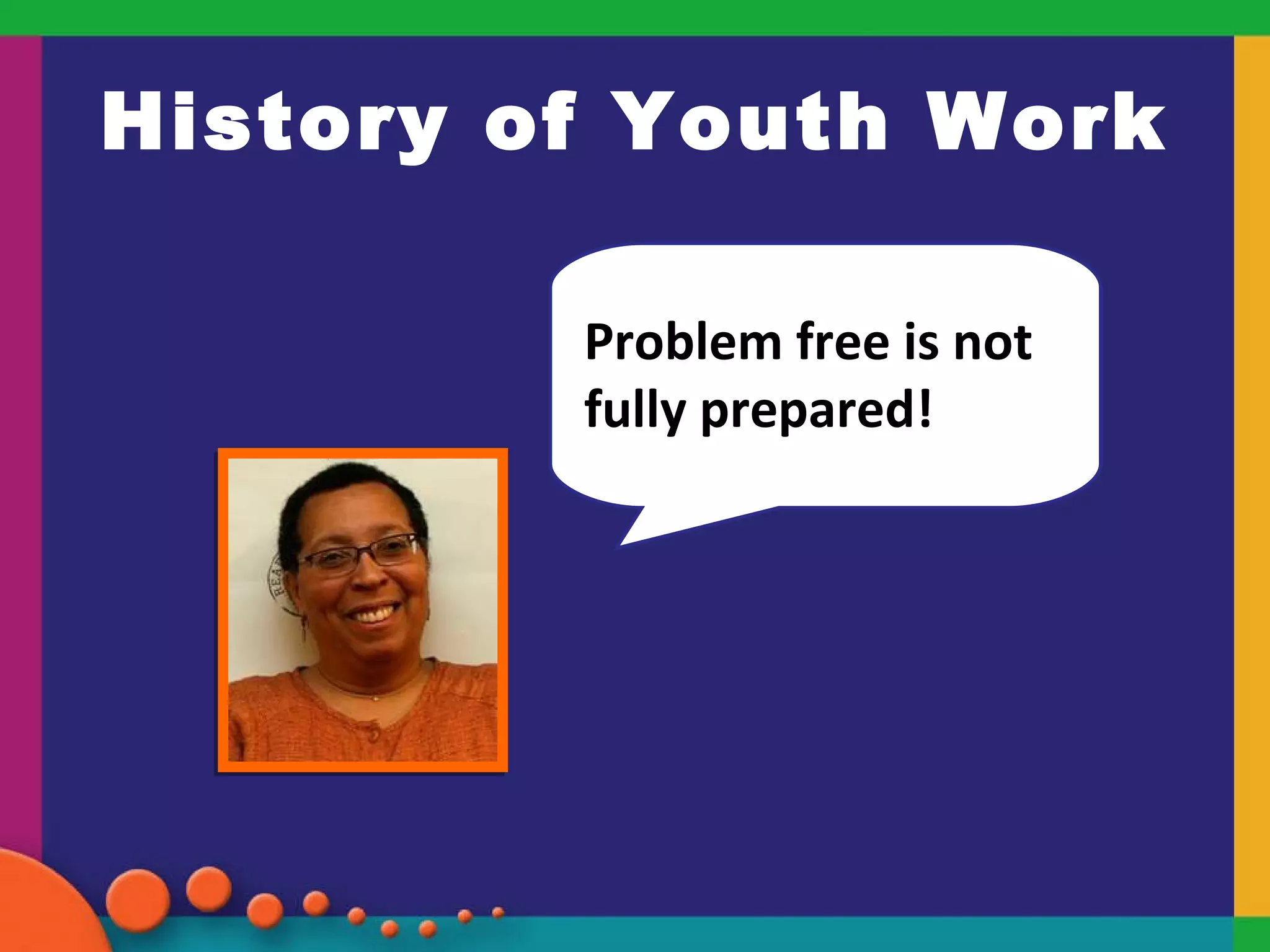
History of Youth Work   “ Problem free is not fully prepared!
What is PYD? PYD strives to identify and promote the conditions under which teens thrive.
PYD Frameworks 1. Richard Lerner, Tufts/4-H  (http://ase.tufts.edu/iaryd) 2. Search Institute  (www.search-institute.org)
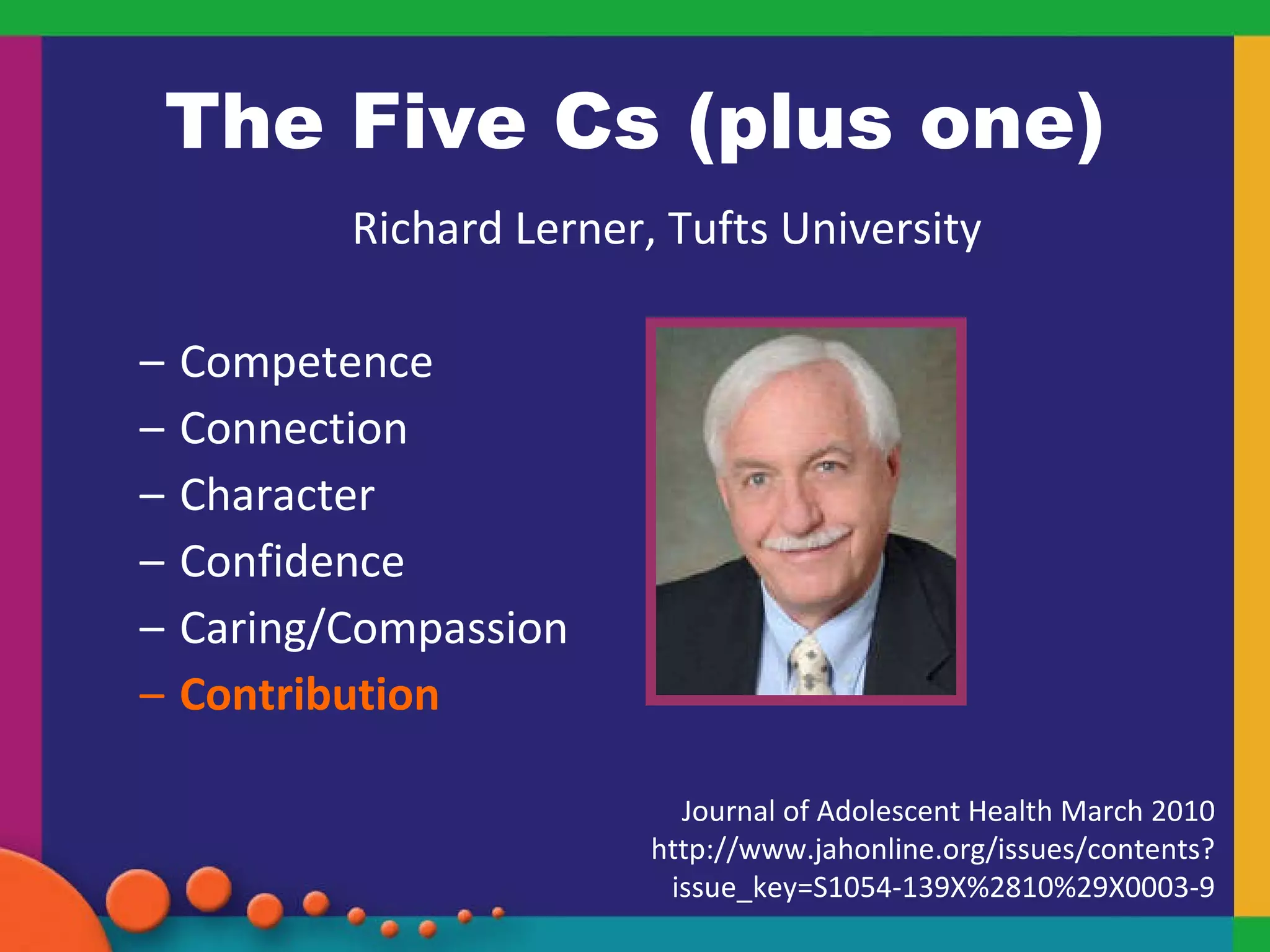
The Five Cs (plus one) Richard Lerner, Tufts University Competence Connection Character Confidence Caring/Compassion Contribution Journal of Adolescent Health March 2010 http://www.jahonline.org/issues/contents?issue_key=S1054-139X%2810%29X0003-9
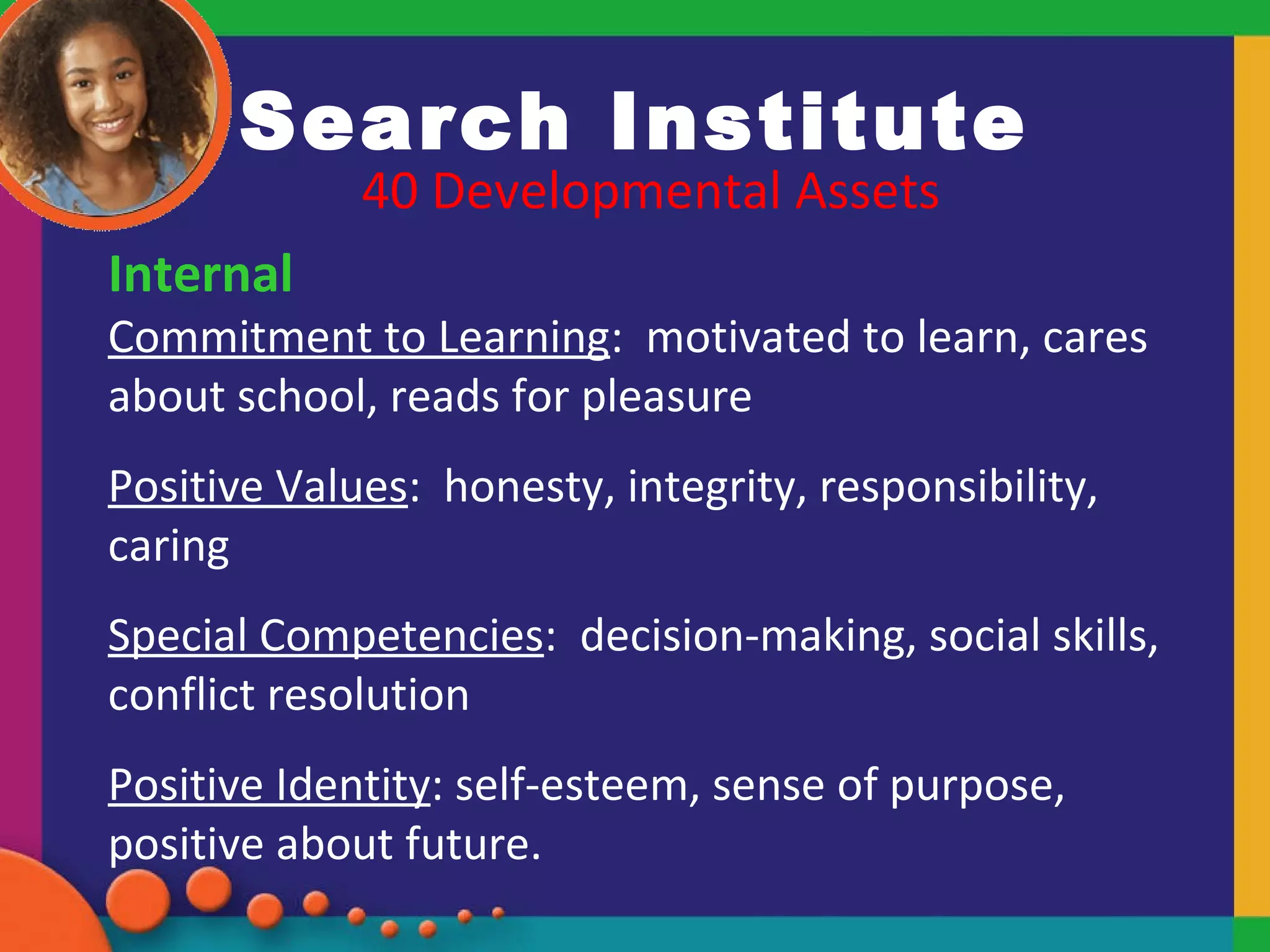
Search Institute 40 Developmental Assets Internal   Commitment to Learning :  motivated to learn, cares about school, reads for pleasure Positive Values :  honesty, integrity, responsibility, caring Special Competencies :  decision-making, social skills, conflict resolution Positive Identity : self-esteem, sense of purpose, positive about future.
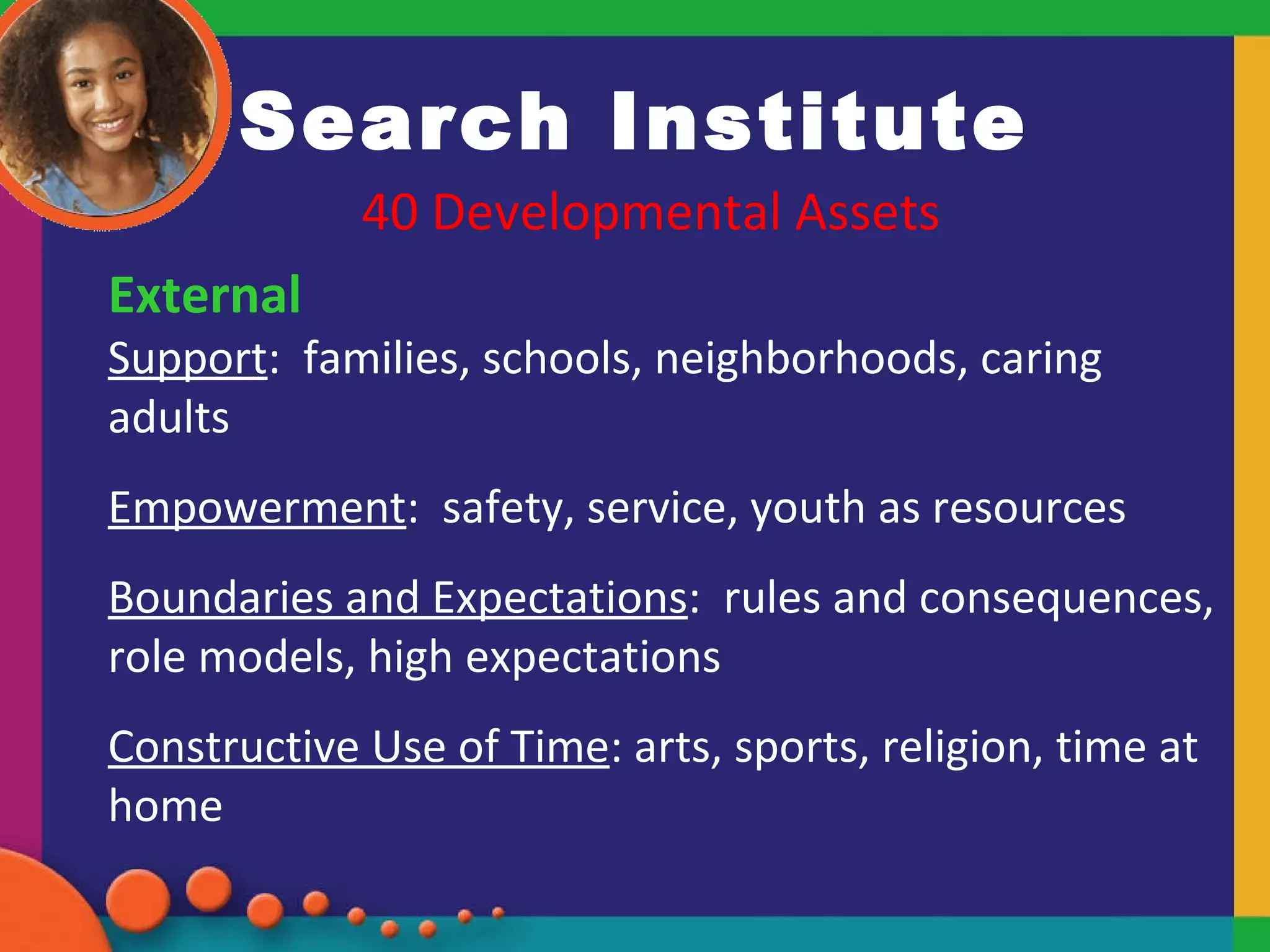
Search Institute 40 Developmental Assets External Support :  families, schools, neighborhoods, caring adults Empowerment :  safety, service, youth as resources Boundaries and Expectations :  rules and consequences, role models, high expectations Constructive Use of Time : arts, sports, religion, time at home
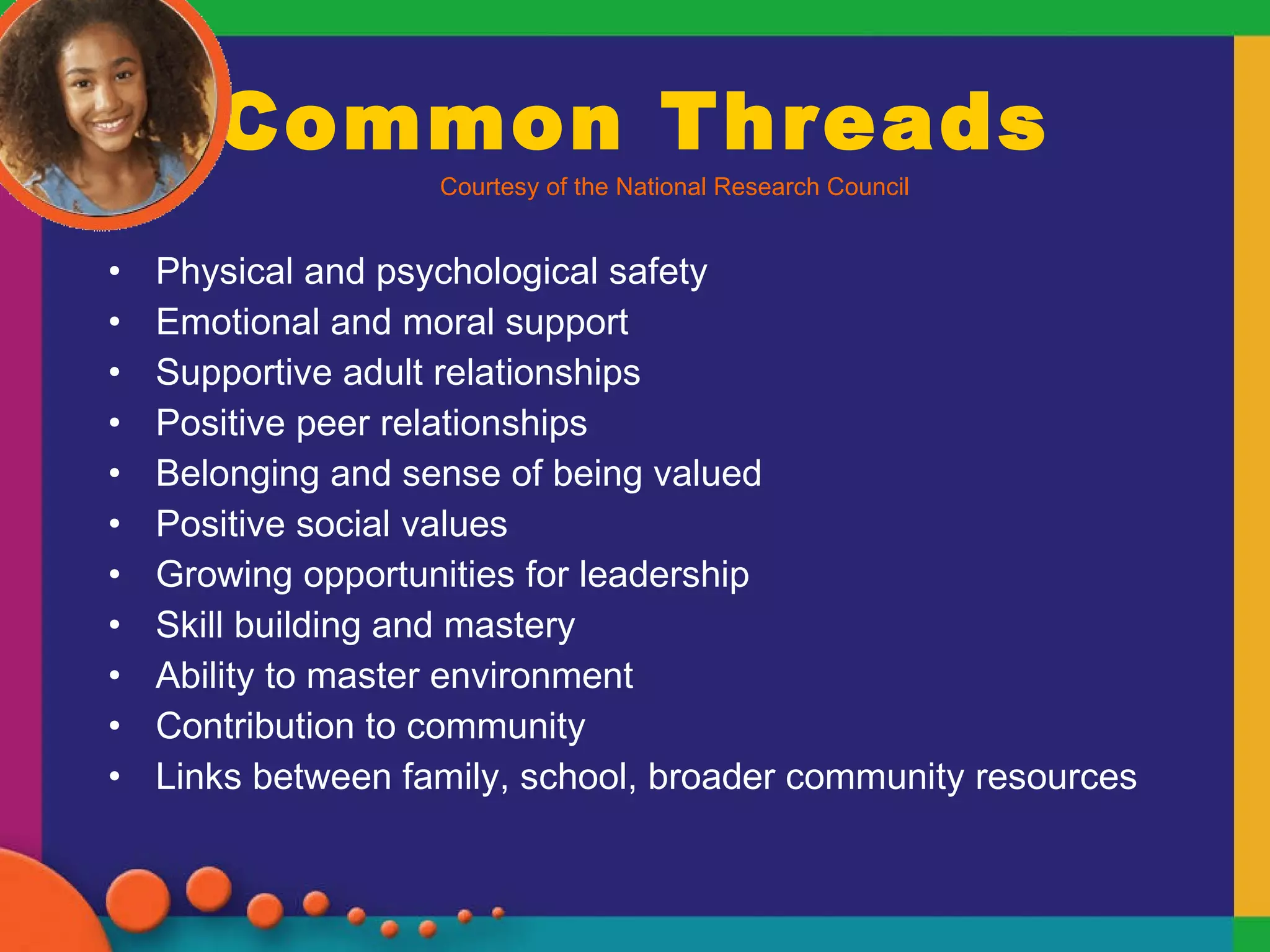
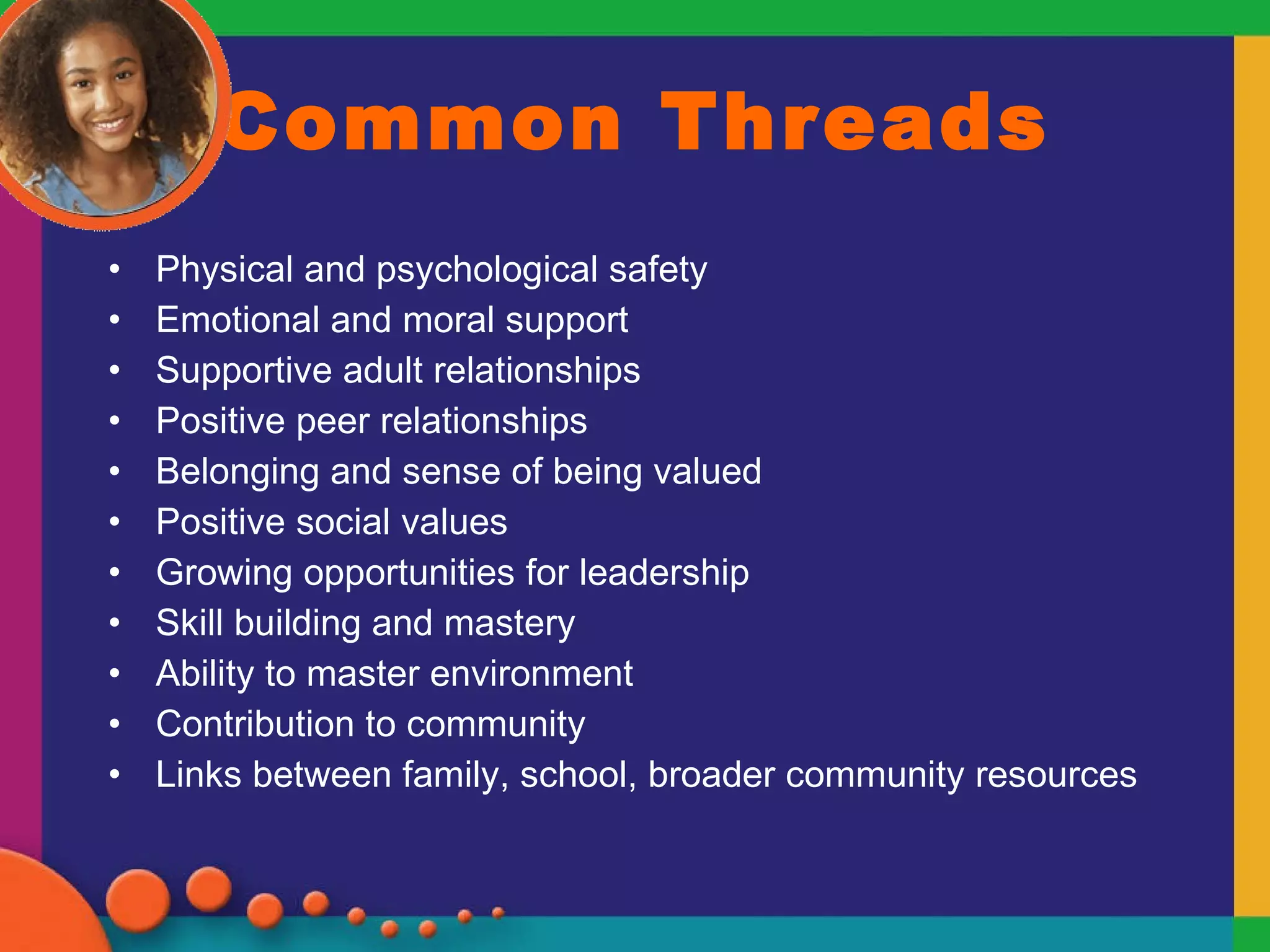
Common Threads Courtesy of the National Research Council Physical and psychological safety Emotional and moral support Supportive adult relationships Positive peer relationships Belonging and sense of being valued Positive social values Growing opportunities for leadership Skill building and mastery Ability to master environment Contribution to community Links between family, school, broader community resources
Putting PYD into Practice
Practical PYD PYD is: Embracing a young person’s differences Supporting young people in making their own decisions  Providing opportunities to express feelings and needs  Working with youth to identify boundaries PYD is not: Making judgments based on  appearance or circumstances Telling them what to do Avoiding a youth’s concerns  or challenges Letting a young person do  whatever they want
Why Use It? PYD benefits your youth Improves self-esteem Cultivates responsibility Builds trust
Why Use It? It benefits your staff Strengthens relationships with youth Improves ability to serve youth Provides structure
Why Use It? It benefits your whole organization Creates positive work environment Makes youth your best marketers Informs the board of directors/stakeholders
Creating a PYD Environment After participating in this brilliant webinar, you decide that you want your facility to be a model for PYD.  You head down to the lobby to see what a young person entering your program would see.
Common Threads Physical and psychological safety Emotional and moral support Supportive adult relationships Positive peer relationships Belonging and sense of being valued Positive social values Growing opportunities for leadership Skill building and mastery Ability to master environment Contribution to community Links between family, school, broader community resources
PYD in Practice Safe (and inconspicuous) entrance Youth-friendly hours Youth greeters or guides Youth-designed decorations Places to lounge, cool things to do
Providing PYD Care You’re called to pick up a teenage girl from the local McDonalds. She has been crying and has bruising on her wrists. You notice she is wearing a Paramore t-shirt and has a swim team patch from a local high school on her backpack. You bring her back to the shelter.
Common Threads Physical and psychological safety Emotional and moral support Supportive adult relationships Positive peer relationships Belonging and sense of being valued Positive social values Growing opportunities for leadership Skill building and mastery Ability to master environment Contribution to community Links between family, school, broader community resources
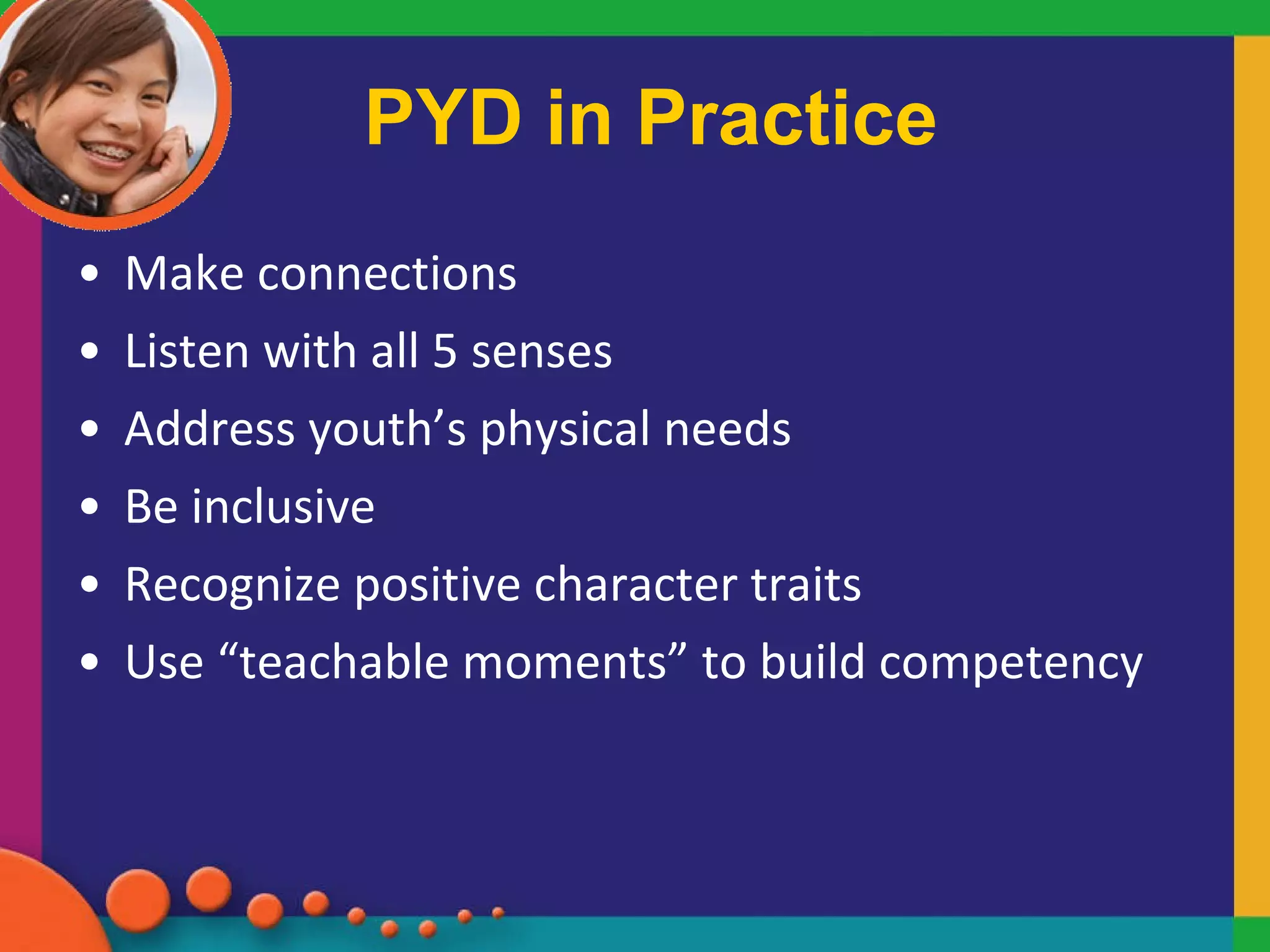
PYD in Practice Make connections Listen with all 5 senses Address youth’s physical needs  Be inclusive Recognize positive character traits Use “teachable moments” to build competency
Let’s recap Much of what you are doing is already PYD Simple steps count Even the smallest results can encourage staff and young people to keep going
Let’s recap Questions??  Comments??
Contact Us Jennifer Rich [email_address]   (305) 981-1498 Ravenna Motil-McGuire [email_address]   (240) 645-4926

Positive Youth Development

  • 1.
  • 2.
    Who We AreJennifer Rich Director National Clearinghouse on Families & Youth Ravenna Motil-McGuire Public Information Specialist National Clearinghouse on Families & Youth
  • 3.
    PYD Resources PositiveYouth Development: An Introduction Putting Positive Youth Development into Practice: A Resource Guide
  • 4.
    PYD Resources Freetwo-part online training http://ncfy-learn.jbsinternational.com/
  • 5.
    History of YouthWork Before 1950 – Adolescence? What’s that?
  • 6.
    History of YouthWork 1950s and 60s – Trouble brews
  • 7.
    History of YouthWork 1970s and 80s – Targeting behaviors
  • 8.
    History of YouthWork 1980s – Positive Youth Development begins to germinate
  • 9.
    History of YouthWork “ Problem free is not fully prepared!
  • 10.
    What is PYD?PYD strives to identify and promote the conditions under which teens thrive.
  • 11.
    PYD Frameworks 1.Richard Lerner, Tufts/4-H (http://ase.tufts.edu/iaryd) 2. Search Institute (www.search-institute.org)
  • 12.
    The Five Cs(plus one) Richard Lerner, Tufts University Competence Connection Character Confidence Caring/Compassion Contribution Journal of Adolescent Health March 2010 http://www.jahonline.org/issues/contents?issue_key=S1054-139X%2810%29X0003-9
  • 13.
    Search Institute 40Developmental Assets Internal Commitment to Learning : motivated to learn, cares about school, reads for pleasure Positive Values : honesty, integrity, responsibility, caring Special Competencies : decision-making, social skills, conflict resolution Positive Identity : self-esteem, sense of purpose, positive about future.
  • 14.
    Search Institute 40Developmental Assets External Support : families, schools, neighborhoods, caring adults Empowerment : safety, service, youth as resources Boundaries and Expectations : rules and consequences, role models, high expectations Constructive Use of Time : arts, sports, religion, time at home
  • 15.
    Common Threads Courtesyof the National Research Council Physical and psychological safety Emotional and moral support Supportive adult relationships Positive peer relationships Belonging and sense of being valued Positive social values Growing opportunities for leadership Skill building and mastery Ability to master environment Contribution to community Links between family, school, broader community resources
  • 16.
  • 17.
    Practical PYD PYDis: Embracing a young person’s differences Supporting young people in making their own decisions Providing opportunities to express feelings and needs Working with youth to identify boundaries PYD is not: Making judgments based on appearance or circumstances Telling them what to do Avoiding a youth’s concerns or challenges Letting a young person do whatever they want
  • 18.
    Why Use It?PYD benefits your youth Improves self-esteem Cultivates responsibility Builds trust
  • 19.
    Why Use It?It benefits your staff Strengthens relationships with youth Improves ability to serve youth Provides structure
  • 20.
    Why Use It?It benefits your whole organization Creates positive work environment Makes youth your best marketers Informs the board of directors/stakeholders
  • 21.
    Creating a PYDEnvironment After participating in this brilliant webinar, you decide that you want your facility to be a model for PYD. You head down to the lobby to see what a young person entering your program would see.
  • 22.
    Common Threads Physicaland psychological safety Emotional and moral support Supportive adult relationships Positive peer relationships Belonging and sense of being valued Positive social values Growing opportunities for leadership Skill building and mastery Ability to master environment Contribution to community Links between family, school, broader community resources
  • 23.
    PYD in PracticeSafe (and inconspicuous) entrance Youth-friendly hours Youth greeters or guides Youth-designed decorations Places to lounge, cool things to do
  • 24.
    Providing PYD CareYou’re called to pick up a teenage girl from the local McDonalds. She has been crying and has bruising on her wrists. You notice she is wearing a Paramore t-shirt and has a swim team patch from a local high school on her backpack. You bring her back to the shelter.
  • 25.
    Common Threads Physicaland psychological safety Emotional and moral support Supportive adult relationships Positive peer relationships Belonging and sense of being valued Positive social values Growing opportunities for leadership Skill building and mastery Ability to master environment Contribution to community Links between family, school, broader community resources
  • 26.
    PYD in PracticeMake connections Listen with all 5 senses Address youth’s physical needs Be inclusive Recognize positive character traits Use “teachable moments” to build competency
  • 27.
    Let’s recap Muchof what you are doing is already PYD Simple steps count Even the smallest results can encourage staff and young people to keep going
  • 28.
  • 29.
    Contact Us JenniferRich [email_address] (305) 981-1498 Ravenna Motil-McGuire [email_address] (240) 645-4926

Editor's Notes

  • #2 -Robin does housekeeping
  • #3 -Jen introduces NCFY -Ravenna what she does if you call (manual) PYD resources -
  • #10 International Youth Foundation (IYF) and Forum for Youth Investment
  • #14 Support 1. Family support —Family life provides high levels of love and support.2. Positive family communication —Young person and her or his parent(s) communicate positively, and young person is willing to seek parent(s) advice and counsel.3. Other adult relationships —Young person receives support from three or more nonparent adults.4. Caring neighborhood —Young person experiences caring neighbors.5. Caring school climate —School provides a caring, encouraging environment.6. Parent involvement in schooling —Parent(s) are actively involved in helping young person succeed in school. Empowerment 7. Community values youth —Young person perceives that adults in the community value youth.8. Youth as resources —Young people are given useful roles in the community.9. Service to others —Young person serves in the community one hour or more per week.10. Safety —Young person feels safe at home, school, and in the neighborhood. Boundaries and Expectations 11. Family boundaries —Family has clear rules and consequences, and monitors the young person's whereabouts.12. School boundaries —School provides clear rules and consequences.13. Neighborhood boundaries —Neighbors take responsibility for monitoring young people's behavior.14. Adult role models —Parent(s) and other adults model positive, responsible behavior.15. Positive peer influence —Young person's best friends model responsible behavior.16. High expectations —Both parent(s) and teachers encourage the young person to do well. Constructive Use of Time 17. Creative activities —Young person spends three or more hours per week in lessons or practice in music, theater, or other arts.18. Youth programs —Young person spends three or more hours per week in sports, clubs, or organizations at school and/or in community organizations.19. Religious community —Young person spends one or more hours per week in activities in religious institution.20. Time at home —Young person is out with friends "with nothing special to do," two or fewer nights.
  • #15 Support 1. Family support —Family life provides high levels of love and support.2. Positive family communication —Young person and her or his parent(s) communicate positively, and young person is willing to seek parent(s) advice and counsel.3. Other adult relationships —Young person receives support from three or more nonparent adults.4. Caring neighborhood —Young person experiences caring neighbors.5. Caring school climate —School provides a caring, encouraging environment.6. Parent involvement in schooling —Parent(s) are actively involved in helping young person succeed in school. Empowerment 7. Community values youth —Young person perceives that adults in the community value youth.8. Youth as resources —Young people are given useful roles in the community.9. Service to others —Young person serves in the community one hour or more per week.10. Safety —Young person feels safe at home, school, and in the neighborhood. Boundaries and Expectations 11. Family boundaries —Family has clear rules and consequences, and monitors the young person's whereabouts.12. School boundaries —School provides clear rules and consequences.13. Neighborhood boundaries —Neighbors take responsibility for monitoring young people's behavior.14. Adult role models —Parent(s) and other adults model positive, responsible behavior.15. Positive peer influence —Young person's best friends model responsible behavior.16. High expectations —Both parent(s) and teachers encourage the young person to do well. Constructive Use of Time 17. Creative activities —Young person spends three or more hours per week in lessons or practice in music, theater, or other arts.18. Youth programs —Young person spends three or more hours per week in sports, clubs, or organizations at school and/or in community organizations.19. Religious community —Young person spends one or more hours per week in activities in religious institution.20. Time at home —Young person is out with friends "with nothing special to do," two or fewer nights.
  • #16 Support 1. Family support —Family life provides high levels of love and support.2. Positive family communication —Young person and her or his parent(s) communicate positively, and young person is willing to seek parent(s) advice and counsel.3. Other adult relationships —Young person receives support from three or more nonparent adults.4. Caring neighborhood —Young person experiences caring neighbors.5. Caring school climate —School provides a caring, encouraging environment.6. Parent involvement in schooling —Parent(s) are actively involved in helping young person succeed in school. Empowerment 7. Community values youth —Young person perceives that adults in the community value youth.8. Youth as resources —Young people are given useful roles in the community.9. Service to others —Young person serves in the community one hour or more per week.10. Safety —Young person feels safe at home, school, and in the neighborhood. Boundaries and Expectations 11. Family boundaries —Family has clear rules and consequences, and monitors the young person's whereabouts.12. School boundaries —School provides clear rules and consequences.13. Neighborhood boundaries —Neighbors take responsibility for monitoring young people's behavior.14. Adult role models —Parent(s) and other adults model positive, responsible behavior.15. Positive peer influence —Young person's best friends model responsible behavior.16. High expectations —Both parent(s) and teachers encourage the young person to do well. Constructive Use of Time 17. Creative activities —Young person spends three or more hours per week in lessons or practice in music, theater, or other arts.18. Youth programs —Young person spends three or more hours per week in sports, clubs, or organizations at school and/or in community organizations.19. Religious community —Young person spends one or more hours per week in activities in religious institution.20. Time at home —Young person is out with friends "with nothing special to do," two or fewer nights.
  • #17 Shelter care (get a scenario) Brief Intervention (adrian) Aftercare Street Outreach
  • #18 Add some bullet points of example
  • #19 Ravenna starts
  • #20 1. 2. attitude, language, behaviors
  • #22 Organizational’s not the right word…
  • #23 Support 1. Family support —Family life provides high levels of love and support.2. Positive family communication —Young person and her or his parent(s) communicate positively, and young person is willing to seek parent(s) advice and counsel.3. Other adult relationships —Young person receives support from three or more nonparent adults.4. Caring neighborhood —Young person experiences caring neighbors.5. Caring school climate —School provides a caring, encouraging environment.6. Parent involvement in schooling —Parent(s) are actively involved in helping young person succeed in school. Empowerment 7. Community values youth —Young person perceives that adults in the community value youth.8. Youth as resources —Young people are given useful roles in the community.9. Service to others —Young person serves in the community one hour or more per week.10. Safety —Young person feels safe at home, school, and in the neighborhood. Boundaries and Expectations 11. Family boundaries —Family has clear rules and consequences, and monitors the young person's whereabouts.12. School boundaries —School provides clear rules and consequences.13. Neighborhood boundaries —Neighbors take responsibility for monitoring young people's behavior.14. Adult role models —Parent(s) and other adults model positive, responsible behavior.15. Positive peer influence —Young person's best friends model responsible behavior.16. High expectations —Both parent(s) and teachers encourage the young person to do well. Constructive Use of Time 17. Creative activities —Young person spends three or more hours per week in lessons or practice in music, theater, or other arts.18. Youth programs —Young person spends three or more hours per week in sports, clubs, or organizations at school and/or in community organizations.19. Religious community —Young person spends one or more hours per week in activities in religious institution.20. Time at home —Young person is out with friends "with nothing special to do," two or fewer nights.
  • #25 Ask audience how they’d help
  • #26 Support 1. Family support —Family life provides high levels of love and support.2. Positive family communication —Young person and her or his parent(s) communicate positively, and young person is willing to seek parent(s) advice and counsel.3. Other adult relationships —Young person receives support from three or more nonparent adults.4. Caring neighborhood —Young person experiences caring neighbors.5. Caring school climate —School provides a caring, encouraging environment.6. Parent involvement in schooling —Parent(s) are actively involved in helping young person succeed in school. Empowerment 7. Community values youth —Young person perceives that adults in the community value youth.8. Youth as resources —Young people are given useful roles in the community.9. Service to others —Young person serves in the community one hour or more per week.10. Safety —Young person feels safe at home, school, and in the neighborhood. Boundaries and Expectations 11. Family boundaries —Family has clear rules and consequences, and monitors the young person's whereabouts.12. School boundaries —School provides clear rules and consequences.13. Neighborhood boundaries —Neighbors take responsibility for monitoring young people's behavior.14. Adult role models —Parent(s) and other adults model positive, responsible behavior.15. Positive peer influence —Young person's best friends model responsible behavior.16. High expectations —Both parent(s) and teachers encourage the young person to do well. Constructive Use of Time 17. Creative activities —Young person spends three or more hours per week in lessons or practice in music, theater, or other arts.18. Youth programs —Young person spends three or more hours per week in sports, clubs, or organizations at school and/or in community organizations.19. Religious community —Young person spends one or more hours per week in activities in religious institution.20. Time at home —Young person is out with friends "with nothing special to do," two or fewer nights.
  • #28 -talk to daisy
  • #29 -talk to daisy