DEFINITION
POSITION
PAPER
A position paper presents the
writer’s stand or viewpoint on
a particular issue.
SHS FILESPOSITION PAPER.pptx
It is generally opinionated but
contains factual details and
evidence that strengthen the
writer’s stand.
• to generate support from the readers through strong and
valid assertions
• to change the power and opinions of others
• it can be an essential tool in bringing about societal
change
PURPOSE
AUDIENCE
• to persuade the readers to take on your side
KINDS
READERS
2
Those whom you share the same values and those
who have opposite beliefs
PARTS
POSITION
PAPER
• Start with an introduction which presents the issue while
grabbling the attention of readers
• Define the issue and discuss its background
• Provide a general statement of your position via your
thesis statement
• State your main arguments
• Provide sufficient evidence for each argument such as
statistical data, interviews with experts, and testimonies
• Provide counterarguments against the possible weakness
of your arguments
• Restate your position and main arguments
• Suggest a course of action.
• State what makes your position superior and more
acceptable.
• End with a powerful closing statement such as quotation,
a challenge, or a question.
PROCESS
WRITING
POSITION PAPER
• The issue should be debatable
• The issue should be current and relevant
• Two basic things to consider: Pros and Cons
•
Primary or Field Report
Secondary Research
•
A tool in gathering an information from an actual
observation of the place or the subject in relation to
the environment.
•
It is a data gathering tool in which the information
is obtained from a person knowledgeable on the
topic.
STEPS
INTERVIEWan
• Planning and setting up the interview
• Note-taking
• Reflecting on the interview
• Writing up your notes
TYPES
INTERVIEW
Too limiting. The question already provides the
choices for the interviewee.
Example: Do you think K12 implementation is an
advantage or disadvantage? Why?
A type of questioning which is too assuming. The
condition is already set and the interviewee is
prompted to just cite his/ her reasons for
answer.
Example: Do you think the incident in COMELEC
website hacking affected the 2016 Presidential
elections? How extensive is the effect in your own
views?
It allows the interviewee to provide information
such as anecdotes, personal revelations and
expressions of attitudes.
Example: Please tell me about the preparations in
your department for the full implementation of
K12?
It requires a specific answer from the
interviewee. He/ She has to be direct with the
answers.
Example: What are the tracks in Grade 11 and 12?
It involves getting information from published materials,
such as:
-Books
-Magazines
-Journals
Write a paragraph reflecting your thesis statement-the
central idea in your paper.
1. A strong thesis statement takes some sort of stand.
Weak: There are some negative and positive aspects to the Banana
Herb Tea Supplement.
Strong: Because Banana Herb Tea Supplement promotes rapid weight
loss that results in the loss of muscle and lean body mass,
it poses a potential danger to customers.
2. A strong thesis statement justifies discussion.
Weak: My family is an extended family.
Strong: While most American families would view consanguineal
marriage as a threat to the nuclear family structure, many Iranian
families, like my own, believe that these marriages help reinforce
kinship ties in an extended family.
3. A strong thesis statement expresses one main idea.
Weak: Companies need to exploit the marketing potential of the
Internet, and Web pages can provide both advertising and
customer support.
Strong: Because the Internet is filled with tremendous marketing
potential, companies should exploit this potential by using Web
pages that offer both advertising and customer support.
2. A strong thesis statement is specific.
Weak: World Hunger has many cause and effects.
Strong: Hunger persists in Glandelinia because jobs are scarce and
farming in the infertile soil is rarely profitable.
Clear and engaging thesis statements contain words like
because, since, so, although, unless, however and while.
Argumentation
• It presents an opinion or a position on a controversial
topic to the reader
• It explains, clarifies and illustrates that opinion or
position.
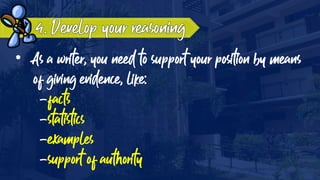
• As a writer, you need to support your position by means
of giving evidence, like:
-facts
-statistics
-examples
-support of authority
• Ways on how to construct effective counterarguments
1) Identify how strong the opposition is
2) Know the arguments which might be used against
your thesis statement
3) Identify the best ways on how you can refute these
arguments
4) Know if it might help you to agree with some of these
points
5) Identify which of your arguments that the readers might
try to discredit
6) Assess how closely the target readers identify with the
counterargument
7) Build on the weak links on the opposition’s thinking
GUIDELINES
WRITING
Position Paper
Position Paper
Position Paper
Position Paper
Position Paper
Position Paper
Position Paper
Position Paper
Position Paper
Position Paper

Position Paper

  • 4.
  • 5.
    A position paperpresents the writer’s stand or viewpoint on a particular issue. SHS FILESPOSITION PAPER.pptx
  • 6.
    It is generallyopinionated but contains factual details and evidence that strengthen the writer’s stand.
  • 7.
    • to generatesupport from the readers through strong and valid assertions • to change the power and opinions of others • it can be an essential tool in bringing about societal change
  • 8.
  • 9.
    • to persuadethe readers to take on your side
  • 10.
  • 11.
    Those whom youshare the same values and those who have opposite beliefs
  • 12.
  • 13.
    • Start withan introduction which presents the issue while grabbling the attention of readers • Define the issue and discuss its background • Provide a general statement of your position via your thesis statement
  • 14.
    • State yourmain arguments • Provide sufficient evidence for each argument such as statistical data, interviews with experts, and testimonies • Provide counterarguments against the possible weakness of your arguments
  • 15.
    • Restate yourposition and main arguments • Suggest a course of action. • State what makes your position superior and more acceptable. • End with a powerful closing statement such as quotation, a challenge, or a question.
  • 16.
  • 17.
    • The issueshould be debatable • The issue should be current and relevant • Two basic things to consider: Pros and Cons
  • 18.
    • Primary or FieldReport Secondary Research
  • 20.
    • A tool ingathering an information from an actual observation of the place or the subject in relation to the environment.
  • 21.
    • It is adata gathering tool in which the information is obtained from a person knowledgeable on the topic.
  • 22.
  • 23.
    • Planning andsetting up the interview • Note-taking • Reflecting on the interview • Writing up your notes
  • 24.
  • 25.
    Too limiting. Thequestion already provides the choices for the interviewee. Example: Do you think K12 implementation is an advantage or disadvantage? Why?
  • 26.
    A type ofquestioning which is too assuming. The condition is already set and the interviewee is prompted to just cite his/ her reasons for answer.
  • 27.
    Example: Do youthink the incident in COMELEC website hacking affected the 2016 Presidential elections? How extensive is the effect in your own views?
  • 28.
    It allows theinterviewee to provide information such as anecdotes, personal revelations and expressions of attitudes.
  • 29.
    Example: Please tellme about the preparations in your department for the full implementation of K12?
  • 30.
    It requires aspecific answer from the interviewee. He/ She has to be direct with the answers.
  • 31.
    Example: What arethe tracks in Grade 11 and 12?
  • 33.
    It involves gettinginformation from published materials, such as: -Books -Magazines -Journals
  • 34.
    Write a paragraphreflecting your thesis statement-the central idea in your paper.
  • 35.
    1. A strongthesis statement takes some sort of stand. Weak: There are some negative and positive aspects to the Banana Herb Tea Supplement. Strong: Because Banana Herb Tea Supplement promotes rapid weight loss that results in the loss of muscle and lean body mass, it poses a potential danger to customers.
  • 36.
    2. A strongthesis statement justifies discussion. Weak: My family is an extended family. Strong: While most American families would view consanguineal marriage as a threat to the nuclear family structure, many Iranian families, like my own, believe that these marriages help reinforce kinship ties in an extended family.
  • 37.
    3. A strongthesis statement expresses one main idea. Weak: Companies need to exploit the marketing potential of the Internet, and Web pages can provide both advertising and customer support.
  • 38.
    Strong: Because theInternet is filled with tremendous marketing potential, companies should exploit this potential by using Web pages that offer both advertising and customer support.
  • 39.
    2. A strongthesis statement is specific. Weak: World Hunger has many cause and effects. Strong: Hunger persists in Glandelinia because jobs are scarce and farming in the infertile soil is rarely profitable.
  • 40.
    Clear and engagingthesis statements contain words like because, since, so, although, unless, however and while.
  • 41.
    Argumentation • It presentsan opinion or a position on a controversial topic to the reader • It explains, clarifies and illustrates that opinion or position.
  • 42.
    • As awriter, you need to support your position by means of giving evidence, like: -facts -statistics -examples -support of authority
  • 43.
    • Ways onhow to construct effective counterarguments 1) Identify how strong the opposition is 2) Know the arguments which might be used against your thesis statement 3) Identify the best ways on how you can refute these arguments
  • 44.
    4) Know ifit might help you to agree with some of these points 5) Identify which of your arguments that the readers might try to discredit 6) Assess how closely the target readers identify with the counterargument 7) Build on the weak links on the opposition’s thinking
  • 45.