POPULATION PROBLEM IN DEVELOPED
COUNTRIES
FUNDAMENTALS OF PHYSICAL AND HUMAN
GEOGRAPHY
Submitted by: Submitted to:
Md Imran Hossain Rakib Alamgir Kabir
Environmental Science Lecturer
Roll no.:18531045 Bangladesh University
ID no. : 18014070 of professionals
OBJECTIVES
To know about the population
problems in developed countries
To know due to population problems
what are the main impacts on
environment
To know how to get rid from the
problems
CONTENTS
Introduction
Population problems in developed countries
Impacts on environment
How to stop population problems in developed
countries
Conclusion
INTRODUCTION
Population is compulsory for a country. But over
population is curse for not only the nation but also for
the whole country and its development status. In fact
developed countries also suffer through this problems
The growth pressure of population on resource base,
especially an arable land, has created many socio-
economic, cultural, ecological and environmental
problems. The population problems vary in space and
time and differ from region.
POPULATION PROBLEMS IN
DEVELOPED COUNTRIES
 Developed countries are highly industrialized and
urbanized. In these countries, the per capital
income is not only high, most of their population
independent either on secondary or tertiary sector.
 A developed country, industrialized country, more
developed country, or "more economically
developed country" (MEDC), is a sovereign state
that has a highly developed economy and advanced
technological infrastructure relative to other less
industrialized nations.
POPULATION PROBLEMS IN
DEVELOPED COUNTRIES
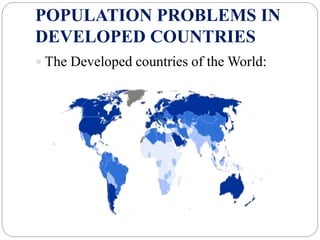
 The Developed countries of the World:
POPULATION PROBLEMS IN
DEVELOPED COUNTRIES
 These developed countries, despite high degree
of development, efficient agriculture and large-
scale industrial production, are also confronted
with many of the population problems:
1. Long Span of Life
2. Small Workforce
3. Rural Population
4. Urbanization
LONG SPAN OF LIFE:
In developed countries, both the birth and death rates
are low. Moreover, the proportion of younger people in
the population is relatively small whereas there is an
ever-increasing proportion of an older person (senior
citizens) in the population.
SMALL WORKFORCE:
As the standard of education improves, children
remain longer in school and join the workforce late.
This, combined with low birth rate, means that the
labor force expands only slowly while industrial and
other employment opportunities continue to multiply.
RURAL POPULATION:
There are more social amenities like universities, colleges,
hospitals, banks and places of recreation in urban areas.
For this reason, the rural youth out migrate from their
villages and start their career in towns and cities. The
fewer, especially the old people, live in villages.
URBANIZATION
As a town expands, the pressure on transport, water
supplies, sewage and refuse disposal grows and creates
problems. Smoke and chemical effluents from factories
produce air and water pollution. Traffic congestion and
noise are other problems.
SOME OTHER PROBLEMS
 SOCIAL PROBLEMS:
1.Violence
2.Drugs
3.Descrimination
IMPACTS ON ENVIRONMENT
 Environmental problems are very much a hazard in the
developing countries as in the developed world.
Pollution is heavy thick black smog is common in many
countries as a result of too many cars, taxis and buses.
The exhaust fumes from these vehicles blend into a
toxic cocktail of gases. Respiratory problems especially
cardiovascular illness and lung cancer are becoming
common in people.
 Pollution of air, land and water is a major problem in
most developed world cities. The drive to
industrialization brings with it inevitable problems,
especially as legislation to protect the environment is
often non-existent or rarely enforced. Furthermore, the
hidden economy can add to the levels of pollution as
small, unlicensed industries are set up in peoples
homes or on rooftops. These industries release their
pollutants into the air, land and water.
HOW TO STOP POPULATION
PROBLEMS IN
DEVELOPED COUNTRIES
 Make proper family plans to balance the birth and
death rate
 By create more job opportunities and training
 By recycling wastes . This will help the environment to
be more safe for human beings living
 By making proper URP
CONCLUSION
The undeveloped, developing and developed
countries have some problems in common. Most of
the developed countries have areas where agriculture
or industry could be improved or where the
population is too large and dense. But the problems
the countries faced for population is really very
harmful for their future growth. The pollution,
urbanization, unemployment, rural population all
these problems are effecting the developed economy,
despicable income per capital rate and others.
Population problems in developed countries

Population problems in developed countries

  • 1.
    POPULATION PROBLEM INDEVELOPED COUNTRIES FUNDAMENTALS OF PHYSICAL AND HUMAN GEOGRAPHY Submitted by: Submitted to: Md Imran Hossain Rakib Alamgir Kabir Environmental Science Lecturer Roll no.:18531045 Bangladesh University ID no. : 18014070 of professionals
  • 2.
    OBJECTIVES To know aboutthe population problems in developed countries To know due to population problems what are the main impacts on environment To know how to get rid from the problems
  • 3.
    CONTENTS Introduction Population problems indeveloped countries Impacts on environment How to stop population problems in developed countries Conclusion
  • 4.
    INTRODUCTION Population is compulsoryfor a country. But over population is curse for not only the nation but also for the whole country and its development status. In fact developed countries also suffer through this problems The growth pressure of population on resource base, especially an arable land, has created many socio- economic, cultural, ecological and environmental problems. The population problems vary in space and time and differ from region.
  • 5.
    POPULATION PROBLEMS IN DEVELOPEDCOUNTRIES  Developed countries are highly industrialized and urbanized. In these countries, the per capital income is not only high, most of their population independent either on secondary or tertiary sector.  A developed country, industrialized country, more developed country, or "more economically developed country" (MEDC), is a sovereign state that has a highly developed economy and advanced technological infrastructure relative to other less industrialized nations.
  • 6.
    POPULATION PROBLEMS IN DEVELOPEDCOUNTRIES  The Developed countries of the World:
  • 7.
    POPULATION PROBLEMS IN DEVELOPEDCOUNTRIES  These developed countries, despite high degree of development, efficient agriculture and large- scale industrial production, are also confronted with many of the population problems: 1. Long Span of Life 2. Small Workforce 3. Rural Population 4. Urbanization
  • 8.
    LONG SPAN OFLIFE: In developed countries, both the birth and death rates are low. Moreover, the proportion of younger people in the population is relatively small whereas there is an ever-increasing proportion of an older person (senior citizens) in the population. SMALL WORKFORCE: As the standard of education improves, children remain longer in school and join the workforce late. This, combined with low birth rate, means that the labor force expands only slowly while industrial and other employment opportunities continue to multiply.
  • 9.
    RURAL POPULATION: There aremore social amenities like universities, colleges, hospitals, banks and places of recreation in urban areas. For this reason, the rural youth out migrate from their villages and start their career in towns and cities. The fewer, especially the old people, live in villages. URBANIZATION As a town expands, the pressure on transport, water supplies, sewage and refuse disposal grows and creates problems. Smoke and chemical effluents from factories produce air and water pollution. Traffic congestion and noise are other problems.
  • 10.
    SOME OTHER PROBLEMS SOCIAL PROBLEMS: 1.Violence 2.Drugs 3.Descrimination
  • 11.
    IMPACTS ON ENVIRONMENT Environmental problems are very much a hazard in the developing countries as in the developed world. Pollution is heavy thick black smog is common in many countries as a result of too many cars, taxis and buses. The exhaust fumes from these vehicles blend into a toxic cocktail of gases. Respiratory problems especially cardiovascular illness and lung cancer are becoming common in people.
  • 12.
     Pollution ofair, land and water is a major problem in most developed world cities. The drive to industrialization brings with it inevitable problems, especially as legislation to protect the environment is often non-existent or rarely enforced. Furthermore, the hidden economy can add to the levels of pollution as small, unlicensed industries are set up in peoples homes or on rooftops. These industries release their pollutants into the air, land and water.
  • 13.
    HOW TO STOPPOPULATION PROBLEMS IN DEVELOPED COUNTRIES  Make proper family plans to balance the birth and death rate  By create more job opportunities and training  By recycling wastes . This will help the environment to be more safe for human beings living  By making proper URP
  • 14.
    CONCLUSION The undeveloped, developingand developed countries have some problems in common. Most of the developed countries have areas where agriculture or industry could be improved or where the population is too large and dense. But the problems the countries faced for population is really very harmful for their future growth. The pollution, urbanization, unemployment, rural population all these problems are effecting the developed economy, despicable income per capital rate and others.