
Chapter 2.5 Population, Energy, and Climate Change
What are the Major Air Pollution Problems? Troposphere The atmospheric layer closet to earth ’ s surface A dynamic system involved in the chemical cycling of the earth vital nutrients Stratosphere 17 to 48 kilometers above the earth ’ s surface Ozone layer Air pollution Primary pollutants Secondary pollutants Carbon Oxides Carbon monoxide (CO) A colorless, odorless, highly toxic gas  Carbon dioxide (CO2) Colorless, odorless gas 93% found in the atmosphere is caused by the natural carbon cycle
What are the Major Air Pollution Problems? Particles A variety of solid particles and liquid droplets that remain suspended in the air for long periods. Ozone O3 is the major component of smog Volatile Organic Compounds (VOCs) Organic compounds that exist as gases in the atmosphere Radioactive Radon (Rn) A naturally occurring colorless & odorless radioactive gas found in rocks and soil
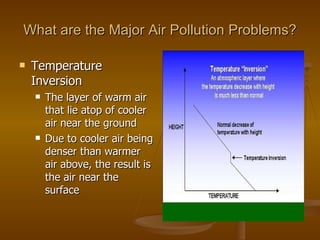
What are the Major Air Pollution Problems? Temperature Inversion The layer of warm air that lie atop of cooler air near the ground Due to cooler air being denser than warmer air above, the result is the air near the surface
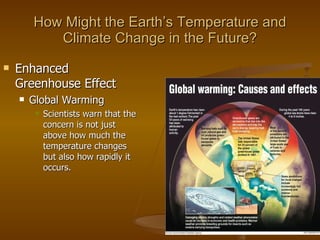
How Might the Earth ’s Temperature and Climate Change in the Future? Enhanced Greenhouse Effect Global Warming Scientists warn that the concern is not just above how much the temperature changes but also how rapidly it occurs.
How can technology help?
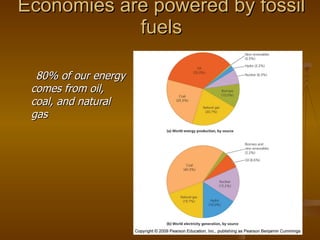
Economies are powered by fossil fuels 80% of our energy comes from oil, coal, and natural gas
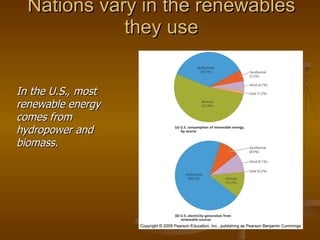
Nations vary in the renewables they use In the U.S., most renewable energy comes from hydropower and biomass.
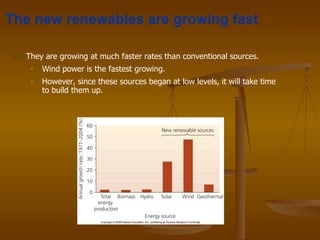
The new renewables are growing fast They are growing at much faster rates than conventional sources. Wind power is the fastest growing. However, since these sources began at low levels, it will take time to build them up.
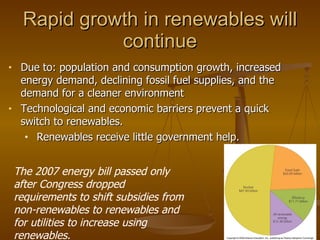
Due to: population and consumption growth, increased energy demand, declining fossil fuel supplies, and the demand for a cleaner environment Technological and economic barriers prevent a quick switch to renewables. Renewables receive little government help. Rapid growth in renewables will continue The 2007 energy bill passed only after Congress dropped requirements to shift subsidies from non-renewables to renewables and for utilities to increase using renewables.
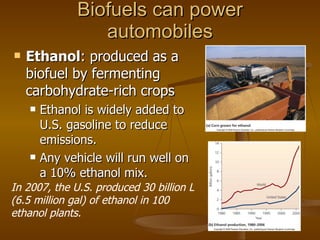
Biofuels can power automobiles Ethanol : produced as a biofuel by fermenting carbohydrate-rich crops Ethanol is widely added to U.S. gasoline to reduce emissions. Any vehicle will run well on a 10% ethanol mix. In 2007, the U.S. produced 30 billion L (6.5 million gal) of ethanol in 100 ethanol plants.
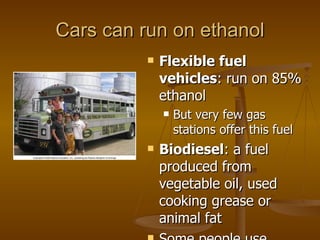
Cars can run on ethanol Flexible fuel vehicles : run on 85% ethanol But very few gas stations offer this fuel Biodiesel : a fuel produced from vegetable oil, used cooking grease or animal fat Some people use straight vegetable oil in their diesel engines.
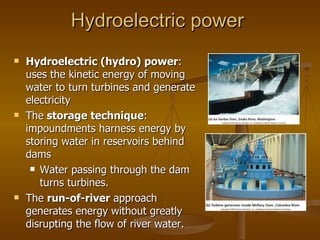
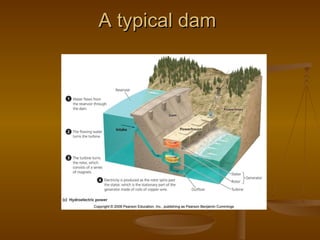
Hydroelectric power Hydroelectric (hydro) power : uses the kinetic energy of moving water to turn turbines and generate electricity The  storage technique : impoundments harness energy by storing water in reservoirs behind dams Water passing through the dam turns turbines. The  run-of-river  approach generates energy without greatly disrupting the flow of river water.
A typical dam
Hydropower is clean and renewable Hydropower has two clear advantages over fossil fuels for producing electricity: It is renewable: as long as precipitation fills rivers, we can use water to turn turbines. It is clean: no carbon dioxide is emitted. Hydropower is efficient. It has an EROI of 10:1, as high as any modern-day energy source.
Hydropower has negative impacts Damming rivers destroys riverine habitats. Natural flooding cycles are disrupted. Sediment deposition Thermal pollution of downstream water Reducing fish populations and aquatic biodiversity
Hydroelectric power is widely used Nations with large rivers and economic resources have used dams. But hydropower is not likely to expand. Most of the world ’ s large rivers have already been dammed. People have grown aware of the ecological impact of dams.
Solar energy The sun provides energy for almost all biological activity on Earth. There is great potential in solar energy, but we are still developing technologies to efficiently use it. Passive solar energy : the most common way to harness solar energy  Buildings are designed to maximize direct absorption of sunlight in winter and keep cool in summer. Active solar   energy collection : uses technology to focus, move, or store solar energy
Passive solar heating is simple and effective  Low south-facing windows maximize heat in the winter. Overhangs shade windows in the summer. Thermal mass : construction materials that absorb, store, and release heat By heating buildings in winter and cooling them in summer, passive solar methods conserve energy and reduce costs.
Active solar energy collection  Flat plate solar collectors (solar panels) : one active method for harnessing solar energy Installed on rooftops  Dark-colored, heat-absorbing metal plates  Water, air, or antifreeze pass through the collectors, transferring heat throughout the building. Heated water is stored and used later. Effective for heating water for homes
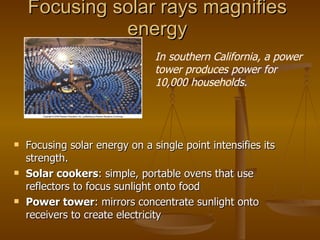
Focusing solar rays magnifies energy Focusing solar energy on a single point intensifies its strength. Solar cookers : simple, portable ovens that use reflectors to focus sunlight onto food  Power tower : mirrors concentrate sunlight onto receivers to create electricity In southern California, a power tower produces power for 10,000 households.
Solar power is little used but fast growing Solar energy was pushed to the sidelines by fossil fuels. Because of a lack of investment, solar energy contributes only a miniscule amount of energy. But solar energy use has grown 25%/year since 1971. Solar energy is attractive in developing nations. Where hundreds of millions don ’ t have electricity The U.S. may recover its leadership, given a 2005 federal tax credit and some state initiatives. Solar energy use should increase as prices fall, technologies improve, and governments enact economic incentives.
Solar power offers many benefits  The sun will burn for 4 – 5 billion more years. Solar technologies use no fuels, are quiet, safe, contain no moving parts, and require little maintenance. They allow local, decentralized control over power. Developing nations can use solar cookers and photovoltaics. Net metering : PV owners can sell excess electricity to their local power utility New jobs are being created. Solar power does not emit greenhouse gases and air pollution. Manufacturing units currently require fossil fuels.
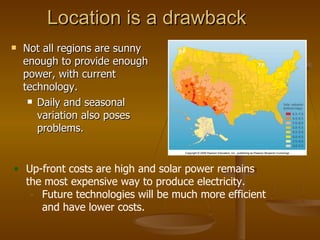
Location is a drawback Not all regions are sunny enough to provide enough power, with current technology. Daily and seasonal variation also poses problems. Up-front costs are high and solar power remains the most expensive way to produce electricity. Future technologies will be much more efficient and have lower costs.
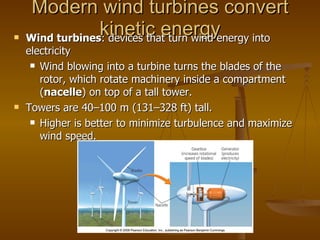
Modern wind turbines convert kinetic energy Wind turbines : devices that turn wind energy into electricity Wind blowing into a turbine turns the blades of the rotor, which rotate machinery inside a compartment ( nacelle ) on top of a tall tower. Towers are 40 – 100 m (131 – 328 ft) tall. Higher is better to minimize turbulence and maximize wind speed.
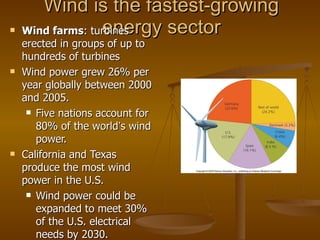
Wind is the fastest-growing energy sector Wind farms : turbines erected in groups of up to hundreds of turbines Wind power grew 26% per year globally between 2000 and 2005. Five nations account for 80% of the world ’ s wind power. California and Texas produce the most wind power in the U.S. Wind power could be expanded to meet 30% of the U.S. electrical needs by 2030.
Wind power has many benefits Wind produces no emissions once installed. It prevents the release of CO 2, , SO 2 , NO x , mercury. It is more efficient than conventional power sources. Turbines also use less water than conventional power plants. It can be used on many scales, from one turbine to hundreds. Farmers and ranchers can lease their land. Produces extra revenue  Landowners can still use their land for other uses.
Wind power has some downsides We have no control over when wind blows. This poses little problem if wind is one of several sources of electricity. Good wind sources are not always near population centers that need energy. Residents often oppose wind farms near population centers. Wind turbines also kill birds and bats when they fly into rotating blades.
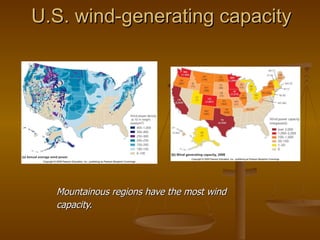
U.S. wind-generating capacity Mountainous regions have the most wind capacity.
Conclusion More people are becoming convinced that we need to shift to renewable energy sources. Biomass and hydropower already play important roles. Renewable sources include solar, wind, geothermal, and ocean energies. Hydrogen fuel may produce electricity. Most renewable sources have been hampered by inadequate funding for research and by artificially cheap fossil fuels. But there is hope that we can shift to renewables with minimal disruption.
What do you know?
QUESTION: Review We can harness power from wind by using devices called: Wind turbines Wind parks Wind farms Solar cells Nacelles     
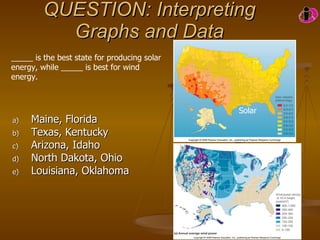
QUESTION: Interpreting Graphs and Data Maine, Florida Texas, Kentucky Arizona, Idaho North Dakota, Ohio Louisiana, Oklahoma _____ is the best state for producing solar energy, while _____ is best for wind energy. Solar Wind

Population energy climate change

  • 1.
    Chapter 2.5 Population,Energy, and Climate Change
  • 2.
    What are theMajor Air Pollution Problems? Troposphere The atmospheric layer closet to earth ’ s surface A dynamic system involved in the chemical cycling of the earth vital nutrients Stratosphere 17 to 48 kilometers above the earth ’ s surface Ozone layer Air pollution Primary pollutants Secondary pollutants Carbon Oxides Carbon monoxide (CO) A colorless, odorless, highly toxic gas Carbon dioxide (CO2) Colorless, odorless gas 93% found in the atmosphere is caused by the natural carbon cycle
  • 3.
    What are theMajor Air Pollution Problems? Particles A variety of solid particles and liquid droplets that remain suspended in the air for long periods. Ozone O3 is the major component of smog Volatile Organic Compounds (VOCs) Organic compounds that exist as gases in the atmosphere Radioactive Radon (Rn) A naturally occurring colorless & odorless radioactive gas found in rocks and soil
  • 4.
    What are theMajor Air Pollution Problems? Temperature Inversion The layer of warm air that lie atop of cooler air near the ground Due to cooler air being denser than warmer air above, the result is the air near the surface
  • 5.
    How Might theEarth ’s Temperature and Climate Change in the Future? Enhanced Greenhouse Effect Global Warming Scientists warn that the concern is not just above how much the temperature changes but also how rapidly it occurs.
  • 6.
  • 7.
    Economies are poweredby fossil fuels 80% of our energy comes from oil, coal, and natural gas
  • 8.
    Nations vary inthe renewables they use In the U.S., most renewable energy comes from hydropower and biomass.
  • 9.
    The new renewablesare growing fast They are growing at much faster rates than conventional sources. Wind power is the fastest growing. However, since these sources began at low levels, it will take time to build them up.
  • 10.
    Due to: populationand consumption growth, increased energy demand, declining fossil fuel supplies, and the demand for a cleaner environment Technological and economic barriers prevent a quick switch to renewables. Renewables receive little government help. Rapid growth in renewables will continue The 2007 energy bill passed only after Congress dropped requirements to shift subsidies from non-renewables to renewables and for utilities to increase using renewables.
  • 11.
    Biofuels can powerautomobiles Ethanol : produced as a biofuel by fermenting carbohydrate-rich crops Ethanol is widely added to U.S. gasoline to reduce emissions. Any vehicle will run well on a 10% ethanol mix. In 2007, the U.S. produced 30 billion L (6.5 million gal) of ethanol in 100 ethanol plants.
  • 12.
    Cars can runon ethanol Flexible fuel vehicles : run on 85% ethanol But very few gas stations offer this fuel Biodiesel : a fuel produced from vegetable oil, used cooking grease or animal fat Some people use straight vegetable oil in their diesel engines.
  • 13.
    Hydroelectric power Hydroelectric(hydro) power : uses the kinetic energy of moving water to turn turbines and generate electricity The storage technique : impoundments harness energy by storing water in reservoirs behind dams Water passing through the dam turns turbines. The run-of-river approach generates energy without greatly disrupting the flow of river water.
  • 14.
  • 15.
    Hydropower is cleanand renewable Hydropower has two clear advantages over fossil fuels for producing electricity: It is renewable: as long as precipitation fills rivers, we can use water to turn turbines. It is clean: no carbon dioxide is emitted. Hydropower is efficient. It has an EROI of 10:1, as high as any modern-day energy source.
  • 16.
    Hydropower has negativeimpacts Damming rivers destroys riverine habitats. Natural flooding cycles are disrupted. Sediment deposition Thermal pollution of downstream water Reducing fish populations and aquatic biodiversity
  • 17.
    Hydroelectric power iswidely used Nations with large rivers and economic resources have used dams. But hydropower is not likely to expand. Most of the world ’ s large rivers have already been dammed. People have grown aware of the ecological impact of dams.
  • 18.
    Solar energy Thesun provides energy for almost all biological activity on Earth. There is great potential in solar energy, but we are still developing technologies to efficiently use it. Passive solar energy : the most common way to harness solar energy Buildings are designed to maximize direct absorption of sunlight in winter and keep cool in summer. Active solar energy collection : uses technology to focus, move, or store solar energy
  • 19.
    Passive solar heatingis simple and effective Low south-facing windows maximize heat in the winter. Overhangs shade windows in the summer. Thermal mass : construction materials that absorb, store, and release heat By heating buildings in winter and cooling them in summer, passive solar methods conserve energy and reduce costs.
  • 20.
    Active solar energycollection Flat plate solar collectors (solar panels) : one active method for harnessing solar energy Installed on rooftops Dark-colored, heat-absorbing metal plates Water, air, or antifreeze pass through the collectors, transferring heat throughout the building. Heated water is stored and used later. Effective for heating water for homes
  • 21.
    Focusing solar raysmagnifies energy Focusing solar energy on a single point intensifies its strength. Solar cookers : simple, portable ovens that use reflectors to focus sunlight onto food Power tower : mirrors concentrate sunlight onto receivers to create electricity In southern California, a power tower produces power for 10,000 households.
  • 22.
    Solar power islittle used but fast growing Solar energy was pushed to the sidelines by fossil fuels. Because of a lack of investment, solar energy contributes only a miniscule amount of energy. But solar energy use has grown 25%/year since 1971. Solar energy is attractive in developing nations. Where hundreds of millions don ’ t have electricity The U.S. may recover its leadership, given a 2005 federal tax credit and some state initiatives. Solar energy use should increase as prices fall, technologies improve, and governments enact economic incentives.
  • 23.
    Solar power offersmany benefits The sun will burn for 4 – 5 billion more years. Solar technologies use no fuels, are quiet, safe, contain no moving parts, and require little maintenance. They allow local, decentralized control over power. Developing nations can use solar cookers and photovoltaics. Net metering : PV owners can sell excess electricity to their local power utility New jobs are being created. Solar power does not emit greenhouse gases and air pollution. Manufacturing units currently require fossil fuels.
  • 24.
    Location is adrawback Not all regions are sunny enough to provide enough power, with current technology. Daily and seasonal variation also poses problems. Up-front costs are high and solar power remains the most expensive way to produce electricity. Future technologies will be much more efficient and have lower costs.
  • 25.
    Modern wind turbinesconvert kinetic energy Wind turbines : devices that turn wind energy into electricity Wind blowing into a turbine turns the blades of the rotor, which rotate machinery inside a compartment ( nacelle ) on top of a tall tower. Towers are 40 – 100 m (131 – 328 ft) tall. Higher is better to minimize turbulence and maximize wind speed.
  • 26.
    Wind is thefastest-growing energy sector Wind farms : turbines erected in groups of up to hundreds of turbines Wind power grew 26% per year globally between 2000 and 2005. Five nations account for 80% of the world ’ s wind power. California and Texas produce the most wind power in the U.S. Wind power could be expanded to meet 30% of the U.S. electrical needs by 2030.
  • 27.
    Wind power hasmany benefits Wind produces no emissions once installed. It prevents the release of CO 2, , SO 2 , NO x , mercury. It is more efficient than conventional power sources. Turbines also use less water than conventional power plants. It can be used on many scales, from one turbine to hundreds. Farmers and ranchers can lease their land. Produces extra revenue Landowners can still use their land for other uses.
  • 28.
    Wind power hassome downsides We have no control over when wind blows. This poses little problem if wind is one of several sources of electricity. Good wind sources are not always near population centers that need energy. Residents often oppose wind farms near population centers. Wind turbines also kill birds and bats when they fly into rotating blades.
  • 29.
    U.S. wind-generating capacityMountainous regions have the most wind capacity.
  • 30.
    Conclusion More peopleare becoming convinced that we need to shift to renewable energy sources. Biomass and hydropower already play important roles. Renewable sources include solar, wind, geothermal, and ocean energies. Hydrogen fuel may produce electricity. Most renewable sources have been hampered by inadequate funding for research and by artificially cheap fossil fuels. But there is hope that we can shift to renewables with minimal disruption.
  • 31.
  • 32.
    QUESTION: Review Wecan harness power from wind by using devices called: Wind turbines Wind parks Wind farms Solar cells Nacelles     
  • 33.
    QUESTION: Interpreting Graphsand Data Maine, Florida Texas, Kentucky Arizona, Idaho North Dakota, Ohio Louisiana, Oklahoma _____ is the best state for producing solar energy, while _____ is best for wind energy. Solar Wind

Editor's Notes