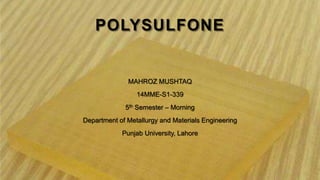
POLYSULFONE
MAHROZ MUSHTAQ
14MME-S1-339
5th Semester – Morning
Department of Metallurgy and Materials Engineering
Punjab University, Lahore
 Objectives
• Introduction
• Polymerization method
• Grades and producers
• Properties
• Processing techniques
• Applications
• Research on polymeric material
• Conclusion
 INTRODUCTION
• Polysulfone was the first thermoplastics developed for long term service beyond (149
°C).
• Toughness and stability .
• Polysulfones are used in specially applications (membrane for artificial kidney) and often
are a superior replacement for polycarbonates.
 Repeating unit 
 Molecular Formula  C27H22O4S
 POLYMERIZATION
 condensation polymerization method from bisphenol A and 4, 4 – dichlorosulphonyl
sulfone.
 Grades of PSU
PSU GF
– 110
PSU GF
– 130
Unfilled
PSU
PSU CF
– 30
PSU GF
– 120
 TRADE NAMES
 Commercial availability
• Granular
• Sheets
Tensile strength 50 – 70.3 MPa
Elongation 40 – 80 %
Young’s Modulus 2.48 GPa
Density 1.24 g/cm^3
Rockwell R120
Chemical
resistance
Yes
Operating
temperature
149 °C
Glass transition 170 – 185 °C
Melting 180 – 190 °C
Decomposition 460 – 600 °C
% Crystallinity 42 %
 PROPERTIES
 LIMITATIONS  PROCESSING TECHNIQUES
 APPLICATIONS
Medical
equipment
trays
Service
trays and
carafes
Heart
valve
holders
Hemodialysis
membrane
(Artificial
kidney)
Plumbing
fittings
Water
treatment
membrane
IMPROVING THE THERMAL AND MECHANICAL PROPERTIES OF
POLYSULFONE BY INCORPORATION OF GRAPHENE OXIDE
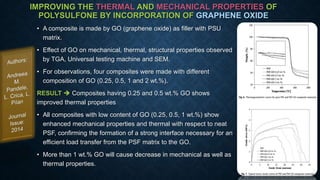
• A composite is made by GO (graphene oxide) as filler with PSU
matrix.
• Effect of GO on mechanical, thermal, structural properties observed
by TGA, Universal testing machine and SEM.
• For observations, four composites were made with different
composition of GO (0.25, 0.5, 1 and 2 wt.%).
RESULT  Composites having 0.25 and 0.5 wt.% GO shows
improved thermal properties
• All composites with low content of GO (0.25, 0.5, 1 wt.%) show
enhanced mechanical properties and thermal with respect to neat
PSF, confirming the formation of a strong interface necessary for an
efficient load transfer from the PSF matrix to the GO.
• More than 1 wt.% GO will cause decrease in mechanical as well as
thermal properties.
CONCLUSION
Polysulfone is popular due to mechanical properties, chemical inertness, oxidative
resistance and high thermal stability. It also utilize in making surface hardened composites
of epoxy resin and use as membrane on large scale.
Thanks for listening 
Polysulfone

Polysulfone

  • 1.
    POLYSULFONE MAHROZ MUSHTAQ 14MME-S1-339 5th Semester– Morning Department of Metallurgy and Materials Engineering Punjab University, Lahore
  • 2.
     Objectives • Introduction •Polymerization method • Grades and producers • Properties • Processing techniques • Applications • Research on polymeric material • Conclusion
  • 3.
     INTRODUCTION • Polysulfonewas the first thermoplastics developed for long term service beyond (149 °C). • Toughness and stability . • Polysulfones are used in specially applications (membrane for artificial kidney) and often are a superior replacement for polycarbonates.  Repeating unit   Molecular Formula  C27H22O4S
  • 4.
     POLYMERIZATION  condensationpolymerization method from bisphenol A and 4, 4 – dichlorosulphonyl sulfone.  Grades of PSU PSU GF – 110 PSU GF – 130 Unfilled PSU PSU CF – 30 PSU GF – 120
  • 5.
     TRADE NAMES Commercial availability • Granular • Sheets Tensile strength 50 – 70.3 MPa Elongation 40 – 80 % Young’s Modulus 2.48 GPa Density 1.24 g/cm^3 Rockwell R120 Chemical resistance Yes Operating temperature 149 °C Glass transition 170 – 185 °C Melting 180 – 190 °C Decomposition 460 – 600 °C % Crystallinity 42 %  PROPERTIES
  • 6.
     LIMITATIONS PROCESSING TECHNIQUES
  • 7.
  • 8.
    IMPROVING THE THERMALAND MECHANICAL PROPERTIES OF POLYSULFONE BY INCORPORATION OF GRAPHENE OXIDE • A composite is made by GO (graphene oxide) as filler with PSU matrix. • Effect of GO on mechanical, thermal, structural properties observed by TGA, Universal testing machine and SEM. • For observations, four composites were made with different composition of GO (0.25, 0.5, 1 and 2 wt.%). RESULT  Composites having 0.25 and 0.5 wt.% GO shows improved thermal properties • All composites with low content of GO (0.25, 0.5, 1 wt.%) show enhanced mechanical properties and thermal with respect to neat PSF, confirming the formation of a strong interface necessary for an efficient load transfer from the PSF matrix to the GO. • More than 1 wt.% GO will cause decrease in mechanical as well as thermal properties.
  • 9.
    CONCLUSION Polysulfone is populardue to mechanical properties, chemical inertness, oxidative resistance and high thermal stability. It also utilize in making surface hardened composites of epoxy resin and use as membrane on large scale. Thanks for listening 