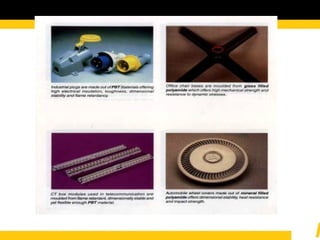
ENGINEERING PLASTICS
&
APPLICATIONS
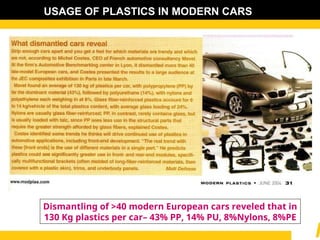
Dismantling of >40 modern European cars reveled that in
130 Kg plastics per car– 43% PP, 14% PU, 8%Nylons, 8%PE
USAGE OF PLASTICS IN MODERN CARS
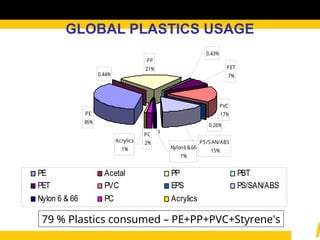
PE
36%
PP
21%
PVC
17%
PET
7%
PS/SAN/ABS
15%
PC
2%
Nylon6&66
1%
0.44%
0.43%
0.26%
Acrylics
1%
PE Acetal PP PBT
PET PVC EPS PS/SAN/ABS
Nylon 6 & 66 PC Acrylics
s
79 % Plastics consumed – PE+PP+PVC+Styrene's
GLOBAL PLASTICS USAGE
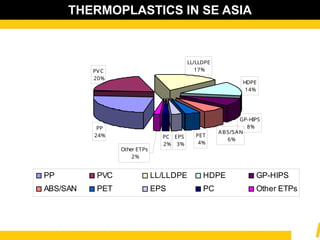
PP
24%
LL/LLDPE
17%
GP-HIPS
8%
PET
4%
EPS
3%
PC
2%
Other ETPs
2%
PVC
20%
ABS/SAN
6%
HDPE
14%
PP PVC LL/LLDPE HDPE GP-HIPS
ABS/SAN PET EPS PC Other ETPs
THERMOPLASTICS IN SE ASIA
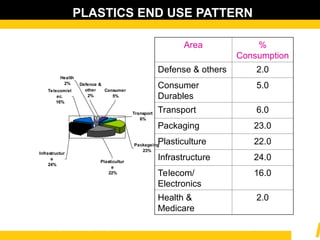
PLASTICS END USE PATTERN
Plasticultur
e
22%
Telecom/el
ec.
16%
Infrastructur
e
24%
Defence &
other
2%
Packageing
23%
Health
2%
Transport
6%
Consumer
5%
Area %
Consumption
Defense & others 2.0
Consumer
Durables
5.0
Transport 6.0
Packaging 23.0
Plasticulture 22.0
Infrastructure 24.0
Telecom/
Electronics
16.0
Health &
Medicare
2.0
PLASTICS-THE MATERIAL OF CHOICE
• User Friendly
• Versatility
• Light-weight
• Energy Efficient
• Non-corrosive
• Aesthetic
• Abundant
• Recyclable
PLASTICS – Emerging Material to meet
Engineering Application Demands
• Density
• MFI (Melt flow Index)
• Mechanical Properties
• Impact Strength
• Stiffness
• Toughness
• Creep Resistance
• Abrasion Resistance
• Tear Resistance
 Optical Properties
 Gloss Clarity & Opacity
PLASTICS – Emerging Material to meet
Engineering Application Demands
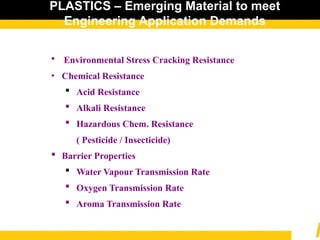
 Environmental Stress Cracking Resistance
• Chemical Resistance
 Acid Resistance
 Alkali Resistance
 Hazardous Chem. Resistance
( Pesticide / Insecticide)
 Barrier Properties
 Water Vapour Transmission Rate
 Oxygen Transmission Rate
 Aroma Transmission Rate
PLASTICS – Emerging Material to meet
Engineering Application Demands
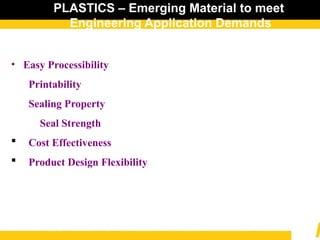
• Easy Processibility
 Printability
 Sealing Property
 Seal Strength
 Cost Effectiveness
 Product Design Flexibility
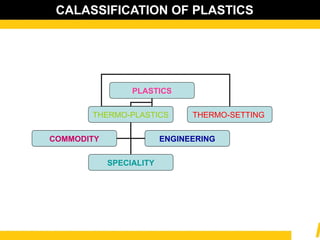
CALASSIFICATION OF PLASTICS
PLASTICS
THERMO-PLASTICS THERMO-SETTING
COMMODITY ENGINEERING
SPECIALITY
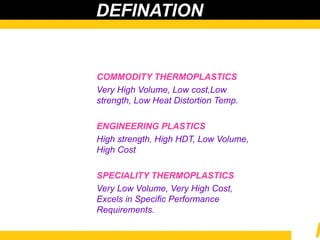
DEFINATION
COMMODITY THERMOPLASTICS
Very High Volume, Low cost,Low
strength, Low Heat Distortion Temp.
ENGINEERING PLASTICS
High strength, High HDT, Low Volume,
High Cost
SPECIALITY THERMOPLASTICS
Very Low Volume, Very High Cost,
Excels in Specific Performance
Requirements.
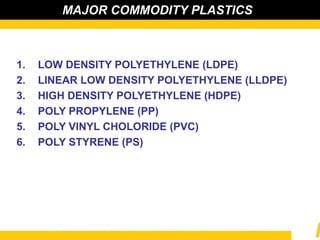
MAJOR COMMODITY PLASTICS
1. LOW DENSITY POLYETHYLENE (LDPE)
2. LINEAR LOW DENSITY POLYETHYLENE (LLDPE)
3. HIGH DENSITY POLYETHYLENE (HDPE)
4. POLY PROPYLENE (PP)
5. POLY VINYL CHOLORIDE (PVC)
6. POLY STYRENE (PS)
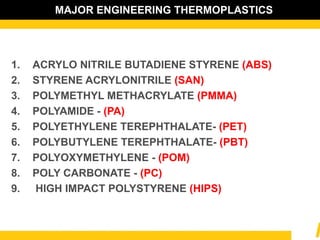
MAJOR ENGINEERING THERMOPLASTICS
1. ACRYLO NITRILE BUTADIENE STYRENE (ABS)
2. STYRENE ACRYLONITRILE (SAN)
3. POLYMETHYL METHACRYLATE (PMMA)
4. POLYAMIDE - (PA)
5. POLYETHYLENE TEREPHTHALATE- (PET)
6. POLYBUTYLENE TEREPHTHALATE- (PBT)
7. POLYOXYMETHYLENE - (POM)
8. POLY CARBONATE - (PC)
9. HIGH IMPACT POLYSTYRENE (HIPS)
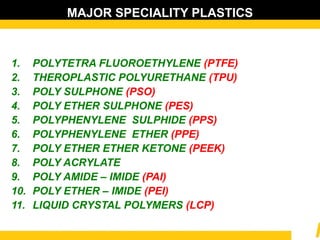
MAJOR SPECIALITY PLASTICS
1. POLYTETRA FLUOROETHYLENE (PTFE)
2. THEROPLASTIC POLYURETHANE (TPU)
3. POLY SULPHONE (PSO)
4. POLY ETHER SULPHONE (PES)
5. POLYPHENYLENE SULPHIDE (PPS)
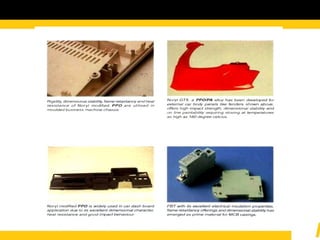
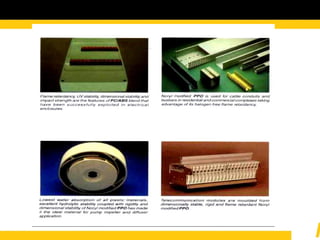
6. POLYPHENYLENE ETHER (PPE)
7. POLY ETHER ETHER KETONE (PEEK)
8. POLY ACRYLATE
9. POLY AMIDE – IMIDE (PAI)
10. POLY ETHER – IMIDE (PEI)
11. LIQUID CRYSTAL POLYMERS (LCP)
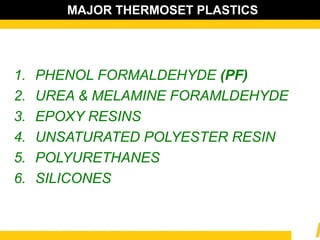
MAJOR THERMOSET PLASTICS
1. PHENOL FORMALDEHYDE (PF)
2. UREA & MELAMINE FORAMLDEHYDE
3. EPOXY RESINS
4. UNSATURATED POLYESTER RESIN
5. POLYURETHANES
6. SILICONES
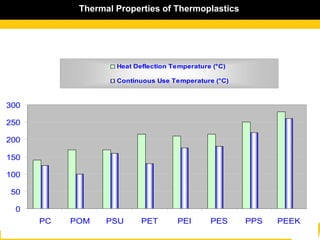
0
50
100
150
200
250
300
PC POM PSU PET PEI PES PPS PEEK
Heat Deflection Temperature (°C)
Continuous Use Temperature (°C)
Thermal Properties of Thermoplastics
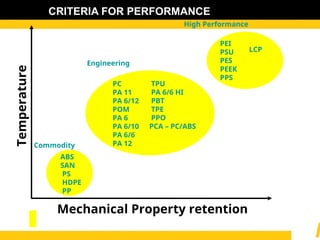
ABS
SAN
PS
HDPE
PP
PC
PA 11
PA 6/12
POM
PA 6
PA 6/10
PA 6/6
PA 12
TPU
PA 6/6 HI
PBT
TPE
PPO
PCA – PC/ABS
Commodity
Engineering
High Performance
PEI
PSU
PES
PEEK
PPS
LCP
Temperature
Mechanical Property retention
CRITERIA FOR PERFORMANCE
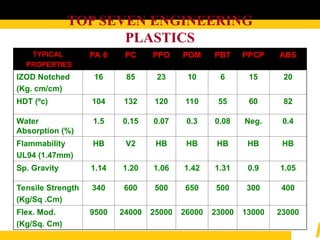
TOP SEVEN ENGINEERING
PLASTICS
TYPICAL
PROPERTIES
PA 6 PC PPO POM PBT PPCP ABS
IZOD Notched
(Kg. cm/cm)
16 85 23 10 6 15 20
HDT (ºc) 104 132 120 110 55 60 82
Water
Absorption (%)
1.5 0.15 0.07 0.3 0.08 Neg. 0.4
Flammability
UL94 (1.47mm)
HB V2 HB HB HB HB HB
Sp. Gravity 1.14 1.20 1.06 1.42 1.31 0.9 1.05
Tensile Strength
(Kg/Sq .Cm)
340 600 500 650 500 300 400
Flex. Mod.
(Kg/Sq. Cm)
9500 24000 25000 26000 23000 13000 23000
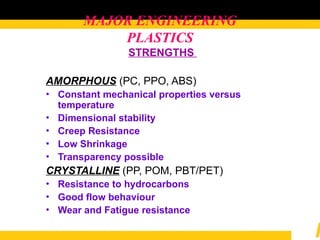
MAJOR ENGINEERING
PLASTICS
STRENGTHS
AMORPHOUS (PC, PPO, ABS)
• Constant mechanical properties versus
temperature
• Dimensional stability
• Creep Resistance
• Low Shrinkage
• Transparency possible
CRYSTALLINE (PP, POM, PBT/PET)
• Resistance to hydrocarbons
• Good flow behaviour
• Wear and Fatigue resistance
POLYAMIDES
• Several types are available based on raw material
used
• Most widely used polyamides are Nylon 6 & 66
• Condensation reaction of dicarboxylic acids and
diamins (Commercially through the route of
intermediate salts) ---- Nylon 6,& 66
• Ring opening reaction of lactam – Nylon 6, Nylon 12
etc.
• Condensation reaction of amino acids – Nylon 7,
Nylon 11 etc.
POLYAMIDES
Characteristics of Polyamides
• Semi-crystalline material
• Polar in nature
• Resistant to hydrocarbon solvents, grease, lubricants
• Hygroscopic
• High to medium rigidity – improved by glass fibre filling
• Good electrical insulation – adversely affected by moisture
absorption.
• Good abrasion resistance and low coefficient of friction
• Flame retardant versions are difficult process.
• Dimensions affected by humidity.
• Not good temp. resistance under load – improved by glass
fibre filling.
POLYAMIDES
APPLICATIONS OF POLYAMIDE
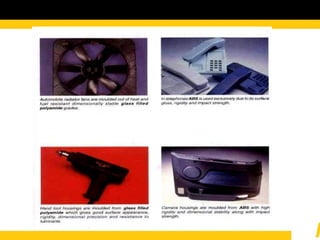
• Gear, Cams, bushes, Bearings
• Valve Seats
• Terminal Blocks
• Connectors
• Automotive Exterior
• Under bonnet Automotive Parts
• Motor Housing
• Optical fibre Sheathing (Nylon 12)
• Insulating liners (Railways
• Hair combs
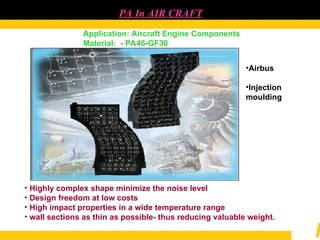
PA In AIR CRAFT
Application: Aircraft Engine Components
Material: - PA46-GF30
• Highly complex shape minimize the noise level
• Design freedom at low costs
• High impact properties in a wide temperature range
• wall sections as thin as possible- thus reducing valuable weight.
•Airbus
•Injection
moulding
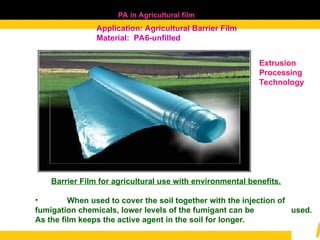
PA in Agricultural film
Application: Agricultural Barrier Film
Material: PA6-unfilled
Barrier Film for agricultural use with environmental benefits.
• When used to cover the soil together with the injection of
fumigation chemicals, lower levels of the fumigant can be used.
As the film keeps the active agent in the soil for longer.
Extrusion
Processing
Technology
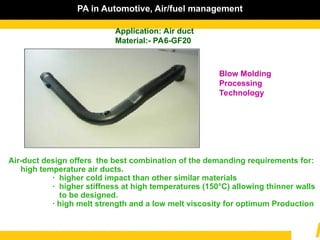
PA in Automotive, Air/fuel management
Application: Air duct
Material:- PA6-GF20
Blow Molding
Processing
Technology
Air-duct design offers the best combination of the demanding requirements for:
high temperature air ducts.
· higher cold impact than other similar materials
· higher stiffness at high temperatures (150°C) allowing thinner walls
to be designed.
· high melt strength and a low melt viscosity for optimum Production
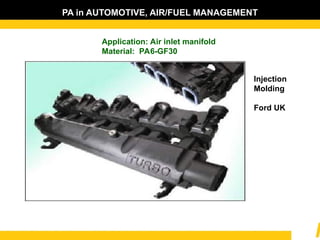
PA in AUTOMOTIVE, AIR/FUEL MANAGEMENT
Application: Air inlet manifold
Material: PA6-GF30
Injection
Molding
Ford UK
PA6: The material of choice for air inlet manifolds
• ‘Fuel economy’ & ‘weight reduction’
• Single molding and replacing aluminium and steel by
plastics
• Provides the chemical, temperature and vibration
resistance required to survive the expected life of
vehicles.
• lower system costs compared to metals through part
and function integration,
• Easier assembly and longer tool life.
• Temperature resistance and a higher burst pressure
resistance after welding.
• Providing safer solutions or more design freedom, as
well as lower system costs as a result of an easier
• Processibility and better surface appearance.
POLY CARBONATE
POLYCARBONATE
• Poly carbonate was first developed in the laboratory
of GE in 1953.
• It was first commercialised in 1958 by GE under the
Trade name of LEXAN
• Polycarbonate Lexan is an ester of carbonic acid.
• LEXAN is commercially produced by
polycondesation of Bisphenol A and Phosgene
POLY CARBONATE
CHARACTERISTICS :
• Highest impact strength
• High rigidity
• High dimensional stability
• High heat distortion temp
• Usability in the temperature range of -50 deg. To 135 deg.
• Flame retardancy and low combustibility
• High optical clarity
• Good electrical insulation properties
• Good strain resistance
• Low water absorption
• Food grades available.
• Good low temp. impact strength
POLY CARBONATE
APPLICATIONS:
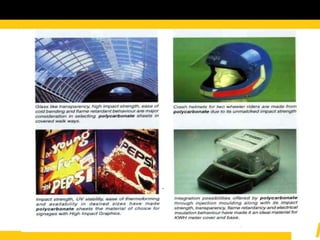
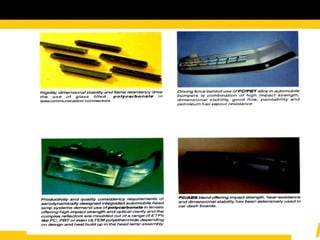
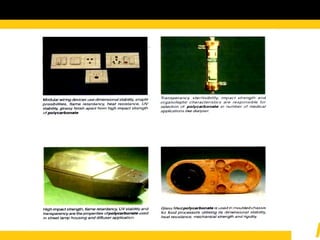
• AUTOMOTIVE HEADLAMPS, REFLECTORS AND LENSES
• INDICATORS AND BLINKERS
• DASH BOARD COMPONENTS
• CRASH HELMETS
• TELECOM CONNECTORS
• DOMESTIC ELECTRICAL SWITCHES
• TRAFFIC SIGNAL LENSES
• SIGNAL HOUSINGS
• TELEGRAPHIC POLE INSULATOR
• TERMINAL BLOCKS
• LIGHT DIFFUSER
• STREET LAMP CANOPIES
• BUSINESS MACHINE COMPONENTS
POLY CARBONATE
APPLICATIONS
• BABY FEEDING BOTTLES, MIXIE JARS
• BLOOD OXYGENATORS
• I.V. CANNUELA
• FACTORY ROOFINGS
• RAILWAYS PLATFORMS FOOFINGS/BUS STOPS
• SAFETY GLAZINGS
• TELEPHONE BOOTHS
• OFFICE AND FACTORY PARTITIONS
• COMPACT DISKS AND OPTICAL DATA STORAGE DISKS
• RETURNABLE WATER AND MILK BOTTLES.
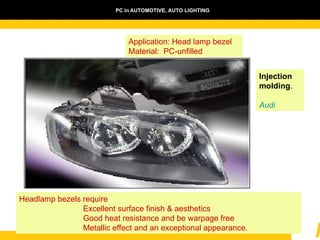
PC in AUTOMOTIVE, AUTO LIGHTING
Application: Head lamp bezel
Material: PC-unfilled
Headlamp bezels require
Excellent surface finish & aesthetics
Good heat resistance and be warpage free
Metallic effect and an exceptional appearance.
Injection
molding.
Audi
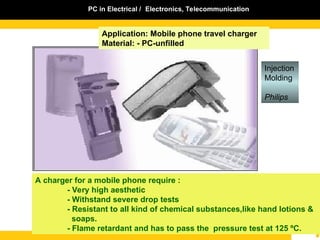
PC in Electrical / Electronics, Telecommunication
Application: Mobile phone travel charger
Material: - PC-unfilled
A charger for a mobile phone require :
- Very high aesthetic
- Withstand severe drop tests
- Resistant to all kind of chemical substances,like hand lotions &
soaps.
- Flame retardant and has to pass the pressure test at 125 ºC.
Injection
Molding
Philips
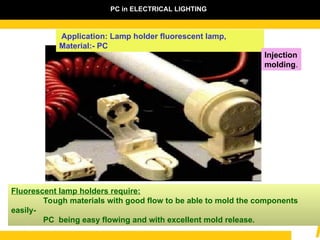
PC in ELECTRICAL LIGHTING
Application: Lamp holder fluorescent lamp,
Material:- PC
Fluorescent lamp holders require:
Tough materials with good flow to be able to mold the components
easily-
PC being easy flowing and with excellent mold release.
Injection
molding.
PC in Electrical / Electronics
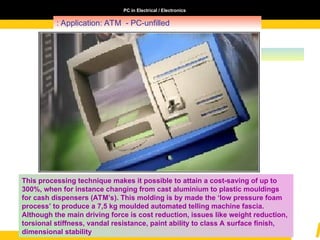
: Application: ATM - PC-unfilled
This processing technique makes it possible to attain a cost-saving of up to
300%, when for instance changing from cast aluminium to plastic mouldings
for cash dispensers (ATM’s). This molding is by made the ‘low pressure foam
process’ to produce a 7,5 kg moulded automated telling machine fascia.
Although the main driving force is cost reduction, issues like weight reduction,
torsional stiffness, vandal resistance, paint ability to class A surface finish,
dimensional stability
THERMOPLASTIC POLY ESTER(PET & PBT)
• Crystalline in nature
• Based mainly on polybutylene
terephthalate. A few grades based on
polyethylene and polycyclohexane
dimethanol terephalate are also available
• The base resins are commercially
manufactured by Esterification reaction of
Terephthalic Acid and appropriate diols.
THERMO PLASTIC POLYESTER (PET & PBT)
CHARACTERISTICS
• High Mechanical Strength
• Excellent chemical resistance
• High temperature resistance in glass filled grades
• High dimensional stability
• Excellent Electrical tracking resistance
• Can be made flame retardant
• Effect of humidity minimal
• Excellent flow
THERMOPLASTIC POLYESTER (PET & PBT)
APPLICATIONS:
• Connectors
• TV Components
• Industrial Switches/plug’s
• Business machine components
• Keyboard buttons
• Steam irons
• Cookers
• Air vents
• Plumbing
• Auto ignition systems
• Under bonnet connectors
• Head lamp reflectors
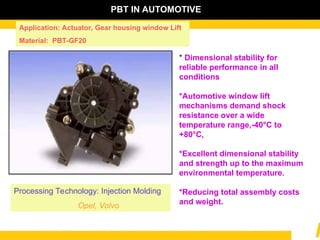
* Dimensional stability for
reliable performance in all
conditions
*Automotive window lift
mechanisms demand shock
resistance over a wide
temperature range,-40°C to
+80°C,
*Excellent dimensional stability
and strength up to the maximum
environmental temperature.
*Reducing total assembly costs
and weight.
Processing Technology: Injection Molding
Opel, Volvo
Application: Actuator, Gear housing window Lift
Material: PBT-GF20
PBT IN AUTOMOTIVE
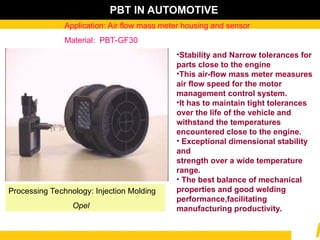
•Stability and Narrow tolerances for
parts close to the engine
•This air-flow mass meter measures
air flow speed for the motor
management control system.
•It has to maintain tight tolerances
over the life of the vehicle and
withstand the temperatures
encountered close to the engine.
• Exceptional dimensional stability
and
strength over a wide temperature
range.
• The best balance of mechanical
properties and good welding
performance,facilitating
manufacturing productivity.
Application: Air flow mass meter housing and sensor
Material: PBT-GF30
PBT IN AUTOMOTIVE
Processing Technology: Injection Molding
Opel
PBT IN AUTOMOTIVE
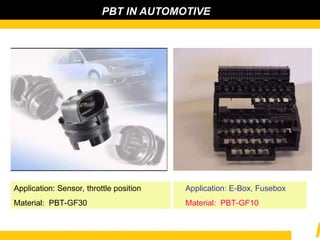
Application: Sensor, throttle position
Material: PBT-GF30
Application: E-Box, Fusebox
Material: PBT-GF10
Application: Compact NS Schneider Material: PBT-GF30
PBT IN : Electrical / Electronics, Power distribution & circuit protect
Application: Bobbins Schneider
Material: PBT-GF30
Processing Technology: Injection Molding.
Schneider
Application: Breake Booster Valve bodies
Material: PET-GF35
•Glass fiber reinforced
polyethylene terephthalate
(PET) is the material of
choice for automotive brake
booster valve body
applications.
• It provides weight,
performance and cost
advantages over previously
used thermosets.
Processing Technology : Injection Molding
ADI BMW
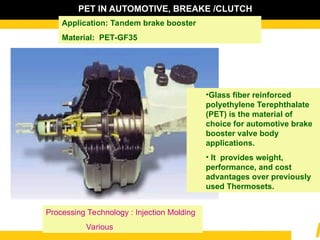
PET IN AUTOMOTIVE, BREAKE /CLUTCH
Application: Tandem brake booster
Material: PET-GF35
•Glass fiber reinforced
polyethylene Terephthalate
(PET) is the material of
choice for automotive brake
booster valve body
applications.
• It provides weight,
performance, and cost
advantages over previously
used Thermosets.
Processing Technology : Injection Molding
Various
POLYACETAL (POM)
• Polymer of formaldehyde, commonly known as
Polyacetal, Acetal polymer or Polyoxymethylene was
first commercialised by Du pont in 1959.
• Copolymers were introduced by celanese
corporation 1960 to overcome thermal stability
problem at processing temp.
• Polyacetal is commercially made by polymerisation
of high purity formaldehyde in rapidly stirred inert
medium like dry heptane with controlled traces of
water added containing phosphine and amine
initiators.
POLYACETAL (POM)
CHARACTERISTICS OF POLYACETAL (POM)
• High crystalline
• High flammable
• Resilient and good combination of stiffness and
toughness
• Creep resistant- superior to polyamide
• Low static and dynamic co-efficient at friction
• Very high degree of precision moulding possible
• Not high temp. resistant
• Resistant to organic solvents upto 70 degree.
POLYACETAL (POM)
POLYACETAL (POM)
APPLICATIONS OF POLYACETAL (POM)
• Gears
• Conveyor belt links
• Sprockets and chains
• Blower wheels
• Cams
• Fan blades
• Carburettor float and bodies
• Aerosol containers
• Lighter bodies
• LPG Cylinder caps
• Shower heads
Thank you
Thank you

Engineering plastic & applications detailed study

  • 1.
  • 2.
    Dismantling of >40modern European cars reveled that in 130 Kg plastics per car– 43% PP, 14% PU, 8%Nylons, 8%PE USAGE OF PLASTICS IN MODERN CARS
  • 3.
    PE 36% PP 21% PVC 17% PET 7% PS/SAN/ABS 15% PC 2% Nylon6&66 1% 0.44% 0.43% 0.26% Acrylics 1% PE Acetal PPPBT PET PVC EPS PS/SAN/ABS Nylon 6 & 66 PC Acrylics s 79 % Plastics consumed – PE+PP+PVC+Styrene's GLOBAL PLASTICS USAGE
  • 4.
    PP 24% LL/LLDPE 17% GP-HIPS 8% PET 4% EPS 3% PC 2% Other ETPs 2% PVC 20% ABS/SAN 6% HDPE 14% PP PVCLL/LLDPE HDPE GP-HIPS ABS/SAN PET EPS PC Other ETPs THERMOPLASTICS IN SE ASIA
  • 5.
    PLASTICS END USEPATTERN Plasticultur e 22% Telecom/el ec. 16% Infrastructur e 24% Defence & other 2% Packageing 23% Health 2% Transport 6% Consumer 5% Area % Consumption Defense & others 2.0 Consumer Durables 5.0 Transport 6.0 Packaging 23.0 Plasticulture 22.0 Infrastructure 24.0 Telecom/ Electronics 16.0 Health & Medicare 2.0
  • 6.
    PLASTICS-THE MATERIAL OFCHOICE • User Friendly • Versatility • Light-weight • Energy Efficient • Non-corrosive • Aesthetic • Abundant • Recyclable
  • 7.
    PLASTICS – EmergingMaterial to meet Engineering Application Demands • Density • MFI (Melt flow Index) • Mechanical Properties • Impact Strength • Stiffness • Toughness • Creep Resistance • Abrasion Resistance • Tear Resistance  Optical Properties  Gloss Clarity & Opacity
  • 8.
    PLASTICS – EmergingMaterial to meet Engineering Application Demands  Environmental Stress Cracking Resistance • Chemical Resistance  Acid Resistance  Alkali Resistance  Hazardous Chem. Resistance ( Pesticide / Insecticide)  Barrier Properties  Water Vapour Transmission Rate  Oxygen Transmission Rate  Aroma Transmission Rate
  • 9.
    PLASTICS – EmergingMaterial to meet Engineering Application Demands • Easy Processibility  Printability  Sealing Property  Seal Strength  Cost Effectiveness  Product Design Flexibility
  • 10.
    CALASSIFICATION OF PLASTICS PLASTICS THERMO-PLASTICSTHERMO-SETTING COMMODITY ENGINEERING SPECIALITY
  • 11.
    DEFINATION COMMODITY THERMOPLASTICS Very HighVolume, Low cost,Low strength, Low Heat Distortion Temp. ENGINEERING PLASTICS High strength, High HDT, Low Volume, High Cost SPECIALITY THERMOPLASTICS Very Low Volume, Very High Cost, Excels in Specific Performance Requirements.
  • 12.
    MAJOR COMMODITY PLASTICS 1.LOW DENSITY POLYETHYLENE (LDPE) 2. LINEAR LOW DENSITY POLYETHYLENE (LLDPE) 3. HIGH DENSITY POLYETHYLENE (HDPE) 4. POLY PROPYLENE (PP) 5. POLY VINYL CHOLORIDE (PVC) 6. POLY STYRENE (PS)
  • 13.
    MAJOR ENGINEERING THERMOPLASTICS 1.ACRYLO NITRILE BUTADIENE STYRENE (ABS) 2. STYRENE ACRYLONITRILE (SAN) 3. POLYMETHYL METHACRYLATE (PMMA) 4. POLYAMIDE - (PA) 5. POLYETHYLENE TEREPHTHALATE- (PET) 6. POLYBUTYLENE TEREPHTHALATE- (PBT) 7. POLYOXYMETHYLENE - (POM) 8. POLY CARBONATE - (PC) 9. HIGH IMPACT POLYSTYRENE (HIPS)
  • 14.
    MAJOR SPECIALITY PLASTICS 1.POLYTETRA FLUOROETHYLENE (PTFE) 2. THEROPLASTIC POLYURETHANE (TPU) 3. POLY SULPHONE (PSO) 4. POLY ETHER SULPHONE (PES) 5. POLYPHENYLENE SULPHIDE (PPS) 6. POLYPHENYLENE ETHER (PPE) 7. POLY ETHER ETHER KETONE (PEEK) 8. POLY ACRYLATE 9. POLY AMIDE – IMIDE (PAI) 10. POLY ETHER – IMIDE (PEI) 11. LIQUID CRYSTAL POLYMERS (LCP)
  • 15.
    MAJOR THERMOSET PLASTICS 1.PHENOL FORMALDEHYDE (PF) 2. UREA & MELAMINE FORAMLDEHYDE 3. EPOXY RESINS 4. UNSATURATED POLYESTER RESIN 5. POLYURETHANES 6. SILICONES
  • 16.
    0 50 100 150 200 250 300 PC POM PSUPET PEI PES PPS PEEK Heat Deflection Temperature (°C) Continuous Use Temperature (°C) Thermal Properties of Thermoplastics Thermal Properties of Thermoplastics
  • 17.
    ABS SAN PS HDPE PP PC PA 11 PA 6/12 POM PA6 PA 6/10 PA 6/6 PA 12 TPU PA 6/6 HI PBT TPE PPO PCA – PC/ABS Commodity Engineering High Performance PEI PSU PES PEEK PPS LCP Temperature Mechanical Property retention CRITERIA FOR PERFORMANCE
  • 18.
    TOP SEVEN ENGINEERING PLASTICS TYPICAL PROPERTIES PA6 PC PPO POM PBT PPCP ABS IZOD Notched (Kg. cm/cm) 16 85 23 10 6 15 20 HDT (ºc) 104 132 120 110 55 60 82 Water Absorption (%) 1.5 0.15 0.07 0.3 0.08 Neg. 0.4 Flammability UL94 (1.47mm) HB V2 HB HB HB HB HB Sp. Gravity 1.14 1.20 1.06 1.42 1.31 0.9 1.05 Tensile Strength (Kg/Sq .Cm) 340 600 500 650 500 300 400 Flex. Mod. (Kg/Sq. Cm) 9500 24000 25000 26000 23000 13000 23000
  • 19.
    MAJOR ENGINEERING PLASTICS STRENGTHS AMORPHOUS (PC,PPO, ABS) • Constant mechanical properties versus temperature • Dimensional stability • Creep Resistance • Low Shrinkage • Transparency possible CRYSTALLINE (PP, POM, PBT/PET) • Resistance to hydrocarbons • Good flow behaviour • Wear and Fatigue resistance
  • 20.
    POLYAMIDES • Several typesare available based on raw material used • Most widely used polyamides are Nylon 6 & 66 • Condensation reaction of dicarboxylic acids and diamins (Commercially through the route of intermediate salts) ---- Nylon 6,& 66 • Ring opening reaction of lactam – Nylon 6, Nylon 12 etc. • Condensation reaction of amino acids – Nylon 7, Nylon 11 etc.
  • 21.
    POLYAMIDES Characteristics of Polyamides •Semi-crystalline material • Polar in nature • Resistant to hydrocarbon solvents, grease, lubricants • Hygroscopic • High to medium rigidity – improved by glass fibre filling • Good electrical insulation – adversely affected by moisture absorption. • Good abrasion resistance and low coefficient of friction • Flame retardant versions are difficult process. • Dimensions affected by humidity. • Not good temp. resistance under load – improved by glass fibre filling.
  • 22.
    POLYAMIDES APPLICATIONS OF POLYAMIDE •Gear, Cams, bushes, Bearings • Valve Seats • Terminal Blocks • Connectors • Automotive Exterior • Under bonnet Automotive Parts • Motor Housing • Optical fibre Sheathing (Nylon 12) • Insulating liners (Railways • Hair combs
  • 23.
    PA In AIRCRAFT Application: Aircraft Engine Components Material: - PA46-GF30 • Highly complex shape minimize the noise level • Design freedom at low costs • High impact properties in a wide temperature range • wall sections as thin as possible- thus reducing valuable weight. •Airbus •Injection moulding
  • 24.
    PA in Agriculturalfilm Application: Agricultural Barrier Film Material: PA6-unfilled Barrier Film for agricultural use with environmental benefits. • When used to cover the soil together with the injection of fumigation chemicals, lower levels of the fumigant can be used. As the film keeps the active agent in the soil for longer. Extrusion Processing Technology
  • 25.
    PA in Automotive,Air/fuel management Application: Air duct Material:- PA6-GF20 Blow Molding Processing Technology Air-duct design offers the best combination of the demanding requirements for: high temperature air ducts. · higher cold impact than other similar materials · higher stiffness at high temperatures (150°C) allowing thinner walls to be designed. · high melt strength and a low melt viscosity for optimum Production
  • 26.
    PA in AUTOMOTIVE,AIR/FUEL MANAGEMENT Application: Air inlet manifold Material: PA6-GF30 Injection Molding Ford UK
  • 27.
    PA6: The materialof choice for air inlet manifolds • ‘Fuel economy’ & ‘weight reduction’ • Single molding and replacing aluminium and steel by plastics • Provides the chemical, temperature and vibration resistance required to survive the expected life of vehicles. • lower system costs compared to metals through part and function integration, • Easier assembly and longer tool life. • Temperature resistance and a higher burst pressure resistance after welding. • Providing safer solutions or more design freedom, as well as lower system costs as a result of an easier • Processibility and better surface appearance.
  • 28.
    POLY CARBONATE POLYCARBONATE • Polycarbonate was first developed in the laboratory of GE in 1953. • It was first commercialised in 1958 by GE under the Trade name of LEXAN • Polycarbonate Lexan is an ester of carbonic acid. • LEXAN is commercially produced by polycondesation of Bisphenol A and Phosgene
  • 29.
    POLY CARBONATE CHARACTERISTICS : •Highest impact strength • High rigidity • High dimensional stability • High heat distortion temp • Usability in the temperature range of -50 deg. To 135 deg. • Flame retardancy and low combustibility • High optical clarity • Good electrical insulation properties • Good strain resistance • Low water absorption • Food grades available. • Good low temp. impact strength
  • 30.
    POLY CARBONATE APPLICATIONS: • AUTOMOTIVEHEADLAMPS, REFLECTORS AND LENSES • INDICATORS AND BLINKERS • DASH BOARD COMPONENTS • CRASH HELMETS • TELECOM CONNECTORS • DOMESTIC ELECTRICAL SWITCHES • TRAFFIC SIGNAL LENSES • SIGNAL HOUSINGS • TELEGRAPHIC POLE INSULATOR • TERMINAL BLOCKS • LIGHT DIFFUSER • STREET LAMP CANOPIES • BUSINESS MACHINE COMPONENTS
  • 31.
    POLY CARBONATE APPLICATIONS • BABYFEEDING BOTTLES, MIXIE JARS • BLOOD OXYGENATORS • I.V. CANNUELA • FACTORY ROOFINGS • RAILWAYS PLATFORMS FOOFINGS/BUS STOPS • SAFETY GLAZINGS • TELEPHONE BOOTHS • OFFICE AND FACTORY PARTITIONS • COMPACT DISKS AND OPTICAL DATA STORAGE DISKS • RETURNABLE WATER AND MILK BOTTLES.
  • 32.
    PC in AUTOMOTIVE,AUTO LIGHTING Application: Head lamp bezel Material: PC-unfilled Headlamp bezels require Excellent surface finish & aesthetics Good heat resistance and be warpage free Metallic effect and an exceptional appearance. Injection molding. Audi
  • 33.
    PC in Electrical/ Electronics, Telecommunication Application: Mobile phone travel charger Material: - PC-unfilled A charger for a mobile phone require : - Very high aesthetic - Withstand severe drop tests - Resistant to all kind of chemical substances,like hand lotions & soaps. - Flame retardant and has to pass the pressure test at 125 ºC. Injection Molding Philips
  • 34.
    PC in ELECTRICALLIGHTING Application: Lamp holder fluorescent lamp, Material:- PC Fluorescent lamp holders require: Tough materials with good flow to be able to mold the components easily- PC being easy flowing and with excellent mold release. Injection molding.
  • 35.
    PC in Electrical/ Electronics : Application: ATM - PC-unfilled This processing technique makes it possible to attain a cost-saving of up to 300%, when for instance changing from cast aluminium to plastic mouldings for cash dispensers (ATM’s). This molding is by made the ‘low pressure foam process’ to produce a 7,5 kg moulded automated telling machine fascia. Although the main driving force is cost reduction, issues like weight reduction, torsional stiffness, vandal resistance, paint ability to class A surface finish, dimensional stability
  • 36.
    THERMOPLASTIC POLY ESTER(PET& PBT) • Crystalline in nature • Based mainly on polybutylene terephthalate. A few grades based on polyethylene and polycyclohexane dimethanol terephalate are also available • The base resins are commercially manufactured by Esterification reaction of Terephthalic Acid and appropriate diols.
  • 37.
    THERMO PLASTIC POLYESTER(PET & PBT) CHARACTERISTICS • High Mechanical Strength • Excellent chemical resistance • High temperature resistance in glass filled grades • High dimensional stability • Excellent Electrical tracking resistance • Can be made flame retardant • Effect of humidity minimal • Excellent flow
  • 38.
    THERMOPLASTIC POLYESTER (PET& PBT) APPLICATIONS: • Connectors • TV Components • Industrial Switches/plug’s • Business machine components • Keyboard buttons • Steam irons • Cookers • Air vents • Plumbing • Auto ignition systems • Under bonnet connectors • Head lamp reflectors
  • 39.
    * Dimensional stabilityfor reliable performance in all conditions *Automotive window lift mechanisms demand shock resistance over a wide temperature range,-40°C to +80°C, *Excellent dimensional stability and strength up to the maximum environmental temperature. *Reducing total assembly costs and weight. Processing Technology: Injection Molding Opel, Volvo Application: Actuator, Gear housing window Lift Material: PBT-GF20 PBT IN AUTOMOTIVE
  • 40.
    •Stability and Narrowtolerances for parts close to the engine •This air-flow mass meter measures air flow speed for the motor management control system. •It has to maintain tight tolerances over the life of the vehicle and withstand the temperatures encountered close to the engine. • Exceptional dimensional stability and strength over a wide temperature range. • The best balance of mechanical properties and good welding performance,facilitating manufacturing productivity. Application: Air flow mass meter housing and sensor Material: PBT-GF30 PBT IN AUTOMOTIVE Processing Technology: Injection Molding Opel
  • 41.
    PBT IN AUTOMOTIVE Application:Sensor, throttle position Material: PBT-GF30 Application: E-Box, Fusebox Material: PBT-GF10
  • 42.
    Application: Compact NSSchneider Material: PBT-GF30 PBT IN : Electrical / Electronics, Power distribution & circuit protect Application: Bobbins Schneider Material: PBT-GF30 Processing Technology: Injection Molding. Schneider
  • 43.
    Application: Breake BoosterValve bodies Material: PET-GF35 •Glass fiber reinforced polyethylene terephthalate (PET) is the material of choice for automotive brake booster valve body applications. • It provides weight, performance and cost advantages over previously used thermosets. Processing Technology : Injection Molding ADI BMW PET IN AUTOMOTIVE, BREAKE /CLUTCH
  • 44.
    PET IN AUTOMOTIVE,BREAKE /CLUTCH Application: Tandem brake booster Material: PET-GF35 •Glass fiber reinforced polyethylene Terephthalate (PET) is the material of choice for automotive brake booster valve body applications. • It provides weight, performance, and cost advantages over previously used Thermosets. Processing Technology : Injection Molding Various
  • 45.
    POLYACETAL (POM) • Polymerof formaldehyde, commonly known as Polyacetal, Acetal polymer or Polyoxymethylene was first commercialised by Du pont in 1959. • Copolymers were introduced by celanese corporation 1960 to overcome thermal stability problem at processing temp. • Polyacetal is commercially made by polymerisation of high purity formaldehyde in rapidly stirred inert medium like dry heptane with controlled traces of water added containing phosphine and amine initiators.
  • 46.
    POLYACETAL (POM) CHARACTERISTICS OFPOLYACETAL (POM) • High crystalline • High flammable • Resilient and good combination of stiffness and toughness • Creep resistant- superior to polyamide • Low static and dynamic co-efficient at friction • Very high degree of precision moulding possible • Not high temp. resistant • Resistant to organic solvents upto 70 degree.
  • 47.
    POLYACETAL (POM) POLYACETAL (POM) APPLICATIONSOF POLYACETAL (POM) • Gears • Conveyor belt links • Sprockets and chains • Blower wheels • Cams • Fan blades • Carburettor float and bodies • Aerosol containers • Lighter bodies • LPG Cylinder caps • Shower heads
  • 55.