Polynomial Tensor Sketch
for Element-wise Matrix Function
Insu Han 1 Haim Avron 2 Jinwoo Shin 1
1 KAIST
2 Tel Aviv University
Problem: Element-wise Matrix Function
Example:
Given and a function , element-wise matrix function
is defined as
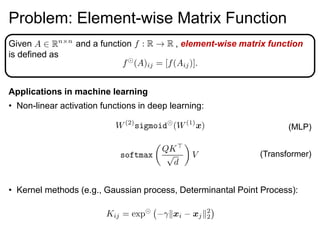
Problem: Element-wise Matrix Function
Applications in machine learning
• Non-linear activation functions in deep learning:
• Kernel methods (e.g., Gaussian process, Determinantal Point Process):
(MLP)
(Transformer)
Given and a function , element-wise matrix function
is defined as
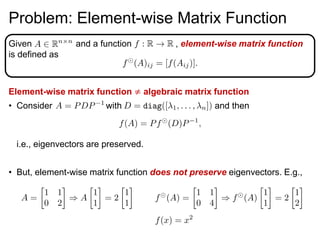
Problem: Element-wise Matrix Function
Element-wise matrix function ≠ algebraic matrix function
• Consider with and then
i.e., eigenvectors are preserved.
• But, element-wise matrix function does not preserve eigenvectors. E.g.,
Given and a function , element-wise matrix function
is defined as
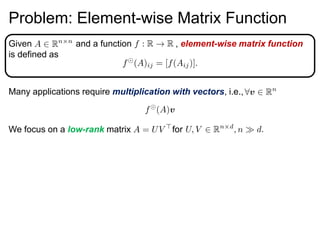
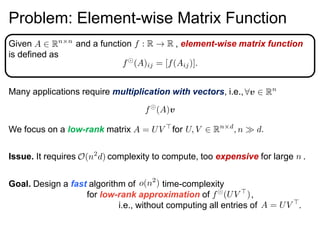
Many applications require multiplication with vectors, i.e.,
We focus on a low-rank matrix for
Problem: Element-wise Matrix Function
Given and a function , element-wise matrix function
is defined as
Many applications require multiplication with vectors, i.e.,
We focus on a low-rank matrix for
Problem: Element-wise Matrix Function
Issue. It requires complexity to compute, too expensive for large .
Goal. Design a fast algorithm of time-complexity
for low-rank approximation of ,
i.e., without computing all entries of .
Given and a function , element-wise matrix function
is defined as
Main Result: Polynomial Tensor Sketch
Our key ideas:
1. Tensor sketch [PP13] can approximate element-wise matrix monomial
function in time, i.e.,
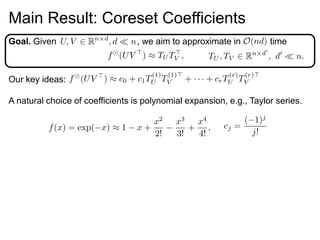
Goal. Given , we aim to approximate in time
Main Result: Polynomial Tensor Sketch
Our key ideas:
1. Tensor sketch [PP13] can approximate element-wise matrix monomial
function in time, i.e.,
2. Polynomial approximation on
Goal. Given , we aim to approximate in time
Main Result: Polynomial Tensor Sketch
Our key ideas:
1. Tensor sketch [PP13] can approximate element-wise matrix monomial
function in time.
2. Polynomial approximation on
Applying Tensor sketch with , the low-rank approximation on
can be done in time.
target dimension for Tensor sketch
polynomial degree
Goal. Given , we aim to approximate in time
Main Result: Polynomial Tensor Sketch
Our key ideas:
1. Tensor sketch [PP13] can approximate element-wise matrix monomial
function in time.
2. Polynomial approximation on
Applying Tensor sketch with , the low-rank approximation on
can be done in time.
Q. How can find good coefficients?
target dimension for Tensor sketch
polynomial degree
Goal. Given , we aim to approximate in time
Main Result: Coreset Coefficients
Our key ideas:
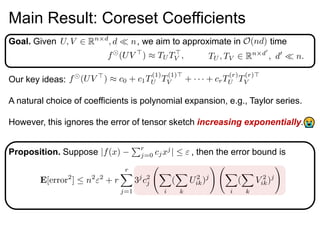
A natural choice of coefficients is polynomial expansion, e.g., Taylor series.
Goal. Given , we aim to approximate in time
Main Result: Coreset Coefficients
Our key ideas:
A natural choice of coefficients is polynomial expansion, e.g., Taylor series.
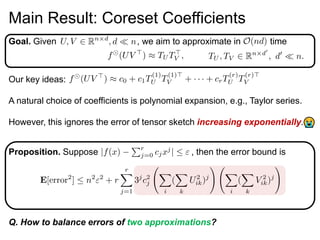
However, this ignores the error of tensor sketch increasing exponentially.
Proposition. Suppose , then the error bound is
Goal. Given , we aim to approximate in time
Main Result: Coreset Coefficients
Our key ideas:
A natural choice of coefficients is polynomial expansion, e.g., Taylor series.
However, this ignores the error of tensor sketch increasing exponentially.
Q. How to balance errors of two approximations?
Goal. Given , we aim to approximate in time
Proposition. Suppose , then the error bound is
Main Result: Coreset Coefficients
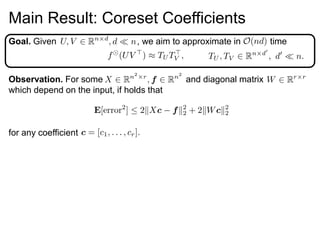
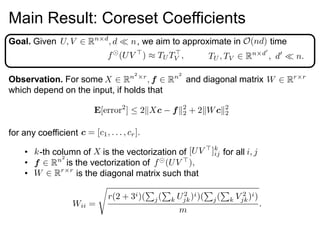
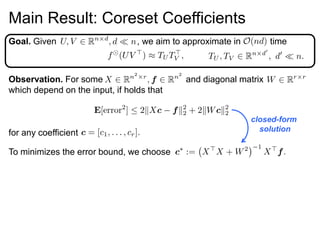
Observation. For some and diagonal matrix
which depend on the input, if holds that
for any coefficient
Goal. Given , we aim to approximate in time
Main Result: Coreset Coefficients
• -th column of is the vectorization of for all
• is the vectorization of
• is the diagonal matrix such that
Goal. Given , we aim to approximate in time
Observation. For some and diagonal matrix
which depend on the input, if holds that
for any coefficient
Main Result: Coreset Coefficients
To minimizes the error bound, we choose
closed-form
solution
Goal. Given , we aim to approximate in time
Observation. For some and diagonal matrix
which depend on the input, if holds that
for any coefficient
Main Result: Coreset Coefficients
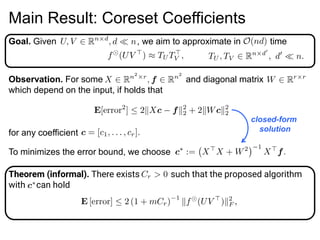
Observation. For some and diagonal matrix
which depend on the input, if holds that
for any coefficient
To minimizes the error bound, we choose
Goal. Given , we aim to approximate in time
closed-form
solution
Theorem (informal). There exists such that the proposed algorithm
with can hold
Main Result: Coreset Coefficients
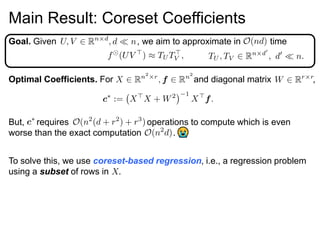
Optimal Coefficients. For and diagonal matrix ,
But, requires operations to compute which is even
worse than the exact computation .
Goal. Given , we aim to approximate in time
Main Result: Coreset Coefficients
To solve this, we use coreset-based regression, i.e., a regression problem
using a subset of rows in .
Goal. Given , we aim to approximate in time
Optimal Coefficients. For and diagonal matrix ,
But, requires operations to compute which is even
worse than the exact computation .
Main Result: Coreset Coefficients
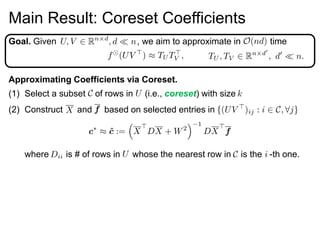
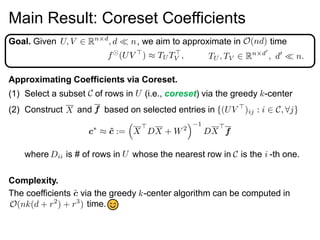
Approximating Coefficients via Coreset.
(1) Select a subset of rows in (i.e., coreset) with size
(2) Construct and based on selected entries in
where is # of rows in whose the nearest row in is the -th one.
Goal. Given , we aim to approximate in time
Main Result: Coreset Coefficients
Goal. Given , we aim to approximate in time
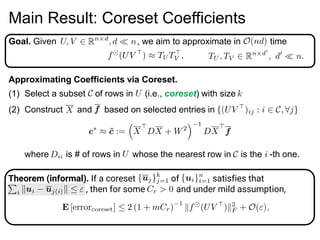
Approximating Coefficients via Coreset.
(1) Select a subset of rows in (i.e., coreset) with size
(2) Construct and based on selected entries in
where is # of rows in whose the nearest row in is the -th one.
Theorem (informal). If a coreset of satisfies that
, then for some and under mild assumption,
Main Result: Coreset Coefficients
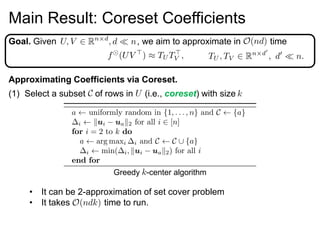
Approximating Coefficients via Coreset.
(1) Select a subset of rows in (i.e., coreset) with size
• It can be 2-approximation of set cover problem
• It takes time to run.
Goal. Given , we aim to approximate in time
Greedy -center algorithm
Main Result: Coreset Coefficients
Approximating Coefficients via Coreset.
(1) Select a subset of rows in (i.e., coreset) via the greedy -center
(2) Construct and based on selected entries in
where is # of rows in whose the nearest row in is the -th one.
Goal. Given , we aim to approximate in time
Complexity.
The coefficients via the greedy -center algorithm can be computed in
time.
Main Result: Summary
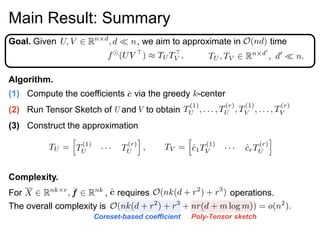
Algorithm.
(1) Compute the coefficients via the greedy -center
(2) Run Tensor Sketch of and to obtain
(3) Construct the approximation
For , requires operations.
The overall complexity is
Coreset-based coefficient Poly-Tensor sketch
Complexity.
Goal. Given , we aim to approximate in time
Experiments: Kernel Approximation
RBF Kernel Approximation.
Our method (Coreset-TS) outperforms other competitors; random Fourier
feature (RFF), and algorithm with coefficient from Taylor (Taylor-TS) and
Chebyshev series (Chebyshev-TS).
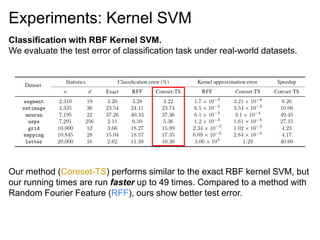
Experiments: Kernel SVM
Classification with RBF Kernel SVM.
We evaluate the test error of classification task under real-world datasets.
Our method (Coreset-TS) performs similar to the exact RBF kernel SVM, but
our running times are run faster up to 49 times. Compared to a method with
Random Fourier Feature (RFF), ours show better test error.
Experiments: Sinkhorn Algorithm
Sinkhorn Algorithm for Computing Optimal Transport Distance.
Given vectors and a low-rank matrix , Sinkhorn requires to compute
We evaluate speed up and approximation ratio of Random Fourier Feature
(RFF), Nystrom method and our algorithm (Coreset-TS) to image color
transformation. Ours show the smallest variance on approximation ratio.
Experiments: Neural Network Linearization
Linearization of Neural Network.
Given a 2-layer fully-connected network, a low-rank approximation on non-
linear operation can be linearized the network:
• (+) The inference time can be reduced once parameters are pre-computed
• (āˆ’) The inputs should be computed with non-linear transform, i.e.,
Results on final 2 FC layers of AlexNet trained by CIFAR10 dataset
Conclusion
• We propose a fast low-rank approximation for the element-wise matrix
functions by combining Tensor sketch and polynomial approximation.
• For a linear-time algorithm, we utilize -center greedy algorithm to obtain
coefficients and provide error analysis.
• Empirically, we apply our algorithm into practical ML applications such as
kernel SVM, optimal transport and neural network linearization.
• We believe that our contribution would be a broader interest of other ML
applications.
Thanks for your attention

Polynomial Tensor Sketch for Element-wise Matrix Function (ICML 2020)

  • 1.
    Polynomial Tensor Sketch forElement-wise Matrix Function Insu Han 1 Haim Avron 2 Jinwoo Shin 1 1 KAIST 2 Tel Aviv University
  • 2.
    Problem: Element-wise MatrixFunction Example: Given and a function , element-wise matrix function is defined as
  • 3.
    Problem: Element-wise MatrixFunction Applications in machine learning • Non-linear activation functions in deep learning: • Kernel methods (e.g., Gaussian process, Determinantal Point Process): (MLP) (Transformer) Given and a function , element-wise matrix function is defined as
  • 4.
    Problem: Element-wise MatrixFunction Element-wise matrix function ≠ algebraic matrix function • Consider with and then i.e., eigenvectors are preserved. • But, element-wise matrix function does not preserve eigenvectors. E.g., Given and a function , element-wise matrix function is defined as
  • 5.
    Many applications requiremultiplication with vectors, i.e., We focus on a low-rank matrix for Problem: Element-wise Matrix Function Given and a function , element-wise matrix function is defined as
  • 6.
    Many applications requiremultiplication with vectors, i.e., We focus on a low-rank matrix for Problem: Element-wise Matrix Function Issue. It requires complexity to compute, too expensive for large . Goal. Design a fast algorithm of time-complexity for low-rank approximation of , i.e., without computing all entries of . Given and a function , element-wise matrix function is defined as
  • 7.
    Main Result: PolynomialTensor Sketch Our key ideas: 1. Tensor sketch [PP13] can approximate element-wise matrix monomial function in time, i.e., Goal. Given , we aim to approximate in time
  • 8.
    Main Result: PolynomialTensor Sketch Our key ideas: 1. Tensor sketch [PP13] can approximate element-wise matrix monomial function in time, i.e., 2. Polynomial approximation on Goal. Given , we aim to approximate in time
  • 9.
    Main Result: PolynomialTensor Sketch Our key ideas: 1. Tensor sketch [PP13] can approximate element-wise matrix monomial function in time. 2. Polynomial approximation on Applying Tensor sketch with , the low-rank approximation on can be done in time. target dimension for Tensor sketch polynomial degree Goal. Given , we aim to approximate in time
  • 10.
    Main Result: PolynomialTensor Sketch Our key ideas: 1. Tensor sketch [PP13] can approximate element-wise matrix monomial function in time. 2. Polynomial approximation on Applying Tensor sketch with , the low-rank approximation on can be done in time. Q. How can find good coefficients? target dimension for Tensor sketch polynomial degree Goal. Given , we aim to approximate in time
  • 11.
    Main Result: CoresetCoefficients Our key ideas: A natural choice of coefficients is polynomial expansion, e.g., Taylor series. Goal. Given , we aim to approximate in time
  • 12.
    Main Result: CoresetCoefficients Our key ideas: A natural choice of coefficients is polynomial expansion, e.g., Taylor series. However, this ignores the error of tensor sketch increasing exponentially. Proposition. Suppose , then the error bound is Goal. Given , we aim to approximate in time
  • 13.
    Main Result: CoresetCoefficients Our key ideas: A natural choice of coefficients is polynomial expansion, e.g., Taylor series. However, this ignores the error of tensor sketch increasing exponentially. Q. How to balance errors of two approximations? Goal. Given , we aim to approximate in time Proposition. Suppose , then the error bound is
  • 14.
    Main Result: CoresetCoefficients Observation. For some and diagonal matrix which depend on the input, if holds that for any coefficient Goal. Given , we aim to approximate in time
  • 15.
    Main Result: CoresetCoefficients • -th column of is the vectorization of for all • is the vectorization of • is the diagonal matrix such that Goal. Given , we aim to approximate in time Observation. For some and diagonal matrix which depend on the input, if holds that for any coefficient
  • 16.
    Main Result: CoresetCoefficients To minimizes the error bound, we choose closed-form solution Goal. Given , we aim to approximate in time Observation. For some and diagonal matrix which depend on the input, if holds that for any coefficient
  • 17.
    Main Result: CoresetCoefficients Observation. For some and diagonal matrix which depend on the input, if holds that for any coefficient To minimizes the error bound, we choose Goal. Given , we aim to approximate in time closed-form solution Theorem (informal). There exists such that the proposed algorithm with can hold
  • 18.
    Main Result: CoresetCoefficients Optimal Coefficients. For and diagonal matrix , But, requires operations to compute which is even worse than the exact computation . Goal. Given , we aim to approximate in time
  • 19.
    Main Result: CoresetCoefficients To solve this, we use coreset-based regression, i.e., a regression problem using a subset of rows in . Goal. Given , we aim to approximate in time Optimal Coefficients. For and diagonal matrix , But, requires operations to compute which is even worse than the exact computation .
  • 20.
    Main Result: CoresetCoefficients Approximating Coefficients via Coreset. (1) Select a subset of rows in (i.e., coreset) with size (2) Construct and based on selected entries in where is # of rows in whose the nearest row in is the -th one. Goal. Given , we aim to approximate in time
  • 21.
    Main Result: CoresetCoefficients Goal. Given , we aim to approximate in time Approximating Coefficients via Coreset. (1) Select a subset of rows in (i.e., coreset) with size (2) Construct and based on selected entries in where is # of rows in whose the nearest row in is the -th one. Theorem (informal). If a coreset of satisfies that , then for some and under mild assumption,
  • 22.
    Main Result: CoresetCoefficients Approximating Coefficients via Coreset. (1) Select a subset of rows in (i.e., coreset) with size • It can be 2-approximation of set cover problem • It takes time to run. Goal. Given , we aim to approximate in time Greedy -center algorithm
  • 23.
    Main Result: CoresetCoefficients Approximating Coefficients via Coreset. (1) Select a subset of rows in (i.e., coreset) via the greedy -center (2) Construct and based on selected entries in where is # of rows in whose the nearest row in is the -th one. Goal. Given , we aim to approximate in time Complexity. The coefficients via the greedy -center algorithm can be computed in time.
  • 24.
    Main Result: Summary Algorithm. (1)Compute the coefficients via the greedy -center (2) Run Tensor Sketch of and to obtain (3) Construct the approximation For , requires operations. The overall complexity is Coreset-based coefficient Poly-Tensor sketch Complexity. Goal. Given , we aim to approximate in time
  • 25.
    Experiments: Kernel Approximation RBFKernel Approximation. Our method (Coreset-TS) outperforms other competitors; random Fourier feature (RFF), and algorithm with coefficient from Taylor (Taylor-TS) and Chebyshev series (Chebyshev-TS).
  • 26.
    Experiments: Kernel SVM Classificationwith RBF Kernel SVM. We evaluate the test error of classification task under real-world datasets. Our method (Coreset-TS) performs similar to the exact RBF kernel SVM, but our running times are run faster up to 49 times. Compared to a method with Random Fourier Feature (RFF), ours show better test error.
  • 27.
    Experiments: Sinkhorn Algorithm SinkhornAlgorithm for Computing Optimal Transport Distance. Given vectors and a low-rank matrix , Sinkhorn requires to compute We evaluate speed up and approximation ratio of Random Fourier Feature (RFF), Nystrom method and our algorithm (Coreset-TS) to image color transformation. Ours show the smallest variance on approximation ratio.
  • 28.
    Experiments: Neural NetworkLinearization Linearization of Neural Network. Given a 2-layer fully-connected network, a low-rank approximation on non- linear operation can be linearized the network: • (+) The inference time can be reduced once parameters are pre-computed • (āˆ’) The inputs should be computed with non-linear transform, i.e., Results on final 2 FC layers of AlexNet trained by CIFAR10 dataset
  • 29.
    Conclusion • We proposea fast low-rank approximation for the element-wise matrix functions by combining Tensor sketch and polynomial approximation. • For a linear-time algorithm, we utilize -center greedy algorithm to obtain coefficients and provide error analysis. • Empirically, we apply our algorithm into practical ML applications such as kernel SVM, optimal transport and neural network linearization. • We believe that our contribution would be a broader interest of other ML applications. Thanks for your attention