INDIAN INSTITUTE OF CARPET TECHNOLOGY
(BHADOHI)
APPLICATION OF
POLYMER IN SPACE
PRESENTED BY
KULDEEP KUMAR
HARSH YADAV
•jbijkjkl
Introduction
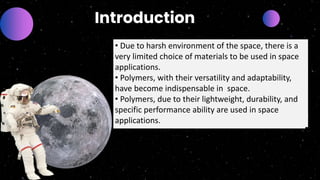
• Due to harsh environment of the space, there is a
very limited choice of materials to be used in space
applications.
• Polymers, with their versatility and adaptability,
have become indispensable in space.
• Polymers, due to their lightweight, durability, and
specific performance ability are used in space
applications.
SPACE APPLICATIONS
• Thermal Blankets
• Thermal Control Paints
• Adhesives
• Electrical Components
• Helmets
• Structural Components
• Rovers and Landers
• Antenna and Communication Devices
• Space Suit Fabric
Key Properties of Polymers for Space Applications
Polymers used in space must exhibit a range of specialized properties to withstand
extreme conditions, including:
1.Thermal Stability: The ability to endure extreme temperatures, both high
and low.
2.Radiation Resistance: Resilience against high levels of ionizing radiation
encountered in space.
3.Mechanical Strength: Sufficient strength and durability to handle the
stresses of launch, microgravity, and space operations
4.Lightweight:A high strength-to-weight ratio to minimize launch costs and
improve efficiency.
5.Chemical Resistance: Resistance to outgassing and chemical reactions with
the space environment
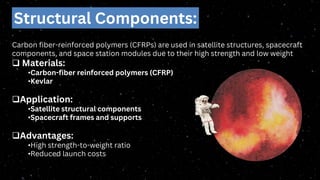
Structural Components:
Carbon fiber-reinforced polymers (CFRPs) are used in satellite structures, spacecraft
components, and space station modules due to their high strength and low weight
 Materials:
•Carbon-fiber reinforced polymers (CFRP)
•Kevlar
Application:
•Satellite structural components
•Spacecraft frames and supports
Advantages:
•High strength-to-weight ratio
•Reduced launch costs
Thermal Insulation:
Polymers like polyimide films (Kapton) are used for thermal insulation, protecting
spacecraft from the intense heat and cold of space.
1.Electrical Insulation
Materials
•Polyimides (e.g., Kapton)
•Fluoropolymers (e.g., Teflon)
Applications
•Insulation for wiring and cabling
•Circuit board substrates
 Properties: High dielectric strength and thermal stability
2.Thermal Protection Systems (TPS)
 Materials
• Polyimides (e.g., Kapton)
• Phenolic resins
• Ablative materials (e.g., phenolic impregnated carbon ablator - PICA)
 Applications
• Heat shields
• Insulation blankets
 Properties
• Protect spacecraft during re-entry
• Maintain internal temperature stability
2.Protective Coatings:
Radiation Shields:Polymers incorporated with metal particles or other
radiation-absorbing materials provide protection from cosmic radiation.
 Materials:
• Polyethylene
• Hydrogen-rich polymers (e.g., polyethylene composites)
 Applications:
• Space suits
 Advantages
• Effective in shielding against cosmic rays
• Reduces radiation exposure to astronauts
Flexibility and Durability
 Materials:
• Elastomers (e.g., silicone rubber, fluorosilicone)
• Thermoplastic polymers (e.g., PEEK - polyether ether ketone)
 Applications:
• Seals and gaskets
• Flexible joints and bellows
 Benefits:
• High durability in extreme temperatures
• Maintains elasticity in vacuum conditions
Specific Polymers
• PEI/PE: Polyetherimide/Polycarbonate
• Sodium Polyacrylate
• Velcro
• Teflon
PEI/PC: Polyetherimide/Polycarbonate
• Resistant to high heat, solvents, and flames
• Exhibits high dielectric strength, thermal conductivity, and
tensile strength
• Utilized in the production of satellites and external hardware
• One of the rare 3D printable aerospace-grade plastics available
• Enables the creation of tools, spare parts, repairs, and
structures on-site and on demand
Sodium Polyacrylate
• Super Absorbent Polymer (SAP)
• Utilized in NASA's Maximum Absorbency Garment (space diaper)
• Has the ability to absorb 400 times its weight in water
• Enables MAG to absorb up to 2 liters of liquid, requiring astronauts to change every
8-10 hours
• NASA was not the originator of disposable diapers, adult diapers, sodium
polyacrylate, or SAPS
Other Polymers
• Velcro was created by Swiss scientists for easy to use in zero gravity.
• Teflon, developed by Dupont, is utilized in heat shields, space suits.
• Teflon is most famous polymer for its application in nonstick pans.
Advantages of Using Polymers in Space Application
 Lightweight:In space applications, weight reduction is crucial for minimizing
launch costs.
 Flexibility and Durability :Polymers can endure the mechanical stresses and
temperature extremes of space travel.
 Versatility: Polymers can be engineered to meet a wide range of specific needs,
from insulation to structural strength.
 Ease of Fabrication: Polymers can be easily molded and fabricated into
complex shapes, which is beneficial for designing and manufacturing spacecraft
components.
Challenges and Considerations
 Outgassing: Some polymers release gases in the vacuum of space, which can
contaminate sensitive equipment. Careful selection and pre-treatment of
materials are necessary to mitigate this issue.
 Radiation Resistance :Prolonged exposure to space radiation can degrade
some polymers. Materials must be chosen and tested for their radiation resistance
properties.
 Temperature Extremes: Polymers must withstand the extreme temperatures
of space without becoming brittle or degrading.
Polymer_Application_in_sbBpace[1]23.pptx

Polymer_Application_in_sbBpace[1]23.pptx

  • 1.
    INDIAN INSTITUTE OFCARPET TECHNOLOGY (BHADOHI) APPLICATION OF POLYMER IN SPACE PRESENTED BY KULDEEP KUMAR HARSH YADAV
  • 2.
    •jbijkjkl Introduction • Due toharsh environment of the space, there is a very limited choice of materials to be used in space applications. • Polymers, with their versatility and adaptability, have become indispensable in space. • Polymers, due to their lightweight, durability, and specific performance ability are used in space applications.
  • 3.
    SPACE APPLICATIONS • ThermalBlankets • Thermal Control Paints • Adhesives • Electrical Components • Helmets • Structural Components • Rovers and Landers • Antenna and Communication Devices • Space Suit Fabric
  • 5.
    Key Properties ofPolymers for Space Applications Polymers used in space must exhibit a range of specialized properties to withstand extreme conditions, including: 1.Thermal Stability: The ability to endure extreme temperatures, both high and low. 2.Radiation Resistance: Resilience against high levels of ionizing radiation encountered in space. 3.Mechanical Strength: Sufficient strength and durability to handle the stresses of launch, microgravity, and space operations 4.Lightweight:A high strength-to-weight ratio to minimize launch costs and improve efficiency. 5.Chemical Resistance: Resistance to outgassing and chemical reactions with the space environment
  • 6.
    Structural Components: Carbon fiber-reinforcedpolymers (CFRPs) are used in satellite structures, spacecraft components, and space station modules due to their high strength and low weight  Materials: •Carbon-fiber reinforced polymers (CFRP) •Kevlar Application: •Satellite structural components •Spacecraft frames and supports Advantages: •High strength-to-weight ratio •Reduced launch costs
  • 7.
    Thermal Insulation: Polymers likepolyimide films (Kapton) are used for thermal insulation, protecting spacecraft from the intense heat and cold of space. 1.Electrical Insulation Materials •Polyimides (e.g., Kapton) •Fluoropolymers (e.g., Teflon) Applications •Insulation for wiring and cabling •Circuit board substrates  Properties: High dielectric strength and thermal stability
  • 8.
    2.Thermal Protection Systems(TPS)  Materials • Polyimides (e.g., Kapton) • Phenolic resins • Ablative materials (e.g., phenolic impregnated carbon ablator - PICA)  Applications • Heat shields • Insulation blankets  Properties • Protect spacecraft during re-entry • Maintain internal temperature stability
  • 9.
    2.Protective Coatings: Radiation Shields:Polymersincorporated with metal particles or other radiation-absorbing materials provide protection from cosmic radiation.  Materials: • Polyethylene • Hydrogen-rich polymers (e.g., polyethylene composites)  Applications: • Space suits  Advantages • Effective in shielding against cosmic rays • Reduces radiation exposure to astronauts
  • 10.
    Flexibility and Durability Materials: • Elastomers (e.g., silicone rubber, fluorosilicone) • Thermoplastic polymers (e.g., PEEK - polyether ether ketone)  Applications: • Seals and gaskets • Flexible joints and bellows  Benefits: • High durability in extreme temperatures • Maintains elasticity in vacuum conditions
  • 11.
    Specific Polymers • PEI/PE:Polyetherimide/Polycarbonate • Sodium Polyacrylate • Velcro • Teflon
  • 12.
    PEI/PC: Polyetherimide/Polycarbonate • Resistantto high heat, solvents, and flames • Exhibits high dielectric strength, thermal conductivity, and tensile strength • Utilized in the production of satellites and external hardware • One of the rare 3D printable aerospace-grade plastics available • Enables the creation of tools, spare parts, repairs, and structures on-site and on demand
  • 13.
    Sodium Polyacrylate • SuperAbsorbent Polymer (SAP) • Utilized in NASA's Maximum Absorbency Garment (space diaper) • Has the ability to absorb 400 times its weight in water • Enables MAG to absorb up to 2 liters of liquid, requiring astronauts to change every 8-10 hours • NASA was not the originator of disposable diapers, adult diapers, sodium polyacrylate, or SAPS Other Polymers • Velcro was created by Swiss scientists for easy to use in zero gravity. • Teflon, developed by Dupont, is utilized in heat shields, space suits. • Teflon is most famous polymer for its application in nonstick pans.
  • 14.
    Advantages of UsingPolymers in Space Application  Lightweight:In space applications, weight reduction is crucial for minimizing launch costs.  Flexibility and Durability :Polymers can endure the mechanical stresses and temperature extremes of space travel.  Versatility: Polymers can be engineered to meet a wide range of specific needs, from insulation to structural strength.  Ease of Fabrication: Polymers can be easily molded and fabricated into complex shapes, which is beneficial for designing and manufacturing spacecraft components.
  • 15.
    Challenges and Considerations Outgassing: Some polymers release gases in the vacuum of space, which can contaminate sensitive equipment. Careful selection and pre-treatment of materials are necessary to mitigate this issue.  Radiation Resistance :Prolonged exposure to space radiation can degrade some polymers. Materials must be chosen and tested for their radiation resistance properties.  Temperature Extremes: Polymers must withstand the extreme temperatures of space without becoming brittle or degrading.