VSR and Polygraph
Agenda
- Why we need polygraph
- What is polygraph
- compatible
- Schedule convert to Polygraph
Why we need polygraph
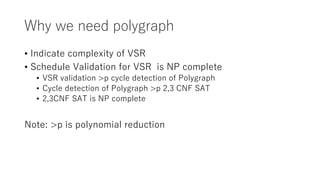
• Indicate complexity of VSR
• Schedule Validation for VSR is NP complete
• VSR validation >p cycle detection of Polygraph
• Cycle detection of Polygraph >p 2,3 CNF SAT
• 2,3CNF SAT is NP complete
Note: >p is polynomial reduction
What is polygraph
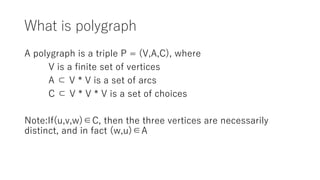
A polygraph is a triple P = (V,A,C), where
V is a finite set of vertices
A ⊂ V * V is a set of arcs
C ⊂ V * V * V is a set of choices
Note:If(u,v,w)∈C, then the three vertices are necessarily
distinct, and in fact (w,u)∈A
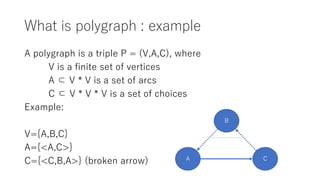
What is polygraph : example
A polygraph is a triple P = (V,A,C), where
V is a finite set of vertices
A ⊂ V * V is a set of arcs
C ⊂ V * V * V is a set of choices
Example:
V={A,B,C}
A={<A,C>}
C={<C,B,A>} (broken arrow) A
B
C
Compatible
- Suppose
- P = (V,A,C) is a polygraph
- D = (V,B) be a directed graph
- We say that D is compatible with P
- if
- A ⊂ B and,
- Each choice(u,v,w)∈C either (u,v)∈B or (v,w) ∈ B
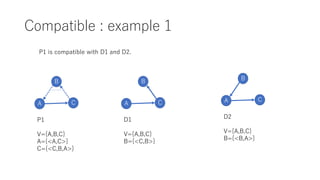
Compatible : example 1
A
B
C
P1
V={A,B,C}
A={<A,C>}
C={<C,B,A>}
A
B
C
D1
V={A,B,C}
B={<C,B>}
A
B
C
D2
V={A,B,C}
B={<B,A>}
P1 is compatible with D1 and D2.
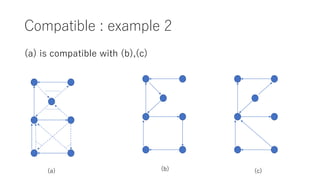
Compatible : example 2
(a) is compatible with (b),(c)
(c)(a) (b)
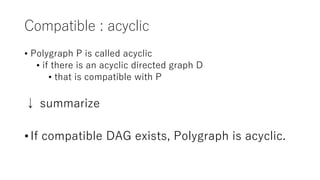
Compatible : acyclic
• Polygraph P is called acyclic
• if there is an acyclic directed graph D
• that is compatible with P
↓ summarize
• If compatible DAG exists, Polygraph is acyclic.
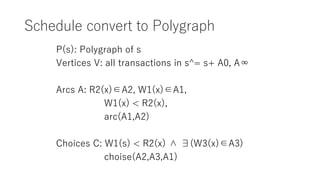
Schedule convert to Polygraph
P(s): Polygraph of s
Vertices V: all transactions in s^= s+ A0, A∞
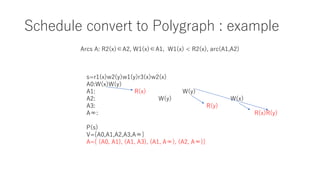
Arcs A: R2(x)∈A2, W1(x)∈A1,
W1(x) < R2(x),
arc(A1,A2)
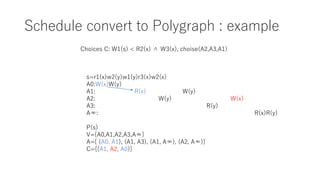
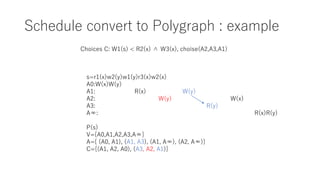
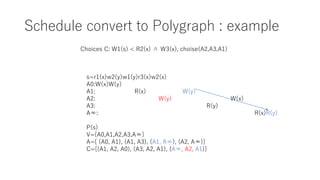
Choices C: W1(s) < R2(x) ∧ ∃(W3(x)∈A3)
choise(A2,A3,A1)
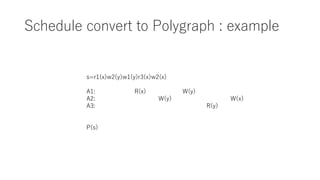
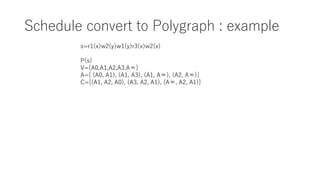
Schedule convert to Polygraph : example
s=r1(x)w2(y)w1(y)r3(x)w2(x)
A1: R(x) W(y)
A2: W(y) W(x)
A3: R(y)
P(s)
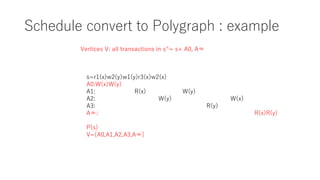
Schedule convert to Polygraph : example
s=r1(x)w2(y)w1(y)r3(x)w2(x)
A0:W(x)W(y)
A1: R(x) W(y)
A2: W(y) W(x)
A3: R(y)
A∞: R(x)R(y)
P(s)
V={A0,A1,A2,A3,A∞}
Vertices V: all transactions in s^= s+ A0, A∞
Schedule convert to Polygraph : example
s=r1(x)w2(y)w1(y)r3(x)w2(x)
A0:W(x)W(y)
A1: R(x) W(y)
A2: W(y) W(x)
A3: R(y)
A∞: R(x)R(y)
P(s)
V={A0,A1,A2,A3,A∞}
A={ (A0, A1), (A1, A3), (A1, A∞), (A2, A∞)}
Arcs A: R2(x)∈A2, W1(x)∈A1, W1(x) < R2(x), arc(A1,A2)
Schedule convert to Polygraph : example
s=r1(x)w2(y)w1(y)r3(x)w2(x)
A0:W(x)W(y)
A1: R(x) W(y)
A2: W(y) W(x)
A3: R(y)
A∞: R(x)R(y)
P(s)
V={A0,A1,A2,A3,A∞}
A={ (A0, A1), (A1, A3), (A1, A∞), (A2, A∞)}
C={(A1, A2, A0)}
Choices C: W1(s) < R2(x) ∧ W3(x), choise(A2,A3,A1)
Schedule convert to Polygraph : example
s=r1(x)w2(y)w1(y)r3(x)w2(x)
A0:W(x)W(y)
A1: R(x) W(y)
A2: W(y) W(x)
A3: R(y)
A∞: R(x)R(y)
P(s)
V={A0,A1,A2,A3,A∞}
A={ (A0, A1), (A1, A3), (A1, A∞), (A2, A∞)}
C={(A1, A2, A0), (A3, A2, A1)}
Choices C: W1(s) < R2(x) ∧ W3(x), choise(A2,A3,A1)
Schedule convert to Polygraph : example
s=r1(x)w2(y)w1(y)r3(x)w2(x)
A0:W(x)W(y)
A1: R(x) W(y)
A2: W(y) W(x)
A3: R(y)
A∞: R(x)R(y)
P(s)
V={A0,A1,A2,A3,A∞}
A={ (A0, A1), (A1, A3), (A1, A∞), (A2, A∞)}
C={(A1, A2, A0), (A3, A2, A1), (A∞, A2, A1)}
Choices C: W1(s) < R2(x) ∧ W3(x), choise(A2,A3,A1)
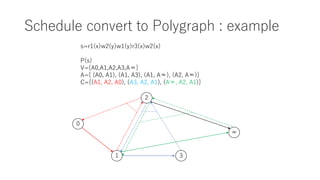
Schedule convert to Polygraph : example
s=r1(x)w2(y)w1(y)r3(x)w2(x)
P(s)
V={A0,A1,A2,A3,A∞}
A={ (A0, A1), (A1, A3), (A1, A∞), (A2, A∞)}
C={(A1, A2, A0), (A3, A2, A1), (A∞, A2, A1)}
Schedule convert to Polygraph : example
s=r1(x)w2(y)w1(y)r3(x)w2(x)
P(s)
V={A0,A1,A2,A3,A∞}
A={ (A0, A1), (A1, A3), (A1, A∞), (A2, A∞)}
C={(A1, A2, A0), (A3, A2, A1), (A∞, A2, A1)}
0
1
2
3
∞
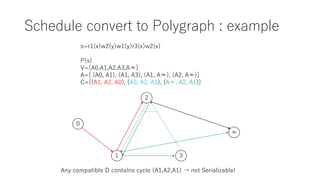
Schedule convert to Polygraph : example
s=r1(x)w2(y)w1(y)r3(x)w2(x)
P(s)
V={A0,A1,A2,A3,A∞}
A={ (A0, A1), (A1, A3), (A1, A∞), (A2, A∞)}
C={(A1, A2, A0), (A3, A2, A1), (A∞, A2, A1)}
0
1
2
3
∞
Any compatible D contains cycle (A1,A2,A1) → not Serializable!

Polygraph

  • 1.
  • 2.
    Agenda - Why weneed polygraph - What is polygraph - compatible - Schedule convert to Polygraph
  • 3.
    Why we needpolygraph • Indicate complexity of VSR • Schedule Validation for VSR is NP complete • VSR validation >p cycle detection of Polygraph • Cycle detection of Polygraph >p 2,3 CNF SAT • 2,3CNF SAT is NP complete Note: >p is polynomial reduction
  • 4.
    What is polygraph Apolygraph is a triple P = (V,A,C), where V is a finite set of vertices A ⊂ V * V is a set of arcs C ⊂ V * V * V is a set of choices Note:If(u,v,w)∈C, then the three vertices are necessarily distinct, and in fact (w,u)∈A
  • 5.
    What is polygraph: example A polygraph is a triple P = (V,A,C), where V is a finite set of vertices A ⊂ V * V is a set of arcs C ⊂ V * V * V is a set of choices Example: V={A,B,C} A={<A,C>} C={<C,B,A>} (broken arrow) A B C
  • 6.
    Compatible - Suppose - P= (V,A,C) is a polygraph - D = (V,B) be a directed graph - We say that D is compatible with P - if - A ⊂ B and, - Each choice(u,v,w)∈C either (u,v)∈B or (v,w) ∈ B
  • 7.
    Compatible : example1 A B C P1 V={A,B,C} A={<A,C>} C={<C,B,A>} A B C D1 V={A,B,C} B={<C,B>} A B C D2 V={A,B,C} B={<B,A>} P1 is compatible with D1 and D2.
  • 8.
    Compatible : example2 (a) is compatible with (b),(c) (c)(a) (b)
  • 9.
    Compatible : acyclic •Polygraph P is called acyclic • if there is an acyclic directed graph D • that is compatible with P ↓ summarize • If compatible DAG exists, Polygraph is acyclic.
  • 10.
    Schedule convert toPolygraph P(s): Polygraph of s Vertices V: all transactions in s^= s+ A0, A∞ Arcs A: R2(x)∈A2, W1(x)∈A1, W1(x) < R2(x), arc(A1,A2) Choices C: W1(s) < R2(x) ∧ ∃(W3(x)∈A3) choise(A2,A3,A1)
  • 11.
    Schedule convert toPolygraph : example s=r1(x)w2(y)w1(y)r3(x)w2(x) A1: R(x) W(y) A2: W(y) W(x) A3: R(y) P(s)
  • 12.
    Schedule convert toPolygraph : example s=r1(x)w2(y)w1(y)r3(x)w2(x) A0:W(x)W(y) A1: R(x) W(y) A2: W(y) W(x) A3: R(y) A∞: R(x)R(y) P(s) V={A0,A1,A2,A3,A∞} Vertices V: all transactions in s^= s+ A0, A∞
  • 13.
    Schedule convert toPolygraph : example s=r1(x)w2(y)w1(y)r3(x)w2(x) A0:W(x)W(y) A1: R(x) W(y) A2: W(y) W(x) A3: R(y) A∞: R(x)R(y) P(s) V={A0,A1,A2,A3,A∞} A={ (A0, A1), (A1, A3), (A1, A∞), (A2, A∞)} Arcs A: R2(x)∈A2, W1(x)∈A1, W1(x) < R2(x), arc(A1,A2)
  • 14.
    Schedule convert toPolygraph : example s=r1(x)w2(y)w1(y)r3(x)w2(x) A0:W(x)W(y) A1: R(x) W(y) A2: W(y) W(x) A3: R(y) A∞: R(x)R(y) P(s) V={A0,A1,A2,A3,A∞} A={ (A0, A1), (A1, A3), (A1, A∞), (A2, A∞)} C={(A1, A2, A0)} Choices C: W1(s) < R2(x) ∧ W3(x), choise(A2,A3,A1)
  • 15.
    Schedule convert toPolygraph : example s=r1(x)w2(y)w1(y)r3(x)w2(x) A0:W(x)W(y) A1: R(x) W(y) A2: W(y) W(x) A3: R(y) A∞: R(x)R(y) P(s) V={A0,A1,A2,A3,A∞} A={ (A0, A1), (A1, A3), (A1, A∞), (A2, A∞)} C={(A1, A2, A0), (A3, A2, A1)} Choices C: W1(s) < R2(x) ∧ W3(x), choise(A2,A3,A1)
  • 16.
    Schedule convert toPolygraph : example s=r1(x)w2(y)w1(y)r3(x)w2(x) A0:W(x)W(y) A1: R(x) W(y) A2: W(y) W(x) A3: R(y) A∞: R(x)R(y) P(s) V={A0,A1,A2,A3,A∞} A={ (A0, A1), (A1, A3), (A1, A∞), (A2, A∞)} C={(A1, A2, A0), (A3, A2, A1), (A∞, A2, A1)} Choices C: W1(s) < R2(x) ∧ W3(x), choise(A2,A3,A1)
  • 17.
    Schedule convert toPolygraph : example s=r1(x)w2(y)w1(y)r3(x)w2(x) P(s) V={A0,A1,A2,A3,A∞} A={ (A0, A1), (A1, A3), (A1, A∞), (A2, A∞)} C={(A1, A2, A0), (A3, A2, A1), (A∞, A2, A1)}
  • 18.
    Schedule convert toPolygraph : example s=r1(x)w2(y)w1(y)r3(x)w2(x) P(s) V={A0,A1,A2,A3,A∞} A={ (A0, A1), (A1, A3), (A1, A∞), (A2, A∞)} C={(A1, A2, A0), (A3, A2, A1), (A∞, A2, A1)} 0 1 2 3 ∞
  • 19.
    Schedule convert toPolygraph : example s=r1(x)w2(y)w1(y)r3(x)w2(x) P(s) V={A0,A1,A2,A3,A∞} A={ (A0, A1), (A1, A3), (A1, A∞), (A2, A∞)} C={(A1, A2, A0), (A3, A2, A1), (A∞, A2, A1)} 0 1 2 3 ∞ Any compatible D contains cycle (A1,A2,A1) → not Serializable!