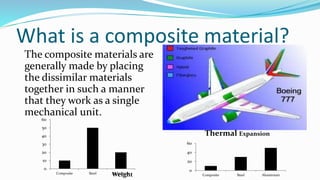
What is a composite material?
The composite materials are
generally made by placing
the dissimilar materials
together in such a manner
that they work as a single
mechanical unit.
0
10
20
30
40
50
60
Composite Steel Aluminium
Weight
0
20
40
60
Composite Steel Aluminium
Thermal Expansion
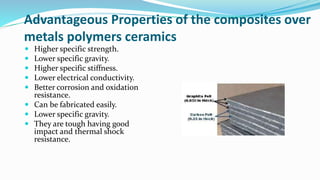
Advantageous Properties of the composites over
metals polymers ceramics
 Higher specific strength.
 Lower specific gravity.
 Higher specific stiffness.
 Lower electrical conductivity.
 Better corrosion and oxidation
resistance.
 Can be fabricated easily.
 Lower specific gravity.
 They are tough having good
impact and thermal shock
resistance.
Constituents of Composites
Matrix Phase is the continuous
body constituent which encloses
the composite and give it its bulk
form. Matrix phase may be
metal, ceramics (or) polymers.
Dispersed Phase is the
structural constituent which
determines the internal structure
of composite
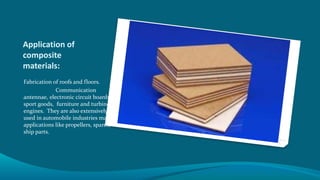
Application of
composite
materials:
Fabrication of roofs and floors.
Communication
antennae, electronic circuit boards,
sport goods, furniture and turbine
engines. They are also extensively
used in automobile industries marine
applications like propellers, spares,
ship parts.
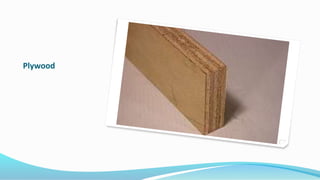
Plywood
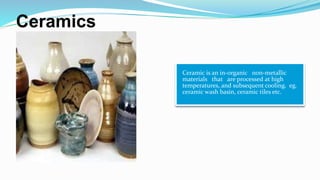
Ceramics
Ceramic is an in-organic non-metallic
materials that are processed at high
temperatures, and subsequent cooling. eg.
ceramic wash basin, ceramic tiles etc.
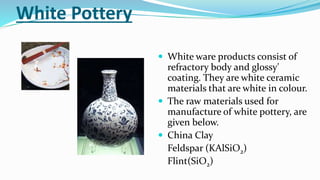
White Pottery
 White ware products consist of
refractory body and glossy'
coating. They are white ceramic
materials that are white in colour.
 The raw materials used for
manufacture of white pottery, are
given below.
 China Clay
Feldspar (KAlSiO2)
Flint(SiO2)
MANUFACTURE OF WHITE POTTERY
 Step I Preparation of
body ware
 The raw materials Kaoline
[Al (OH)4 SiO5] and
Feldspar are made into fine
powder and mixed with
water to form a creamIt is
dried and then fired in a
'biscuit' oven to get porous
ware called 'Bisque’
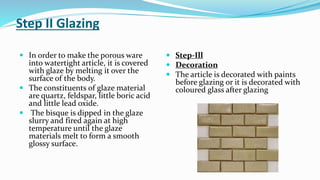
Step II Glazing
 In order to make the porous ware
into watertight article, it is covered
with glaze by melting it over the
surface of the body.
 The constituents of glaze material
are quartz, feldspar, little boric acid
and little lead oxide.
 The bisque is dipped in the glaze
slurry and fired again at high
temperature until the glaze
materials melt to form a smooth
glossy surface.
 Step-Ill
 Decoration
 The article is decorated with paints
before glazing or it is decorated with
coloured glass after glazing
Purpose of Glazing
 To get decorative effect.
 To make the surface impervious to
liquids.
 To improve appearance of the
article.
 To increase the durability of ceramic
material.
 To get a smooth glossy appearance.
 To protect the surface from
atmospheric action.
 Salt glazing
 In salt glazing, common salt
(sodium chloride) is used for getting
glossy films over earthenware. The
process consists of throwing NaCl
into furnace when the article is in
red-hot condition.

 At high temperature, NaCl melts
and reacts with silica of the article
to form a glossy and impervious film
of 'Sodium Silicate'
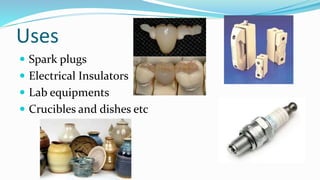
Uses
 Spark plugs
 Electrical Insulators
 Lab equipments
 Crucibles and dishes etc
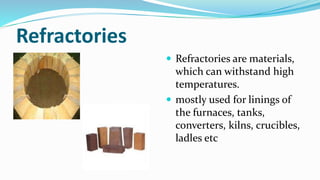
Refractories
 Refractories are materials,
which can withstand high
temperatures.
 mostly used for linings of
the furnaces, tanks,
converters, kilns, crucibles,
ladles etc
Requirements of a good refractory:
 Refractoriness: It is the ability to withstand
very high temperature without deformation
during operation.
 Strength or Refractoriness under load
(RUL): They must
possess high mechanical strength even at very
high temperature and bear maximum possible
load without breakage.
 Thermal expansion: A good refractory
should have low thermal expansion under
normal conditions.
 Thermal conductivity: In general a good
refractory must have low thermal conductivity
to reduce heat losses by radiation. But when
heat is to be supplied from outside the
refractory must possess good conductivity.
 Porosity: A good refractory should have low
porosity. In porous refractory the molten
metal and slag enters and weaken the
structure. But porosity helps in thermal
shock-resistance of refractories.
 Thermal spalling: It is breaking, cracking,
peeling off or
fracturing of the refractory under high
temperature. A good
refractory must have low thermal spalling.
 Chemical composition: A good refractory
must be chemically inert with charge and slag.
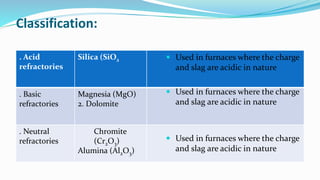
Classification:
. Acid
refractories
Silica (SiO2
. Basic
refractories
Magnesia (MgO)
2. Dolomite
. Neutral
refractories
Chromite
(Cr2O3)
Alumina (Al2O3)
 Used in furnaces where the charge
and slag are acidic in nature
 Used in furnaces where the charge
and slag are acidic in nature
 Used in furnaces where the charge
and slag are acidic in nature
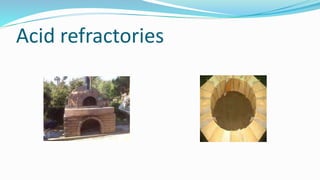
Acid refractories
Lubricants
 “Lubricants may be
defined as the Substance
which reduces the
friction between the two
moving surfaces”.
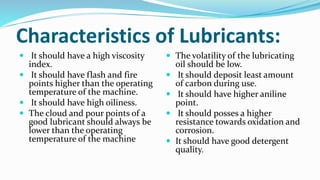
Characteristics of Lubricants:
 It should have a high viscosity
index.
 It should have flash and fire
points higher than the operating
temperature of the machine.
 It should have high oiliness.
 The cloud and pour points of a
good lubricant should always be
lower than the operating
temperature of the machine
 The volatility of the lubricating
oil should be low.
 It should deposit least amount
of carbon during use.
 It should have higher aniline
point.
 It should posses a higher
resistance towards oxidation and
corrosion.
 It should have good detergent
quality.
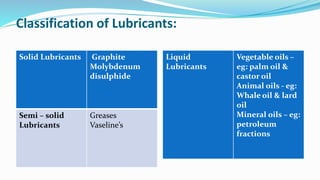
Classification of Lubricants:
Solid Lubricants Graphite
Molybdenum
disulphide
Semi – solid
Lubricants
Greases
Vaseline’s
Liquid
Lubricants
Vegetable oils –
eg: palm oil &
castor oil
Animal oils - eg:
Whale oil & lard
oil
Mineral oils – eg:
petroleum
fractions
Thank you

Poly.chemIV

  • 2.
    What is acomposite material? The composite materials are generally made by placing the dissimilar materials together in such a manner that they work as a single mechanical unit. 0 10 20 30 40 50 60 Composite Steel Aluminium Weight 0 20 40 60 Composite Steel Aluminium Thermal Expansion
  • 3.
    Advantageous Properties ofthe composites over metals polymers ceramics  Higher specific strength.  Lower specific gravity.  Higher specific stiffness.  Lower electrical conductivity.  Better corrosion and oxidation resistance.  Can be fabricated easily.  Lower specific gravity.  They are tough having good impact and thermal shock resistance.
  • 4.
    Constituents of Composites MatrixPhase is the continuous body constituent which encloses the composite and give it its bulk form. Matrix phase may be metal, ceramics (or) polymers. Dispersed Phase is the structural constituent which determines the internal structure of composite
  • 5.
    Application of composite materials: Fabrication ofroofs and floors. Communication antennae, electronic circuit boards, sport goods, furniture and turbine engines. They are also extensively used in automobile industries marine applications like propellers, spares, ship parts.
  • 6.
  • 7.
    Ceramics Ceramic is anin-organic non-metallic materials that are processed at high temperatures, and subsequent cooling. eg. ceramic wash basin, ceramic tiles etc.
  • 8.
    White Pottery  Whiteware products consist of refractory body and glossy' coating. They are white ceramic materials that are white in colour.  The raw materials used for manufacture of white pottery, are given below.  China Clay Feldspar (KAlSiO2) Flint(SiO2)
  • 9.
    MANUFACTURE OF WHITEPOTTERY  Step I Preparation of body ware  The raw materials Kaoline [Al (OH)4 SiO5] and Feldspar are made into fine powder and mixed with water to form a creamIt is dried and then fired in a 'biscuit' oven to get porous ware called 'Bisque’
  • 10.
    Step II Glazing In order to make the porous ware into watertight article, it is covered with glaze by melting it over the surface of the body.  The constituents of glaze material are quartz, feldspar, little boric acid and little lead oxide.  The bisque is dipped in the glaze slurry and fired again at high temperature until the glaze materials melt to form a smooth glossy surface.  Step-Ill  Decoration  The article is decorated with paints before glazing or it is decorated with coloured glass after glazing
  • 11.
    Purpose of Glazing To get decorative effect.  To make the surface impervious to liquids.  To improve appearance of the article.  To increase the durability of ceramic material.  To get a smooth glossy appearance.  To protect the surface from atmospheric action.  Salt glazing  In salt glazing, common salt (sodium chloride) is used for getting glossy films over earthenware. The process consists of throwing NaCl into furnace when the article is in red-hot condition.   At high temperature, NaCl melts and reacts with silica of the article to form a glossy and impervious film of 'Sodium Silicate'
  • 12.
    Uses  Spark plugs Electrical Insulators  Lab equipments  Crucibles and dishes etc
  • 13.
    Refractories  Refractories arematerials, which can withstand high temperatures.  mostly used for linings of the furnaces, tanks, converters, kilns, crucibles, ladles etc
  • 14.
    Requirements of agood refractory:  Refractoriness: It is the ability to withstand very high temperature without deformation during operation.  Strength or Refractoriness under load (RUL): They must possess high mechanical strength even at very high temperature and bear maximum possible load without breakage.  Thermal expansion: A good refractory should have low thermal expansion under normal conditions.  Thermal conductivity: In general a good refractory must have low thermal conductivity to reduce heat losses by radiation. But when heat is to be supplied from outside the refractory must possess good conductivity.  Porosity: A good refractory should have low porosity. In porous refractory the molten metal and slag enters and weaken the structure. But porosity helps in thermal shock-resistance of refractories.  Thermal spalling: It is breaking, cracking, peeling off or fracturing of the refractory under high temperature. A good refractory must have low thermal spalling.  Chemical composition: A good refractory must be chemically inert with charge and slag.
  • 15.
    Classification: . Acid refractories Silica (SiO2 .Basic refractories Magnesia (MgO) 2. Dolomite . Neutral refractories Chromite (Cr2O3) Alumina (Al2O3)  Used in furnaces where the charge and slag are acidic in nature  Used in furnaces where the charge and slag are acidic in nature  Used in furnaces where the charge and slag are acidic in nature
  • 16.
  • 17.
    Lubricants  “Lubricants maybe defined as the Substance which reduces the friction between the two moving surfaces”.
  • 18.
    Characteristics of Lubricants: It should have a high viscosity index.  It should have flash and fire points higher than the operating temperature of the machine.  It should have high oiliness.  The cloud and pour points of a good lubricant should always be lower than the operating temperature of the machine  The volatility of the lubricating oil should be low.  It should deposit least amount of carbon during use.  It should have higher aniline point.  It should posses a higher resistance towards oxidation and corrosion.  It should have good detergent quality.
  • 19.
    Classification of Lubricants: SolidLubricants Graphite Molybdenum disulphide Semi – solid Lubricants Greases Vaseline’s Liquid Lubricants Vegetable oils – eg: palm oil & castor oil Animal oils - eg: Whale oil & lard oil Mineral oils – eg: petroleum fractions
  • 20.