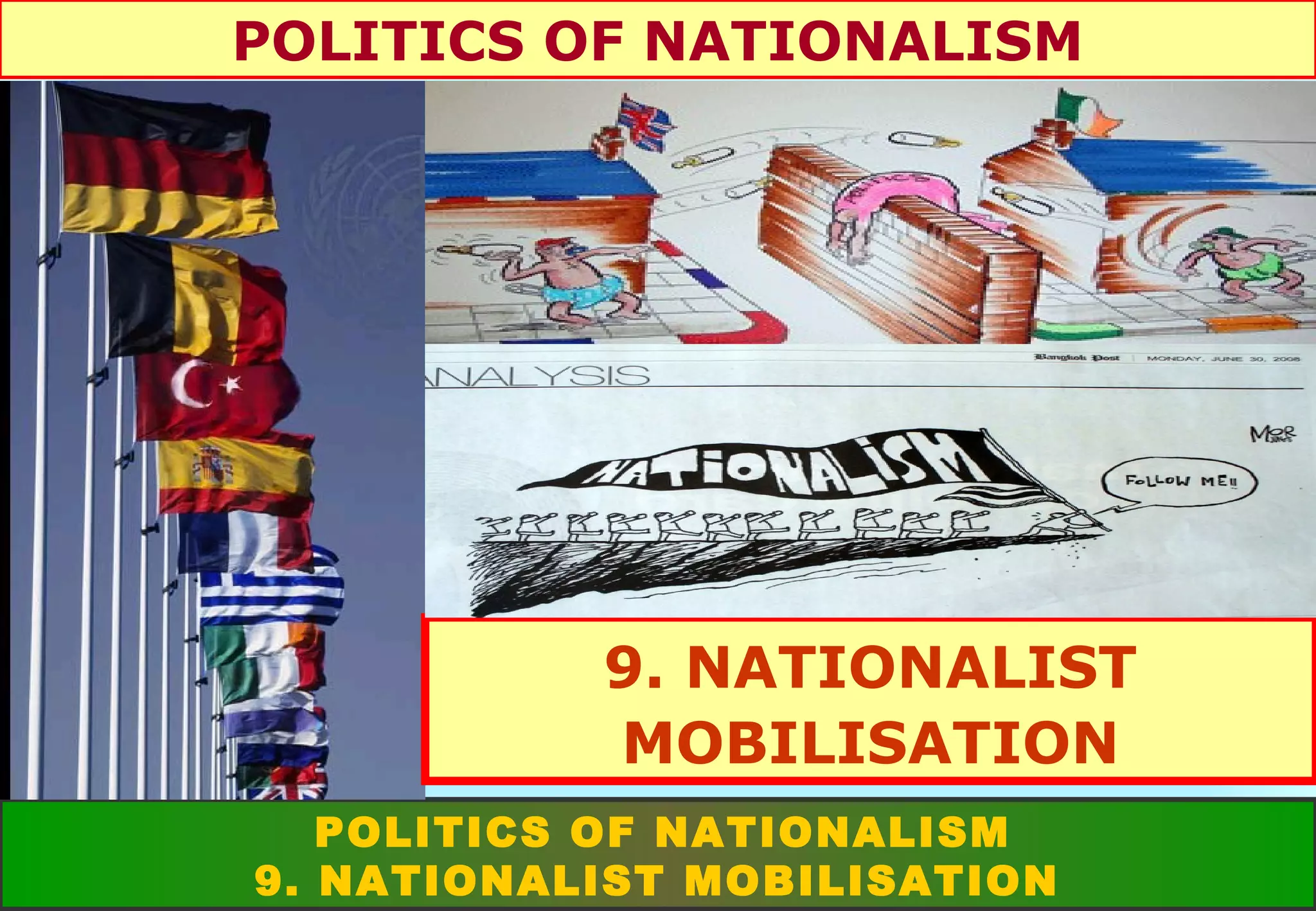
POLITICS OF NATIONALISM

9. NATIONALIST
MOBILISATION
POLITICS OF NATIONALISM
9. NATIONALIST MOBILISATION
OUTLINE
•Integrationist nationalism
•Colonial nationalism
•Separatist nationalism
•Common features

POLITICS OF NATIONALISM
9. NATIONALIST MOBILISATION
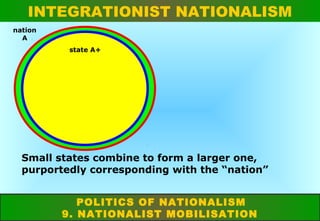
INTEGRATIONIST NATIONALISM
nation
A
state A+
state A

state C
state B

Small states combine to form a larger one,
purportedly corresponding with the “nation”
POLITICS OF NATIONALISM
9. NATIONALIST MOBILISATION
INTEGRATIONIST NATIONALISM
•

•
•
•

THE PROTOTYPE? REVOLUTIONARY FRANCE:
Pre-1789 France as a mixture of
–Territories ruled directly from Paris
–Territories with substantial autonomy or
under external influence
Revolution: territorial centralisation
Identification with French culture
Powerful impact of “jacobin” model elsewhere

POLITICS OF NATIONALISM
9. NATIONALIST MOBILISATION
INTEGRATIONIST NATIONALISM
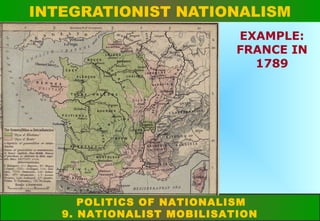
EXAMPLE:
FRANCE IN
1789

POLITICS OF NATIONALISM
9. NATIONALIST MOBILISATION
INTEGRATIONIST NATIONALISM
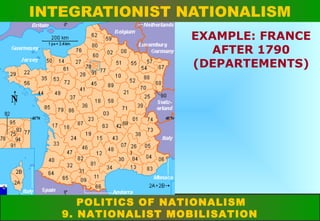
EXAMPLE: FRANCE
AFTER 1790
(DEPARTEMENTS)

POLITICS OF NATIONALISM
9. NATIONALIST MOBILISATION
INTEGRATIONIST NATIONALISM
OTHER EXAMPLES:
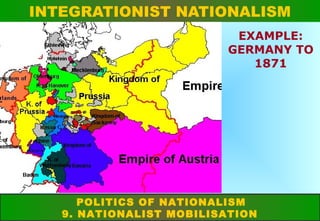
•Germany (-1871)
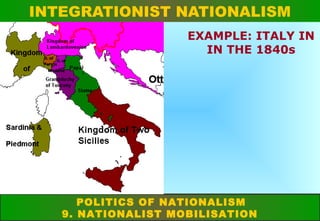
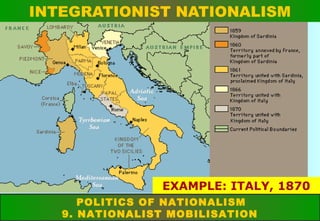
•Italy (-1870)
•United States (-1787, and later)
•Switzerland (-1848)
In all cases, but in varying degrees:
elites seek to (1) neutralise outside influences and (2)
build internal unity
Commonly occurring development: later authoritarian
phase (“purification” of national territory)

POLITICS OF NATIONALISM
9. NATIONALIST MOBILISATION
INTEGRATIONIST NATIONALISM
EXAMPLE:
GERMANY TO
1871

POLITICS OF NATIONALISM
9. NATIONALIST MOBILISATION
INTEGRATIONIST NATIONALISM
EXAMPLE: ITALY IN
IN THE 1840s

POLITICS OF NATIONALISM
9. NATIONALIST MOBILISATION
INTEGRATIONIST NATIONALISM

EXAMPLE: ITALY, 1870
POLITICS OF NATIONALISM
9. NATIONALIST MOBILISATION
INTEGRATIONIST NATIONALISM
CULTURAL INTEGRATION:
• Commonly follows process of political
unification, or achievement of political
independence
• Rests on notions of:
–Centralised state (no local autonomy)
–Single culture
–Major exceptions to first of these (USA,
Germany)
• May find extreme expression in authoritarian
nationalism, fascism, etc.
POLITICS OF NATIONALISM
9. NATIONALIST MOBILISATION
INTEGRATIONIST NATIONALISM
IRREDENTISM:
• Extension of “national territory” to include all
areas that “rightfully” belong
• Many examples:
–Germany in 1930s
–Ireland (Northern Ireland, to 1998)
–India (Azad Kashmir), Pakistan (Jammu and
Kashmir)
• In general, weakens over time (impact of
borders on language and culture)
POLITICS OF NATIONALISM
9. NATIONALIST MOBILISATION
COLONIAL NATIONALISM
GENERAL FORM:
• Movement for independence of colonial
population (“creoles”)
• Depends on mechanics of relationship with
metropolitan power (eg Virginia etc. v Britain;
New Spain v. Spain; Brazil v. Portugal)
• Depends also on capacity of colonial
population to control indigenous population

POLITICS OF NATIONALISM
9. NATIONALIST MOBILISATION
COLONIAL NATIONALISM
SOME EARLY EXAMPLES:
• North America
–Colonies rebel against Great Britain (1775-83)
–Later unify as USA (1787)
• Spanish America
–Colonies rebel against Spain (1810-)
–Establish independence (Argentina etc.)
–Further secessions (Uruguay, Paraguay etc.)
• Ireland
–“Grattan’s Parliament”, 1782 (but different pattern
to the other cases)

POLITICS OF NATIONALISM
9. NATIONALIST MOBILISATION
COLONIAL NATIONALISM
INDIGENOUS ISSUE:
• Sizeable indigenous population survives
(Peru, Bolivia), or large mestizo population
(rest of Spanish America, except Chile,
Argentina, Uruguay): continuing issue (eg
election of Morales in Bolivia)
• Moderate indigenous population survives
(Maori in New Zealand): strong culture and
legal position
• Indigenous population now insignificant (USA,
Canada, Australia)—but apologies by Rudd
and Harper, 2008
POLITICS OF NATIONALISM
9. NATIONALIST MOBILISATION
COLONIAL NATIONALISM
“CREOLE” DIVISIONS:
• White population of South Africa divided
between Afrikaners and English speakers (but
overall small minority)
• European-origin population of Canada divided
between English speakers and French
speakers; division strengthens (negligible
indigenous threat)

POLITICS OF NATIONALISM
9. NATIONALIST MOBILISATION
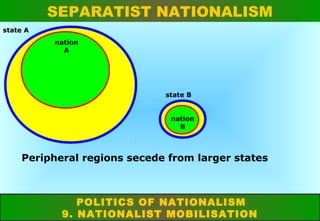
SEPARATIST NATIONALISM
state A
nation
A

state B

nation
B

nation
B

Peripheral regions secede from larger states

POLITICS OF NATIONALISM
9. NATIONALIST MOBILISATION
SEPARATIST NATIONALISM
NATIONAL INDEPENDENCE
•

•
•
•

EUROPEAN EXAMPLES:
Ottoman empire: secession of
–Greece (1822), Serbia (1878), Romania
(1878), Bulgaria (1908)
Habsburg monarchy: break-up in 1918
–Czechoslovakia, Romania, Yugoslavia
United Kingdom: secession of
–Ireland (1922)
Post-communist collapse in 1990s:
–USSR, Yugoslavia, Czechoslovakia
POLITICS OF NATIONALISM
9. NATIONALIST MOBILISATION
SEPARATIST NATIONALISM
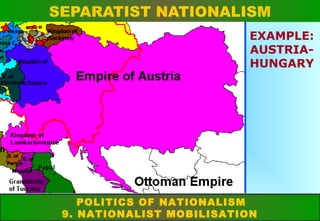
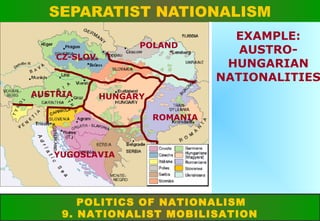
EXAMPLE:
AUSTRIAHUNGARY

POLITICS OF NATIONALISM
9. NATIONALIST MOBILISATION
SEPARATIST NATIONALISM
POLAND
CZ-SLOV.

AUSTRIA

EXAMPLE:
AUSTROHUNGARIAN
NATIONALITIES

HUNGARY
ROMANIA

YUGOSLAVIA

POLITICS OF NATIONALISM
9. NATIONALIST MOBILISATION
SEPARATIST NATIONALISM
•

•

•
•

SMALLER EUROPEAN NATIONS:
In the case of certain smaller European nations,
national movement followed a distinctive path
(Miroslav Hroch, 1985)
In these cases, the “nation” had an “incomplete social
structure” (nobility and landed classes belonged to
another nation)
These nations were also sometimes described as
“historyless”, “ethnic trash” (Engels)
Examples: Czech, Lithuanian, Estonian, Finnish,
Norwegian, Flemish and Slovak nationalism

POLITICS OF NATIONALISM
9. NATIONALIST MOBILISATION
SEPARATIST NATIONALISM
SMALLER EUROPEAN NATIONS: NATIONALIST
PHASES
• Phase A (pre-industrial): elements within
elites develop interest in local history, folklore
• Phase B (transitional): middle class leadership
of nation emerges, makes political demands
• Phase C (modern): mass nationalism:
leadership mobilises followers behind
nationalist demands
(Hroch, 1985)
POLITICS OF NATIONALISM
9. NATIONALIST MOBILISATION
SEPARATIST NATIONALISM
ANTI-COLONIAL FORM:
• Asia
–Indian independence (1947), etc.
–Further secessions, eg Pakistan (1947),
Bangladesh (1971)
• Africa
–Nigeria (1960), etc. (indigenous population)
–South Africa: complex path

POLITICS OF NATIONALISM
9. NATIONALIST MOBILISATION
SEPARATIST NATIONALISM
“CREOLE” ISSUE:
• South Africa, Rhodesia: significant white
populations survive, fight rearguard action
• India: Anglo-Indian population loses
significance
• Europe: different patterns
–Estonia, Latvia, Czechoslovakia
(disappearance of Germans)
–Ireland, Finland (remainder of former
privileged ruling group survives)
POLITICS OF NATIONALISM
9. NATIONALIST MOBILISATION
SEPARATIST NATIONALISM
AUTHENTICITY OF INDIGENOUS CULTURE
• Widespread willingness to accept
metropolitan language in Asia and especially
Africa
• Insistence on indigenous language in Europe,
except e.g. Ireland (some other examples)
• Occasional struggles over language norms (eg
Norway (Bokmål v Nynorsk), Greece
(Katharevousa v. Dimotiki)

POLITICS OF NATIONALISM
9. NATIONALIST MOBILISATION
COMMON FEATURES
NATIONALIST ACTORS:
• Three identifiable in principle:
–Metropolitan power (remote: e.g. imperial
capital in Europe; or adjacent: capital of
local state)
–Regional centre (economically, socially and
politically privileged; “high” culture)
–Regional periphery (economically, socially
and politically marginal; separate culture)

POLITICS OF NATIONALISM
9. NATIONALIST MOBILISATION
COMMON FEATURES
NATIONALIST ACTORS:
• Variable significance of three actors:
–Metropolitan power encounters very little
opposition (integrationist nationalism)
–Regional centre the major victor, but two
other actors relevant (colonial nationalism)
–Regional periphery the victor, but two other
actors relevant (separatist nationalism)

POLITICS OF NATIONALISM
9. NATIONALIST MOBILISATION
COMMON FEATURES
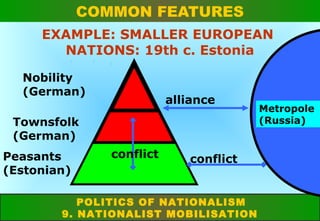
EXAMPLE: SMALLER EUROPEAN
NATIONS: 19th c. Estonia
Nobility
(German)

alliance

Townsfolk
(German)
Peasants
(Estonian)

conflict

conflict

POLITICS OF NATIONALISM
9. NATIONALIST MOBILISATION

Metropole
(Russia)
COMMON FEATURES
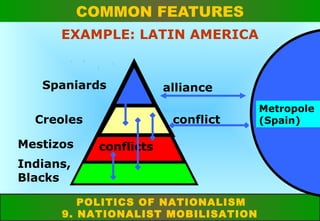
EXAMPLE: LATIN AMERICA

Spaniards
Creoles
Mestizos

alliance
conflict

conflicts

Indians,
Blacks
POLITICS OF NATIONALISM
9. NATIONALIST MOBILISATION

Metropole
(Spain)
COMMON FEATURES
NATIONALIST PROGRAMME:
• Nation as an entity whose distinctiveness is to
be preserved, and whose mission to humanity
is to be promoted
• Nation as a community with a shared past,
perhaps with a common descent and racial
background, and with a homeland of its own
• Political ambition to secure the unity of the
nation in relation to potentially disruptive
forces within its own borders, and to establish
its independence in relation to external rivals.
POLITICS OF NATIONALISM
9. NATIONALIST MOBILISATION
THE END …

NEXT: EXPLAINING NATIONALISM
POLITICS OF NATIONALISM
9. NATIONALIST MOBILISATION

Polnat09.bb

  • 1.
    POLITICS OF NATIONALISM 9.NATIONALIST MOBILISATION POLITICS OF NATIONALISM 9. NATIONALIST MOBILISATION
  • 2.
    OUTLINE •Integrationist nationalism •Colonial nationalism •Separatistnationalism •Common features POLITICS OF NATIONALISM 9. NATIONALIST MOBILISATION
  • 3.
    INTEGRATIONIST NATIONALISM nation A state A+ stateA state C state B Small states combine to form a larger one, purportedly corresponding with the “nation” POLITICS OF NATIONALISM 9. NATIONALIST MOBILISATION
  • 4.
    INTEGRATIONIST NATIONALISM • • • • THE PROTOTYPE?REVOLUTIONARY FRANCE: Pre-1789 France as a mixture of –Territories ruled directly from Paris –Territories with substantial autonomy or under external influence Revolution: territorial centralisation Identification with French culture Powerful impact of “jacobin” model elsewhere POLITICS OF NATIONALISM 9. NATIONALIST MOBILISATION
  • 5.
    INTEGRATIONIST NATIONALISM EXAMPLE: FRANCE IN 1789 POLITICSOF NATIONALISM 9. NATIONALIST MOBILISATION
  • 6.
    INTEGRATIONIST NATIONALISM EXAMPLE: FRANCE AFTER1790 (DEPARTEMENTS) POLITICS OF NATIONALISM 9. NATIONALIST MOBILISATION
  • 7.
    INTEGRATIONIST NATIONALISM OTHER EXAMPLES: •Germany(-1871) •Italy (-1870) •United States (-1787, and later) •Switzerland (-1848) In all cases, but in varying degrees: elites seek to (1) neutralise outside influences and (2) build internal unity Commonly occurring development: later authoritarian phase (“purification” of national territory) POLITICS OF NATIONALISM 9. NATIONALIST MOBILISATION
  • 8.
    INTEGRATIONIST NATIONALISM EXAMPLE: GERMANY TO 1871 POLITICSOF NATIONALISM 9. NATIONALIST MOBILISATION
  • 9.
    INTEGRATIONIST NATIONALISM EXAMPLE: ITALYIN IN THE 1840s POLITICS OF NATIONALISM 9. NATIONALIST MOBILISATION
  • 10.
    INTEGRATIONIST NATIONALISM EXAMPLE: ITALY,1870 POLITICS OF NATIONALISM 9. NATIONALIST MOBILISATION
  • 11.
    INTEGRATIONIST NATIONALISM CULTURAL INTEGRATION: •Commonly follows process of political unification, or achievement of political independence • Rests on notions of: –Centralised state (no local autonomy) –Single culture –Major exceptions to first of these (USA, Germany) • May find extreme expression in authoritarian nationalism, fascism, etc. POLITICS OF NATIONALISM 9. NATIONALIST MOBILISATION
  • 12.
    INTEGRATIONIST NATIONALISM IRREDENTISM: • Extensionof “national territory” to include all areas that “rightfully” belong • Many examples: –Germany in 1930s –Ireland (Northern Ireland, to 1998) –India (Azad Kashmir), Pakistan (Jammu and Kashmir) • In general, weakens over time (impact of borders on language and culture) POLITICS OF NATIONALISM 9. NATIONALIST MOBILISATION
  • 13.
    COLONIAL NATIONALISM GENERAL FORM: •Movement for independence of colonial population (“creoles”) • Depends on mechanics of relationship with metropolitan power (eg Virginia etc. v Britain; New Spain v. Spain; Brazil v. Portugal) • Depends also on capacity of colonial population to control indigenous population POLITICS OF NATIONALISM 9. NATIONALIST MOBILISATION
  • 14.
    COLONIAL NATIONALISM SOME EARLYEXAMPLES: • North America –Colonies rebel against Great Britain (1775-83) –Later unify as USA (1787) • Spanish America –Colonies rebel against Spain (1810-) –Establish independence (Argentina etc.) –Further secessions (Uruguay, Paraguay etc.) • Ireland –“Grattan’s Parliament”, 1782 (but different pattern to the other cases) POLITICS OF NATIONALISM 9. NATIONALIST MOBILISATION
  • 15.
    COLONIAL NATIONALISM INDIGENOUS ISSUE: •Sizeable indigenous population survives (Peru, Bolivia), or large mestizo population (rest of Spanish America, except Chile, Argentina, Uruguay): continuing issue (eg election of Morales in Bolivia) • Moderate indigenous population survives (Maori in New Zealand): strong culture and legal position • Indigenous population now insignificant (USA, Canada, Australia)—but apologies by Rudd and Harper, 2008 POLITICS OF NATIONALISM 9. NATIONALIST MOBILISATION
  • 16.
    COLONIAL NATIONALISM “CREOLE” DIVISIONS: •White population of South Africa divided between Afrikaners and English speakers (but overall small minority) • European-origin population of Canada divided between English speakers and French speakers; division strengthens (negligible indigenous threat) POLITICS OF NATIONALISM 9. NATIONALIST MOBILISATION
  • 17.
    SEPARATIST NATIONALISM state A nation A stateB nation B nation B Peripheral regions secede from larger states POLITICS OF NATIONALISM 9. NATIONALIST MOBILISATION
  • 18.
    SEPARATIST NATIONALISM NATIONAL INDEPENDENCE • • • • EUROPEANEXAMPLES: Ottoman empire: secession of –Greece (1822), Serbia (1878), Romania (1878), Bulgaria (1908) Habsburg monarchy: break-up in 1918 –Czechoslovakia, Romania, Yugoslavia United Kingdom: secession of –Ireland (1922) Post-communist collapse in 1990s: –USSR, Yugoslavia, Czechoslovakia POLITICS OF NATIONALISM 9. NATIONALIST MOBILISATION
  • 19.
    SEPARATIST NATIONALISM EXAMPLE: AUSTRIAHUNGARY POLITICS OFNATIONALISM 9. NATIONALIST MOBILISATION
  • 20.
  • 21.
    SEPARATIST NATIONALISM • • • • SMALLER EUROPEANNATIONS: In the case of certain smaller European nations, national movement followed a distinctive path (Miroslav Hroch, 1985) In these cases, the “nation” had an “incomplete social structure” (nobility and landed classes belonged to another nation) These nations were also sometimes described as “historyless”, “ethnic trash” (Engels) Examples: Czech, Lithuanian, Estonian, Finnish, Norwegian, Flemish and Slovak nationalism POLITICS OF NATIONALISM 9. NATIONALIST MOBILISATION
  • 22.
    SEPARATIST NATIONALISM SMALLER EUROPEANNATIONS: NATIONALIST PHASES • Phase A (pre-industrial): elements within elites develop interest in local history, folklore • Phase B (transitional): middle class leadership of nation emerges, makes political demands • Phase C (modern): mass nationalism: leadership mobilises followers behind nationalist demands (Hroch, 1985) POLITICS OF NATIONALISM 9. NATIONALIST MOBILISATION
  • 23.
    SEPARATIST NATIONALISM ANTI-COLONIAL FORM: •Asia –Indian independence (1947), etc. –Further secessions, eg Pakistan (1947), Bangladesh (1971) • Africa –Nigeria (1960), etc. (indigenous population) –South Africa: complex path POLITICS OF NATIONALISM 9. NATIONALIST MOBILISATION
  • 24.
    SEPARATIST NATIONALISM “CREOLE” ISSUE: •South Africa, Rhodesia: significant white populations survive, fight rearguard action • India: Anglo-Indian population loses significance • Europe: different patterns –Estonia, Latvia, Czechoslovakia (disappearance of Germans) –Ireland, Finland (remainder of former privileged ruling group survives) POLITICS OF NATIONALISM 9. NATIONALIST MOBILISATION
  • 25.
    SEPARATIST NATIONALISM AUTHENTICITY OFINDIGENOUS CULTURE • Widespread willingness to accept metropolitan language in Asia and especially Africa • Insistence on indigenous language in Europe, except e.g. Ireland (some other examples) • Occasional struggles over language norms (eg Norway (Bokmål v Nynorsk), Greece (Katharevousa v. Dimotiki) POLITICS OF NATIONALISM 9. NATIONALIST MOBILISATION
  • 26.
    COMMON FEATURES NATIONALIST ACTORS: •Three identifiable in principle: –Metropolitan power (remote: e.g. imperial capital in Europe; or adjacent: capital of local state) –Regional centre (economically, socially and politically privileged; “high” culture) –Regional periphery (economically, socially and politically marginal; separate culture) POLITICS OF NATIONALISM 9. NATIONALIST MOBILISATION
  • 27.
    COMMON FEATURES NATIONALIST ACTORS: •Variable significance of three actors: –Metropolitan power encounters very little opposition (integrationist nationalism) –Regional centre the major victor, but two other actors relevant (colonial nationalism) –Regional periphery the victor, but two other actors relevant (separatist nationalism) POLITICS OF NATIONALISM 9. NATIONALIST MOBILISATION
  • 28.
    COMMON FEATURES EXAMPLE: SMALLEREUROPEAN NATIONS: 19th c. Estonia Nobility (German) alliance Townsfolk (German) Peasants (Estonian) conflict conflict POLITICS OF NATIONALISM 9. NATIONALIST MOBILISATION Metropole (Russia)
  • 29.
    COMMON FEATURES EXAMPLE: LATINAMERICA Spaniards Creoles Mestizos alliance conflict conflicts Indians, Blacks POLITICS OF NATIONALISM 9. NATIONALIST MOBILISATION Metropole (Spain)
  • 30.
    COMMON FEATURES NATIONALIST PROGRAMME: •Nation as an entity whose distinctiveness is to be preserved, and whose mission to humanity is to be promoted • Nation as a community with a shared past, perhaps with a common descent and racial background, and with a homeland of its own • Political ambition to secure the unity of the nation in relation to potentially disruptive forces within its own borders, and to establish its independence in relation to external rivals. POLITICS OF NATIONALISM 9. NATIONALIST MOBILISATION
  • 31.
    THE END … NEXT:EXPLAINING NATIONALISM POLITICS OF NATIONALISM 9. NATIONALIST MOBILISATION

Editor's Notes

  • #14 Note: Spanish America divided into four viceroyalties: New Spain: independent as Mexico, 1821; five central American states later secede New Granada: Independent as Grand Columbia, 1811; Venezuela and Ecuador independent 1830; Panama 1903 Peru: Chile independent, 1818; Peru, 1821 Rio de la Plata: Argentina independent 1816; Uruguay, 1828; Paraguay, 1835