POLITICS OF NATIONALISM

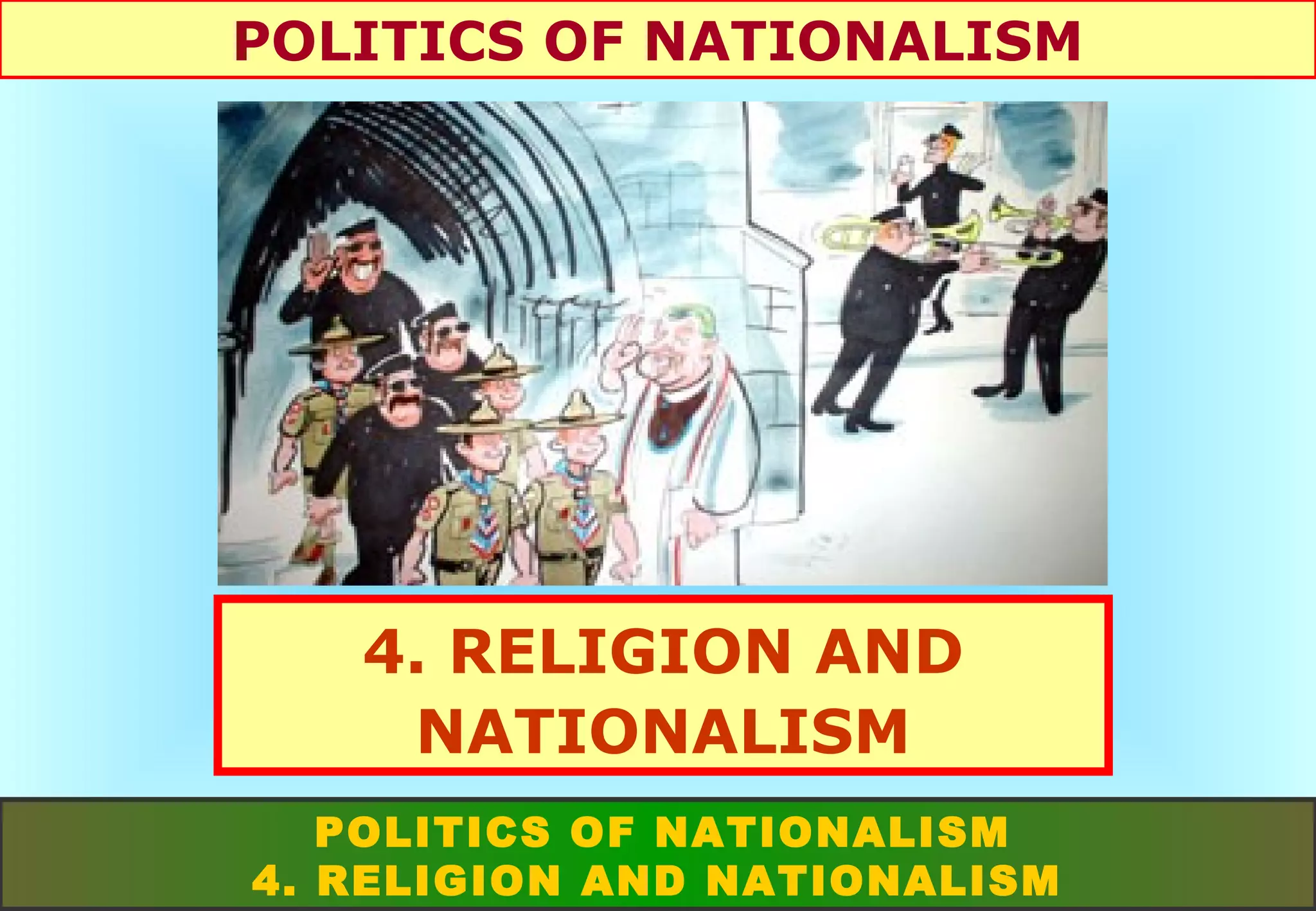
4. RELIGION AND
NATIONALISM
POLITICS OF NATIONALISM
4. RELIGION AND NATIONALISM
OUTLINE
Look at relationship between
religion and nationalism:
• Religion as a source of
division
• Religion, society and politics
• Religion and national identity
POLITICS OF NATIONALISM
4. RELIGION AND NATIONALISM
NATURE OF RELIGION
Definition:
Religion: “a unified system of beliefs and
practices relative to sacred things, that is to
say, things set apart and forbidden—beliefs
and practices which unite into one single
moral community called a Church, all those
who adhere to them” (Durkheim)

POLITICS OF NATIONALISM
4. RELIGION AND NATIONALISM
NATURE OF RELIGION
Implications of definition:
Religion embodies beliefs and practices (or
rituals):
• Beliefs: ideological component, may have
political implications
(e.g. about matters of public policy)
• Rituals: external expressions of belief,
typically non-political, but may have political
implications
(e.g. public displays, processions)
POLITICS OF NATIONALISM
4. RELIGION AND NATIONALISM
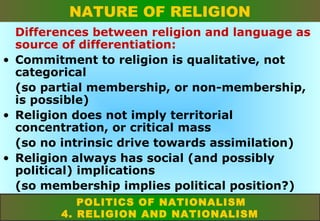
NATURE OF RELIGION
Differences between religion and language as
source of differentiation:
• Commitment to religion is qualitative, not
categorical
(so partial membership, or non-membership,
is possible)
• Religion does not imply territorial
concentration, or critical mass
(so no intrinsic drive towards assimilation)
• Religion always has social (and possibly
political) implications
(so membership implies political position?)
POLITICS OF NATIONALISM
4. RELIGION AND NATIONALISM
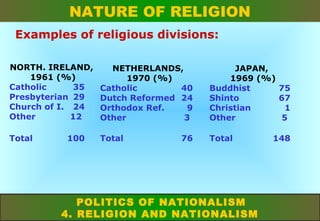
NATURE OF RELIGION
Examples of religious divisions:
NORTH. IRELAND,
1961 (%)
Catholic
35
Presbyterian 29
Church of I. 24
Other
12

NETHERLANDS,
1970 (%)
Catholic
40
Dutch Reformed 24
Orthodox Ref.
9
Other
3

JAPAN,
1969 (%)
Buddhist
75
Shinto
67
Christian
1
Other
5

Total

Total

Total

100

76

POLITICS OF NATIONALISM
4. RELIGION AND NATIONALISM

148
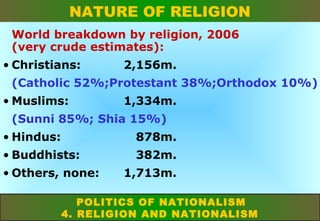
NATURE OF RELIGION
World breakdown by religion, 2006
(very crude estimates):
• Christians:

2,156m.

(Catholic 52%;Protestant 38%;Orthodox 10%)
• Muslims:

1,334m.

(Sunni 85%; Shia 15%)
• Hindus:

878m.

• Buddhists:

382m.

• Others, none:

1,713m.

POLITICS OF NATIONALISM
4. RELIGION AND NATIONALISM
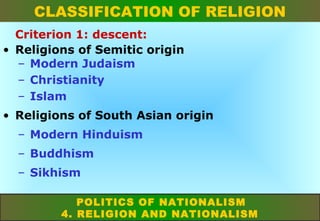
CLASSIFICATION OF RELIGION
Criterion 1: descent:
• Religions of Semitic origin
– Modern Judaism
– Christianity
– Islam
• Religions of South Asian origin
– Modern Hinduism
– Buddhism
– Sikhism
POLITICS OF NATIONALISM
4. RELIGION AND NATIONALISM
CLASSIFICATION OF RELIGION
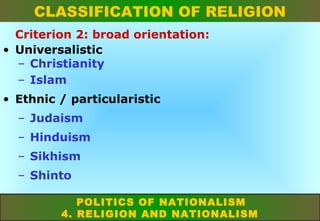
Criterion 2: broad orientation:
• Universalistic
– Christianity
– Islam
• Ethnic / particularistic
– Judaism
– Hinduism
– Sikhism
– Shinto
POLITICS OF NATIONALISM
4. RELIGION AND NATIONALISM
RELIGION AND SOCIETY
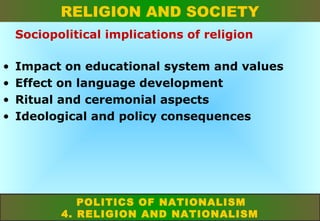
Sociopolitical implications of religion
•
•
•
•

Impact on educational system and values
Effect on language development
Ritual and ceremonial aspects
Ideological and policy consequences

POLITICS OF NATIONALISM
4. RELIGION AND NATIONALISM
RELIGION AND SOCIETY
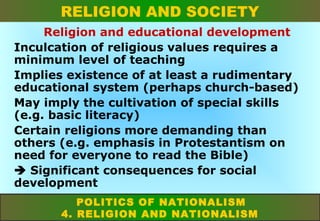
Religion and educational development
Inculcation of religious values requires a
minimum level of teaching
Implies existence of at least a rudimentary
educational system (perhaps church-based)
May imply the cultivation of special skills
(e.g. basic literacy)
Certain religions more demanding than
others (e.g. emphasis in Protestantism on
need for everyone to read the Bible)
 Significant consequences for social
development
POLITICS OF NATIONALISM
4. RELIGION AND NATIONALISM
RELIGION AND SOCIETY
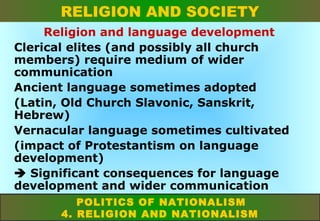
Religion and language development
Clerical elites (and possibly all church
members) require medium of wider
communication
Ancient language sometimes adopted
(Latin, Old Church Slavonic, Sanskrit,
Hebrew)
Vernacular language sometimes cultivated
(impact of Protestantism on language
development)
 Significant consequences for language
development and wider communication
POLITICS OF NATIONALISM
4. RELIGION AND NATIONALISM
RELIGION AND SOCIETY
Religion, ritual and ceremonial
Religions tend to share common rituals
which facilitate cross-cultural
communication
(ceremonies of worship, prayer rituals,
pilgrimages)
 Significant consequences for community
building

POLITICS OF NATIONALISM
4. RELIGION AND NATIONALISM
RELIGION AND SOCIETY
Religion and politics
Different religions may have different
implications for public policy:
–Protestant emphasis on sabbatarianism,
prohibition
–Catholic emphasis on sexual morality, family
—
and on Catholic schools and medical services
Raises prospect of conflict with secular state, or
between religions
 Significant consequences for political
mobilisation
POLITICS OF NATIONALISM
4. RELIGION AND NATIONALISM
RELIGION AND NATIONAL IDENTITY
Formation of national identity
• May be greatly facilitated by social impact of
religion (building of broad community)
• But universalist religions are inclusive
(promote notion of bonds between all
humans)
• Nevertheless, may have implications for
defining narrower patterns of identity
– Impact of “ethnic” religions
– Effect of organisational structures
– Religious labels as ethnonational labels
POLITICS OF NATIONALISM
4. RELIGION AND NATIONALISM
RELIGION AND NATIONAL IDENTITY
“Ethnic” religion and national identity
Community is defined as a collectivity unified,
and distinguished from others, by shared beliefs
and rituals
(e.g. Shinto, Judaism)
Religious writings, tracts and ceremonials may
be those of an ethnonational community
(they document history of a people, not just of a
religion; e.g. Old Testament and Israel)
But: ethnic religion may sometimes be divisive
(e.g. tribal / local religions)
POLITICS OF NATIONALISM
4. RELIGION AND NATIONALISM
RELIGION AND NATIONAL IDENTITY
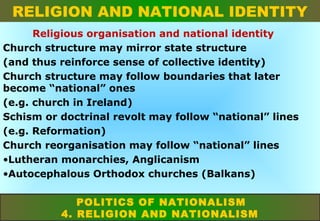
Religious organisation and national identity
Church structure may mirror state structure
(and thus reinforce sense of collective identity)
Church structure may follow boundaries that later
become “national” ones
(e.g. church in Ireland)
Schism or doctrinal revolt may follow “national” lines
(e.g. Reformation)
Church reorganisation may follow “national” lines
•Lutheran monarchies, Anglicanism
•Autocephalous Orthodox churches (Balkans)
POLITICS OF NATIONALISM
4. RELIGION AND NATIONALISM
RELIGION AND NATIONAL IDENTITY
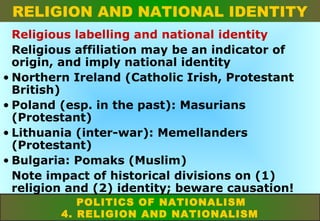
Religious labelling and national identity
Religious affiliation may be an indicator of
origin, and imply national identity
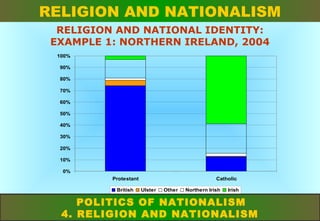
• Northern Ireland (Catholic Irish, Protestant
British)
• Poland (esp. in the past): Masurians
(Protestant)
• Lithuania (inter-war): Memellanders
(Protestant)
• Bulgaria: Pomaks (Muslim)
Note impact of historical divisions on (1)
religion and (2) identity; beware causation!
POLITICS OF NATIONALISM
4. RELIGION AND NATIONALISM
RELIGION AND NATIONALISM
RELIGION AND NATIONAL IDENTITY:
EXAMPLE 1: NORTHERN IRELAND, 2004
100%
90%
80%
70%
60%
50%
40%
30%
20%
10%
0%
Protestant
British

Catholic
Ulster

Other

Northern Irish

Irish

POLITICS OF NATIONALISM
4. RELIGION AND NATIONALISM
RELIGION AND NATIONALISM
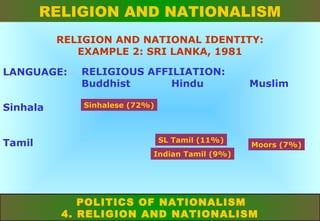
RELIGION AND NATIONAL IDENTITY:
EXAMPLE 2: SRI LANKA, 1981
LANGUAGE:
Sinhala
Tamil

RELIGIOUS AFFILIATION:
Buddhist
Hindu

Muslim

Sinhalese (72%)

SL Tamil (11%)

Moors (7%)

Indian Tamil (9%)

POLITICS OF NATIONALISM
4. RELIGION AND NATIONALISM
RELIGION AND NATIONALISM
RELIGION AND NATIONAL IDENTITY:
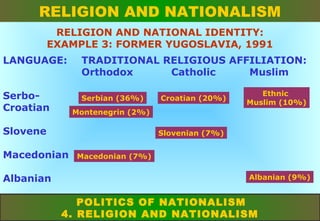
EXAMPLE 3: FORMER YUGOSLAVIA, 1991
LANGUAGE:
SerboCroatian

TRADITIONAL RELIGIOUS AFFILIATION:
Orthodox
Catholic
Muslim
Serbian (36%)

Ethnic
Muslim (10%)

Montenegrin (2%)

Slovene

Slovenian (7%)

Macedonian
Albanian

Croatian (20%)

Macedonian (7%)
Albanian (9%)

POLITICS OF NATIONALISM
4. RELIGION AND NATIONALISM
RELIGION AND NATIONALISM
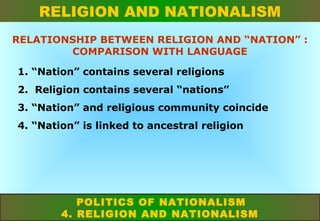
RELATIONSHIP BETWEEN RELIGION AND “NATION” :
COMPARISON WITH LANGUAGE
1. “Nation” contains several religions
2. Religion contains several “nations”
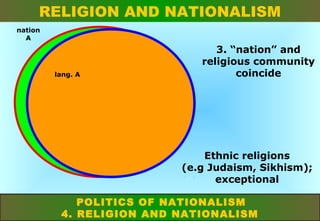
3. “Nation” and religious community coincide
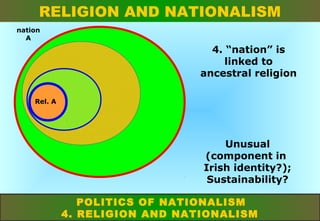
4. “Nation” is linked to ancestral religion

POLITICS OF NATIONALISM
4. RELIGION AND NATIONALISM
RELIGION AND NATIONALISM
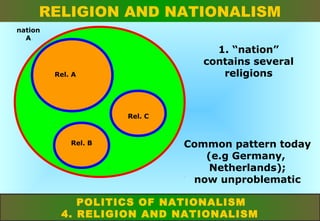
nation
A

1. “nation”
contains several
religions

Rel. A

Rel. C

Rel. B

Common pattern today
(e.g Germany,
Netherlands);
now unproblematic

POLITICS OF NATIONALISM
4. RELIGION AND NATIONALISM
RELIGION AND NATIONALISM
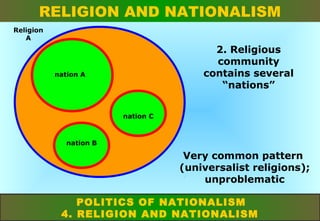
Religion
A

2. Religious
community
contains several
“nations”

nation A

nation C

nation B

Very common pattern
(universalist religions);
unproblematic
POLITICS OF NATIONALISM
4. RELIGION AND NATIONALISM
RELIGION AND NATIONALISM
nation
A

lang. A

3. “nation” and
religious community
coincide

Ethnic religions
(e.g Judaism, Sikhism);
exceptional
POLITICS OF NATIONALISM
4. RELIGION AND NATIONALISM
RELIGION AND NATIONALISM
nation
A

4. “nation” is
linked to
ancestral religion
Rel. A

Unusual
(component in
Irish identity?);
Sustainability?
POLITICS OF NATIONALISM
4. RELIGION AND NATIONALISM
THE END …

NEXT: HISTORICAL IMAGES AND NATIONALISM
POLITICS OF NATIONALISM
4. RELIGION AND NATIONALISM

Polnat04(3)

  • 1.
    POLITICS OF NATIONALISM 4.RELIGION AND NATIONALISM POLITICS OF NATIONALISM 4. RELIGION AND NATIONALISM
  • 2.
    OUTLINE Look at relationshipbetween religion and nationalism: • Religion as a source of division • Religion, society and politics • Religion and national identity POLITICS OF NATIONALISM 4. RELIGION AND NATIONALISM
  • 3.
    NATURE OF RELIGION Definition: Religion:“a unified system of beliefs and practices relative to sacred things, that is to say, things set apart and forbidden—beliefs and practices which unite into one single moral community called a Church, all those who adhere to them” (Durkheim) POLITICS OF NATIONALISM 4. RELIGION AND NATIONALISM
  • 4.
    NATURE OF RELIGION Implicationsof definition: Religion embodies beliefs and practices (or rituals): • Beliefs: ideological component, may have political implications (e.g. about matters of public policy) • Rituals: external expressions of belief, typically non-political, but may have political implications (e.g. public displays, processions) POLITICS OF NATIONALISM 4. RELIGION AND NATIONALISM
  • 5.
    NATURE OF RELIGION Differencesbetween religion and language as source of differentiation: • Commitment to religion is qualitative, not categorical (so partial membership, or non-membership, is possible) • Religion does not imply territorial concentration, or critical mass (so no intrinsic drive towards assimilation) • Religion always has social (and possibly political) implications (so membership implies political position?) POLITICS OF NATIONALISM 4. RELIGION AND NATIONALISM
  • 6.
    NATURE OF RELIGION Examplesof religious divisions: NORTH. IRELAND, 1961 (%) Catholic 35 Presbyterian 29 Church of I. 24 Other 12 NETHERLANDS, 1970 (%) Catholic 40 Dutch Reformed 24 Orthodox Ref. 9 Other 3 JAPAN, 1969 (%) Buddhist 75 Shinto 67 Christian 1 Other 5 Total Total Total 100 76 POLITICS OF NATIONALISM 4. RELIGION AND NATIONALISM 148
  • 7.
    NATURE OF RELIGION Worldbreakdown by religion, 2006 (very crude estimates): • Christians: 2,156m. (Catholic 52%;Protestant 38%;Orthodox 10%) • Muslims: 1,334m. (Sunni 85%; Shia 15%) • Hindus: 878m. • Buddhists: 382m. • Others, none: 1,713m. POLITICS OF NATIONALISM 4. RELIGION AND NATIONALISM
  • 8.
    CLASSIFICATION OF RELIGION Criterion1: descent: • Religions of Semitic origin – Modern Judaism – Christianity – Islam • Religions of South Asian origin – Modern Hinduism – Buddhism – Sikhism POLITICS OF NATIONALISM 4. RELIGION AND NATIONALISM
  • 9.
    CLASSIFICATION OF RELIGION Criterion2: broad orientation: • Universalistic – Christianity – Islam • Ethnic / particularistic – Judaism – Hinduism – Sikhism – Shinto POLITICS OF NATIONALISM 4. RELIGION AND NATIONALISM
  • 10.
    RELIGION AND SOCIETY Sociopoliticalimplications of religion • • • • Impact on educational system and values Effect on language development Ritual and ceremonial aspects Ideological and policy consequences POLITICS OF NATIONALISM 4. RELIGION AND NATIONALISM
  • 11.
    RELIGION AND SOCIETY Religionand educational development Inculcation of religious values requires a minimum level of teaching Implies existence of at least a rudimentary educational system (perhaps church-based) May imply the cultivation of special skills (e.g. basic literacy) Certain religions more demanding than others (e.g. emphasis in Protestantism on need for everyone to read the Bible)  Significant consequences for social development POLITICS OF NATIONALISM 4. RELIGION AND NATIONALISM
  • 12.
    RELIGION AND SOCIETY Religionand language development Clerical elites (and possibly all church members) require medium of wider communication Ancient language sometimes adopted (Latin, Old Church Slavonic, Sanskrit, Hebrew) Vernacular language sometimes cultivated (impact of Protestantism on language development)  Significant consequences for language development and wider communication POLITICS OF NATIONALISM 4. RELIGION AND NATIONALISM
  • 13.
    RELIGION AND SOCIETY Religion,ritual and ceremonial Religions tend to share common rituals which facilitate cross-cultural communication (ceremonies of worship, prayer rituals, pilgrimages)  Significant consequences for community building POLITICS OF NATIONALISM 4. RELIGION AND NATIONALISM
  • 14.
    RELIGION AND SOCIETY Religionand politics Different religions may have different implications for public policy: –Protestant emphasis on sabbatarianism, prohibition –Catholic emphasis on sexual morality, family — and on Catholic schools and medical services Raises prospect of conflict with secular state, or between religions  Significant consequences for political mobilisation POLITICS OF NATIONALISM 4. RELIGION AND NATIONALISM
  • 15.
    RELIGION AND NATIONALIDENTITY Formation of national identity • May be greatly facilitated by social impact of religion (building of broad community) • But universalist religions are inclusive (promote notion of bonds between all humans) • Nevertheless, may have implications for defining narrower patterns of identity – Impact of “ethnic” religions – Effect of organisational structures – Religious labels as ethnonational labels POLITICS OF NATIONALISM 4. RELIGION AND NATIONALISM
  • 16.
    RELIGION AND NATIONALIDENTITY “Ethnic” religion and national identity Community is defined as a collectivity unified, and distinguished from others, by shared beliefs and rituals (e.g. Shinto, Judaism) Religious writings, tracts and ceremonials may be those of an ethnonational community (they document history of a people, not just of a religion; e.g. Old Testament and Israel) But: ethnic religion may sometimes be divisive (e.g. tribal / local religions) POLITICS OF NATIONALISM 4. RELIGION AND NATIONALISM
  • 17.
    RELIGION AND NATIONALIDENTITY Religious organisation and national identity Church structure may mirror state structure (and thus reinforce sense of collective identity) Church structure may follow boundaries that later become “national” ones (e.g. church in Ireland) Schism or doctrinal revolt may follow “national” lines (e.g. Reformation) Church reorganisation may follow “national” lines •Lutheran monarchies, Anglicanism •Autocephalous Orthodox churches (Balkans) POLITICS OF NATIONALISM 4. RELIGION AND NATIONALISM
  • 18.
    RELIGION AND NATIONALIDENTITY Religious labelling and national identity Religious affiliation may be an indicator of origin, and imply national identity • Northern Ireland (Catholic Irish, Protestant British) • Poland (esp. in the past): Masurians (Protestant) • Lithuania (inter-war): Memellanders (Protestant) • Bulgaria: Pomaks (Muslim) Note impact of historical divisions on (1) religion and (2) identity; beware causation! POLITICS OF NATIONALISM 4. RELIGION AND NATIONALISM
  • 19.
    RELIGION AND NATIONALISM RELIGIONAND NATIONAL IDENTITY: EXAMPLE 1: NORTHERN IRELAND, 2004 100% 90% 80% 70% 60% 50% 40% 30% 20% 10% 0% Protestant British Catholic Ulster Other Northern Irish Irish POLITICS OF NATIONALISM 4. RELIGION AND NATIONALISM
  • 20.
    RELIGION AND NATIONALISM RELIGIONAND NATIONAL IDENTITY: EXAMPLE 2: SRI LANKA, 1981 LANGUAGE: Sinhala Tamil RELIGIOUS AFFILIATION: Buddhist Hindu Muslim Sinhalese (72%) SL Tamil (11%) Moors (7%) Indian Tamil (9%) POLITICS OF NATIONALISM 4. RELIGION AND NATIONALISM
  • 21.
    RELIGION AND NATIONALISM RELIGIONAND NATIONAL IDENTITY: EXAMPLE 3: FORMER YUGOSLAVIA, 1991 LANGUAGE: SerboCroatian TRADITIONAL RELIGIOUS AFFILIATION: Orthodox Catholic Muslim Serbian (36%) Ethnic Muslim (10%) Montenegrin (2%) Slovene Slovenian (7%) Macedonian Albanian Croatian (20%) Macedonian (7%) Albanian (9%) POLITICS OF NATIONALISM 4. RELIGION AND NATIONALISM
  • 22.
    RELIGION AND NATIONALISM RELATIONSHIPBETWEEN RELIGION AND “NATION” : COMPARISON WITH LANGUAGE 1. “Nation” contains several religions 2. Religion contains several “nations” 3. “Nation” and religious community coincide 4. “Nation” is linked to ancestral religion POLITICS OF NATIONALISM 4. RELIGION AND NATIONALISM
  • 23.
    RELIGION AND NATIONALISM nation A 1.“nation” contains several religions Rel. A Rel. C Rel. B Common pattern today (e.g Germany, Netherlands); now unproblematic POLITICS OF NATIONALISM 4. RELIGION AND NATIONALISM
  • 24.
    RELIGION AND NATIONALISM Religion A 2.Religious community contains several “nations” nation A nation C nation B Very common pattern (universalist religions); unproblematic POLITICS OF NATIONALISM 4. RELIGION AND NATIONALISM
  • 25.
    RELIGION AND NATIONALISM nation A lang.A 3. “nation” and religious community coincide Ethnic religions (e.g Judaism, Sikhism); exceptional POLITICS OF NATIONALISM 4. RELIGION AND NATIONALISM
  • 26.
    RELIGION AND NATIONALISM nation A 4.“nation” is linked to ancestral religion Rel. A Unusual (component in Irish identity?); Sustainability? POLITICS OF NATIONALISM 4. RELIGION AND NATIONALISM
  • 27.
    THE END … NEXT:HISTORICAL IMAGES AND NATIONALISM POLITICS OF NATIONALISM 4. RELIGION AND NATIONALISM