POLITICS OF NATIONALISM

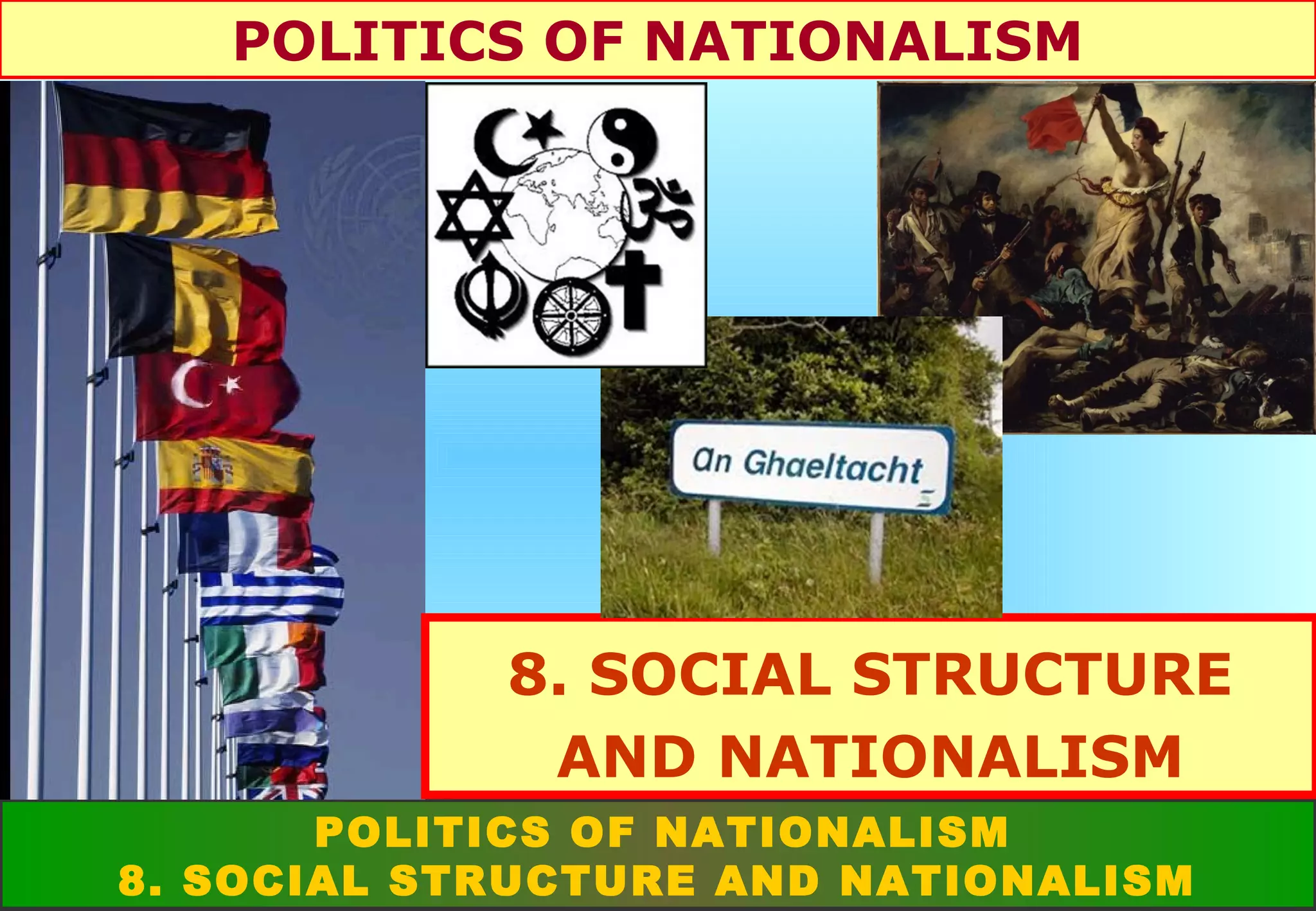
8. SOCIAL STRUCTURE
AND NATIONALISM
POLITICS OF NATIONALISM
8. SOCIAL STRUCTURE AND NATIONALISM
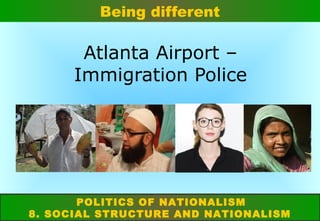
Being different

Atlanta Airport –
Immigration Police

POLITICS OF NATIONALISM
8. SOCIAL STRUCTURE AND NATIONALISM
OUTLINE
Main topics:
•Relationship between nationalism
and underlying social
characteristics
–Social class
–Region

POLITICS OF NATIONALISM
8. SOCIAL STRUCTURE AND NATIONALISM
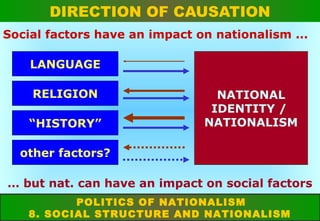
DIRECTION OF CAUSATION
Social factors have an impact on nationalism ...
LANGUAGE
RELIGION
“HISTORY”

NATIONAL
IDENTITY /
NATIONALISM

other factors?
… but nat. can have an impact on social factors
POLITICS OF NATIONALISM
8. SOCIAL STRUCTURE AND NATIONALISM
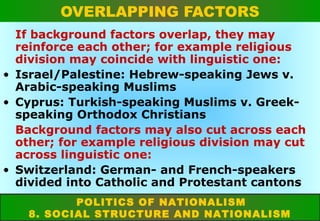
OVERLAPPING FACTORS
If background factors overlap, they may
reinforce each other; for example religious
division may coincide with linguistic one:
• Israel/Palestine: Hebrew-speaking Jews v.
Arabic-speaking Muslims
• Cyprus: Turkish-speaking Muslims v. Greekspeaking Orthodox Christians
Background factors may also cut across each
other; for example religious division may cut
across linguistic one:
• Switzerland: German- and French-speakers
divided into Catholic and Protestant cantons
POLITICS OF NATIONALISM
8. SOCIAL STRUCTURE AND NATIONALISM
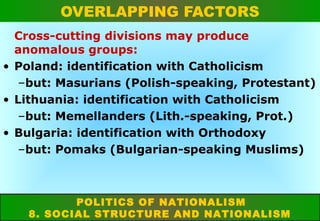
OVERLAPPING FACTORS
Cross-cutting divisions may produce
anomalous groups:
• Poland: identification with Catholicism
–but: Masurians (Polish-speaking, Protestant)
• Lithuania: identification with Catholicism
–but: Memellanders (Lith.-speaking, Prot.)
• Bulgaria: identification with Orthodoxy
–but: Pomaks (Bulgarian-speaking Muslims)

POLITICS OF NATIONALISM
8. SOCIAL STRUCTURE AND NATIONALISM
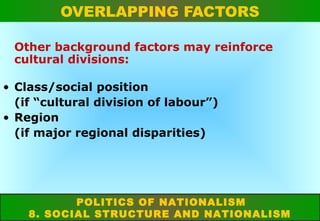
OVERLAPPING FACTORS
Other background factors may reinforce
cultural divisions:
• Class/social position
(if “cultural division of labour”)
• Region
(if major regional disparities)

POLITICS OF NATIONALISM
8. SOCIAL STRUCTURE AND NATIONALISM
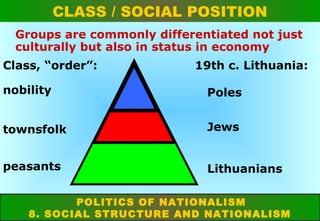
CLASS / SOCIAL POSITION
Groups are commonly differentiated not just
culturally but also in status in economy
Class, “order”:

19th c. Lithuania:

nobility

Poles

townsfolk

Jews

peasants

Lithuanians

POLITICS OF NATIONALISM
8. SOCIAL STRUCTURE AND NATIONALISM
CLASS / SOCIAL POSITION
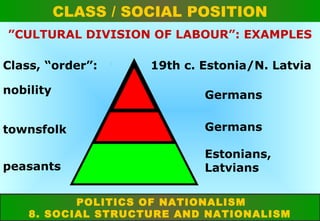
”CULTURAL DIVISION OF LABOUR”: EXAMPLES
Class, “order”:

19th c. Estonia/N. Latvia

nobility

Germans

townsfolk

Germans

peasants

Estonians,
Latvians

POLITICS OF NATIONALISM
8. SOCIAL STRUCTURE AND NATIONALISM
CLASS / SOCIAL POSITION
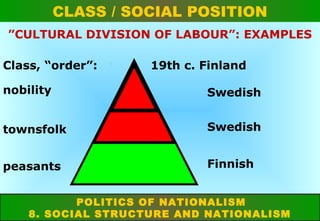
”CULTURAL DIVISION OF LABOUR”: EXAMPLES
Class, “order”:

19th c. Finland

nobility

Swedish

townsfolk

Swedish

peasants

Finnish

POLITICS OF NATIONALISM
8. SOCIAL STRUCTURE AND NATIONALISM
CLASS / SOCIAL POSITION
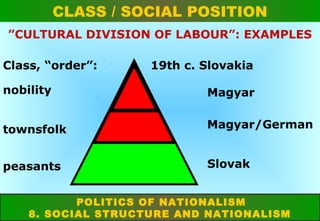
”CULTURAL DIVISION OF LABOUR”: EXAMPLES
Class, “order”:

19th c. Slovakia

nobility

Magyar

townsfolk

Magyar/German

peasants

Slovak

POLITICS OF NATIONALISM
8. SOCIAL STRUCTURE AND NATIONALISM
CLASS / SOCIAL POSITION
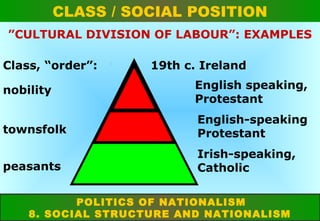
”CULTURAL DIVISION OF LABOUR”: EXAMPLES
Class, “order”:

19th c. Ireland

nobility

English speaking,
Protestant

townsfolk

English-speaking
Protestant

peasants

Irish-speaking,
Catholic

POLITICS OF NATIONALISM
8. SOCIAL STRUCTURE AND NATIONALISM
CLASS / SOCIAL POSITION
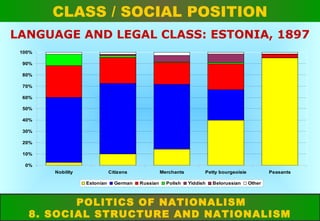
LANGUAGE AND LEGAL CLASS: ESTONIA, 1897
100%
90%
80%
70%
60%
50%
40%
30%
20%
10%
0%
Nobility

Citizens
Estonian

German

Merchants
Russian

Polish

Petty bourgeoisie
Yiddish

Belorussian

Peasants
Other

POLITICS OF NATIONALISM
8. SOCIAL STRUCTURE AND NATIONALISM
CLASS / SOCIAL POSITION
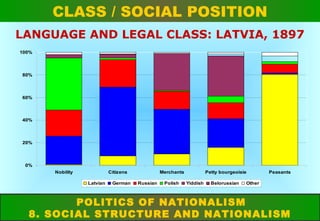
LANGUAGE AND LEGAL CLASS: LATVIA, 1897
100%

80%

60%

40%

20%

0%
Nobility

Citizens
Latvian

German

Merchants
Russian

Polish

Petty bourgeoisie
Yiddish

Belorussian

Peasants

Other

POLITICS OF NATIONALISM
8. SOCIAL STRUCTURE AND NATIONALISM
CLASS / SOCIAL POSITION
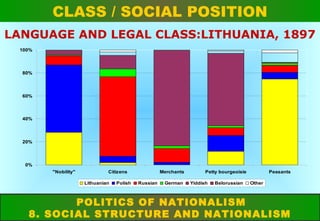
LANGUAGE AND LEGAL CLASS:LITHUANIA, 1897
100%

80%

60%

40%

20%

0%
"Nobility"

Citizens
Lithuanian

Polish

Merchants
Russian

German

Petty bourgeoisie
Yiddish

Belorussian

Peasants
Other

POLITICS OF NATIONALISM
8. SOCIAL STRUCTURE AND NATIONALISM
CLASS / SOCIAL POSITION
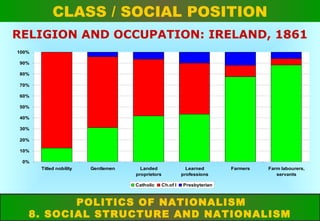
RELIGION AND OCCUPATION: IRELAND, 1861
100%
90%
80%
70%
60%
50%
40%
30%
20%
10%
0%
Titled nobility

Gentlemen

Landed
proprietors
Catholic

Ch.of I

Learned
professions

Farmers

Farm labourers,
servants

Presbyterian

POLITICS OF NATIONALISM
8. SOCIAL STRUCTURE AND NATIONALISM
CLASS / SOCIAL POSITION
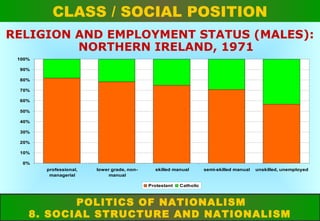
RELIGION AND EMPLOYMENT STATUS (MALES):
NORTHERN IRELAND, 1971
100%
90%
80%
70%
60%
50%
40%
30%
20%
10%
0%
professional,
managerial

lower grade, nonmanual

skilled manual

Protestant

semi-skilled manual

unskilled, unemployed

Catholic

POLITICS OF NATIONALISM
8. SOCIAL STRUCTURE AND NATIONALISM
REGION
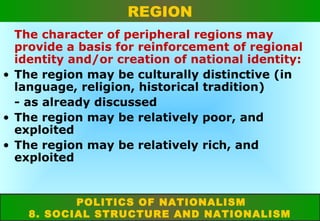
The character of peripheral regions may
provide a basis for reinforcement of regional
identity and/or creation of national identity:
• The region may be culturally distinctive (in
language, religion, historical tradition)
- as already discussed
• The region may be relatively poor, and
exploited
• The region may be relatively rich, and
exploited

POLITICS OF NATIONALISM
8. SOCIAL STRUCTURE AND NATIONALISM
REGION
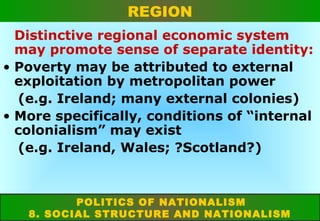
Distinctive regional economic system
may promote sense of separate identity:
• Poverty may be attributed to external
exploitation by metropolitan power
(e.g. Ireland; many external colonies)
• More specifically, conditions of “internal
colonialism” may exist
(e.g. Ireland, Wales; ?Scotland?)

POLITICS OF NATIONALISM
8. SOCIAL STRUCTURE AND NATIONALISM
REGION
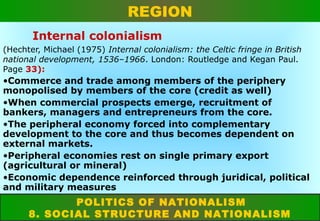
Internal colonialism
(Hechter, Michael (1975) Internal colonialism: the Celtic fringe in British
national development, 1536–1966. London: Routledge and Kegan Paul.
Page 33):

•Commerce and trade among members of the periphery
monopolised by members of the core (credit as well)
•When commercial prospects emerge, recruitment of
bankers, managers and entrepreneurs from the core.
•The peripheral economy forced into complementary
development to the core and thus becomes dependent on
external markets.
•Peripheral economies rest on single primary export
(agricultural or mineral)
•Economic dependence reinforced through juridical, political
and military measures

POLITICS OF NATIONALISM
8. SOCIAL STRUCTURE AND NATIONALISM
REGION

•
•
•
•

Geographically peripheral region may
also be relatively wealthy, and allege
exploitation by centre:
Baltic states in USSR
Slovenia in former Yugoslavia
Catalonia in Spain
East Ulster in Ireland?

POLITICS OF NATIONALISM
8. SOCIAL STRUCTURE AND NATIONALISM
THE END …

NEXT: NATIONALIST MOBILISATION
POLITICS OF NATIONALISM
8. SOCIAL STRUCTURE AND NATIONALISM

Polnat08.bb

  • 1.
    POLITICS OF NATIONALISM 8.SOCIAL STRUCTURE AND NATIONALISM POLITICS OF NATIONALISM 8. SOCIAL STRUCTURE AND NATIONALISM
  • 2.
    Being different Atlanta Airport– Immigration Police POLITICS OF NATIONALISM 8. SOCIAL STRUCTURE AND NATIONALISM
  • 3.
    OUTLINE Main topics: •Relationship betweennationalism and underlying social characteristics –Social class –Region POLITICS OF NATIONALISM 8. SOCIAL STRUCTURE AND NATIONALISM
  • 4.
    DIRECTION OF CAUSATION Socialfactors have an impact on nationalism ... LANGUAGE RELIGION “HISTORY” NATIONAL IDENTITY / NATIONALISM other factors? … but nat. can have an impact on social factors POLITICS OF NATIONALISM 8. SOCIAL STRUCTURE AND NATIONALISM
  • 5.
    OVERLAPPING FACTORS If backgroundfactors overlap, they may reinforce each other; for example religious division may coincide with linguistic one: • Israel/Palestine: Hebrew-speaking Jews v. Arabic-speaking Muslims • Cyprus: Turkish-speaking Muslims v. Greekspeaking Orthodox Christians Background factors may also cut across each other; for example religious division may cut across linguistic one: • Switzerland: German- and French-speakers divided into Catholic and Protestant cantons POLITICS OF NATIONALISM 8. SOCIAL STRUCTURE AND NATIONALISM
  • 6.
    OVERLAPPING FACTORS Cross-cutting divisionsmay produce anomalous groups: • Poland: identification with Catholicism –but: Masurians (Polish-speaking, Protestant) • Lithuania: identification with Catholicism –but: Memellanders (Lith.-speaking, Prot.) • Bulgaria: identification with Orthodoxy –but: Pomaks (Bulgarian-speaking Muslims) POLITICS OF NATIONALISM 8. SOCIAL STRUCTURE AND NATIONALISM
  • 7.
    OVERLAPPING FACTORS Other backgroundfactors may reinforce cultural divisions: • Class/social position (if “cultural division of labour”) • Region (if major regional disparities) POLITICS OF NATIONALISM 8. SOCIAL STRUCTURE AND NATIONALISM
  • 8.
    CLASS / SOCIALPOSITION Groups are commonly differentiated not just culturally but also in status in economy Class, “order”: 19th c. Lithuania: nobility Poles townsfolk Jews peasants Lithuanians POLITICS OF NATIONALISM 8. SOCIAL STRUCTURE AND NATIONALISM
  • 9.
    CLASS / SOCIALPOSITION ”CULTURAL DIVISION OF LABOUR”: EXAMPLES Class, “order”: 19th c. Estonia/N. Latvia nobility Germans townsfolk Germans peasants Estonians, Latvians POLITICS OF NATIONALISM 8. SOCIAL STRUCTURE AND NATIONALISM
  • 10.
    CLASS / SOCIALPOSITION ”CULTURAL DIVISION OF LABOUR”: EXAMPLES Class, “order”: 19th c. Finland nobility Swedish townsfolk Swedish peasants Finnish POLITICS OF NATIONALISM 8. SOCIAL STRUCTURE AND NATIONALISM
  • 11.
    CLASS / SOCIALPOSITION ”CULTURAL DIVISION OF LABOUR”: EXAMPLES Class, “order”: 19th c. Slovakia nobility Magyar townsfolk Magyar/German peasants Slovak POLITICS OF NATIONALISM 8. SOCIAL STRUCTURE AND NATIONALISM
  • 12.
    CLASS / SOCIALPOSITION ”CULTURAL DIVISION OF LABOUR”: EXAMPLES Class, “order”: 19th c. Ireland nobility English speaking, Protestant townsfolk English-speaking Protestant peasants Irish-speaking, Catholic POLITICS OF NATIONALISM 8. SOCIAL STRUCTURE AND NATIONALISM
  • 13.
    CLASS / SOCIALPOSITION LANGUAGE AND LEGAL CLASS: ESTONIA, 1897 100% 90% 80% 70% 60% 50% 40% 30% 20% 10% 0% Nobility Citizens Estonian German Merchants Russian Polish Petty bourgeoisie Yiddish Belorussian Peasants Other POLITICS OF NATIONALISM 8. SOCIAL STRUCTURE AND NATIONALISM
  • 14.
    CLASS / SOCIALPOSITION LANGUAGE AND LEGAL CLASS: LATVIA, 1897 100% 80% 60% 40% 20% 0% Nobility Citizens Latvian German Merchants Russian Polish Petty bourgeoisie Yiddish Belorussian Peasants Other POLITICS OF NATIONALISM 8. SOCIAL STRUCTURE AND NATIONALISM
  • 15.
    CLASS / SOCIALPOSITION LANGUAGE AND LEGAL CLASS:LITHUANIA, 1897 100% 80% 60% 40% 20% 0% "Nobility" Citizens Lithuanian Polish Merchants Russian German Petty bourgeoisie Yiddish Belorussian Peasants Other POLITICS OF NATIONALISM 8. SOCIAL STRUCTURE AND NATIONALISM
  • 16.
    CLASS / SOCIALPOSITION RELIGION AND OCCUPATION: IRELAND, 1861 100% 90% 80% 70% 60% 50% 40% 30% 20% 10% 0% Titled nobility Gentlemen Landed proprietors Catholic Ch.of I Learned professions Farmers Farm labourers, servants Presbyterian POLITICS OF NATIONALISM 8. SOCIAL STRUCTURE AND NATIONALISM
  • 17.
    CLASS / SOCIALPOSITION RELIGION AND EMPLOYMENT STATUS (MALES): NORTHERN IRELAND, 1971 100% 90% 80% 70% 60% 50% 40% 30% 20% 10% 0% professional, managerial lower grade, nonmanual skilled manual Protestant semi-skilled manual unskilled, unemployed Catholic POLITICS OF NATIONALISM 8. SOCIAL STRUCTURE AND NATIONALISM
  • 18.
    REGION The character ofperipheral regions may provide a basis for reinforcement of regional identity and/or creation of national identity: • The region may be culturally distinctive (in language, religion, historical tradition) - as already discussed • The region may be relatively poor, and exploited • The region may be relatively rich, and exploited POLITICS OF NATIONALISM 8. SOCIAL STRUCTURE AND NATIONALISM
  • 19.
    REGION Distinctive regional economicsystem may promote sense of separate identity: • Poverty may be attributed to external exploitation by metropolitan power (e.g. Ireland; many external colonies) • More specifically, conditions of “internal colonialism” may exist (e.g. Ireland, Wales; ?Scotland?) POLITICS OF NATIONALISM 8. SOCIAL STRUCTURE AND NATIONALISM
  • 20.
    REGION Internal colonialism (Hechter, Michael(1975) Internal colonialism: the Celtic fringe in British national development, 1536–1966. London: Routledge and Kegan Paul. Page 33): •Commerce and trade among members of the periphery monopolised by members of the core (credit as well) •When commercial prospects emerge, recruitment of bankers, managers and entrepreneurs from the core. •The peripheral economy forced into complementary development to the core and thus becomes dependent on external markets. •Peripheral economies rest on single primary export (agricultural or mineral) •Economic dependence reinforced through juridical, political and military measures POLITICS OF NATIONALISM 8. SOCIAL STRUCTURE AND NATIONALISM
  • 21.
    REGION • • • • Geographically peripheral regionmay also be relatively wealthy, and allege exploitation by centre: Baltic states in USSR Slovenia in former Yugoslavia Catalonia in Spain East Ulster in Ireland? POLITICS OF NATIONALISM 8. SOCIAL STRUCTURE AND NATIONALISM
  • 22.
    THE END … NEXT:NATIONALIST MOBILISATION POLITICS OF NATIONALISM 8. SOCIAL STRUCTURE AND NATIONALISM