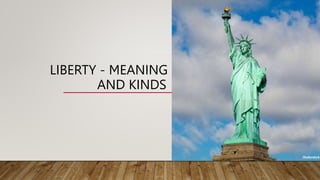
LIBERTY - MEANING
AND KINDS
DEFINITION
• The root of the word liberty is Latin word “liber” which means
free.
According to H.J.Laski
• The absence of restraints on those social conditions that are
indispensable for the betterment and welfare of individual in
modern age.
• In every organized society there exist certain rules and
regulation that secure rights and impose certain limitation and
checks in order to secure liberty of all.
2
TWO ASPECT OF LIBERTY
• Negative aspect
• Positive aspect
3
KINDS OF LIBERTY
• Natural liberty
• National liberty
• Civil liberty
• Political liberty
• Economic liberty
4
NATURAL LIBERTY
• The concept of natural liberty points out the period before the
organized political life and implies the absence of all legal restraints
on human freedom of action.
• Locke believed in the supremacy of natural law that secures natural
right such as life, liberty, and property while state comes into
existence for the protection of natural rights. Locke gives priority to
these right as these are, in his opinion, prior to state its law.
5
NATIONAL LIBERTY
• National liberty relates to the independence of state from
external control and it has been closely associated with
nationalism.
6
CIVIL LIBERTY
• According to Laski civil liberty consists in the liberty of an
individual in action and thought in those areas of life
where the result of one’s efforts are mainly personal in
nature.
7
POLITICAL LIBERTY
• Participation of citizens in political life
• Government is elected by the people
• People are indirectly participate in political decision-
making
• Right to vote
• Right to criticize government policies
8
ECONOMIC LIBERTY
• Part of civil liberty
• Right of individual regarding the earning of their
livelihood
• Economic right
• Right to work and choice of professional
9
CIVIL RIGHT
Civil right is right of citizens to political and social freedom
and equality. These are:
• Physical right
• Freedom of activity of mind
• Practical activity
10
CONTINUE....
Civil right also include:
• Right to life
• Right to education
• Right to association
• Right to other facilities
11
ECONOMIC RIGHT
Right to work
• Every citizen should have the right to work and adopt the
profession of his choice. State is under obligation to provide equal
opportunities to all .
• Modern welfare state have introduce a network of labor laws so as
to protect the interests of the working classes from the exploitation
of the capitalists.
• Some state provide maximum facilities such as unemployment
insurance 12
RIGHT TO PROPERTY
• Right to own property is regarded as a basic human right .
Right to property include ownership to one's belongings,
movable and immovable both.
• Private property is, in fact essential for the development of
one’s moral personality.
• State should be the protector of this right and not to
invader.
13
FREQUENTLY ASKED QUESTIONS
• Write the meaning of Liberty?
• Write down the characteristic of Liberty?
• Write down the kinds of Liberty?
• What do you mean by Political Liberty?
• What do you mean by Civil Liberty?
• What do you mean by Economic Liberty?
14
THANK YOU
15

Liberty

  • 1.
  • 2.
    DEFINITION • The rootof the word liberty is Latin word “liber” which means free. According to H.J.Laski • The absence of restraints on those social conditions that are indispensable for the betterment and welfare of individual in modern age. • In every organized society there exist certain rules and regulation that secure rights and impose certain limitation and checks in order to secure liberty of all. 2
  • 3.
    TWO ASPECT OFLIBERTY • Negative aspect • Positive aspect 3
  • 4.
    KINDS OF LIBERTY •Natural liberty • National liberty • Civil liberty • Political liberty • Economic liberty 4
  • 5.
    NATURAL LIBERTY • Theconcept of natural liberty points out the period before the organized political life and implies the absence of all legal restraints on human freedom of action. • Locke believed in the supremacy of natural law that secures natural right such as life, liberty, and property while state comes into existence for the protection of natural rights. Locke gives priority to these right as these are, in his opinion, prior to state its law. 5
  • 6.
    NATIONAL LIBERTY • Nationalliberty relates to the independence of state from external control and it has been closely associated with nationalism. 6
  • 7.
    CIVIL LIBERTY • Accordingto Laski civil liberty consists in the liberty of an individual in action and thought in those areas of life where the result of one’s efforts are mainly personal in nature. 7
  • 8.
    POLITICAL LIBERTY • Participationof citizens in political life • Government is elected by the people • People are indirectly participate in political decision- making • Right to vote • Right to criticize government policies 8
  • 9.
    ECONOMIC LIBERTY • Partof civil liberty • Right of individual regarding the earning of their livelihood • Economic right • Right to work and choice of professional 9
  • 10.
    CIVIL RIGHT Civil rightis right of citizens to political and social freedom and equality. These are: • Physical right • Freedom of activity of mind • Practical activity 10
  • 11.
    CONTINUE.... Civil right alsoinclude: • Right to life • Right to education • Right to association • Right to other facilities 11
  • 12.
    ECONOMIC RIGHT Right towork • Every citizen should have the right to work and adopt the profession of his choice. State is under obligation to provide equal opportunities to all . • Modern welfare state have introduce a network of labor laws so as to protect the interests of the working classes from the exploitation of the capitalists. • Some state provide maximum facilities such as unemployment insurance 12
  • 13.
    RIGHT TO PROPERTY •Right to own property is regarded as a basic human right . Right to property include ownership to one's belongings, movable and immovable both. • Private property is, in fact essential for the development of one’s moral personality. • State should be the protector of this right and not to invader. 13
  • 14.
    FREQUENTLY ASKED QUESTIONS •Write the meaning of Liberty? • Write down the characteristic of Liberty? • Write down the kinds of Liberty? • What do you mean by Political Liberty? • What do you mean by Civil Liberty? • What do you mean by Economic Liberty? 14
  • 15.