Active	citizenship	and	Adult	
education	for	young	vulnerable	
adults
Kai	Pata
Tallinn	University
The	project	is	funded	by	the	European	
Union’s	Horizon	2020	Research	and	
Innovation	Programme,	Contract	No.	
693388
EduMap project
• EduMAP http://blogs.uta.fi/edumap/ is	a	Horizon2020	research	project	
(February	2016- February	2019)	focusing	on	the	educational	needs	of	
young	people	with	low	levels	of	basic	and	functional	literacy,	with	deficient	
language	and	cultural	skills	(foreign	newcomers,	ethnic	minorities),	those	
who	have	dropped	out	of	school	and	those	not	in	education	or	training	due	
to	handicap.
• The	main	research	question	is:	What	policies	and	practices	are	needed	in	
the	field	of	adult	education	to	include	young	adults	at	risk	of	social	
exclusion	in	active	participatory	citizenship	in	Europe?
• Final	product:	IDSS	system	that	uses	actual	European	case	studies	and	data	
input	for	advising	policymakers	how	to	improve	adult	education	for	
vulnerable	youth
Adult	education	for	active	citizenship
• The	European	discussion	on	active	citizenship	emerged	to	counteract	deficits	in	the	social	
cohesion	and	solidarity	and,	above	all,	the	democratic	deficit.	
• Lisbon	European	Council,	2000	- active	citizenship	concept	has	emerged:	The	key	idea	of	
active	citizenship	is	that	a	person	is	engaged	in	participation	in	activities	that	support	a	
community.	
• ‘Learning	for	active	citizenship”	was	stated	as	one	of	three	major	pillars	in	lifelong	learning
(Commission	of	the	European	Communities,	2001).	
• The	key	competences:	the	ability	to	communicate	in	one's	mother	tongue	and	foreign	languages,	
adopting	civic	competence	based	on	knowledge	of	social	and	political	concepts,	and	a	commitment	
to	active	and	democratic	participation	(European	Parliament	and	the	Council	of	the	European	Union,	
2006).	
• Adult	education	has	been	seen	as	a	key	means	for	supporting	active	citizenship and	social	
cohesion,	and	equal	opportunities,	and	for	reducing	the	democratic	deficit across	Europe	
(Mascherini et	al.,	2009:	5).	
• However	there	has	been	the	neo-liberal	shift	in	the	field	of	adult	education:	While	historically,	adult	
education	has	been	an	important	means	for	providing	people	with	a	broader,	more	humane	
education,	recently	in	many	European	countries,	adult	education	has	become	reduced	to	only	one	of	
its	functions,	namely	that	of	employability	or	‘learning	for	earning’	and	only	now	the	lifelong	learning	
also	for	learning	self-development	and	excercising active	citizenship has	been	highlighted.
Active	citizenship	concept
• Active	citizenship	is	first	and	foremost	about	participation	in	civil	
society.	
• Active	citizenship	should	be	seen	as	a	public identity	and	not	as	an	
individual	one.	(Biesta,	2009	)
• Active	citizenship	supported	the	strategic	goal	set	for	the	European	
Community	- to	become	‘the	most	competitive	and	dynamic	
knowledge-based	economy	in	the	world	with	more	and	better	jobs	
and	greater	social	cohesion’
• Recent	concern:	young	people,	in	particular,	are	often	not	strongly	
embedded	within	their	communities,	and may	lack	the	knowledge	
and	skills	to	act	effectively	as	citizens.
Learning	for	active	citizenship
• Learning	for	active	citizenship	comprises	two	approaches	to	citizenship	learning,	
namely	learning	about citizenship	and	learning	through citizenship (cf.	Johnston,	
2003:	158,	Kalekin-Fishman,	Tsitselikis &	Pitkänen,	2007:	28-32).	
• Learning	about	citizenship	covers	historical	and	cultural	understanding	as	well	as	
information	on	citizens’	rights	and	responsibilities.	This	learning	is	primarily	about	
citizenship	as	status,	and	focuses	mainly	on	the	politico-juridical	spheres	of	
citizenship.	It	relates	with	the	concept	responsive	citizenship	(e.g.	in	Hungary)
• Learning	through	active	citizenship	is	seen	as	part	of	lifelong	activity	in	which	a	
person	constructs	the	crucial	links	between	learning	and	societal	action	-
citizenship	as	practice (Concept	active	citizenship	is	becoming	widespread	across	
European	countries	agendas.)
• The	contexts	where	citizenship	can	be	learnt	occur	not	only	in	educational	
organisations but	in	various	areas	of	social	life:	civil	society,	work,	and	what	is	
usually	designed	as	the	private	sphere.	(Kalekin-Fishman,	Tsitselikis and	Pitkänen,	
2007:	30.)
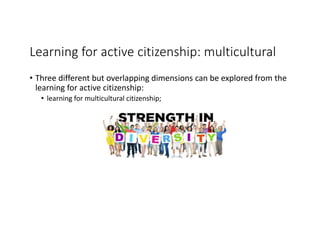
Learning	for	active	citizenship:	multicultural
• Three	different	but	overlapping	dimensions	can	be	explored	from	the	
learning	for	active	citizenship:	
• learning	for	multicultural	citizenship;
Socio-cultural	dimension
Benefits	of	being	engaged	as	an	active	citizen
• Being	actively	engaged	in a	community	is	considered	to	be	more	
desirable	than	being	outside of	a	community.
• Active	citizenship	is	not	about	participation	in	any	community	(such	
as	extremist	groups	)
• New	context	supported	by	social	media	and	migration:	the	increasing	
internationalisation - a	person	can	be	actively	engaged	with	diverse	
national	and	international	communities
Socio-cultural	dimension:	values
• Ethical	boundaries	set	limits	for	active	participation,	specifying	the	particular	
values	that	should	be	underpinned	through	the	participation	in	the	community	
life.
• As	a	rule,	people’s	activities	should	support	the	community	and	should	not	
contravene	principles	of	human	rights	and	the	rule	of	law	(Hoskins	et	al.,	2006:	
11).
• However	to	be	active	in	different	communities	with	different	value-sets,	often	
personal	values	acceptable	in	one	community	may	partially	contradict	with	the	
values	of	other	community that	constrains	being	active	citizen	in	that	
community.
• In	culturally	diverse	countries	the	notion	of	active	citizenship	is	characterized	by	
the	values	of	tolerance	and	non-violence	and	by	the	acknowledgement	of	
human	rights	and	mutual	respect.	(Brooks	and	Holford,	2009:	17.)
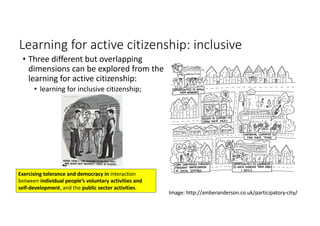
Learning	for	active	citizenship:	inclusive
• Three	different	but	overlapping	
dimensions	can	be	explored	from	the	
learning	for	active	citizenship:	
• learning	for	inclusive	citizenship;	
Image:	http://amberanderson.co.uk/participatory-city/
Exercising	tolerance	and	democracy	in	interaction	
between	individual	people’s	voluntary	activities	and	
self-development,	and	the	public	sector	activities.
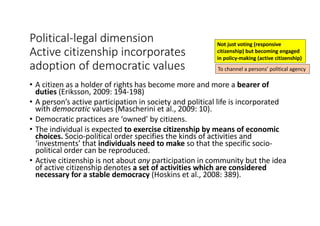
Political-legal	dimension
Active	citizenship	incorporates	
adoption	of	democratic	values
• A	citizen	as	a	holder	of	rights	has	become	more	and	more	a	bearer	of	
duties (Eriksson,	2009:	194-198)
• A	person’s	active	participation	in	society	and	political	life	is	incorporated	
with	democratic	values	(Mascherini et	al.,	2009:	10).	
• Democratic	practices	are	‘owned’	by	citizens.
• The	individual	is	expected	to	exercise	citizenship	by	means	of	economic	
choices.	Socio-political	order	specifies	the	kinds	of	activities	and	
‘investments’	that	individuals	need	to	make	so	that	the	specific	socio-
political	order	can	be	reproduced.	
• Active	citizenship	is	not	about	any participation	in	community	but	the	idea	
of	active	citizenship	denotes	a	set	of	activities	which	are	considered	
necessary	for	a	stable	democracy	(Hoskins	et	al.,	2008:	389).	
Not	just	voting	(responsive	
citizenship)	but	becoming	engaged	
in	policy-making	(active	citizenship)
To	channel	a	persons’	political	agency
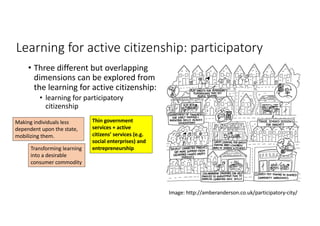
Learning	for	active	citizenship:	participatory
• Three	different	but	overlapping	
dimensions	can	be	explored	from	
the	learning	for	active	citizenship:	
• learning	for	participatory	
citizenship	
Image:	http://amberanderson.co.uk/participatory-city/
Thin	government	
services	+	active	
citizens’	services	(e.g.	
social	enterprises)	and	
entrepreneurship
Making	individuals	less	
dependent	upon	the	state,	
mobilizing	them.
Transforming	learning	
into	a	desirable	
consumer	commodity
Socio-economic	dimension	of	active	
citizenship
• In	neo-liberal	discussion	on	active	citizenship,	the	importance	of	
employment	and	effective	economic	and	societal	participation	have	
been	stressed,	and	citizens’	entrepreneurial	attitudes	are	
encouraged	(Brooks	and	Holford,	2009:	11-12).	
• In	this	discourse,	an	active	citizen	is	presented	as	the	opposite	to	a	
passive	citizen	who	is	dependent	of	the	support	of	the	welfare	state	
and	constantly	in	danger	of	becoming	marginalised (Eriksson,	2009:	
194).
Socio-economic	dimension
’Consumer	citizenship’
• There	is	the	constant	shift	of	responsibilities	from	the	state	traditionally	obliged	to	
create	civil,	political	and	social	rights	to	the	individual	consumer’s	fundamental	
right – the	’consumer	citizenship’.	
• The	individual	actions	of	active	citizens	are	considered	to	be	the	main	‘solution’	for	
collective	problems.
• An	active	citizen	is	the	person	who,	through	active	involvement	in	the	local	
community,	would	provide	those	‘services’	that	are	no	longer	available	through	
welfare	state	provision.	
• With	the	the	’consumer	citizenship’	one	of	the	key	principles	of	a	democratic	
society:	the	goal	of	equal	opportunities.
• The	goal	of	equal	opportunities	is	difficult	to	fulfil	for	vulnerable	people.	Younger	
generations,	the	unemployed,	workers	at	home,	and	so	on,	are	being	left	behind	in	
exercising	active	citizenship	in	the	community	and	become	passive	receivers	
(Milana,	2008:	208.)
Active	citizenship	in	Europe
Politico-legal
Socio-economic
Socio-cultural
In	UK	the	‘Big	Society’	and	‘localism’	-
community	activities	are	in	the	focus	of	
policies.
In	France,	politico-legal	values	like	liberty,	equality,	
fraternity,	human	rights,	tolerance,	rule	of	law	and	citizen	
duties are	explicitly	stressed.	
The	development	of	democratic	competences	and	active	
socio-political	participation	of	citizens	are	highlighted	in	
Germany.	Germany:	people’s	involvement	in	active	
participation	concerns	both	citizens	and	denizens	.
In	Germany:	Individual	
people’s	and	NGOs	societal	
activities	are	seen	important	
contributions	to	society and	
complementary	to	the	
governmental	measures	
Thin	government	
services	+	active	
citizens’	services	(e.g.	
social	enterprises)	and	
entrepreneurship
In	UK	encouraging	people	to	take	
an	active	role	in	their	communities	
(including	volunteering),	‘social	
action’,	but	the	underlying	idea	of	
increasing	community	self-help	
and	reducing	state	intervention	
In	Spain,	respecting	others,	
showing	tolerance,	co-
operation	and	solidarity	
among	people	and	groups	are	
seen	as	central	values.
In	Scandinavian	countries,	there	appears	to	
be	an	obvious	focus	on	democratic	
community	values	- human	rights	and	
freedom,	diversity	and	equality.
Exercising	tolerance	and	democracy	in	interaction	
between	individual	people’s	voluntary	activities	and	
self-development,	and	the	public	sector	activities.
In	Denmark	active	citizen	is	connected	both	to	
citizens	and	foreigners	who	apply	for	a	permanent	
residence in	the	country
In	Finland	active	citizenship	it	no	less	than	as	an	
ethical	attitude	to	the	world,	global	citizenship	
and	includes	social	and	civic	activities,	protection	
of	human	rights	and	non-discrimination,	as	well	
as	a	person’s	self-development,	responsible	
consumption	and	environmental	responsibility
Estonia:	citizen’s	
capability	and	
willingness	to	have	a	
positive	impact	in	the	
society
Estonia:	curricula	
highlight	‘civic	initiative	
and	entrepreneurship’
Not	just	voting	(responsive	
citizenship)	but	becoming	engaged	
in	policy-making	(active	citizenship)
Latvia:	to	feel	safe	and	belonging	to	
Latvia,	everyone	[here]	will	have	the	
opportunity	to	achieve	his	or	her	goals
Lithuania:	Government	must	reduce	
areas	of	intervention,	thus	enabling	
citizens	and	communities	to	take	
responsibility	into	their	hands to	be	
proactive,	enterprising,	creative	in	
their	solutions	and	ready	to	take	risks,
trusting	their	fellow-citizens.
Cohesion,	
inclusion	and	
involvement
Making	individuals	less	
dependent	upon	the	state,	
mobilizing	them.
Transforming	learning	
into	a	desirable	
consumer	commodity	
To	channel	a	persons’	political	agency
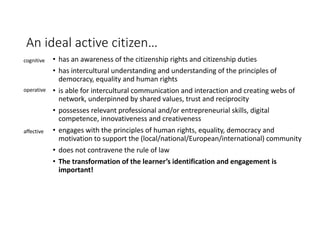
An	ideal	active	citizen…
• has	an	awareness	of	the	citizenship	rights	and	citizenship	duties	
• has	intercultural	understanding	and	understanding	of	the	principles	of	
democracy,	equality	and	human	rights
• is	able	for	intercultural	communication	and	interaction	and	creating	webs	of	
network,	underpinned	by	shared	values,	trust	and	reciprocity	
• possesses	relevant	professional	and/or	entrepreneurial	skills,	digital	
competence,	innovativeness	and	creativeness
• engages	with	the	principles	of	human	rights,	equality,	democracy	and	
motivation	to	support	the	(local/national/European/international)	community	
• does	not	contravene	the	rule	of	law	
• The	transformation	of	the	learner’s	identification	and	engagement	is	
important!	
affective
cognitive
operative
Active	citizenship	practices	are	changed	by	
new	interaction	environments
• Increasing	availability	of	digital	media	and	communication	means,	in	particular,	
opens	up	many	new	and	innovative	avenues	for	people	to	practice	their	
citizenship	in	diverse	ways	(cf.	Brooks	and	Holford,	2009:	15).	
• In	addition	to	schools,	civil	society	and	workplaces,	the	participatory	forms	of	
citizenship	can	be	learned	in	through	diverse	actions	in	virtual	communities,	
digital	milieus	and	single-issue	interest	groups.	
• Many	youth	groups	live	in	a	hybrid	space	between	the	mainstream	culture	and	
peripheral	ways	of	living.	If	no	efforts	are	made	to	create	real	preconditions	for	
their	societal	membership	and	participation,	the	members	of	these	groups	are	at	
risk	of	being	marginalized	and	defined	as	outsiders. (McCollum,	2011.)	
• In	order	to	prevent	social	exclusion	among	vulnerable	groups,	educational	
institutions	need	to	shape	curriculum	contents,	educational	initiatives	and	
pedagogies	in	ways	that	are	acceptable	to	a	wider	range	of	cultural	codes	and	
communicative	practices	to	which	the	learners	have	been	socialised.
Final	words
• This	presentation	relies	on	the	effort	of	H2020	EDuMap project	
consortium	and	is	based	on	the	report:	Conceptual	Framework	on	
Active	Citizenship
• Contact:	http://blogs.uta.fi/edumap/
The	project	is	funded	by	the	European	
Union’s	Horizon	2020	Research	and	
Innovation	Programme,	Contract	No.	
693388

Policyworkshop edu map_active citizenship