Work Package 3
Targeted research on best practices among vulnerable groups
The project is funded by the European
Union’s Horizon 2020 Research and
Innovation Programme.
Contract No. 693388
Dr. Beate Schmidt-Behlau
Work Package 3
Content of the presentation:
Part I: Methodology and Sampling
Part II: Findings (Selected)
Part III: Ways Forward (Selected)
The project is funded by the European
Union’s Horizon 2020 Research and
Innovation Programme.
Contract No. 693388
Work Package 3
Part I: Methodology and Sampling
The project is funded by the European
Union’s Horizon 2020 Research and
Innovation Programme.
Contract No. 693388
The project is funded by the European Union’s
Horizon 2020 Research and Innovation Programme.
Contract No. 693388
Work Package 3 Methodology
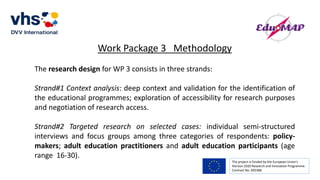
The research design for WP 3 consists in three strands:
Strand#1 Context analysis: deep context and validation for the identification of
the educational programmes; exploration of accessibility for research purposes
and negotiation of research access.
Strand#2 Targeted research on selected cases: individual semi-structured
interviews and focus groups among three categories of respondents: policy-
makers; adult education practitioners and adult education participants (age
range 16-30).
The project is funded by the European Union’s
Horizon 2020 Research and Innovation Programme.
Contract No. 693388
Work Package 3 Methodology
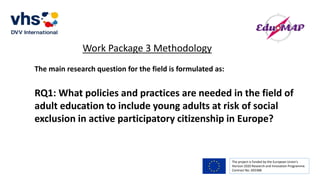
The main research question for the field is formulated as:
RQ1: What policies and practices are needed in the field of
adult education to include young adults at risk of social
exclusion in active participatory citizenship in Europe?
The project is funded by the European Union’s
Horizon 2020 Research and Innovation Programme.
Contract No. 693388
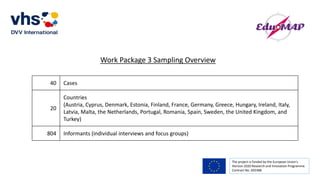
Work Package 3 Sampling Overview
40 Cases
20
Countries
(Austria, Cyprus, Denmark, Estonia, Finland, France, Germany, Greece, Hungary, Ireland, Italy,
Latvia, Malta, the Netherlands, Portugal, Romania, Spain, Sweden, the United Kingdom, and
Turkey)
804 Informants (individual interviews and focus groups)
The project is funded by the European Union’s
Horizon 2020 Research and Innovation Programme.
Contract No. 693388
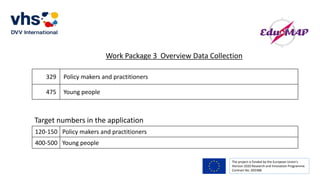
Work Package 3 Overview Data Collection
329 Policy makers and practitioners
475 Young people
Target numbers in the application
120-150 Policy makers and practitioners
400-500 Young people
Work Package 3
Part II: Findings (selected)
The project is funded by the European
Union’s Horizon 2020 Research and
Innovation Programme.
Contract No. 693388
The project is funded by the European Union’s
Horizon 2020 Research and Innovation Programme.
Contract No. 693388
Young people‘s experiences (vulnerabilities)
Young people give accounts of their experiences of specific life conditions which
create a lack of opportunities to secure their human rights. Young adults across the
40 EduMAP cases mention the lack of or having limited access to the following:
• formal qualifications; access to resources such as information, knowledge ,
political power and representation (exclusion); social capital including social
networks and connections.
They also mention
• inadequate beliefs, customs and attitudes in response to risk or disasters; poor
living conditions; frail physical and mental limits.
Young people‘s experiences (barriers)
Young people experience many barriers that prevent them from accessing and participating in
adult education. They mention for example:
• multilayered vulnerabilities ←→ creates low self-esteem and Class B citizen feeling
• discrimination and racism ←→ creates ‘akward’ situations and exclusion
• a lack of some basic goods or services or access to them ←→ creates stress in securing
them
• poor or difficult living conditions ←→ creates worries and inability to focus on learning
The project is funded by the European Union’s
Horizon 2020 Research and Innovation Programme.
Contract No. 693388
Young people‘s experiences (barriers)
• health problems ←→ creates mood swings and inability to follow studies
• lack of supportive environment ←→ creates struggles around motivations to learn
• negative experiences with formal learning ←→ creates the wish to disengage with learning
• Having to follow typical gender roles ←→ creates the pressure to conform or prove benefits
The project is funded by the European Union’s
Horizon 2020 Research and Innovation Programme.
Contract No. 693388
Young people‘s views (active citizenship)
 Having an image or role model to follow
 Being responsible for one’s own life
 Being autonomous and independent
 Being supportive and helpful towards others – friends and family
 Playing a role in the community or a wider peer group, contributing to change
 Being financially independent and working
 Having a sense of belonging
 Being politically active
 Young refugees and migrants are focused on language learning and employment
The project is funded by the European Union’s
Horizon 2020 Research and Innovation Programme.
Contract No. 693388
Policy makers‘ conceptions
Responses from policy makers in EduMAP cases are wide ranging, complex and
multifaceted . An emerging key issue is the difficulty in outlining a definition of
vulnerability that covers ALL specific needs and ALL young people at risk of social
exclusion
Three main challenges are visible:
1. Of only providing a limiting definition that fails to protect and address all young
people’s needs
2. Of stereotyping or ‘labelling’ and creating discrimination against specific groups
3. When there is lack of funding, the most vulnerable have to be identified
The project is funded by the European Union’s
Horizon 2020 Research and Innovation Programme.
Contract No. 693388
Policy makers‘ conceptions
Four main categories emerge from EduMAP field research:
• Vulnerability as state of social emergency ←→ individuals and
organisations without ‘a safety net’ that will essentially protect them in
case of for example social, natural, or war situations.
• Vulnerability as education and basic skills deficit ←→ the deficit is seen
mainly in the lack of access to and deficit in education and basic sills.
• Vulnerability as disempowerment ←→ exclusion of particular groups
from societal and political participation (refugees, migrants).
• Vulnerability as fault ←→ combined with structural racism and
discrimination in societies ‘fault’ is attributed to the individual. If the
individual does not comply, ‘punishment’ follows.
The project is funded by the European Union’s
Horizon 2020 Research and Innovation Programme.
Contract No. 693388
Programme elements contributing to fostering APC
Several elements emerge across the cases from EduMAP field research which
contribute as drivers for success
• A holistic and integrated social support and pedagogical approach, centred on
the learners and their specific and individual learning and support needs.
• A well trained, multidisciplinary education and support team or mediated
access to supportive services.
The project is funded by the European Union’s
Horizon 2020 Research and Innovation Programme.
Contract No. 693388
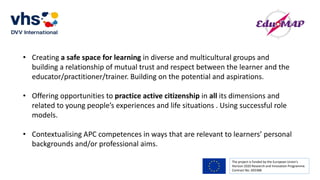
• Creating a safe space for learning in diverse and multicultural groups and
building a relationship of mutual trust and respect between the learner and the
educator/practitioner/trainer. Building on the potential and aspirations.
• Offering opportunities to practice active citizenship in all its dimensions and
related to young people’s experiences and life situations . Using successful role
models.
• Contextualising APC competences in ways that are relevant to learners’ personal
backgrounds and/or professional aims.
Work Package 3
Part III: Ways Forward (selected)
The project is funded by the European
Union’s Horizon 2020 Research and
Innovation Programme.
Contract No. 693388
Work Package 3 Ways forward
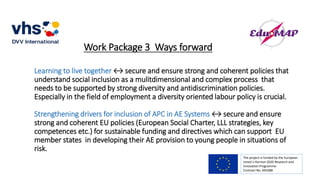
Learning to live together ↔ secure and ensure strong and coherent policies that
understand social inclusion as a mulitdimensional and complex process that
needs to be supported by strong diversity and antidiscrimination policies.
Especially in the field of employment a diversity oriented labour policy is crucial.
Strengthening drivers for inclusion of APC in AE Systems ↔ secure and ensure
strong and coherent EU policies (European Social Charter, LLL strategies, key
competences etc.) for sustainable funding and directives which can support EU
member states in developing their AE provision to young people in situations of
risk.
The project is funded by the European
Union’s Horizon 2020 Research and
Innovation Programme.
Contract No. 693388
Work Package 3 Ways forward
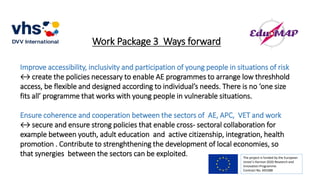
Improve accessibility, inclusivity and participation of young people in situations of risk
↔ create the policies necessary to enable AE programmes to arrange low threshhold
access, be flexible and designed according to individual’s needs. There is no ‘one size
fits all’ programme that works with young people in vulnerable situations.
Ensure coherence and cooperation between the sectors of AE, APC, VET and work
↔ secure and ensure strong policies that enable cross- sectoral collaboration for
example between youth, adult education and active citizenship, integration, health
promotion . Contribute to strenghthening the development of local economies, so
that synergies between the sectors can be exploited. The project is funded by the European
Union’s Horizon 2020 Research and
Innovation Programme.
Contract No. 693388
Lifelong Learning is a key instrument for employability but
above all for social inclusion and democratic participation,
personal development and well-being. People need to be given
fair opportunities to discover and nurture their talents.
Ministry for Education and Employment (2014b), Malta National Lifelong Learning Strategy 2020
The project is funded by the European
Union’s Horizon 2020 Research and
Innovation Programme.
Contract No. 693388

Targeted research on best practices among vulnerable groups (WP3)

  • 1.
    Work Package 3 Targetedresearch on best practices among vulnerable groups The project is funded by the European Union’s Horizon 2020 Research and Innovation Programme. Contract No. 693388 Dr. Beate Schmidt-Behlau
  • 2.
    Work Package 3 Contentof the presentation: Part I: Methodology and Sampling Part II: Findings (Selected) Part III: Ways Forward (Selected) The project is funded by the European Union’s Horizon 2020 Research and Innovation Programme. Contract No. 693388
  • 3.
    Work Package 3 PartI: Methodology and Sampling The project is funded by the European Union’s Horizon 2020 Research and Innovation Programme. Contract No. 693388
  • 4.
    The project isfunded by the European Union’s Horizon 2020 Research and Innovation Programme. Contract No. 693388 Work Package 3 Methodology The research design for WP 3 consists in three strands: Strand#1 Context analysis: deep context and validation for the identification of the educational programmes; exploration of accessibility for research purposes and negotiation of research access. Strand#2 Targeted research on selected cases: individual semi-structured interviews and focus groups among three categories of respondents: policy- makers; adult education practitioners and adult education participants (age range 16-30).
  • 5.
    The project isfunded by the European Union’s Horizon 2020 Research and Innovation Programme. Contract No. 693388 Work Package 3 Methodology The main research question for the field is formulated as: RQ1: What policies and practices are needed in the field of adult education to include young adults at risk of social exclusion in active participatory citizenship in Europe?
  • 6.
    The project isfunded by the European Union’s Horizon 2020 Research and Innovation Programme. Contract No. 693388 Work Package 3 Sampling Overview 40 Cases 20 Countries (Austria, Cyprus, Denmark, Estonia, Finland, France, Germany, Greece, Hungary, Ireland, Italy, Latvia, Malta, the Netherlands, Portugal, Romania, Spain, Sweden, the United Kingdom, and Turkey) 804 Informants (individual interviews and focus groups)
  • 7.
    The project isfunded by the European Union’s Horizon 2020 Research and Innovation Programme. Contract No. 693388 Work Package 3 Overview Data Collection 329 Policy makers and practitioners 475 Young people Target numbers in the application 120-150 Policy makers and practitioners 400-500 Young people
  • 8.
    Work Package 3 PartII: Findings (selected) The project is funded by the European Union’s Horizon 2020 Research and Innovation Programme. Contract No. 693388
  • 9.
    The project isfunded by the European Union’s Horizon 2020 Research and Innovation Programme. Contract No. 693388 Young people‘s experiences (vulnerabilities) Young people give accounts of their experiences of specific life conditions which create a lack of opportunities to secure their human rights. Young adults across the 40 EduMAP cases mention the lack of or having limited access to the following: • formal qualifications; access to resources such as information, knowledge , political power and representation (exclusion); social capital including social networks and connections. They also mention • inadequate beliefs, customs and attitudes in response to risk or disasters; poor living conditions; frail physical and mental limits.
  • 10.
    Young people‘s experiences(barriers) Young people experience many barriers that prevent them from accessing and participating in adult education. They mention for example: • multilayered vulnerabilities ←→ creates low self-esteem and Class B citizen feeling • discrimination and racism ←→ creates ‘akward’ situations and exclusion • a lack of some basic goods or services or access to them ←→ creates stress in securing them • poor or difficult living conditions ←→ creates worries and inability to focus on learning
  • 11.
    The project isfunded by the European Union’s Horizon 2020 Research and Innovation Programme. Contract No. 693388 Young people‘s experiences (barriers) • health problems ←→ creates mood swings and inability to follow studies • lack of supportive environment ←→ creates struggles around motivations to learn • negative experiences with formal learning ←→ creates the wish to disengage with learning • Having to follow typical gender roles ←→ creates the pressure to conform or prove benefits
  • 12.
    The project isfunded by the European Union’s Horizon 2020 Research and Innovation Programme. Contract No. 693388 Young people‘s views (active citizenship)  Having an image or role model to follow  Being responsible for one’s own life  Being autonomous and independent  Being supportive and helpful towards others – friends and family  Playing a role in the community or a wider peer group, contributing to change  Being financially independent and working  Having a sense of belonging  Being politically active  Young refugees and migrants are focused on language learning and employment
  • 13.
    The project isfunded by the European Union’s Horizon 2020 Research and Innovation Programme. Contract No. 693388 Policy makers‘ conceptions Responses from policy makers in EduMAP cases are wide ranging, complex and multifaceted . An emerging key issue is the difficulty in outlining a definition of vulnerability that covers ALL specific needs and ALL young people at risk of social exclusion Three main challenges are visible: 1. Of only providing a limiting definition that fails to protect and address all young people’s needs 2. Of stereotyping or ‘labelling’ and creating discrimination against specific groups 3. When there is lack of funding, the most vulnerable have to be identified
  • 14.
    The project isfunded by the European Union’s Horizon 2020 Research and Innovation Programme. Contract No. 693388 Policy makers‘ conceptions Four main categories emerge from EduMAP field research: • Vulnerability as state of social emergency ←→ individuals and organisations without ‘a safety net’ that will essentially protect them in case of for example social, natural, or war situations. • Vulnerability as education and basic skills deficit ←→ the deficit is seen mainly in the lack of access to and deficit in education and basic sills. • Vulnerability as disempowerment ←→ exclusion of particular groups from societal and political participation (refugees, migrants). • Vulnerability as fault ←→ combined with structural racism and discrimination in societies ‘fault’ is attributed to the individual. If the individual does not comply, ‘punishment’ follows.
  • 15.
    The project isfunded by the European Union’s Horizon 2020 Research and Innovation Programme. Contract No. 693388 Programme elements contributing to fostering APC Several elements emerge across the cases from EduMAP field research which contribute as drivers for success • A holistic and integrated social support and pedagogical approach, centred on the learners and their specific and individual learning and support needs. • A well trained, multidisciplinary education and support team or mediated access to supportive services.
  • 16.
    The project isfunded by the European Union’s Horizon 2020 Research and Innovation Programme. Contract No. 693388 • Creating a safe space for learning in diverse and multicultural groups and building a relationship of mutual trust and respect between the learner and the educator/practitioner/trainer. Building on the potential and aspirations. • Offering opportunities to practice active citizenship in all its dimensions and related to young people’s experiences and life situations . Using successful role models. • Contextualising APC competences in ways that are relevant to learners’ personal backgrounds and/or professional aims.
  • 17.
    Work Package 3 PartIII: Ways Forward (selected) The project is funded by the European Union’s Horizon 2020 Research and Innovation Programme. Contract No. 693388
  • 18.
    Work Package 3Ways forward Learning to live together ↔ secure and ensure strong and coherent policies that understand social inclusion as a mulitdimensional and complex process that needs to be supported by strong diversity and antidiscrimination policies. Especially in the field of employment a diversity oriented labour policy is crucial. Strengthening drivers for inclusion of APC in AE Systems ↔ secure and ensure strong and coherent EU policies (European Social Charter, LLL strategies, key competences etc.) for sustainable funding and directives which can support EU member states in developing their AE provision to young people in situations of risk. The project is funded by the European Union’s Horizon 2020 Research and Innovation Programme. Contract No. 693388
  • 19.
    Work Package 3Ways forward Improve accessibility, inclusivity and participation of young people in situations of risk ↔ create the policies necessary to enable AE programmes to arrange low threshhold access, be flexible and designed according to individual’s needs. There is no ‘one size fits all’ programme that works with young people in vulnerable situations. Ensure coherence and cooperation between the sectors of AE, APC, VET and work ↔ secure and ensure strong policies that enable cross- sectoral collaboration for example between youth, adult education and active citizenship, integration, health promotion . Contribute to strenghthening the development of local economies, so that synergies between the sectors can be exploited. The project is funded by the European Union’s Horizon 2020 Research and Innovation Programme. Contract No. 693388
  • 20.
    Lifelong Learning isa key instrument for employability but above all for social inclusion and democratic participation, personal development and well-being. People need to be given fair opportunities to discover and nurture their talents. Ministry for Education and Employment (2014b), Malta National Lifelong Learning Strategy 2020 The project is funded by the European Union’s Horizon 2020 Research and Innovation Programme. Contract No. 693388

Editor's Notes

  • #7 Result – rich qualitative insights which will be further exploited in working papers
  • #10 (e.g. weak housing structure, poor social protection, poor maintenance infrastructure, etc.)
  • #11 (e.g. weak housing structure, poor social protection, poor maintenance infrastructure, etc.)
  • #12 (e.g. weak housing structure, poor social protection, poor maintenance infrastructure, etc.)
  • #13 (e.g. weak housing structure, poor social protection, poor maintenance infrastructure, etc.)
  • #14 (e.g. weak housing structure, poor social protection, poor maintenance infrastructure, etc.)
  • #15 (e.g. weak housing structure, poor social protection, poor maintenance infrastructure, etc.)
  • #19 1 European societeis are multicultural, but still some policies and employers attitudes do not foster the idea of having support structures for inclusion in place: ‚ a young person has to be more Irish than the Irissh‘