CULTIVATION PRACTICES OF POINTED
GOURD
 Family : Cucurbitaceae
 Scientific name : Trichosanthes dioica roxb.
 Common name : Pointed Gourd (Parwal)
 Chromosome number: 2n = 24
 Native to India [ Indo-Malayan region]
Importances
 Immature fruits are popular vegetables. It contains 2% protein, 0.3%
fat, 2.2% carbohydrate, 29mg vitamins (per 100g) edible portion.
 For making curry, fried and pickles.
 Young leaves are very nutritious and are used as leafy vegetables.
 Recommendation for bronchitis, high fever and nervousness.
 Have diuretic and laxative properties and is light and easy to digest.
Introduction
Botany
 It is a perennial, dioecious cucurbit grown as vine.
Vines are pencil thick in size.
 Leaves are dark green, cordate, ovate, simple and
not lobed.
 Stems are generally 0.5 – 1 cm thick and have simple
tendrils.
 Flowers : Dioecious, tubular white
 Fruit is botanically called pepo.
 Fruits are small, round and thick, long, green with white stripes or green
with no stripes.
 Anthesis occurs at 6 – 9 pm.
 Pollen viable = 10 hrs. of before anther dehiscence and till the 49 hrs.
dehiscence.
 Stigma receptivity = 7 hrs. before anthesis and 2 days after anthesis.
Based on shape, size and striations fruits can be grouped into 5 categories:
 Long, dark green with white stripes
 Thick, dark green with very pale green stripes ; 10 – 16 cm long
 Roundish, dark green with white stripes, 5 – 8 cm long.
 Tapering, green and striped, 5 - 8 cm long.
Climatic Requirements
 Warm season crop, hot humid condition is best for growth
 Severe cold / frost are unfavorable for plant growth and
development
 Response well to rainfall
 Optimum temperature = 30 – 35°C
Soil
 It can be grown in both sandy and loamy soils
 Soil rich in OM and well drained
 pH = 6 – 6.5
 Commonly grown on river bed
 The crop does not grow well in heavy soil.
Varieties
Promising varieties:
 Swarna Alaukik, Swarna Rekha, Rajendra parwal-1, Rajendra parwal-
Faizabad parwal-1, Faizabad parwal-3, Faizabad parwal-4, Chess
hybrid-1, Chess hybrid-2
* Chess hybrid-1 : Resistant to fruit fly infestation
Planting requirement
 Propagated by vine and stem cuttings: Stem is made about 60cm long
one year fruiting vines of both male and female plants. Cuttings are
and kept in the nursery for root development. The cuttings are ready for
transplanting in about 2 -3 months.
 Fresh vines with 8 – 10 nodes per cuttings are suitable for field planting.
 Cuttings should be partially or fully defoliated to check transpiration.
 Propagation through root suckers can done if possible.
Time of planting
 Transplanting is done in the month of Bhadra – Kartik.
 Seed propagation is avoided due to poor germination and inability to
determine sex of the plants before flowering. As a result, crop established
from seed may contain 50% non fruiting male plants.
 Vine cuttings may be transplanted during August in uplands and in
November on river beds spaced at 2m x 2m. Vine cuttings are folded in the
shape of the ring and planted in pits, keeping the ends above the ground.
Also straight vine cuttings are planted in a furrow filled with FYM and soil,
keeping the cutting ends above ground.
 84 vine cuttings are required for 1 kattha area of which 10% should be
Cultivation Practices
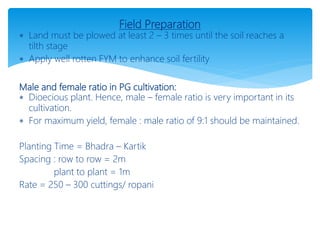
Field Preparation
 Land must be plowed at least 2 – 3 times until the soil reaches a
tilth stage
 Apply well rotten FYM to enhance soil fertility
Male and female ratio in PG cultivation:
 Dioecious plant. Hence, male – female ratio is very important in its
cultivation.
 For maximum yield, female : male ratio of 9:1 should be maintained.
Planting Time = Bhadra – Kartik
Spacing : row to row = 2m
plant to plant = 1m
Rate = 250 – 300 cuttings/ ropani
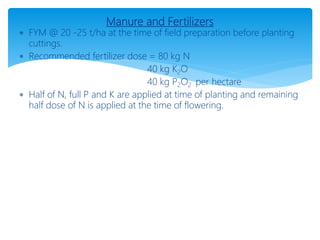
Manure and Fertilizers
 FYM @ 20 -25 t/ha at the time of field preparation before planting
cuttings.
 Recommended fertilizer dose = 80 kg N
40 kg K2O
40 kg P2O2 per hectare
 Half of N, full P and K are applied at time of planting and remaining
half dose of N is applied at the time of flowering.
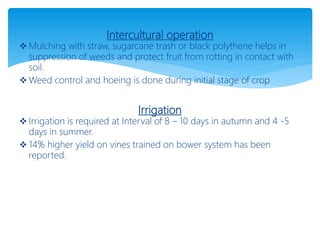
Intercultural operation
 Mulching with straw, sugarcane trash or black polythene helps in
suppression of weeds and protect fruit from rotting in contact with
soil.
 Weed control and hoeing is done during initial stage of crop
Irrigation
 Irrigation is required at Interval of 8 – 10 days in autumn and 4 -5
days in summer.
 14% higher yield on vines trained on bower system has been
reported.
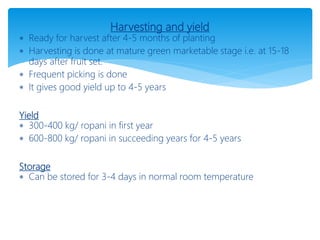
Harvesting and yield
 Ready for harvest after 4-5 months of planting
 Harvesting is done at mature green marketable stage i.e. at 15-18
days after fruit set.
 Frequent picking is done
 It gives good yield up to 4-5 years
Yield
 300-400 kg/ ropani in first year
 600-800 kg/ ropani in succeeding years for 4-5 years
Storage
 Can be stored for 3-4 days in normal room temperature
Problems
Pest
 Red bitter beetle
 Blister beetle
 Fruit flies
 Red pumpkin beetle
Disease
 Scorching of leaves
 Fruit rot
 Downy mildew
 Mosaic

Pointed gourd

  • 1.
  • 2.
     Family :Cucurbitaceae  Scientific name : Trichosanthes dioica roxb.  Common name : Pointed Gourd (Parwal)  Chromosome number: 2n = 24  Native to India [ Indo-Malayan region] Importances  Immature fruits are popular vegetables. It contains 2% protein, 0.3% fat, 2.2% carbohydrate, 29mg vitamins (per 100g) edible portion.  For making curry, fried and pickles.  Young leaves are very nutritious and are used as leafy vegetables.  Recommendation for bronchitis, high fever and nervousness.  Have diuretic and laxative properties and is light and easy to digest. Introduction
  • 3.
    Botany  It isa perennial, dioecious cucurbit grown as vine. Vines are pencil thick in size.  Leaves are dark green, cordate, ovate, simple and not lobed.  Stems are generally 0.5 – 1 cm thick and have simple tendrils.  Flowers : Dioecious, tubular white  Fruit is botanically called pepo.  Fruits are small, round and thick, long, green with white stripes or green with no stripes.  Anthesis occurs at 6 – 9 pm.  Pollen viable = 10 hrs. of before anther dehiscence and till the 49 hrs. dehiscence.  Stigma receptivity = 7 hrs. before anthesis and 2 days after anthesis. Based on shape, size and striations fruits can be grouped into 5 categories:  Long, dark green with white stripes  Thick, dark green with very pale green stripes ; 10 – 16 cm long  Roundish, dark green with white stripes, 5 – 8 cm long.  Tapering, green and striped, 5 - 8 cm long.
  • 4.
    Climatic Requirements  Warmseason crop, hot humid condition is best for growth  Severe cold / frost are unfavorable for plant growth and development  Response well to rainfall  Optimum temperature = 30 – 35°C Soil  It can be grown in both sandy and loamy soils  Soil rich in OM and well drained  pH = 6 – 6.5  Commonly grown on river bed  The crop does not grow well in heavy soil.
  • 5.
    Varieties Promising varieties:  SwarnaAlaukik, Swarna Rekha, Rajendra parwal-1, Rajendra parwal- Faizabad parwal-1, Faizabad parwal-3, Faizabad parwal-4, Chess hybrid-1, Chess hybrid-2 * Chess hybrid-1 : Resistant to fruit fly infestation
  • 6.
    Planting requirement  Propagatedby vine and stem cuttings: Stem is made about 60cm long one year fruiting vines of both male and female plants. Cuttings are and kept in the nursery for root development. The cuttings are ready for transplanting in about 2 -3 months.  Fresh vines with 8 – 10 nodes per cuttings are suitable for field planting.  Cuttings should be partially or fully defoliated to check transpiration.  Propagation through root suckers can done if possible. Time of planting  Transplanting is done in the month of Bhadra – Kartik.  Seed propagation is avoided due to poor germination and inability to determine sex of the plants before flowering. As a result, crop established from seed may contain 50% non fruiting male plants.  Vine cuttings may be transplanted during August in uplands and in November on river beds spaced at 2m x 2m. Vine cuttings are folded in the shape of the ring and planted in pits, keeping the ends above the ground. Also straight vine cuttings are planted in a furrow filled with FYM and soil, keeping the cutting ends above ground.  84 vine cuttings are required for 1 kattha area of which 10% should be Cultivation Practices
  • 7.
    Field Preparation  Landmust be plowed at least 2 – 3 times until the soil reaches a tilth stage  Apply well rotten FYM to enhance soil fertility Male and female ratio in PG cultivation:  Dioecious plant. Hence, male – female ratio is very important in its cultivation.  For maximum yield, female : male ratio of 9:1 should be maintained. Planting Time = Bhadra – Kartik Spacing : row to row = 2m plant to plant = 1m Rate = 250 – 300 cuttings/ ropani
  • 8.
    Manure and Fertilizers FYM @ 20 -25 t/ha at the time of field preparation before planting cuttings.  Recommended fertilizer dose = 80 kg N 40 kg K2O 40 kg P2O2 per hectare  Half of N, full P and K are applied at time of planting and remaining half dose of N is applied at the time of flowering.
  • 9.
    Intercultural operation  Mulchingwith straw, sugarcane trash or black polythene helps in suppression of weeds and protect fruit from rotting in contact with soil.  Weed control and hoeing is done during initial stage of crop Irrigation  Irrigation is required at Interval of 8 – 10 days in autumn and 4 -5 days in summer.  14% higher yield on vines trained on bower system has been reported.
  • 10.
    Harvesting and yield Ready for harvest after 4-5 months of planting  Harvesting is done at mature green marketable stage i.e. at 15-18 days after fruit set.  Frequent picking is done  It gives good yield up to 4-5 years Yield  300-400 kg/ ropani in first year  600-800 kg/ ropani in succeeding years for 4-5 years Storage  Can be stored for 3-4 days in normal room temperature
  • 11.
    Problems Pest  Red bitterbeetle  Blister beetle  Fruit flies  Red pumpkin beetle Disease  Scorching of leaves  Fruit rot  Downy mildew  Mosaic