1
Commercial Carrier Journal
Spring Symposium
May 19, 2015
FMCSA Regulatory Update
Jack Van Steenburg
Assistant Administrator
And Chief Safety Officer
Federal Motor Carrier Safety Administration
Our Mission
Placing safety as
our highest priority:
Prevent crashes, injuries, and fatalities
involving CMV transportation through
education, innovation, regulation,
enforcement, financial assistance,
partnerships, and
full accountability
2
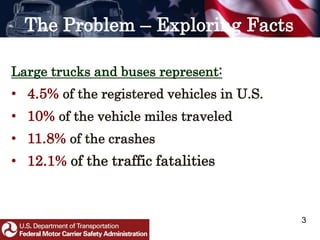
The Problem – Exploring Facts
Large trucks and buses represent:
• 4.5% of the registered vehicles in U.S.
• 10% of the vehicle miles traveled
• 11.8% of the crashes
• 12.1% of the traffic fatalities
3
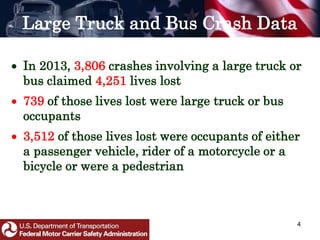
Large Truck and Bus Crash Data
ď‚· In 2013, 3,806 crashes involving a large truck or
bus claimed 4,251 lives lost
ď‚· 739 of those lives lost were large truck or bus
occupants
ď‚· 3,512 of those lives lost were occupants of either
a passenger vehicle, rider of a motorcycle or a
bicycle or were a pedestrian
4
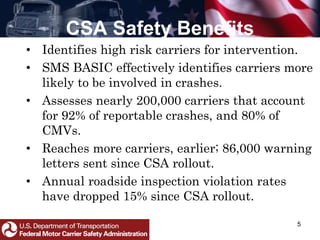
CSA Safety Benefits
• Identifies high risk carriers for intervention.
• SMS BASIC effectively identifies carriers more
likely to be involved in crashes.
• Assesses nearly 200,000 carriers that account
for 92% of reportable crashes, and 80% of
CMVs.
• Reaches more carriers, earlier; 86,000 warning
letters sent since CSA rollout.
• Annual roadside inspection violation rates
have dropped 15% since CSA rollout.
5
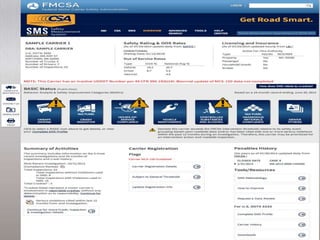
SMS Display Page
6
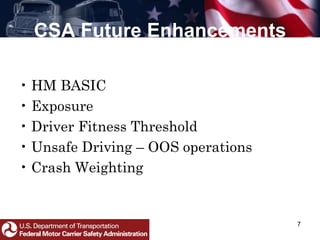
CSA Future Enhancements
• HM BASIC
• Exposure
• Driver Fitness Threshold
• Unsafe Driving – OOS operations
• Crash Weighting
7
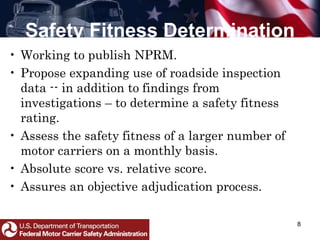
Safety Fitness Determination
8
• Working to publish NPRM.
• Propose expanding use of roadside inspection
data -- in addition to findings from
investigations – to determine a safety fitness
rating.
• Assess the safety fitness of a larger number of
motor carriers on a monthly basis.
• Absolute score vs. relative score.
• Assures an objective adjudication process.
Hours of Service
• A naturalistic study comparing impacts of
restart provisions before and after July 1, 2013.
• Drivers from fleets of all sizes, operations, and
industry sectors.
• Led by Virginia Tech Transportation Institute
and leading experts on fatigue.
• OIG oversight and independent peer review.
9
Electronic Logging Devices
10
Final Rule to be published in 2015. Benefits
include:
• Cut paperwork and save money
• Easier to review driver hours-of-service (HOS)
records
• Protect drivers from harassment
• By improving hours of service compliance,
ELDs are estimated to prevent about 20
fatalities and over 400 injuries each year.
Coercion Rule
11
Working to publish a Coercion Final Rule later
this year.
• Prohibit carriers, shippers, receivers and
transportation intermediaries from pressuring
drivers into violating FMCSA regulations.
• Includes procedures for reporting incidents of
coercion.
• Sets rules of practice FMCSA to handle
allegations.
Other Regulatory Matters
12
• Entry Level Driver Training.
• Drug and Alcohol Clearinghouse.
• National Registry of Certified Medical
Examiners
• Financial Responsibility
Thinking Outside the Box
• Driver Recognition
– ATA has helped champion this initiative
– The poster will hang at USDOT HQ.
• Beyond Compliance
– What are the technologies?
– What are the incentives to carriers?
– How to monitor compliance?
13
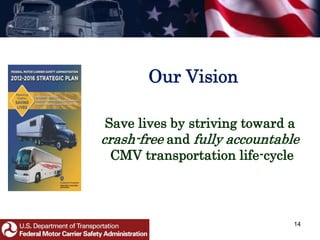
Our Vision
Save lives by striving toward a
crash-free and fully accountable
CMV transportation life-cycle
14
www.fmcsa.dot.gov
john.vansteenburg@dot.gov
15

Point counterpoint van steenburg ccj spring 2015

  • 1.
    1 Commercial Carrier Journal SpringSymposium May 19, 2015 FMCSA Regulatory Update Jack Van Steenburg Assistant Administrator And Chief Safety Officer Federal Motor Carrier Safety Administration
  • 2.
    Our Mission Placing safetyas our highest priority: Prevent crashes, injuries, and fatalities involving CMV transportation through education, innovation, regulation, enforcement, financial assistance, partnerships, and full accountability 2
  • 3.
    The Problem –Exploring Facts Large trucks and buses represent: • 4.5% of the registered vehicles in U.S. • 10% of the vehicle miles traveled • 11.8% of the crashes • 12.1% of the traffic fatalities 3
  • 4.
    Large Truck andBus Crash Data ď‚· In 2013, 3,806 crashes involving a large truck or bus claimed 4,251 lives lost ď‚· 739 of those lives lost were large truck or bus occupants ď‚· 3,512 of those lives lost were occupants of either a passenger vehicle, rider of a motorcycle or a bicycle or were a pedestrian 4
  • 5.
    CSA Safety Benefits •Identifies high risk carriers for intervention. • SMS BASIC effectively identifies carriers more likely to be involved in crashes. • Assesses nearly 200,000 carriers that account for 92% of reportable crashes, and 80% of CMVs. • Reaches more carriers, earlier; 86,000 warning letters sent since CSA rollout. • Annual roadside inspection violation rates have dropped 15% since CSA rollout. 5
  • 6.
  • 7.
    CSA Future Enhancements •HM BASIC • Exposure • Driver Fitness Threshold • Unsafe Driving – OOS operations • Crash Weighting 7
  • 8.
    Safety Fitness Determination 8 •Working to publish NPRM. • Propose expanding use of roadside inspection data -- in addition to findings from investigations – to determine a safety fitness rating. • Assess the safety fitness of a larger number of motor carriers on a monthly basis. • Absolute score vs. relative score. • Assures an objective adjudication process.
  • 9.
    Hours of Service •A naturalistic study comparing impacts of restart provisions before and after July 1, 2013. • Drivers from fleets of all sizes, operations, and industry sectors. • Led by Virginia Tech Transportation Institute and leading experts on fatigue. • OIG oversight and independent peer review. 9
  • 10.
    Electronic Logging Devices 10 FinalRule to be published in 2015. Benefits include: • Cut paperwork and save money • Easier to review driver hours-of-service (HOS) records • Protect drivers from harassment • By improving hours of service compliance, ELDs are estimated to prevent about 20 fatalities and over 400 injuries each year.
  • 11.
    Coercion Rule 11 Working topublish a Coercion Final Rule later this year. • Prohibit carriers, shippers, receivers and transportation intermediaries from pressuring drivers into violating FMCSA regulations. • Includes procedures for reporting incidents of coercion. • Sets rules of practice FMCSA to handle allegations.
  • 12.
    Other Regulatory Matters 12 •Entry Level Driver Training. • Drug and Alcohol Clearinghouse. • National Registry of Certified Medical Examiners • Financial Responsibility
  • 13.
    Thinking Outside theBox • Driver Recognition – ATA has helped champion this initiative – The poster will hang at USDOT HQ. • Beyond Compliance – What are the technologies? – What are the incentives to carriers? – How to monitor compliance? 13
  • 14.
    Our Vision Save livesby striving toward a crash-free and fully accountable CMV transportation life-cycle 14
  • 15.