Minimizing Violations at 
Roadside Inspections 
Steve Keppler 
Executive Director 
Commercial Vehicle Safety Alliance
#CCJSymp 
About CVSA 
• A non-profit 501(c)(3) trade association 
– 70 Members, 470 Associate Members, 25 Local Members 
– Began at industry’s urging in 1980 with several western States and Canadian 
provinces 
• Why was it initiated? 
– Safety was a concern ------ deregulation 
– Need for uniformity and reciprocity in regulation, standards, and enforcement 
• How does it work? 
– Support from public and private sectors critical 
– All CMV disciplines at the table and involved in setting and maintaining the 
standards 
– Focused agenda, clear expectations and results 
– Open the doors from the get-go 
– Processes and procedures for input and output are explicit and inclusive
Special Committees 
• Driver/Traffic Enforcement 
• Hazardous Materials 
• Information Systems 
• Passenger Carrier 
• COHMED 
• NAIC 
• Level VI 
#CCJSymp 
• Program Initiatives 
• Size and Weight 
• Training 
• Vehicle 
• Operation Safe Driver 
• Operation Air Brake 
• Roadcheck 
• International Driver 
Excellence Award 
Programs
CVSA also works strategically 
• Principal North America federal agencies are at the 
table and engaged in the dialogue 
– FMCSA, FHWA, PHMSA, NHTSA, RITA, TSA, DOE (US) 
– Transport Canada, CCMTA (Canada) 
– SCT, Federal Police (Mexico) 
• US Congress 
– Government Affairs 
– Legislative activity 
– Testify at hearings 
• Association of Associations 
• Industry has a seat at the table and has a voice 
#CCJSymp
CMV Safety -- Unique relationships 
• Federal/State/Provincial relationships 
– MCSAP in U.S. 
• $218M (FY2014) --- $8M in 1984 
– Additional $95M in other state grants 
• 20% (minimum) State match 
– Many states put in MUCH more of their own $$ 
– Provincial-centric in Canada 
– Federal focus in Mexico 
• Varying agencies in States (US) have responsibility 
– “Lead Agency” coordinates 
#CCJSymp
Motor Carrier Safety Assistance 
#CCJSymp 
Program 
• Bulk of MCSAP $$ is Formula Based 
– Several state grants are competitive 
– Border, New Entrant, High Priority, CDLPI, SaDIP, PRISM, CVISN 
• State has to produce an Annual Commercial Vehicle Safety 
Plan. 
– 49 CFR Part 350 
– Reviewed and approved by FMCSA 
• Performance-based and data-driven. 
• MCSAP Program Elements 
– Driver/Vehicle Inspections, Traffic Enforcement, Compliance 
Reviews, Public Education and Awareness, Data Collection
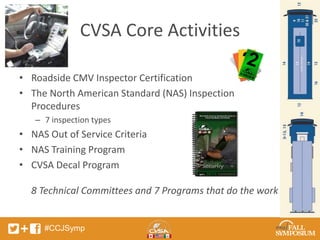
CVSA Core Activities 
• Roadside CMV Inspector Certification 
• The North American Standard (NAS) Inspection 
Procedures 
– 7 inspection types 
• NAS Out of Service Criteria 
• NAS Training Program 
• CVSA Decal Program 
8 Technical Committees and 7 Programs that do the work 
#CCJSymp
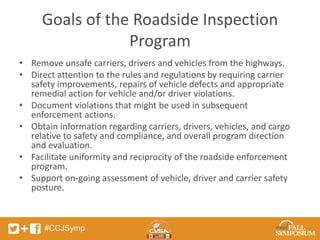
Goals of the Roadside Inspection 
#CCJSymp 
Program 
• Remove unsafe carriers, drivers and vehicles from the highways. 
• Direct attention to the rules and regulations by requiring carrier 
safety improvements, repairs of vehicle defects and appropriate 
remedial action for vehicle and/or driver violations. 
• Document violations that might be used in subsequent 
enforcement actions. 
• Obtain information regarding carriers, drivers, vehicles, and cargo 
relative to safety and compliance, and overall program direction 
and evaluation. 
• Facilitate uniformity and reciprocity of the roadside enforcement 
program. 
• Support on-going assessment of vehicle, driver and carrier safety 
posture.
#CCJSymp 
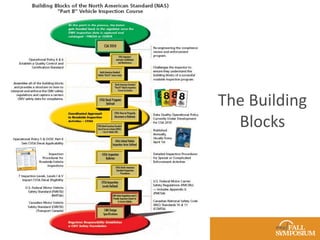
The Building 
Blocks
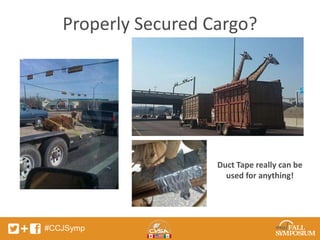
Properly Secured Cargo? 
#CCJSymp 
Duct Tape really can be 
used for anything!
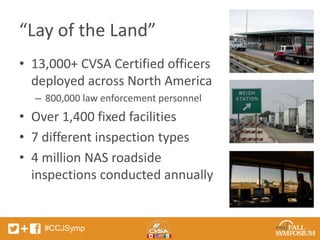
“Lay of the Land” 
• 13,000+ CVSA Certified officers 
deployed across North America 
– 800,000 law enforcement personnel 
• Over 1,400 fixed facilities 
• 7 different inspection types 
• 4 million NAS roadside 
inspections conducted annually 
#CCJSymp
#CCJSymp 
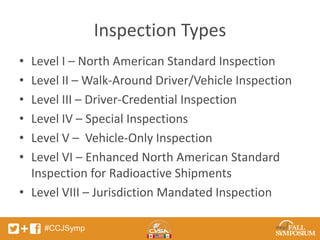
Inspection Types 
• Level I – North American Standard Inspection 
• Level II – Walk-Around Driver/Vehicle Inspection 
• Level III – Driver-Credential Inspection 
• Level IV – Special Inspections 
• Level V – Vehicle-Only Inspection 
• Level VI – Enhanced North American Standard 
Inspection for Radioactive Shipments 
• Level VIII – Jurisdiction Mandated Inspection
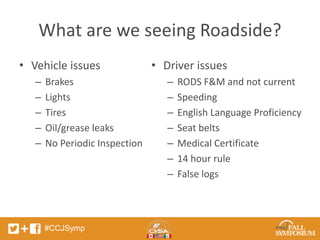
What are we seeing Roadside? 
• Vehicle issues 
– Brakes 
– Lights 
– Tires 
– Oil/grease leaks 
– No Periodic Inspection 
#CCJSymp 
• Driver issues 
– RODS F&M and not current 
– Speeding 
– English Language Proficiency 
– Seat belts 
– Medical Certificate 
– 14 hour rule 
– False logs
#CCJSymp 
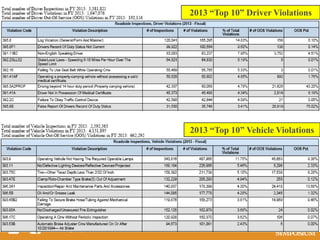
2013 “Top 10” Driver Violations 
2013 “Top 10” Vehicle Violations
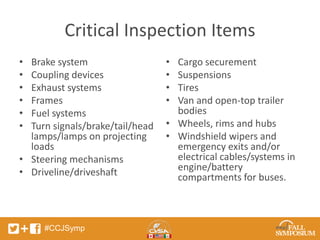
Critical Inspection Items 
• Brake system 
• Coupling devices 
• Exhaust systems 
• Frames 
• Fuel systems 
• Turn signals/brake/tail/head 
lamps/lamps on projecting 
loads 
• Steering mechanisms 
• Driveline/driveshaft 
#CCJSymp 
• Cargo securement 
• Suspensions 
• Tires 
• Van and open-top trailer 
bodies 
• Wheels, rims and hubs 
• Windshield wipers and 
emergency exits and/or 
electrical cables/systems in 
engine/battery 
compartments for buses.
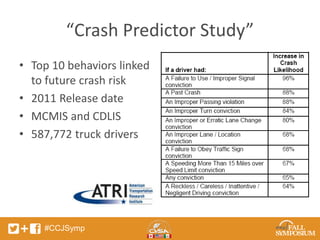
“Crash Predictor Study” 
• Top 10 behaviors linked 
to future crash risk 
• 2011 Release date 
• MCMIS and CDLIS 
• 587,772 truck drivers 
#CCJSymp
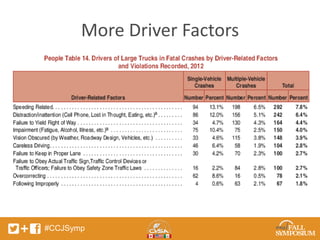
More Driver Factors 
#CCJSymp
#CCJSymp 
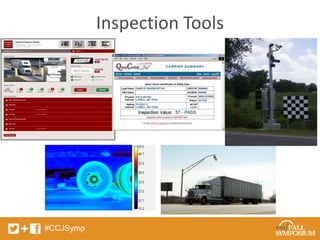
Inspection Tools
#CCJSymp
Why Should You Care? 
– Safety is everyone’s responsibility 
– There is a connection between safety and 
profitability 
– Driver and employee quality of life and retention 
– CSA and Interventions 
– Insurance and Business impacts 
– The Tortise and the Hare 
– View safety is an investment, not a cost 
• Make it a habit and not a fad 
#CCJSymp
Enforcement Works 
• Intervention Model measures the effectiveness of roadside 
inspections and traffic enforcement activities. 
– http://ai.fmcsa.dot.gov/pe/IRModelPg.aspx 
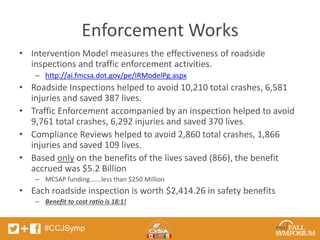
• Roadside Inspections helped to avoid 10,210 total crashes, 6,581 
injuries and saved 387 lives. 
• Traffic Enforcement accompanied by an inspection helped to avoid 
9,761 total crashes, 6,292 injuries and saved 370 lives. 
• Compliance Reviews helped to avoid 2,860 total crashes, 1,866 
injuries and saved 109 lives. 
• Based only on the benefits of the lives saved (866), the benefit 
accrued was $5.2 Billion 
– MCSAP funding…….less than $250 Million 
• Each roadside inspection is worth $2,414.26 in safety benefits 
– Benefit to cost ratio is 18:1! 
#CCJSymp
Thanks and 
come join us! 
– CVSA Workshop 
• April 12-16, 2015 
• Jacksonville, FL 
– Contact info 
• www.cvsa.org 
• 301-830-6143 
#CCJSymp

Steve Keppler - Minimizing Roadside Inspections

  • 1.
    Minimizing Violations at Roadside Inspections Steve Keppler Executive Director Commercial Vehicle Safety Alliance
  • 2.
    #CCJSymp About CVSA • A non-profit 501(c)(3) trade association – 70 Members, 470 Associate Members, 25 Local Members – Began at industry’s urging in 1980 with several western States and Canadian provinces • Why was it initiated? – Safety was a concern ------ deregulation – Need for uniformity and reciprocity in regulation, standards, and enforcement • How does it work? – Support from public and private sectors critical – All CMV disciplines at the table and involved in setting and maintaining the standards – Focused agenda, clear expectations and results – Open the doors from the get-go – Processes and procedures for input and output are explicit and inclusive
  • 3.
    Special Committees •Driver/Traffic Enforcement • Hazardous Materials • Information Systems • Passenger Carrier • COHMED • NAIC • Level VI #CCJSymp • Program Initiatives • Size and Weight • Training • Vehicle • Operation Safe Driver • Operation Air Brake • Roadcheck • International Driver Excellence Award Programs
  • 4.
    CVSA also worksstrategically • Principal North America federal agencies are at the table and engaged in the dialogue – FMCSA, FHWA, PHMSA, NHTSA, RITA, TSA, DOE (US) – Transport Canada, CCMTA (Canada) – SCT, Federal Police (Mexico) • US Congress – Government Affairs – Legislative activity – Testify at hearings • Association of Associations • Industry has a seat at the table and has a voice #CCJSymp
  • 5.
    CMV Safety --Unique relationships • Federal/State/Provincial relationships – MCSAP in U.S. • $218M (FY2014) --- $8M in 1984 – Additional $95M in other state grants • 20% (minimum) State match – Many states put in MUCH more of their own $$ – Provincial-centric in Canada – Federal focus in Mexico • Varying agencies in States (US) have responsibility – “Lead Agency” coordinates #CCJSymp
  • 6.
    Motor Carrier SafetyAssistance #CCJSymp Program • Bulk of MCSAP $$ is Formula Based – Several state grants are competitive – Border, New Entrant, High Priority, CDLPI, SaDIP, PRISM, CVISN • State has to produce an Annual Commercial Vehicle Safety Plan. – 49 CFR Part 350 – Reviewed and approved by FMCSA • Performance-based and data-driven. • MCSAP Program Elements – Driver/Vehicle Inspections, Traffic Enforcement, Compliance Reviews, Public Education and Awareness, Data Collection
  • 7.
    CVSA Core Activities • Roadside CMV Inspector Certification • The North American Standard (NAS) Inspection Procedures – 7 inspection types • NAS Out of Service Criteria • NAS Training Program • CVSA Decal Program 8 Technical Committees and 7 Programs that do the work #CCJSymp
  • 8.
    Goals of theRoadside Inspection #CCJSymp Program • Remove unsafe carriers, drivers and vehicles from the highways. • Direct attention to the rules and regulations by requiring carrier safety improvements, repairs of vehicle defects and appropriate remedial action for vehicle and/or driver violations. • Document violations that might be used in subsequent enforcement actions. • Obtain information regarding carriers, drivers, vehicles, and cargo relative to safety and compliance, and overall program direction and evaluation. • Facilitate uniformity and reciprocity of the roadside enforcement program. • Support on-going assessment of vehicle, driver and carrier safety posture.
  • 9.
  • 10.
    Properly Secured Cargo? #CCJSymp Duct Tape really can be used for anything!
  • 11.
    “Lay of theLand” • 13,000+ CVSA Certified officers deployed across North America – 800,000 law enforcement personnel • Over 1,400 fixed facilities • 7 different inspection types • 4 million NAS roadside inspections conducted annually #CCJSymp
  • 12.
    #CCJSymp Inspection Types • Level I – North American Standard Inspection • Level II – Walk-Around Driver/Vehicle Inspection • Level III – Driver-Credential Inspection • Level IV – Special Inspections • Level V – Vehicle-Only Inspection • Level VI – Enhanced North American Standard Inspection for Radioactive Shipments • Level VIII – Jurisdiction Mandated Inspection
  • 13.
    What are weseeing Roadside? • Vehicle issues – Brakes – Lights – Tires – Oil/grease leaks – No Periodic Inspection #CCJSymp • Driver issues – RODS F&M and not current – Speeding – English Language Proficiency – Seat belts – Medical Certificate – 14 hour rule – False logs
  • 14.
    #CCJSymp 2013 “Top10” Driver Violations 2013 “Top 10” Vehicle Violations
  • 15.
    Critical Inspection Items • Brake system • Coupling devices • Exhaust systems • Frames • Fuel systems • Turn signals/brake/tail/head lamps/lamps on projecting loads • Steering mechanisms • Driveline/driveshaft #CCJSymp • Cargo securement • Suspensions • Tires • Van and open-top trailer bodies • Wheels, rims and hubs • Windshield wipers and emergency exits and/or electrical cables/systems in engine/battery compartments for buses.
  • 16.
    “Crash Predictor Study” • Top 10 behaviors linked to future crash risk • 2011 Release date • MCMIS and CDLIS • 587,772 truck drivers #CCJSymp
  • 17.
  • 18.
  • 19.
  • 20.
    Why Should YouCare? – Safety is everyone’s responsibility – There is a connection between safety and profitability – Driver and employee quality of life and retention – CSA and Interventions – Insurance and Business impacts – The Tortise and the Hare – View safety is an investment, not a cost • Make it a habit and not a fad #CCJSymp
  • 21.
    Enforcement Works •Intervention Model measures the effectiveness of roadside inspections and traffic enforcement activities. – http://ai.fmcsa.dot.gov/pe/IRModelPg.aspx • Roadside Inspections helped to avoid 10,210 total crashes, 6,581 injuries and saved 387 lives. • Traffic Enforcement accompanied by an inspection helped to avoid 9,761 total crashes, 6,292 injuries and saved 370 lives. • Compliance Reviews helped to avoid 2,860 total crashes, 1,866 injuries and saved 109 lives. • Based only on the benefits of the lives saved (866), the benefit accrued was $5.2 Billion – MCSAP funding…….less than $250 Million • Each roadside inspection is worth $2,414.26 in safety benefits – Benefit to cost ratio is 18:1! #CCJSymp
  • 22.
    Thanks and comejoin us! – CVSA Workshop • April 12-16, 2015 • Jacksonville, FL – Contact info • www.cvsa.org • 301-830-6143 #CCJSymp