Of Mice and Men
Themes and Crooks
      Free Powerpoint Templates
                                  Page 1
TITLE: Themes


Learning Objectives
 We are learning to...
 • Consider the themes that emerge
   from the text
 • Analyse text for meaning
 Skills for Life: Questioning –
   how and why?
     Free Powerpoint Templates
                                 Page 2
Theme
The theme of a piece of fiction is
  its view about life and how
  people behave.
In fiction, the theme is not
  intended to teach or preach. In
  fact, it is not presented directly
  at all. You extract it from the
  characters, action, and setting
  that make up the story. The
  reader must figure out the
      Free Powerpoint Templates
  themes themselves.            Page 3
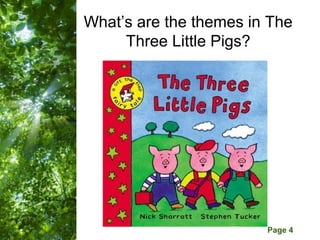
What’s are the themes in The
     Three Little Pigs?


    Free Powerpoint Templates
                                Page 4
Steinbeck Diary 1938

In every bit of honest writing in the
  world there is a base theme. Try
  to understand men, [for] if you
  understand each other you will
  be kind to each other. Knowing
  a man well never leads to hate
  and nearly always leads to love.


      Free Powerpoint Templates
                                  Page 5
What are the themes in
          OMAM?
• Dreams (and the fragility of the
  American Dream)
• Friendship
• Loneliness
• The natural world
• Weakness
• The cycle of hopelessness
• Prejudice
• And others...Templates
     Free Powerpoint
                             Page 6
What are the themes in
            OMAM?
• Dreams (and the fragility of the
  American Dream)
• Friendship
• Loneliness
•   The natural world
•   Weakness
•   The cycle of hopelessness
•   Prejudice
      Free Powerpoint Templates
•   And others...               Page 7
Loneliness and Crooks


How does Steinbeck present
 Crooks as a lonely character?


     Free Powerpoint Templates
                                 Page 8
TASK: Find quote and analyse
 them using TEPEE


     Free Powerpoint Templates
                                 Page 9
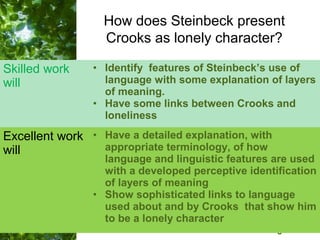
How does Steinbeck present
                  Crooks as lonely character?

Skilled work   6 sections – perfect!
                • Identify features of Steinbeck’s use of
will              language with some explanation of layers
                  of meaning.
                • Have some links between Crooks and
                  loneliness

Excellent work • Have a detailed explanation, with
will             appropriate terminology, of how
                  language and linguistic features are used
                  with a developed perceptive identification
                  of layers of meaning
                • Show sophisticated links to language
                  used about and by Crooks that show him
                  to be a lonely character
                     Free Powerpoint Templates
                                                  Page 10
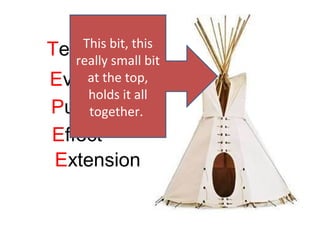
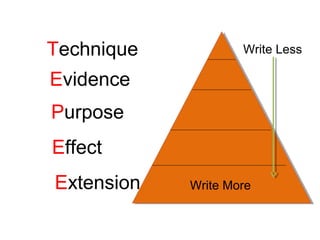
This bit, this
Technique bit
   really small
Evidence
     at the top,
     holds it all
Purpose
     together.
Effect
Extension
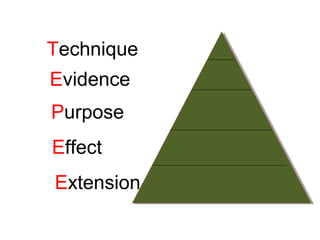
Technique
Evidence
Purpose
Effect
Extension
Technique           Write Less

Evidence
Purpose
Effect
Extension   Write More
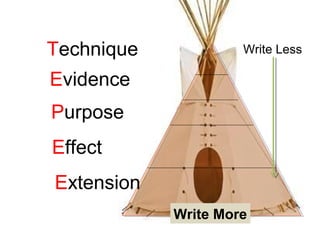
Technique            Write Less

Evidence
Purpose
Effect
Extension
            Write More
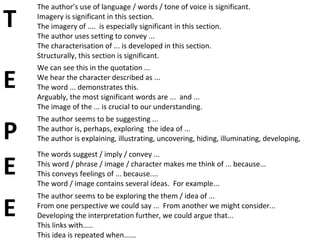
The author’s use of language / words / tone of voice is significant.

T   Imagery is significant in this section.
    The imagery of .... is especially significant in this section.
    The author uses setting to convey ...
    The characterisation of ... is developed in this section.
    Structurally, this section is significant.
    We can see this in the quotation ...

E   We hear the character described as ...
    The word ... demonstrates this.
    Arguably, the most significant words are ... and ...
    The image of the ... is crucial to our understanding.
    The author seems to be suggesting ...

P   The author is, perhaps, exploring the idea of ...
    The author is explaining, illustrating, uncovering, hiding, illuminating, developing,
    The words suggest / imply / convey ...

E   This word / phrase / image / character makes me think of ... because...
    This conveys feelings of ... because....
    The word / image contains several ideas. For example...
    The author seems to be exploring the them / idea of ...

E   From one perspective we could say ... From another we might consider...
    Developing the interpretation further, we could argue that...
    This links with.....
    This idea is repeated when......
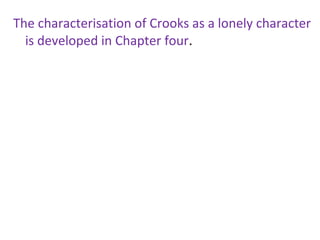
The characterisation of Crooks as a lonely character
  is developed in Chapter four.
The characterisation of Crooks as a lonely character
  is developed in Chapter four. Steinbeck describes
  the character as ‘a proud, aloof man. He kept his
  distance and demanded that other people keep
  theirs.’
The characterisation of Crooks as a lonely character
  is developed in Chapter four. Steinbeck describes
  the character as ‘a proud, aloof man. He kept his
  distance and demanded that other people keep
  theirs.’ The author seems to be suggesting that
  Crooks’ isolation is self-imposed.
The characterisation of Crooks as a lonely character
  is developed in Chapter four. Steinbeck describes
  the character as ‘a proud, aloof man. He kept his
  distance and demanded that other people keep
  theirs.’ The author seems to be suggesting that
  Crooks’ isolation is self-imposed. The word
  ‘proud’ suggests Crooks’ intelligence and dignity
  and conveys the idea that he is acutely aware of
  his prejudicial treatment. ‘Aloof’ also suggests
  that his disinterest is conspicuous.
The characterisation of Crooks as a lonely character is
  developed in Chapter four. Steinbeck describes the
  character as ‘a proud, aloof man. He kept his distance
  and demanded that other people keep theirs.’ The
  author seems to be suggesting that Crooks’ isolation
  is self-imposed. The word ‘proud’ suggests Crooks’
  intelligence and dignity and conveys the idea that he
  is acutely aware of his prejudicial treatment. ‘Aloof’
  also suggests that his disinterest is conspicuous. The
  author seems to be exploring the idea that loneliness
  can be a way of protection and this real danger is
  made more obvious later in the chapter when
  Curley’s wife threatens him.
How does Steinbeck present Crooks
                         as lonely character?

Skilled work will 6• sectionsfeatures of Steinbeck’s use of
                      Identify – perfect!
                     language with some explanation of layers of
                     meaning.
                   • Have some links between Crooks and loneliness
Excellent work     • Have a detailed explanation, with appropriate
will                 terminology, of how language and linguistic
                     features are used with a develop perceptive
                     identification of layers of meaning
                   • Show sophisticated links to language used
                     about and by Crooks that show him to be a
                     lonely character
Crooks’ bleak view...
I seen hundreds of men come by on
  the road an’ on the ranches, with
  their bindles on their back an’ that
  same damn thing in their heads . . .
  every damn one of ’em’s got a little
  piece of land in his head. An’ never
  a God damn one of ’em ever gets it.
  Just like heaven. Ever’body wants a
  little piece of lan’. I read plenty of
  books out here. Nobody never gets
  to heaven, and nobody gets no
  land. Powerpoint Templates
        Free
                                  Page 22
The imagery of Crooks as a disabled man is
  especially significant in this section. We can
  see this when the character described as ‘his
  body was bent to the left by his crooked
  spine’. This gives a clear image of Crooks as a
  disabled man, but Steinbeck could be
  suggesting that Crooks’ prejudicial treatment
  disables him. His name, Crooks, emphasises
  this.

4 Crooks

  • 1.
    Of Mice andMen Themes and Crooks Free Powerpoint Templates Page 1
  • 2.
    TITLE: Themes Learning Objectives We are learning to... • Consider the themes that emerge from the text • Analyse text for meaning Skills for Life: Questioning – how and why? Free Powerpoint Templates Page 2
  • 3.
    Theme The theme ofa piece of fiction is its view about life and how people behave. In fiction, the theme is not intended to teach or preach. In fact, it is not presented directly at all. You extract it from the characters, action, and setting that make up the story. The reader must figure out the Free Powerpoint Templates themes themselves. Page 3
  • 4.
    What’s are thethemes in The Three Little Pigs? Free Powerpoint Templates Page 4
  • 5.
    Steinbeck Diary 1938 Inevery bit of honest writing in the world there is a base theme. Try to understand men, [for] if you understand each other you will be kind to each other. Knowing a man well never leads to hate and nearly always leads to love. Free Powerpoint Templates Page 5
  • 6.
    What are thethemes in OMAM? • Dreams (and the fragility of the American Dream) • Friendship • Loneliness • The natural world • Weakness • The cycle of hopelessness • Prejudice • And others...Templates Free Powerpoint Page 6
  • 7.
    What are thethemes in OMAM? • Dreams (and the fragility of the American Dream) • Friendship • Loneliness • The natural world • Weakness • The cycle of hopelessness • Prejudice Free Powerpoint Templates • And others... Page 7
  • 8.
    Loneliness and Crooks Howdoes Steinbeck present Crooks as a lonely character? Free Powerpoint Templates Page 8
  • 9.
    TASK: Find quoteand analyse them using TEPEE Free Powerpoint Templates Page 9
  • 10.
    How does Steinbeckpresent Crooks as lonely character? Skilled work 6 sections – perfect! • Identify features of Steinbeck’s use of will language with some explanation of layers of meaning. • Have some links between Crooks and loneliness Excellent work • Have a detailed explanation, with will appropriate terminology, of how language and linguistic features are used with a developed perceptive identification of layers of meaning • Show sophisticated links to language used about and by Crooks that show him to be a lonely character Free Powerpoint Templates Page 10
  • 11.
    This bit, this Techniquebit really small Evidence at the top, holds it all Purpose together. Effect Extension
  • 12.
  • 13.
    Technique Write Less Evidence Purpose Effect Extension Write More
  • 14.
    Technique Write Less Evidence Purpose Effect Extension Write More
  • 15.
    The author’s useof language / words / tone of voice is significant. T Imagery is significant in this section. The imagery of .... is especially significant in this section. The author uses setting to convey ... The characterisation of ... is developed in this section. Structurally, this section is significant. We can see this in the quotation ... E We hear the character described as ... The word ... demonstrates this. Arguably, the most significant words are ... and ... The image of the ... is crucial to our understanding. The author seems to be suggesting ... P The author is, perhaps, exploring the idea of ... The author is explaining, illustrating, uncovering, hiding, illuminating, developing, The words suggest / imply / convey ... E This word / phrase / image / character makes me think of ... because... This conveys feelings of ... because.... The word / image contains several ideas. For example... The author seems to be exploring the them / idea of ... E From one perspective we could say ... From another we might consider... Developing the interpretation further, we could argue that... This links with..... This idea is repeated when......
  • 16.
    The characterisation ofCrooks as a lonely character is developed in Chapter four.
  • 17.
    The characterisation ofCrooks as a lonely character is developed in Chapter four. Steinbeck describes the character as ‘a proud, aloof man. He kept his distance and demanded that other people keep theirs.’
  • 18.
    The characterisation ofCrooks as a lonely character is developed in Chapter four. Steinbeck describes the character as ‘a proud, aloof man. He kept his distance and demanded that other people keep theirs.’ The author seems to be suggesting that Crooks’ isolation is self-imposed.
  • 19.
    The characterisation ofCrooks as a lonely character is developed in Chapter four. Steinbeck describes the character as ‘a proud, aloof man. He kept his distance and demanded that other people keep theirs.’ The author seems to be suggesting that Crooks’ isolation is self-imposed. The word ‘proud’ suggests Crooks’ intelligence and dignity and conveys the idea that he is acutely aware of his prejudicial treatment. ‘Aloof’ also suggests that his disinterest is conspicuous.
  • 20.
    The characterisation ofCrooks as a lonely character is developed in Chapter four. Steinbeck describes the character as ‘a proud, aloof man. He kept his distance and demanded that other people keep theirs.’ The author seems to be suggesting that Crooks’ isolation is self-imposed. The word ‘proud’ suggests Crooks’ intelligence and dignity and conveys the idea that he is acutely aware of his prejudicial treatment. ‘Aloof’ also suggests that his disinterest is conspicuous. The author seems to be exploring the idea that loneliness can be a way of protection and this real danger is made more obvious later in the chapter when Curley’s wife threatens him.
  • 21.
    How does Steinbeckpresent Crooks as lonely character? Skilled work will 6• sectionsfeatures of Steinbeck’s use of Identify – perfect! language with some explanation of layers of meaning. • Have some links between Crooks and loneliness Excellent work • Have a detailed explanation, with appropriate will terminology, of how language and linguistic features are used with a develop perceptive identification of layers of meaning • Show sophisticated links to language used about and by Crooks that show him to be a lonely character
  • 22.
    Crooks’ bleak view... Iseen hundreds of men come by on the road an’ on the ranches, with their bindles on their back an’ that same damn thing in their heads . . . every damn one of ’em’s got a little piece of land in his head. An’ never a God damn one of ’em ever gets it. Just like heaven. Ever’body wants a little piece of lan’. I read plenty of books out here. Nobody never gets to heaven, and nobody gets no land. Powerpoint Templates Free Page 22
  • 23.
    The imagery ofCrooks as a disabled man is especially significant in this section. We can see this when the character described as ‘his body was bent to the left by his crooked spine’. This gives a clear image of Crooks as a disabled man, but Steinbeck could be suggesting that Crooks’ prejudicial treatment disables him. His name, Crooks, emphasises this.