Beautiful Poems
SOCIAL FUNCTION OF POEMS
Social Function of Poems
• To give pleasure.
• To entertain.
• To give value of life.
• As a way to express feelings and emotions.
You may see slide 59 – 67 to read the explanation
of the author’s purpose when he writes poems.
STRUCTURE OF POEM
A. Line.​ Line is a word or a row of words. It is the basic unit of
poetry.
B. Stanza​. A stanza is a group of lines in a poem. It is often
called a verse.
C. Rhyme scheme​. Rhyme is a pattern of words that contain
similar sounds. Rhyme scheme is the pattern that end
rhymes form in a stanza or poem. Rhyme scheme is
designated by the assignment of a different letter of the
alphabet to each new rhyme, for example, AABB, AAAA,
ABAB.
D. Meter​. Meter is the rhythmic structure of a poem.
Sometimes you can feel the meter or rhythm by tapping for
each syllable.
E. Line Break​. A line break is where a line of poetry ends. It
causes the reader to pause and will determine how the poem
is read.
LANGUAGE FEATURES OF POEMS
Word Choice. Word choice is the writer's selection of
words as determined by a number of factors,
including meaning (both denotative and connotative),
specificity, level of diction, tone, and audience. Word
choice will make the poetry good and effective.
For example, rather than use small, in poem you can
use tiny, petite, little, etc.
Symbol. a symbol is an event or a physical object (a
thing, a person, a place) that represents something
non-physical such as an idea, a value, or an emotion.
For example, a ring is symbolic of unity and marriage; a
budding tree in spring might symbolize life and fertility;
a leafless tree in the winter could be a symbol for
death.
LANGUAGE FEATURES OF POEMS
Tone​ ​and Mood. Mood is a characteristic state of feeling. Tone is
the distinctive property of a complex sound. These are ways which
a poet reveals attitudes and feelings, in the style of language or
expression of thought used to develop the subject. Certain tones
include not only irony and satire, but may be loving,
condescending, bitter, pitying, fanciful, solemn, and a host of other
emotions and attitudes. Tone can also refer to the overall mood of
the poem itself, in the sense of a pervading atmosphere intended
to influence the readers' emotional response and foster
expectations of the conclusion.
Imagery. Imagery is the use of vivid language to genera e ideas
and/or evoke images, not only of the visual sense, but of sensation
and emotion as well. There are some kinds of imagery, such as
visual imagery, auditory imagery, gustatory imagery, olfactory
imagery, and kinesthetic imagery ( temperature, feeling,
movement, touch). For example, The noise of your eyes/ it's far
too loud / and thus I look away (Auditory Imagery).
Figurative​ ​Language or Figures of Speech
Figurative language is language that uses words
or expressions with a meaning that is different
from the literal interpretation. A figure of
speech is a word or phrase that has a meaning
other than the literal meaning. Figurative
language is the use of multiple types of
language, including "figures of speech", to
make language more colorful and descriptive.
You may read the further explanation about Figurative language at slide 25 -31
LANGUAGE FEATURES OF POEMS
7
Poem Elements
• Rhythm
• Sound
• Imagery
• Form
Writers use many elements to create their
poems. These elements include:
8
Rhythm
• Rhythm is the flow of the
beat in a poem.
• Gives poetry a musical feel.
• Can be fast or slow,
depending on mood and
subject of poem.
• You can measure rhythm in
meter, by counting the beats
in each line.
• (See next two slides for
examples.)
9
Rhythm Example
The pickety fence
The pickety fence
Give it a lick it's
The pickety fence
Give it a lick it's
A clickety fence
Give it a lick it's a lickety fence
Give it a lick
Give it a lick
Give it a lick
With a rickety stick
pickety
pickety
pickety
pick.
The Pickety Fence by David McCord
The rhythm in this poem is fast –
to match the speed of the stick
striking the fence.
10
Rhythm Example
When the night begins to fall
And the sky begins to glow
You look up and see the tall
City of lights begin to grow –
In rows and little golden squares
The lights come out. First here, then there
Behind the windowpanes as though
A million billion bees had built
Their golden hives and honeycombs
Above you in the air.
By Mary Britton Miller
Where Are You Now?
The rhythm in this poem is
slow – to match the night
gently falling and the
lights slowly coming on.
11
Sound
• Rhyme
• Repetition
• Alliteration
• Onomatopoeia
Writers love to use interesting sounds in
their poems. After all, poems are meant to
be heard. These sound devices include:
12
Rhyme
• Rhymes are words that end
with the same sound. (Hat,
cat and bat rhyme.)
• Rhyming sounds don’t have
to be spelled the same way.
(Cloud and allowed
rhyme.)
• Rhyme is the most common
sound device in poetry.
13
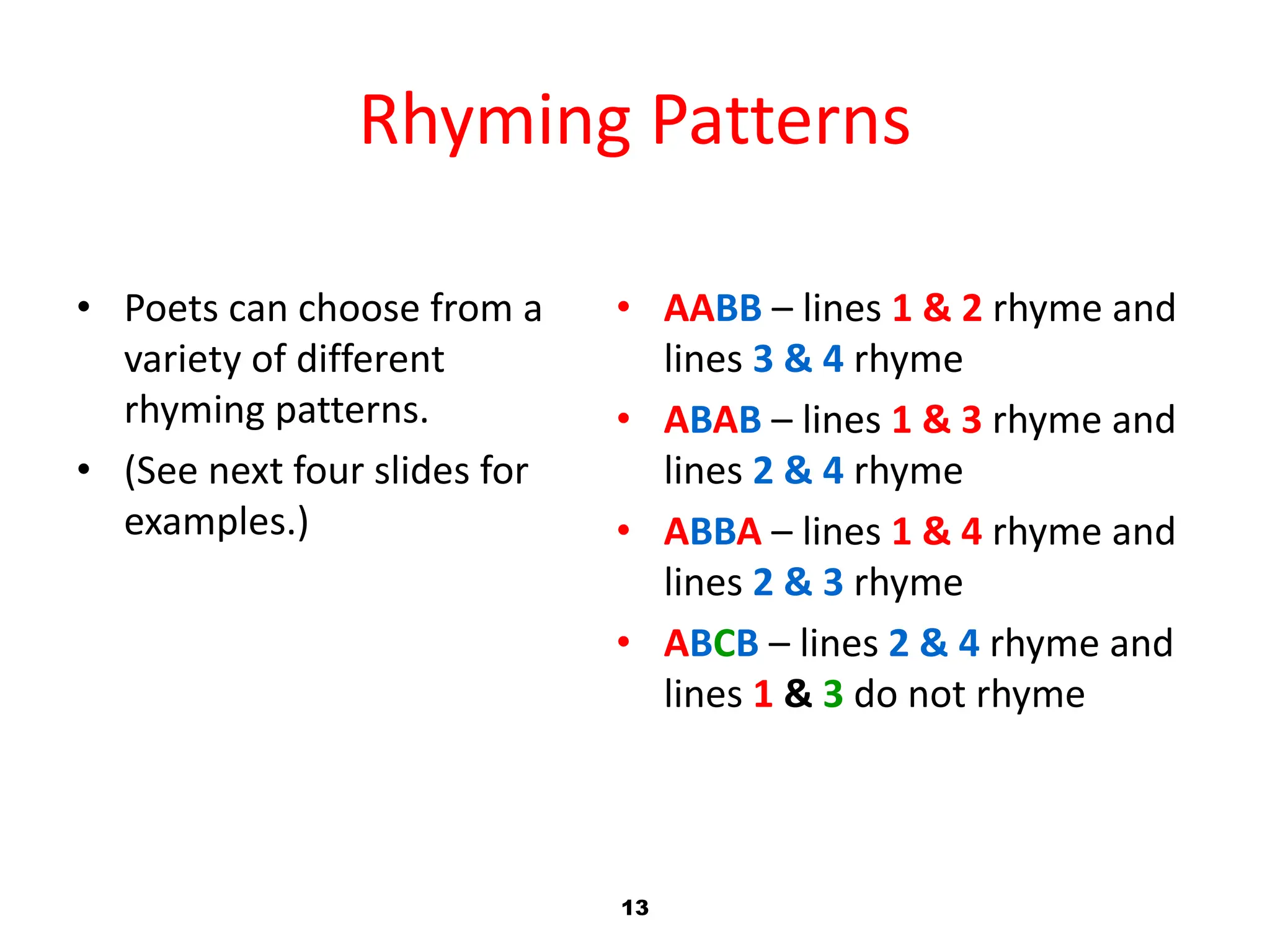
Rhyming Patterns
• Poets can choose from a
variety of different
rhyming patterns.
• (See next four slides for
examples.)
• AABB – lines 1 & 2 rhyme and
lines 3 & 4 rhyme
• ABAB – lines 1 & 3 rhyme and
lines 2 & 4 rhyme
• ABBA – lines 1 & 4 rhyme and
lines 2 & 3 rhyme
• ABCB – lines 2 & 4 rhyme and
lines 1 & 3 do not rhyme
14
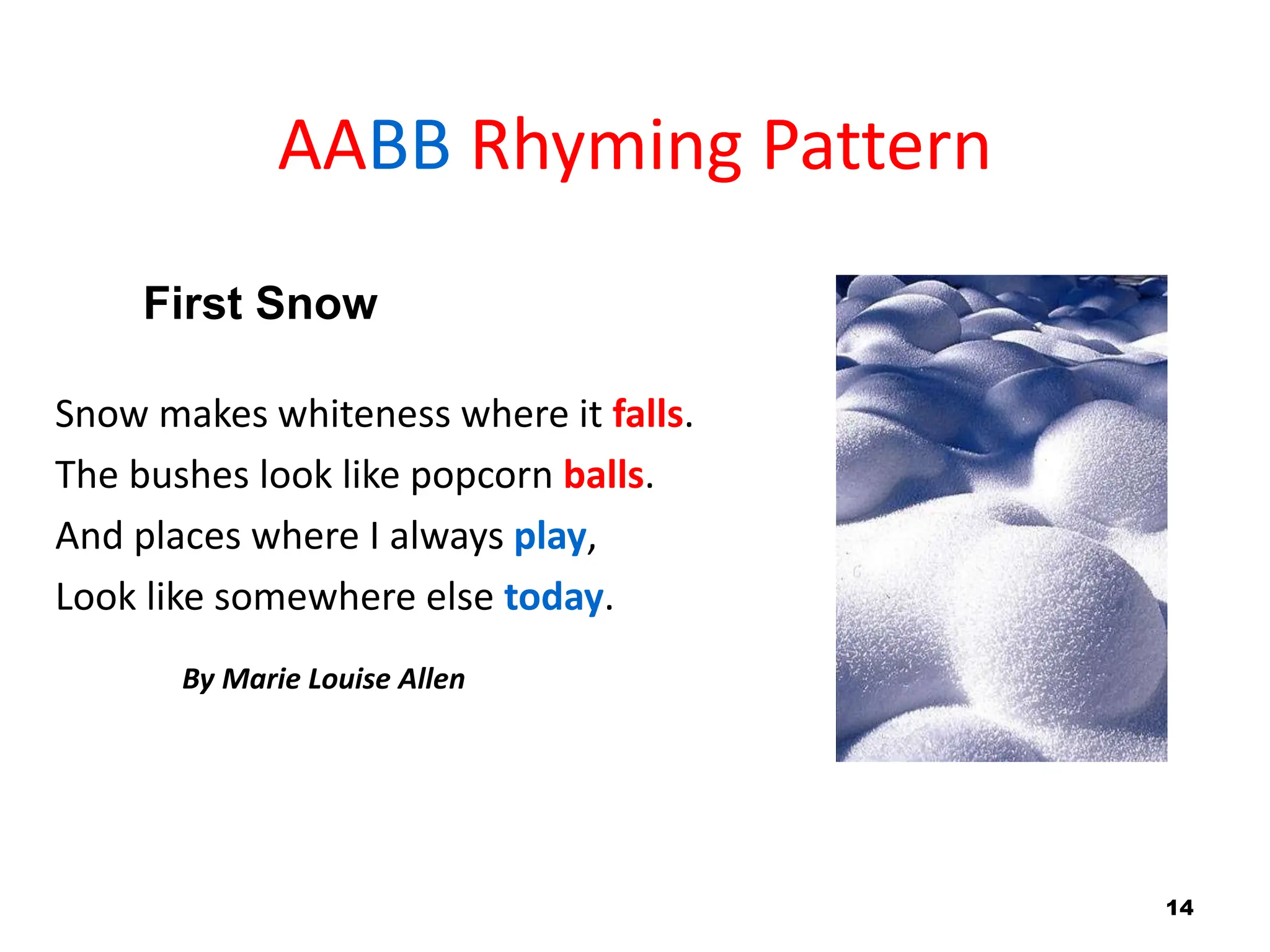
AABB Rhyming Pattern
Snow makes whiteness where it falls.
The bushes look like popcorn balls.
And places where I always play,
Look like somewhere else today.
By Marie Louise Allen
First Snow
15
ABAB Rhyming Pattern
I love noodles. Give me oodles.
Make a mound up to the sun.
Noodles are my favorite foodles.
I eat noodles by the ton.
By Lucia and James L. Hymes, Jr.
Oodles of Noodles
16
ABBA Rhyming Pattern
Let me fetch sticks,
Let me fetch stones,
Throw me your bones,
Teach me your tricks.
By Eleanor Farjeon
From “Bliss”
17
ABCB Rhyming Pattern
The alligator chased his tail
Which hit him in the snout;
He nibbled, gobbled, swallowed it,
And turned right inside-out.
by Mary Macdonald
The Alligator
18
Repetition
• Repetition occurs when poets
repeat words, phrases, or lines
in a poem.
• Creates a pattern.
• Increases rhythm.
• Strengthens feelings, ideas and
mood in a poem.
• (See next slide for example.)
19
Repetition Example
Some one tossed a pancake,
A buttery, buttery, pancake.
Someone tossed a pancake
And flipped it up so high,
That now I see the pancake,
The buttery, buttery pancake,
Now I see that pancake
Stuck against the sky.
by Sandra Liatsos
The Sun
20
Alliteration
• Alliteration is the
repetition of the first
consonant sound in
words, as in the nursery
rhyme “Peter Piper
picked a peck of pickled
peppers.”
• (See next slide for
example.)
The snake slithered silently
along the sunny sidewalk.
21
Alliteration Example
I jiggled it
jaggled it
jerked it.
I pushed
and pulled
and poked it.
But –
As soon as I stopped,
And left it alone
This tooth came out
On its very own!
by Lee Bennett Hopkins
This Tooth
22
Onomatopoeia
• Words that represent the
actual sound of something are
words of onomatopoeia. Dogs
“bark,” cats “purr,” thunder
“booms,” rain “drips,” and the
clock “ticks.”
• Appeals to the sense of sound.
• (See next slide for example.)
23
Onomatopoeia Example
Scrunch, scrunch, scrunch.
Crunch, crunch, crunch.
Frozen snow and brittle ice
Make a winter sound that’s nice
Underneath my stamping feet
And the cars along the street.
Scrunch, scrunch, scrunch.
Crunch, crunch, crunch.
by Margaret Hillert
Listen
24
Imagery
Five Senses
 Imagery is the use of words to
create pictures, or images, in
your mind.
 Appeals to the five senses:
smell, sight, hearing, taste and
touch.
 Details about smells, sounds,
colors, and taste create strong
images.
 To create vivid images writers
use figures of speech.
25
Figures of Speech
• Figures of speech are tools
that writers use to create
images, or “paint pictures,”
in your mind.
• Similes, metaphors, and
personification are three
figures of speech that
create imagery.
26
Simile
• A simile compares two
things using the words
“like” or “as.”
• Comparing one thing to
another creates a vivid
image.
• (See next slide for
example.) The runner streaked like a cheetah.
27
Simile Example
An emerald is as green as grass,
A ruby red as blood;
A sapphire shines as blue as heaven;
A flint lies in the mud.
A diamond is a brilliant stone,
To catch the world’s desire;
An opal holds a fiery spark;
But a flint holds fire.
By Christina Rosetti
Flint
28
Metaphor
• A metaphor compares two
things without using the
words “like” or “as.”
• Gives the qualities of one
thing to something that is
quite different.
• (See next slide for example.)
The winter wind is a wolf
howling at the door.
29
Metaphor Example
The Night is a big black cat
The moon is her topaz eye,
The stars are the mice she hunts at night,
In the field of the sultry sky.
By G. Orr Clark
The Night is a Big Black Cat
30
Personification
• Personification gives
human traits and feelings
to things that are not
human – like animals or
objects.
• (See next slide for
example.)
The moon smiled down at me.
31
Personification Example
Mister Sun
Wakes up at dawn,
Puts his golden
Slippers on,
Climbs the summer
Sky at noon,
Trading places
With the moon.
by J. Patrick Lewis
From “Mister Sun”
32
Forms of Poetry
• Couplet
• Tercet
• Acrostic
• Cinquain
• Haiku
• Senryu
• Concrete Poem
• Free Verse
• Limerick
There are many forms of poetry including the:
33
Lines and Stanzas
• Most poems are written
in lines.
• A group of lines in a
poem is called a stanza.
• Stanzas separate ideas
in a poem. They act like
paragraphs.
• This poem has two
stanzas.
March
A blue day
A blue jay
And a good beginning.
One crow,
Melting snow –
Spring’s winning!
By Eleanor Farjeon
34
Couplet
• A couplet is a poem, or
stanza in a poem,
written in two lines.
• Usually rhymes.
The Jellyfish
Who wants my jellyfish?
I’m not sellyfish!
By Ogden Nash
35
Tercet
• A tercet is a poem, or
stanza, written in three
lines.
• Usually rhymes.
• Lines 1 and 2 can rhyme;
lines 1 and 3 can rhyme;
sometimes all 3 lines
rhyme. Winter Moon
How thin and sharp is the moon tonight!
How thin and sharp and ghostly white
Is the slim curved crook of the moon tonight!
By Langston Hughes
36
Quatrain
• A quatrain is a poem, or
stanza, written in four lines.
• The quatrain is the most
common form of stanza
used in poetry.
• Usually rhymes.
• Can be written in variety of
rhyming patterns.
• (See slide 9 entitled
“Rhyming Patterns.”)
The Lizard
The lizard is a timid thing
That cannot dance or fly or sing;
He hunts for bugs beneath the floor
And longs to be a dinosaur.
By John Gardner
37
Traditional Cinquain
• A cinquain is a poem written
in five lines that do not
rhyme.
• Traditional cinquain has five
lines containing 22 syllables
in the following pattern:
Line 1 – 2 syllables
Line 2 – 4 syllables
Line 3 – 6 syllables
Line 4 – 8 syllables
Line 5 – 2 syllables
Oh, cat
are you grinning
curled in the window seat
as sun warms you this December
morning?
By Paul B. Janezco
38
Word-Count Cinquain
• Word-count cinquain for younger
students uses the following pattern:
Line 1: One word (title)
Line 2: Two words (describe the
title)
Line 3: Three words (describe an
action)
Line 4: Four words (describe a
feeling)
Line 5: One word (another word for
title)
Owl
Swift, ferocious
Watches for food
Soaring through the night
Hunter
39
Diamante
• A diamante is a seven-line
poem written in the
shape of a diamond.
• Does not rhyme.
• Follows pattern.
• Can use synonyms or
antonyms.
• (See next two slides for
examples.)
Diamante Pattern
Line 1 – Your topic (noun)
Line 2 – Two adjectives about
Line 3 – Three “ing” words about
Line 4 – Four nouns or short
phrase linking topic (or topics)
Line 5 – Three “ing” words about
Line 5 – Two adjectives about
Line 7 – Your ending topic (noun)
40
Synonym Diamante
Monsters
Creepy, sinister,
Hiding, lurking, stalking,
Vampires, mummies, werewolves and more –
Chasing, pouncing eating,
Hungry, scary,
Creatures
41
Antonym Diamante
Day
Bright, sunny,
Laughing, playing, doing,
Up in the east, down in the west –
Talking, resting, sleeping,
Quiet, dark,
Night
42
Haiku
• A haiku is a Japanese poem
with 3 lines of 5, 7, and 5
syllables. (Total of 17
syllables.)
• Does not rhyme.
• Is about an aspect of nature
or the seasons.
• Captures a moment in
time.
Little frog among
rain-shaken leaves, are you, too,
splashed with fresh, green paint?
by Gaki
43
Senryu
• A senryu follows same
pattern as haiku.
• Written in 3 unrhymed lines
of 5, 7, and 5 syllables, with
total of 17 syllables.
• Is about human nature,
rather than natural world.
First day, new school year,
backpack harbors a fossil…
last June’s cheese sandwich.
By Cristine O’Connell George
44
Concrete Poem
• A concrete poem (also
called shape poem) is
written in the shape of its
subject.
• The way the words are
arranged is as important
what they mean.
• Does not have to rhyme.
45
Free Verse
• A free verse poem does
not use rhyme or
patterns.
• Can vary freely in length
of lines, stanzas, and
subject.
Revenge
When I find out
who took
the last cooky
out of the jar
and left
me a bunch of
stale old messy
crumbs, I'm
going to take
me a handful
and crumb
up someone's bed.
By Myra Cohn Livingston
46
Acrostic
• In an acrostic poem the
first letter of each line,
read down the page,
spells the subject of the
poem.
• Type of free verse
poem.
• Does not usually rhyme.
Loose brown parachute
Escaping
And
Floating on puffs of air.
by Paul Paolilli
47
Limerick
• A limerick is a funny
poem of 5 lines.
• Lines 1, 2 & 5 rhyme.
• Lines 3 & 4 are shorter
and rhyme.
• Line 5 refers to line 1.
• Limericks are a kind of
nonsense poem.
I really don’t know about Jim.
When he comes to our farm for a swim,
The fish as a rule,
jump out of the pool.
Is there something the matter with him?
By John Ciardi
There Seems to Be a Problem
48
Nonsense Poems
• A nonsense poem is a
humorous poem with silly
characters and actions. It
is meant to be fun.
• Can be written as a
limerick or as another
form of poetry.
A Princess Laments
I kissed a frog because I’d heard
That it would turn into a prince.
That’s not exactly what occurred,
And I’ve been croaking ever since.
by Jack Prelutsky
49
Word Play
• Some poems use a
special kind of word
play by making up
words or misspelling
them on purpose. The Walrus
The pounding spatter
Of salty sea
Makes the walrus
Walrusty.
By Douglas Florian
50
Voice
• Poet as speaker (slides 47-49)
• Human character in poem as speaker (slide 50)
• Object or animal as speaker (slides 51-52)
• More than one speaker (slides 53-54)
Hello!
Hi!
“Voice” is the speaker in a poem. The speaker
can be the poet himself or a character he created
in the poem. There can be one speaker or many
speakers.
51
Voice: Poet as Speaker
Who has seen the wind?
Neither I nor you:
But when the leaves hang trembling
The wind is passing thro’.
Who has seen the wind?
Neither you nor I:
But when the trees bow down their heads,
The wind is passing by.
by Christina Rosetti
In this poem, the poet
speaks of her feelings
about the power of the
wind.
The Wind
52
Voice: Poet as Speaker
There is an old lady who lives down the hall,
Wrinkled and gray and toothless and small.
At seven already she’s up,
Going from door to door with a cup.
“Do you have any sugar?” she asks,
Although she’s got more than you.
“Do you have any sugar?” she asks,
Hoping you’ll talk for a minute or two.
by Frank Asch
In this poem, the poet tells
a story about a lonely old
woman hoping to talk.
The Sugar Lady
53
Voice: Human Character as Speaker
We had a tug of war today
Old March Wind and I.
He tried to steal my new red kite
That Daddy helped me fly.
He huffed and puffed.
I pulled so hard
And held that string so tight
Old March Wind gave up at last
And let me keep my kite.
by Jean Conder Soule
In this poem, the voice is
that of a child flying a kite
on a windy day. The child
is the character in the
poem.
For Keeps
54
Voice: Poet as Speaker
White sheep, white sheep,
On a blue hill,
When the wind stops
You all stand still.
When the wind blows
You walk away slow.
White sheet, white sheep,
Where do you go?
by Christina Rosetti
In this poem, the poet speaks to
clouds - something that cannot
answer back. She uses a
metaphor when she calls the
clouds “white sheep.”
Clouds
55
Voice: Object as Speaker
The cardboard ceiling lifts
Pickmepickmepickme, I pray
The fingers do! They choose me,
Sky Blue!
Hurrah! Hooray!
by April Halprin Wayland
In this poem, the voice is that
of a blue crayon, happy to be
picked by the artist. The
crayon is the character in the
poem.
Crayon Dance
56
Voice: Animal as Speaker
Heavy
Heavy hot
Heavy hot hangs
Thick sticky
Icky
But I lie
Nose high
Cool pool
No fool
A turtle in July
by Marilyn Singer
In this poem, the voice is that of a
turtle keeping cool on a hot July
day. The turtle is the character in
the poem.
Turtle in July
57
Voice: Two Speakers
I talk with the moon, said the owl
While she lingers over my tree
I talk with the moon, said the owl
And the night belongs to me.
I talk with the sun said the wren
As soon as he starts to shine
I talk with the sun, said the wren
And the day is mine.
By Beverly McLoughland
There are two voices in this
poem. In the first stanza the
voice is that of the night-time
owl. In the second stanza the
voice is that of the day-time
wren.
I Talk With the Moon
58
Voice: Multiple Speakers
When monster mothers get together
They brag about their babies.
The other day I heard one say,
“He’s got his very first fang today!”
“Mine is ugly.”
“Mine is mean.”
“Mine is turning
nice and green.”
“Mine’s as scaly
as a fish.”
“Mine is sort of
yellowish.”
“Mine breathes fire
and smoke and such.”
“Mine has skin
you’d hate to touch.”
In this poem, there are many voices. The speakers
are the monster mothers describing their babies.
Monster Mothers
By Florence Parry Heide
59
Author’s Purpose
The poet has an “author’s purpose” when he writes a poem. The
purpose can be to:
• Share feelings (joy, sadness, anger, fear, loneliness)
• Tell a story
• Send a message (theme - something to think about)
• Be humorous
• Provide description* (e.g., person, object, concept)
*Although description is important in all poems, the focus of some poems is
the description itself rather than feelings, story-telling, message, or humor.
60
Author’s Purpose: Share Feelings
Underneath my belt
My stomach was a stone.
Sinking was the way I felt.
And hollow.
And alone.
By Dorothy Aldis
The author’s purpose is to
share her feelings about
being lost and scared.
When I Was Lost
61
Author’s Purpose: Tell Story
Jimmy Jet By Shel Silverstein
I'll tell you the story of Jimmy Jet –
And you know what I tell you is true.
He loved to watch his TV set
Almost as much as you.
He watched all day,he watched all night
Till he grew pale and lean,
From "The Early Show" to “The Late Late Show”
And all the shows between.
He watched till his eyes were frozen wide,
And his bottom grew into his chair.
And his chin turned into a tuning dial,
And antennae grew out of his hair.
And his brains turned into TV tubes,
And his face to a TV screen.
And two knobs saying “VERT.” and “HORIZ.”
Grew where his ears had been.
And he grew a plug that looked like a tail
So we plugged in little Jim.
And now instead of him watching TV
We all sit around and watch him.
The author’s purpose is to tell the story of a
boy who watched too much television.
62
Author’s Purpose: Send Message
Pages and pages
A seesaw of ideas –
Share the adventure
Fiction, nonfiction:
Door to our past and future
Swinging back and forth
WHAM! The book slams shut,
But we read it together
With our minds open
by Patricia and Frederick McKissack
The author’s purpose is to
send a serious message.
The message, or theme, is
that reading is an adventure
that can be shared.
Share the Adventure
63
Author’s Purpose: Be Humorous
I’m very grateful to my skin
For keeping all my insides in –
I do so hate to think about
What I would look like inside-out.
By Colin West
The author’s purpose is
to write a humorous poem
about the purpose of skin.
Insides
64
Author’s Purpose: Be Descriptive
“My nose is blue,
My teeth are green,
My face is like a soup tureen.
I look just like a lima bean.
I’m very, very lovely.
My feet are far too short
And long.
My hands are left and right
And wrong.
My voice is like the hippo’s song.
I’m very, very,
Very, very,
Very, very
Lovely?”
Me by Karla Kuskin
The author’s purpose is to
describe a strange-looking
person.
65
Author’s Purpose: Be Descriptive
Roars over carpet
zig-zag-zips
sucking up fuzz
through metal lips.
By Dee Lillegard
The author’s purpose is to
describe an object – a vacuum
cleaner.
Vacuum Cleaner
66
Author’s Purpose: Be Descriptive
Emerald, ruby, turquoise blue,
Beatles come in every hue:
Beetles that pinch or sting or bite,
Tiger beetles that claw and fight,
Beetles whose burnished armor gleams,
Whirligig beetles that dance on streams,
Antlered beetles in staglike poses,
Beetles that smell – and not like roses,
Others that click like castanets,
That dig or swim or zoom like jets,
Hard as coffee beans, brown as leather,
Or shimmering bright as a peacock feather!
By Ethel Jacobson
The author’s purpose is
to describe a variety of
beetles.
Beetles
67
Author’s Purpose: Be Descriptive
Sun
And rain
And wind
And storms
And thunder go together.
There has to be a bit of each
To make the weather.
By Myra Cohn Livingston
The author’s purpose is to
describe a concept – weather.
Understanding
68
Mood
• Mood is the atmosphere, or
emotion, in the poem created
by the poet.
• Can be happy, angry, silly, sad,
excited, fearful or thoughtful.
• Poet uses words and images
to create mood.
• Author’s purpose helps
determine mood.
• (See slides 65-72 for
examples.)
69
Mood - Barefoot Days
In the morning, very early,
That’s the time I love to go
Barefoot where the fern grows curly
And grass is cool between each toe,
On a summer morning-O!
On a summer morning!
That is when the birds go by
Up the sunny slopes of air,
And each rose has a butterfly
Or a golden bee to wear;
And I am glad in every toe –
Such a summer morning-O!
Such a summer morning!
Barefoot Days by Rachel Field
The mood in this poem is
happy. What clues in the
poem can you use to
determine the mood?
70
Mood - Mad Song
I shut my door
To keep you out
Won’t do no good
To stand and shout
Won’t listen to
A thing you say
Just time you took
Yourself away
I lock my door
To keep me here
Until I’m sure
You disappear.
By Myra Cohn Livingston
Mad Song
The mood in this poem is
angry. What clues in the
poem can you use to
determine the mood?
71
Mood - Poem
I loved my friend.
He went away from me.
There’s nothing more to say.
The poem ends,
Soft as it began –
I loved my friend:
By Langston Hughes
Poem
The mood in this poem is
sad. What clues in the
poem can you use to
determine the mood?
72
Mood - Something is There
Something is there
there on the stair
coming down
coming down
stepping with care.
Coming down
coming down
slinkety-sly.
Something is coming and wants to get by.
By Lilian Moore
Something is There
The mood in this poem
is fearful. What clues in
the poem can you use to
determine the mood?
73
Mood - Joyful
A summer day is full of ease,
a bank is full of money,
our lilac bush is full of bees,
And I am full of honey.
By Rose Burgunder The mood in this poem is
happy. What clues in the
poem can you use to
determine the mood?
Joyful
74
Mood - Foghorns
The foghorns moaned
in the bay last night
so sad
so deep
I thought I heard the city
crying in its sleep.
By Lilian Moore
Foghorns
The mood in this poem is sad.
What clues in the poem can you
use to determine the mood?
75
Mood - Magic Landscape
Shall I draw a magic landscape?
In the genius of my fingers
I hold the seeds.
Can I grow a painting like a flower?
Can I sculpture a future without weeds?
By Joyce Carol Thomas
Magic Landscape
The mood in this poem is
thoughtful. What clues in
the poem can you use to
determine the mood?
76
Mood - Higglety, Pigglety, Pop
Higglety, Pigglety, Pop!
The dog has eaten the mop;
The pig’s in a hurry,
The cat’s in a flurry,
Higglety, Pigglety, Pop!
By Samuel Goodrich
Higglety, Pigglety, Pop!
The mood in this poem is
silly. What clues in the
poem can you use to
determine the mood?
77
Reading for Meaning
• To find meaning in a poem, readers ask questions as they read. There are
many things to pay attention to when reading a poem:
Title – Provides clues about – topic, mood, speaker, author’s purpose?
Rhythm – Fast or slow? Why?
Sound Devices – What effects do they have?
Imagery – What pictures do we make in our minds?
Figures of Speech – What do they tell us about the subject?
Voice – Who is speaking - poet or character; one voice or more?
Author’s Purpose – Sending message, sharing feelings, telling story,
being funny, being descriptive?
Mood – Happy, sad, angry, thoughtful, silly, excited, frightened?
Plot – What is happening in the poem?
Remember, to make meaning, readers must make connections and tap into
their background knowledge and prior experiences as they read.

Beautiful Poems.pptx

  • 1.
  • 2.
    SOCIAL FUNCTION OFPOEMS Social Function of Poems • To give pleasure. • To entertain. • To give value of life. • As a way to express feelings and emotions. You may see slide 59 – 67 to read the explanation of the author’s purpose when he writes poems.
  • 3.
    STRUCTURE OF POEM A.Line.​ Line is a word or a row of words. It is the basic unit of poetry. B. Stanza​. A stanza is a group of lines in a poem. It is often called a verse. C. Rhyme scheme​. Rhyme is a pattern of words that contain similar sounds. Rhyme scheme is the pattern that end rhymes form in a stanza or poem. Rhyme scheme is designated by the assignment of a different letter of the alphabet to each new rhyme, for example, AABB, AAAA, ABAB. D. Meter​. Meter is the rhythmic structure of a poem. Sometimes you can feel the meter or rhythm by tapping for each syllable. E. Line Break​. A line break is where a line of poetry ends. It causes the reader to pause and will determine how the poem is read.
  • 4.
    LANGUAGE FEATURES OFPOEMS Word Choice. Word choice is the writer's selection of words as determined by a number of factors, including meaning (both denotative and connotative), specificity, level of diction, tone, and audience. Word choice will make the poetry good and effective. For example, rather than use small, in poem you can use tiny, petite, little, etc. Symbol. a symbol is an event or a physical object (a thing, a person, a place) that represents something non-physical such as an idea, a value, or an emotion. For example, a ring is symbolic of unity and marriage; a budding tree in spring might symbolize life and fertility; a leafless tree in the winter could be a symbol for death.
  • 5.
    LANGUAGE FEATURES OFPOEMS Tone​ ​and Mood. Mood is a characteristic state of feeling. Tone is the distinctive property of a complex sound. These are ways which a poet reveals attitudes and feelings, in the style of language or expression of thought used to develop the subject. Certain tones include not only irony and satire, but may be loving, condescending, bitter, pitying, fanciful, solemn, and a host of other emotions and attitudes. Tone can also refer to the overall mood of the poem itself, in the sense of a pervading atmosphere intended to influence the readers' emotional response and foster expectations of the conclusion. Imagery. Imagery is the use of vivid language to genera e ideas and/or evoke images, not only of the visual sense, but of sensation and emotion as well. There are some kinds of imagery, such as visual imagery, auditory imagery, gustatory imagery, olfactory imagery, and kinesthetic imagery ( temperature, feeling, movement, touch). For example, The noise of your eyes/ it's far too loud / and thus I look away (Auditory Imagery).
  • 6.
    Figurative​ ​Language orFigures of Speech Figurative language is language that uses words or expressions with a meaning that is different from the literal interpretation. A figure of speech is a word or phrase that has a meaning other than the literal meaning. Figurative language is the use of multiple types of language, including "figures of speech", to make language more colorful and descriptive. You may read the further explanation about Figurative language at slide 25 -31 LANGUAGE FEATURES OF POEMS
  • 7.
    7 Poem Elements • Rhythm •Sound • Imagery • Form Writers use many elements to create their poems. These elements include:
  • 8.
    8 Rhythm • Rhythm isthe flow of the beat in a poem. • Gives poetry a musical feel. • Can be fast or slow, depending on mood and subject of poem. • You can measure rhythm in meter, by counting the beats in each line. • (See next two slides for examples.)
  • 9.
    9 Rhythm Example The picketyfence The pickety fence Give it a lick it's The pickety fence Give it a lick it's A clickety fence Give it a lick it's a lickety fence Give it a lick Give it a lick Give it a lick With a rickety stick pickety pickety pickety pick. The Pickety Fence by David McCord The rhythm in this poem is fast – to match the speed of the stick striking the fence.
  • 10.
    10 Rhythm Example When thenight begins to fall And the sky begins to glow You look up and see the tall City of lights begin to grow – In rows and little golden squares The lights come out. First here, then there Behind the windowpanes as though A million billion bees had built Their golden hives and honeycombs Above you in the air. By Mary Britton Miller Where Are You Now? The rhythm in this poem is slow – to match the night gently falling and the lights slowly coming on.
  • 11.
    11 Sound • Rhyme • Repetition •Alliteration • Onomatopoeia Writers love to use interesting sounds in their poems. After all, poems are meant to be heard. These sound devices include:
  • 12.
    12 Rhyme • Rhymes arewords that end with the same sound. (Hat, cat and bat rhyme.) • Rhyming sounds don’t have to be spelled the same way. (Cloud and allowed rhyme.) • Rhyme is the most common sound device in poetry.
  • 13.
    13 Rhyming Patterns • Poetscan choose from a variety of different rhyming patterns. • (See next four slides for examples.) • AABB – lines 1 & 2 rhyme and lines 3 & 4 rhyme • ABAB – lines 1 & 3 rhyme and lines 2 & 4 rhyme • ABBA – lines 1 & 4 rhyme and lines 2 & 3 rhyme • ABCB – lines 2 & 4 rhyme and lines 1 & 3 do not rhyme
  • 14.
    14 AABB Rhyming Pattern Snowmakes whiteness where it falls. The bushes look like popcorn balls. And places where I always play, Look like somewhere else today. By Marie Louise Allen First Snow
  • 15.
    15 ABAB Rhyming Pattern Ilove noodles. Give me oodles. Make a mound up to the sun. Noodles are my favorite foodles. I eat noodles by the ton. By Lucia and James L. Hymes, Jr. Oodles of Noodles
  • 16.
    16 ABBA Rhyming Pattern Letme fetch sticks, Let me fetch stones, Throw me your bones, Teach me your tricks. By Eleanor Farjeon From “Bliss”
  • 17.
    17 ABCB Rhyming Pattern Thealligator chased his tail Which hit him in the snout; He nibbled, gobbled, swallowed it, And turned right inside-out. by Mary Macdonald The Alligator
  • 18.
    18 Repetition • Repetition occurswhen poets repeat words, phrases, or lines in a poem. • Creates a pattern. • Increases rhythm. • Strengthens feelings, ideas and mood in a poem. • (See next slide for example.)
  • 19.
    19 Repetition Example Some onetossed a pancake, A buttery, buttery, pancake. Someone tossed a pancake And flipped it up so high, That now I see the pancake, The buttery, buttery pancake, Now I see that pancake Stuck against the sky. by Sandra Liatsos The Sun
  • 20.
    20 Alliteration • Alliteration isthe repetition of the first consonant sound in words, as in the nursery rhyme “Peter Piper picked a peck of pickled peppers.” • (See next slide for example.) The snake slithered silently along the sunny sidewalk.
  • 21.
    21 Alliteration Example I jiggledit jaggled it jerked it. I pushed and pulled and poked it. But – As soon as I stopped, And left it alone This tooth came out On its very own! by Lee Bennett Hopkins This Tooth
  • 22.
    22 Onomatopoeia • Words thatrepresent the actual sound of something are words of onomatopoeia. Dogs “bark,” cats “purr,” thunder “booms,” rain “drips,” and the clock “ticks.” • Appeals to the sense of sound. • (See next slide for example.)
  • 23.
    23 Onomatopoeia Example Scrunch, scrunch,scrunch. Crunch, crunch, crunch. Frozen snow and brittle ice Make a winter sound that’s nice Underneath my stamping feet And the cars along the street. Scrunch, scrunch, scrunch. Crunch, crunch, crunch. by Margaret Hillert Listen
  • 24.
    24 Imagery Five Senses  Imageryis the use of words to create pictures, or images, in your mind.  Appeals to the five senses: smell, sight, hearing, taste and touch.  Details about smells, sounds, colors, and taste create strong images.  To create vivid images writers use figures of speech.
  • 25.
    25 Figures of Speech •Figures of speech are tools that writers use to create images, or “paint pictures,” in your mind. • Similes, metaphors, and personification are three figures of speech that create imagery.
  • 26.
    26 Simile • A similecompares two things using the words “like” or “as.” • Comparing one thing to another creates a vivid image. • (See next slide for example.) The runner streaked like a cheetah.
  • 27.
    27 Simile Example An emeraldis as green as grass, A ruby red as blood; A sapphire shines as blue as heaven; A flint lies in the mud. A diamond is a brilliant stone, To catch the world’s desire; An opal holds a fiery spark; But a flint holds fire. By Christina Rosetti Flint
  • 28.
    28 Metaphor • A metaphorcompares two things without using the words “like” or “as.” • Gives the qualities of one thing to something that is quite different. • (See next slide for example.) The winter wind is a wolf howling at the door.
  • 29.
    29 Metaphor Example The Nightis a big black cat The moon is her topaz eye, The stars are the mice she hunts at night, In the field of the sultry sky. By G. Orr Clark The Night is a Big Black Cat
  • 30.
    30 Personification • Personification gives humantraits and feelings to things that are not human – like animals or objects. • (See next slide for example.) The moon smiled down at me.
  • 31.
    31 Personification Example Mister Sun Wakesup at dawn, Puts his golden Slippers on, Climbs the summer Sky at noon, Trading places With the moon. by J. Patrick Lewis From “Mister Sun”
  • 32.
    32 Forms of Poetry •Couplet • Tercet • Acrostic • Cinquain • Haiku • Senryu • Concrete Poem • Free Verse • Limerick There are many forms of poetry including the:
  • 33.
    33 Lines and Stanzas •Most poems are written in lines. • A group of lines in a poem is called a stanza. • Stanzas separate ideas in a poem. They act like paragraphs. • This poem has two stanzas. March A blue day A blue jay And a good beginning. One crow, Melting snow – Spring’s winning! By Eleanor Farjeon
  • 34.
    34 Couplet • A coupletis a poem, or stanza in a poem, written in two lines. • Usually rhymes. The Jellyfish Who wants my jellyfish? I’m not sellyfish! By Ogden Nash
  • 35.
    35 Tercet • A tercetis a poem, or stanza, written in three lines. • Usually rhymes. • Lines 1 and 2 can rhyme; lines 1 and 3 can rhyme; sometimes all 3 lines rhyme. Winter Moon How thin and sharp is the moon tonight! How thin and sharp and ghostly white Is the slim curved crook of the moon tonight! By Langston Hughes
  • 36.
    36 Quatrain • A quatrainis a poem, or stanza, written in four lines. • The quatrain is the most common form of stanza used in poetry. • Usually rhymes. • Can be written in variety of rhyming patterns. • (See slide 9 entitled “Rhyming Patterns.”) The Lizard The lizard is a timid thing That cannot dance or fly or sing; He hunts for bugs beneath the floor And longs to be a dinosaur. By John Gardner
  • 37.
    37 Traditional Cinquain • Acinquain is a poem written in five lines that do not rhyme. • Traditional cinquain has five lines containing 22 syllables in the following pattern: Line 1 – 2 syllables Line 2 – 4 syllables Line 3 – 6 syllables Line 4 – 8 syllables Line 5 – 2 syllables Oh, cat are you grinning curled in the window seat as sun warms you this December morning? By Paul B. Janezco
  • 38.
    38 Word-Count Cinquain • Word-countcinquain for younger students uses the following pattern: Line 1: One word (title) Line 2: Two words (describe the title) Line 3: Three words (describe an action) Line 4: Four words (describe a feeling) Line 5: One word (another word for title) Owl Swift, ferocious Watches for food Soaring through the night Hunter
  • 39.
    39 Diamante • A diamanteis a seven-line poem written in the shape of a diamond. • Does not rhyme. • Follows pattern. • Can use synonyms or antonyms. • (See next two slides for examples.) Diamante Pattern Line 1 – Your topic (noun) Line 2 – Two adjectives about Line 3 – Three “ing” words about Line 4 – Four nouns or short phrase linking topic (or topics) Line 5 – Three “ing” words about Line 5 – Two adjectives about Line 7 – Your ending topic (noun)
  • 40.
    40 Synonym Diamante Monsters Creepy, sinister, Hiding,lurking, stalking, Vampires, mummies, werewolves and more – Chasing, pouncing eating, Hungry, scary, Creatures
  • 41.
    41 Antonym Diamante Day Bright, sunny, Laughing,playing, doing, Up in the east, down in the west – Talking, resting, sleeping, Quiet, dark, Night
  • 42.
    42 Haiku • A haikuis a Japanese poem with 3 lines of 5, 7, and 5 syllables. (Total of 17 syllables.) • Does not rhyme. • Is about an aspect of nature or the seasons. • Captures a moment in time. Little frog among rain-shaken leaves, are you, too, splashed with fresh, green paint? by Gaki
  • 43.
    43 Senryu • A senryufollows same pattern as haiku. • Written in 3 unrhymed lines of 5, 7, and 5 syllables, with total of 17 syllables. • Is about human nature, rather than natural world. First day, new school year, backpack harbors a fossil… last June’s cheese sandwich. By Cristine O’Connell George
  • 44.
    44 Concrete Poem • Aconcrete poem (also called shape poem) is written in the shape of its subject. • The way the words are arranged is as important what they mean. • Does not have to rhyme.
  • 45.
    45 Free Verse • Afree verse poem does not use rhyme or patterns. • Can vary freely in length of lines, stanzas, and subject. Revenge When I find out who took the last cooky out of the jar and left me a bunch of stale old messy crumbs, I'm going to take me a handful and crumb up someone's bed. By Myra Cohn Livingston
  • 46.
    46 Acrostic • In anacrostic poem the first letter of each line, read down the page, spells the subject of the poem. • Type of free verse poem. • Does not usually rhyme. Loose brown parachute Escaping And Floating on puffs of air. by Paul Paolilli
  • 47.
    47 Limerick • A limerickis a funny poem of 5 lines. • Lines 1, 2 & 5 rhyme. • Lines 3 & 4 are shorter and rhyme. • Line 5 refers to line 1. • Limericks are a kind of nonsense poem. I really don’t know about Jim. When he comes to our farm for a swim, The fish as a rule, jump out of the pool. Is there something the matter with him? By John Ciardi There Seems to Be a Problem
  • 48.
    48 Nonsense Poems • Anonsense poem is a humorous poem with silly characters and actions. It is meant to be fun. • Can be written as a limerick or as another form of poetry. A Princess Laments I kissed a frog because I’d heard That it would turn into a prince. That’s not exactly what occurred, And I’ve been croaking ever since. by Jack Prelutsky
  • 49.
    49 Word Play • Somepoems use a special kind of word play by making up words or misspelling them on purpose. The Walrus The pounding spatter Of salty sea Makes the walrus Walrusty. By Douglas Florian
  • 50.
    50 Voice • Poet asspeaker (slides 47-49) • Human character in poem as speaker (slide 50) • Object or animal as speaker (slides 51-52) • More than one speaker (slides 53-54) Hello! Hi! “Voice” is the speaker in a poem. The speaker can be the poet himself or a character he created in the poem. There can be one speaker or many speakers.
  • 51.
    51 Voice: Poet asSpeaker Who has seen the wind? Neither I nor you: But when the leaves hang trembling The wind is passing thro’. Who has seen the wind? Neither you nor I: But when the trees bow down their heads, The wind is passing by. by Christina Rosetti In this poem, the poet speaks of her feelings about the power of the wind. The Wind
  • 52.
    52 Voice: Poet asSpeaker There is an old lady who lives down the hall, Wrinkled and gray and toothless and small. At seven already she’s up, Going from door to door with a cup. “Do you have any sugar?” she asks, Although she’s got more than you. “Do you have any sugar?” she asks, Hoping you’ll talk for a minute or two. by Frank Asch In this poem, the poet tells a story about a lonely old woman hoping to talk. The Sugar Lady
  • 53.
    53 Voice: Human Characteras Speaker We had a tug of war today Old March Wind and I. He tried to steal my new red kite That Daddy helped me fly. He huffed and puffed. I pulled so hard And held that string so tight Old March Wind gave up at last And let me keep my kite. by Jean Conder Soule In this poem, the voice is that of a child flying a kite on a windy day. The child is the character in the poem. For Keeps
  • 54.
    54 Voice: Poet asSpeaker White sheep, white sheep, On a blue hill, When the wind stops You all stand still. When the wind blows You walk away slow. White sheet, white sheep, Where do you go? by Christina Rosetti In this poem, the poet speaks to clouds - something that cannot answer back. She uses a metaphor when she calls the clouds “white sheep.” Clouds
  • 55.
    55 Voice: Object asSpeaker The cardboard ceiling lifts Pickmepickmepickme, I pray The fingers do! They choose me, Sky Blue! Hurrah! Hooray! by April Halprin Wayland In this poem, the voice is that of a blue crayon, happy to be picked by the artist. The crayon is the character in the poem. Crayon Dance
  • 56.
    56 Voice: Animal asSpeaker Heavy Heavy hot Heavy hot hangs Thick sticky Icky But I lie Nose high Cool pool No fool A turtle in July by Marilyn Singer In this poem, the voice is that of a turtle keeping cool on a hot July day. The turtle is the character in the poem. Turtle in July
  • 57.
    57 Voice: Two Speakers Italk with the moon, said the owl While she lingers over my tree I talk with the moon, said the owl And the night belongs to me. I talk with the sun said the wren As soon as he starts to shine I talk with the sun, said the wren And the day is mine. By Beverly McLoughland There are two voices in this poem. In the first stanza the voice is that of the night-time owl. In the second stanza the voice is that of the day-time wren. I Talk With the Moon
  • 58.
    58 Voice: Multiple Speakers Whenmonster mothers get together They brag about their babies. The other day I heard one say, “He’s got his very first fang today!” “Mine is ugly.” “Mine is mean.” “Mine is turning nice and green.” “Mine’s as scaly as a fish.” “Mine is sort of yellowish.” “Mine breathes fire and smoke and such.” “Mine has skin you’d hate to touch.” In this poem, there are many voices. The speakers are the monster mothers describing their babies. Monster Mothers By Florence Parry Heide
  • 59.
    59 Author’s Purpose The poethas an “author’s purpose” when he writes a poem. The purpose can be to: • Share feelings (joy, sadness, anger, fear, loneliness) • Tell a story • Send a message (theme - something to think about) • Be humorous • Provide description* (e.g., person, object, concept) *Although description is important in all poems, the focus of some poems is the description itself rather than feelings, story-telling, message, or humor.
  • 60.
    60 Author’s Purpose: ShareFeelings Underneath my belt My stomach was a stone. Sinking was the way I felt. And hollow. And alone. By Dorothy Aldis The author’s purpose is to share her feelings about being lost and scared. When I Was Lost
  • 61.
    61 Author’s Purpose: TellStory Jimmy Jet By Shel Silverstein I'll tell you the story of Jimmy Jet – And you know what I tell you is true. He loved to watch his TV set Almost as much as you. He watched all day,he watched all night Till he grew pale and lean, From "The Early Show" to “The Late Late Show” And all the shows between. He watched till his eyes were frozen wide, And his bottom grew into his chair. And his chin turned into a tuning dial, And antennae grew out of his hair. And his brains turned into TV tubes, And his face to a TV screen. And two knobs saying “VERT.” and “HORIZ.” Grew where his ears had been. And he grew a plug that looked like a tail So we plugged in little Jim. And now instead of him watching TV We all sit around and watch him. The author’s purpose is to tell the story of a boy who watched too much television.
  • 62.
    62 Author’s Purpose: SendMessage Pages and pages A seesaw of ideas – Share the adventure Fiction, nonfiction: Door to our past and future Swinging back and forth WHAM! The book slams shut, But we read it together With our minds open by Patricia and Frederick McKissack The author’s purpose is to send a serious message. The message, or theme, is that reading is an adventure that can be shared. Share the Adventure
  • 63.
    63 Author’s Purpose: BeHumorous I’m very grateful to my skin For keeping all my insides in – I do so hate to think about What I would look like inside-out. By Colin West The author’s purpose is to write a humorous poem about the purpose of skin. Insides
  • 64.
    64 Author’s Purpose: BeDescriptive “My nose is blue, My teeth are green, My face is like a soup tureen. I look just like a lima bean. I’m very, very lovely. My feet are far too short And long. My hands are left and right And wrong. My voice is like the hippo’s song. I’m very, very, Very, very, Very, very Lovely?” Me by Karla Kuskin The author’s purpose is to describe a strange-looking person.
  • 65.
    65 Author’s Purpose: BeDescriptive Roars over carpet zig-zag-zips sucking up fuzz through metal lips. By Dee Lillegard The author’s purpose is to describe an object – a vacuum cleaner. Vacuum Cleaner
  • 66.
    66 Author’s Purpose: BeDescriptive Emerald, ruby, turquoise blue, Beatles come in every hue: Beetles that pinch or sting or bite, Tiger beetles that claw and fight, Beetles whose burnished armor gleams, Whirligig beetles that dance on streams, Antlered beetles in staglike poses, Beetles that smell – and not like roses, Others that click like castanets, That dig or swim or zoom like jets, Hard as coffee beans, brown as leather, Or shimmering bright as a peacock feather! By Ethel Jacobson The author’s purpose is to describe a variety of beetles. Beetles
  • 67.
    67 Author’s Purpose: BeDescriptive Sun And rain And wind And storms And thunder go together. There has to be a bit of each To make the weather. By Myra Cohn Livingston The author’s purpose is to describe a concept – weather. Understanding
  • 68.
    68 Mood • Mood isthe atmosphere, or emotion, in the poem created by the poet. • Can be happy, angry, silly, sad, excited, fearful or thoughtful. • Poet uses words and images to create mood. • Author’s purpose helps determine mood. • (See slides 65-72 for examples.)
  • 69.
    69 Mood - BarefootDays In the morning, very early, That’s the time I love to go Barefoot where the fern grows curly And grass is cool between each toe, On a summer morning-O! On a summer morning! That is when the birds go by Up the sunny slopes of air, And each rose has a butterfly Or a golden bee to wear; And I am glad in every toe – Such a summer morning-O! Such a summer morning! Barefoot Days by Rachel Field The mood in this poem is happy. What clues in the poem can you use to determine the mood?
  • 70.
    70 Mood - MadSong I shut my door To keep you out Won’t do no good To stand and shout Won’t listen to A thing you say Just time you took Yourself away I lock my door To keep me here Until I’m sure You disappear. By Myra Cohn Livingston Mad Song The mood in this poem is angry. What clues in the poem can you use to determine the mood?
  • 71.
    71 Mood - Poem Iloved my friend. He went away from me. There’s nothing more to say. The poem ends, Soft as it began – I loved my friend: By Langston Hughes Poem The mood in this poem is sad. What clues in the poem can you use to determine the mood?
  • 72.
    72 Mood - Somethingis There Something is there there on the stair coming down coming down stepping with care. Coming down coming down slinkety-sly. Something is coming and wants to get by. By Lilian Moore Something is There The mood in this poem is fearful. What clues in the poem can you use to determine the mood?
  • 73.
    73 Mood - Joyful Asummer day is full of ease, a bank is full of money, our lilac bush is full of bees, And I am full of honey. By Rose Burgunder The mood in this poem is happy. What clues in the poem can you use to determine the mood? Joyful
  • 74.
    74 Mood - Foghorns Thefoghorns moaned in the bay last night so sad so deep I thought I heard the city crying in its sleep. By Lilian Moore Foghorns The mood in this poem is sad. What clues in the poem can you use to determine the mood?
  • 75.
    75 Mood - MagicLandscape Shall I draw a magic landscape? In the genius of my fingers I hold the seeds. Can I grow a painting like a flower? Can I sculpture a future without weeds? By Joyce Carol Thomas Magic Landscape The mood in this poem is thoughtful. What clues in the poem can you use to determine the mood?
  • 76.
    76 Mood - Higglety,Pigglety, Pop Higglety, Pigglety, Pop! The dog has eaten the mop; The pig’s in a hurry, The cat’s in a flurry, Higglety, Pigglety, Pop! By Samuel Goodrich Higglety, Pigglety, Pop! The mood in this poem is silly. What clues in the poem can you use to determine the mood?
  • 77.
    77 Reading for Meaning •To find meaning in a poem, readers ask questions as they read. There are many things to pay attention to when reading a poem: Title – Provides clues about – topic, mood, speaker, author’s purpose? Rhythm – Fast or slow? Why? Sound Devices – What effects do they have? Imagery – What pictures do we make in our minds? Figures of Speech – What do they tell us about the subject? Voice – Who is speaking - poet or character; one voice or more? Author’s Purpose – Sending message, sharing feelings, telling story, being funny, being descriptive? Mood – Happy, sad, angry, thoughtful, silly, excited, frightened? Plot – What is happening in the poem? Remember, to make meaning, readers must make connections and tap into their background knowledge and prior experiences as they read.