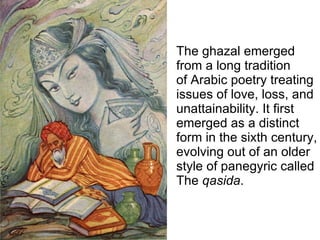
The ghazal emerged
from a long tradition
of Arabic poetry treating
issues of love, loss, and
unattainability. It first
emerged as a distinct
form in the sixth century,
evolving out of an older
style of panegyric called
The qasida.
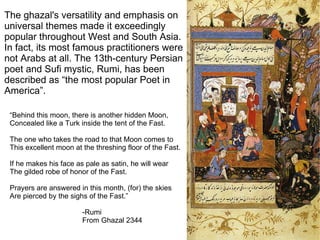
The ghazal's versatility and emphasis on
universal themes made it exceedingly
popular throughout West and South Asia.
In fact, its most famous practitioners were
not Arabs at all. The 13th-century Persian
poet and Sufi mystic, Rumi, has been
described as “the most popular Poet in
America”.

 “Behind this moon, there is another hidden Moon,
 Concealed like a Turk inside the tent of the Fast.

 The one who takes the road to that Moon comes to
 This excellent moon at the threshing floor of the Fast.

 If he makes his face as pale as satin, he will wear
 The gilded robe of honor of the Fast.

 Prayers are answered in this month, (for) the skies
 Are pierced by the sighs of the Fast.”

                        -Rumi
                        From Ghazal 2344
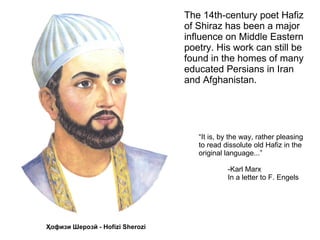
The 14th-century poet Hafiz
of Shiraz has been a major
influence on Middle Eastern
poetry. His work can still be
found in the homes of many
educated Persians in Iran
and Afghanistan.


   “It is, by the way, rather pleasing
   to read dissolute old Hafiz in the
   original language...”

            -Karl Marx
            In a letter to F. Engels
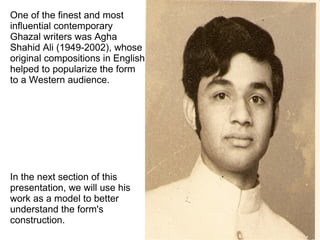
One of the finest and most
influential contemporary
Ghazal writers was Agha
Shahid Ali (1949-2002), whose
original compositions in English
helped to popularize the form
to a Western audience.


In the next section of this
presentation, we will use his
work as a model to better
understand the form's
construction.
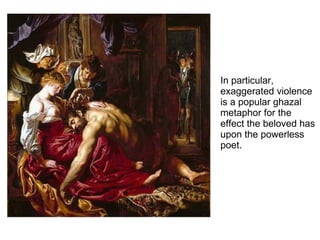
In particular,
exaggerated violence
is a popular ghazal
metaphor for the
effect the beloved has
upon the powerless
poet.
Writing a ghazal : Form

                                    Ghazals are traditionally
                         ly r
                                    composed in couplets.
                     bab ose
                  pro mp lish
              e is t co Eng         The first couplet rhymes, and
           urn inen s in            all subsequent couplets must
        bo rom plet
   y  Os t p ou                     end with the same word that
 zz mos ed c
O e     m
 th rhy .
                                    ended the first.
   of day
     to
                                    what is more, each couplet
                                    must carry poetic meaning
                                    when standing-alone, in
                                    addition to its role in the
                                    overall composition.
Tonight
by Agha Shahid Ali

Where are you now? Who lies beneath your spell tonight?
Whom else from rapture’s road will you expel tonight?

Those “Fabrics of Cashmere--“ ”to make Me beautiful--“
“Trinket”-- to gem– “Me to adorn– How– tell”-- tonight?

I beg for haven: Prisons, let open your gates–
A refugee from Belief seeks a cell tonight.

God’s vintage loneliness has turned to vinegar–
All the archangels– their wings frozen– fell tonight.

Lord, cried out the idols, Don’t let us be broken
Only we can convert the infidel tonight.

Mughal ceilings, let your mirrored convexities
multiply me at once under your spell tonight.

[cont'd.]
He’s freed some fire from ice in pity for Heaven.
He’s left open– for God– the doors of Hell tonight.

In the heart’s veined temple, all statues have been
     smashed
No priest in saffron’s left to toll its knell tonight

God, limit these punishments, there’s still Judgment Day–
I’m a mere sinner, I’m no infidel tonight.

Executioners near the woman at the window.
Damn you, Elijah, I’ll bless Jezebel tonight.

The hunt is over, and I hear the Call to Prayer
fade into that of the wounded gazelle tonight.

My rivals for your love– you’ve invited them all?
This is mere insult, this is no farewell tonight.

And I, Shahid, only am escaped to tell thee–
God sobs in my arms. Call me Ishmael tonight.
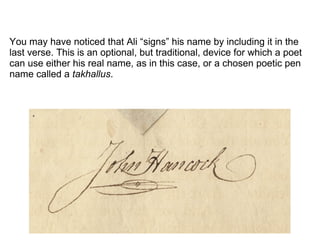
You may have noticed that Ali “signs” his name by including it in the
last verse. This is an optional, but traditional, device for which a poet
can use either his real name, as in this case, or a chosen poetic pen
name called a takhallus.
Pitfalls of the English ghazal
Students of poetry are aware of how much easier good rhymes are to
achieve in Romance languages, and the adjustments that must be
made for English.

Likewise, many of the languages in which ghazals have been composed,
like Urdu, have postpositional pronouns and other grammatical devices
that make it easy to unobnoxiously repeat an end word.

Be sure to pick your repeating word carefully! Simple adverbs are often a
good choice, as in Ali's example. You will have to experiment.
Image sources (in order of appearance):

http://www.humanevents.com/images/islm_cartoon_8.jpg
http://www.al-funun.org/al-funun/images/abu_nuwas.html
http://upload.wikimedia.org/wikipedia/commons/5/5d/Andr04.jpg
http://upload.wikimedia.org/wikipedia/commons/c/c6/Hofizi_Sherozi.jpg
http://kafilabackup.files.wordpress.com/2011/01/shahid.jpg?w=600
http://www.abcgallery.com/R/rossetti/rossetti8.html
http://www.codart.nl/images/RubensSamsonAndDelilahCa1610LondonNG450.jpg
http://images3.mtv.com/uri/mgid:uma:artist:mtv.com:1004?width=281&height=211
http://bookillustration.org/images/gallery108/14Fig8_L.jpg
Text sources:

Slide 3: http://en.wikipedia.org/wiki/Ghazal
Slide 4: http://en.wikipedia.org/wiki/Rumi / http://news.bbc.co.uk/2/hi/south_asia/7016090.stm /
http://www.dar-al-masnavi.org/gh-2344.html
Slide 5: http://en.wikipedia.org/wiki/Hafiz_Shirazi
Slide 6: http://en.wikipedia.org/wiki/Agha_Shahid_Ali
Slides 8-13: http://en.wikipedia.org/wiki/Ghazal

Ghazals

  • 3.
    The ghazal emerged froma long tradition of Arabic poetry treating issues of love, loss, and unattainability. It first emerged as a distinct form in the sixth century, evolving out of an older style of panegyric called The qasida.
  • 4.
    The ghazal's versatilityand emphasis on universal themes made it exceedingly popular throughout West and South Asia. In fact, its most famous practitioners were not Arabs at all. The 13th-century Persian poet and Sufi mystic, Rumi, has been described as “the most popular Poet in America”. “Behind this moon, there is another hidden Moon, Concealed like a Turk inside the tent of the Fast. The one who takes the road to that Moon comes to This excellent moon at the threshing floor of the Fast. If he makes his face as pale as satin, he will wear The gilded robe of honor of the Fast. Prayers are answered in this month, (for) the skies Are pierced by the sighs of the Fast.” -Rumi From Ghazal 2344
  • 5.
    The 14th-century poetHafiz of Shiraz has been a major influence on Middle Eastern poetry. His work can still be found in the homes of many educated Persians in Iran and Afghanistan. “It is, by the way, rather pleasing to read dissolute old Hafiz in the original language...” -Karl Marx In a letter to F. Engels
  • 6.
    One of thefinest and most influential contemporary Ghazal writers was Agha Shahid Ali (1949-2002), whose original compositions in English helped to popularize the form to a Western audience. In the next section of this presentation, we will use his work as a model to better understand the form's construction.
  • 9.
    In particular, exaggerated violence isa popular ghazal metaphor for the effect the beloved has upon the powerless poet.
  • 10.
    Writing a ghazal: Form Ghazals are traditionally ly r composed in couplets. bab ose pro mp lish e is t co Eng The first couplet rhymes, and urn inen s in all subsequent couplets must bo rom plet y Os t p ou end with the same word that zz mos ed c O e m th rhy . ended the first. of day to what is more, each couplet must carry poetic meaning when standing-alone, in addition to its role in the overall composition.
  • 11.
    Tonight by Agha ShahidAli Where are you now? Who lies beneath your spell tonight? Whom else from rapture’s road will you expel tonight? Those “Fabrics of Cashmere--“ ”to make Me beautiful--“ “Trinket”-- to gem– “Me to adorn– How– tell”-- tonight? I beg for haven: Prisons, let open your gates– A refugee from Belief seeks a cell tonight. God’s vintage loneliness has turned to vinegar– All the archangels– their wings frozen– fell tonight. Lord, cried out the idols, Don’t let us be broken Only we can convert the infidel tonight. Mughal ceilings, let your mirrored convexities multiply me at once under your spell tonight. [cont'd.]
  • 12.
    He’s freed somefire from ice in pity for Heaven. He’s left open– for God– the doors of Hell tonight. In the heart’s veined temple, all statues have been smashed No priest in saffron’s left to toll its knell tonight God, limit these punishments, there’s still Judgment Day– I’m a mere sinner, I’m no infidel tonight. Executioners near the woman at the window. Damn you, Elijah, I’ll bless Jezebel tonight. The hunt is over, and I hear the Call to Prayer fade into that of the wounded gazelle tonight. My rivals for your love– you’ve invited them all? This is mere insult, this is no farewell tonight. And I, Shahid, only am escaped to tell thee– God sobs in my arms. Call me Ishmael tonight.
  • 13.
    You may havenoticed that Ali “signs” his name by including it in the last verse. This is an optional, but traditional, device for which a poet can use either his real name, as in this case, or a chosen poetic pen name called a takhallus.
  • 15.
    Pitfalls of theEnglish ghazal Students of poetry are aware of how much easier good rhymes are to achieve in Romance languages, and the adjustments that must be made for English. Likewise, many of the languages in which ghazals have been composed, like Urdu, have postpositional pronouns and other grammatical devices that make it easy to unobnoxiously repeat an end word. Be sure to pick your repeating word carefully! Simple adverbs are often a good choice, as in Ali's example. You will have to experiment.
  • 18.
    Image sources (inorder of appearance): http://www.humanevents.com/images/islm_cartoon_8.jpg http://www.al-funun.org/al-funun/images/abu_nuwas.html http://upload.wikimedia.org/wikipedia/commons/5/5d/Andr04.jpg http://upload.wikimedia.org/wikipedia/commons/c/c6/Hofizi_Sherozi.jpg http://kafilabackup.files.wordpress.com/2011/01/shahid.jpg?w=600 http://www.abcgallery.com/R/rossetti/rossetti8.html http://www.codart.nl/images/RubensSamsonAndDelilahCa1610LondonNG450.jpg http://images3.mtv.com/uri/mgid:uma:artist:mtv.com:1004?width=281&height=211 http://bookillustration.org/images/gallery108/14Fig8_L.jpg
  • 19.
    Text sources: Slide 3:http://en.wikipedia.org/wiki/Ghazal Slide 4: http://en.wikipedia.org/wiki/Rumi / http://news.bbc.co.uk/2/hi/south_asia/7016090.stm / http://www.dar-al-masnavi.org/gh-2344.html Slide 5: http://en.wikipedia.org/wiki/Hafiz_Shirazi Slide 6: http://en.wikipedia.org/wiki/Agha_Shahid_Ali Slides 8-13: http://en.wikipedia.org/wiki/Ghazal