Elements Of Poetry
Elements Of Poetry
FORM
FORM
SOUND DEVISES
SOUND DEVISES
IMAGERY
IMAGERY
MOOD/TONE
MOOD/TONE
THEME
THEME
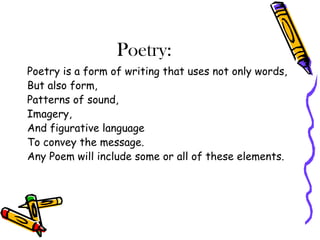
Poetry:
Poetry is a form of writing that uses not only words,
But also form,
Patterns of sound,
Imagery,
And figurative language
To convey the message.
Any Poem will include some or all of these elements.
FORM:
• A poem’s form is its
appearance. Poems are
divided into lines. Many
poems, especially longer ones,
may also be divided into
groups of lines called stanzas.
• Stanzas function like
paragraphs in a story. Each
one contains a single idea or
takes the idea one step
further.
What is the purpose of the first
stanza of “The Highwayman”?
Yo soy Joaquin
Perdido en un mundo de confusion
I am Joaquin, lost in a world of
confusion,
Caught up in the whirl of a gringo
society,
Suppressed by manipulation, and
destroyed by modern society.
Sets the scene
SOUND Devises
Some poems use techniques of sound
such as rhythm, rhyme, and
alliteration.
Rhythm:
• The pattern of beats or
stresses in a poem.
Poets use patterns of
stressed and unstressed
syllables to create a
regular rhythm.
Try beating out the rhythm
with a finger as you read
these lines.
My fathers have lost the
economic battle
And won the struggle of cultural
survival.
RHYME:
The repetition of the same or similar sounds,
usually in stressed syllables at the ends of
lines, but sometimes within a line.
In the first reading of “Joaquin,” did
you see any rhyming?
Rhyme Scheme
The rhyming pattern that is created at
the end of lines of poetry.
Mary had a little lamb, A
Its fleece as white as snow. B
And everywhere that Mary went, C
The lamb was sure to go. B
If the poem does not have a rhyme
scheme it is considered to be a
free verse poem.
• Twinkle, twinkle, little star, (A)
How I wonder what you are! (B)
Up above the world so high, (C)
Like a diamond in the sky. (C)
Twinkle, twinkle, little star, (A)
How I wonder what you are! (B)
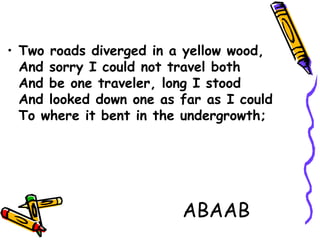
ABAAB
• Two roads diverged in a yellow wood,
And sorry I could not travel both
And be one traveler, long I stood
And looked down one as far as I could
To where it bent in the undergrowth;
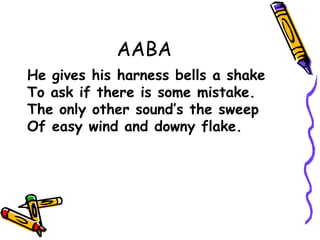
AABA
He gives his harness bells a shake
To ask if there is some mistake.
The only other sound’s the sweep
Of easy wind and downy flake.
ABCB ABCB
The sun did not shine.
It was too wet to play.
So we sat in the house.
All that cold, cold, wet day.
I sat there with Sally.
We sat there, we two.
And I said, "How I wish
We had something to do!"
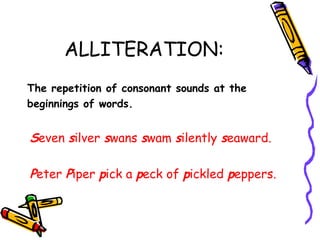
ALLITERATION:
The repetition of consonant sounds at the
beginnings of words.
Seven silver swans swam silently seaward.
Peter Piper pick a peck of pickled peppers.
Onomatopoeia
Words that are used to represent
particular sounds.
Crash Boom
Bang Zip
Repetition
The repeating of a particular sound
devise to create an effect.
To create emphasis, a poet may repeat
words or lines within the poem.
IMAGERY
Poets use words that
appeal to the reader’s
senses of sight,
sound, touch, taste,
and smell.
Which senses does the
following stanza appeal
to?
Back, he spurred like a madman,
shouting curses to the sky,
With the white road smoking behind
him and his rapier brandished high.
Sight?
Sound?
FIGURES OF SPEECH:
Figures of speech are a special kind of
imagery.
They create pictures by making
comparisons.
SIMILE
A comparison using like or as.
Talk of your cold! through the parka’s
fold it stabbed like a driven nail.
METAPHOR:
Describes one thing
as if it were
another.
The wind is now
a roaring, smashing
monster of destruction,
raking all man's work
from the valleys,
from the vales,
and sends them spinning,
broken flying -
.
Extended Metaphor
A metaphor that extends throughout
the entire poem instead of just a few
lines of the poem.
Mother to Son
By: Langston Hughes
Well, son, I’ll tell you:
Life for me ain’t been no crystalstair.
It’s had tacks in it,
And splinters,
And boards torn up,
And places with no carpet on the floor –
Bare.
But all the time
I’se been a-climbin on,
And reachin’ landin’s,
And turnin’ corners,
And sometimes goin’ in the dark
Where there ain’t been no light.
So, boy, don’t you turn back.
Don’t you set down on the stops
‘Cause you finds it kinder hard.
don’t you fall now –
For I’se still goin’, honey,
I’se still climbin’, and life for me ain’t been no crystal
stair.
PERSONIFICATION:
Gives human characteristics to something
nonhuman.
…and the stars o’erhead
were dancing heel and toe…
In “The Highwayman,” images create a
picture of Tim.
Which figures are used to describe his eyes
and his hair?
His eyes were hollows of madness, his hair like
moldy hay,
eyes : hollows of madness : Metaphor
hair : moldy hay : Simile
Which figures are used to
describe the following?
• My love is like a
rose.
• Our love bloomed in
the garden.
• The rose tipped its
head as we passed
by.
• Simile
• Personification
• Personification
Mood/Tone
The feelings the author’s word choices
give the poem.
The only other sounds the sweep
Of easy wind and downy flake.
The woods are lovely, dark and deep.
“A Dream” by Langston Hughes
Excerpt:
• Hold fast to dreams
For when dreams go
Life is a barren field
Frozen with snow.
• Mood: The mood of this poem is contemplative
and somber. It reflects on the importance of
dreams and the emptiness that comes when
they are lost.
• Tone: The tone is earnest and cautionary.
Hughes conveys a sense of seriousness about
the value of holding on to dreams.
THEME:
The theme of a poem is its central or
main idea.
To identify a poem’s theme, ask
yourself what ideas or insights about
life or human nature you have found in
the poem.

elementsofpoetry-100426133835-phpapp02-140909111355-phpapp01 (1).ppt

  • 1.
    Elements Of Poetry ElementsOf Poetry FORM FORM SOUND DEVISES SOUND DEVISES IMAGERY IMAGERY MOOD/TONE MOOD/TONE THEME THEME
  • 2.
    Poetry: Poetry is aform of writing that uses not only words, But also form, Patterns of sound, Imagery, And figurative language To convey the message. Any Poem will include some or all of these elements.
  • 3.
    FORM: • A poem’sform is its appearance. Poems are divided into lines. Many poems, especially longer ones, may also be divided into groups of lines called stanzas. • Stanzas function like paragraphs in a story. Each one contains a single idea or takes the idea one step further. What is the purpose of the first stanza of “The Highwayman”? Yo soy Joaquin Perdido en un mundo de confusion I am Joaquin, lost in a world of confusion, Caught up in the whirl of a gringo society, Suppressed by manipulation, and destroyed by modern society. Sets the scene
  • 4.
    SOUND Devises Some poemsuse techniques of sound such as rhythm, rhyme, and alliteration.
  • 5.
    Rhythm: • The patternof beats or stresses in a poem. Poets use patterns of stressed and unstressed syllables to create a regular rhythm. Try beating out the rhythm with a finger as you read these lines. My fathers have lost the economic battle And won the struggle of cultural survival.
  • 6.
    RHYME: The repetition ofthe same or similar sounds, usually in stressed syllables at the ends of lines, but sometimes within a line. In the first reading of “Joaquin,” did you see any rhyming?
  • 7.
    Rhyme Scheme The rhymingpattern that is created at the end of lines of poetry. Mary had a little lamb, A Its fleece as white as snow. B And everywhere that Mary went, C The lamb was sure to go. B If the poem does not have a rhyme scheme it is considered to be a free verse poem.
  • 8.
    • Twinkle, twinkle,little star, (A) How I wonder what you are! (B) Up above the world so high, (C) Like a diamond in the sky. (C) Twinkle, twinkle, little star, (A) How I wonder what you are! (B)
  • 9.
    ABAAB • Two roadsdiverged in a yellow wood, And sorry I could not travel both And be one traveler, long I stood And looked down one as far as I could To where it bent in the undergrowth;
  • 10.
    AABA He gives hisharness bells a shake To ask if there is some mistake. The only other sound’s the sweep Of easy wind and downy flake.
  • 11.
    ABCB ABCB The sundid not shine. It was too wet to play. So we sat in the house. All that cold, cold, wet day. I sat there with Sally. We sat there, we two. And I said, "How I wish We had something to do!"
  • 12.
    ALLITERATION: The repetition ofconsonant sounds at the beginnings of words. Seven silver swans swam silently seaward. Peter Piper pick a peck of pickled peppers.
  • 13.
    Onomatopoeia Words that areused to represent particular sounds. Crash Boom Bang Zip
  • 14.
    Repetition The repeating ofa particular sound devise to create an effect. To create emphasis, a poet may repeat words or lines within the poem.
  • 15.
    IMAGERY Poets use wordsthat appeal to the reader’s senses of sight, sound, touch, taste, and smell. Which senses does the following stanza appeal to? Back, he spurred like a madman, shouting curses to the sky, With the white road smoking behind him and his rapier brandished high. Sight? Sound?
  • 16.
    FIGURES OF SPEECH: Figuresof speech are a special kind of imagery. They create pictures by making comparisons.
  • 17.
    SIMILE A comparison usinglike or as. Talk of your cold! through the parka’s fold it stabbed like a driven nail.
  • 18.
    METAPHOR: Describes one thing asif it were another. The wind is now a roaring, smashing monster of destruction, raking all man's work from the valleys, from the vales, and sends them spinning, broken flying - .
  • 19.
    Extended Metaphor A metaphorthat extends throughout the entire poem instead of just a few lines of the poem.
  • 20.
    Mother to Son By:Langston Hughes Well, son, I’ll tell you: Life for me ain’t been no crystalstair. It’s had tacks in it, And splinters, And boards torn up, And places with no carpet on the floor – Bare. But all the time I’se been a-climbin on, And reachin’ landin’s, And turnin’ corners, And sometimes goin’ in the dark Where there ain’t been no light. So, boy, don’t you turn back. Don’t you set down on the stops ‘Cause you finds it kinder hard. don’t you fall now – For I’se still goin’, honey, I’se still climbin’, and life for me ain’t been no crystal stair.
  • 21.
    PERSONIFICATION: Gives human characteristicsto something nonhuman. …and the stars o’erhead were dancing heel and toe…
  • 22.
    In “The Highwayman,”images create a picture of Tim. Which figures are used to describe his eyes and his hair? His eyes were hollows of madness, his hair like moldy hay, eyes : hollows of madness : Metaphor hair : moldy hay : Simile
  • 23.
    Which figures areused to describe the following? • My love is like a rose. • Our love bloomed in the garden. • The rose tipped its head as we passed by. • Simile • Personification • Personification
  • 24.
    Mood/Tone The feelings theauthor’s word choices give the poem. The only other sounds the sweep Of easy wind and downy flake. The woods are lovely, dark and deep.
  • 25.
    “A Dream” byLangston Hughes Excerpt: • Hold fast to dreams For when dreams go Life is a barren field Frozen with snow. • Mood: The mood of this poem is contemplative and somber. It reflects on the importance of dreams and the emptiness that comes when they are lost. • Tone: The tone is earnest and cautionary. Hughes conveys a sense of seriousness about the value of holding on to dreams.
  • 26.
    THEME: The theme ofa poem is its central or main idea. To identify a poem’s theme, ask yourself what ideas or insights about life or human nature you have found in the poem.