Midterm Key Answers:
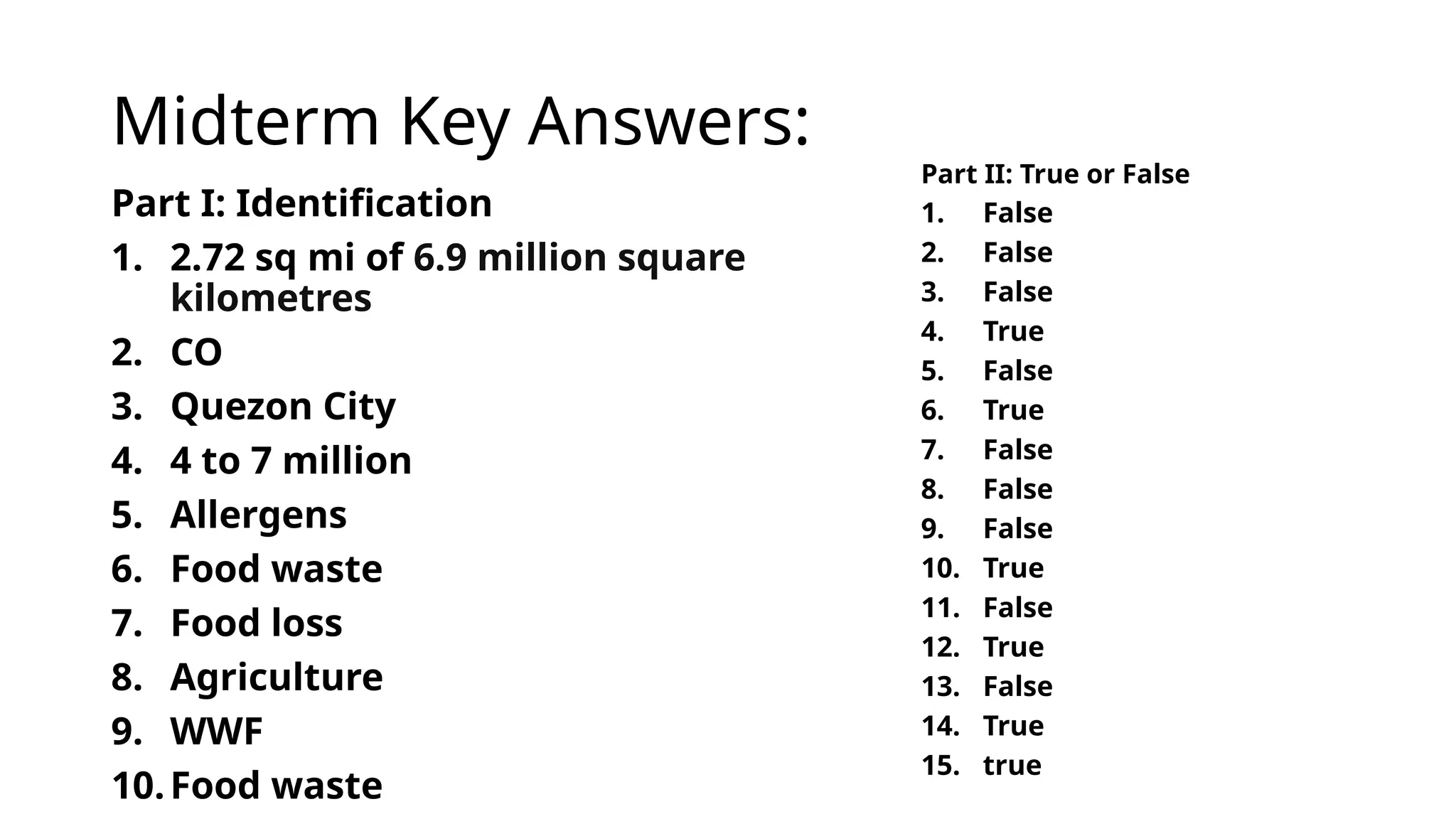
Part I: Identification
1. 2.72 sq mi of 6.9 million square
kilometres
2. CO
3. Quezon City
4. 4 to 7 million
5. Allergens
6. Food waste
7. Food loss
8. Agriculture
9. WWF
10.Food waste
Part II: True or False
1. False
2. False
3. False
4. True
5. False
6. True
7. False
8. False
9. False
10. True
11. False
12. True
13. False
14. True
15. true
Midterm Key Answers:
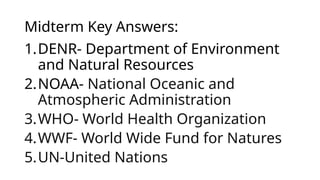
1.DENR- Department of Environment
and Natural Resources
2.NOAA- National Oceanic and
Atmospheric Administration
3.WHO- World Health Organization
4.WWF- World Wide Fund for Natures
5.UN-United Nations
Midterm Key Answers:
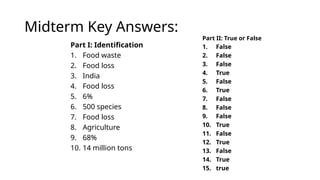
Part I: Identification
1. Food waste
2. Food loss
3. India
4. Food loss
5. 6%
6. 500 species
7. Food loss
8. Agriculture
9. 68%
10. 14 million tons
Part II: True or False
1. False
2. False
3. False
4. True
5. False
6. True
7. False
8. False
9. False
10. True
11. False
12. True
13. False
14. True
15. true
Midterm Key Answers:
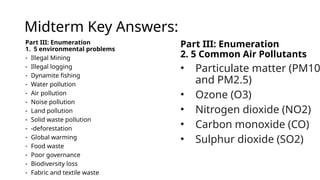
Part III: Enumeration
1. 5 environmental problems
- Illegal Mining
- Illegal logging
- Dynamite fishing
- Water pollution
- Air pollution
- Noise pollution
- Land pollution
- Solid waste pollution
- -deforestation
- Global warming
- Food waste
- Poor governance
- Biodiversity loss
- Fabric and textile waste
Part III: Enumeration
2. 5 Common Air Pollutants
• Particulate matter (PM10
and PM2.5)
• Ozone (O3)
• Nitrogen dioxide (NO2)
• Carbon monoxide (CO)
• Sulphur dioxide (SO2)
Midterm Key Answers:
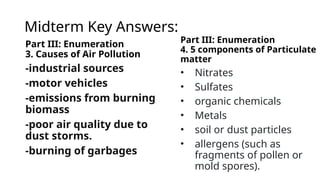
Part III: Enumeration
3. Causes of Air Pollution
-industrial sources
-motor vehicles
-emissions from burning
biomass
-poor air quality due to
dust storms.
-burning of garbages
Part III: Enumeration
4. 5 components of Particulate
matter
• Nitrates
• Sulfates
• organic chemicals
• Metals
• soil or dust particles
• allergens (such as
fragments of pollen or
mold spores).
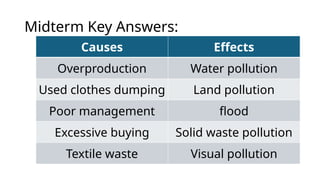
Midterm Key Answers:
Causes Effects
Overproduction Water pollution
Used clothes dumping Land pollution
Poor management flood
Excessive buying Solid waste pollution
Textile waste Visual pollution
Environmental Laws
Mariza R. Mapalo
GCE 1: People and Earth’s Ecosystem
Constitutional Policy and Framework on
Environmental Protection
• Our fundamental right to a healthy environment, however, is
primarily embodied in Section 16,
• Article II of the Constitution which states, "the State shall
protect and advance the right of the people to a balanced and
healthful ecology in accord with the rhythm and harmony of
nature."
• Other constitutional provisions also serve as basis for several
environmental laws. Section 15, Article II of the Constitution
states that,
"the State shall protect and promote the right to
health of the people and instill health
consciousness among them."
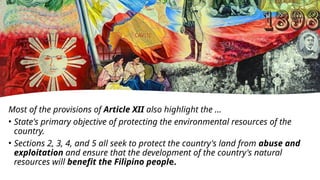
Most of the provisions of Article XII also highlight the …
• State's primary objective of protecting the environmental resources of the
country.
• Sections 2, 3, 4, and 5 all seek to protect the country's land from abuse and
exploitation and ensure that the development of the country's natural
resources will benefit the Filipino people.
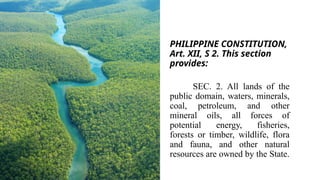
PHILIPPINE CONSTITUTION,
Art. XII, S 2. This section
provides:
SEC. 2. All lands of the
public domain, waters, minerals,
coal, petroleum, and other
mineral oils, all forces of
potential energy, fisheries,
forests or timber, wildlife, flora
and fauna, and other natural
resources are owned by the State.
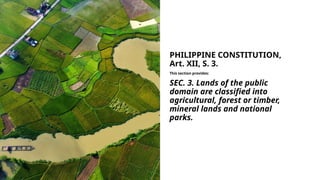
PHILIPPINE CONSTITUTION,
Art. XII, S. 3.
This section provides:
SEC. 3. Lands of the public
domain are classified into
agricultural, forest or timber,
mineral lands and national
parks.
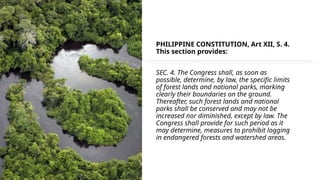
PHILIPPINE CONSTITUTION, Art XII, S. 4.
This section provides:
SEC. 4. The Congress shall, as soon as
possible, determine, by law, the specific limits
of forest lands and national parks, marking
clearly their boundaries on the ground.
Thereafter, such forest lands and national
parks shall be conserved and may not be
increased nor diminished, except by law. The
Congress shall provide for such period as it
may determine, measures to prohibit logging
in endangered forests and watershed areas.
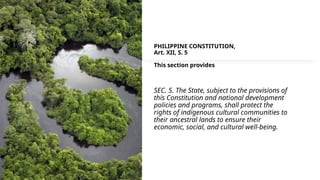
PHILIPPINE CONSTITUTION,
Art. XII, S. 5
This section provides
SEC. 5. The State, subject to the provisions of
this Constitution and national development
policies and programs, shall protect the
rights of indigenous cultural communities to
their ancestral lands to ensure their
economic, social, and cultural well-being.
Even prior to the 1987 Constitution,
Presidential Decree No. 1151 or the
Philippine Environmental Policy
declares as a continuing policy of
the state:
a.to create, develop, maintain, and improve
conditions under which man and nature can
thrive in productive and enjoyable harmony
with each other:
b.to fulfill the social, economic and other
requirements of present and future
generations of Filipino: and
c.to ensure the attainment of an environmental
quality that is conducive to a life of dignity and
well-being.
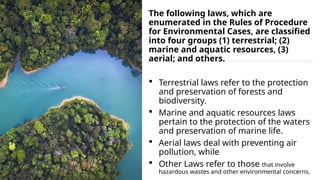
The following laws, which are
enumerated in the Rules of Procedure
for Environmental Cases, are classified
into four groups (1) terrestrial; (2)
marine and aquatic resources, (3)
aerial; and others.
 Terrestrial laws refer to the protection
and preservation of forests and
biodiversity.
 Marine and aquatic resources laws
pertain to the protection of the waters
and preservation of marine life.
 Aerial laws deal with preventing air
pollution, while
 Other Laws refer to those that involve
hazardous wastes and other environmental concerns.
Terrestrial Laws
Act No. 3572 (1929) An Act to Prohibit the Cutting
of Tindalo, Akle, or Molave
Trees, under Certain
Conditions, and to Penalize
Violations Thereof
Presidential Decree
No. 705
Revising Presidential Decree No,
389, Otherwise Known as the
Forestry Reform Code of the
Philippines [REVISED FORESTRY
Terrestrial Laws
Presidential Decree
No. 1433
Promulgating the Plant
Quarantine Law of 1978, Thereby
Revising and Consolidating
Existing Plant Quarantine Laws
to Further Improve and
Strengthen the Plant Quarantine
Service of the Bureau of Plant
Industry [Plant Quarantine
Terrestrial Laws
Republic Act No. 3571
(1963
An Act to Prohibit the Cutting,
Destroying or Injuring of
Planted or Growing Trees,
Flowering Plants and Shrubs
or Plants of Scenic Value along
Public Roads, in Plazas, Parks,
School Premises or in any
Other Public Ground
Terrestrial Laws
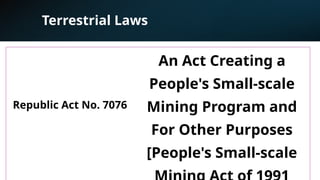
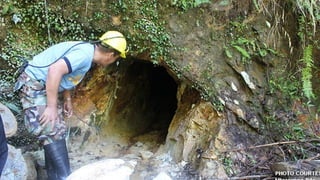
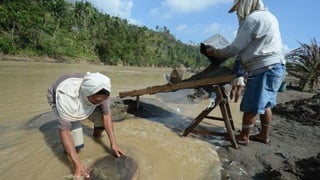
Republic Act No. 7076
An Act Creating a
People's Small-scale
Mining Program and
For Other Purposes
[People's Small-scale
Terrestrial Laws
Republic Act No.
9072
An Act Providing for the
Establishment and Management of
National Integrated Protected Areas
System, Defining its Scope and
Coverage, and for Other Purposes
[National Integrated Protected Areas
System Act of 1992]
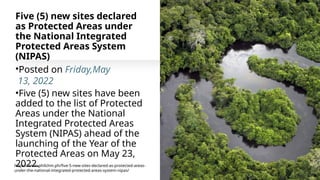
Five (5) new sites declared
as Protected Areas under
the National Integrated
Protected Areas System
(NIPAS)
•Posted on Friday,May
13, 2022
•Five (5) new sites have been
added to the list of Protected
Areas under the National
Integrated Protected Areas
System (NIPAS) ahead of the
launching of the Year of the
Protected Areas on May 23,
2022.
https://www.philchm.ph/five-5-new-sites-declared-as-protected-areas-
under-the-national-integrated-protected-areas-system-nipas/
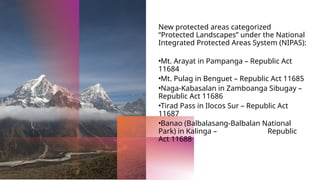
New protected areas categorized
“Protected Landscapes” under the National
Integrated Protected Areas System (NIPAS):
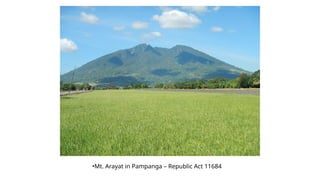
•Mt. Arayat in Pampanga – Republic Act
11684
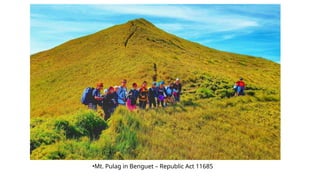
•Mt. Pulag in Benguet – Republic Act 11685
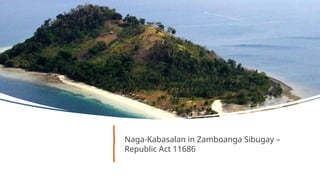
•Naga-Kabasalan in Zamboanga Sibugay –
Republic Act 11686
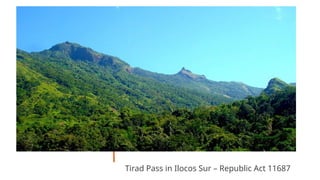
•Tirad Pass in Ilocos Sur – Republic Act
11687
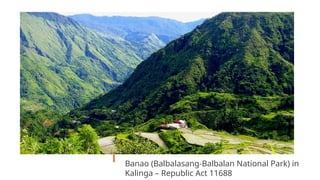
•Banao (Balbalasang-Balbalan National
Park) in Kalinga – Republic
Act 11688
•Mt. Arayat in Pampanga – Republic Act 11684
•Mt. Pulag in Benguet – Republic Act 11685
Naga-Kabasalan in Zamboanga Sibugay –
Republic Act 11686
Tirad Pass in Ilocos Sur – Republic Act 11687
Banao (Balbalasang-Balbalan National Park) in
Kalinga – Republic Act 11688
Terrestrial Laws
Republic Act No.
7586
An Act Providing for the
Establishment and Management
of National Integrated Protected
Areas System, Defining its Scope
and Coverage, and for Other
Purposes [National Integrated
Protected Areas System Act of
Terrestrial Laws
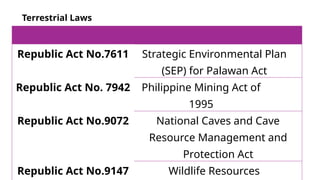
Republic Act No.7611 Strategic Environmental Plan
(SEP) for Palawan Act
Republic Act No. 7942 Philippine Mining Act of
1995
Republic Act No.9072 National Caves and Cave
Resource Management and
Protection Act
Republic Act No.9147 Wildlife Resources
Republic Act
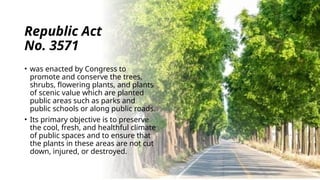
No. 3571
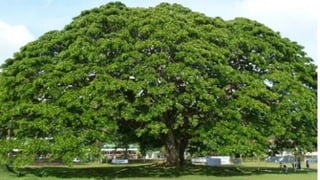
• was enacted by Congress to
promote and conserve the trees,
shrubs, flowering plants, and plants
of scenic value which are planted
public areas such as parks and
public schools or along public roads.
• Its primary objective is to preserve
the cool, fresh, and healthful climate
of public spaces and to ensure that
the plants in these areas are not cut
down, injured, or destroyed.
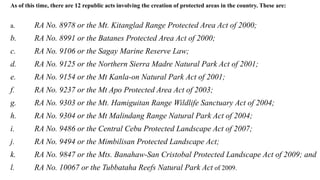
As of this time, there are 12 republic acts involving the creation of protected areas in the country. These are:
a. RA No. 8978 or the Mt. Kitanglad Range Protected Area Act of 2000;
b. RA No. 8991 or the Batanes Protected Area Act of 2000;
c. RA No. 9106 or the Sagay Marine Reserve Law;
d. RA No. 9125 or the Northern Sierra Madre Natural Park Act of 2001;
e. RA No. 9154 or the Mt Kanla-on Natural Park Act of 2001;
f. RA No. 9237 or the Mt Apo Protected Area Act of 2003;
g. RA No. 9303 or the Mt. Hamiguitan Range Wildlife Sanctuary Act of 2004;
h. RA No. 9304 or the Mt Malindang Range Natural Park Act of 2004;
i. RA No. 9486 or the Central Cebu Protected Landscape Act of 2007;
j. RA No. 9494 or the Mimbilisan Protected Landscape Act;
k. RA No. 9847 or the Mts. Banahaw-San Cristobal Protected Landscape Act of 2009; and
l. RA No. 10067 or the Tubbataha Reefs Natural Park Act of 2009.
Marine and Aquatic Resources Laws
Presidential Decree No. 979 Providing for the Revision of Presidential Decree No 600
Governing Marine Pollution [Marine Pollution Decree of 1976]
Presidential Decree No. 106 (1976) A Decree Instituting a Water Code. Thereby Revising and
Consolidating the Laws Governing the Ownership, Appropriation,
Utilization, Exploitation, Development, Conservation and
Protection of Water Resources [WATER CODE OF THE
PHILIPPINES]
Republic Act No. 4850 (1966). An Act Creating the Laguna Lake Development Authority,
Prescribing its Powers. Function and Duties. Providing Funds
Therefor, and for Other Purposes [Laguna Lake Development
Authority Act]
Republic Act No. 8550 An Act Providing for the Development, Management and
Conservation of the Fisheries and Aquatic Resources, Integrating
All Laws Pertinent Thereto, and for Other Purposes [PHILIPPINE
FISHERIES CODE OF 1998
Republic Act No. 9275 (2004). An Act Providing for a Comprehensive Water Quality
Management, and for Other Purposes [Philippine Clean Water Act
Presidential Decree No. 979
or the Marine Pollution
Decree of 1976
• was issued in recognition of
the vital importance of the
marine environment and the
need to address the growing
marine pollution in the
country.
• The law prevents the further
destruction of the marine
environment by penalizing
certain acts that cause
marine pollution, such as
dumping and discharging to
rivers, brooks, and springs.
Presidential Decree No. 1067 or the
Water Code of the Philippines
• was promulgated in 1976 in order to
consolidate the various water
legislations.
• It establishes the framework for the
appropriation, utilization, control,
and conservation of water resources
in the country in recognition of the
increasing scarcity of water supply
and resources.
• The law therefore seeks to provide
proper management of the country's
water resources to sufficiently meet
future developments and needs.
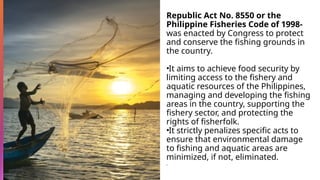
Republic Act No. 8550 or the
Philippine Fisheries Code of 1998-
was enacted by Congress to protect
and conserve the fishing grounds in
the country.
•It aims to achieve food security by
limiting access to the fishery and
aquatic resources of the Philippines,
managing and developing the fishing
areas in the country, supporting the
fishery sector, and protecting the
rights of fisherfolk.
•It strictly penalizes specific acts to
ensure that environmental damage
to fishing and aquatic areas are
minimized, if not, eliminated.
•
Republic Act No. 9275 or the
Philippine Clean Water Act of
2004- aims to preserve, and
revive the quality of the
country's fresh, brackish, and
marine waters by promoting
environmental strategies
geared towards the protection
of water resources.
• It also formulates an
integrated water quality
management framework for
the utilization and
development of the
country's water supply
and for the prevention of
water pollution.
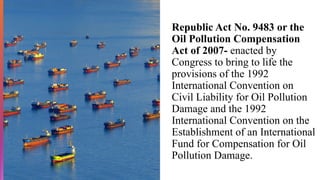
Republic Act No. 9483 or the
Oil Pollution Compensation
Act of 2007- enacted by
Congress to bring to life the
provisions of the 1992
International Convention on
Civil Liability for Oil Pollution
Damage and the 1992
International Convention on the
Establishment of an International
Fund for Compensation for Oil
Pollution Damage.
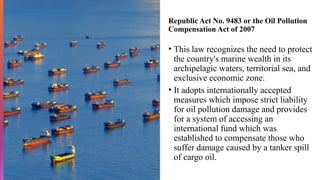
Republic Act No. 9483 or the Oil Pollution
Compensation Act of 2007
• This law recognizes the need to protect
the country's marine wealth in its
archipelagic waters, territorial sea, and
exclusive economic zone.
• It adopts internationally accepted
measures which impose strict liability
for oil pollution damage and provides
for a system of accessing an
international fund which was
established to compensate those who
suffer damage caused by a tanker spill
of cargo oil.
Aerial
Law
Republic Act No. 8749 or the Philippine
Clean Air Act of 1999- espouses the
constitutional right of the people to a balanced
and healthful ecology.
Aerial
Law
In recognition of the dangers of air pollution and the need for a
clean habitat and environment the law provides for an integrated
air quality improvement framework designed to implement a
management and control program to reduce emissions and prevent
air pollution.
It also provides for an air quality control action plan that shall be
implemented to enforce appropriate devices, methods, systems, and
measures to ensure air quality control.
Other Laws
Presidential Decree No. 856
(1975).
Code on Sanitation of the Philippines [CODE ON SANITATION OF
THE PHILIPPINES]
Republic Act No. 6969 An Act to Control Toxic Substances and Hazardous and Nuclear
Wastes Providing Penalties for Violations Thereof, and for Other
Purposes [Toxic Substances and Hazardous and Nuclear Wastes
Control Act of 1990].
Republic Act No. 8371 (1997) An Act to Recognize, Protect and Promote the Rights of Indigenous
Cultural Communities/Indigenous People, Creating a National
Commission of Indigenous People, Establishing Implementing
Mechanisms, Appropriating Funds Therefor, and for Other Purposes
[Indigenous Peoples Rights Act]
Republic Act No. 9003 An Act Providing for an Ecological Solid Waste Management Program,
Creating the Necessary Institutional Mechanisms and Incentives,
Declaring Certain Acts Prohibited and Providing Penalties,
Appropriating Funds Therefor, and for Other Purposes [Ecological
Solid Waste Management Act of 2000.
Republic Act No. 9729 An Act Mainstreaming Climate Change into Government Policy
• recognizes that the health of the people is of paramount
importance; therefore, there is a need to improve public
services that are directed towards the protection and
promotion of health.
• The law provides guidelines for sanitary conditions of food
establishments, public laundry, schools, public swimming
or bathing places, bus stations, and more.
• The Department of Health (DOH) is tasked to regulate the
proper sanitation conditions and monitor the covered premises
for violations of sanitary conditions as provided for in this law.
Presidential Decree No. 856 or the Code on
Sanitation of the Philippines
•enacted by Congress to regulate, restrict, or prohibit
the importation, manufacture, processing, sale,
distribution, use and disposal of chemical
substances and mixtures that present unreasonable
risk and/or injury to health or the environment.
•It also prohibits the entry of hazardous materials
and nuclear wastes into the country.
Republic Act No. 6969 or the Toxic Substances and
Hazardous and Nuclear Wastes Control Act of 1990
Republic Act No. 8371 or the
Indigenous Peoples Rights
Act of 1997-is also treated as
an Environmental Law by virtue
of its provisions protecting the
ancestral domains and
imposing the requirement
upon project proponents to
secure the Free Prior and
Informed Consent of the
affected Indigenous Peoples
before the utilization of natural
resources over their ancestral
domains can be made.
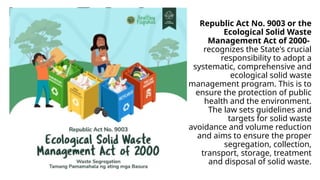
Republic Act No. 9003 or the
Ecological Solid Waste
Management Act of 2000-
recognizes the State's crucial
responsibility to adopt a
systematic, comprehensive and
ecological solid waste
management program. This is to
ensure the protection of public
health and the environment.
The law sets guidelines and
targets for solid waste
avoidance and volume reduction
and aims to ensure the proper
segregation, collection,
transport, storage, treatment
and disposal of solid waste.
Republic Act No. 9729 or
the Philippine Climate
Change Act of 2009 is a
new development in
Environmental Law.
It declares as a policy of the State to
'"systematically integrate the
concept of climate change in various
phases of policy formulation,
development plans, poverty
reduction strategies and other
developmental tools and techniques
by all agencies and instrumentalities
of the government."
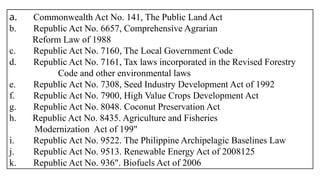
a. Commonwealth Act No. 141, The Public Land Act
b. Republic Act No. 6657, Comprehensive Agrarian
Reform Law of 1988
c. Republic Act No. 7160, The Local Government Code
d. Republic Act No. 7161, Tax laws incorporated in the Revised Forestry
Code and other environmental laws
e. Republic Act No. 7308, Seed Industry Development Act of 1992
f. Republic Act No. 7900, High Value Crops Development Act
g. Republic Act No. 8048. Coconut Preservation Act
h. Republic Act No. 8435. Agriculture and Fisheries
Modernization Act of 199"
i. Republic Act No. 9522. The Philippine Archipelagic Baselines Law
j. Republic Act No. 9513. Renewable Energy Act of 2008125
k. Republic Act No. 936". Biofuels Act of 2006

PCLU_MIDTERM_LESSON 2_Environmentals LAws.pptx

  • 1.
    Midterm Key Answers: PartI: Identification 1. 2.72 sq mi of 6.9 million square kilometres 2. CO 3. Quezon City 4. 4 to 7 million 5. Allergens 6. Food waste 7. Food loss 8. Agriculture 9. WWF 10.Food waste Part II: True or False 1. False 2. False 3. False 4. True 5. False 6. True 7. False 8. False 9. False 10. True 11. False 12. True 13. False 14. True 15. true
  • 2.
    Midterm Key Answers: 1.DENR-Department of Environment and Natural Resources 2.NOAA- National Oceanic and Atmospheric Administration 3.WHO- World Health Organization 4.WWF- World Wide Fund for Natures 5.UN-United Nations
  • 3.
    Midterm Key Answers: PartI: Identification 1. Food waste 2. Food loss 3. India 4. Food loss 5. 6% 6. 500 species 7. Food loss 8. Agriculture 9. 68% 10. 14 million tons Part II: True or False 1. False 2. False 3. False 4. True 5. False 6. True 7. False 8. False 9. False 10. True 11. False 12. True 13. False 14. True 15. true
  • 4.
    Midterm Key Answers: PartIII: Enumeration 1. 5 environmental problems - Illegal Mining - Illegal logging - Dynamite fishing - Water pollution - Air pollution - Noise pollution - Land pollution - Solid waste pollution - -deforestation - Global warming - Food waste - Poor governance - Biodiversity loss - Fabric and textile waste Part III: Enumeration 2. 5 Common Air Pollutants • Particulate matter (PM10 and PM2.5) • Ozone (O3) • Nitrogen dioxide (NO2) • Carbon monoxide (CO) • Sulphur dioxide (SO2)
  • 5.
    Midterm Key Answers: PartIII: Enumeration 3. Causes of Air Pollution -industrial sources -motor vehicles -emissions from burning biomass -poor air quality due to dust storms. -burning of garbages Part III: Enumeration 4. 5 components of Particulate matter • Nitrates • Sulfates • organic chemicals • Metals • soil or dust particles • allergens (such as fragments of pollen or mold spores).
  • 6.
    Midterm Key Answers: CausesEffects Overproduction Water pollution Used clothes dumping Land pollution Poor management flood Excessive buying Solid waste pollution Textile waste Visual pollution
  • 7.
    Environmental Laws Mariza R.Mapalo GCE 1: People and Earth’s Ecosystem
  • 8.
    Constitutional Policy andFramework on Environmental Protection • Our fundamental right to a healthy environment, however, is primarily embodied in Section 16, • Article II of the Constitution which states, "the State shall protect and advance the right of the people to a balanced and healthful ecology in accord with the rhythm and harmony of nature." • Other constitutional provisions also serve as basis for several environmental laws. Section 15, Article II of the Constitution states that, "the State shall protect and promote the right to health of the people and instill health consciousness among them."
  • 9.
    Most of theprovisions of Article XII also highlight the … • State's primary objective of protecting the environmental resources of the country. • Sections 2, 3, 4, and 5 all seek to protect the country's land from abuse and exploitation and ensure that the development of the country's natural resources will benefit the Filipino people.
  • 10.
    PHILIPPINE CONSTITUTION, Art. XII,S 2. This section provides: SEC. 2. All lands of the public domain, waters, minerals, coal, petroleum, and other mineral oils, all forces of potential energy, fisheries, forests or timber, wildlife, flora and fauna, and other natural resources are owned by the State.
  • 11.
    PHILIPPINE CONSTITUTION, Art. XII,S. 3. This section provides: SEC. 3. Lands of the public domain are classified into agricultural, forest or timber, mineral lands and national parks.
  • 12.
    PHILIPPINE CONSTITUTION, ArtXII, S. 4. This section provides: SEC. 4. The Congress shall, as soon as possible, determine, by law, the specific limits of forest lands and national parks, marking clearly their boundaries on the ground. Thereafter, such forest lands and national parks shall be conserved and may not be increased nor diminished, except by law. The Congress shall provide for such period as it may determine, measures to prohibit logging in endangered forests and watershed areas.
  • 13.
    PHILIPPINE CONSTITUTION, Art. XII,S. 5 This section provides SEC. 5. The State, subject to the provisions of this Constitution and national development policies and programs, shall protect the rights of indigenous cultural communities to their ancestral lands to ensure their economic, social, and cultural well-being.
  • 14.
    Even prior tothe 1987 Constitution, Presidential Decree No. 1151 or the Philippine Environmental Policy declares as a continuing policy of the state: a.to create, develop, maintain, and improve conditions under which man and nature can thrive in productive and enjoyable harmony with each other: b.to fulfill the social, economic and other requirements of present and future generations of Filipino: and c.to ensure the attainment of an environmental quality that is conducive to a life of dignity and well-being.
  • 15.
    The following laws,which are enumerated in the Rules of Procedure for Environmental Cases, are classified into four groups (1) terrestrial; (2) marine and aquatic resources, (3) aerial; and others.  Terrestrial laws refer to the protection and preservation of forests and biodiversity.  Marine and aquatic resources laws pertain to the protection of the waters and preservation of marine life.  Aerial laws deal with preventing air pollution, while  Other Laws refer to those that involve hazardous wastes and other environmental concerns.
  • 16.
    Terrestrial Laws Act No.3572 (1929) An Act to Prohibit the Cutting of Tindalo, Akle, or Molave Trees, under Certain Conditions, and to Penalize Violations Thereof Presidential Decree No. 705 Revising Presidential Decree No, 389, Otherwise Known as the Forestry Reform Code of the Philippines [REVISED FORESTRY
  • 23.
    Terrestrial Laws Presidential Decree No.1433 Promulgating the Plant Quarantine Law of 1978, Thereby Revising and Consolidating Existing Plant Quarantine Laws to Further Improve and Strengthen the Plant Quarantine Service of the Bureau of Plant Industry [Plant Quarantine
  • 25.
    Terrestrial Laws Republic ActNo. 3571 (1963 An Act to Prohibit the Cutting, Destroying or Injuring of Planted or Growing Trees, Flowering Plants and Shrubs or Plants of Scenic Value along Public Roads, in Plazas, Parks, School Premises or in any Other Public Ground
  • 26.
    Terrestrial Laws Republic ActNo. 7076 An Act Creating a People's Small-scale Mining Program and For Other Purposes [People's Small-scale
  • 29.
    Terrestrial Laws Republic ActNo. 9072 An Act Providing for the Establishment and Management of National Integrated Protected Areas System, Defining its Scope and Coverage, and for Other Purposes [National Integrated Protected Areas System Act of 1992]
  • 30.
    Five (5) newsites declared as Protected Areas under the National Integrated Protected Areas System (NIPAS) •Posted on Friday,May 13, 2022 •Five (5) new sites have been added to the list of Protected Areas under the National Integrated Protected Areas System (NIPAS) ahead of the launching of the Year of the Protected Areas on May 23, 2022. https://www.philchm.ph/five-5-new-sites-declared-as-protected-areas- under-the-national-integrated-protected-areas-system-nipas/
  • 31.
    New protected areascategorized “Protected Landscapes” under the National Integrated Protected Areas System (NIPAS): •Mt. Arayat in Pampanga – Republic Act 11684 •Mt. Pulag in Benguet – Republic Act 11685 •Naga-Kabasalan in Zamboanga Sibugay – Republic Act 11686 •Tirad Pass in Ilocos Sur – Republic Act 11687 •Banao (Balbalasang-Balbalan National Park) in Kalinga – Republic Act 11688
  • 32.
    •Mt. Arayat inPampanga – Republic Act 11684
  • 33.
    •Mt. Pulag inBenguet – Republic Act 11685
  • 34.
    Naga-Kabasalan in ZamboangaSibugay – Republic Act 11686
  • 35.
    Tirad Pass inIlocos Sur – Republic Act 11687
  • 36.
    Banao (Balbalasang-Balbalan NationalPark) in Kalinga – Republic Act 11688
  • 37.
    Terrestrial Laws Republic ActNo. 7586 An Act Providing for the Establishment and Management of National Integrated Protected Areas System, Defining its Scope and Coverage, and for Other Purposes [National Integrated Protected Areas System Act of
  • 38.
    Terrestrial Laws Republic ActNo.7611 Strategic Environmental Plan (SEP) for Palawan Act Republic Act No. 7942 Philippine Mining Act of 1995 Republic Act No.9072 National Caves and Cave Resource Management and Protection Act Republic Act No.9147 Wildlife Resources
  • 39.
    Republic Act No. 3571 •was enacted by Congress to promote and conserve the trees, shrubs, flowering plants, and plants of scenic value which are planted public areas such as parks and public schools or along public roads. • Its primary objective is to preserve the cool, fresh, and healthful climate of public spaces and to ensure that the plants in these areas are not cut down, injured, or destroyed.
  • 40.
    As of thistime, there are 12 republic acts involving the creation of protected areas in the country. These are: a. RA No. 8978 or the Mt. Kitanglad Range Protected Area Act of 2000; b. RA No. 8991 or the Batanes Protected Area Act of 2000; c. RA No. 9106 or the Sagay Marine Reserve Law; d. RA No. 9125 or the Northern Sierra Madre Natural Park Act of 2001; e. RA No. 9154 or the Mt Kanla-on Natural Park Act of 2001; f. RA No. 9237 or the Mt Apo Protected Area Act of 2003; g. RA No. 9303 or the Mt. Hamiguitan Range Wildlife Sanctuary Act of 2004; h. RA No. 9304 or the Mt Malindang Range Natural Park Act of 2004; i. RA No. 9486 or the Central Cebu Protected Landscape Act of 2007; j. RA No. 9494 or the Mimbilisan Protected Landscape Act; k. RA No. 9847 or the Mts. Banahaw-San Cristobal Protected Landscape Act of 2009; and l. RA No. 10067 or the Tubbataha Reefs Natural Park Act of 2009.
  • 41.
    Marine and AquaticResources Laws Presidential Decree No. 979 Providing for the Revision of Presidential Decree No 600 Governing Marine Pollution [Marine Pollution Decree of 1976] Presidential Decree No. 106 (1976) A Decree Instituting a Water Code. Thereby Revising and Consolidating the Laws Governing the Ownership, Appropriation, Utilization, Exploitation, Development, Conservation and Protection of Water Resources [WATER CODE OF THE PHILIPPINES] Republic Act No. 4850 (1966). An Act Creating the Laguna Lake Development Authority, Prescribing its Powers. Function and Duties. Providing Funds Therefor, and for Other Purposes [Laguna Lake Development Authority Act] Republic Act No. 8550 An Act Providing for the Development, Management and Conservation of the Fisheries and Aquatic Resources, Integrating All Laws Pertinent Thereto, and for Other Purposes [PHILIPPINE FISHERIES CODE OF 1998 Republic Act No. 9275 (2004). An Act Providing for a Comprehensive Water Quality Management, and for Other Purposes [Philippine Clean Water Act
  • 42.
    Presidential Decree No.979 or the Marine Pollution Decree of 1976 • was issued in recognition of the vital importance of the marine environment and the need to address the growing marine pollution in the country. • The law prevents the further destruction of the marine environment by penalizing certain acts that cause marine pollution, such as dumping and discharging to rivers, brooks, and springs.
  • 43.
    Presidential Decree No.1067 or the Water Code of the Philippines • was promulgated in 1976 in order to consolidate the various water legislations. • It establishes the framework for the appropriation, utilization, control, and conservation of water resources in the country in recognition of the increasing scarcity of water supply and resources. • The law therefore seeks to provide proper management of the country's water resources to sufficiently meet future developments and needs.
  • 44.
    Republic Act No.8550 or the Philippine Fisheries Code of 1998- was enacted by Congress to protect and conserve the fishing grounds in the country. •It aims to achieve food security by limiting access to the fishery and aquatic resources of the Philippines, managing and developing the fishing areas in the country, supporting the fishery sector, and protecting the rights of fisherfolk. •It strictly penalizes specific acts to ensure that environmental damage to fishing and aquatic areas are minimized, if not, eliminated. •
  • 45.
    Republic Act No.9275 or the Philippine Clean Water Act of 2004- aims to preserve, and revive the quality of the country's fresh, brackish, and marine waters by promoting environmental strategies geared towards the protection of water resources. • It also formulates an integrated water quality management framework for the utilization and development of the country's water supply and for the prevention of water pollution.
  • 46.
    Republic Act No.9483 or the Oil Pollution Compensation Act of 2007- enacted by Congress to bring to life the provisions of the 1992 International Convention on Civil Liability for Oil Pollution Damage and the 1992 International Convention on the Establishment of an International Fund for Compensation for Oil Pollution Damage.
  • 47.
    Republic Act No.9483 or the Oil Pollution Compensation Act of 2007 • This law recognizes the need to protect the country's marine wealth in its archipelagic waters, territorial sea, and exclusive economic zone. • It adopts internationally accepted measures which impose strict liability for oil pollution damage and provides for a system of accessing an international fund which was established to compensate those who suffer damage caused by a tanker spill of cargo oil.
  • 48.
    Aerial Law Republic Act No.8749 or the Philippine Clean Air Act of 1999- espouses the constitutional right of the people to a balanced and healthful ecology.
  • 49.
    Aerial Law In recognition ofthe dangers of air pollution and the need for a clean habitat and environment the law provides for an integrated air quality improvement framework designed to implement a management and control program to reduce emissions and prevent air pollution. It also provides for an air quality control action plan that shall be implemented to enforce appropriate devices, methods, systems, and measures to ensure air quality control.
  • 50.
    Other Laws Presidential DecreeNo. 856 (1975). Code on Sanitation of the Philippines [CODE ON SANITATION OF THE PHILIPPINES] Republic Act No. 6969 An Act to Control Toxic Substances and Hazardous and Nuclear Wastes Providing Penalties for Violations Thereof, and for Other Purposes [Toxic Substances and Hazardous and Nuclear Wastes Control Act of 1990]. Republic Act No. 8371 (1997) An Act to Recognize, Protect and Promote the Rights of Indigenous Cultural Communities/Indigenous People, Creating a National Commission of Indigenous People, Establishing Implementing Mechanisms, Appropriating Funds Therefor, and for Other Purposes [Indigenous Peoples Rights Act] Republic Act No. 9003 An Act Providing for an Ecological Solid Waste Management Program, Creating the Necessary Institutional Mechanisms and Incentives, Declaring Certain Acts Prohibited and Providing Penalties, Appropriating Funds Therefor, and for Other Purposes [Ecological Solid Waste Management Act of 2000. Republic Act No. 9729 An Act Mainstreaming Climate Change into Government Policy
  • 51.
    • recognizes thatthe health of the people is of paramount importance; therefore, there is a need to improve public services that are directed towards the protection and promotion of health. • The law provides guidelines for sanitary conditions of food establishments, public laundry, schools, public swimming or bathing places, bus stations, and more. • The Department of Health (DOH) is tasked to regulate the proper sanitation conditions and monitor the covered premises for violations of sanitary conditions as provided for in this law. Presidential Decree No. 856 or the Code on Sanitation of the Philippines
  • 52.
    •enacted by Congressto regulate, restrict, or prohibit the importation, manufacture, processing, sale, distribution, use and disposal of chemical substances and mixtures that present unreasonable risk and/or injury to health or the environment. •It also prohibits the entry of hazardous materials and nuclear wastes into the country. Republic Act No. 6969 or the Toxic Substances and Hazardous and Nuclear Wastes Control Act of 1990
  • 55.
    Republic Act No.8371 or the Indigenous Peoples Rights Act of 1997-is also treated as an Environmental Law by virtue of its provisions protecting the ancestral domains and imposing the requirement upon project proponents to secure the Free Prior and Informed Consent of the affected Indigenous Peoples before the utilization of natural resources over their ancestral domains can be made.
  • 56.
    Republic Act No.9003 or the Ecological Solid Waste Management Act of 2000- recognizes the State's crucial responsibility to adopt a systematic, comprehensive and ecological solid waste management program. This is to ensure the protection of public health and the environment. The law sets guidelines and targets for solid waste avoidance and volume reduction and aims to ensure the proper segregation, collection, transport, storage, treatment and disposal of solid waste.
  • 57.
    Republic Act No.9729 or the Philippine Climate Change Act of 2009 is a new development in Environmental Law. It declares as a policy of the State to '"systematically integrate the concept of climate change in various phases of policy formulation, development plans, poverty reduction strategies and other developmental tools and techniques by all agencies and instrumentalities of the government."
  • 58.
    a. Commonwealth ActNo. 141, The Public Land Act b. Republic Act No. 6657, Comprehensive Agrarian Reform Law of 1988 c. Republic Act No. 7160, The Local Government Code d. Republic Act No. 7161, Tax laws incorporated in the Revised Forestry Code and other environmental laws e. Republic Act No. 7308, Seed Industry Development Act of 1992 f. Republic Act No. 7900, High Value Crops Development Act g. Republic Act No. 8048. Coconut Preservation Act h. Republic Act No. 8435. Agriculture and Fisheries Modernization Act of 199" i. Republic Act No. 9522. The Philippine Archipelagic Baselines Law j. Republic Act No. 9513. Renewable Energy Act of 2008125 k. Republic Act No. 936". Biofuels Act of 2006