Pneumocystis jirovecii
Pneumonia
Emilie Catherinot, MD, PhD
a,b
, Fanny Lanternier, MD, MSc
a
,
Marie-Elisabeth Bougnoux, MD, PhD
c
, Marc Lecuit, MD, PhD
a
,
Louis-Jean Couderc, MD, PhD
b
, Olivier Lortholary, MD, PhD
a,d,
*
Pneumocystis has gained attention during the last decade in the context of the AIDS
epidemic and the increasing use of cytotoxic and immunosuppressive therapies. The
accumulation of knowledge about this curious fungus is continuous. This article
summarizes current knowledge on biology, pathophysiology, epidemiology, diag-
nosis, prevention, and treatment of pulmonary Pneumocystis jirovecii infection, with
a particular focus on the evolving pathophysiology and epidemiology.
HISTORICAL BACKGROUND OF PNEUMOCYSTIS SPP
Members of the fungal genus now known as Pneumocystis were first identified in 1909
by Chagas in the lung of guinea pigs that had been experimentally infected with Try-
panosoma cruzi. Chagas thought he had identified a new trypanosomal life form. In
1910, Carini noted morphologically similar organisms in the lung of rats infected
with Trypanosoma lewisi, and likewise thought they were a new type of trypanosome.
In 1912, Delanoe and Delanoe, working at the Institut Pasteur, Paris, reviewed Carini’s
data and observed the cysts in the lung of Parisian sewer rats. Delanoe and Delanoe
realized this was a unique organism and a separate species from Trypanosoma, and
named it Pneumocystis carinii, Pneumocystis highlighting the pulmonary tropism and
pathogenesis of the organism, carinii in honor of A. Carini.1
a
Universit
e Paris Descartes, Service de Maladies Infectieuses et Tropicales, 149 Rue de Sèvres,
Centre d’Infectiologie Necker-Pasteur, Hôpital Necker-Enfants Malades, Paris 75015, France
b
Universit
e Versailles-Saint Quentin, Hôpital Foch, Service de Pneumologie, Suresnes, France
c
Universit
e Paris Descartes, Hôpital Necker-Enfants Malades, Service de Microbiologie, Paris
75015, France
d
Institut Pasteur, Centre National de R
ef
erence Mycologie et antifongiques, Paris, France
* Corresponding author. Universit
e Paris Descartes, Hôpital Necker-Enfants Malades, Centre
d’Infectiologie Necker-Pasteur, Service de Maladies Infectieuses et Tropicales, 149 Rue de Sèv-
res, Paris 75015, France.
E-mail address: olivier.lortholary@nck.aphp.fr (O. Lortholary).
KEYWORDS
 Pneumocystis jirovecii  AIDS  Pulmonary infections
 Chemoprophylaxis
Infect Dis Clin N Am 24 (2010) 107–138
doi:10.1016/j.idc.2009.10.010 id.theclinics.com
0891-5520/10/$ – see front matter ª 2010 Elsevier Inc. All rights reserved.
Just before World War II, German physicians described an epidemic form of inter-
stitial plasma cell pneumonitis of unknown etiology occurring in malnourished infants.2
A first relationship between Pneumocystis infection and disease was suggested in
1942, when Van der Meer and Brug observed Pneumocystis in lung sections from
infants with plasma cell pneumonitis.3
This observation was largely ignored. In 1951
and 1952, the Czech pathologists Vanek and Jirovec reported the association of
Pneumocystis in the lung among premature and malnourished children with interstitial
plasma cell pneumonitis housed in nursing homes of Central and Eastern Europe.4
By
the end of 1980, starvation and premature birth were important causes of Pneumocys-
tis pneumonia (PCP). Among 3346 cases of PCP reported worldwide, 2281 (68%)
occurred among infants whose predisposition was either malnutrition or prematurity.5
In 1955, Weller observed that prolonged high-dose dexamethasone corticosteroid
treatment of rats resulted in pneumocystosis.6
In the 1960s, Pneumocystis started
to be recognized as an opportunistic pathogen in immunosuppressed children with
acute leukemia or with congenital immunodeficiency impairing T-lymphocyte func-
tion.7,8
In 1981, PCP was the first opportunistic infection reported in homosexual
men in the United States, presenting with what was idiomatically coined the ‘‘Gay’s
syndrome,’’ subsequently known as the acquired immunodeficiency syndrome
(AIDS).9,10
With the extent of the AIDS epidemic, there was a dramatic increase in
the incidence of pneumocystosis. During the 1980s PCP was the AIDS-defining illness
for more than half of adults and adolescents with AIDS in the United States.11
The
introduction of pneumocystosis prophylaxis in 1989 and potent combination antiretro-
viral therapy in 1996 have led to substantial declines in the incidence of PCP in human
immunodeficiency virus (HIV)-infected persons.12,13
However, PCP remains a leading
cause of opportunistic infection, morbidity, and mortality in HIV-infected persons who
either are not receiving or are not responding to highly active antiretroviral treatment
(HAART) and among those who are unaware of their HIV status.14
PCP is also of clin-
ical importance in non-HIV immunocompromised persons, such as patients receiving
immunosuppressive treatment or antineoplastic chemotherapy.
TAXONOMY
Pneumocystis organisms were considered to form a unique taxonomic entity (desig-
nated as P carinii). Recent research has demonstrated that the genus Pneumocystis
is in fact a complex group with numerous species. Based on morphologic criteria
and response of the infection to treatment with the antiprotozoan drug pentamidine,
it was initially thought that P carinii was a protozoan. In 1988, Edman and Stringer
independently showed that the ribosomal RNA sequences of P carinii were related
to those of fungus and completely unrelated to those of other parasites.15,16
All recent
phylogenetic analyses place Pneumocystis within the fungal kingdom. Pneumocystis
species are currently classified within the phylum Ascomycota, in a unique class,
order, and family (Pneumocystidomycetes, Pneumocystidales, and Pneumocystida-
cae, respectively).17
However, Pneumocystis organisms are atypical fungal microor-
ganisms: (1) they are unable to grow in vitro in fungal culture media; (2) they
respond to antiparasitic agents like pentamidine and cotrimoxazole; (3) their cell
wall contains cholesterol rather than ergosterol—this difference explains why ampho-
tericin B is inactive against Pneumocystis spp.
In 1976, Frenkel noted phenotypic differences between Pneumocystis from different
mammals and proposed to elevate the organism that infects humans as a different
species.18
He named it Pneumocystis jiroveci, in recognition to the pathologist Jirovec
who early reported the organism in humans. The name did not gain acceptance at this
Catherinot et al
108
time. The first indication of a molecular difference between Pneumocystis organisms
from humans and laboratory animals came from analyses of protein sizes.19
However,
demonstration that differences observed in protein sizes resulted from interspecies
variability was difficult to establish because of possible confounding factors such as
possible host-mediated modification of Pneumocystis proteins, presence of dead
organisms, or contamination with host proteins.
DNA analysis provided further evidence of genetic divergence between Pneumo-
cystis organisms.20
The 18S rRNA sequences from human-derived Pneumocystis
and rat-derived Pneumocystis differ by 5%. Several other genes or gene fragments
have been analyzed.21–28
In all cases, the gene sequence differed between host
species. In addition, experiments with rats, mice, ferrets, and nonhuman primates
have demonstrated host-species specificity.29–31
At the 2001 International Workshop on Opportunistic Protists in Cincinnati, the
group of researchers discussed the nomenclature of Pneumocystis and proposed to
rename the organisms currently named as special forms of P carinii as species in
the genus Pneumocystis, and drew up guidelines for the creation of a new species
name.32
Pneumocystis jiroveci was chosen to deign the form that infects humans
and Pneumocystis carinii to deign 1 of the 2 the species that infect rats, in which it
was first recognized. DNA analysis further demonstrated that DNA sequence polymor-
phisms were often observed in isolates of P jiroveci, suggesting that multiple strains
exist.20
The correct and valid name according to the international code of zoologic
nomenclature (ICBU) is P jirovecii with a double ‘‘i.’’ To date, taxonomy and nomencla-
ture for these organisms is a focus of continuing controversy.33–35
BASIC BIOLOGY AND IMMUNOPATHOGENESIS
Life Cycle
Many investigators have attempted to cultivate Pneumocystis using a variety of tech-
niques, but have had limited success, impeding studies of Pneumocystis. Studies of
the life cycle of Pneumocystis have been based mainly on light and electron micro-
scopic analysis of forms seen in infected lungs or short-term culture.36
There are 2
predominant life cycle forms, the trophic form and the cyst form. The trophic form is
small (1–4 mm) and predominate over the cyst form during infection by approximately
10 to 1. The mature cyst is 8 to 10 mm in diameter. Three intermediate cyst stages
(early, intermediate, and late precysts) have been visualized. It has been hypothesized
that the trophic form can conjugate and develop into cysts that undergo maturation,
then the mature cyst, containing 8 intracystic nuclei, produce trophic forms as it
ruptures. This model is compatible with the life cycle of other ascomyceteous fungi.
Whether encystment stage is an obligate step for the replication of the trophic forms
remains a matter of controversy.37
Interaction with Host Cells
In an infected host, Pneumocystis exists almost exclusively within the alveoli of the
lung. The trophic forms attach to the alveolar epithelium, through interdigitation of their
cell membranes with those of the host cells. Ultrastructural analysis has shown that
the adherence is characterized by close apposition of the cell surfaces without fusion
of the membranes or changes in the intramenbranous particles.38,39
Studies using
cultured lung epithelial cells showed that adherence of Pneumocystis alone does
not disrupt alveolar epithelial cell structure or the barrier function.36
Pneumocystis
maintains an extracellular existence within alveoli, and probably obtains essential
nutrients from the alveolar fluid or living cells.39
Pneumocystis jirovecii Pneumonia 109
Binding of Pneumocystis to alveolar epithelial cell is facilitated by both fibronectin
and vitronectin that are present in alveolar lung fluid. These proteins coat the surface
of Pneumocystis and subsequently mediate attachment, presumably working through
cognate integrins, as well as through mannose binding receptors on the host cells.37
Interaction of Pneumocystis with alveolar epithelial cell and alveolar macrophages
initiates cascades of cellular response in both Pneumocystis organism and lung cells.
It has been demonstrated that attachment of Pneumocystis to lung epithelial cells
enhances Pneumocystis proliferation by activation of selective kinase signaling path-
ways.37
The adherence of Pneumocystis also inhibits the growth of lung epithelial cells
through cyclin-dependent kinase regulatory pathways.39–41
Alveolar macrophages are the primary resident phagocytes that mediate the clear-
ance of the organisms from the lung. Cultured rodent alveolar macrophages can bind
and take up Pneumocystis, through the interactions of macrophage mannose recep-
tors with the Pneumocystis major surface glycoprotein termed Msg as well as through
interaction of macrophage dectin-1 receptors interacting with the b-glucan moiety of
the organisms. IgG may facilitate the uptake process by opsonization of the organ-
isms.36
Once internalized, Pneumocystis is incorporated into phagolysosomes and
subsequently degraded.36
The essential role of macrophages in the control of PCP
has been demonstrated in animal models. Clearance of Pneumocystis is markedly
impaired in macrophage-depleted animals.42
Blocking Pneumocystis-induced macro-
phage apoptosis enhances host defense to the infection and prolongs survival in an
animal model.43
Phagocytosis, respiratory burst, and inflammatory activation of alve-
olar macrophages in response to Pneumocystis are impaired in HIV-infected persons,
and may contribute to the pathogenesis of infection.44,45
Immune control of Pneumocystis also involves production of chemokines and inflam-
matory cytokines by alveolar macrophages and epithelial cells.36
Accumulating
evidence indicates that b-glucan molecules, which are abundant in the cell wall of Pneu-
mocystis, are important components that drive the initiation of inflammatory response
during PCP. Macrophages expresses several b-glucan receptors, including dectin-1,
Toll-like receptor 2, and the CD11b/CD18 (CR3) integrin, whose binding initiate
signaling cascades result in nuclear factor (NF) kB activation and subsequently stimu-
lation of inflammatory gene expression such as tumor necrosis factor, and chemokines
such as interleukin (IL)-8.36
The dectin-1 and CR3 b-glucan receptors are absent from
alveolar epithelial cells. In these cells, lactosylceramide and other receptors, including
Toll-like receptors, trigger inflammatory signaling in response to b-glucans.36
Immune Response to Pneumocystis Pneumonia
Ultimately, pattern recognition induces chemokines and inflammatory cytokine
production, which promote neutrophils and T-lymphocyte recruitment and activation.
CD41 T cells are essential for the control of Pneumocystis infection. Indeed, specific
depletion of CD41 T cells in mice induces susceptibility to Pneumocystis, and infec-
tion resolves when mice are repopulated with sensitized or naive splenic CD41 T
cells.37,46
Reconstitution with CD41 T cells clears Pneumocystis infection in severe
combined immune deficiency (SCID) mice.37,47–49
CD41 T cells coordinate the host
inflammatory response by recruiting and activating additional immune effector cells
including monocytes and macrophages, which are responsible for elimination of the
organism. In contrast to CD41 T cells, the role of CD81 T cells in host defense against
Pneumocystis is more controversial. Reconstitution of SCID mice with CD81 T cells
does not protect them against infection, and wild-type mice depleted of CD81 T cells
alone are resistant.37,47–49
However, CD81 T cells may have some beneficial effect,
particularly in a situation of chronic CD41 depletion. For example, mice depleted of
Catherinot et al
110
both CD41 and CD81 T cells develop more intense infection than mice depleted of
CD41 T cells alone.47,50
However, proinflammatory responses to Pneumocystis may be detrimental to the
host. For example, Pneumocystis infected SCID mice have preserved oxygenation
and lung function until the late stage of the disease.36
Reconstitution of these mice
with intact spleen cells results in an intense T-cell mediated inflammatory response,
consisting of both CD41 and CD81 T cells, causing impaired lung compliance and
gas exchange.51
Both CD41 and CD81 T cells may result in deleterious lung inflam-
mation. Reconstitution with CD41 T cells of SCID mice can result in hyperinflamma-
tory responses, resulting in the death of the host.48
Other investigators have
demonstrated that the lung damage and hypoxia in mouse models depend on the
presence of CD81 T cells in the lung.51,52
In addition to T cells, neutrophils, recruited by CXCL2 and IL-8, also participate in
lung inflammation during PCP. Neutrophil recruitment seems to closely correlate
with lung injury in humans.53
Furthermore, IL-8 production is correlated with neutrophil
infiltration and impaired gas exchange during severe PCP in humans.54,55
The level of
IL-8 in the bronchoalveolar lavage fluid could be a predictor of lung impairment and
death from PCP.55
Recruited neutrophils release protease and reactive oxygen
species that directly injure alveolar epithelial cells and capillary endothelial cells.
However, in CD41 T-cell depleted mice, Pneumocystis infection induces similar
lung injury in mice with or without normal neutrophil function, suggesting that CD81
T-cell mediated inflammation might be more directly responsible for pulmonary injury
than neutrophil-mediated inflammation during PCP in mouse models.56
EPIDEMIOLOGY
In this section the possible reservoirs of Pneumocystis spp and data on human colo-
nization are discussed, and groups at risk of PCP are addressed.
Although Pneumocystis DNA has been identified in the air surrounding apple
orchards and the surface of pond water, the existence of an environmental niche for
Pneumocystis is uncertain.57–60
However, exposure to P jirovecii is common early
during life, as demonstrated by a high seroprevalence of anti-Pneumocystis anti-
bodies in immunocompetent children. In a Spanish study conducted in 3 rural villages,
the overall seroprevalence was 73% among 233 children aged 6 to 13 years.61
An age-
related increase in seroprevalence was observed, from 52% at age 6 years to 66% at
10 years and 80% at 13 years. International seroepidemiologic surveys have shown
that Pneumocystis had a worldwide distribution, but that the prevalence of antibodies
varies among different geographic areas. Indeed, in a study conducted in the urban
area of Santiago, Chile, the seroprevalence of anti-Pneumocystis antibodies reached
85% by 20 months of age.62
This primary infection is probably asymptomatic,
although careful analysis has not been performed to determine if subtle clinical mani-
festations do occur. Indeed, a recent study suggests that P jirovecii may manifest itself
as a self-limiting upper respiratory tract infection in infants aged 9 months or less,
predominantly those between 1,5 and 4 months old.63
For decades, the theory of the reactivation of a latent Pneumocystis infection
acquired during infancy was popular. However, some epidemiologic and experimental
evidence argues against the reactivation of latent PCP. Geographic clustering of
cases of PCP in the urban setting has been observed,64,65
and genotypes found in
patients with PCP are similar to those found in the current patient’s environment but
not those from his or her place of birth.66,67
Some experimental evidence also argues
against a reactivation of a previously acquired latent infection. Indeed, healthy adult
Pneumocystis jirovecii Pneumonia 111
mice inoculated with Pneumocystis clear the infection from the lung within 3 weeks,
whereas the process takes slightly longer in neonates.67
Mice that have cleared the
infection do not develop PCP once they are rendered CD41 T-cell deficient.68
At present, animal and human studies favor an airborne transmission model for
PCP. Animal model studies have shown that Pneumocystis spp is communicable
and that the principal mode of transmission is the airborne route. Indeed, exposure
of animals colonized with Pneumocystis led to colonization of healthy animals and
to development of clinical disease in immunocompromised animals.69–71
In addition,
the presence of Pneumocystis DNA has been demonstrated (by using nested poly-
merase chain reaction [PCR]) on filters from cages housing Pneumocystis infected
Wistar rats,72
and transmission of Pneumocystis without physical contact from
infected conventional rats to germ-free rats has also been demonstrated.73
Several outbreaks of PCP have been reported, mainly among renal transplant recip-
ients.74–79
Molecular analyses of Pneumocystis in some of these studies demon-
strated nosocomial acquisition of the infection.80–82
Although human and animal
reports favor an airborne transmission pattern for Pneumocystis infection, the mode
of transmission, that is, direct person-to-person spread or common environmental
source, is still unknown.
As PCP seems to succeed to a dynamic process of infection, the role of colonization
in humans should be of major importance in Pneumocystis transmission. A permanent
colonization/clearance cycle of Pneumocystis has been demonstrated in humans
much like that observed in animal models.71,83
Many reports indicate that Pneumocys-
tis DNA can be detected in the respiratory tract without clinical disease. These situa-
tions have been described as Pneumocystis colonization or carriage. The prevalence
of Pneumocystis colonization among healthy adults is low, although varying between
studies from 0% to 20%.84,85
However, it should be recognized that various PCR tech-
niques and samples were used: nested or heminested PCR; autopsy lung specimens,
bronchoalveolar lavage fluid (BAL), oral washing samples, induced sputum, or nasal-
swab samples could explain the discrepancies between results among studies.
Another explanation could be the varying occupational or geographic exposures of
the targeted populations.
Some groups of adult patients are at higher risk of Pneumocystis colonization.
Pneumocystis colonization is more prevalent in the HIV-infected population. Pneumo-
cystis colonization, versus infection, has been demonstrated by nested PCR analysis:
(1) on induced sputum or BAL fluid of patients who had clinical and laboratory diag-
noses other than PCP86–88
; and (2) on lung tissue from patients who died of other
causes.89
Using these various respiratory samples, the prevalence of Pneumocystis
colonization was 31% to 68%, including patients who were receiving anti-Pneumo-
cystis prophylaxis and patients with CD4 cell counts of less than 200/mL.
Pneumocystis airway colonization is also more prevalent in patients with chronic
lung diseases.90–92
Among chronic lung disease, chronic obstructive pulmonary
disease (COPD) was associated with the highest prevalence of Pneumocystis coloni-
zation, reaching 37% to 55%.93–95
Frequency of Pneumocystis colonization is corre-
lated with more severe stages of COPD, regardless of smoking history, suggesting
a role of Pneumocystis colonization in the progression of disease.94
Smoking
increases the risk of Pneumocystis colonization. Indeed, in patients with interstitial
lung disease, smokers have a higher risk of Pneumocystis colonization than
nonsmokers.96
Within HIV-infected individuals, smoking increased the risk of Pneu-
mocystis colonization89
and infection.97,98
Pneumocystis colonization also occurs in other patients with various underlying
conditions. Among 82 patients with diabetes mellitus, multiple myeloma, chronic
Catherinot et al
112
lymphoid leukemia, or sarcoidosis, 13 (16%) were colonized with Pneumocystis on
BAL using heminested PCR.99
Corticosteroid treatment may also favor Pneumocystis
colonization. In a study of 93 subjects undergoing diagnostic bronchoscopy with BAL
and PCR to detect Pneumocystis, 8 (44%) of 18 patients receiving more than
20 mg/d prednisolone were colonized, compared with 9 (12%) of the 75 not receiving
such prednisolone dosage.100
Pregnancy also seems to be a risk factor of coloniza-
tion; with one study reporting up to 16% of third-trimester pregnant women being
colonized, suggesting that physiologic immunosuppression associated with preg-
nancy may favor Pneumocystis colonization.101
High seroprevalence of anti-Pneumocystis antibody in children suggests that Pneu-
mocystis colonization occurs frequently in children, who could be a reservoir for Pneu-
mocystis. Pneumocystis colonization has been demonstrated by nested and real-time
PCR on nasopharyngeal aspirate in 15% to 32% of children aged 1 month to 2 years
hospitalized with bronchiolitis or acute respiratory infection and without evidence of
PCP.62,63,102,103
Pneumocystis organisms have also been found by immunohisto-
chemical or Gomori methenamine silver stain on autopsy lung of 9% to 32% of infants
aged 5 days to 1 year dying of sudden infant death syndrome or other causes
(including medical condition or injuries).104
The observation of Pneumocystis coloniza-
tion early in life, in human neonates, has suggested vertical transmission of Pneumo-
cystis as an additional route of transmission. A recent study supports this hypothesis,
demonstrating Pneumocystis DNA by PCR from 11 lung and 8 placenta samples of 20
aborted fetuses from immunocompetent women who had miscarriages.105
These data
provide, for the first time, molecular evidence of P jirovecii transplacental transmission
in humans.
The consideration of possible nosocomial transmission of Pneumocystis prompted
studies about Pneumocystis colonization among health care workers (HCW). Pneumo-
cystis colonization has been found more frequently in immunocompetent HCW in
close occupational contact with patients with PCP than in HCW who had no occupa-
tional exposure.106,107
In contrast, a previous study failed to find Pneumocystis colo-
nization by PCR on oropharyngeal washings obtained from 20 exposed and 20
unexposed HCW.108
In addition, Miller and colleagues106
demonstrated that strains
were different between patients and HCW by genotype analysis. Further studies
should assess the impact of asymptomatic carriers in the dynamic of Pneumocystis
transmission.
In conclusion, various host populations may be susceptible to Pneumocystis colo-
nization, with several clinical consequences. Individuals colonized with Pneumocystis
may be at risk of development of PCP.109,110
These populations may also serve as
a reservoir for maintenance and transmission of the organism. In patients with
COPD, Pneumocystis colonization might favor progression of the disease by sus-
tained inflammation, as has been suggested by animal studies.95,111
Animal models
of simian immunodeficiency virus–infected macaques also suggests that Pneumocys-
tis colonization may favor development of chronic lung disease in HIV-infected
patients.112
An association between Pneumocystis colonization and sudden infant
death syndrome has been evoked, although it remains unclear.62,104,113
However,
further evaluation of the impact of Pneumocystis colonization is warranted.
GROUPS AT RISK FOR PNEUMOCYSTIS PNEUMONIA
HIV Infection
During HIV infection, the level and percentage of circulating CD41 cells and the
control of viral replication have been found to be predictive of the risk of
Pneumocystis jirovecii Pneumonia 113
pneumocystosis. Indeed, PCP develops predominantly in persons whose CD41 cell
count is less than 200 cells/mL or 15% of T cells, and whose viral replication is not
controlled.114–116
Early in the epidemic, the incidence of PCP was almost 20 cases
per 100 person-years among HIV-infected patients with CD41 cell counts of less
than 200 cells/mL.115
There is a gradient of risk, however, as the CD41 cell count
approaches this level. Approximately 10% to 15% of cases of PCP occur in patients
with CD41 T-cell counts of more than 200/mL, but the incidence of such cases is very
low given the large number if HIV-infected patients who belong to this category.117
It
has also been noted that HIV-infected infants tend to develop PCP with a CD41 cell
count well above 200/mL. These observations suggest that CD4 cell depletion is not
entirely responsible for Pneumocystis disease susceptibility. At present, most HIV-in-
fected patients who develop PCP are unaware of their HIV infection or are outside of
medical care.118
In this situation, pneumocystosis is still the most frequent opportu-
nistic infection in developed areas.119
Non-HIV Immunocompromised Hosts
Since the routine use of PCP prophylaxis and HAART in HIV-infected patients, patients
without HIV infection account now for the majority of cases of PCP in industrialized
countries.120,121
In addition, incidence of PCP has been shown to increase in these
patients.122,123
Non-HIV immunocompromised hosts at risk for PCP include some
patients with primary immunodeficiency, patients with secondary immunodeficiency
such as hematological malignancies and solid tumors (especially brain tumor), solid
organ and bone marrow transplant recipients, and patients with collagen-vascular
disorders (especially Wegener granulomatosis). There is no biologic quantitative
marker clearly correlated with the risk of Pneumocystis infection in these immunode-
ficiencies as CD41 cell count is in HIV infection. Indeed, PCP is encountered in
patients with normal CD41 cell count.124
The most common treatment-related risk
factors are steroid and cytotoxic therapy.122,125
Primary Immunodeficiencies
Infants with primary immunodeficiency (PID) may be at increased risk of PCP. In this
setting, PCP occurs mainly before 1 year of age and often reveals the immunologic
disorder. Most of the cases have been reported in PID impairing T-cell func-
tion.8,126–131
Severe combined immunodeficiency and X-linked hyper-IgM syndrome
are at higher risk.8,126–129
In some instances, PCP has been observed in the setting
of X-linked agammaglobulinemia.8,132–134
B cells in Pneumocystis have a role exper-
imentally in the generation of anti-Pneumocystis CD41 memory T cells, though
susceptibility seems to be cellular-mediated135
and immunoglobulin therapy does
not prevent the disease.133,136
However, PCP in pure B-cell deficiency is rare and
occurs in infants a few months old, and does not justify primary prophylaxis. PCP is
extremely uncommon in primary immunodeficiencies of phagocytes such as chronic
granulomatous disease.137–139
Hematologic Malignancies
Hematologic malignant disorders, especially leukemias and lymphomas, are the most
common underlying immunosuppressive conditions at the time of PCP diagnosis in
HIV negative patients.123,124,139,140
Patients with acute lymphoblastic leukemia were
historically at higher risk of PCP. With the routine use of PCP prophylaxis in these
patients, the attack rate for PCP, which was 1.1% to 21%, markedly decreased to
0.17% for 2929 patients in a study conducted in the 1980s.123
Thus, attack rates for
patients with other hematological malignancies are now higher. The attack rate in large
Catherinot et al
114
groups of patients was 0.31% to 0.34% for lymphoma patients, and 0.32% for
patients with leukemia other than acute lymphoblastic leukemia.123,125
Some specific therapeutic regimens received for the underlying hematologic disease
areassociatedwithanincreased levelofcellular immunosuppressionandaconsequent
increased risk of PCP. Most of the patients received corticosteroids at the time of PCP
diagnosis.124,125,139–141
Indeed, difference in attack rate observed historically in
patients with acute lymphoblastic leukemia in comparison with acute myeloid leukemia
resulted from high-dose steroids they received. Purine analogues, commonly used in
chronic lymphoid malignancies, lead to severe and prolonged T-cell immunosuppres-
sion predisposing to opportunistic infections including PCP.142–144
Thereby, the attack
rate for PCP was 0.97% of 2969 patients with low-grade lymphoid malignancies who
received fludarabine, most of whom had previously received alkylator agents or corti-
costeroids.123
Other cytotoxic agents that have been found to be associated with an
increased risk of PCP are cytarabine, vincristine, cyclophosphamide, and metho-
trexate.123,124,145,146
Monoclonal antibody therapies are recently developed agents
increasingly used for the treatment of lymphoid malignancies. Among them, alemtuzu-
mab, which targets CD52, induces a global lymphocyte depletion resulting in profound
and prolonged (12–18 months) cellular immunodeficiency, also predisposing to
PCP.147–150
Rituximab, which targets CD201 B cells, increases the risk of PCP in
patients receiving CHOP-14 and CHEOP-14 based chemotherapy.151,152
Solid Tumors
The incidence of PCP in patients with solid tumors seems to be increasing. At Memo-
rial Sloan-Kettering Cancer Center, cases among patients with solid tumors increased
from 14% during 1963 to 1975 to 47% in 1988 to 1992.5
In patients with solid tumors,
corticosteroid use seems to be the common predisposition. Indeed, half of the
patients with solid tumor at the diagnosis of PCP had primary or metastatic brain
tumors and had received high doses of corticosteroids.153,154
The attack rate for
this subpopulation was reported to be 1.3% to 1.7%.123
PCP has also been rarely re-
ported in patients with cancer treated with chemotherapy alone.125,155
It is noticeable
that most of the patients with metastatic brain lesions had primitive breast or lung
cancer, and that most of the cases of PCP in patients without brain lesions are
encountered in patients with lung or breast neoplasm.125,140
The high frequency of
these 2 neoplasms may explain this observation. Another hypothesis is the role of
thoracic irradiation and smoking on lung damage, and the increased risk of Pneumo-
cystis colonization and subsequent infection.
Inflammatory and Collagen-Vascular Disease
In one series, the overall incidence of PCP for patients with collagen-vascular disease
was estimated to be 2% or less.5
In a retrospective study of 34 cases of PCP in
patients with various inflammatory or collagen-vascular diseases (Wegener granulo-
matosis, n 5 12; systemic lupus erythematosus, n 5 6; polyarteritis nodosa, n 5 4;
poly/dermatomyositis, n 5 5, other, n 5 7), most patients received corticosteroid
therapy plus a second immunosuppressive agent.156
Among patients receiving immu-
nosuppressive therapy for inflammatory or collagen-vascular disease, patients with
Wegener granulomatosis are at higher risk for the development of PCP: Incidence
of PCP was 6% in a series of 180 patients followed between 1968 and 1992 receiving
daily corticosteroid with additional immunosuppressive therapy.157
All patients were
lymphocytopenic, and PCP occurred during the tapering of steroid therapy in more
than 90% of patients.
Pneumocystis jirovecii Pneumonia 115
Among patients with systemic lupus, PCP has been observed before immunosup-
pressive therapy was initiated, and risk may be associated with a lymphocyte count of
0.4  109
/L.5
Patients with dermatomyositis or polymyositis and pulmonary involve-
ment receiving high-dose corticosteroid therapy have a high risk of PCP.158–160
In
addition, cases of fulminant PCP have been reported in patients with dermatomyositis
treated with corticosteroids who were lymphopenic before therapy.161
Patients with ulcerative colitis treated with corticosteroids with or without cyclo-
sporine are also at some risk.162,163
Infliximab therapy may increase the risk of
PCP.164
An attack rate of 0.4% was observed in 5000 patients with rheumatoid
arthritis who received this treatment.165
Other cases have been reported in patients
receiving infliximab for inflammatory bowel disease, others inflammatory arthritis or
collagen-vascular disease.160,164,165
Median length of time from onset of infliximab
infusion and development of PCP was short: 21 days to 8.5 weeks.164,165
Solid Organ Transplantation
Transplantation of solid organs is increasingly used, placing a growing number of
patients at risk for PCP.
Among renal transplant recipients, incidence of PCP is 1% to 10%5,166
in the
absence of prophylaxis. The vast majority of PCP occurs 3 to 6 months after transplan-
tation. Risk factors for the development of PCP, including previous treatment of rejec-
tion episodes, drugs used for maintenance of immunosuppression (cyclosporine,
tacrolimus, sirolimus, and mycophenolate mofetil), have been identified in some
studies but not confirmed by others.77,78,167–173
However, practices in immunosup-
pressive therapy continually change and may modulate the risk of infection.174,175
Indeed, increasing use of alemtuzumab and rituximab for rejection management will
probably result in an increased incidence of opportunistic infection in solid organ
transplant recipients. In addition to these risk factors, several groups have reported
outbreaks of PCP among renal transplant recipients, suggesting that the risk of
acquiring PCP is higher if the disease is prevalent in the local community.75
The reported attack rate among heart transplant recipients has varied widely, from
5% to 41%.5
In studies among liver transplant recipients, 10% to 11% of patients
developed PCP.5,123
PCP is more frequent in the recipients of lung and heart-lung
transplants than in other solid organ transplant recipients, with reported attack rates
of 16% to 43% of heart-lung and lung transplant recipients in the absence of prophy-
laxis.5,123
Similar to renal transplant recipients, PCP usually occurs before 6 months in
the post-transplant period, and is unlikely to occur in patients compliant with
prophylaxis.
Bone Marrow and Hematopoietic Stem Cell Transplantation
Allogenic bone marrow transplantation (BMT) and hematopoietic stem cell transplan-
tation (HSCT) leads to severe immunosuppression, which extends in the post-trans-
plant period for months to a more prolonged period if graft versus host disease
(GVHD) requires continuous immunosuppressive therapy. The risk of development
of PCP is also increased with the use of T-cell depleted graft.125,176
Before the routine
use trimethoprim-sulfamethoxazole prophylaxis, PCP developed in 9% to 16% of allo-
genic bone marrow transplant recipients.5
Most bone marrow transplant recipients
who developed PCP did not receive adequate prophylaxis.177,178
Miscellaneous Disorders
Besides these more common situations, Pneumocystis is an opportunistic pathogen in
patients with idiopathic CD41 T-cell lymphocytopenia.179
Three cases of PCP have
Catherinot et al
116
also been reported among 51 patients with Good syndrome.180
In some instance, PCP
has been reported in patients without predisposing conditions.181
Some of these
patients were elderly, and clustered cases have been reported. Pulmonary involve-
ment was atypical in some of the patients. Localized lobar or focal infiltrate and pleural
effusion were seen. An increasing recognition of infections that have been existent but
not identified has been evoked.182
The existence of an underlying unrecognized
immunodeficiency in these patients remains possible.
The relationship of corticosteroids to Pneumocystis has been emphasized by the
occurrence of pneumocystosis in patients with Cushing syndrome and in children
receiving corticosteroid for asthma, a disease not known to predispose to any oppor-
tunistic infection.183–185
In a study of patients with endogenous Cushing syndrome
who developed opportunistic infections, the plasma cortisol levels were highest
among patients who developed PCP compared with those who developed cryptococ-
cosis, aspergillosis, or nocardiosis, suggesting that higher amounts of immunosup-
pression may be required to produce P jirovecii disease.183
CLINICAL PRESENTATION
PCP classically presents with fever, cough, and dyspnea. Physical examination is
nonspecific, and the pulmonary auscultation is often normal, even in the presence
of significant disease and hypoxemia. Discrete crackles may be present. Acute dysp-
nea with pleuritic chest pain may indicate the development of a pneumothorax, which
has been described in 2% to 4% of patients.186,187
In general, HIV-infected persons
present with a subacute course and longer symptom duration than other immunocom-
promised persons, respectively 25 to 28 and 5 to 6 days.123,139
Respiratory involve-
ment is usually less severe in HIV-infected persons, with a high arterial oxygen
tension and a lower respiratory rate.123,139
Reflecting severity of the lung inflammation,
their BAL specimens contain significantly fewer neutrophils compared with patients
without HIV infection.188
RADIOLOGICAL PRESENTATION
On chest radiograph, PCP usually presents with bilateral, diffuse, reticular, or granular
opacities. Chest radiograph may be normal at diagnosis in as many as 39% of
cases.189
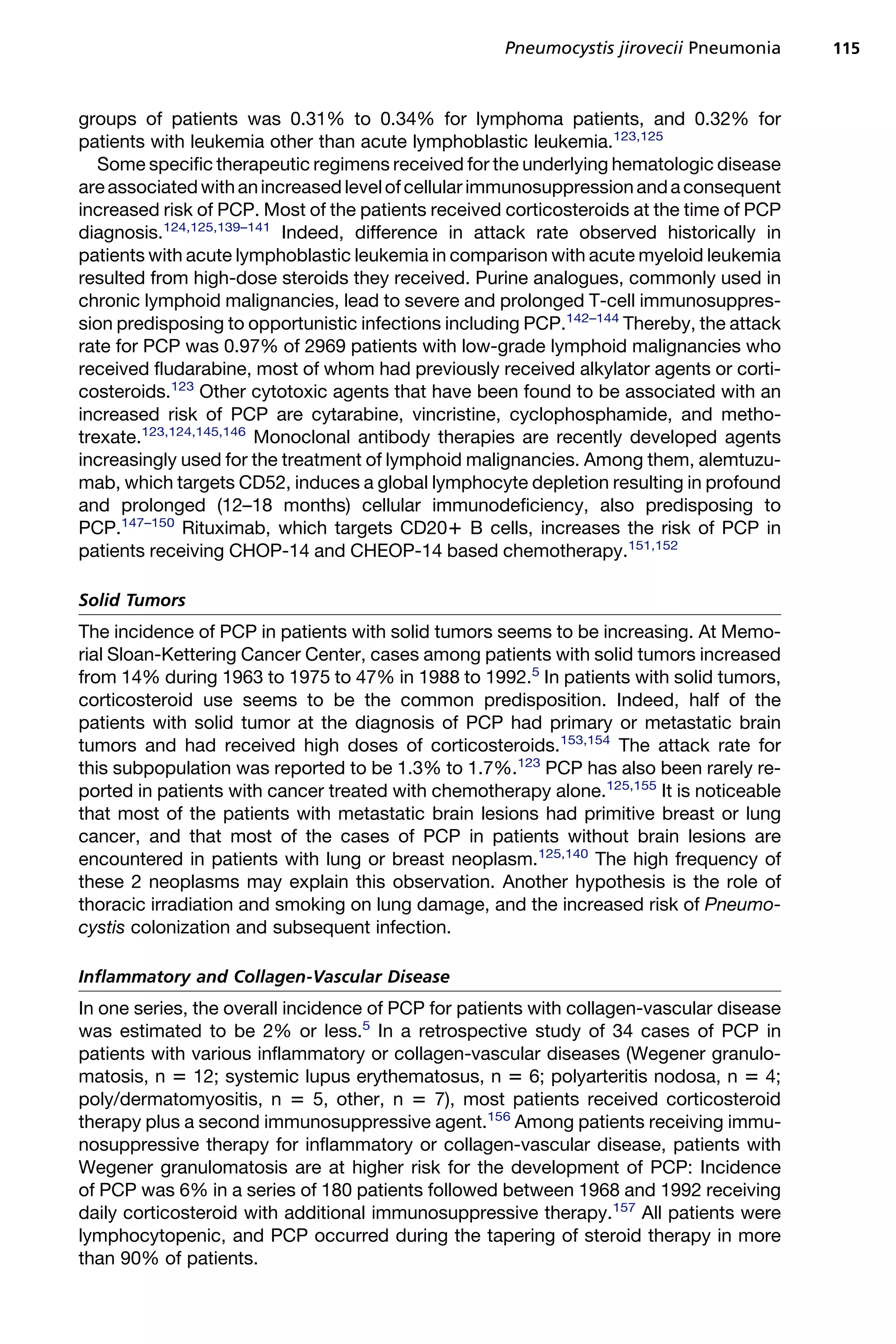
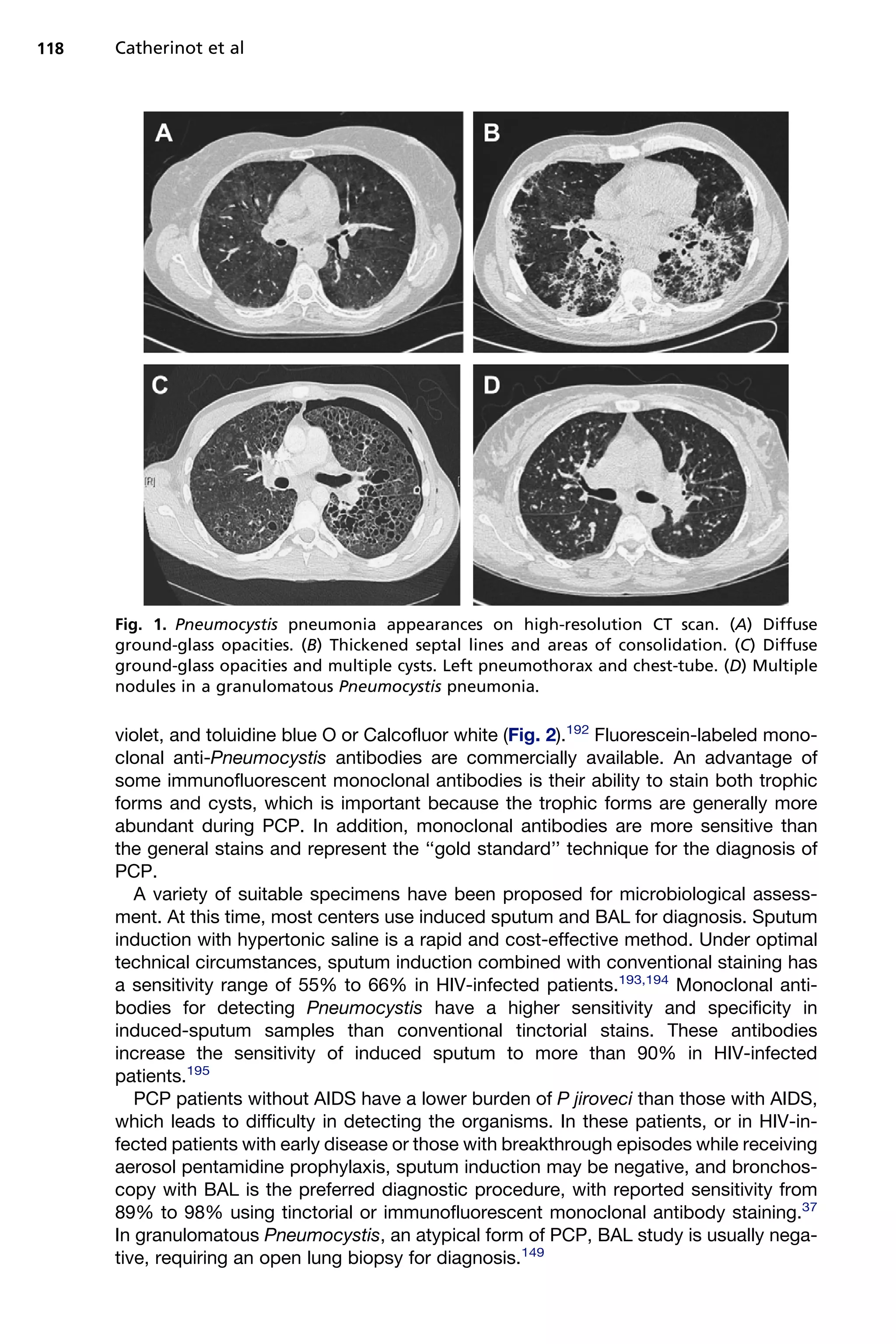
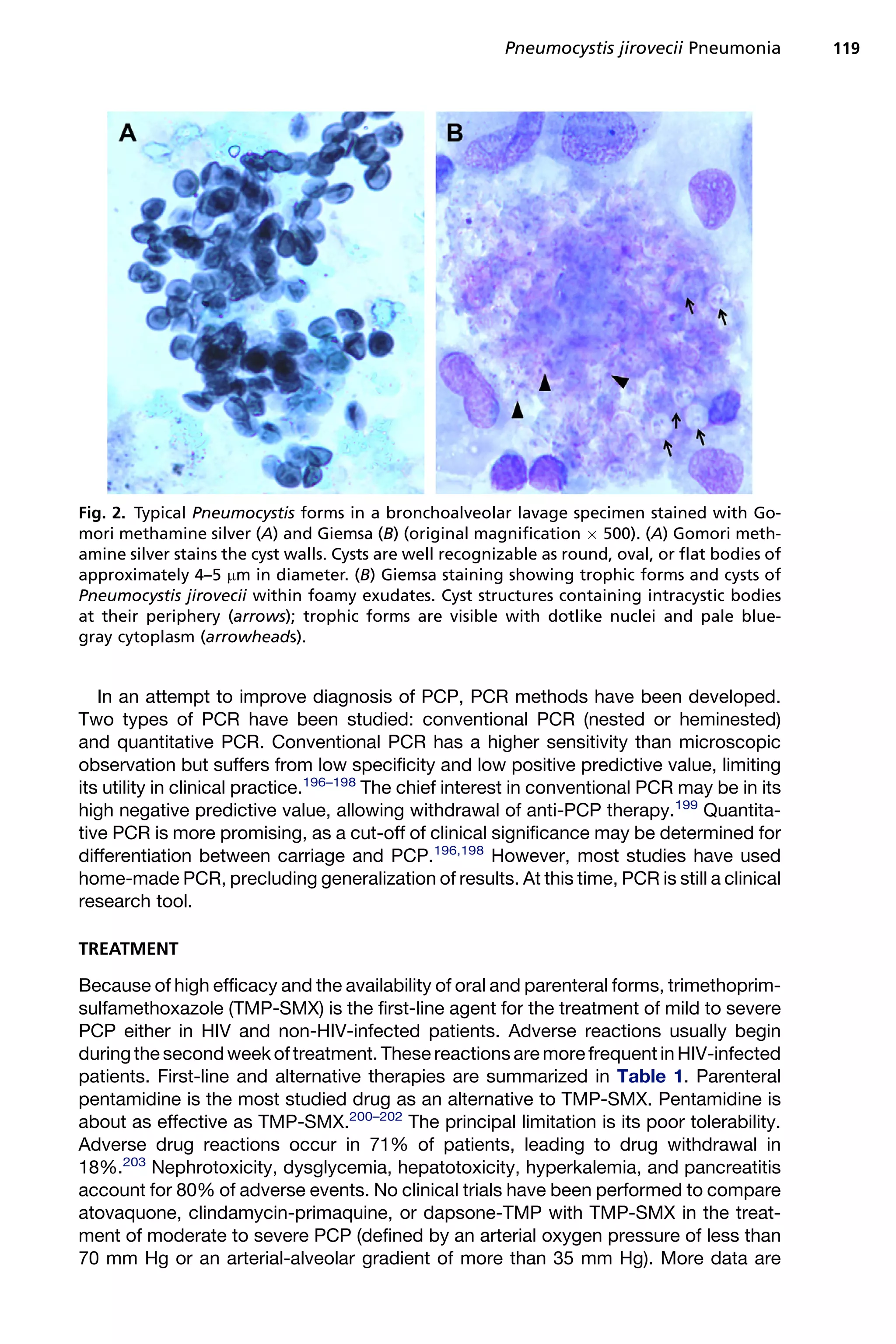
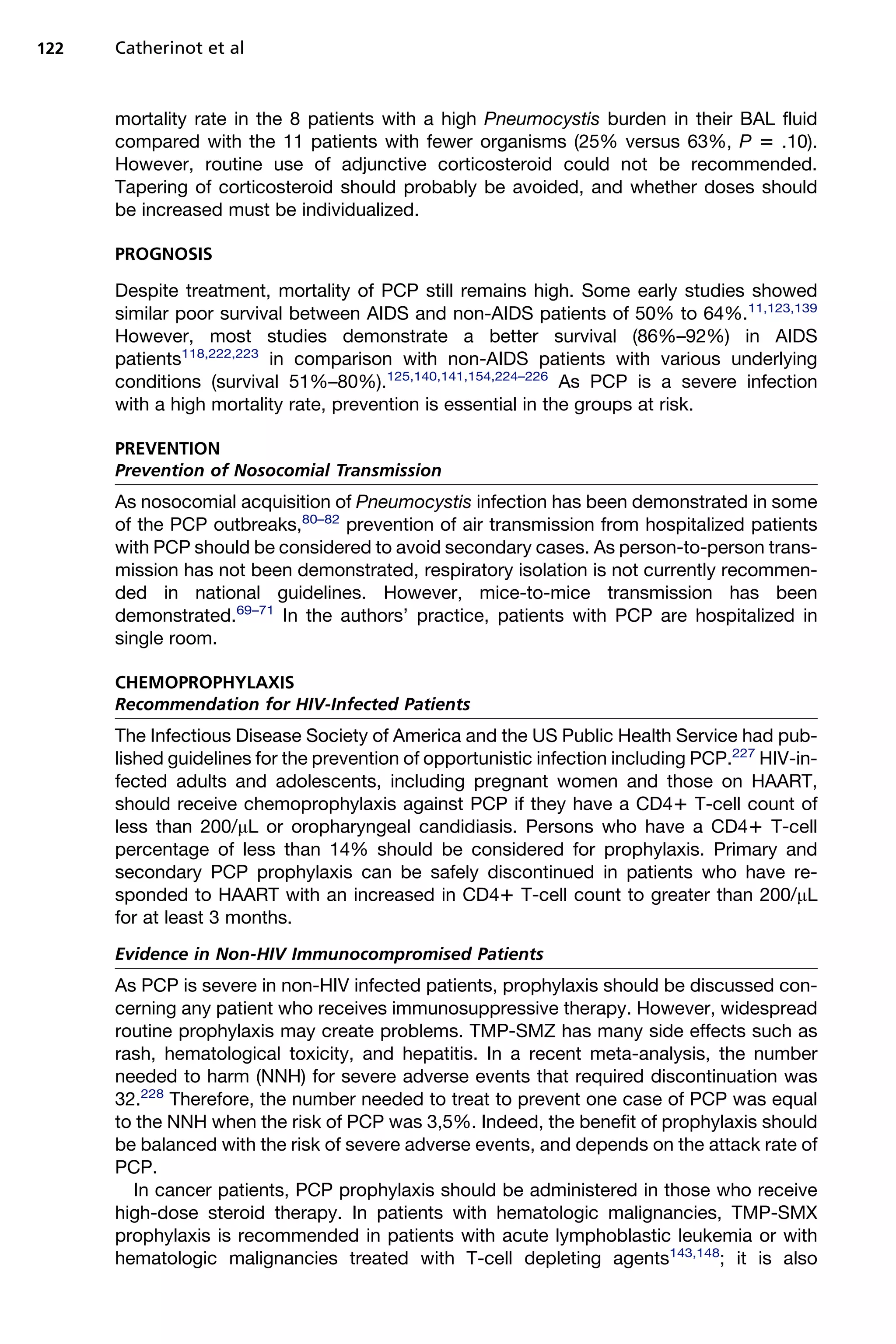
High-resolution computed tomography (CT) scanning is more sensitive
than chest radiograph for detection of PCP (Fig. 1; for a review, see Boiselle and
colleagues.189
). A CT scan typically shows ground-glass opacities with patchy distri-
bution, predominating in perihilar regions of lungs. Thickened septal lines and areas of
consolidation may be present. Multiple and bilateral cysts are observed in 10% to
34% of cases. Cyst formation increases the risk of pneumothorax. Other atypical
manifestations include multiple thick-walled cavitary nodules and noncavitary
nodules. Lymphadenopathy and effusions are less frequent.190
In the setting of Pneu-
mocystis prophylaxis with aerosolized pentamidine, patients are more likely to present
with predominantly upper lobe disease, pneumothorax, or cyst formation.187,191
MICROBIOLOGICAL DIAGNOSIS
As Pneumocystis cannot readily be cultured in the laboratory, the diagnosis of PCP
continues to mostly rely on the microscopic demonstration of the characteristic organ-
isms in respiratory specimens such as BAL fluid or induced sputum. Trophic forms can
be detected with the use of certain stains, such as modified Papanicolaou, Giemsa, or
Gram-Weigert. Cysts can be stained with Gomori-methenamine silver, cresyl echt
Pneumocystis jirovecii Pneumonia 117
violet, and toluidine blue O or Calcofluor white (Fig. 2).192
Fluorescein-labeled mono-
clonal anti-Pneumocystis antibodies are commercially available. An advantage of
some immunofluorescent monoclonal antibodies is their ability to stain both trophic
forms and cysts, which is important because the trophic forms are generally more
abundant during PCP. In addition, monoclonal antibodies are more sensitive than
the general stains and represent the ‘‘gold standard’’ technique for the diagnosis of
PCP.
A variety of suitable specimens have been proposed for microbiological assess-
ment. At this time, most centers use induced sputum and BAL for diagnosis. Sputum
induction with hypertonic saline is a rapid and cost-effective method. Under optimal
technical circumstances, sputum induction combined with conventional staining has
a sensitivity range of 55% to 66% in HIV-infected patients.193,194
Monoclonal anti-
bodies for detecting Pneumocystis have a higher sensitivity and specificity in
induced-sputum samples than conventional tinctorial stains. These antibodies
increase the sensitivity of induced sputum to more than 90% in HIV-infected
patients.195
PCP patients without AIDS have a lower burden of P jiroveci than those with AIDS,
which leads to difficulty in detecting the organisms. In these patients, or in HIV-in-
fected patients with early disease or those with breakthrough episodes while receiving
aerosol pentamidine prophylaxis, sputum induction may be negative, and bronchos-
copy with BAL is the preferred diagnostic procedure, with reported sensitivity from
89% to 98% using tinctorial or immunofluorescent monoclonal antibody staining.37
In granulomatous Pneumocystis, an atypical form of PCP, BAL study is usually nega-
tive, requiring an open lung biopsy for diagnosis.149
Fig. 1. Pneumocystis pneumonia appearances on high-resolution CT scan. (A) Diffuse
ground-glass opacities. (B) Thickened septal lines and areas of consolidation. (C) Diffuse
ground-glass opacities and multiple cysts. Left pneumothorax and chest-tube. (D) Multiple
nodules in a granulomatous Pneumocystis pneumonia.
Catherinot et al
118
In an attempt to improve diagnosis of PCP, PCR methods have been developed.
Two types of PCR have been studied: conventional PCR (nested or heminested)
and quantitative PCR. Conventional PCR has a higher sensitivity than microscopic
observation but suffers from low specificity and low positive predictive value, limiting
its utility in clinical practice.196–198
The chief interest in conventional PCR may be in its
high negative predictive value, allowing withdrawal of anti-PCP therapy.199
Quantita-
tive PCR is more promising, as a cut-off of clinical significance may be determined for
differentiation between carriage and PCP.196,198
However, most studies have used
home-made PCR, precluding generalization of results. At this time, PCR is still a clinical
research tool.
TREATMENT
Because of high efficacy and the availability of oral and parenteral forms, trimethoprim-
sulfamethoxazole (TMP-SMX) is the first-line agent for the treatment of mild to severe
PCP either in HIV and non-HIV-infected patients. Adverse reactions usually begin
during the second week of treatment. These reactions are more frequent in HIV-infected
patients. First-line and alternative therapies are summarized in Table 1. Parenteral
pentamidine is the most studied drug as an alternative to TMP-SMX. Pentamidine is
about as effective as TMP-SMX.200–202
The principal limitation is its poor tolerability.
Adverse drug reactions occur in 71% of patients, leading to drug withdrawal in
18%.203
Nephrotoxicity, dysglycemia, hepatotoxicity, hyperkalemia, and pancreatitis
account for 80% of adverse events. No clinical trials have been performed to compare
atovaquone, clindamycin-primaquine, or dapsone-TMP with TMP-SMX in the treat-
ment of moderate to severe PCP (defined by an arterial oxygen pressure of less than
70 mm Hg or an arterial-alveolar gradient of more than 35 mm Hg). More data are
Fig. 2. Typical Pneumocystis forms in a bronchoalveolar lavage specimen stained with Go-
mori methamine silver (A) and Giemsa (B) (original magnification  500). (A) Gomori meth-
amine silver stains the cyst walls. Cysts are well recognizable as round, oval, or flat bodies of
approximately 4–5 mm in diameter. (B) Giemsa staining showing trophic forms and cysts of
Pneumocystis jirovecii within foamy exudates. Cyst structures containing intracystic bodies
at their periphery (arrows); trophic forms are visible with dotlike nuclei and pale blue-
gray cytoplasm (arrowheads).
Pneumocystis jirovecii Pneumonia 119
Table 1
Treatment of Pneumocystis pneumonia
Medication Dose and Route Comments Adverse Events
First choice Trimethoprim 1
sulfamethoxazole
15–20 mg/kg
75–100 mg/kg
Intravenous or
orally, divided
into 3–4 doses
daily
Contraindication in
cases of allergy to
sulfa drugs
Cytopenia
Skin reactions (mild to severe: toxic epidermal
necrolysis, Stevens-Johnson syndrome)
Hepatitis, pancreatitis
Gastrointestinal disturbance
Renal insufficiency, hyperkalemia
Anaphylaxis
Alternative choice
Mild to moderate PCP
Dapsone 1
trimethoprime
100 mg/d orally
5 mg/kg 3 times
daily
Contraindication in
cases of G6PD
deficiency
Possible cross-
reaction with sulfa
allergy
Methemoglobinemia
Skin rash
Fever
Gastrointestinal disturbance
Atovaquone 750 mg 2–3 times
daily orally
Bioavailability
increased with
high-fat meal
Skin rash
Fever
Gastrointestinal disturbance
Hepatitis
Clindamycin 1
primaquine
600 mg 4 times daily
intravenous or
350–400 mg 4
times daily orally
30 mg daily orally
Contraindication in
cases of G6PD
Skin rash
Fever
Neutropenia
Gastrointestinal disturbance
Methemoglobinemia
Alternative choice
Moderate to severe PCP
Pentamidine 4 mg/kg daily
intravenous
Hypotension, Cardiac arrhythmias (torsades de
pointes)
Hyperkalemia, hypomagnesemia, hypocalcemia
Renal insufficiency
Pancreatitis, hypoglycemia (early), diabetes mellitus
(late)
Neutropenia
Hepatitis
Catherinot
et
al
120
available in the treatment of mild to moderate PCP (defined by an arterial-alveolar
gradient of less than 35 mm Hg and between 35 and 45 mm Hg, respectively): Clinda-
mycin-primaquine and dapsone-TMP exhibit comparable efficacy and toxicity to TMP-
SMX204–206
; atovaquone is less effective but better tolerated than TMP-SMX and as
effective as pentamidine.207,208
In addition to the classic alternative therapy, caspofun-
gin may be a promising drug, although experience is limited. Two patients were treated
successfully with caspofungin alone,209,210
while 4 other patients had received caspo-
fungin in addition to TMP-SMX.211
Available data of the pre-corticosteroid era suggest that patients generally
improved after 4 to 8 days of therapy.139
If progression is observed after 4 days,
a second pathogen should be excluded and another treatment of PCP should
be considered. The most studied second-line drugs are intravenous pentamidine
and clindamycin-primaquine.212–214
A recent systematic review showed that clinda-
mycin-primaquine was associated with a better outcome of second-line treatment
compared with pentamidine.212
TMP-SMX was associated with a favorable outcome
of second-line treatment for those failing another first-line regimen. More recently,
caspofungin was successfully administered as a salvage therapy in 2 transplant-recip-
ient patients in addition to TMP-SMX.211
No clear association between mutations in the dihydropteroate synthetase (DHPS),
the target enzyme of sulfonamides, and TMP-SMX treatment failure or altered
outcome has been demonstrated.39,215,216
Mutations in the gene encoding cyto-
chrome B, conferring potential atovaquone resistance, have also been described;
however, their clinical impact on treatment failure has not been determined.217
Rec-
ommended duration of treatment is 21 days in HIV-infected patients and 14 days in
non-HIV immunocompromised hosts. Recommendation for longer treatment in HIV-
infected patients is supported by a higher organism burden and a slower clinical
response, leading to a higher risk of relapse after only 14 days of treatment. Subse-
quently, treatment should be extended in non-HIV infected patients when clinical
improvement is prolonged.
Corticosteroids in HIV-Infected Patients
Inflammation is correlated to lung injury in animal models (see earlier discussion). Early
in the AIDS epidemic, randomized trials accordingly had evaluated the efficacy of
corticosteroid treatment to reduce morbidity and mortality of PCP. Benefit to survival
on corticosteroid administration begins during the first 72 hours of treatment, and has
been demonstrated in HIV-infected patients whose arterial oxygen pressure is equal
or less than 70 mm Hg or whose alveolar-arterial oxygen gradient is of 35 mm Hg or
more.218
The United States recommended regimen is 40 mg prednisone twice daily
for 5 days, then 40 mg once daily for 5 days, followed by 20 mg once daily for 11
days.219
Corticosteroids in Non-HIV Infected Patients
No randomized studies on the use of adjunctive corticosteroids have been conducted
in non-HIV infected patients. The problems are that non-HIV immunocompromised
hosts constitute a nonhomogeneous group of patients and that most of them have
been on corticosteroids at the time they developed PCP. One retrospective study
demonstrated an accelerated recovery among 16 patients with severe PCP who
received 60 mg or more of prednisone daily in comparison with 14 patients maintained
on a low-dose regimen.220
Another study of 31 patients with severe PCP failed to
demonstrate any benefit from corticosteroid adjunctive therapy.221
There was a trend,
however, among patients who received corticosteroid adjunctive therapy, to a lower
Pneumocystis jirovecii Pneumonia 121
mortality rate in the 8 patients with a high Pneumocystis burden in their BAL fluid
compared with the 11 patients with fewer organisms (25% versus 63%, P 5 .10).
However, routine use of adjunctive corticosteroid could not be recommended.
Tapering of corticosteroid should probably be avoided, and whether doses should
be increased must be individualized.
PROGNOSIS
Despite treatment, mortality of PCP still remains high. Some early studies showed
similar poor survival between AIDS and non-AIDS patients of 50% to 64%.11,123,139
However, most studies demonstrate a better survival (86%–92%) in AIDS
patients118,222,223
in comparison with non-AIDS patients with various underlying
conditions (survival 51%–80%).125,140,141,154,224–226
As PCP is a severe infection
with a high mortality rate, prevention is essential in the groups at risk.
PREVENTION
Prevention of Nosocomial Transmission
As nosocomial acquisition of Pneumocystis infection has been demonstrated in some
of the PCP outbreaks,80–82
prevention of air transmission from hospitalized patients
with PCP should be considered to avoid secondary cases. As person-to-person trans-
mission has not been demonstrated, respiratory isolation is not currently recommen-
ded in national guidelines. However, mice-to-mice transmission has been
demonstrated.69–71
In the authors’ practice, patients with PCP are hospitalized in
single room.
CHEMOPROPHYLAXIS
Recommendation for HIV-Infected Patients
The Infectious Disease Society of America and the US Public Health Service had pub-
lished guidelines for the prevention of opportunistic infection including PCP.227
HIV-in-
fected adults and adolescents, including pregnant women and those on HAART,
should receive chemoprophylaxis against PCP if they have a CD41 T-cell count of
less than 200/mL or oropharyngeal candidiasis. Persons who have a CD41 T-cell
percentage of less than 14% should be considered for prophylaxis. Primary and
secondary PCP prophylaxis can be safely discontinued in patients who have re-
sponded to HAART with an increased in CD41 T-cell count to greater than 200/mL
for at least 3 months.
Evidence in Non-HIV Immunocompromised Patients
As PCP is severe in non-HIV infected patients, prophylaxis should be discussed con-
cerning any patient who receives immunosuppressive therapy. However, widespread
routine prophylaxis may create problems. TMP-SMZ has many side effects such as
rash, hematological toxicity, and hepatitis. In a recent meta-analysis, the number
needed to harm (NNH) for severe adverse events that required discontinuation was
32.228
Therefore, the number needed to treat to prevent one case of PCP was equal
to the NNH when the risk of PCP was 3,5%. Indeed, the benefit of prophylaxis should
be balanced with the risk of severe adverse events, and depends on the attack rate of
PCP.
In cancer patients, PCP prophylaxis should be administered in those who receive
high-dose steroid therapy. In patients with hematologic malignancies, TMP-SMX
prophylaxis is recommended in patients with acute lymphoblastic leukemia or with
hematologic malignancies treated with T-cell depleting agents143,148
; it is also
Catherinot et al
122
recommended for patients treated with CHOP-14 and CHEOP-14 regimens.151
Routine prophylaxis is considered in patients with other regimens if they have other
risk factors (chronic lung disease, corticotherapy).
Guidelines have been published in HSCT recipients.229
(1) Allogenic HSCT patients
should receive prophylaxis from engraftment until 6 months post HSCT in all cases,
and throughout all periods of immunosuppression for those who are receiving immu-
nosuppressive therapy or have chronic GVHD. (2) PCP prophylaxis should be consid-
ered for autologous HSCT patients who have underlying hematologic malignancies
such as lymphoma or leukemia, are undergoing intense conditioning regimens or graft
manipulation, or have recently received fludarabine or 2-CDA. Attention should be
given to absorption of the drugs in patients with digestive GVHD, foe example, atova-
quone, which requires a fatty meal for a good absorption.
PCP prophylaxis should be administered lifelong in lung, heart, and heart-lung
transplant recipients.230
PCP prophylaxis is administered to liver transplant recipients
for 1 year in most transplant centers. However, it has been suggested that the low inci-
dence of PCP in this population after the 6-month post-transplant period permits
a shorter duration of prophylaxis.231
In renal transplant recipients, PCP prophylaxis
is recommended for a minimum of 4 months after transplantation and for another 3
to 4 months after a rejection episode.232
However, prophylactic therapy should be
extended (duration 6–12 months) in patients who received lymphocyte-depleting
monoclonal antibody or antithymocyte globulin.175
PCP prophylaxis merits consider-
ation in patients who require a high level of immunosuppression for the treatment of
organ rejection, and in patients with frequent opportunistic infection, including cyto-
megalovirus disease.230
PCP prophylaxis should be administered in patients with Wegener granulomatosis
while they are receiving daily corticosteroids.157,233
Although there are no published
guidelines, PCP prophylaxis should be initiated in patients with dermatomyositis, pol-
ymyositis, or systemic lupus erythematosus who have known risk factors for the
development of PCP, that is, high-dose corticosteroids, lymphopenia, and interstitial
pulmonary disease.158,159,161
TMP-SMX prophylaxis could be administered in patients
treated with up to 25 mg of methotrexate per week. Such patients need to receive
folate supplementation (1 mg per day) or leucovorin on the day after receiving meth-
otrexate, as well as monitoring of blood cells count and liver function tests.192
Chemoprophylaxis Regimen
TMP-SMX is the most studied and the first-choice prophylaxis in HIV-infected and in
non-HIV immunocompromised hosts. Protection rates are excellent, reaching 89% to
100%.234–238
One double-strength tablet daily is the preferred regimen.227
One single-
strength tablet per day and one double-strength tablet 3 times per week are accept-
able alternative regimens, associated with fewer side effects.227
First-choice and
alternative prophylaxis schemes are reported in Table 2. Aerosolized pentamidine
given monthly is less effective, particularly in patients with low CD41 cell count
(protection rate 60%–90%).234–240
Pentamidine must be administered in a Respigard
nebulizer to a patient in decubitus, to optimize repartition of the drug throughout the
lung. The major side effects are cough and bronchospasm.
Resistance and Prophylaxis Failure
Mutation prevalence in the DHPS gene has clearly increased during the past years. In
one study conducted in the United States on 145 isolates, mutation prevalence was
0% in 1983 to 1993, 25% in 1994 to 1995, and 70% in 2000 to 2001.241
Virtually all
of the observed DHPS gene mutations are nonsynonymous point mutations at 2 amino
Pneumocystis jirovecii Pneumonia 123
acid positions in an active site involved in substrate binding.37,242
DHPS mutations
have been associated with failure of TMP-SMX and dapsone prophylaxis.241–245
Mutations in the dihydrofolate reductase, the target enzyme of trimethoprim and pyri-
methamine, have also been recognized.246
Mutations in the atovaquone target gene,
encoding cytochrome B, have been associated with prior exposure to atovaquone,
although their clinical relevance is uncertain.217
SUMMARY
PCP still remains a severe opportunistic infection, associated with a high mortality
rate. Despite a growing knowledge base on PCP, progress is desired in many direc-
tions. First, one is still not able to measure the level of risk of PCP in the non-HIV immu-
nocompromised host. Biologic markers of immunodeficiency, such as CD4 levels in
HIV-infected patients, are needed. It is hoped that such tools will exist in the future.
Factors influencing colonization, such as previous lung disease or smoking habit,
should be taken into consideration in immunocompromised patients with a low inci-
dence risk of PCP. Second, treatment needs to be improved. Available anti-Pneumo-
cystis drugs are associated with many side effects, and mutations have emerged.
Although patients infected with Pneumocystis that contains DHPS mutations still
respond to TMP-SMX treatment, new drugs with different mechanisms of action are
Table 2
Prophylactic regimen against Pneumocystis pneumonia
Medication Dose and Route Comments
First choice Trimethoprim 1
sulfamethoxazole
80–160 mg daily
400–800 mg daily
orally or
intravenous
Contraindication in
cases of allergy to
sulfa drugs
Trimethoprim 1
sulfamethoxazole
160 mg 3 times a week
800 mg 3 times a week
orally or
intravenous
Alternative choice Dapsone 100 mg daily orally Contraindication in
cases of G6PD
deficiency
Possible cross-reaction
with sulfa allergy
Dapsone 1
pyrimethamine
50 mg daily orally
50 mg per week 1
leucovorin 25 mg
per week
Contraindication in
cases of G6PD
deficiency
Possible cross-
reaction with sulfa
allergy
Atovaquone 750 mg 2 times daily
orally
Bioavailability
increased with high-
fat meal
Pentamidine 300 mg monthly Administrate in
decubitus to
optimize lung
distribution
Double-strength tablet daily dose of trimethoprim-sulfamethoxazole (TMP-SMX) and dapsone 1
pyrimethamine prophylactic regimen are also effective against toxoplasmosis. Atovaquone and
single-strength tablet daily dose of TMP-SMX also can be considered.
Catherinot et al
124
needed. Caspofungin, which targets Pneumocystis glucans synthetase (GSC1),
thereby inhibiting fungal cell wall synthesis, theoretically acts synergistically with
TMP-SMX. Further clinical evaluation of this treatment is warranted. Finally, as
mortality of PCP results from lung injury, progress in the management of the lung
inflammatory response could improve prognosis.
REFERENCES
1. Delanoe P, Delanoe M. [Sur les rapports des kystes de carinii du poumon des
rats avec le Trypanosoma lewisi]. CR Acad Sci 1912;155:658–60 [in French].
2. Ammich O. [Uber die nichtsyphilitische interstitielle pneumoniae des ersten
kindersalters]. Virchows Arch Pathol Anat 1938;302:539–54 [in German].
3. Van der Meer G, Brug SL. [Infection par Pneumocystis chez l’homme et chez les
animaux]. Annales de la Soci
et
e Belge de M
edecine Tropicale 1942;22:301–5
[in French].
4. Vanek J, Jirovec O. [Parasitaere pneumonie. Interstitielle plasmazellen pneumo-
nie der fruehgeborenen verursacht durch Pneumocytis carinii]. Zentralbl Bak-
teriol 1952;158:120–7 [in German].
5. Sepkowitz KA, Brown AE, Armstrong D. Pneumocystis carinii pneumonia without
acquired immunodeficiency syndrome. More patients, same risk. Arch Intern
Med 1995;155(11):1125–8.
6. Ng VL, Yajko DM, Hadley WK. Extrapulmonary pneumocystosis. Clin Microbiol
Rev 1997;10(3):401–18.
7. Excler JL, Mojon M, Guyonnet C, et al. [Pneumocystis carinii pneumonia in chil-
dren. Apropos of 33 cases]. Pediatrie 1984;39(7):513–23 [in French].
8. Walzer PD, Schultz MG, Western KA, et al. Pneumocystis carinii pneumonia and
primary immune deficiency diseases. Natl Cancer Inst Monogr 1976;43:65–74.
9. Gottlieb MS, Schroff R, Schanker HM, et al. Pneumocystis carinii pneumonia and
mucosal candidiasis in previously healthy homosexual men: evidence of a new
acquired cellular immunodeficiency. N Engl J Med 1981;305(24):1425–31.
10. Masur H, Michelis MA, Greene JB, et al. An outbreak of community-acquired
Pneumocystis carinii pneumonia: initial manifestation of cellular immune
dysfunction. N Engl J Med 1981;305(24):1431–8.
11. Jaffe HW, Bregman DJ, Selik RM. Acquired immune deficiency syndrome in the
United States: the first 1,000 cases. J Infect Dis 1983;148(2):339–45.
12. Gebo KA, Fleishman JA, Moore RD. Hospitalizations for metabolic conditions,
opportunistic infections, and injection drug use among HIV patients: trends
between 1996 and 2000 in 12 states. J Acquir Immune Defic Syndr 2005;
40(5):609–16.
13. San-Andres FJ, Rubio R, Castilla J, et al. Incidence of acquired immunodefi-
ciency syndrome-associated opportunistic diseases and the effect of treatment
on a cohort of 1115 patients infected with human immunodeficiency virus, 1989-
1997. Clin Infect Dis 2003;36(9):1177–85.
14. Bonnet F, Lewden C, May T, et al. Opportunistic infections as causes of death in
HIV-infected patients in the HAART era in France. Scand J Infect Dis 2005;
37(6-7):482–7.
15. Edman JC, Kovacs JA, Masur H, et al. Ribosomal RNA sequence shows Pneu-
mocystis carinii to be a member of the fungi. Nature 1988;334(6182):519–22.
16. Stringer SL, Stringer JR, Blase MA, et al. Pneumocystis carinii: sequence from
ribosomal RNA implies a close relationship with fungi. Exp Parasitol 1989;
68(4):450–61.
Pneumocystis jirovecii Pneumonia 125
17. Redhead SA, Cushion MT, Frenkel JK, et al. Pneumocystis and Trypanosoma
cruzi: nomenclature and typifications. J Eukaryot Microbiol 2006;53(1):2–11.
18. Frenkel JK. Pneumocystis jiroveci n. sp. from man: morphology, physiology, and
immunology in relation to pathology. Natl Cancer Inst Monogr 1976;43:13–30.
19. Walzer PD, Linke MJ. A comparison of the antigenic characteristics of rat and
human Pneumocystis carinii by immunoblotting. J Immunol 1987;138(7):
2257–65.
20. Stringer JR, Beard CB, Miller RF, et al. A new name (Pneumocystis jiroveci) for
Pneumocystis from humans. Emerg Infect Dis 2002;8(9):891–6.
21. Li J, Edlind T. Phylogeny of Pneumocystis carinii based on beta-tubulin
sequence. J Eukaryot Microbiol 1994;41(5):97S.
22. Mazars E, Odberg-Ferragut C, Dei-Cas E, et al. Polymorphism of the thymidy-
late synthase gene of Pneumocystis carinii from different host species. J Eukar-
yot Microbiol 1995;42(1):26–32.
23. Ma L, Kovacs JA. Expression and characterization of recombinant human-
derived Pneumocystis carinii dihydrofolate reductase. Antimicrob Agents Che-
mother 2000;44(11):3092–6.
24. Banerji S, Lugli EB, Miller RF, et al. Analysis of genetic diversity at the arom locus
in isolates of Pneumocystis carinii. J Eukaryot Microbiol 1995;42(6):675–9.
25. Sinclair K, Wakefield AE, Banerji S, et al. Pneumocystis carinii organisms
derived from rat and human hosts are genetically distinct. Mol Biochem Parasi-
tol 1991;45(1):183–4.
26. Liu Y, Rocourt M, Pan S, et al. Sequence and variability of the 5.8s and 26s rRNA
genes of Pneumocystis carinii. Nucleic Acids Res 1992;20(14):3763–72.
27. Denis CM, Mazars E, Guyot K, et al. Genetic divergence at the soda locus of six
different formae speciales of Pneumocystis carinii. Med Mycol 2000;38(4):
289–300.
28. Shah JS, Pieciak W, Liu J, et al. Diversity of host species and strains of Pneumocys-
tis cariniiisbased on rRNA sequences.ClinDiagn LabImmunol1996;3(1):119–27.
29. Aliouat EM, Mazars E, Dei-Cas E, et al. Pneumocystis cross infection experi-
ments using SCID mice and nude rats as recipient host, showed strong host-
species specificity. J Eukaryot Microbiol 1994;41(5):71S.
30. Gigliotti F, Harmsen AG, Haidaris CG, et al. Pneumocystis carinii is not univer-
sally transmissible between mammalian species. Infect Immun 1993;61(7):
2886–90.
31. Beard CB, Jennings VM, Teague WG, et al. Experimental inoculation of immuno-
suppressed owl monkeys with Pneumocystis carinii f. sp. hominis. J Eukaryot
Microbiol 1999;46(5):113S–5S.
32. Stringer JR, Cushion MT, Wakefield AE. New nomenclature for the genus Pneu-
mocystis. J Eukaryot Microbiol 2001;(Suppl):184S–9S.
33. Gigliotti F. Pneumocystis carinii: has the name really been changed? Clin Infect
Dis 2005;41(12):1752–5.
34. Cushion MT, Stringer JR. Has the name really been changed? It has for most
researchers. Clin Infect Dis 2005;41(12):1756–8.
35. Gigliotti F. Pneumocystis carinii nomenclature: response to cushion and stringer.
Clin Infect Dis 2006;42(8):1208–9.
36. Thomas CF Jr, Limper AH. Current insights into the biology and pathogenesis of
Pneumocystis pneumonia. Nat Rev Microbiol 2007;5(4):298–308.
37. Huang L, Morris A, Limper AH, et al. An official ATS workshop summary: recent
advances and future directions in Pneumocystis pneumonia (PCP). Proc Am
Thorac Soc 2006;3(8):655–64.
Catherinot et al
126
38. Yoneda K, Walzer PD. Attachment of Pneumocystis carinii to type I alveolar cells
studied by freeze-fracture electron microscopy. Infect Immun 1983;40(2):812–5.
39. Walzer PD, Smulian AG. Pneumocystis species. In: Linvingstone C, editor, Prin-
ciples and practice of infectious disease, vol. 2. Elsevier; 2004. p. 3080–94.
40. Limper AH, Martin WJ 2nd. Pneumocystis carinii: inhibition of lung cell growth
mediated by parasite attachment. J Clin Invest 1990;85(2):391–6.
41. Limper AH, Edens M, Anders RA, et al. Pneumocystis carinii inhibits cyclin-depen-
dent kinase activity in lung epithelial cells. J Clin Invest 1998;101(5):1148–55.
42. Limper AH, Hoyte JS, Standing JE. The role of alveolar macrophages in Pneu-
mocystis carinii degradation and clearance from the lung. J Clin Invest 1997;
99(9):2110–7.
43. Lasbury ME, Durant PJ, Ray CA, et al. Suppression of alveolar macrophage
apoptosis prolongs survival of rats and mice with Pneumocystis pneumonia.
J Immunol 2006;176(11):6443–53.
44. Koziel H, Eichbaum Q, Kruskal BA, et al. Reduced binding and phagocytosis of
Pneumocystis carinii by alveolar macrophages from persons infected with HIV-1
correlates with mannose receptor downregulation. J Clin Invest 1998;102(7):
1332–44.
45. Koziel H, Li X, Armstrong MY, et al. Alveolar macrophages from human immuno-
deficiency virus-infected persons demonstrate impaired oxidative burst
response to Pneumocystis carinii in vitro. Am J Respir Cell Mol Biol 2000;
23(4):452–9.
46. Beck JM, Warnock ML, Kaltreider HB, et al. Host defenses against Pneumocys-
tis carinii in mice selectively depleted of CD41 lymphocytes. Chest 1993;
103(Suppl 2):116S–8S.
47. Bhagwat SP, Gigliotti F, Xu H, et al. Contribution of T cell subsets to the patho-
physiology of Pneumocystis-related immunorestitution disease. Am J Physiol
Lung Cell Mol Physiol 2006;291(6):L1256–66.
48. Roths JB, Sidman CL. Both immunity and hyperresponsiveness to Pneumocys-
tis carinii result from transfer of CD41 but not CD81 T cells into severe
combined immunodeficiency mice. J Clin Invest 1992;90(2):673–8.
49. Harmsen AG, Stankiewicz M. Requirement for CD41 cells in resistance to Pneu-
mocystis carinii pneumonia in mice. J Exp Med 1990;172(3):937–45.
50. Beck JM, Newbury RL, Palmer BE, et al. Role of CD81 lymphocytes in host
defense against Pneumocystis carinii in mice. J Lab Clin Med 1996;128(5):
477–87.
51. Wright TW, Gigliotti F, Finkelstein JN, et al. Immune-mediated inflammation
directly impairs pulmonary function, contributing to the pathogenesis of Pneu-
mocystis carinii pneumonia. J Clin Invest 1999;104(9):1307–17.
52. Beck JM, Warnock ML, Curtis JL, et al. Inflammatory responses to Pneumocystis
carinii in mice selectively depleted of helper T lymphocytes. Am J Respir Cell
Mol Biol 1991;5(2):186–97.
53. Azoulay E, Parrot A, Flahault A, et al. AIDS-related Pneumocystis carinii pneu-
monia in the era of adjunctive steroids: implication of BAL neutrophilia. Am J
Respir Crit Care Med 1999;160(2):493–9.
54. Limper AH, Offord KP, Smith TF, et al. Pneumocystis carinii pneumonia. Differ-
ences in lung parasite number and inflammation in patients with and without
AIDS. Am Rev Respir Dis 1989;140(5):1204–9.
55. Benfield TL, Vestbo J, Junge J, et al. Prognostic value of interleukin-8 in AIDS-
associated Pneumocystis carinii pneumonia. Am J Respir Crit Care Med 1995;
151(4):1058–62.
Pneumocystis jirovecii Pneumonia 127
56. Swain SD, Wright TW, Degel PM, et al. Neither neutrophils nor reactive oxygen
species contribute to tissue damage during Pneumocystis pneumonia in mice.
Infect Immun 2004;72(10):5722–32.
57. Wakefield AE. DNA sequences identical to Pneumocystis carinii f. sp. carinii and
Pneumocystis carinii f. sp. hominis in samples of air spora. J Clin Microbiol
1996;34(7):1754–9.
58. Casanova-Cardiel L, Leibowitz MJ. Presence of Pneumocystis carinii DNA in
pond water. J Eukaryot Microbiol 1997;44(6):28S.
59. Morris A, Beard CB, Huang L. Update on the epidemiology and transmission of
Pneumocystis carinii. Microbes Infect 2002;4(1):95–103.
60. Wakefield AE. Detection of DNA sequences identical to Pneumocystis carinii in
samples of ambient air. J Eukaryot Microbiol 1994;41(5):116S.
61. Respaldiza N, Medrano FJ, Medrano AC, et al. High seroprevalence of
Pneumocystis infection in Spanish children. Clin Microbiol Infect 2004;10(11):
1029–31.
62. Vargas SL, Hughes WT, Santolaya ME, et al. Search for primary infection by
Pneumocystis carinii in a cohort of normal, healthy infants. Clin Infect Dis
2001;32(6):855–61.
63. Larsen HH, von Linstow ML, Lundgren B, et al. Primary Pneumocystis infection
in infants hospitalized with acute respiratory tract infection. Emerg Infect Dis
2007;13(1):66–72.
64. Morris AM, Swanson M, Ha H, et al. Geographic distribution of human immuno-
deficiency virus-associated Pneumocystis carinii pneumonia in San Francisco.
Am J Respir Crit Care Med 2000;162(5):1622–6.
65. Dohn MN, White ML, Vigdorth EM, et al. Geographic clustering of Pneumocystis
carinii pneumonia in patients with HIV infection. Am J Respir Crit Care Med
2000;162(5):1617–21.
66. Beard CB, Carter JL, Keely SP, et al. Genetic variation in Pneumocystis carinii
isolates from different geographic regions: Implications for transmission. Emerg
Infect Dis 2000;6(3):265–72.
67. Garvy BA, Qureshi MH. Delayed inflammatory response to Pneumocystis carinii
infection in neonatal mice is due to an inadequate lung environment. J Immunol
2000;165(11):6480–6.
68. Chen W, Gigliotti F, Harmsen AG. Latency is not an inevitable outcome of infec-
tion with Pneumocystis carinii. Infect Immun 1993;61(12):5406–9.
69. An CL, Gigliotti F, Harmsen AG. Exposure of immunocompetent adult mice to
Pneumocystis carinii f. sp. muris by cohousing: growth of P. carinii f. sp. muris
and host immune response. Infect Immun 2003;71(4):2065–70.
70. Gigliotti F, Harmsen AG, Wright TW. Characterization of transmission of Pneumo-
cystis carinii f. sp. muris through immunocompetent BALB/c mice. Infect Immun
2003;71(7):3852–6.
71. Chabe M, Dei-Cas E, Creusy C, et al. Immunocompetent hosts as a reservoir of
Pneumocystis organisms: histological and RT-PCR data demonstrate active
replication. Eur J Clin Microbiol Infect Dis 2004;23(2):89–97.
72. Olsson M, Sukura A, Lindberg LA, et al. Detection of Pneumocystis carinii DNA
by filtration of air. Scand J Infect Dis 1996;28(3):279–82.
73. Hughes WT, Bartley DL, Smith BM. A natural source of infection due to Pneumo-
cystis carinii. J Infect Dis 1983;147(3):595.
74. Arichi N, Kishikawa H, Mitsui Y, et al. Cluster outbreak of Pneumocystis pneu-
monia among kidney transplant patients within a single center. Transplant
Proc 2009;41(1):170–2.
Catherinot et al
128
75. de Boer MG, Bruijnesteijn van Coppenraet LE, Gaasbeek A, et al. An outbreak
of Pneumocystis jiroveci pneumonia with 1 predominant genotype among renal
transplant recipients: interhuman transmission or a common environmental
source? Clin Infect Dis 2007;44(9):1143–9.
76. Olsson M, Eriksson BM, Elvin K, et al. Genotypes of clustered cases of Pneumo-
cystis carinii pneumonia. Scand J Infect Dis 2001;33(4):285–9.
77. Hennequin C, Page B, Roux P, et al. Outbreak of Pneumocystis carinii pneu-
monia in a renal transplant unit. Eur J Clin Microbiol Infect Dis 1995;14(2):122–6.
78. Branten AJ, Beckers PJ, Tiggeler RG, et al. Pneumocystis carinii pneumonia in
renal transplant recipients. Nephrol Dial Transplant 1995;10(7):1194–7.
79. Singer C, Armstrong D, Rosen PP, et al. Pneumocystis carinii pneumonia:
a cluster of eleven cases. Ann Intern Med 1975;82(6):772–7.
80. Hocker B, Wendt C, Nahimana A, et al. Molecular evidence of Pneumocystis
transmission in pediatric transplant unit. Emerg Infect Dis 2005;11(2):330–2.
81. Schmoldt S, Schuhegger R, Wendler T, et al. Molecular evidence of nosocomial
Pneumocystis jirovecii transmission among 16 patients after kidney transplanta-
tion. J Clin Microbiol 2008;46(3):966–71.
82. Rabodonirina M, Vanhems P, Couray-Targe S, et al. Molecular evidence of interhu-
man transmission of Pneumocystis pneumonia among renal transplant recipients
hospitalized with HIV-infected patients. Emerg Infect Dis 2004;10(10):1766–73.
83. Montes-Cano MA, de la Horra C, Dapena FJ, et al. Dynamic colonisation by
different Pneumocystis jirovecii genotypes in cystic fibrosis patients. Clin Micro-
biol Infect 2007;13(10):1008–11.
84. Morris A, Wei K, Afshar K, et al. Epidemiology and clinical significance of Pneu-
mocystis colonization. J Infect Dis 2008;197(1):10–7.
85. Nevez G, Jounieaux V, Linas MD, et al. High frequency of Pneumocystis carinii
sp.f. hominis colonization in HIV-negative patients. J Eukaryot Microbiol 1997;
44(6):36S.
86. Huang L, Crothers K, Morris A, et al. Pneumocystis colonization in HIV-infected
patients. J Eukaryot Microbiol 2003;50(Suppl):616–7.
87. Wakefield AE, Lindley AR, Ambrose HE, et al. Limited asymptomatic carriage of
Pneumocystis jiroveci in human immunodeficiency virus-infected patients.
J Infect Dis 2003;187(6):901–8.
88. Rabodonirina M, Raffenot D, Cotte L, et al. Rapid detection of Pneumocystis car-
inii in bronchoalveolar lavage specimens from human immunodeficiency virus-
infected patients: use of a simple DNA extraction procedure and nested PCR.
J Clin Microbiol 1997;35(11):2748–51.
89. Morris A, Kingsley LA, Groner G, et al. Prevalence and clinical predictors of
Pneumocystis colonization among HIV-infected men. AIDS 2004;18(5):793–8.
90. Sing A, Roggenkamp A, Autenrieth IB, et al. Pneumocystis carinii carriage in
immunocompetent patients with primary pulmonary disorders as detected by
single or nested PCR. J Clin Microbiol 1999;37(10):3409–10.
91. Sing A, Geiger AM, Hogardt M, et al. Pneumocystis carinii carriage among
cystic fibrosis patients, as detected by nested PCR. J Clin Microbiol 2001;
39(7):2717–8.
92. Matos O, Costa MC, Correia I, et al. Pneumocystis jirovecii carriage in Portu-
guese immunocompetent patients: preliminary results. J Eukaryot Microbiol
2003;50(Suppl):647–8.
93. Probst M, Ries H, Schmidt-Wieland T, et al. Detection of Pneumocystis carinii
DNA in patients with chronic lung diseases. Eur J Clin Microbiol Infect Dis
2000;19(8):644–5.
Pneumocystis jirovecii Pneumonia 129
94. Morris A, Sciurba FC, Lebedeva IP, et al. Association of chronic obstructive
pulmonary disease severity and Pneumocystis colonization. Am J Respir Crit
Care Med 2004;170(4):408–13.
95. Calderon EJ, Rivero L, Respaldiza N, et al. Systemic inflammation in patients
with chronic obstructive pulmonary disease who are colonized with Pneumocys-
tis jiroveci. Clin Infect Dis 2007;45(2):e17–9.
96. Vidal S, de la Horra C, Martin J, et al. Pneumocystis jirovecii colonisation in
patients with interstitial lung disease. Clin Microbiol Infect 2006;12(3):231–5.
97. Miguez-Burbano MJ, Ashkin D, Rodriguez A, et al. Increased risk of Pneumo-
cystis carinii and community-acquired pneumonia with tobacco use in HIV
disease. Int J Infect Dis 2005;9(4):208–17.
98. Miguez-Burbano MJ, Burbano X, Ashkin D, et al. Impact of tobacco use on the
development of opportunistic respiratory infections in HIV seropositive patients
on antiretroviral therapy. Addict Biol 2003;8(1):39–43.
99. Nevez G, Raccurt C, Vincent P, et al. Pulmonary colonization with Pneu-
mocystis carinii in human immunodeficiency virus-negative patients: as-
sessing risk with blood CD41 T cell counts. Clin Infect Dis 1999;29(5):
1331–2.
100. Maskell NA, Waine DJ, Lindley A, et al. Asymptomatic carriage of Pneumocystis
jiroveci in subjects undergoing bronchoscopy: a prospective study. Thorax
2003;58(7):594–7.
101. Vargas SL, Ponce CA, Sanchez CA, et al. Pregnancy and asymptomatic
carriage of Pneumocystis jiroveci. Emerg Infect Dis 2003;9(5):605–6.
102. Nevez G, Totet A, Pautard JC, et al. Pneumocystis carinii detection using
nested-PCR in nasopharyngeal aspirates of immunocompetent infants with
bronchiolitis. J Eukaryot Microbiol 2001;(Suppl):122S–3S.
103. Totet A, Meliani L, Lacube P, et al. Immunocompetent infants as a human reser-
voir for Pneumocystis jirovecii: rapid screening by non-invasive sampling and
real-time PCR at the mitochondrial large subunit rRNA gene. J Eukaryot Micro-
biol 2003;50(Suppl):668–9.
104. Vargas SL, Ponce CA, Galvez P, et al. Pneumocystis is not a direct cause of
sudden infant death syndrome. Pediatr Infect Dis J 2007;26(1):81–3.
105. Montes-Cano MA, Chabe M, Fontillon-Alberdi M, et al. Vertical transmission of
Pneumocystis jirovecii in humans. Emerg Infect Dis 2009;15(1):125–7.
106. Miller RF, Ambrose HE, Wakefield AE. Pneumocystis carinii f. sp. hominis DNA in
immunocompetent health care workers in contact with patients with P. carinii
pneumonia. J Clin Microbiol 2001;39(11):3877–82.
107. Vargas SL, Ponce CA, Gigliotti F, et al. Transmission of Pneumocystis carinii
DNA from a patient with P. carinii pneumonia to immunocompetent contact
health care workers. J Clin Microbiol 2000;38(4):1536–8.
108. Lundgren B, Elvin K, Rothman LP, et al. Transmission of Pneumocystis carinii
from patients to hospital staff. Thorax 1997;52(5):422–4.
109. Wissmann G, Varela JM, Calderon EJ. Prevention of Pneumocystis pneumonia in
patients with inflammatory bowel disease based on the detection of Pneumo-
cystis colonization. Inflamm Bowel Dis 2008;14(12):1751–2.
110. Mori S, Cho I, Ichiyasu H, et al. Asymptomatic carriage of Pneumocystis jiroveci
in elderly patients with rheumatoid arthritis in Japan: a possible association
between colonization and development of Pneumocystis jiroveci pneumonia
during low-dose MTX therapy. Mod Rheumatol 2008;18(3):240–6.
111. Christensen PJ, Preston AM, Ling T, et al. Pneumocystis murina infection and
cigarette smoke exposure interact to cause increased organism burden,
Catherinot et al
130
development of airspace enlargement, and pulmonary inflammation in mice.
Infect Immun 2008;76(8):3481–90.
112. Norris KA, Morris A, Patil S, et al. Pneumocystis colonization, airway inflamma-
tion, and pulmonary function decline in acquired immunodeficiency syndrome.
Immunol Res 2006;36(1–3):175–87.
113. Vargas SL, Ponce CA, Hughes WT, et al. Association of primary Pneumocystis
carinii infection and sudden infant death syndrome. Clin Infect Dis 1999;29(6):
1489–93.
114. Masur H, Ognibene FP, Yarchoan R, et al. CD4 counts as predictors of opportu-
nistic pneumonias in human immunodeficiency virus (HIV) infection. Ann Intern
Med 1989;111(3):223–31.
115. Phair J, Munoz A, Detels R, et al. The risk of Pneumocystis carinii pneumonia
among men infected with human immunodeficiency virus type 1. Multicenter
AIDS Cohort Study Group. N Engl J Med 1990;322(3):161–5.
116. D’Egidio GE, Kravcik S, Cooper CL, et al. Pneumocystis jiroveci pneumonia
prophylaxis is not required with a CD41 T-cell count 200 cells/microl when viral
replication is suppressed. AIDS 2007;21(13):1711–5.
117. Kovacs JA, Masur H. Evolving health effects of Pneumocystis: one hundred
years of progress in diagnosis and treatment. JAMA 2009;301(24):2578–85.
118. Walzer PD, Evans HE, Copas AJ, et al. Early predictors of mortality from Pneu-
mocystis jirovecii pneumonia in HIV-infected patients: 1985–2006. Clin Infect Dis
2008;46(4):625–33.
119. Pillonel J. [Surveillance de l’infection par le VIH/SIDA en France, 2006]. Bull

Epid
emiol Hebd 2007;46–47:386–93 [in French].
120. Mikaelsson L, Jacobsson G, Andersson R. Pneumocystis pneumonia—a retro-
spective study 1991–2001 in Gothenburg, Sweden. J Infect 2006;53(4):260–5.
121. Hui M, Kwok WT. Pneumocystis carinii pneumonia in Hong Kong: a 10 year
retrospective study. J Med Microbiol 2006;55(Pt 1):85–8.
122. Arend SM, Kroon FP, van’t Wout JW. Pneumocystis carinii pneumonia in patients
without AIDS, 1980 through 1993. An analysis of 78 cases. Arch Intern Med
1995;155(22):2436–41.
123. Russian DA, Levine SJ. Pneumocystis carinii pneumonia in patients without HIV
infection. Am J Med Sci 2001;321(1):56–65.
124. Overgaard UM, Helweg-Larsen J. Pneumocystis jiroveci pneumonia (PCP) in
HIV-1-negative patients: a retrospective study 2002-2004. Scand J Infect Dis
2007;39(6–7):589–95.
125. Sepkowitz KA, Brown AE, Telzak EE, et al. Pneumocystis carinii pneumonia
among patients without AIDS at a cancer hospital. JAMA 1992;267(6):832–7.
126. Leggiadro RJ, Winkelstein JA, Hughes WT. Prevalence of Pneumocystis
carinii pneumonitis in severe combined immunodeficiency. J Pediatr 1981;
99(1):96–8.
127. Walzer PD, Schultz MG, Western KA, et al. Pneumocystis carinii pneumonia and
primary immune deficiency diseases of infancy and childhood. J Pediatr 1973;
82(3):416–22.
128. Levy J, Espanol-Boren T, Thomas C, et al. Clinical spectrum of X-linked hyper-
IgM syndrome. J Pediatr 1997;131(1 Pt 1):47–54.
129. Winkelstein JA, Marino MC, Ochs H, et al. The X-linked hyper-IgM syndrome:
clinical and immunologic features of 79 patients. Medicine (Baltimore) 2003;
82(6):373–84.
130. Imai K, Morio T, Zhu Y, et al. Clinical course of patients with wasp gene muta-
tions. Blood 2004;103(2):456–64.
Pneumocystis jirovecii Pneumonia 131
131. Elhasid R, Etzioni A. Major histocompatibility complex class II deficiency: a clin-
ical review. Blood Rev 1996;10(4):242–8.
132. Richman DD, Zamvil L, Remington JS. Recurrent Pneumocystis carinii pneumonia
in a child with hypogammaglobulinemia. Am J Dis Child 1973;125(1):102–3.
133. Dittrich AM, Schulze I, Magdorf K, et al. X-linked agammaglobulinaemia and
Pneumocystis carinii pneumonia—an unusual coincidence? Eur J Pediatr
2003;162(6):432–3.
134. Burke BA, Good RA. Pneumocystis carinii infection. Medicine (Baltimore) 1973;
52(1):23–51.
135. Lund FE, Hollifield M, Schuer K, et al. B cells are required for generation of
protective effector and memory CD4 cells in response to Pneumocystis lung
infection. J Immunol 2006;176(10):6147–54.
136. Alibrahim A, Lepore M, Lierl M, et al. Pneumocystis carinii pneumonia in an infant
withX-linkedagammaglobulinemia.J Allergy ClinImmunol1998;101(4Pt1):552–3.
137. Adinoff AD, Johnston RB Jr, Dolen J, et al. Chronic granulomatous disease and
Pneumocystis carinii pneumonia. Pediatrics 1982;69(1):133–4.
138. Rosenszweig SD, Holland SM. Phagocyte immunodeficiencies and their infec-
tions. J Allergy Clin Immunol 2004;113(4):620–6.
139. Kovacs JA, Hiemenz JW, Macher AM, et al. Pneumocystis carinii pneumonia:
a comparison between patients with the acquired immunodeficiency syndrome
and patients with other immunodeficiencies. Ann Intern Med 1984;100(5):663–71.
140. Yale SH, Limper AH. Pneumocystis carinii pneumonia in patients without
acquired immunodeficiency syndrome: associated illness and prior corticoste-
roid therapy. Mayo Clin Proc 1996;71(1):5–13.
141. Pagano L, Fianchi L, Mele L, et al. Pneumocystis carinii pneumonia in patients
with malignant haematological diseases: 10 years’ experience of infection in
gimema centres. Br J Haematol 2002;117(2):379–86.
142. Cheson BD. Infectious and immunosuppressive complications of purine analog
therapy. J Clin Oncol 1995;13(9):2431–48.
143. Byrd JC, Hargis JB, Kester KE, et al. Opportunistic pulmonary infections with flu-
darabine in previously treated patients with low-grade lymphoid malignancies:
a role for Pneumocystis carinii pneumonia prophylaxis. Am J Hematol 1995;
49(2):135–42.
144. Morra E, Nosari A, Montillo M. Infectious complications in chronic lymphocytic
leukaemia. Hematol Cell Ther 1999;41(4):145–51.
145. Roblot F, Imbert S, Godet C, et al. Risk factors analysis for Pneumocystis jiroveci
pneumonia (PCP) in patients with haematological malignancies and pneumonia.
Scand J Infect Dis 2004;36(11–12):848–54.
146. De Castro N, Pavie J, Lagrange-Xelot M, et al. [Pneumocystis jiroveci pneu-
monia in patients with cancer: is it unavoidable?]. Rev Mal Respir 2007;24(6):
741–50 [in French].
147. Martin SI, Marty FM, Fiumara K, et al. Infectious complications associated with
alemtuzumab use for lymphoproliferative disorders. Clin Infect Dis 2006;43(1):
16–24.
148. Lundin J, Kimby E, Bjorkholm M, et al. Phase II trial of subcutaneous anti-CD52
monoclonal antibody alemtuzumab (Campath-1H) as first-line treatment for
patients with B-cell chronic lymphocytic leukemia (B-CLL). Blood 2002;100(3):
768–73.
149. Otahbachi M, Nugent K, Buscemi D. Granulomatous Pneumocystis jiroveci
pneumonia in a patient with chronic lymphocytic leukemia: a literature review
and hypothesis on pathogenesis. Am J Med Sci 2007;333(2):131–5.
Catherinot et al
132
150. Morrison VA. Update on prophylaxis and therapy of infection in patients
with chronic lymphocytic leukemia. Expert Rev Anticancer Ther 2001;1(1):
84–90.
151. Kolstad A, Holte H, Fossa A, et al. Pneumocystis jirovecii pneumonia in B-cell
lymphoma patients treated with the rituximab-CHOEP-14 regimen. Haematolog-
ica 2007;92(1):139–40.
152. Venhuizen AC, Hustinx WN, van Houte AJ, et al. Three cases of Pneumocystis
jirovecii pneumonia (PCP) during first-line treatment with rituximab in combina-
tion with CHOP-14 for aggressive B-cell non-Hodgkin’s lymphoma. Eur J Hae-
matol 2008;80(3):275–6.
153. Varthalitis I, Meunier F. Pneumocystis carinii pneumonia in cancer patients.
Cancer Treat Rev 1993;19(4):387–413.
154. Henson JW, Jalaj JK, Walker RW, et al. Pneumocystis carinii pneumonia in
patients with primary brain tumors. Arch Neurol 1991;48(4):406–9.
155. Kulke MH, Vance EA. Pneumocystis carinii pneumonia in patients receiving
chemotherapy for breast cancer. Clin Infect Dis 1997;25(2):215–8.
156. Godeau B, Coutant-Perronne V, Le Thi Huong D, et al. Pneumocystis carinii
pneumonia in the course of connective tissue disease: report of 34 cases.
J Rheumatol 1994;21(2):246–51.
157. Ognibene FP, Shelhamer JH, Hoffman GS, et al. Pneumocystis carinii pneu-
monia: a major complication of immunosuppressive therapy in patients with We-
gener’s granulomatosis. Am J Respir Crit Care Med 1995;151(3 Pt 1):795–9.
158. Kadoya A, Okada J, Iikuni Y, et al. Risk factors for Pneumocystis carinii pneu-
monia in patients with polymyositis/dermatomyositis or systemic lupus erythe-
matosus. J Rheumatol 1996;23(7):1186–8.
159. Alarcon GS. Infections in systemic connective tissue diseases: systemic lupus
erythematosus, scleroderma, and polymyositis/dermatomyositis. Infect Dis
Clin North Am 2006;20(4):849–75.
160. Marie E. [Infections au cours des polymyosites et des dermatomyosites]. Presse
Med 2009;38:303–16 [in French].
161. Bachelez H, Schremmer B, Cadranel J, et al. Fulminant Pneumocystis carinii pneu-
monia in 4 patients with dermatomyositis. Arch Intern Med 1997;157(13):1501–3.
162. Smith MB, Hanauer SB. Pneumocystis carinii pneumonia during cyclosporine
therapy for ulcerative colitis. N Engl J Med 1992;327:497–8.
163. Bernstein CN, Kolodny M, Block E, et al. Pneumocystis carinii pneumonia in
patients with ulcerative colitis treated with steroids. Am J Gastroenterol 1993;
88:574–7.
164. Kaur N, Mahl TC. Pneumocystis jiroveci (carinii) pneumonia after infliximab
therapy: a review of 84 cases. Dig Dis Sci 2007;52(6):1481–4.
165. Komano Y, Harigai M, Koike R, et al. Pneumocystis jiroveci pneumonia in
patients with rheumatoid arthritis treated with infliximab: a retrospective review
and case-control study of 21 patients. Arthritis Rheum 2009;61(3):305–12.
166. Gordon SM, LaRosa SP, Kalmadi S, et al. Should prophylaxis for Pneumocystis
carinii pneumonia in solid organ transplant recipients ever be discontinued? Clin
Infect Dis 1999;28(2):240–6.
167. Hardy AM, Wajszczuk CP, Suffredini AF, et al. Pneumocystis carinii pneumonia in
renal-transplant recipients treated with cyclosporine and steroids. J Infect Dis
1984;149(2):143–7.
168. Lufft V, Kliem V, Behrend M, et al. Incidence of Pneumocystis carinii pneumonia
after renal transplantation. Impact of immunosuppression. Transplantation 1996;
62(3):421–3.
Pneumocystis jirovecii Pneumonia 133
169. Sollinger HW. Mycophenolate mofetil for the prevention of acute rejection in
primary cadaveric renal allograft recipients. U.S. Renal Transplant Mycopheno-
late Mofetil Study Group. Transplantation 1995;60(3):225–32.
170. Dominguez J, Mahalati K, Kiberd B, et al. Conversion to rapamycin immunosup-
pression in renal transplant recipients: report of an initial experience. Transplan-
tation 2000;70(8):1244–7.
171. Radisic M, Lattes R, Chapman JF, et al. Risk factors for Pneumocystis carinii
pneumonia in kidney transplant recipients: a case-control study. Transpl Infect
Dis 2003;5(2):84–93.
172. Arend SM, Westendorp RG, Kroon FP, et al. Rejection treatment and cytomeg-
alovirus infection as risk factors for Pneumocystis carinii pneumonia in renal
transplant recipients. Clin Infect Dis 1996;22(6):920–5.
173. Neff RT, Jindal RM, Yoo DY, et al. Analysis of USRDS: incidence and risk
factors for Pneumocystis jiroveci pneumonia. Transplantation 2009;88(1):
135–41.
174. Shapiro R, Young JB, Milford EL, et al. Immunosuppression: evolution in practice
and trends, 1993-2003. Am J Transplant 2005;5(4):874–86.
175. Issa NC, Fishman JA. Infectious complications of antilymphocyte therapies in
solid organ transplantation. Clin Infect Dis 2009;48(6):772–86.
176. Anderson KC, Soiffer R, DeLage R, et al. T-cell-depleted autologous bone
marrow transplantation therapy: analysis of immune deficiency and late compli-
cations. Blood 1990;76(1):235–44.
177. Tuan IZ, Dennison D, Weisdorf DJ. Pneumocystis carinii pneumonitis
following bone marrow transplantation. Bone Marrow Transplant 1992;10(3):
267–72.
178. De Castro N, Neuville S, Sarfati C, et al. Occurrence of Pneumocystis jiroveci
pneumonia after allogeneic stem cell transplantation: a 6-year retrospective
study. Bone Marrow Transplant 2005;36(10):879–83.
179. Duncan RA, von Reyn CF, Alliegro GM, et al. Idiopathic CD41 T-lymphocytope-
nia—four patients with opportunistic infections and no evidence of HIV infection.
N Engl J Med 1993;328(6):393–8.
180. Tarr PE, Sneller MC, Mechanic LJ, et al. Infections in patients with immunodefi-
ciency with thymoma (good syndrome). Report of 5 cases and review of the liter-
ature. Medicine (Baltimore) 2001;80(2):123–33.
181. Al Soub H, Taha RY, El Deeb Y, et al. Pneumocystis carinii pneumonia in a patient
without a predisposing illness: case report and review. Scand J Infect Dis 2004;
36(8):618–21.
182. Hughes WT. Pneumocystis carinii infections in mothers, infants and non-AIDS
elderly adults. In: Sattler FR, Walzer PD, editors, Pneumocystis carinii clinical
infectious diseases, vol. 2. London: Bailliere Tindall; 1995. p. 461–70.
183. Graham BS, Tucker WS Jr. Opportunistic infections in endogenous Cushing’s
syndrome. Ann Intern Med 1984;101(3):334–8.
184. Abernathy-Carver KJ, Fan LL, Boguniewicz M, et al. Legionella and Pneumocys-
tis pneumonias in asthmatic children on high doses of systemic steroids. Pediatr
Pulmonol 1994;18(3):135–8.
185. Oosterhuis JK, van den Berg G, Monteban-Kooistra WE, et al. Life-threatening
Pneumocystis jiroveci pneumonia following treatment of severe Cushing’s
syndrome. Neth J Med 2007;65(6):215–7.
186. Walzer PD, Perl DP, Krogstad DJ, et al. Pneumocystis carinii pneumonia in the
United States. Epidemiologic, diagnostic, and clinical features. Ann Intern
Med 1974;80(1):83–93.
Catherinot et al
134
187. Sepkowitz KA, Telzak EE, Gold JW, et al. Pneumothorax in AIDS. Ann Intern Med
1991;114(6):455–9.
188. Munoz P, Munoz RM, Palomo J, et al. Pneumocystis carinii infection in heart
transplant recipients. Efficacy of a weekend prophylaxis schedule. Medicine
(Baltimore) 1997;76(6):415–22.
189. Boiselle PM, Crans CA Jr, Kaplan MA. The changing face of Pneumocystis
carinii pneumonia in AIDS patients. AJR Am J Roentgenol 1999;172(5):
1301–9.
190. Kennedy CA, Goetz MB. Atypical roentgenographic manifestations of Pneumo-
cystis carinii pneumonia. Arch Intern Med 1992;152(7):1390–8.
191. Jules-Elysee KM, Stover DE, Zaman MB, et al. Aerosolized pentamidine: effect
on diagnosis and presentation of Pneumocystis carinii pneumonia. Ann Intern
Med 1990;112(10):750–7.
192. Thomas CF Jr, Limper AH. Pneumocystis pneumonia. N Engl J Med 2004;
350(24):2487–98.
193. Pitchenik AE, Ganjei P, Torres A, et al. Sputum examination for the diagnosis of
Pneumocystis carinii pneumonia in the acquired immunodeficiency syndrome.
Am Rev Respir Dis 1986;133(2):226–9.
194. O’Brien RF, Quinn JL, Miyahara BT, et al. Diagnosis of Pneumocystis carinii
pneumonia by induced sputum in a city with moderate incidence of AIDS. Chest
1989;95(1):136–8.
195. Kovacs JA, Ng VL, Masur H, et al. Diagnosis of Pneumocystis carinii pneu-
monia: improved detection in sputum with use of monoclonal antibodies.
N Engl J Med 1988;318(10):589–93.
196. Fujisawa T, Suda T, Matsuda H, et al. Real-time PCR is more specific than
conventional PCR for induced sputum diagnosis of Pneumocystis pneumonia
in immunocompromised patients without HIV infection. Respirology 2009;
14(2):203–9.
197. Ribes JA, Limper AH, Espy MJ, et al. PCR detection of Pneumocystis carinii in
bronchoalveolar lavage specimens: analysis of sensitivity and specificity. J Clin
Microbiol 1997;35(4):830–5.
198. Flori P, Bellete B, Durand F, et al. Comparison between real-time PCR, conven-
tional PCR and different staining techniques for diagnosing Pneumocystis jiroveci
pneumonia from bronchoalveolar lavage specimens. J Med Microbiol 2004;53(Pt
7):603–7.
199. Azoulay E, Bergeron A, Chevret S, et al. Polymerase chain reaction for diag-
nosing Pneumocystis pneumonia in non-HIV immunocompromised patients
with pulmonary infiltrates. Chest 2009;135(3):655–61.
200. Wharton JM, Coleman DL, Wofsy CB, et al. Trimethoprim-sulfamethoxazole or
pentamidine for Pneumocystis carinii pneumonia in the acquired immunodefi-
ciency syndrome. A prospective randomized trial. Ann Intern Med 1986;
105(1):37–44.
201. Sattler FR, Cowan R, Nielsen DM, et al. Trimethoprim-sulfamethoxazole
compared with pentamidine for treatment of Pneumocystis carinii pneumonia
in the acquired immunodeficiency syndrome. A prospective, noncrossover
study. Ann Intern Med 1988;109(4):280–7.
202. Klein NC, Duncanson FP, Lenox TH, et al. Trimethoprim-sulfamethoxazole
versus pentamidine for Pneumocystis carinii pneumonia in AIDS patients:
results of a large prospective randomized treatment trial. AIDS 1992;6(3):301–5.
203. O’Brien JG, Dong BJ, Coleman RL, et al. A 5-year retrospective review of
adverse drug reactions and their risk factors in human immunodeficiency
Pneumocystis jirovecii Pneumonia 135
virus-infected patients who were receiving intravenous pentamidine therapy for
Pneumocystis carinii pneumonia. Clin Infect Dis 1997;24(5):854–9.
204. Safrin S, Finkelstein DM, Feinberg J, et al. Comparison of three regimens for
treatment of mild to moderate Pneumocystis carinii pneumonia in patients with
AIDS. A double-blind, randomized, trial of oral trimethoprim-sulfamethoxazole,
dapsone-trimethoprim, and clindamycin-primaquine. ACTG 108 Study Group.
Ann Intern Med 1996;124(9):792–802.
205. Toma E, Fournier S, Dumont M, et al. Clindamycin/primaquine versus trimetho-
prim-sulfamethoxazole as primary therapy for Pneumocystis carinii pneumonia
in AIDS: a randomized, double-blind pilot trial. Clin Infect Dis 1993;17(2):178–84.
206. Leoung GS, Mills J, Hopewell PC, et al. Dapsone-trimethoprim for Pneumocystis
carinii pneumonia in the acquired immunodeficiency syndrome. Ann Intern Med
1986;105(1):45–8.
207. Dohn MN, Weinberg WG, Torres RA, et al. Oral atovaquone compared with intra-
venous pentamidine for Pneumocystis carinii pneumonia in patients with AIDS.
Atovaquone Study Group. Ann Intern Med 1994;121(3):174–80.
208. Rosenberg DM, McCarthy W, Slavinsky J, et al. Atovaquone suspension for
treatment of Pneumocystis carinii pneumonia in HIV-infected patients. AIDS
2001;15(2):211–4.
209. Mu XD, Que CL, He B, et al. Caspofungin as salvage treatment of severe Pneu-
mocystis pneumonia: case report and literature review. Chin Med J (Engl) 2009;
122(8):996–9.
210. Hof H, Schnulle P. Pneumocystis jiroveci pneumonia in a patient with Wegener’s
granulomatosis treated efficiently with caspofungin. Mycoses 2008;51(Suppl 1):
65–7.
211. Utili R, Durante-Mangoni E, Basilico C, et al. Efficacy of caspofungin addition to
trimethoprim-sulfamethoxazole treatment for severe Pneumocystis pneumonia
in solid organ transplant recipients. Transplantation 2007;84(6):685–8.
212. Benfield T, Atzori C, Miller RF, et al. Second-line salvage treatment of AIDS-asso-
ciated Pneumocystis jirovecii pneumonia: a case series and systematic review.
J Acquir Immune Defic Syndr 2008;48(1):63–7.
213. Toma E, Fournier S, Poisson M, et al. Clindamycin with primaquine for Pneumo-
cystis carinii pneumonia. Lancet 1989;1(8646):1046–8.
214. Noskin GA, Murphy RL, Black JR, et al. Salvage therapy with clindamycin/prima-
quine for Pneumocystis carinii pneumonia. Clin Infect Dis 1992;14(1):183–8.
215. Navin TR, Beard CB, Huang L, et al. Effect of mutations in Pneumocystis carinii
dihydropteroate synthase gene on outcome of P carinii pneumonia in patients
with HIV-1: a prospective study. Lancet 2001;358(9281):545–9.
216. Crothers K, Beard CB, Turner J, et al. Severity and outcome of HIV-associated
Pneumocystis pneumonia containing Pneumocystis jirovecii dihydropteroate
synthase gene mutations. AIDS 2005;19(8):801–5.
217. Kazanjian P, Armstrong W, Hossler PA, et al. Pneumocystis carinii cytochrome
b mutations are associated with atovaquone exposure in patients with AIDS.
J Infect Dis 2001;183(5):819–22.
218. Briel M, Bucher HC, Boscacci R, et al. Adjunctive corticosteroids for Pneumo-
cystis jiroveci pneumonia in patients with HIV-infection. Cochrane Database
Syst Rev 2006;(3):CD006150.
219. Bozzette SA, Sattler FR, Chiu J, et al. A controlled trial of early adjunctive treat-
ment with corticosteroids for Pneumocystis carinii pneumonia in the acquired
immunodeficiency syndrome. California Collaborative Treatment Group.
N Engl J Med 1990;323(21):1451–7.
Catherinot et al
136
220. Pareja JG, Garland R, Koziel H. Use of adjunctive corticosteroids in severe adult
non-HIV Pneumocystis carinii pneumonia. Chest 1998;113(5):1215–24.
221. Delclaux C, Zahar JR, Amraoui G, et al. Corticosteroids as adjunctive therapy for
severe Pneumocystis carinii pneumonia in non-human immunodeficiency virus-
infected patients: retrospective study of 31 patients. Clin Infect Dis 1999;29(3):
670–2.
222. Mansharamani NG, Garland R, Delaney D, et al. Management and outcome
patterns for adult Pneumocystis carinii pneumonia, 1985 to 1995: comparison
of HIV-associated cases to other immunocompromised states. Chest 2000;
118(3):704–11.
223. Gerrard JG. Pneumocystis carinii pneumonia in HIV-negative immunocompro-
mised adults. Med J Aust 1995;162(5):233–5.
224. Roblot F, Godet C, Le Moal G, et al. Analysis of underlying diseases and prog-
nosis factors associated with Pneumocystis carinii pneumonia in immunocom-
promised HIV-negative patients. Eur J Clin Microbiol Infect Dis 2002;21(7):
523–31.
225. Roblot F, Le Moal G, Godet C, et al. Pneumocystis carinii pneumonia in patients
with hematologic malignancies: a descriptive study. J Infect 2003;47(1):19–27.
226. Bollee G, Sarfati C, Thiery G, et al. Clinical picture of Pneumocystis jiroveci
pneumonia in cancer patients. Chest 2007;132(4):1305–10.
227. Masur H, Kaplan JE, Holmes KK. Guidelines for preventing opportunistic infec-
tions among HIV-infected persons—2002. Recommendations of the U.S. Public
Health Service and the Infectious Diseases Society of America. Ann Intern Med
2002;137(5 Pt 2):435–78.
228. Green H, Paul M, Vidal L, et al. Prophylaxis of Pneumocystis pneumonia in
immunocompromised non-HIV-infected patients: systematic review and meta-
analysis of randomized controlled trials. Mayo Clin Proc 2007;82(9):1052–9.
229. Dykewicz CA. Summary of the guidelines for preventing opportunistic infections
among hematopoietic stem cell transplant recipients. Clin Infect Dis 2001;33(2):
139–44.
230. Fishman JA. Prevention of infection caused by Pneumocystis carinii in transplant
recipients. Clin Infect Dis 2001;33(8):1397–405.
231. Trotter JF, Levi M, Steinberg T, et al. Absence of Pneumocystis jiroveci pneu-
monia in liver transplantation recipients receiving short-term (3-month) prophy-
laxis. Transpl Infect Dis 2008;10(5):369–71.
232. EBPG Expert Group on Renal Transplantation. European best practice guide-
lines for renal transplantation. Section IV: long-term management of the trans-
plant recipient. IV.7.1. Late infections. Pneumocystis carinii pneumonia.
Nephrol Dial Transplant 2002;17(S4):36–9.
233. Godeau B, Mainardi JL, Roudot-Thoraval F, et al. Factors associated with Pneu-
mocystis carinii pneumonia in Wegener’s granulomatosis. Ann Rheum Dis 1995;
54(12):991–4.
234. Bozzette SA, Finkelstein DM, Spector SA, et al. A randomized trial of three anti-
Pneumocystis agents in patients with advanced human immunodeficiency virus
infection. Niaid AIDS clinical trials group. N Engl J Med 1995;332(11):693–9.
235. Bucher HC, Griffith L, Guyatt GH, et al. Meta-analysis of prophylactic treatments
against Pneumocystis carinii pneumonia and toxoplasma encephalitis in HIV-
infected patients. J Acquir Immune Defic Syndr Hum Retrovirol 1997;15(2):
104–14.
236. Stein DS, Stevens RC, Terry D, et al. Use of low-dose trimethoprim-sulfamethox-
azole thrice weekly for primary and secondary prophylaxis of Pneumocystis
Pneumocystis jirovecii Pneumonia 137
carinii pneumonia in human immunodeficiency virus-infected patients. Antimi-
crob Agents Chemother 1991;35(9):1705–9.
237. Schneider MM, Hoepelman AI, Eeftinck Schattenkerk JK, et al. A controlled trial
of aerosolized pentamidine or trimethoprim-sulfamethoxazole as primary
prophylaxis against Pneumocystis carinii pneumonia in patients with human
immunodeficiency virus infection. The Dutch AIDS treatment group. N Engl J
Med 1992;327(26):1836–41.
238. Antinori A, Murri R, Ammassari A, et al. Aerosolized pentamidine, cotrimoxazole
and dapsone-pyrimethamine for primary prophylaxis of Pneumocystis carinii
pneumonia and toxoplasmic encephalitis. AIDS 1995;9(12):1343–50.
239. Hirschel B, Lazzarin A, Chopard P, et al. A controlled study of inhaled pentam-
idine for primary prevention of Pneumocystis carinii pneumonia. N Engl J Med
1991;324(16):1079–83.
240. Casale L, Gold H, Schechter C, et al. Decreased efficacy of inhaled pentami-
dine in the prevention of Pneumocystis carinii pneumonia among HIV-infected
patients with severe immunodeficiency. Chest 1993;103(2):342–4.
241. Kazanjian PH, Fisk D, Armstrong W, et al. Increase in prevalence of Pneumocys-
tis carinii mutations in patients with AIDS and P. carinii pneumonia, in the United
States and china. J Infect Dis 2004;189(9):1684–7.
242. Kazanjian P, Locke AB, Hossler PA, et al. Pneumocystis carinii mutations asso-
ciated with sulfa and sulfone prophylaxis failures in AIDS patients. AIDS 1998;
12(8):873–8.
243. Takahashi T, Hosoya N, Endo T, et al. Relationship between mutations in dihy-
dropteroate synthase of Pneumocystis carinii f. sp. hominis isolates in Japan
and resistance to sulfonamide therapy. J Clin Microbiol 2000;38(9):3161–4.
244. Mei Q, Gurunathan S, Masur H, et al. Failure of co-trimoxazole in Pneumocystis
carinii infection and mutations in dihydropteroate synthase gene. Lancet 1998;
351(9116):1631–2.
245. Ma L, Borio L, Masur H, et al. Pneumocystis carinii dihydropteroate synthase but
not dihydrofolate reductase gene mutations correlate with prior trimethoprim-
sulfamethoxazole or dapsone use. J Infect Dis 1999;180(6):1969–78.
246. Nahimana A, Rabodonirina M, Bille J, et al. Mutations of Pneumocystis jirovecii
dihydrofolate reductase associated with failure of prophylaxis. Antimicrob
Agents Chemother 2004;48(11):4301–5.
Catherinot et al
138

Pneumocystis jirovecii pneumonia

  • 1.
    Pneumocystis jirovecii Pneumonia Emilie Catherinot,MD, PhD a,b , Fanny Lanternier, MD, MSc a , Marie-Elisabeth Bougnoux, MD, PhD c , Marc Lecuit, MD, PhD a , Louis-Jean Couderc, MD, PhD b , Olivier Lortholary, MD, PhD a,d, * Pneumocystis has gained attention during the last decade in the context of the AIDS epidemic and the increasing use of cytotoxic and immunosuppressive therapies. The accumulation of knowledge about this curious fungus is continuous. This article summarizes current knowledge on biology, pathophysiology, epidemiology, diag- nosis, prevention, and treatment of pulmonary Pneumocystis jirovecii infection, with a particular focus on the evolving pathophysiology and epidemiology. HISTORICAL BACKGROUND OF PNEUMOCYSTIS SPP Members of the fungal genus now known as Pneumocystis were first identified in 1909 by Chagas in the lung of guinea pigs that had been experimentally infected with Try- panosoma cruzi. Chagas thought he had identified a new trypanosomal life form. In 1910, Carini noted morphologically similar organisms in the lung of rats infected with Trypanosoma lewisi, and likewise thought they were a new type of trypanosome. In 1912, Delanoe and Delanoe, working at the Institut Pasteur, Paris, reviewed Carini’s data and observed the cysts in the lung of Parisian sewer rats. Delanoe and Delanoe realized this was a unique organism and a separate species from Trypanosoma, and named it Pneumocystis carinii, Pneumocystis highlighting the pulmonary tropism and pathogenesis of the organism, carinii in honor of A. Carini.1 a Universit e Paris Descartes, Service de Maladies Infectieuses et Tropicales, 149 Rue de Sèvres, Centre d’Infectiologie Necker-Pasteur, Hôpital Necker-Enfants Malades, Paris 75015, France b Universit e Versailles-Saint Quentin, Hôpital Foch, Service de Pneumologie, Suresnes, France c Universit e Paris Descartes, Hôpital Necker-Enfants Malades, Service de Microbiologie, Paris 75015, France d Institut Pasteur, Centre National de R ef erence Mycologie et antifongiques, Paris, France * Corresponding author. Universit e Paris Descartes, Hôpital Necker-Enfants Malades, Centre d’Infectiologie Necker-Pasteur, Service de Maladies Infectieuses et Tropicales, 149 Rue de Sèv- res, Paris 75015, France. E-mail address: olivier.lortholary@nck.aphp.fr (O. Lortholary). KEYWORDS Pneumocystis jirovecii AIDS Pulmonary infections Chemoprophylaxis Infect Dis Clin N Am 24 (2010) 107–138 doi:10.1016/j.idc.2009.10.010 id.theclinics.com 0891-5520/10/$ – see front matter ª 2010 Elsevier Inc. All rights reserved.
  • 2.
    Just before WorldWar II, German physicians described an epidemic form of inter- stitial plasma cell pneumonitis of unknown etiology occurring in malnourished infants.2 A first relationship between Pneumocystis infection and disease was suggested in 1942, when Van der Meer and Brug observed Pneumocystis in lung sections from infants with plasma cell pneumonitis.3 This observation was largely ignored. In 1951 and 1952, the Czech pathologists Vanek and Jirovec reported the association of Pneumocystis in the lung among premature and malnourished children with interstitial plasma cell pneumonitis housed in nursing homes of Central and Eastern Europe.4 By the end of 1980, starvation and premature birth were important causes of Pneumocys- tis pneumonia (PCP). Among 3346 cases of PCP reported worldwide, 2281 (68%) occurred among infants whose predisposition was either malnutrition or prematurity.5 In 1955, Weller observed that prolonged high-dose dexamethasone corticosteroid treatment of rats resulted in pneumocystosis.6 In the 1960s, Pneumocystis started to be recognized as an opportunistic pathogen in immunosuppressed children with acute leukemia or with congenital immunodeficiency impairing T-lymphocyte func- tion.7,8 In 1981, PCP was the first opportunistic infection reported in homosexual men in the United States, presenting with what was idiomatically coined the ‘‘Gay’s syndrome,’’ subsequently known as the acquired immunodeficiency syndrome (AIDS).9,10 With the extent of the AIDS epidemic, there was a dramatic increase in the incidence of pneumocystosis. During the 1980s PCP was the AIDS-defining illness for more than half of adults and adolescents with AIDS in the United States.11 The introduction of pneumocystosis prophylaxis in 1989 and potent combination antiretro- viral therapy in 1996 have led to substantial declines in the incidence of PCP in human immunodeficiency virus (HIV)-infected persons.12,13 However, PCP remains a leading cause of opportunistic infection, morbidity, and mortality in HIV-infected persons who either are not receiving or are not responding to highly active antiretroviral treatment (HAART) and among those who are unaware of their HIV status.14 PCP is also of clin- ical importance in non-HIV immunocompromised persons, such as patients receiving immunosuppressive treatment or antineoplastic chemotherapy. TAXONOMY Pneumocystis organisms were considered to form a unique taxonomic entity (desig- nated as P carinii). Recent research has demonstrated that the genus Pneumocystis is in fact a complex group with numerous species. Based on morphologic criteria and response of the infection to treatment with the antiprotozoan drug pentamidine, it was initially thought that P carinii was a protozoan. In 1988, Edman and Stringer independently showed that the ribosomal RNA sequences of P carinii were related to those of fungus and completely unrelated to those of other parasites.15,16 All recent phylogenetic analyses place Pneumocystis within the fungal kingdom. Pneumocystis species are currently classified within the phylum Ascomycota, in a unique class, order, and family (Pneumocystidomycetes, Pneumocystidales, and Pneumocystida- cae, respectively).17 However, Pneumocystis organisms are atypical fungal microor- ganisms: (1) they are unable to grow in vitro in fungal culture media; (2) they respond to antiparasitic agents like pentamidine and cotrimoxazole; (3) their cell wall contains cholesterol rather than ergosterol—this difference explains why ampho- tericin B is inactive against Pneumocystis spp. In 1976, Frenkel noted phenotypic differences between Pneumocystis from different mammals and proposed to elevate the organism that infects humans as a different species.18 He named it Pneumocystis jiroveci, in recognition to the pathologist Jirovec who early reported the organism in humans. The name did not gain acceptance at this Catherinot et al 108
  • 3.
    time. The firstindication of a molecular difference between Pneumocystis organisms from humans and laboratory animals came from analyses of protein sizes.19 However, demonstration that differences observed in protein sizes resulted from interspecies variability was difficult to establish because of possible confounding factors such as possible host-mediated modification of Pneumocystis proteins, presence of dead organisms, or contamination with host proteins. DNA analysis provided further evidence of genetic divergence between Pneumo- cystis organisms.20 The 18S rRNA sequences from human-derived Pneumocystis and rat-derived Pneumocystis differ by 5%. Several other genes or gene fragments have been analyzed.21–28 In all cases, the gene sequence differed between host species. In addition, experiments with rats, mice, ferrets, and nonhuman primates have demonstrated host-species specificity.29–31 At the 2001 International Workshop on Opportunistic Protists in Cincinnati, the group of researchers discussed the nomenclature of Pneumocystis and proposed to rename the organisms currently named as special forms of P carinii as species in the genus Pneumocystis, and drew up guidelines for the creation of a new species name.32 Pneumocystis jiroveci was chosen to deign the form that infects humans and Pneumocystis carinii to deign 1 of the 2 the species that infect rats, in which it was first recognized. DNA analysis further demonstrated that DNA sequence polymor- phisms were often observed in isolates of P jiroveci, suggesting that multiple strains exist.20 The correct and valid name according to the international code of zoologic nomenclature (ICBU) is P jirovecii with a double ‘‘i.’’ To date, taxonomy and nomencla- ture for these organisms is a focus of continuing controversy.33–35 BASIC BIOLOGY AND IMMUNOPATHOGENESIS Life Cycle Many investigators have attempted to cultivate Pneumocystis using a variety of tech- niques, but have had limited success, impeding studies of Pneumocystis. Studies of the life cycle of Pneumocystis have been based mainly on light and electron micro- scopic analysis of forms seen in infected lungs or short-term culture.36 There are 2 predominant life cycle forms, the trophic form and the cyst form. The trophic form is small (1–4 mm) and predominate over the cyst form during infection by approximately 10 to 1. The mature cyst is 8 to 10 mm in diameter. Three intermediate cyst stages (early, intermediate, and late precysts) have been visualized. It has been hypothesized that the trophic form can conjugate and develop into cysts that undergo maturation, then the mature cyst, containing 8 intracystic nuclei, produce trophic forms as it ruptures. This model is compatible with the life cycle of other ascomyceteous fungi. Whether encystment stage is an obligate step for the replication of the trophic forms remains a matter of controversy.37 Interaction with Host Cells In an infected host, Pneumocystis exists almost exclusively within the alveoli of the lung. The trophic forms attach to the alveolar epithelium, through interdigitation of their cell membranes with those of the host cells. Ultrastructural analysis has shown that the adherence is characterized by close apposition of the cell surfaces without fusion of the membranes or changes in the intramenbranous particles.38,39 Studies using cultured lung epithelial cells showed that adherence of Pneumocystis alone does not disrupt alveolar epithelial cell structure or the barrier function.36 Pneumocystis maintains an extracellular existence within alveoli, and probably obtains essential nutrients from the alveolar fluid or living cells.39 Pneumocystis jirovecii Pneumonia 109
  • 4.
    Binding of Pneumocystisto alveolar epithelial cell is facilitated by both fibronectin and vitronectin that are present in alveolar lung fluid. These proteins coat the surface of Pneumocystis and subsequently mediate attachment, presumably working through cognate integrins, as well as through mannose binding receptors on the host cells.37 Interaction of Pneumocystis with alveolar epithelial cell and alveolar macrophages initiates cascades of cellular response in both Pneumocystis organism and lung cells. It has been demonstrated that attachment of Pneumocystis to lung epithelial cells enhances Pneumocystis proliferation by activation of selective kinase signaling path- ways.37 The adherence of Pneumocystis also inhibits the growth of lung epithelial cells through cyclin-dependent kinase regulatory pathways.39–41 Alveolar macrophages are the primary resident phagocytes that mediate the clear- ance of the organisms from the lung. Cultured rodent alveolar macrophages can bind and take up Pneumocystis, through the interactions of macrophage mannose recep- tors with the Pneumocystis major surface glycoprotein termed Msg as well as through interaction of macrophage dectin-1 receptors interacting with the b-glucan moiety of the organisms. IgG may facilitate the uptake process by opsonization of the organ- isms.36 Once internalized, Pneumocystis is incorporated into phagolysosomes and subsequently degraded.36 The essential role of macrophages in the control of PCP has been demonstrated in animal models. Clearance of Pneumocystis is markedly impaired in macrophage-depleted animals.42 Blocking Pneumocystis-induced macro- phage apoptosis enhances host defense to the infection and prolongs survival in an animal model.43 Phagocytosis, respiratory burst, and inflammatory activation of alve- olar macrophages in response to Pneumocystis are impaired in HIV-infected persons, and may contribute to the pathogenesis of infection.44,45 Immune control of Pneumocystis also involves production of chemokines and inflam- matory cytokines by alveolar macrophages and epithelial cells.36 Accumulating evidence indicates that b-glucan molecules, which are abundant in the cell wall of Pneu- mocystis, are important components that drive the initiation of inflammatory response during PCP. Macrophages expresses several b-glucan receptors, including dectin-1, Toll-like receptor 2, and the CD11b/CD18 (CR3) integrin, whose binding initiate signaling cascades result in nuclear factor (NF) kB activation and subsequently stimu- lation of inflammatory gene expression such as tumor necrosis factor, and chemokines such as interleukin (IL)-8.36 The dectin-1 and CR3 b-glucan receptors are absent from alveolar epithelial cells. In these cells, lactosylceramide and other receptors, including Toll-like receptors, trigger inflammatory signaling in response to b-glucans.36 Immune Response to Pneumocystis Pneumonia Ultimately, pattern recognition induces chemokines and inflammatory cytokine production, which promote neutrophils and T-lymphocyte recruitment and activation. CD41 T cells are essential for the control of Pneumocystis infection. Indeed, specific depletion of CD41 T cells in mice induces susceptibility to Pneumocystis, and infec- tion resolves when mice are repopulated with sensitized or naive splenic CD41 T cells.37,46 Reconstitution with CD41 T cells clears Pneumocystis infection in severe combined immune deficiency (SCID) mice.37,47–49 CD41 T cells coordinate the host inflammatory response by recruiting and activating additional immune effector cells including monocytes and macrophages, which are responsible for elimination of the organism. In contrast to CD41 T cells, the role of CD81 T cells in host defense against Pneumocystis is more controversial. Reconstitution of SCID mice with CD81 T cells does not protect them against infection, and wild-type mice depleted of CD81 T cells alone are resistant.37,47–49 However, CD81 T cells may have some beneficial effect, particularly in a situation of chronic CD41 depletion. For example, mice depleted of Catherinot et al 110
  • 5.
    both CD41 andCD81 T cells develop more intense infection than mice depleted of CD41 T cells alone.47,50 However, proinflammatory responses to Pneumocystis may be detrimental to the host. For example, Pneumocystis infected SCID mice have preserved oxygenation and lung function until the late stage of the disease.36 Reconstitution of these mice with intact spleen cells results in an intense T-cell mediated inflammatory response, consisting of both CD41 and CD81 T cells, causing impaired lung compliance and gas exchange.51 Both CD41 and CD81 T cells may result in deleterious lung inflam- mation. Reconstitution with CD41 T cells of SCID mice can result in hyperinflamma- tory responses, resulting in the death of the host.48 Other investigators have demonstrated that the lung damage and hypoxia in mouse models depend on the presence of CD81 T cells in the lung.51,52 In addition to T cells, neutrophils, recruited by CXCL2 and IL-8, also participate in lung inflammation during PCP. Neutrophil recruitment seems to closely correlate with lung injury in humans.53 Furthermore, IL-8 production is correlated with neutrophil infiltration and impaired gas exchange during severe PCP in humans.54,55 The level of IL-8 in the bronchoalveolar lavage fluid could be a predictor of lung impairment and death from PCP.55 Recruited neutrophils release protease and reactive oxygen species that directly injure alveolar epithelial cells and capillary endothelial cells. However, in CD41 T-cell depleted mice, Pneumocystis infection induces similar lung injury in mice with or without normal neutrophil function, suggesting that CD81 T-cell mediated inflammation might be more directly responsible for pulmonary injury than neutrophil-mediated inflammation during PCP in mouse models.56 EPIDEMIOLOGY In this section the possible reservoirs of Pneumocystis spp and data on human colo- nization are discussed, and groups at risk of PCP are addressed. Although Pneumocystis DNA has been identified in the air surrounding apple orchards and the surface of pond water, the existence of an environmental niche for Pneumocystis is uncertain.57–60 However, exposure to P jirovecii is common early during life, as demonstrated by a high seroprevalence of anti-Pneumocystis anti- bodies in immunocompetent children. In a Spanish study conducted in 3 rural villages, the overall seroprevalence was 73% among 233 children aged 6 to 13 years.61 An age- related increase in seroprevalence was observed, from 52% at age 6 years to 66% at 10 years and 80% at 13 years. International seroepidemiologic surveys have shown that Pneumocystis had a worldwide distribution, but that the prevalence of antibodies varies among different geographic areas. Indeed, in a study conducted in the urban area of Santiago, Chile, the seroprevalence of anti-Pneumocystis antibodies reached 85% by 20 months of age.62 This primary infection is probably asymptomatic, although careful analysis has not been performed to determine if subtle clinical mani- festations do occur. Indeed, a recent study suggests that P jirovecii may manifest itself as a self-limiting upper respiratory tract infection in infants aged 9 months or less, predominantly those between 1,5 and 4 months old.63 For decades, the theory of the reactivation of a latent Pneumocystis infection acquired during infancy was popular. However, some epidemiologic and experimental evidence argues against the reactivation of latent PCP. Geographic clustering of cases of PCP in the urban setting has been observed,64,65 and genotypes found in patients with PCP are similar to those found in the current patient’s environment but not those from his or her place of birth.66,67 Some experimental evidence also argues against a reactivation of a previously acquired latent infection. Indeed, healthy adult Pneumocystis jirovecii Pneumonia 111
  • 6.
    mice inoculated withPneumocystis clear the infection from the lung within 3 weeks, whereas the process takes slightly longer in neonates.67 Mice that have cleared the infection do not develop PCP once they are rendered CD41 T-cell deficient.68 At present, animal and human studies favor an airborne transmission model for PCP. Animal model studies have shown that Pneumocystis spp is communicable and that the principal mode of transmission is the airborne route. Indeed, exposure of animals colonized with Pneumocystis led to colonization of healthy animals and to development of clinical disease in immunocompromised animals.69–71 In addition, the presence of Pneumocystis DNA has been demonstrated (by using nested poly- merase chain reaction [PCR]) on filters from cages housing Pneumocystis infected Wistar rats,72 and transmission of Pneumocystis without physical contact from infected conventional rats to germ-free rats has also been demonstrated.73 Several outbreaks of PCP have been reported, mainly among renal transplant recip- ients.74–79 Molecular analyses of Pneumocystis in some of these studies demon- strated nosocomial acquisition of the infection.80–82 Although human and animal reports favor an airborne transmission pattern for Pneumocystis infection, the mode of transmission, that is, direct person-to-person spread or common environmental source, is still unknown. As PCP seems to succeed to a dynamic process of infection, the role of colonization in humans should be of major importance in Pneumocystis transmission. A permanent colonization/clearance cycle of Pneumocystis has been demonstrated in humans much like that observed in animal models.71,83 Many reports indicate that Pneumocys- tis DNA can be detected in the respiratory tract without clinical disease. These situa- tions have been described as Pneumocystis colonization or carriage. The prevalence of Pneumocystis colonization among healthy adults is low, although varying between studies from 0% to 20%.84,85 However, it should be recognized that various PCR tech- niques and samples were used: nested or heminested PCR; autopsy lung specimens, bronchoalveolar lavage fluid (BAL), oral washing samples, induced sputum, or nasal- swab samples could explain the discrepancies between results among studies. Another explanation could be the varying occupational or geographic exposures of the targeted populations. Some groups of adult patients are at higher risk of Pneumocystis colonization. Pneumocystis colonization is more prevalent in the HIV-infected population. Pneumo- cystis colonization, versus infection, has been demonstrated by nested PCR analysis: (1) on induced sputum or BAL fluid of patients who had clinical and laboratory diag- noses other than PCP86–88 ; and (2) on lung tissue from patients who died of other causes.89 Using these various respiratory samples, the prevalence of Pneumocystis colonization was 31% to 68%, including patients who were receiving anti-Pneumo- cystis prophylaxis and patients with CD4 cell counts of less than 200/mL. Pneumocystis airway colonization is also more prevalent in patients with chronic lung diseases.90–92 Among chronic lung disease, chronic obstructive pulmonary disease (COPD) was associated with the highest prevalence of Pneumocystis coloni- zation, reaching 37% to 55%.93–95 Frequency of Pneumocystis colonization is corre- lated with more severe stages of COPD, regardless of smoking history, suggesting a role of Pneumocystis colonization in the progression of disease.94 Smoking increases the risk of Pneumocystis colonization. Indeed, in patients with interstitial lung disease, smokers have a higher risk of Pneumocystis colonization than nonsmokers.96 Within HIV-infected individuals, smoking increased the risk of Pneu- mocystis colonization89 and infection.97,98 Pneumocystis colonization also occurs in other patients with various underlying conditions. Among 82 patients with diabetes mellitus, multiple myeloma, chronic Catherinot et al 112
  • 7.
    lymphoid leukemia, orsarcoidosis, 13 (16%) were colonized with Pneumocystis on BAL using heminested PCR.99 Corticosteroid treatment may also favor Pneumocystis colonization. In a study of 93 subjects undergoing diagnostic bronchoscopy with BAL and PCR to detect Pneumocystis, 8 (44%) of 18 patients receiving more than 20 mg/d prednisolone were colonized, compared with 9 (12%) of the 75 not receiving such prednisolone dosage.100 Pregnancy also seems to be a risk factor of coloniza- tion; with one study reporting up to 16% of third-trimester pregnant women being colonized, suggesting that physiologic immunosuppression associated with preg- nancy may favor Pneumocystis colonization.101 High seroprevalence of anti-Pneumocystis antibody in children suggests that Pneu- mocystis colonization occurs frequently in children, who could be a reservoir for Pneu- mocystis. Pneumocystis colonization has been demonstrated by nested and real-time PCR on nasopharyngeal aspirate in 15% to 32% of children aged 1 month to 2 years hospitalized with bronchiolitis or acute respiratory infection and without evidence of PCP.62,63,102,103 Pneumocystis organisms have also been found by immunohisto- chemical or Gomori methenamine silver stain on autopsy lung of 9% to 32% of infants aged 5 days to 1 year dying of sudden infant death syndrome or other causes (including medical condition or injuries).104 The observation of Pneumocystis coloniza- tion early in life, in human neonates, has suggested vertical transmission of Pneumo- cystis as an additional route of transmission. A recent study supports this hypothesis, demonstrating Pneumocystis DNA by PCR from 11 lung and 8 placenta samples of 20 aborted fetuses from immunocompetent women who had miscarriages.105 These data provide, for the first time, molecular evidence of P jirovecii transplacental transmission in humans. The consideration of possible nosocomial transmission of Pneumocystis prompted studies about Pneumocystis colonization among health care workers (HCW). Pneumo- cystis colonization has been found more frequently in immunocompetent HCW in close occupational contact with patients with PCP than in HCW who had no occupa- tional exposure.106,107 In contrast, a previous study failed to find Pneumocystis colo- nization by PCR on oropharyngeal washings obtained from 20 exposed and 20 unexposed HCW.108 In addition, Miller and colleagues106 demonstrated that strains were different between patients and HCW by genotype analysis. Further studies should assess the impact of asymptomatic carriers in the dynamic of Pneumocystis transmission. In conclusion, various host populations may be susceptible to Pneumocystis colo- nization, with several clinical consequences. Individuals colonized with Pneumocystis may be at risk of development of PCP.109,110 These populations may also serve as a reservoir for maintenance and transmission of the organism. In patients with COPD, Pneumocystis colonization might favor progression of the disease by sus- tained inflammation, as has been suggested by animal studies.95,111 Animal models of simian immunodeficiency virus–infected macaques also suggests that Pneumocys- tis colonization may favor development of chronic lung disease in HIV-infected patients.112 An association between Pneumocystis colonization and sudden infant death syndrome has been evoked, although it remains unclear.62,104,113 However, further evaluation of the impact of Pneumocystis colonization is warranted. GROUPS AT RISK FOR PNEUMOCYSTIS PNEUMONIA HIV Infection During HIV infection, the level and percentage of circulating CD41 cells and the control of viral replication have been found to be predictive of the risk of Pneumocystis jirovecii Pneumonia 113
  • 8.
    pneumocystosis. Indeed, PCPdevelops predominantly in persons whose CD41 cell count is less than 200 cells/mL or 15% of T cells, and whose viral replication is not controlled.114–116 Early in the epidemic, the incidence of PCP was almost 20 cases per 100 person-years among HIV-infected patients with CD41 cell counts of less than 200 cells/mL.115 There is a gradient of risk, however, as the CD41 cell count approaches this level. Approximately 10% to 15% of cases of PCP occur in patients with CD41 T-cell counts of more than 200/mL, but the incidence of such cases is very low given the large number if HIV-infected patients who belong to this category.117 It has also been noted that HIV-infected infants tend to develop PCP with a CD41 cell count well above 200/mL. These observations suggest that CD4 cell depletion is not entirely responsible for Pneumocystis disease susceptibility. At present, most HIV-in- fected patients who develop PCP are unaware of their HIV infection or are outside of medical care.118 In this situation, pneumocystosis is still the most frequent opportu- nistic infection in developed areas.119 Non-HIV Immunocompromised Hosts Since the routine use of PCP prophylaxis and HAART in HIV-infected patients, patients without HIV infection account now for the majority of cases of PCP in industrialized countries.120,121 In addition, incidence of PCP has been shown to increase in these patients.122,123 Non-HIV immunocompromised hosts at risk for PCP include some patients with primary immunodeficiency, patients with secondary immunodeficiency such as hematological malignancies and solid tumors (especially brain tumor), solid organ and bone marrow transplant recipients, and patients with collagen-vascular disorders (especially Wegener granulomatosis). There is no biologic quantitative marker clearly correlated with the risk of Pneumocystis infection in these immunode- ficiencies as CD41 cell count is in HIV infection. Indeed, PCP is encountered in patients with normal CD41 cell count.124 The most common treatment-related risk factors are steroid and cytotoxic therapy.122,125 Primary Immunodeficiencies Infants with primary immunodeficiency (PID) may be at increased risk of PCP. In this setting, PCP occurs mainly before 1 year of age and often reveals the immunologic disorder. Most of the cases have been reported in PID impairing T-cell func- tion.8,126–131 Severe combined immunodeficiency and X-linked hyper-IgM syndrome are at higher risk.8,126–129 In some instances, PCP has been observed in the setting of X-linked agammaglobulinemia.8,132–134 B cells in Pneumocystis have a role exper- imentally in the generation of anti-Pneumocystis CD41 memory T cells, though susceptibility seems to be cellular-mediated135 and immunoglobulin therapy does not prevent the disease.133,136 However, PCP in pure B-cell deficiency is rare and occurs in infants a few months old, and does not justify primary prophylaxis. PCP is extremely uncommon in primary immunodeficiencies of phagocytes such as chronic granulomatous disease.137–139 Hematologic Malignancies Hematologic malignant disorders, especially leukemias and lymphomas, are the most common underlying immunosuppressive conditions at the time of PCP diagnosis in HIV negative patients.123,124,139,140 Patients with acute lymphoblastic leukemia were historically at higher risk of PCP. With the routine use of PCP prophylaxis in these patients, the attack rate for PCP, which was 1.1% to 21%, markedly decreased to 0.17% for 2929 patients in a study conducted in the 1980s.123 Thus, attack rates for patients with other hematological malignancies are now higher. The attack rate in large Catherinot et al 114
  • 9.
    groups of patientswas 0.31% to 0.34% for lymphoma patients, and 0.32% for patients with leukemia other than acute lymphoblastic leukemia.123,125 Some specific therapeutic regimens received for the underlying hematologic disease areassociatedwithanincreased levelofcellular immunosuppressionandaconsequent increased risk of PCP. Most of the patients received corticosteroids at the time of PCP diagnosis.124,125,139–141 Indeed, difference in attack rate observed historically in patients with acute lymphoblastic leukemia in comparison with acute myeloid leukemia resulted from high-dose steroids they received. Purine analogues, commonly used in chronic lymphoid malignancies, lead to severe and prolonged T-cell immunosuppres- sion predisposing to opportunistic infections including PCP.142–144 Thereby, the attack rate for PCP was 0.97% of 2969 patients with low-grade lymphoid malignancies who received fludarabine, most of whom had previously received alkylator agents or corti- costeroids.123 Other cytotoxic agents that have been found to be associated with an increased risk of PCP are cytarabine, vincristine, cyclophosphamide, and metho- trexate.123,124,145,146 Monoclonal antibody therapies are recently developed agents increasingly used for the treatment of lymphoid malignancies. Among them, alemtuzu- mab, which targets CD52, induces a global lymphocyte depletion resulting in profound and prolonged (12–18 months) cellular immunodeficiency, also predisposing to PCP.147–150 Rituximab, which targets CD201 B cells, increases the risk of PCP in patients receiving CHOP-14 and CHEOP-14 based chemotherapy.151,152 Solid Tumors The incidence of PCP in patients with solid tumors seems to be increasing. At Memo- rial Sloan-Kettering Cancer Center, cases among patients with solid tumors increased from 14% during 1963 to 1975 to 47% in 1988 to 1992.5 In patients with solid tumors, corticosteroid use seems to be the common predisposition. Indeed, half of the patients with solid tumor at the diagnosis of PCP had primary or metastatic brain tumors and had received high doses of corticosteroids.153,154 The attack rate for this subpopulation was reported to be 1.3% to 1.7%.123 PCP has also been rarely re- ported in patients with cancer treated with chemotherapy alone.125,155 It is noticeable that most of the patients with metastatic brain lesions had primitive breast or lung cancer, and that most of the cases of PCP in patients without brain lesions are encountered in patients with lung or breast neoplasm.125,140 The high frequency of these 2 neoplasms may explain this observation. Another hypothesis is the role of thoracic irradiation and smoking on lung damage, and the increased risk of Pneumo- cystis colonization and subsequent infection. Inflammatory and Collagen-Vascular Disease In one series, the overall incidence of PCP for patients with collagen-vascular disease was estimated to be 2% or less.5 In a retrospective study of 34 cases of PCP in patients with various inflammatory or collagen-vascular diseases (Wegener granulo- matosis, n 5 12; systemic lupus erythematosus, n 5 6; polyarteritis nodosa, n 5 4; poly/dermatomyositis, n 5 5, other, n 5 7), most patients received corticosteroid therapy plus a second immunosuppressive agent.156 Among patients receiving immu- nosuppressive therapy for inflammatory or collagen-vascular disease, patients with Wegener granulomatosis are at higher risk for the development of PCP: Incidence of PCP was 6% in a series of 180 patients followed between 1968 and 1992 receiving daily corticosteroid with additional immunosuppressive therapy.157 All patients were lymphocytopenic, and PCP occurred during the tapering of steroid therapy in more than 90% of patients. Pneumocystis jirovecii Pneumonia 115
  • 10.
    Among patients withsystemic lupus, PCP has been observed before immunosup- pressive therapy was initiated, and risk may be associated with a lymphocyte count of 0.4 109 /L.5 Patients with dermatomyositis or polymyositis and pulmonary involve- ment receiving high-dose corticosteroid therapy have a high risk of PCP.158–160 In addition, cases of fulminant PCP have been reported in patients with dermatomyositis treated with corticosteroids who were lymphopenic before therapy.161 Patients with ulcerative colitis treated with corticosteroids with or without cyclo- sporine are also at some risk.162,163 Infliximab therapy may increase the risk of PCP.164 An attack rate of 0.4% was observed in 5000 patients with rheumatoid arthritis who received this treatment.165 Other cases have been reported in patients receiving infliximab for inflammatory bowel disease, others inflammatory arthritis or collagen-vascular disease.160,164,165 Median length of time from onset of infliximab infusion and development of PCP was short: 21 days to 8.5 weeks.164,165 Solid Organ Transplantation Transplantation of solid organs is increasingly used, placing a growing number of patients at risk for PCP. Among renal transplant recipients, incidence of PCP is 1% to 10%5,166 in the absence of prophylaxis. The vast majority of PCP occurs 3 to 6 months after transplan- tation. Risk factors for the development of PCP, including previous treatment of rejec- tion episodes, drugs used for maintenance of immunosuppression (cyclosporine, tacrolimus, sirolimus, and mycophenolate mofetil), have been identified in some studies but not confirmed by others.77,78,167–173 However, practices in immunosup- pressive therapy continually change and may modulate the risk of infection.174,175 Indeed, increasing use of alemtuzumab and rituximab for rejection management will probably result in an increased incidence of opportunistic infection in solid organ transplant recipients. In addition to these risk factors, several groups have reported outbreaks of PCP among renal transplant recipients, suggesting that the risk of acquiring PCP is higher if the disease is prevalent in the local community.75 The reported attack rate among heart transplant recipients has varied widely, from 5% to 41%.5 In studies among liver transplant recipients, 10% to 11% of patients developed PCP.5,123 PCP is more frequent in the recipients of lung and heart-lung transplants than in other solid organ transplant recipients, with reported attack rates of 16% to 43% of heart-lung and lung transplant recipients in the absence of prophy- laxis.5,123 Similar to renal transplant recipients, PCP usually occurs before 6 months in the post-transplant period, and is unlikely to occur in patients compliant with prophylaxis. Bone Marrow and Hematopoietic Stem Cell Transplantation Allogenic bone marrow transplantation (BMT) and hematopoietic stem cell transplan- tation (HSCT) leads to severe immunosuppression, which extends in the post-trans- plant period for months to a more prolonged period if graft versus host disease (GVHD) requires continuous immunosuppressive therapy. The risk of development of PCP is also increased with the use of T-cell depleted graft.125,176 Before the routine use trimethoprim-sulfamethoxazole prophylaxis, PCP developed in 9% to 16% of allo- genic bone marrow transplant recipients.5 Most bone marrow transplant recipients who developed PCP did not receive adequate prophylaxis.177,178 Miscellaneous Disorders Besides these more common situations, Pneumocystis is an opportunistic pathogen in patients with idiopathic CD41 T-cell lymphocytopenia.179 Three cases of PCP have Catherinot et al 116
  • 11.
    also been reportedamong 51 patients with Good syndrome.180 In some instance, PCP has been reported in patients without predisposing conditions.181 Some of these patients were elderly, and clustered cases have been reported. Pulmonary involve- ment was atypical in some of the patients. Localized lobar or focal infiltrate and pleural effusion were seen. An increasing recognition of infections that have been existent but not identified has been evoked.182 The existence of an underlying unrecognized immunodeficiency in these patients remains possible. The relationship of corticosteroids to Pneumocystis has been emphasized by the occurrence of pneumocystosis in patients with Cushing syndrome and in children receiving corticosteroid for asthma, a disease not known to predispose to any oppor- tunistic infection.183–185 In a study of patients with endogenous Cushing syndrome who developed opportunistic infections, the plasma cortisol levels were highest among patients who developed PCP compared with those who developed cryptococ- cosis, aspergillosis, or nocardiosis, suggesting that higher amounts of immunosup- pression may be required to produce P jirovecii disease.183 CLINICAL PRESENTATION PCP classically presents with fever, cough, and dyspnea. Physical examination is nonspecific, and the pulmonary auscultation is often normal, even in the presence of significant disease and hypoxemia. Discrete crackles may be present. Acute dysp- nea with pleuritic chest pain may indicate the development of a pneumothorax, which has been described in 2% to 4% of patients.186,187 In general, HIV-infected persons present with a subacute course and longer symptom duration than other immunocom- promised persons, respectively 25 to 28 and 5 to 6 days.123,139 Respiratory involve- ment is usually less severe in HIV-infected persons, with a high arterial oxygen tension and a lower respiratory rate.123,139 Reflecting severity of the lung inflammation, their BAL specimens contain significantly fewer neutrophils compared with patients without HIV infection.188 RADIOLOGICAL PRESENTATION On chest radiograph, PCP usually presents with bilateral, diffuse, reticular, or granular opacities. Chest radiograph may be normal at diagnosis in as many as 39% of cases.189 High-resolution computed tomography (CT) scanning is more sensitive than chest radiograph for detection of PCP (Fig. 1; for a review, see Boiselle and colleagues.189 ). A CT scan typically shows ground-glass opacities with patchy distri- bution, predominating in perihilar regions of lungs. Thickened septal lines and areas of consolidation may be present. Multiple and bilateral cysts are observed in 10% to 34% of cases. Cyst formation increases the risk of pneumothorax. Other atypical manifestations include multiple thick-walled cavitary nodules and noncavitary nodules. Lymphadenopathy and effusions are less frequent.190 In the setting of Pneu- mocystis prophylaxis with aerosolized pentamidine, patients are more likely to present with predominantly upper lobe disease, pneumothorax, or cyst formation.187,191 MICROBIOLOGICAL DIAGNOSIS As Pneumocystis cannot readily be cultured in the laboratory, the diagnosis of PCP continues to mostly rely on the microscopic demonstration of the characteristic organ- isms in respiratory specimens such as BAL fluid or induced sputum. Trophic forms can be detected with the use of certain stains, such as modified Papanicolaou, Giemsa, or Gram-Weigert. Cysts can be stained with Gomori-methenamine silver, cresyl echt Pneumocystis jirovecii Pneumonia 117
  • 12.
    violet, and toluidineblue O or Calcofluor white (Fig. 2).192 Fluorescein-labeled mono- clonal anti-Pneumocystis antibodies are commercially available. An advantage of some immunofluorescent monoclonal antibodies is their ability to stain both trophic forms and cysts, which is important because the trophic forms are generally more abundant during PCP. In addition, monoclonal antibodies are more sensitive than the general stains and represent the ‘‘gold standard’’ technique for the diagnosis of PCP. A variety of suitable specimens have been proposed for microbiological assess- ment. At this time, most centers use induced sputum and BAL for diagnosis. Sputum induction with hypertonic saline is a rapid and cost-effective method. Under optimal technical circumstances, sputum induction combined with conventional staining has a sensitivity range of 55% to 66% in HIV-infected patients.193,194 Monoclonal anti- bodies for detecting Pneumocystis have a higher sensitivity and specificity in induced-sputum samples than conventional tinctorial stains. These antibodies increase the sensitivity of induced sputum to more than 90% in HIV-infected patients.195 PCP patients without AIDS have a lower burden of P jiroveci than those with AIDS, which leads to difficulty in detecting the organisms. In these patients, or in HIV-in- fected patients with early disease or those with breakthrough episodes while receiving aerosol pentamidine prophylaxis, sputum induction may be negative, and bronchos- copy with BAL is the preferred diagnostic procedure, with reported sensitivity from 89% to 98% using tinctorial or immunofluorescent monoclonal antibody staining.37 In granulomatous Pneumocystis, an atypical form of PCP, BAL study is usually nega- tive, requiring an open lung biopsy for diagnosis.149 Fig. 1. Pneumocystis pneumonia appearances on high-resolution CT scan. (A) Diffuse ground-glass opacities. (B) Thickened septal lines and areas of consolidation. (C) Diffuse ground-glass opacities and multiple cysts. Left pneumothorax and chest-tube. (D) Multiple nodules in a granulomatous Pneumocystis pneumonia. Catherinot et al 118
  • 13.
    In an attemptto improve diagnosis of PCP, PCR methods have been developed. Two types of PCR have been studied: conventional PCR (nested or heminested) and quantitative PCR. Conventional PCR has a higher sensitivity than microscopic observation but suffers from low specificity and low positive predictive value, limiting its utility in clinical practice.196–198 The chief interest in conventional PCR may be in its high negative predictive value, allowing withdrawal of anti-PCP therapy.199 Quantita- tive PCR is more promising, as a cut-off of clinical significance may be determined for differentiation between carriage and PCP.196,198 However, most studies have used home-made PCR, precluding generalization of results. At this time, PCR is still a clinical research tool. TREATMENT Because of high efficacy and the availability of oral and parenteral forms, trimethoprim- sulfamethoxazole (TMP-SMX) is the first-line agent for the treatment of mild to severe PCP either in HIV and non-HIV-infected patients. Adverse reactions usually begin during the second week of treatment. These reactions are more frequent in HIV-infected patients. First-line and alternative therapies are summarized in Table 1. Parenteral pentamidine is the most studied drug as an alternative to TMP-SMX. Pentamidine is about as effective as TMP-SMX.200–202 The principal limitation is its poor tolerability. Adverse drug reactions occur in 71% of patients, leading to drug withdrawal in 18%.203 Nephrotoxicity, dysglycemia, hepatotoxicity, hyperkalemia, and pancreatitis account for 80% of adverse events. No clinical trials have been performed to compare atovaquone, clindamycin-primaquine, or dapsone-TMP with TMP-SMX in the treat- ment of moderate to severe PCP (defined by an arterial oxygen pressure of less than 70 mm Hg or an arterial-alveolar gradient of more than 35 mm Hg). More data are Fig. 2. Typical Pneumocystis forms in a bronchoalveolar lavage specimen stained with Go- mori methamine silver (A) and Giemsa (B) (original magnification 500). (A) Gomori meth- amine silver stains the cyst walls. Cysts are well recognizable as round, oval, or flat bodies of approximately 4–5 mm in diameter. (B) Giemsa staining showing trophic forms and cysts of Pneumocystis jirovecii within foamy exudates. Cyst structures containing intracystic bodies at their periphery (arrows); trophic forms are visible with dotlike nuclei and pale blue- gray cytoplasm (arrowheads). Pneumocystis jirovecii Pneumonia 119
  • 14.
    Table 1 Treatment ofPneumocystis pneumonia Medication Dose and Route Comments Adverse Events First choice Trimethoprim 1 sulfamethoxazole 15–20 mg/kg 75–100 mg/kg Intravenous or orally, divided into 3–4 doses daily Contraindication in cases of allergy to sulfa drugs Cytopenia Skin reactions (mild to severe: toxic epidermal necrolysis, Stevens-Johnson syndrome) Hepatitis, pancreatitis Gastrointestinal disturbance Renal insufficiency, hyperkalemia Anaphylaxis Alternative choice Mild to moderate PCP Dapsone 1 trimethoprime 100 mg/d orally 5 mg/kg 3 times daily Contraindication in cases of G6PD deficiency Possible cross- reaction with sulfa allergy Methemoglobinemia Skin rash Fever Gastrointestinal disturbance Atovaquone 750 mg 2–3 times daily orally Bioavailability increased with high-fat meal Skin rash Fever Gastrointestinal disturbance Hepatitis Clindamycin 1 primaquine 600 mg 4 times daily intravenous or 350–400 mg 4 times daily orally 30 mg daily orally Contraindication in cases of G6PD Skin rash Fever Neutropenia Gastrointestinal disturbance Methemoglobinemia Alternative choice Moderate to severe PCP Pentamidine 4 mg/kg daily intravenous Hypotension, Cardiac arrhythmias (torsades de pointes) Hyperkalemia, hypomagnesemia, hypocalcemia Renal insufficiency Pancreatitis, hypoglycemia (early), diabetes mellitus (late) Neutropenia Hepatitis Catherinot et al 120
  • 15.
    available in thetreatment of mild to moderate PCP (defined by an arterial-alveolar gradient of less than 35 mm Hg and between 35 and 45 mm Hg, respectively): Clinda- mycin-primaquine and dapsone-TMP exhibit comparable efficacy and toxicity to TMP- SMX204–206 ; atovaquone is less effective but better tolerated than TMP-SMX and as effective as pentamidine.207,208 In addition to the classic alternative therapy, caspofun- gin may be a promising drug, although experience is limited. Two patients were treated successfully with caspofungin alone,209,210 while 4 other patients had received caspo- fungin in addition to TMP-SMX.211 Available data of the pre-corticosteroid era suggest that patients generally improved after 4 to 8 days of therapy.139 If progression is observed after 4 days, a second pathogen should be excluded and another treatment of PCP should be considered. The most studied second-line drugs are intravenous pentamidine and clindamycin-primaquine.212–214 A recent systematic review showed that clinda- mycin-primaquine was associated with a better outcome of second-line treatment compared with pentamidine.212 TMP-SMX was associated with a favorable outcome of second-line treatment for those failing another first-line regimen. More recently, caspofungin was successfully administered as a salvage therapy in 2 transplant-recip- ient patients in addition to TMP-SMX.211 No clear association between mutations in the dihydropteroate synthetase (DHPS), the target enzyme of sulfonamides, and TMP-SMX treatment failure or altered outcome has been demonstrated.39,215,216 Mutations in the gene encoding cyto- chrome B, conferring potential atovaquone resistance, have also been described; however, their clinical impact on treatment failure has not been determined.217 Rec- ommended duration of treatment is 21 days in HIV-infected patients and 14 days in non-HIV immunocompromised hosts. Recommendation for longer treatment in HIV- infected patients is supported by a higher organism burden and a slower clinical response, leading to a higher risk of relapse after only 14 days of treatment. Subse- quently, treatment should be extended in non-HIV infected patients when clinical improvement is prolonged. Corticosteroids in HIV-Infected Patients Inflammation is correlated to lung injury in animal models (see earlier discussion). Early in the AIDS epidemic, randomized trials accordingly had evaluated the efficacy of corticosteroid treatment to reduce morbidity and mortality of PCP. Benefit to survival on corticosteroid administration begins during the first 72 hours of treatment, and has been demonstrated in HIV-infected patients whose arterial oxygen pressure is equal or less than 70 mm Hg or whose alveolar-arterial oxygen gradient is of 35 mm Hg or more.218 The United States recommended regimen is 40 mg prednisone twice daily for 5 days, then 40 mg once daily for 5 days, followed by 20 mg once daily for 11 days.219 Corticosteroids in Non-HIV Infected Patients No randomized studies on the use of adjunctive corticosteroids have been conducted in non-HIV infected patients. The problems are that non-HIV immunocompromised hosts constitute a nonhomogeneous group of patients and that most of them have been on corticosteroids at the time they developed PCP. One retrospective study demonstrated an accelerated recovery among 16 patients with severe PCP who received 60 mg or more of prednisone daily in comparison with 14 patients maintained on a low-dose regimen.220 Another study of 31 patients with severe PCP failed to demonstrate any benefit from corticosteroid adjunctive therapy.221 There was a trend, however, among patients who received corticosteroid adjunctive therapy, to a lower Pneumocystis jirovecii Pneumonia 121
  • 16.
    mortality rate inthe 8 patients with a high Pneumocystis burden in their BAL fluid compared with the 11 patients with fewer organisms (25% versus 63%, P 5 .10). However, routine use of adjunctive corticosteroid could not be recommended. Tapering of corticosteroid should probably be avoided, and whether doses should be increased must be individualized. PROGNOSIS Despite treatment, mortality of PCP still remains high. Some early studies showed similar poor survival between AIDS and non-AIDS patients of 50% to 64%.11,123,139 However, most studies demonstrate a better survival (86%–92%) in AIDS patients118,222,223 in comparison with non-AIDS patients with various underlying conditions (survival 51%–80%).125,140,141,154,224–226 As PCP is a severe infection with a high mortality rate, prevention is essential in the groups at risk. PREVENTION Prevention of Nosocomial Transmission As nosocomial acquisition of Pneumocystis infection has been demonstrated in some of the PCP outbreaks,80–82 prevention of air transmission from hospitalized patients with PCP should be considered to avoid secondary cases. As person-to-person trans- mission has not been demonstrated, respiratory isolation is not currently recommen- ded in national guidelines. However, mice-to-mice transmission has been demonstrated.69–71 In the authors’ practice, patients with PCP are hospitalized in single room. CHEMOPROPHYLAXIS Recommendation for HIV-Infected Patients The Infectious Disease Society of America and the US Public Health Service had pub- lished guidelines for the prevention of opportunistic infection including PCP.227 HIV-in- fected adults and adolescents, including pregnant women and those on HAART, should receive chemoprophylaxis against PCP if they have a CD41 T-cell count of less than 200/mL or oropharyngeal candidiasis. Persons who have a CD41 T-cell percentage of less than 14% should be considered for prophylaxis. Primary and secondary PCP prophylaxis can be safely discontinued in patients who have re- sponded to HAART with an increased in CD41 T-cell count to greater than 200/mL for at least 3 months. Evidence in Non-HIV Immunocompromised Patients As PCP is severe in non-HIV infected patients, prophylaxis should be discussed con- cerning any patient who receives immunosuppressive therapy. However, widespread routine prophylaxis may create problems. TMP-SMZ has many side effects such as rash, hematological toxicity, and hepatitis. In a recent meta-analysis, the number needed to harm (NNH) for severe adverse events that required discontinuation was 32.228 Therefore, the number needed to treat to prevent one case of PCP was equal to the NNH when the risk of PCP was 3,5%. Indeed, the benefit of prophylaxis should be balanced with the risk of severe adverse events, and depends on the attack rate of PCP. In cancer patients, PCP prophylaxis should be administered in those who receive high-dose steroid therapy. In patients with hematologic malignancies, TMP-SMX prophylaxis is recommended in patients with acute lymphoblastic leukemia or with hematologic malignancies treated with T-cell depleting agents143,148 ; it is also Catherinot et al 122
  • 17.
    recommended for patientstreated with CHOP-14 and CHEOP-14 regimens.151 Routine prophylaxis is considered in patients with other regimens if they have other risk factors (chronic lung disease, corticotherapy). Guidelines have been published in HSCT recipients.229 (1) Allogenic HSCT patients should receive prophylaxis from engraftment until 6 months post HSCT in all cases, and throughout all periods of immunosuppression for those who are receiving immu- nosuppressive therapy or have chronic GVHD. (2) PCP prophylaxis should be consid- ered for autologous HSCT patients who have underlying hematologic malignancies such as lymphoma or leukemia, are undergoing intense conditioning regimens or graft manipulation, or have recently received fludarabine or 2-CDA. Attention should be given to absorption of the drugs in patients with digestive GVHD, foe example, atova- quone, which requires a fatty meal for a good absorption. PCP prophylaxis should be administered lifelong in lung, heart, and heart-lung transplant recipients.230 PCP prophylaxis is administered to liver transplant recipients for 1 year in most transplant centers. However, it has been suggested that the low inci- dence of PCP in this population after the 6-month post-transplant period permits a shorter duration of prophylaxis.231 In renal transplant recipients, PCP prophylaxis is recommended for a minimum of 4 months after transplantation and for another 3 to 4 months after a rejection episode.232 However, prophylactic therapy should be extended (duration 6–12 months) in patients who received lymphocyte-depleting monoclonal antibody or antithymocyte globulin.175 PCP prophylaxis merits consider- ation in patients who require a high level of immunosuppression for the treatment of organ rejection, and in patients with frequent opportunistic infection, including cyto- megalovirus disease.230 PCP prophylaxis should be administered in patients with Wegener granulomatosis while they are receiving daily corticosteroids.157,233 Although there are no published guidelines, PCP prophylaxis should be initiated in patients with dermatomyositis, pol- ymyositis, or systemic lupus erythematosus who have known risk factors for the development of PCP, that is, high-dose corticosteroids, lymphopenia, and interstitial pulmonary disease.158,159,161 TMP-SMX prophylaxis could be administered in patients treated with up to 25 mg of methotrexate per week. Such patients need to receive folate supplementation (1 mg per day) or leucovorin on the day after receiving meth- otrexate, as well as monitoring of blood cells count and liver function tests.192 Chemoprophylaxis Regimen TMP-SMX is the most studied and the first-choice prophylaxis in HIV-infected and in non-HIV immunocompromised hosts. Protection rates are excellent, reaching 89% to 100%.234–238 One double-strength tablet daily is the preferred regimen.227 One single- strength tablet per day and one double-strength tablet 3 times per week are accept- able alternative regimens, associated with fewer side effects.227 First-choice and alternative prophylaxis schemes are reported in Table 2. Aerosolized pentamidine given monthly is less effective, particularly in patients with low CD41 cell count (protection rate 60%–90%).234–240 Pentamidine must be administered in a Respigard nebulizer to a patient in decubitus, to optimize repartition of the drug throughout the lung. The major side effects are cough and bronchospasm. Resistance and Prophylaxis Failure Mutation prevalence in the DHPS gene has clearly increased during the past years. In one study conducted in the United States on 145 isolates, mutation prevalence was 0% in 1983 to 1993, 25% in 1994 to 1995, and 70% in 2000 to 2001.241 Virtually all of the observed DHPS gene mutations are nonsynonymous point mutations at 2 amino Pneumocystis jirovecii Pneumonia 123
  • 18.
    acid positions inan active site involved in substrate binding.37,242 DHPS mutations have been associated with failure of TMP-SMX and dapsone prophylaxis.241–245 Mutations in the dihydrofolate reductase, the target enzyme of trimethoprim and pyri- methamine, have also been recognized.246 Mutations in the atovaquone target gene, encoding cytochrome B, have been associated with prior exposure to atovaquone, although their clinical relevance is uncertain.217 SUMMARY PCP still remains a severe opportunistic infection, associated with a high mortality rate. Despite a growing knowledge base on PCP, progress is desired in many direc- tions. First, one is still not able to measure the level of risk of PCP in the non-HIV immu- nocompromised host. Biologic markers of immunodeficiency, such as CD4 levels in HIV-infected patients, are needed. It is hoped that such tools will exist in the future. Factors influencing colonization, such as previous lung disease or smoking habit, should be taken into consideration in immunocompromised patients with a low inci- dence risk of PCP. Second, treatment needs to be improved. Available anti-Pneumo- cystis drugs are associated with many side effects, and mutations have emerged. Although patients infected with Pneumocystis that contains DHPS mutations still respond to TMP-SMX treatment, new drugs with different mechanisms of action are Table 2 Prophylactic regimen against Pneumocystis pneumonia Medication Dose and Route Comments First choice Trimethoprim 1 sulfamethoxazole 80–160 mg daily 400–800 mg daily orally or intravenous Contraindication in cases of allergy to sulfa drugs Trimethoprim 1 sulfamethoxazole 160 mg 3 times a week 800 mg 3 times a week orally or intravenous Alternative choice Dapsone 100 mg daily orally Contraindication in cases of G6PD deficiency Possible cross-reaction with sulfa allergy Dapsone 1 pyrimethamine 50 mg daily orally 50 mg per week 1 leucovorin 25 mg per week Contraindication in cases of G6PD deficiency Possible cross- reaction with sulfa allergy Atovaquone 750 mg 2 times daily orally Bioavailability increased with high- fat meal Pentamidine 300 mg monthly Administrate in decubitus to optimize lung distribution Double-strength tablet daily dose of trimethoprim-sulfamethoxazole (TMP-SMX) and dapsone 1 pyrimethamine prophylactic regimen are also effective against toxoplasmosis. Atovaquone and single-strength tablet daily dose of TMP-SMX also can be considered. Catherinot et al 124
  • 19.
    needed. Caspofungin, whichtargets Pneumocystis glucans synthetase (GSC1), thereby inhibiting fungal cell wall synthesis, theoretically acts synergistically with TMP-SMX. Further clinical evaluation of this treatment is warranted. Finally, as mortality of PCP results from lung injury, progress in the management of the lung inflammatory response could improve prognosis. REFERENCES 1. Delanoe P, Delanoe M. [Sur les rapports des kystes de carinii du poumon des rats avec le Trypanosoma lewisi]. CR Acad Sci 1912;155:658–60 [in French]. 2. Ammich O. [Uber die nichtsyphilitische interstitielle pneumoniae des ersten kindersalters]. Virchows Arch Pathol Anat 1938;302:539–54 [in German]. 3. Van der Meer G, Brug SL. [Infection par Pneumocystis chez l’homme et chez les animaux]. Annales de la Soci et e Belge de M edecine Tropicale 1942;22:301–5 [in French]. 4. Vanek J, Jirovec O. [Parasitaere pneumonie. Interstitielle plasmazellen pneumo- nie der fruehgeborenen verursacht durch Pneumocytis carinii]. Zentralbl Bak- teriol 1952;158:120–7 [in German]. 5. Sepkowitz KA, Brown AE, Armstrong D. Pneumocystis carinii pneumonia without acquired immunodeficiency syndrome. More patients, same risk. Arch Intern Med 1995;155(11):1125–8. 6. Ng VL, Yajko DM, Hadley WK. Extrapulmonary pneumocystosis. Clin Microbiol Rev 1997;10(3):401–18. 7. Excler JL, Mojon M, Guyonnet C, et al. [Pneumocystis carinii pneumonia in chil- dren. Apropos of 33 cases]. Pediatrie 1984;39(7):513–23 [in French]. 8. Walzer PD, Schultz MG, Western KA, et al. Pneumocystis carinii pneumonia and primary immune deficiency diseases. Natl Cancer Inst Monogr 1976;43:65–74. 9. Gottlieb MS, Schroff R, Schanker HM, et al. Pneumocystis carinii pneumonia and mucosal candidiasis in previously healthy homosexual men: evidence of a new acquired cellular immunodeficiency. N Engl J Med 1981;305(24):1425–31. 10. Masur H, Michelis MA, Greene JB, et al. An outbreak of community-acquired Pneumocystis carinii pneumonia: initial manifestation of cellular immune dysfunction. N Engl J Med 1981;305(24):1431–8. 11. Jaffe HW, Bregman DJ, Selik RM. Acquired immune deficiency syndrome in the United States: the first 1,000 cases. J Infect Dis 1983;148(2):339–45. 12. Gebo KA, Fleishman JA, Moore RD. Hospitalizations for metabolic conditions, opportunistic infections, and injection drug use among HIV patients: trends between 1996 and 2000 in 12 states. J Acquir Immune Defic Syndr 2005; 40(5):609–16. 13. San-Andres FJ, Rubio R, Castilla J, et al. Incidence of acquired immunodefi- ciency syndrome-associated opportunistic diseases and the effect of treatment on a cohort of 1115 patients infected with human immunodeficiency virus, 1989- 1997. Clin Infect Dis 2003;36(9):1177–85. 14. Bonnet F, Lewden C, May T, et al. Opportunistic infections as causes of death in HIV-infected patients in the HAART era in France. Scand J Infect Dis 2005; 37(6-7):482–7. 15. Edman JC, Kovacs JA, Masur H, et al. Ribosomal RNA sequence shows Pneu- mocystis carinii to be a member of the fungi. Nature 1988;334(6182):519–22. 16. Stringer SL, Stringer JR, Blase MA, et al. Pneumocystis carinii: sequence from ribosomal RNA implies a close relationship with fungi. Exp Parasitol 1989; 68(4):450–61. Pneumocystis jirovecii Pneumonia 125
  • 20.
    17. Redhead SA,Cushion MT, Frenkel JK, et al. Pneumocystis and Trypanosoma cruzi: nomenclature and typifications. J Eukaryot Microbiol 2006;53(1):2–11. 18. Frenkel JK. Pneumocystis jiroveci n. sp. from man: morphology, physiology, and immunology in relation to pathology. Natl Cancer Inst Monogr 1976;43:13–30. 19. Walzer PD, Linke MJ. A comparison of the antigenic characteristics of rat and human Pneumocystis carinii by immunoblotting. J Immunol 1987;138(7): 2257–65. 20. Stringer JR, Beard CB, Miller RF, et al. A new name (Pneumocystis jiroveci) for Pneumocystis from humans. Emerg Infect Dis 2002;8(9):891–6. 21. Li J, Edlind T. Phylogeny of Pneumocystis carinii based on beta-tubulin sequence. J Eukaryot Microbiol 1994;41(5):97S. 22. Mazars E, Odberg-Ferragut C, Dei-Cas E, et al. Polymorphism of the thymidy- late synthase gene of Pneumocystis carinii from different host species. J Eukar- yot Microbiol 1995;42(1):26–32. 23. Ma L, Kovacs JA. Expression and characterization of recombinant human- derived Pneumocystis carinii dihydrofolate reductase. Antimicrob Agents Che- mother 2000;44(11):3092–6. 24. Banerji S, Lugli EB, Miller RF, et al. Analysis of genetic diversity at the arom locus in isolates of Pneumocystis carinii. J Eukaryot Microbiol 1995;42(6):675–9. 25. Sinclair K, Wakefield AE, Banerji S, et al. Pneumocystis carinii organisms derived from rat and human hosts are genetically distinct. Mol Biochem Parasi- tol 1991;45(1):183–4. 26. Liu Y, Rocourt M, Pan S, et al. Sequence and variability of the 5.8s and 26s rRNA genes of Pneumocystis carinii. Nucleic Acids Res 1992;20(14):3763–72. 27. Denis CM, Mazars E, Guyot K, et al. Genetic divergence at the soda locus of six different formae speciales of Pneumocystis carinii. Med Mycol 2000;38(4): 289–300. 28. Shah JS, Pieciak W, Liu J, et al. Diversity of host species and strains of Pneumocys- tis cariniiisbased on rRNA sequences.ClinDiagn LabImmunol1996;3(1):119–27. 29. Aliouat EM, Mazars E, Dei-Cas E, et al. Pneumocystis cross infection experi- ments using SCID mice and nude rats as recipient host, showed strong host- species specificity. J Eukaryot Microbiol 1994;41(5):71S. 30. Gigliotti F, Harmsen AG, Haidaris CG, et al. Pneumocystis carinii is not univer- sally transmissible between mammalian species. Infect Immun 1993;61(7): 2886–90. 31. Beard CB, Jennings VM, Teague WG, et al. Experimental inoculation of immuno- suppressed owl monkeys with Pneumocystis carinii f. sp. hominis. J Eukaryot Microbiol 1999;46(5):113S–5S. 32. Stringer JR, Cushion MT, Wakefield AE. New nomenclature for the genus Pneu- mocystis. J Eukaryot Microbiol 2001;(Suppl):184S–9S. 33. Gigliotti F. Pneumocystis carinii: has the name really been changed? Clin Infect Dis 2005;41(12):1752–5. 34. Cushion MT, Stringer JR. Has the name really been changed? It has for most researchers. Clin Infect Dis 2005;41(12):1756–8. 35. Gigliotti F. Pneumocystis carinii nomenclature: response to cushion and stringer. Clin Infect Dis 2006;42(8):1208–9. 36. Thomas CF Jr, Limper AH. Current insights into the biology and pathogenesis of Pneumocystis pneumonia. Nat Rev Microbiol 2007;5(4):298–308. 37. Huang L, Morris A, Limper AH, et al. An official ATS workshop summary: recent advances and future directions in Pneumocystis pneumonia (PCP). Proc Am Thorac Soc 2006;3(8):655–64. Catherinot et al 126
  • 21.
    38. Yoneda K,Walzer PD. Attachment of Pneumocystis carinii to type I alveolar cells studied by freeze-fracture electron microscopy. Infect Immun 1983;40(2):812–5. 39. Walzer PD, Smulian AG. Pneumocystis species. In: Linvingstone C, editor, Prin- ciples and practice of infectious disease, vol. 2. Elsevier; 2004. p. 3080–94. 40. Limper AH, Martin WJ 2nd. Pneumocystis carinii: inhibition of lung cell growth mediated by parasite attachment. J Clin Invest 1990;85(2):391–6. 41. Limper AH, Edens M, Anders RA, et al. Pneumocystis carinii inhibits cyclin-depen- dent kinase activity in lung epithelial cells. J Clin Invest 1998;101(5):1148–55. 42. Limper AH, Hoyte JS, Standing JE. The role of alveolar macrophages in Pneu- mocystis carinii degradation and clearance from the lung. J Clin Invest 1997; 99(9):2110–7. 43. Lasbury ME, Durant PJ, Ray CA, et al. Suppression of alveolar macrophage apoptosis prolongs survival of rats and mice with Pneumocystis pneumonia. J Immunol 2006;176(11):6443–53. 44. Koziel H, Eichbaum Q, Kruskal BA, et al. Reduced binding and phagocytosis of Pneumocystis carinii by alveolar macrophages from persons infected with HIV-1 correlates with mannose receptor downregulation. J Clin Invest 1998;102(7): 1332–44. 45. Koziel H, Li X, Armstrong MY, et al. Alveolar macrophages from human immuno- deficiency virus-infected persons demonstrate impaired oxidative burst response to Pneumocystis carinii in vitro. Am J Respir Cell Mol Biol 2000; 23(4):452–9. 46. Beck JM, Warnock ML, Kaltreider HB, et al. Host defenses against Pneumocys- tis carinii in mice selectively depleted of CD41 lymphocytes. Chest 1993; 103(Suppl 2):116S–8S. 47. Bhagwat SP, Gigliotti F, Xu H, et al. Contribution of T cell subsets to the patho- physiology of Pneumocystis-related immunorestitution disease. Am J Physiol Lung Cell Mol Physiol 2006;291(6):L1256–66. 48. Roths JB, Sidman CL. Both immunity and hyperresponsiveness to Pneumocys- tis carinii result from transfer of CD41 but not CD81 T cells into severe combined immunodeficiency mice. J Clin Invest 1992;90(2):673–8. 49. Harmsen AG, Stankiewicz M. Requirement for CD41 cells in resistance to Pneu- mocystis carinii pneumonia in mice. J Exp Med 1990;172(3):937–45. 50. Beck JM, Newbury RL, Palmer BE, et al. Role of CD81 lymphocytes in host defense against Pneumocystis carinii in mice. J Lab Clin Med 1996;128(5): 477–87. 51. Wright TW, Gigliotti F, Finkelstein JN, et al. Immune-mediated inflammation directly impairs pulmonary function, contributing to the pathogenesis of Pneu- mocystis carinii pneumonia. J Clin Invest 1999;104(9):1307–17. 52. Beck JM, Warnock ML, Curtis JL, et al. Inflammatory responses to Pneumocystis carinii in mice selectively depleted of helper T lymphocytes. Am J Respir Cell Mol Biol 1991;5(2):186–97. 53. Azoulay E, Parrot A, Flahault A, et al. AIDS-related Pneumocystis carinii pneu- monia in the era of adjunctive steroids: implication of BAL neutrophilia. Am J Respir Crit Care Med 1999;160(2):493–9. 54. Limper AH, Offord KP, Smith TF, et al. Pneumocystis carinii pneumonia. Differ- ences in lung parasite number and inflammation in patients with and without AIDS. Am Rev Respir Dis 1989;140(5):1204–9. 55. Benfield TL, Vestbo J, Junge J, et al. Prognostic value of interleukin-8 in AIDS- associated Pneumocystis carinii pneumonia. Am J Respir Crit Care Med 1995; 151(4):1058–62. Pneumocystis jirovecii Pneumonia 127
  • 22.
    56. Swain SD,Wright TW, Degel PM, et al. Neither neutrophils nor reactive oxygen species contribute to tissue damage during Pneumocystis pneumonia in mice. Infect Immun 2004;72(10):5722–32. 57. Wakefield AE. DNA sequences identical to Pneumocystis carinii f. sp. carinii and Pneumocystis carinii f. sp. hominis in samples of air spora. J Clin Microbiol 1996;34(7):1754–9. 58. Casanova-Cardiel L, Leibowitz MJ. Presence of Pneumocystis carinii DNA in pond water. J Eukaryot Microbiol 1997;44(6):28S. 59. Morris A, Beard CB, Huang L. Update on the epidemiology and transmission of Pneumocystis carinii. Microbes Infect 2002;4(1):95–103. 60. Wakefield AE. Detection of DNA sequences identical to Pneumocystis carinii in samples of ambient air. J Eukaryot Microbiol 1994;41(5):116S. 61. Respaldiza N, Medrano FJ, Medrano AC, et al. High seroprevalence of Pneumocystis infection in Spanish children. Clin Microbiol Infect 2004;10(11): 1029–31. 62. Vargas SL, Hughes WT, Santolaya ME, et al. Search for primary infection by Pneumocystis carinii in a cohort of normal, healthy infants. Clin Infect Dis 2001;32(6):855–61. 63. Larsen HH, von Linstow ML, Lundgren B, et al. Primary Pneumocystis infection in infants hospitalized with acute respiratory tract infection. Emerg Infect Dis 2007;13(1):66–72. 64. Morris AM, Swanson M, Ha H, et al. Geographic distribution of human immuno- deficiency virus-associated Pneumocystis carinii pneumonia in San Francisco. Am J Respir Crit Care Med 2000;162(5):1622–6. 65. Dohn MN, White ML, Vigdorth EM, et al. Geographic clustering of Pneumocystis carinii pneumonia in patients with HIV infection. Am J Respir Crit Care Med 2000;162(5):1617–21. 66. Beard CB, Carter JL, Keely SP, et al. Genetic variation in Pneumocystis carinii isolates from different geographic regions: Implications for transmission. Emerg Infect Dis 2000;6(3):265–72. 67. Garvy BA, Qureshi MH. Delayed inflammatory response to Pneumocystis carinii infection in neonatal mice is due to an inadequate lung environment. J Immunol 2000;165(11):6480–6. 68. Chen W, Gigliotti F, Harmsen AG. Latency is not an inevitable outcome of infec- tion with Pneumocystis carinii. Infect Immun 1993;61(12):5406–9. 69. An CL, Gigliotti F, Harmsen AG. Exposure of immunocompetent adult mice to Pneumocystis carinii f. sp. muris by cohousing: growth of P. carinii f. sp. muris and host immune response. Infect Immun 2003;71(4):2065–70. 70. Gigliotti F, Harmsen AG, Wright TW. Characterization of transmission of Pneumo- cystis carinii f. sp. muris through immunocompetent BALB/c mice. Infect Immun 2003;71(7):3852–6. 71. Chabe M, Dei-Cas E, Creusy C, et al. Immunocompetent hosts as a reservoir of Pneumocystis organisms: histological and RT-PCR data demonstrate active replication. Eur J Clin Microbiol Infect Dis 2004;23(2):89–97. 72. Olsson M, Sukura A, Lindberg LA, et al. Detection of Pneumocystis carinii DNA by filtration of air. Scand J Infect Dis 1996;28(3):279–82. 73. Hughes WT, Bartley DL, Smith BM. A natural source of infection due to Pneumo- cystis carinii. J Infect Dis 1983;147(3):595. 74. Arichi N, Kishikawa H, Mitsui Y, et al. Cluster outbreak of Pneumocystis pneu- monia among kidney transplant patients within a single center. Transplant Proc 2009;41(1):170–2. Catherinot et al 128
  • 23.
    75. de BoerMG, Bruijnesteijn van Coppenraet LE, Gaasbeek A, et al. An outbreak of Pneumocystis jiroveci pneumonia with 1 predominant genotype among renal transplant recipients: interhuman transmission or a common environmental source? Clin Infect Dis 2007;44(9):1143–9. 76. Olsson M, Eriksson BM, Elvin K, et al. Genotypes of clustered cases of Pneumo- cystis carinii pneumonia. Scand J Infect Dis 2001;33(4):285–9. 77. Hennequin C, Page B, Roux P, et al. Outbreak of Pneumocystis carinii pneu- monia in a renal transplant unit. Eur J Clin Microbiol Infect Dis 1995;14(2):122–6. 78. Branten AJ, Beckers PJ, Tiggeler RG, et al. Pneumocystis carinii pneumonia in renal transplant recipients. Nephrol Dial Transplant 1995;10(7):1194–7. 79. Singer C, Armstrong D, Rosen PP, et al. Pneumocystis carinii pneumonia: a cluster of eleven cases. Ann Intern Med 1975;82(6):772–7. 80. Hocker B, Wendt C, Nahimana A, et al. Molecular evidence of Pneumocystis transmission in pediatric transplant unit. Emerg Infect Dis 2005;11(2):330–2. 81. Schmoldt S, Schuhegger R, Wendler T, et al. Molecular evidence of nosocomial Pneumocystis jirovecii transmission among 16 patients after kidney transplanta- tion. J Clin Microbiol 2008;46(3):966–71. 82. Rabodonirina M, Vanhems P, Couray-Targe S, et al. Molecular evidence of interhu- man transmission of Pneumocystis pneumonia among renal transplant recipients hospitalized with HIV-infected patients. Emerg Infect Dis 2004;10(10):1766–73. 83. Montes-Cano MA, de la Horra C, Dapena FJ, et al. Dynamic colonisation by different Pneumocystis jirovecii genotypes in cystic fibrosis patients. Clin Micro- biol Infect 2007;13(10):1008–11. 84. Morris A, Wei K, Afshar K, et al. Epidemiology and clinical significance of Pneu- mocystis colonization. J Infect Dis 2008;197(1):10–7. 85. Nevez G, Jounieaux V, Linas MD, et al. High frequency of Pneumocystis carinii sp.f. hominis colonization in HIV-negative patients. J Eukaryot Microbiol 1997; 44(6):36S. 86. Huang L, Crothers K, Morris A, et al. Pneumocystis colonization in HIV-infected patients. J Eukaryot Microbiol 2003;50(Suppl):616–7. 87. Wakefield AE, Lindley AR, Ambrose HE, et al. Limited asymptomatic carriage of Pneumocystis jiroveci in human immunodeficiency virus-infected patients. J Infect Dis 2003;187(6):901–8. 88. Rabodonirina M, Raffenot D, Cotte L, et al. Rapid detection of Pneumocystis car- inii in bronchoalveolar lavage specimens from human immunodeficiency virus- infected patients: use of a simple DNA extraction procedure and nested PCR. J Clin Microbiol 1997;35(11):2748–51. 89. Morris A, Kingsley LA, Groner G, et al. Prevalence and clinical predictors of Pneumocystis colonization among HIV-infected men. AIDS 2004;18(5):793–8. 90. Sing A, Roggenkamp A, Autenrieth IB, et al. Pneumocystis carinii carriage in immunocompetent patients with primary pulmonary disorders as detected by single or nested PCR. J Clin Microbiol 1999;37(10):3409–10. 91. Sing A, Geiger AM, Hogardt M, et al. Pneumocystis carinii carriage among cystic fibrosis patients, as detected by nested PCR. J Clin Microbiol 2001; 39(7):2717–8. 92. Matos O, Costa MC, Correia I, et al. Pneumocystis jirovecii carriage in Portu- guese immunocompetent patients: preliminary results. J Eukaryot Microbiol 2003;50(Suppl):647–8. 93. Probst M, Ries H, Schmidt-Wieland T, et al. Detection of Pneumocystis carinii DNA in patients with chronic lung diseases. Eur J Clin Microbiol Infect Dis 2000;19(8):644–5. Pneumocystis jirovecii Pneumonia 129
  • 24.
    94. Morris A,Sciurba FC, Lebedeva IP, et al. Association of chronic obstructive pulmonary disease severity and Pneumocystis colonization. Am J Respir Crit Care Med 2004;170(4):408–13. 95. Calderon EJ, Rivero L, Respaldiza N, et al. Systemic inflammation in patients with chronic obstructive pulmonary disease who are colonized with Pneumocys- tis jiroveci. Clin Infect Dis 2007;45(2):e17–9. 96. Vidal S, de la Horra C, Martin J, et al. Pneumocystis jirovecii colonisation in patients with interstitial lung disease. Clin Microbiol Infect 2006;12(3):231–5. 97. Miguez-Burbano MJ, Ashkin D, Rodriguez A, et al. Increased risk of Pneumo- cystis carinii and community-acquired pneumonia with tobacco use in HIV disease. Int J Infect Dis 2005;9(4):208–17. 98. Miguez-Burbano MJ, Burbano X, Ashkin D, et al. Impact of tobacco use on the development of opportunistic respiratory infections in HIV seropositive patients on antiretroviral therapy. Addict Biol 2003;8(1):39–43. 99. Nevez G, Raccurt C, Vincent P, et al. Pulmonary colonization with Pneu- mocystis carinii in human immunodeficiency virus-negative patients: as- sessing risk with blood CD41 T cell counts. Clin Infect Dis 1999;29(5): 1331–2. 100. Maskell NA, Waine DJ, Lindley A, et al. Asymptomatic carriage of Pneumocystis jiroveci in subjects undergoing bronchoscopy: a prospective study. Thorax 2003;58(7):594–7. 101. Vargas SL, Ponce CA, Sanchez CA, et al. Pregnancy and asymptomatic carriage of Pneumocystis jiroveci. Emerg Infect Dis 2003;9(5):605–6. 102. Nevez G, Totet A, Pautard JC, et al. Pneumocystis carinii detection using nested-PCR in nasopharyngeal aspirates of immunocompetent infants with bronchiolitis. J Eukaryot Microbiol 2001;(Suppl):122S–3S. 103. Totet A, Meliani L, Lacube P, et al. Immunocompetent infants as a human reser- voir for Pneumocystis jirovecii: rapid screening by non-invasive sampling and real-time PCR at the mitochondrial large subunit rRNA gene. J Eukaryot Micro- biol 2003;50(Suppl):668–9. 104. Vargas SL, Ponce CA, Galvez P, et al. Pneumocystis is not a direct cause of sudden infant death syndrome. Pediatr Infect Dis J 2007;26(1):81–3. 105. Montes-Cano MA, Chabe M, Fontillon-Alberdi M, et al. Vertical transmission of Pneumocystis jirovecii in humans. Emerg Infect Dis 2009;15(1):125–7. 106. Miller RF, Ambrose HE, Wakefield AE. Pneumocystis carinii f. sp. hominis DNA in immunocompetent health care workers in contact with patients with P. carinii pneumonia. J Clin Microbiol 2001;39(11):3877–82. 107. Vargas SL, Ponce CA, Gigliotti F, et al. Transmission of Pneumocystis carinii DNA from a patient with P. carinii pneumonia to immunocompetent contact health care workers. J Clin Microbiol 2000;38(4):1536–8. 108. Lundgren B, Elvin K, Rothman LP, et al. Transmission of Pneumocystis carinii from patients to hospital staff. Thorax 1997;52(5):422–4. 109. Wissmann G, Varela JM, Calderon EJ. Prevention of Pneumocystis pneumonia in patients with inflammatory bowel disease based on the detection of Pneumo- cystis colonization. Inflamm Bowel Dis 2008;14(12):1751–2. 110. Mori S, Cho I, Ichiyasu H, et al. Asymptomatic carriage of Pneumocystis jiroveci in elderly patients with rheumatoid arthritis in Japan: a possible association between colonization and development of Pneumocystis jiroveci pneumonia during low-dose MTX therapy. Mod Rheumatol 2008;18(3):240–6. 111. Christensen PJ, Preston AM, Ling T, et al. Pneumocystis murina infection and cigarette smoke exposure interact to cause increased organism burden, Catherinot et al 130
  • 25.
    development of airspaceenlargement, and pulmonary inflammation in mice. Infect Immun 2008;76(8):3481–90. 112. Norris KA, Morris A, Patil S, et al. Pneumocystis colonization, airway inflamma- tion, and pulmonary function decline in acquired immunodeficiency syndrome. Immunol Res 2006;36(1–3):175–87. 113. Vargas SL, Ponce CA, Hughes WT, et al. Association of primary Pneumocystis carinii infection and sudden infant death syndrome. Clin Infect Dis 1999;29(6): 1489–93. 114. Masur H, Ognibene FP, Yarchoan R, et al. CD4 counts as predictors of opportu- nistic pneumonias in human immunodeficiency virus (HIV) infection. Ann Intern Med 1989;111(3):223–31. 115. Phair J, Munoz A, Detels R, et al. The risk of Pneumocystis carinii pneumonia among men infected with human immunodeficiency virus type 1. Multicenter AIDS Cohort Study Group. N Engl J Med 1990;322(3):161–5. 116. D’Egidio GE, Kravcik S, Cooper CL, et al. Pneumocystis jiroveci pneumonia prophylaxis is not required with a CD41 T-cell count 200 cells/microl when viral replication is suppressed. AIDS 2007;21(13):1711–5. 117. Kovacs JA, Masur H. Evolving health effects of Pneumocystis: one hundred years of progress in diagnosis and treatment. JAMA 2009;301(24):2578–85. 118. Walzer PD, Evans HE, Copas AJ, et al. Early predictors of mortality from Pneu- mocystis jirovecii pneumonia in HIV-infected patients: 1985–2006. Clin Infect Dis 2008;46(4):625–33. 119. Pillonel J. [Surveillance de l’infection par le VIH/SIDA en France, 2006]. Bull Epid emiol Hebd 2007;46–47:386–93 [in French]. 120. Mikaelsson L, Jacobsson G, Andersson R. Pneumocystis pneumonia—a retro- spective study 1991–2001 in Gothenburg, Sweden. J Infect 2006;53(4):260–5. 121. Hui M, Kwok WT. Pneumocystis carinii pneumonia in Hong Kong: a 10 year retrospective study. J Med Microbiol 2006;55(Pt 1):85–8. 122. Arend SM, Kroon FP, van’t Wout JW. Pneumocystis carinii pneumonia in patients without AIDS, 1980 through 1993. An analysis of 78 cases. Arch Intern Med 1995;155(22):2436–41. 123. Russian DA, Levine SJ. Pneumocystis carinii pneumonia in patients without HIV infection. Am J Med Sci 2001;321(1):56–65. 124. Overgaard UM, Helweg-Larsen J. Pneumocystis jiroveci pneumonia (PCP) in HIV-1-negative patients: a retrospective study 2002-2004. Scand J Infect Dis 2007;39(6–7):589–95. 125. Sepkowitz KA, Brown AE, Telzak EE, et al. Pneumocystis carinii pneumonia among patients without AIDS at a cancer hospital. JAMA 1992;267(6):832–7. 126. Leggiadro RJ, Winkelstein JA, Hughes WT. Prevalence of Pneumocystis carinii pneumonitis in severe combined immunodeficiency. J Pediatr 1981; 99(1):96–8. 127. Walzer PD, Schultz MG, Western KA, et al. Pneumocystis carinii pneumonia and primary immune deficiency diseases of infancy and childhood. J Pediatr 1973; 82(3):416–22. 128. Levy J, Espanol-Boren T, Thomas C, et al. Clinical spectrum of X-linked hyper- IgM syndrome. J Pediatr 1997;131(1 Pt 1):47–54. 129. Winkelstein JA, Marino MC, Ochs H, et al. The X-linked hyper-IgM syndrome: clinical and immunologic features of 79 patients. Medicine (Baltimore) 2003; 82(6):373–84. 130. Imai K, Morio T, Zhu Y, et al. Clinical course of patients with wasp gene muta- tions. Blood 2004;103(2):456–64. Pneumocystis jirovecii Pneumonia 131
  • 26.
    131. Elhasid R,Etzioni A. Major histocompatibility complex class II deficiency: a clin- ical review. Blood Rev 1996;10(4):242–8. 132. Richman DD, Zamvil L, Remington JS. Recurrent Pneumocystis carinii pneumonia in a child with hypogammaglobulinemia. Am J Dis Child 1973;125(1):102–3. 133. Dittrich AM, Schulze I, Magdorf K, et al. X-linked agammaglobulinaemia and Pneumocystis carinii pneumonia—an unusual coincidence? Eur J Pediatr 2003;162(6):432–3. 134. Burke BA, Good RA. Pneumocystis carinii infection. Medicine (Baltimore) 1973; 52(1):23–51. 135. Lund FE, Hollifield M, Schuer K, et al. B cells are required for generation of protective effector and memory CD4 cells in response to Pneumocystis lung infection. J Immunol 2006;176(10):6147–54. 136. Alibrahim A, Lepore M, Lierl M, et al. Pneumocystis carinii pneumonia in an infant withX-linkedagammaglobulinemia.J Allergy ClinImmunol1998;101(4Pt1):552–3. 137. Adinoff AD, Johnston RB Jr, Dolen J, et al. Chronic granulomatous disease and Pneumocystis carinii pneumonia. Pediatrics 1982;69(1):133–4. 138. Rosenszweig SD, Holland SM. Phagocyte immunodeficiencies and their infec- tions. J Allergy Clin Immunol 2004;113(4):620–6. 139. Kovacs JA, Hiemenz JW, Macher AM, et al. Pneumocystis carinii pneumonia: a comparison between patients with the acquired immunodeficiency syndrome and patients with other immunodeficiencies. Ann Intern Med 1984;100(5):663–71. 140. Yale SH, Limper AH. Pneumocystis carinii pneumonia in patients without acquired immunodeficiency syndrome: associated illness and prior corticoste- roid therapy. Mayo Clin Proc 1996;71(1):5–13. 141. Pagano L, Fianchi L, Mele L, et al. Pneumocystis carinii pneumonia in patients with malignant haematological diseases: 10 years’ experience of infection in gimema centres. Br J Haematol 2002;117(2):379–86. 142. Cheson BD. Infectious and immunosuppressive complications of purine analog therapy. J Clin Oncol 1995;13(9):2431–48. 143. Byrd JC, Hargis JB, Kester KE, et al. Opportunistic pulmonary infections with flu- darabine in previously treated patients with low-grade lymphoid malignancies: a role for Pneumocystis carinii pneumonia prophylaxis. Am J Hematol 1995; 49(2):135–42. 144. Morra E, Nosari A, Montillo M. Infectious complications in chronic lymphocytic leukaemia. Hematol Cell Ther 1999;41(4):145–51. 145. Roblot F, Imbert S, Godet C, et al. Risk factors analysis for Pneumocystis jiroveci pneumonia (PCP) in patients with haematological malignancies and pneumonia. Scand J Infect Dis 2004;36(11–12):848–54. 146. De Castro N, Pavie J, Lagrange-Xelot M, et al. [Pneumocystis jiroveci pneu- monia in patients with cancer: is it unavoidable?]. Rev Mal Respir 2007;24(6): 741–50 [in French]. 147. Martin SI, Marty FM, Fiumara K, et al. Infectious complications associated with alemtuzumab use for lymphoproliferative disorders. Clin Infect Dis 2006;43(1): 16–24. 148. Lundin J, Kimby E, Bjorkholm M, et al. Phase II trial of subcutaneous anti-CD52 monoclonal antibody alemtuzumab (Campath-1H) as first-line treatment for patients with B-cell chronic lymphocytic leukemia (B-CLL). Blood 2002;100(3): 768–73. 149. Otahbachi M, Nugent K, Buscemi D. Granulomatous Pneumocystis jiroveci pneumonia in a patient with chronic lymphocytic leukemia: a literature review and hypothesis on pathogenesis. Am J Med Sci 2007;333(2):131–5. Catherinot et al 132
  • 27.
    150. Morrison VA.Update on prophylaxis and therapy of infection in patients with chronic lymphocytic leukemia. Expert Rev Anticancer Ther 2001;1(1): 84–90. 151. Kolstad A, Holte H, Fossa A, et al. Pneumocystis jirovecii pneumonia in B-cell lymphoma patients treated with the rituximab-CHOEP-14 regimen. Haematolog- ica 2007;92(1):139–40. 152. Venhuizen AC, Hustinx WN, van Houte AJ, et al. Three cases of Pneumocystis jirovecii pneumonia (PCP) during first-line treatment with rituximab in combina- tion with CHOP-14 for aggressive B-cell non-Hodgkin’s lymphoma. Eur J Hae- matol 2008;80(3):275–6. 153. Varthalitis I, Meunier F. Pneumocystis carinii pneumonia in cancer patients. Cancer Treat Rev 1993;19(4):387–413. 154. Henson JW, Jalaj JK, Walker RW, et al. Pneumocystis carinii pneumonia in patients with primary brain tumors. Arch Neurol 1991;48(4):406–9. 155. Kulke MH, Vance EA. Pneumocystis carinii pneumonia in patients receiving chemotherapy for breast cancer. Clin Infect Dis 1997;25(2):215–8. 156. Godeau B, Coutant-Perronne V, Le Thi Huong D, et al. Pneumocystis carinii pneumonia in the course of connective tissue disease: report of 34 cases. J Rheumatol 1994;21(2):246–51. 157. Ognibene FP, Shelhamer JH, Hoffman GS, et al. Pneumocystis carinii pneu- monia: a major complication of immunosuppressive therapy in patients with We- gener’s granulomatosis. Am J Respir Crit Care Med 1995;151(3 Pt 1):795–9. 158. Kadoya A, Okada J, Iikuni Y, et al. Risk factors for Pneumocystis carinii pneu- monia in patients with polymyositis/dermatomyositis or systemic lupus erythe- matosus. J Rheumatol 1996;23(7):1186–8. 159. Alarcon GS. Infections in systemic connective tissue diseases: systemic lupus erythematosus, scleroderma, and polymyositis/dermatomyositis. Infect Dis Clin North Am 2006;20(4):849–75. 160. Marie E. [Infections au cours des polymyosites et des dermatomyosites]. Presse Med 2009;38:303–16 [in French]. 161. Bachelez H, Schremmer B, Cadranel J, et al. Fulminant Pneumocystis carinii pneu- monia in 4 patients with dermatomyositis. Arch Intern Med 1997;157(13):1501–3. 162. Smith MB, Hanauer SB. Pneumocystis carinii pneumonia during cyclosporine therapy for ulcerative colitis. N Engl J Med 1992;327:497–8. 163. Bernstein CN, Kolodny M, Block E, et al. Pneumocystis carinii pneumonia in patients with ulcerative colitis treated with steroids. Am J Gastroenterol 1993; 88:574–7. 164. Kaur N, Mahl TC. Pneumocystis jiroveci (carinii) pneumonia after infliximab therapy: a review of 84 cases. Dig Dis Sci 2007;52(6):1481–4. 165. Komano Y, Harigai M, Koike R, et al. Pneumocystis jiroveci pneumonia in patients with rheumatoid arthritis treated with infliximab: a retrospective review and case-control study of 21 patients. Arthritis Rheum 2009;61(3):305–12. 166. Gordon SM, LaRosa SP, Kalmadi S, et al. Should prophylaxis for Pneumocystis carinii pneumonia in solid organ transplant recipients ever be discontinued? Clin Infect Dis 1999;28(2):240–6. 167. Hardy AM, Wajszczuk CP, Suffredini AF, et al. Pneumocystis carinii pneumonia in renal-transplant recipients treated with cyclosporine and steroids. J Infect Dis 1984;149(2):143–7. 168. Lufft V, Kliem V, Behrend M, et al. Incidence of Pneumocystis carinii pneumonia after renal transplantation. Impact of immunosuppression. Transplantation 1996; 62(3):421–3. Pneumocystis jirovecii Pneumonia 133
  • 28.
    169. Sollinger HW.Mycophenolate mofetil for the prevention of acute rejection in primary cadaveric renal allograft recipients. U.S. Renal Transplant Mycopheno- late Mofetil Study Group. Transplantation 1995;60(3):225–32. 170. Dominguez J, Mahalati K, Kiberd B, et al. Conversion to rapamycin immunosup- pression in renal transplant recipients: report of an initial experience. Transplan- tation 2000;70(8):1244–7. 171. Radisic M, Lattes R, Chapman JF, et al. Risk factors for Pneumocystis carinii pneumonia in kidney transplant recipients: a case-control study. Transpl Infect Dis 2003;5(2):84–93. 172. Arend SM, Westendorp RG, Kroon FP, et al. Rejection treatment and cytomeg- alovirus infection as risk factors for Pneumocystis carinii pneumonia in renal transplant recipients. Clin Infect Dis 1996;22(6):920–5. 173. Neff RT, Jindal RM, Yoo DY, et al. Analysis of USRDS: incidence and risk factors for Pneumocystis jiroveci pneumonia. Transplantation 2009;88(1): 135–41. 174. Shapiro R, Young JB, Milford EL, et al. Immunosuppression: evolution in practice and trends, 1993-2003. Am J Transplant 2005;5(4):874–86. 175. Issa NC, Fishman JA. Infectious complications of antilymphocyte therapies in solid organ transplantation. Clin Infect Dis 2009;48(6):772–86. 176. Anderson KC, Soiffer R, DeLage R, et al. T-cell-depleted autologous bone marrow transplantation therapy: analysis of immune deficiency and late compli- cations. Blood 1990;76(1):235–44. 177. Tuan IZ, Dennison D, Weisdorf DJ. Pneumocystis carinii pneumonitis following bone marrow transplantation. Bone Marrow Transplant 1992;10(3): 267–72. 178. De Castro N, Neuville S, Sarfati C, et al. Occurrence of Pneumocystis jiroveci pneumonia after allogeneic stem cell transplantation: a 6-year retrospective study. Bone Marrow Transplant 2005;36(10):879–83. 179. Duncan RA, von Reyn CF, Alliegro GM, et al. Idiopathic CD41 T-lymphocytope- nia—four patients with opportunistic infections and no evidence of HIV infection. N Engl J Med 1993;328(6):393–8. 180. Tarr PE, Sneller MC, Mechanic LJ, et al. Infections in patients with immunodefi- ciency with thymoma (good syndrome). Report of 5 cases and review of the liter- ature. Medicine (Baltimore) 2001;80(2):123–33. 181. Al Soub H, Taha RY, El Deeb Y, et al. Pneumocystis carinii pneumonia in a patient without a predisposing illness: case report and review. Scand J Infect Dis 2004; 36(8):618–21. 182. Hughes WT. Pneumocystis carinii infections in mothers, infants and non-AIDS elderly adults. In: Sattler FR, Walzer PD, editors, Pneumocystis carinii clinical infectious diseases, vol. 2. London: Bailliere Tindall; 1995. p. 461–70. 183. Graham BS, Tucker WS Jr. Opportunistic infections in endogenous Cushing’s syndrome. Ann Intern Med 1984;101(3):334–8. 184. Abernathy-Carver KJ, Fan LL, Boguniewicz M, et al. Legionella and Pneumocys- tis pneumonias in asthmatic children on high doses of systemic steroids. Pediatr Pulmonol 1994;18(3):135–8. 185. Oosterhuis JK, van den Berg G, Monteban-Kooistra WE, et al. Life-threatening Pneumocystis jiroveci pneumonia following treatment of severe Cushing’s syndrome. Neth J Med 2007;65(6):215–7. 186. Walzer PD, Perl DP, Krogstad DJ, et al. Pneumocystis carinii pneumonia in the United States. Epidemiologic, diagnostic, and clinical features. Ann Intern Med 1974;80(1):83–93. Catherinot et al 134
  • 29.
    187. Sepkowitz KA,Telzak EE, Gold JW, et al. Pneumothorax in AIDS. Ann Intern Med 1991;114(6):455–9. 188. Munoz P, Munoz RM, Palomo J, et al. Pneumocystis carinii infection in heart transplant recipients. Efficacy of a weekend prophylaxis schedule. Medicine (Baltimore) 1997;76(6):415–22. 189. Boiselle PM, Crans CA Jr, Kaplan MA. The changing face of Pneumocystis carinii pneumonia in AIDS patients. AJR Am J Roentgenol 1999;172(5): 1301–9. 190. Kennedy CA, Goetz MB. Atypical roentgenographic manifestations of Pneumo- cystis carinii pneumonia. Arch Intern Med 1992;152(7):1390–8. 191. Jules-Elysee KM, Stover DE, Zaman MB, et al. Aerosolized pentamidine: effect on diagnosis and presentation of Pneumocystis carinii pneumonia. Ann Intern Med 1990;112(10):750–7. 192. Thomas CF Jr, Limper AH. Pneumocystis pneumonia. N Engl J Med 2004; 350(24):2487–98. 193. Pitchenik AE, Ganjei P, Torres A, et al. Sputum examination for the diagnosis of Pneumocystis carinii pneumonia in the acquired immunodeficiency syndrome. Am Rev Respir Dis 1986;133(2):226–9. 194. O’Brien RF, Quinn JL, Miyahara BT, et al. Diagnosis of Pneumocystis carinii pneumonia by induced sputum in a city with moderate incidence of AIDS. Chest 1989;95(1):136–8. 195. Kovacs JA, Ng VL, Masur H, et al. Diagnosis of Pneumocystis carinii pneu- monia: improved detection in sputum with use of monoclonal antibodies. N Engl J Med 1988;318(10):589–93. 196. Fujisawa T, Suda T, Matsuda H, et al. Real-time PCR is more specific than conventional PCR for induced sputum diagnosis of Pneumocystis pneumonia in immunocompromised patients without HIV infection. Respirology 2009; 14(2):203–9. 197. Ribes JA, Limper AH, Espy MJ, et al. PCR detection of Pneumocystis carinii in bronchoalveolar lavage specimens: analysis of sensitivity and specificity. J Clin Microbiol 1997;35(4):830–5. 198. Flori P, Bellete B, Durand F, et al. Comparison between real-time PCR, conven- tional PCR and different staining techniques for diagnosing Pneumocystis jiroveci pneumonia from bronchoalveolar lavage specimens. J Med Microbiol 2004;53(Pt 7):603–7. 199. Azoulay E, Bergeron A, Chevret S, et al. Polymerase chain reaction for diag- nosing Pneumocystis pneumonia in non-HIV immunocompromised patients with pulmonary infiltrates. Chest 2009;135(3):655–61. 200. Wharton JM, Coleman DL, Wofsy CB, et al. Trimethoprim-sulfamethoxazole or pentamidine for Pneumocystis carinii pneumonia in the acquired immunodefi- ciency syndrome. A prospective randomized trial. Ann Intern Med 1986; 105(1):37–44. 201. Sattler FR, Cowan R, Nielsen DM, et al. Trimethoprim-sulfamethoxazole compared with pentamidine for treatment of Pneumocystis carinii pneumonia in the acquired immunodeficiency syndrome. A prospective, noncrossover study. Ann Intern Med 1988;109(4):280–7. 202. Klein NC, Duncanson FP, Lenox TH, et al. Trimethoprim-sulfamethoxazole versus pentamidine for Pneumocystis carinii pneumonia in AIDS patients: results of a large prospective randomized treatment trial. AIDS 1992;6(3):301–5. 203. O’Brien JG, Dong BJ, Coleman RL, et al. A 5-year retrospective review of adverse drug reactions and their risk factors in human immunodeficiency Pneumocystis jirovecii Pneumonia 135
  • 30.
    virus-infected patients whowere receiving intravenous pentamidine therapy for Pneumocystis carinii pneumonia. Clin Infect Dis 1997;24(5):854–9. 204. Safrin S, Finkelstein DM, Feinberg J, et al. Comparison of three regimens for treatment of mild to moderate Pneumocystis carinii pneumonia in patients with AIDS. A double-blind, randomized, trial of oral trimethoprim-sulfamethoxazole, dapsone-trimethoprim, and clindamycin-primaquine. ACTG 108 Study Group. Ann Intern Med 1996;124(9):792–802. 205. Toma E, Fournier S, Dumont M, et al. Clindamycin/primaquine versus trimetho- prim-sulfamethoxazole as primary therapy for Pneumocystis carinii pneumonia in AIDS: a randomized, double-blind pilot trial. Clin Infect Dis 1993;17(2):178–84. 206. Leoung GS, Mills J, Hopewell PC, et al. Dapsone-trimethoprim for Pneumocystis carinii pneumonia in the acquired immunodeficiency syndrome. Ann Intern Med 1986;105(1):45–8. 207. Dohn MN, Weinberg WG, Torres RA, et al. Oral atovaquone compared with intra- venous pentamidine for Pneumocystis carinii pneumonia in patients with AIDS. Atovaquone Study Group. Ann Intern Med 1994;121(3):174–80. 208. Rosenberg DM, McCarthy W, Slavinsky J, et al. Atovaquone suspension for treatment of Pneumocystis carinii pneumonia in HIV-infected patients. AIDS 2001;15(2):211–4. 209. Mu XD, Que CL, He B, et al. Caspofungin as salvage treatment of severe Pneu- mocystis pneumonia: case report and literature review. Chin Med J (Engl) 2009; 122(8):996–9. 210. Hof H, Schnulle P. Pneumocystis jiroveci pneumonia in a patient with Wegener’s granulomatosis treated efficiently with caspofungin. Mycoses 2008;51(Suppl 1): 65–7. 211. Utili R, Durante-Mangoni E, Basilico C, et al. Efficacy of caspofungin addition to trimethoprim-sulfamethoxazole treatment for severe Pneumocystis pneumonia in solid organ transplant recipients. Transplantation 2007;84(6):685–8. 212. Benfield T, Atzori C, Miller RF, et al. Second-line salvage treatment of AIDS-asso- ciated Pneumocystis jirovecii pneumonia: a case series and systematic review. J Acquir Immune Defic Syndr 2008;48(1):63–7. 213. Toma E, Fournier S, Poisson M, et al. Clindamycin with primaquine for Pneumo- cystis carinii pneumonia. Lancet 1989;1(8646):1046–8. 214. Noskin GA, Murphy RL, Black JR, et al. Salvage therapy with clindamycin/prima- quine for Pneumocystis carinii pneumonia. Clin Infect Dis 1992;14(1):183–8. 215. Navin TR, Beard CB, Huang L, et al. Effect of mutations in Pneumocystis carinii dihydropteroate synthase gene on outcome of P carinii pneumonia in patients with HIV-1: a prospective study. Lancet 2001;358(9281):545–9. 216. Crothers K, Beard CB, Turner J, et al. Severity and outcome of HIV-associated Pneumocystis pneumonia containing Pneumocystis jirovecii dihydropteroate synthase gene mutations. AIDS 2005;19(8):801–5. 217. Kazanjian P, Armstrong W, Hossler PA, et al. Pneumocystis carinii cytochrome b mutations are associated with atovaquone exposure in patients with AIDS. J Infect Dis 2001;183(5):819–22. 218. Briel M, Bucher HC, Boscacci R, et al. Adjunctive corticosteroids for Pneumo- cystis jiroveci pneumonia in patients with HIV-infection. Cochrane Database Syst Rev 2006;(3):CD006150. 219. Bozzette SA, Sattler FR, Chiu J, et al. A controlled trial of early adjunctive treat- ment with corticosteroids for Pneumocystis carinii pneumonia in the acquired immunodeficiency syndrome. California Collaborative Treatment Group. N Engl J Med 1990;323(21):1451–7. Catherinot et al 136
  • 31.
    220. Pareja JG,Garland R, Koziel H. Use of adjunctive corticosteroids in severe adult non-HIV Pneumocystis carinii pneumonia. Chest 1998;113(5):1215–24. 221. Delclaux C, Zahar JR, Amraoui G, et al. Corticosteroids as adjunctive therapy for severe Pneumocystis carinii pneumonia in non-human immunodeficiency virus- infected patients: retrospective study of 31 patients. Clin Infect Dis 1999;29(3): 670–2. 222. Mansharamani NG, Garland R, Delaney D, et al. Management and outcome patterns for adult Pneumocystis carinii pneumonia, 1985 to 1995: comparison of HIV-associated cases to other immunocompromised states. Chest 2000; 118(3):704–11. 223. Gerrard JG. Pneumocystis carinii pneumonia in HIV-negative immunocompro- mised adults. Med J Aust 1995;162(5):233–5. 224. Roblot F, Godet C, Le Moal G, et al. Analysis of underlying diseases and prog- nosis factors associated with Pneumocystis carinii pneumonia in immunocom- promised HIV-negative patients. Eur J Clin Microbiol Infect Dis 2002;21(7): 523–31. 225. Roblot F, Le Moal G, Godet C, et al. Pneumocystis carinii pneumonia in patients with hematologic malignancies: a descriptive study. J Infect 2003;47(1):19–27. 226. Bollee G, Sarfati C, Thiery G, et al. Clinical picture of Pneumocystis jiroveci pneumonia in cancer patients. Chest 2007;132(4):1305–10. 227. Masur H, Kaplan JE, Holmes KK. Guidelines for preventing opportunistic infec- tions among HIV-infected persons—2002. Recommendations of the U.S. Public Health Service and the Infectious Diseases Society of America. Ann Intern Med 2002;137(5 Pt 2):435–78. 228. Green H, Paul M, Vidal L, et al. Prophylaxis of Pneumocystis pneumonia in immunocompromised non-HIV-infected patients: systematic review and meta- analysis of randomized controlled trials. Mayo Clin Proc 2007;82(9):1052–9. 229. Dykewicz CA. Summary of the guidelines for preventing opportunistic infections among hematopoietic stem cell transplant recipients. Clin Infect Dis 2001;33(2): 139–44. 230. Fishman JA. Prevention of infection caused by Pneumocystis carinii in transplant recipients. Clin Infect Dis 2001;33(8):1397–405. 231. Trotter JF, Levi M, Steinberg T, et al. Absence of Pneumocystis jiroveci pneu- monia in liver transplantation recipients receiving short-term (3-month) prophy- laxis. Transpl Infect Dis 2008;10(5):369–71. 232. EBPG Expert Group on Renal Transplantation. European best practice guide- lines for renal transplantation. Section IV: long-term management of the trans- plant recipient. IV.7.1. Late infections. Pneumocystis carinii pneumonia. Nephrol Dial Transplant 2002;17(S4):36–9. 233. Godeau B, Mainardi JL, Roudot-Thoraval F, et al. Factors associated with Pneu- mocystis carinii pneumonia in Wegener’s granulomatosis. Ann Rheum Dis 1995; 54(12):991–4. 234. Bozzette SA, Finkelstein DM, Spector SA, et al. A randomized trial of three anti- Pneumocystis agents in patients with advanced human immunodeficiency virus infection. Niaid AIDS clinical trials group. N Engl J Med 1995;332(11):693–9. 235. Bucher HC, Griffith L, Guyatt GH, et al. Meta-analysis of prophylactic treatments against Pneumocystis carinii pneumonia and toxoplasma encephalitis in HIV- infected patients. J Acquir Immune Defic Syndr Hum Retrovirol 1997;15(2): 104–14. 236. Stein DS, Stevens RC, Terry D, et al. Use of low-dose trimethoprim-sulfamethox- azole thrice weekly for primary and secondary prophylaxis of Pneumocystis Pneumocystis jirovecii Pneumonia 137
  • 32.
    carinii pneumonia inhuman immunodeficiency virus-infected patients. Antimi- crob Agents Chemother 1991;35(9):1705–9. 237. Schneider MM, Hoepelman AI, Eeftinck Schattenkerk JK, et al. A controlled trial of aerosolized pentamidine or trimethoprim-sulfamethoxazole as primary prophylaxis against Pneumocystis carinii pneumonia in patients with human immunodeficiency virus infection. The Dutch AIDS treatment group. N Engl J Med 1992;327(26):1836–41. 238. Antinori A, Murri R, Ammassari A, et al. Aerosolized pentamidine, cotrimoxazole and dapsone-pyrimethamine for primary prophylaxis of Pneumocystis carinii pneumonia and toxoplasmic encephalitis. AIDS 1995;9(12):1343–50. 239. Hirschel B, Lazzarin A, Chopard P, et al. A controlled study of inhaled pentam- idine for primary prevention of Pneumocystis carinii pneumonia. N Engl J Med 1991;324(16):1079–83. 240. Casale L, Gold H, Schechter C, et al. Decreased efficacy of inhaled pentami- dine in the prevention of Pneumocystis carinii pneumonia among HIV-infected patients with severe immunodeficiency. Chest 1993;103(2):342–4. 241. Kazanjian PH, Fisk D, Armstrong W, et al. Increase in prevalence of Pneumocys- tis carinii mutations in patients with AIDS and P. carinii pneumonia, in the United States and china. J Infect Dis 2004;189(9):1684–7. 242. Kazanjian P, Locke AB, Hossler PA, et al. Pneumocystis carinii mutations asso- ciated with sulfa and sulfone prophylaxis failures in AIDS patients. AIDS 1998; 12(8):873–8. 243. Takahashi T, Hosoya N, Endo T, et al. Relationship between mutations in dihy- dropteroate synthase of Pneumocystis carinii f. sp. hominis isolates in Japan and resistance to sulfonamide therapy. J Clin Microbiol 2000;38(9):3161–4. 244. Mei Q, Gurunathan S, Masur H, et al. Failure of co-trimoxazole in Pneumocystis carinii infection and mutations in dihydropteroate synthase gene. Lancet 1998; 351(9116):1631–2. 245. Ma L, Borio L, Masur H, et al. Pneumocystis carinii dihydropteroate synthase but not dihydrofolate reductase gene mutations correlate with prior trimethoprim- sulfamethoxazole or dapsone use. J Infect Dis 1999;180(6):1969–78. 246. Nahimana A, Rabodonirina M, Bille J, et al. Mutations of Pneumocystis jirovecii dihydrofolate reductase associated with failure of prophylaxis. Antimicrob Agents Chemother 2004;48(11):4301–5. Catherinot et al 138