White  paper  
Lighting  control  systems  
  
  
1    
  
Different  control  systems  
There  are  different  lighting  control  systems  that  work  well  with  LED  lighting.  The  most  commonly  used  systems  in  
professional  LED  lighting  are  DALI,  0-­10V,  1-­10V  and  DMX.  Phase  cut  dimming  is  also  used,  but  is  less  suited  for  
professional  LED  lighting.  
Except  for  phase  cut  dimming,  the  used  protocol  has  no  influence  on  the  quality  of  light  with  regards  to  dimming.  
Perfect  dimming  behaviour  is  possible  with  all  of  these  protocols.  
Which  system  should  you  use?  
Different  dimming  protocols  have  their  own  characteristics  and  advantages  and  disadvantages.  The  system  to  choose  
depends  on  your  requirements.  
DALI  
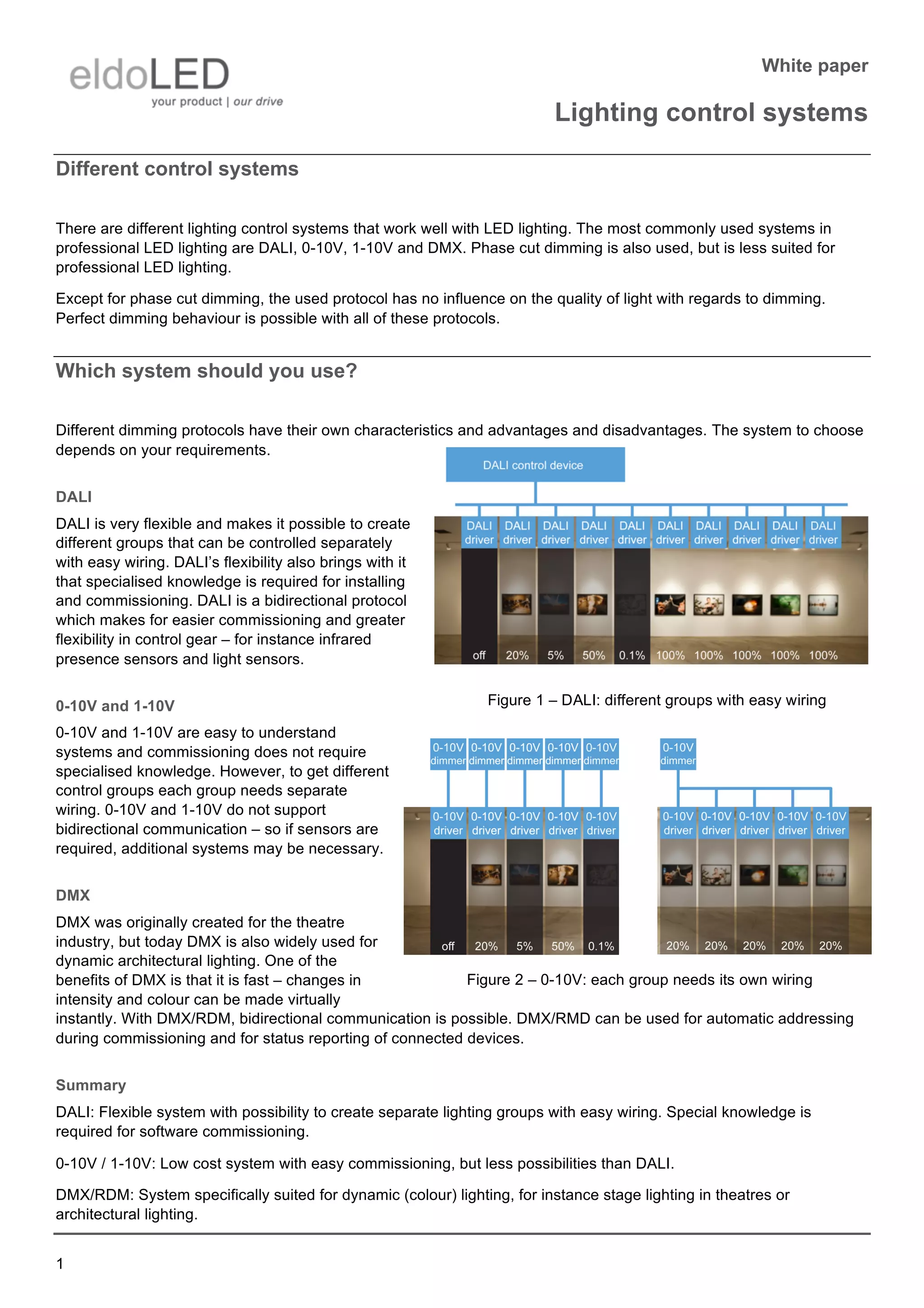
DALI  is  very  flexible  and  makes  it  possible  to  create  
different  groups  that  can  be  controlled  separately  
with  easy  wiring.  DALI’s  flexibility  also  brings  with  it  
that  specialised  knowledge  is  required  for  installing  
and  commissioning.  DALI  is  a  bidirectional  protocol  
which  makes  for  easier  commissioning  and  greater  
flexibility  in  control  gear  –  for  instance  infrared  
presence  sensors  and  light  sensors.  
0-­10V  and  1-­10V  
0-­10V  and  1-­10V  are  easy  to  understand  
systems  and  commissioning  does  not  require  
specialised  knowledge.  However,  to  get  different  
control  groups  each  group  needs  separate  
wiring.  0-­10V  and  1-­10V  do  not  support  
bidirectional  communication  –  so  if  sensors  are  
required,  additional  systems  may  be  necessary.  
DMX  
DMX  was  originally  created  for  the  theatre  
industry,  but  today  DMX  is  also  widely  used  for  
dynamic  architectural  lighting.  One  of  the  
benefits  of  DMX  is  that  it  is  fast  –  changes  in  
intensity  and  colour  can  be  made  virtually  
instantly.  With  DMX/RDM,  bidirectional  communication  is  possible.  DMX/RMD  can  be  used  for  automatic  addressing  
during  commissioning  and  for  status  reporting  of  connected  devices.  
Summary  
DALI:  Flexible  system  with  possibility  to  create  separate  lighting  groups  with  easy  wiring.  Special  knowledge  is  
required  for  software  commissioning.  
0-­10V  /  1-­10V:  Low  cost  system  with  easy  commissioning,  but  less  possibilities  than  DALI.  
DMX/RDM:  System  specifically  suited  for  dynamic  (colour)  lighting,  for  instance  stage  lighting  in  theatres  or  
architectural  lighting.  
Figure  1  –  DALI:  different  groups  with  easy  wiring  
     
Figure  2  –  0-­10V:  each  group  needs  its  own  wiring  
 
2    
  
More  about  DALI  
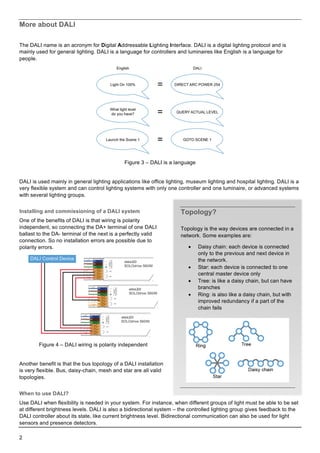
The  DALI  name  is  an  acronym  for  Digital  Addressable  Lighting  Interface.  DALI  is  a  digital  lighting  protocol  and  is  
mainly  used  for  general  lighting.  DALI  is  a  language  for  controllers  and  luminaires  like  English  is  a  language  for  
people.  
  
Figure  3  –  DALI  is  a  language  
DALI  is  used  mainly  in  general  lighting  applications  like  office  lighting,  museum  lighting  and  hospital  lighting.  DALI  is  a  
very  flexible  system  and  can  control  lighting  systems  with  only  one  controller  and  one  luminaire,  or  advanced  systems  
with  several  lighting  groups.  
Installing  and  commissioning  of  a  DALI  system  
One  of  the  benefits  of  DALI  is  that  wiring  is  polarity  
independent,  so  connecting  the  DA+  terminal  of  one  DALI  
ballast  to  the  DA-­  terminal  of  the  next  is  a  perfectly  valid  
connection.  So  no  installation  errors  are  possible  due  to  
polarity  errors.  
  
Figure  4  –  DALI  wiring  is  polarity  independent  
Another  benefit  is  that  the  bus  topology  of  a  DALI  installation  
is  very  flexible.  Bus,  daisy-­chain,  mesh  and  star  are  all  valid  
topologies.  
When  to  use  DALI?  
Use  DALI  when  flexibility  is  needed  in  your  system.  For  instance,  when  different  groups  of  light  must  be  able  to  be  set  
at  different  brightness  levels.  DALI  is  also  a  bidirectional  system  –  the  controlled  lighting  group  gives  feedback  to  the  
DALI  controller  about  its  state,  like  current  brightness  level.  Bidirectional  communication  can  also  be  used  for  light  
sensors  and  presence  detectors.  
Topology?  
Topology  is  the  way  devices  are  connected  in  a  
network.  Some  examples  are:  
• Daisy  chain:  each  device  is  connected  
only  to  the  previous  and  next  device  in  
the  network.  
• Star:  each  device  is  connected  to  one  
central  master  device  only  
• Tree:  is  like  a  daisy  chain,  but  can  have  
branches  
• Ring:  is  also  like  a  daisy  chain,  but  with  
improved  redundancy  if  a  part  of  the  
chain  fails  
  
 
3    
  
DALI  Advantages  
•   Open  IEC  standard  (IEC  62386)  and  can  be  used  by  anyone.  
•   DALI  has  an  active  organisation  and  DALI  is  constantly  improved  and  extended.  
•   Full  digital  control  –  group  creation  or  individual  control  of  fixtures.  
•   Bi-­directional  communication  makes  for  easier  commissioning  and  greater  flexibility  in  control  gear.  
•   Polarity  independent  two  wire  control.  
•   BUS  based  protocol.  
•   Standardised  dimming  curves  –  better  compatibility  between  controllers  and  LED  drivers.  
DALI  Disadvantages  
•   Maximum  64  clients  per  controller.  
•   Slow  –  less  suitable  for  fast  brightness  changes.  
•   Specific  knowledge  is  required  during  commissioning.  
•   Hardware  and  software  commissioning  is  required.  
•   Only  254  digital  values  (from  0-­100%)  gives  low  dimming  resolution.  
0-­10V  and  1-­10V  
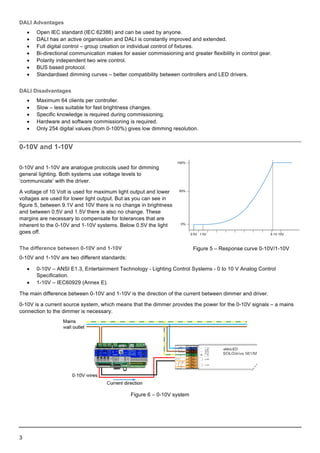
0-­10V  and  1-­10V  are  analogue  protocols  used  for  dimming  
general  lighting.  Both  systems  use  voltage  levels  to  
‘communicate’  with  the  driver.  
A  voltage  of  10  Volt  is  used  for  maximum  light  output  and  lower  
voltages  are  used  for  lower  light  output.  But  as  you  can  see  in  
figure  5,  between  9.1V  and  10V  there  is  no  change  in  brightness  
and  between  0.5V  and  1.5V  there  is  also  no  change.  These  
margins  are  necessary  to  compensate  for  tolerances  that  are  
inherent  to  the  0-­10V  and  1-­10V  systems.  Below  0.5V  the  light  
goes  off.  
The  difference  between  0-­10V  and  1-­10V  
0-­10V  and  1-­10V  are  two  different  standards:  
•   0-­10V  –  ANSI  E1.3,  Entertainment  Technology  -­  Lighting  Control  Systems  -­  0  to  10  V  Analog  Control  
Specification.  
•   1-­10V  –  IEC60929  (Annex  E).  
The  main  difference  between  0-­10V  and  1-­10V  is  the  direction  of  the  current  between  dimmer  and  driver.  
0-­10V  is  a  current  source  system,  which  means  that  the  dimmer  provides  the  power  for  the  0-­10V  signals  –  a  mains  
connection  to  the  dimmer  is  necessary.  
  
Figure  6  –  0-­10V  system  
     
Figure  5  –  Response  curve  0-­10V/1-­10V  
 
4    
  
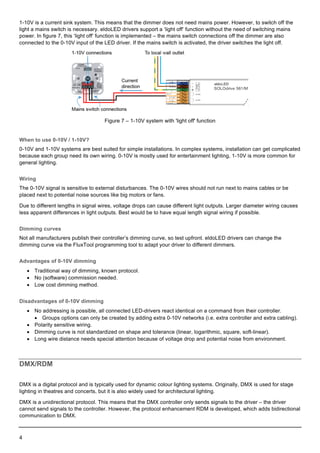
1-­10V  is  a  current  sink  system.  This  means  that  the  dimmer  does  not  need  mains  power.  However,  to  switch  off  the  
light  a  mains  switch  is  necessary.  eldoLED  drivers  support  a  ‘light  off’  function  without  the  need  of  switching  mains  
power.  In  figure  7,  this  ‘light  off’  function  is  implemented  –  the  mains  switch  connections  off  the  dimmer  are  also  
connected  to  the  0-­10V  input  of  the  LED  driver.  If  the  mains  switch  is  activated,  the  driver  switches  the  light  off.  
  
Figure  7  –  1-­10V  system  with  'light  off'  function  
When  to  use  0-­10V  /  1-­10V?  
0-­10V  and  1-­10V  systems  are  best  suited  for  simple  installations.  In  complex  systems,  installation  can  get  complicated  
because  each  group  need  its  own  wiring.  0-­10V  is  mostly  used  for  entertainment  lighting,  1-­10V  is  more  common  for  
general  lighting.  
Wiring  
The  0-­10V  signal  is  sensitive  to  external  disturbances.  The  0-­10V  wires  should  not  run  next  to  mains  cables  or  be  
placed  next  to  potential  noise  sources  like  big  motors  or  fans.  
Due  to  different  lengths  in  signal  wires,  voltage  drops  can  cause  different  light  outputs.  Larger  diameter  wiring  causes  
less  apparent  differences  in  light  outputs.  Best  would  be  to  have  equal  length  signal  wiring  if  possible.  
Dimming  curves  
Not  all  manufacturers  publish  their  controller’s  dimming  curve,  so  test  upfront.  eldoLED  drivers  can  change  the  
dimming  curve  via  the  FluxTool  programming  tool  to  adapt  your  driver  to  different  dimmers.  
Advantages  of  0-­10V  dimming  
•   Traditional  way  of  dimming,  known  protocol.  
•   No  (software)  commission  needed.  
•   Low  cost  dimming  method.  
Disadvantages  of  0-­10V  dimming  
•   No  addressing  is  possible,  all  connected  LED-­drivers  react  identical  on  a  command  from  their  controller.  
•   Groups  options  can  only  be  created  by  adding  extra  0-­10V  networks  (i.e.  extra  controller  and  extra  cabling).  
•   Polarity  sensitive  wiring.  
•   Dimming  curve  is  not  standardized  on  shape  and  tolerance  (linear,  logarithmic,  square,  soft-­linear).  
•   Long  wire  distance  needs  special  attention  because  of  voltage  drop  and  potential  noise  from  environment.  
  
DMX/RDM  
DMX  is  a  digital  protocol  and  is  typically  used  for  dynamic  colour  lighting  systems.  Originally,  DMX  is  used  for  stage  
lighting  in  theatres  and  concerts,  but  it  is  also  widely  used  for  architectural  lighting.  
DMX  is  a  unidirectional  protocol.  This  means  that  the  DMX  controller  only  sends  signals  to  the  driver  –  the  driver  
cannot  send  signals  to  the  controller.  However,  the  protocol  enhancement  RDM  is  developed,  which  adds  bidirectional  
communication  to  DMX.  
 
5    
  
The  protocol  
A  DMX  controller  sends  messages  to  each  device  in  its  network.  The  protocol  sends  a  value  between  0  and  255  to  
each  of  the  512  channels.  For  example:  
Channel:   1   2   3   4   …   509   510   511   512  
Value:   63   42   167   0   …   3   0   255   98  
The  value  can  be  used  to  set  a  light  level,  but  also  to  set  the  position  of  a  moving  head  or  to  change  gobo’s.  
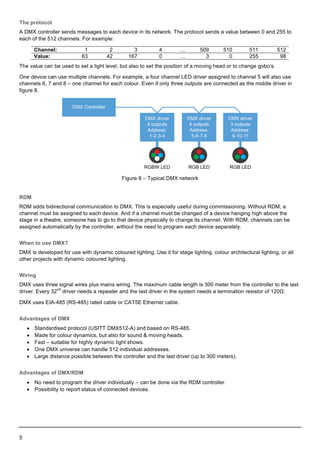
One  device  can  use  multiple  channels.  For  example,  a  four  channel  LED  driver  assigned  to  channel  5  will  also  use  
channels  6,  7  and  8  –  one  channel  for  each  colour.  Even  if  only  three  outputs  are  connected  as  the  middle  driver  in  
figure  8.  
  
Figure  8  –  Typical  DMX  network  
RDM  
RDM  adds  bidirectional  communication  to  DMX.  This  is  especially  useful  during  commissioning.  Without  RDM,  a  
channel  must  be  assigned  to  each  device.  And  if  a  channel  must  be  changed  of  a  device  hanging  high  above  the  
stage  in  a  theatre,  someone  has  to  go  to  that  device  physically  to  change  its  channel.  With  RDM,  channels  can  be  
assigned  automatically  by  the  controller,  without  the  need  to  program  each  device  separately.  
When  to  use  DMX?  
DMX  is  developed  for  use  with  dynamic  coloured  lighting.  Use  it  for  stage  lighting,  colour  architectural  lighting,  or  all  
other  projects  with  dynamic  coloured  lighting.  
Wiring  
DMX  uses  three  signal  wires  plus  mains  wiring.  The  maximum  cable  length  is  300  meter  from  the  controller  to  the  last  
driver.  Every  32
nd
  driver  needs  a  repeater  and  the  last  driver  in  the  system  needs  a  termination  resistor  of  120Ω.  
DMX  uses  EIA-­485  (RS-­485)  rated  cable  or  CAT5E  Ethernet  cable.  
Advantages  of  DMX  
•   Standardised  protocol  (USITT  DMX512-­A)  and  based  on  RS-­485.  
•   Made  for  colour  dynamics,  but  also  for  sound  &  moving  heads.  
•   Fast  –  suitable  for  highly  dynamic  light  shows.  
•   One  DMX  universe  can  handle  512  individual  addresses.  
•   Large  distance  possible  between  the  controller  and  the  last  driver  (up  to  300  meters).  
Advantages  of  DMX/RDM  
•   No  need  to  program  the  driver  individually  –  can  be  done  via  the  RDM  controller.  
•   Possibility  to  report  status  of  connected  devices.  


Europe,  Rest  of  World  
eldoLED  B.V.  
Science  Park  Eindhoven  5125  
5692  ED  Son  
The  Netherlands  
www.eldoled.com  
North  America  
eldoLED  America  
One  Lithonia  Way  
Conyers,  GA  30012  
USA  
  
  ©  2016  eldoLED.  All  rights  reserved.  V1.0  All  content  contained  herein  is  subject  to  change  without  prior  notice.  
More  product  documentation  and  eldoLED´s  terms  and  conditions  are  available  at  www.eldoLED.com  
Disadvantages  of  DMX  &  DMX/RDM  
•   Complex  –  specialised  knowledge  is  needed.  
•   Special  cables  required  for  control  signals  (EIA-­485  or  CAT5E).  
•   Individual  programming  of  drivers  is  needed  (not  with  RDM).  

Learning center white paper lighting control systems_v1.0

  • 1.
    White  paper   Lighting control  systems       1       Different  control  systems   There  are  different  lighting  control  systems  that  work  well  with  LED  lighting.  The  most  commonly  used  systems  in   professional  LED  lighting  are  DALI,  0-­10V,  1-­10V  and  DMX.  Phase  cut  dimming  is  also  used,  but  is  less  suited  for   professional  LED  lighting.   Except  for  phase  cut  dimming,  the  used  protocol  has  no  influence  on  the  quality  of  light  with  regards  to  dimming.   Perfect  dimming  behaviour  is  possible  with  all  of  these  protocols.   Which  system  should  you  use?   Different  dimming  protocols  have  their  own  characteristics  and  advantages  and  disadvantages.  The  system  to  choose   depends  on  your  requirements.   DALI   DALI  is  very  flexible  and  makes  it  possible  to  create   different  groups  that  can  be  controlled  separately   with  easy  wiring.  DALI’s  flexibility  also  brings  with  it   that  specialised  knowledge  is  required  for  installing   and  commissioning.  DALI  is  a  bidirectional  protocol   which  makes  for  easier  commissioning  and  greater   flexibility  in  control  gear  –  for  instance  infrared   presence  sensors  and  light  sensors.   0-­10V  and  1-­10V   0-­10V  and  1-­10V  are  easy  to  understand   systems  and  commissioning  does  not  require   specialised  knowledge.  However,  to  get  different   control  groups  each  group  needs  separate   wiring.  0-­10V  and  1-­10V  do  not  support   bidirectional  communication  –  so  if  sensors  are   required,  additional  systems  may  be  necessary.   DMX   DMX  was  originally  created  for  the  theatre   industry,  but  today  DMX  is  also  widely  used  for   dynamic  architectural  lighting.  One  of  the   benefits  of  DMX  is  that  it  is  fast  –  changes  in   intensity  and  colour  can  be  made  virtually   instantly.  With  DMX/RDM,  bidirectional  communication  is  possible.  DMX/RMD  can  be  used  for  automatic  addressing   during  commissioning  and  for  status  reporting  of  connected  devices.   Summary   DALI:  Flexible  system  with  possibility  to  create  separate  lighting  groups  with  easy  wiring.  Special  knowledge  is   required  for  software  commissioning.   0-­10V  /  1-­10V:  Low  cost  system  with  easy  commissioning,  but  less  possibilities  than  DALI.   DMX/RDM:  System  specifically  suited  for  dynamic  (colour)  lighting,  for  instance  stage  lighting  in  theatres  or   architectural  lighting.   Figure  1  –  DALI:  different  groups  with  easy  wiring       Figure  2  –  0-­10V:  each  group  needs  its  own  wiring  
  • 2.
      2       More  about  DALI   The  DALI  name  is  an  acronym  for  Digital  Addressable  Lighting  Interface.  DALI  is  a  digital  lighting  protocol  and  is   mainly  used  for  general  lighting.  DALI  is  a  language  for  controllers  and  luminaires  like  English  is  a  language  for   people.     Figure  3  –  DALI  is  a  language   DALI  is  used  mainly  in  general  lighting  applications  like  office  lighting,  museum  lighting  and  hospital  lighting.  DALI  is  a   very  flexible  system  and  can  control  lighting  systems  with  only  one  controller  and  one  luminaire,  or  advanced  systems   with  several  lighting  groups.   Installing  and  commissioning  of  a  DALI  system   One  of  the  benefits  of  DALI  is  that  wiring  is  polarity   independent,  so  connecting  the  DA+  terminal  of  one  DALI   ballast  to  the  DA-­  terminal  of  the  next  is  a  perfectly  valid   connection.  So  no  installation  errors  are  possible  due  to   polarity  errors.     Figure  4  –  DALI  wiring  is  polarity  independent   Another  benefit  is  that  the  bus  topology  of  a  DALI  installation   is  very  flexible.  Bus,  daisy-­chain,  mesh  and  star  are  all  valid   topologies.   When  to  use  DALI?   Use  DALI  when  flexibility  is  needed  in  your  system.  For  instance,  when  different  groups  of  light  must  be  able  to  be  set   at  different  brightness  levels.  DALI  is  also  a  bidirectional  system  –  the  controlled  lighting  group  gives  feedback  to  the   DALI  controller  about  its  state,  like  current  brightness  level.  Bidirectional  communication  can  also  be  used  for  light   sensors  and  presence  detectors.   Topology?   Topology  is  the  way  devices  are  connected  in  a   network.  Some  examples  are:   • Daisy  chain:  each  device  is  connected   only  to  the  previous  and  next  device  in   the  network.   • Star:  each  device  is  connected  to  one   central  master  device  only   • Tree:  is  like  a  daisy  chain,  but  can  have   branches   • Ring:  is  also  like  a  daisy  chain,  but  with   improved  redundancy  if  a  part  of  the   chain  fails    
  • 3.
      3       DALI  Advantages   •   Open  IEC  standard  (IEC  62386)  and  can  be  used  by  anyone.   •   DALI  has  an  active  organisation  and  DALI  is  constantly  improved  and  extended.   •   Full  digital  control  –  group  creation  or  individual  control  of  fixtures.   •   Bi-­directional  communication  makes  for  easier  commissioning  and  greater  flexibility  in  control  gear.   •   Polarity  independent  two  wire  control.   •   BUS  based  protocol.   •   Standardised  dimming  curves  –  better  compatibility  between  controllers  and  LED  drivers.   DALI  Disadvantages   •   Maximum  64  clients  per  controller.   •   Slow  –  less  suitable  for  fast  brightness  changes.   •   Specific  knowledge  is  required  during  commissioning.   •   Hardware  and  software  commissioning  is  required.   •   Only  254  digital  values  (from  0-­100%)  gives  low  dimming  resolution.   0-­10V  and  1-­10V   0-­10V  and  1-­10V  are  analogue  protocols  used  for  dimming   general  lighting.  Both  systems  use  voltage  levels  to   ‘communicate’  with  the  driver.   A  voltage  of  10  Volt  is  used  for  maximum  light  output  and  lower   voltages  are  used  for  lower  light  output.  But  as  you  can  see  in   figure  5,  between  9.1V  and  10V  there  is  no  change  in  brightness   and  between  0.5V  and  1.5V  there  is  also  no  change.  These   margins  are  necessary  to  compensate  for  tolerances  that  are   inherent  to  the  0-­10V  and  1-­10V  systems.  Below  0.5V  the  light   goes  off.   The  difference  between  0-­10V  and  1-­10V   0-­10V  and  1-­10V  are  two  different  standards:   •   0-­10V  –  ANSI  E1.3,  Entertainment  Technology  -­  Lighting  Control  Systems  -­  0  to  10  V  Analog  Control   Specification.   •   1-­10V  –  IEC60929  (Annex  E).   The  main  difference  between  0-­10V  and  1-­10V  is  the  direction  of  the  current  between  dimmer  and  driver.   0-­10V  is  a  current  source  system,  which  means  that  the  dimmer  provides  the  power  for  the  0-­10V  signals  –  a  mains   connection  to  the  dimmer  is  necessary.     Figure  6  –  0-­10V  system       Figure  5  –  Response  curve  0-­10V/1-­10V  
  • 4.
      4       1-­10V  is  a  current  sink  system.  This  means  that  the  dimmer  does  not  need  mains  power.  However,  to  switch  off  the   light  a  mains  switch  is  necessary.  eldoLED  drivers  support  a  ‘light  off’  function  without  the  need  of  switching  mains   power.  In  figure  7,  this  ‘light  off’  function  is  implemented  –  the  mains  switch  connections  off  the  dimmer  are  also   connected  to  the  0-­10V  input  of  the  LED  driver.  If  the  mains  switch  is  activated,  the  driver  switches  the  light  off.     Figure  7  –  1-­10V  system  with  'light  off'  function   When  to  use  0-­10V  /  1-­10V?   0-­10V  and  1-­10V  systems  are  best  suited  for  simple  installations.  In  complex  systems,  installation  can  get  complicated   because  each  group  need  its  own  wiring.  0-­10V  is  mostly  used  for  entertainment  lighting,  1-­10V  is  more  common  for   general  lighting.   Wiring   The  0-­10V  signal  is  sensitive  to  external  disturbances.  The  0-­10V  wires  should  not  run  next  to  mains  cables  or  be   placed  next  to  potential  noise  sources  like  big  motors  or  fans.   Due  to  different  lengths  in  signal  wires,  voltage  drops  can  cause  different  light  outputs.  Larger  diameter  wiring  causes   less  apparent  differences  in  light  outputs.  Best  would  be  to  have  equal  length  signal  wiring  if  possible.   Dimming  curves   Not  all  manufacturers  publish  their  controller’s  dimming  curve,  so  test  upfront.  eldoLED  drivers  can  change  the   dimming  curve  via  the  FluxTool  programming  tool  to  adapt  your  driver  to  different  dimmers.   Advantages  of  0-­10V  dimming   •   Traditional  way  of  dimming,  known  protocol.   •   No  (software)  commission  needed.   •   Low  cost  dimming  method.   Disadvantages  of  0-­10V  dimming   •   No  addressing  is  possible,  all  connected  LED-­drivers  react  identical  on  a  command  from  their  controller.   •   Groups  options  can  only  be  created  by  adding  extra  0-­10V  networks  (i.e.  extra  controller  and  extra  cabling).   •   Polarity  sensitive  wiring.   •   Dimming  curve  is  not  standardized  on  shape  and  tolerance  (linear,  logarithmic,  square,  soft-­linear).   •   Long  wire  distance  needs  special  attention  because  of  voltage  drop  and  potential  noise  from  environment.     DMX/RDM   DMX  is  a  digital  protocol  and  is  typically  used  for  dynamic  colour  lighting  systems.  Originally,  DMX  is  used  for  stage   lighting  in  theatres  and  concerts,  but  it  is  also  widely  used  for  architectural  lighting.   DMX  is  a  unidirectional  protocol.  This  means  that  the  DMX  controller  only  sends  signals  to  the  driver  –  the  driver   cannot  send  signals  to  the  controller.  However,  the  protocol  enhancement  RDM  is  developed,  which  adds  bidirectional   communication  to  DMX.  
  • 5.
      5       The  protocol   A  DMX  controller  sends  messages  to  each  device  in  its  network.  The  protocol  sends  a  value  between  0  and  255  to   each  of  the  512  channels.  For  example:   Channel:   1   2   3   4   …   509   510   511   512   Value:   63   42   167   0   …   3   0   255   98   The  value  can  be  used  to  set  a  light  level,  but  also  to  set  the  position  of  a  moving  head  or  to  change  gobo’s.   One  device  can  use  multiple  channels.  For  example,  a  four  channel  LED  driver  assigned  to  channel  5  will  also  use   channels  6,  7  and  8  –  one  channel  for  each  colour.  Even  if  only  three  outputs  are  connected  as  the  middle  driver  in   figure  8.     Figure  8  –  Typical  DMX  network   RDM   RDM  adds  bidirectional  communication  to  DMX.  This  is  especially  useful  during  commissioning.  Without  RDM,  a   channel  must  be  assigned  to  each  device.  And  if  a  channel  must  be  changed  of  a  device  hanging  high  above  the   stage  in  a  theatre,  someone  has  to  go  to  that  device  physically  to  change  its  channel.  With  RDM,  channels  can  be   assigned  automatically  by  the  controller,  without  the  need  to  program  each  device  separately.   When  to  use  DMX?   DMX  is  developed  for  use  with  dynamic  coloured  lighting.  Use  it  for  stage  lighting,  colour  architectural  lighting,  or  all   other  projects  with  dynamic  coloured  lighting.   Wiring   DMX  uses  three  signal  wires  plus  mains  wiring.  The  maximum  cable  length  is  300  meter  from  the  controller  to  the  last   driver.  Every  32 nd  driver  needs  a  repeater  and  the  last  driver  in  the  system  needs  a  termination  resistor  of  120Ω.   DMX  uses  EIA-­485  (RS-­485)  rated  cable  or  CAT5E  Ethernet  cable.   Advantages  of  DMX   •   Standardised  protocol  (USITT  DMX512-­A)  and  based  on  RS-­485.   •   Made  for  colour  dynamics,  but  also  for  sound  &  moving  heads.   •   Fast  –  suitable  for  highly  dynamic  light  shows.   •   One  DMX  universe  can  handle  512  individual  addresses.   •   Large  distance  possible  between  the  controller  and  the  last  driver  (up  to  300  meters).   Advantages  of  DMX/RDM   •   No  need  to  program  the  driver  individually  –  can  be  done  via  the  RDM  controller.   •   Possibility  to  report  status  of  connected  devices.    
  • 6.
        Europe,  Rest of  World   eldoLED  B.V.   Science  Park  Eindhoven  5125   5692  ED  Son   The  Netherlands   www.eldoled.com   North  America   eldoLED  America   One  Lithonia  Way   Conyers,  GA  30012   USA      ©  2016  eldoLED.  All  rights  reserved.  V1.0  All  content  contained  herein  is  subject  to  change  without  prior  notice.   More  product  documentation  and  eldoLED´s  terms  and  conditions  are  available  at  www.eldoLED.com   Disadvantages  of  DMX  &  DMX/RDM   •   Complex  –  specialised  knowledge  is  needed.   •   Special  cables  required  for  control  signals  (EIA-­485  or  CAT5E).   •   Individual  programming  of  drivers  is  needed  (not  with  RDM).