VoIP Security: An OverviewVoIP Security: An Overview
(2008)(2008)
Meletis BelsisMeletis Belsis
Information Security ConsultantInformation Security Consultant
MPhil / MSc / BScMPhil / MSc / BSc
CWNA/CWSP, C|EH, CCSA, ISO27001LACWNA/CWSP, C|EH, CCSA, ISO27001LA
AgendaAgenda
VoIP Technology
VoIP Complexity
VoIP Threats
Example Attacks
The Hacker’s Toolbox
VoIP Countermeasures
The Company
VoIP TechnologyVoIP Technology
• VoIP is an integral part of modern Enterprises
• VoIP allows the reduction of OpEx by providing PSTN
like services
• Based on open IETF and ITU standards
• Protocols used to support VoIP include
TCP/UDP/IP, DNS,TFTP, DHCP,STUN,HTTP,SIP,RTPTCP/UDP/IP, DNS,TFTP, DHCP,STUN,HTTP,SIP,RTP
• VoIP components include:
Routers, Switches, Firewalls, SIP Servers,
Media Gateways, iPBX, WiFi
VoIP SecurityVoIP Security
“ The flexibility of VoIP comes at a price: added
complexity in securing voice and data. Because
VoIP systems are connected to the data network
and share many of the same hardware and
software components, there are more ways for
intruders to attack a VoIP system than a
conventional voice telephone system or PBX “
NIST: Considerations for Voice over IP SystemsNIST: Considerations for Voice over IP Systems
VoIP Security ComplexityVoIP Security Complexity
• Securing a VoIP network is complex because:
– VoIP inherits the TCP/IP Vulnerabilitiesinherits the TCP/IP Vulnerabilities.
– VoIP uses the corporate networkuses the corporate network to operate. Usually
there is no network separation.
– Applying security may affect other attributes of VoIPaffect other attributes of VoIP
(e.g. Delay, Latency, Jitter).
– VoIP usually uses UDP communicationuses UDP communication and thus may
not be able to operate on networks that use firewalls.
Special proxy techniques like STUNSTUN need to be
applied.
VoIP ThreatsVoIP Threats
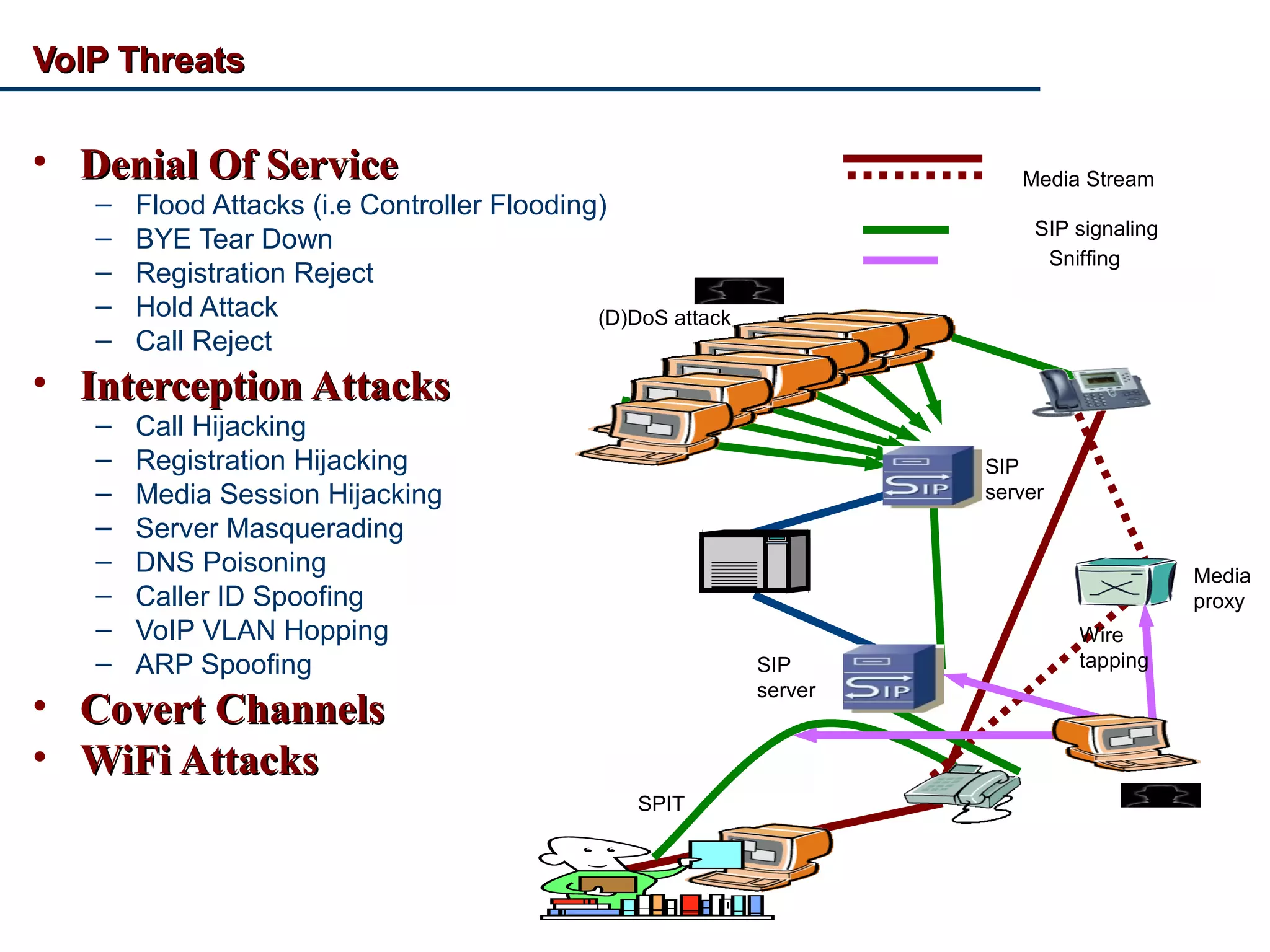
• Denial Of ServiceDenial Of Service
– Flood Attacks (i.e Controller Flooding)
– BYE Tear Down
– Registration Reject
– Hold Attack
– Call Reject
• Interception AttacksInterception Attacks
– Call Hijacking
– Registration Hijacking
– Media Session Hijacking
– Server Masquerading
– DNS Poisoning
– Caller ID Spoofing
– VoIP VLAN Hopping
– ARP Spoofing
• Covert ChannelsCovert Channels
• WiFi AttacksWiFi Attacks
SIP
server
SIP
server
Media
proxy
SIP signaling
Media Stream
Sniffing
(D)DoS attack
Wire
tapping
SPIT
VoIP ThreatsVoIP Threats
• VoIP Platforms Vulnerabilities
– CAN-2004-0056CAN-2004-0056: Malformed H.323 packet to exploit
Nortel BCM vulnerabilities
– CAN-2004-0054CAN-2004-0054: Exploits CISCO IOS H.323
implementation
– CVE-2007-4459CVE-2007-4459: Cisco SIP DoS vulnerabilities.
– CVE-2007-6424CVE-2007-6424: Vulnerabilities on the Fonality
Trixbox 2.0 PBX products
– CVE-2007-5361CVE-2007-5361: Vulnerabilities on the Alcatel- Lucent
OmniPCX Enterprise Communication Server.
– CVE-2007-5556CVE-2007-5556: Vulnerabilities on the Avaya VoIP
Handset.
Server MasqueradingServer Masquerading
Vlan HoppingVlan Hopping
SourceSource:: http://www.securityfocus.com/infocus/1892
SIP InjectionSIP Injection
UE’s initial Register Request looks like:
REGISTER SIP: home1.de SIP/2.0
Username=”user Authorization: Digest Username
user_private@home1.de”,
realm=”home1.de”, nonce=” “, uri=”SIP: home1.de”,
response=” “
Malicious Code infected with SQL injection looks like:
REGISTER SIP: home1.de SIP/2.0
Authorization: Digest
Username=”user_private@home1.de;delete table
users”, realm=”home1.de”, nonce=” “, uri=”SIP:
home1.de”, response=” “
Hacker’s ToolboxHacker’s Toolbox
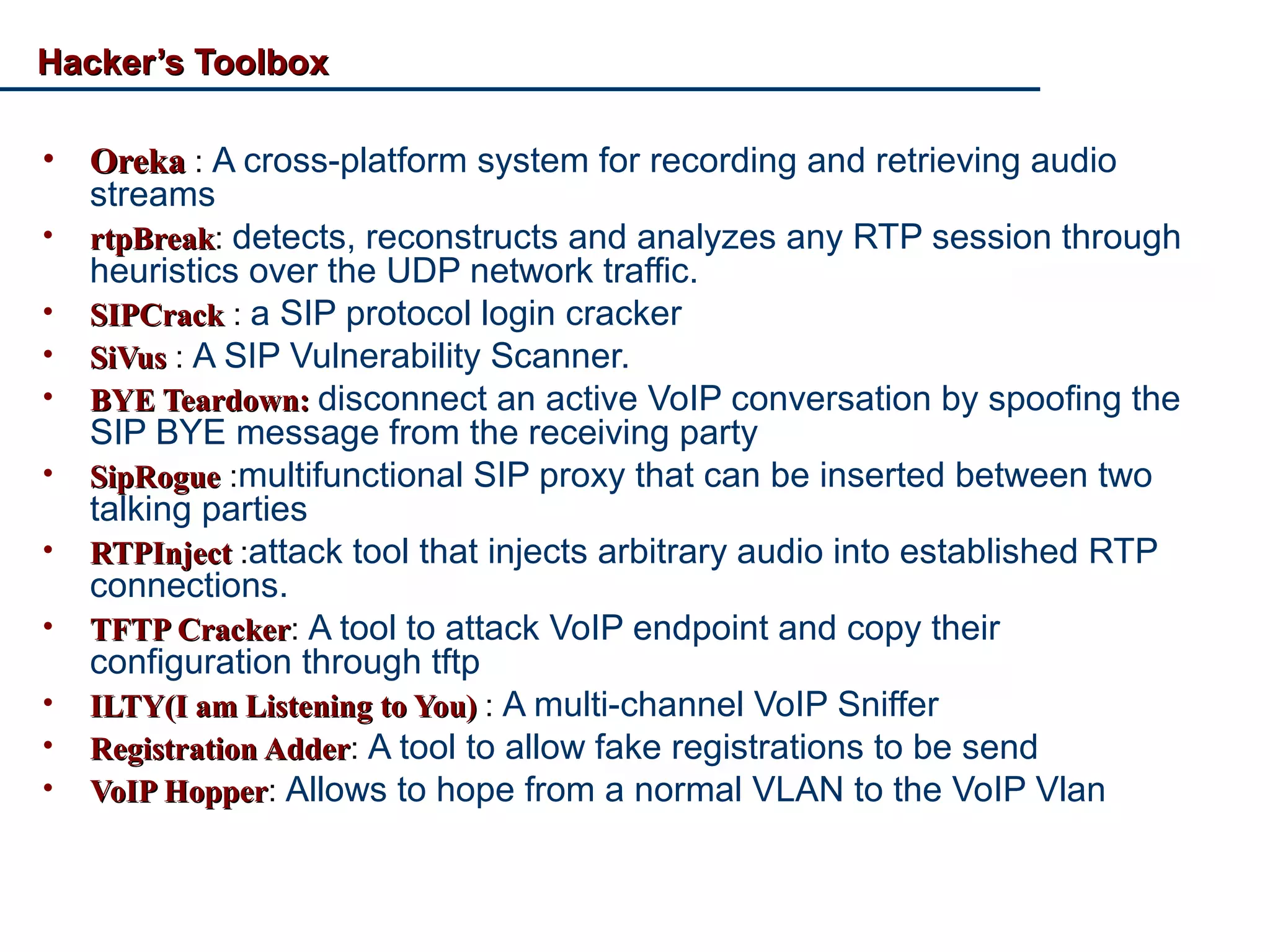
• OrekaOreka : A cross-platform system for recording and retrieving audio
streams
• rtpBreakrtpBreak: detects, reconstructs and analyzes any RTP session through
heuristics over the UDP network traffic.
• SIPCrackSIPCrack : a SIP protocol login cracker
• SiVusSiVus : A SIP Vulnerability Scanner.
• BYE Teardown:BYE Teardown: disconnect an active VoIP conversation by spoofing the
SIP BYE message from the receiving party
• SipRogueSipRogue :multifunctional SIP proxy that can be inserted between two
talking parties
• RTPInjectRTPInject :attack tool that injects arbitrary audio into established RTP
connections.
• TFTP CrackerTFTP Cracker: A tool to attack VoIP endpoint and copy their
configuration through tftp
• ILTY(I am Listening to You)ILTY(I am Listening to You) : A multi-channel VoIP Sniffer
• Registration AdderRegistration Adder: A tool to allow fake registrations to be send
• VoIP HopperVoIP Hopper: Allows to hope from a normal VLAN to the VoIP Vlan
Hackers ToolboxHackers Toolbox
RTPInject SiVUS Scanner
13
WiFi VoIPWiFi VoIP
NetStumblerNetStumbler
Is used by WarDriversIs used by WarDrivers
to detect unprotectedto detect unprotected
WiFi NetworksWiFi Networks
AirSnortAirSnort
Is widely used to
attack WEP
passwords
VoIP CountermeasuresVoIP Countermeasures
• Network SeparationNetwork Separation : Although dedicated
VoIP VLANs offer a level of security, a dedicate
VoIP network will be more secure.
• SIP EncryptionSIP Encryption: The TLS protocol can be used
to encrypt the SIP messages exchanged
between the nodes. TLS provides only Server
authentication. S/MIME is another option for SIP
encryption.
• RTP EncryptionRTP Encryption: Secure RTP(SRTP) can be
used to encrypt media in a VoIP network
VoIP CountermeasuresVoIP Countermeasures
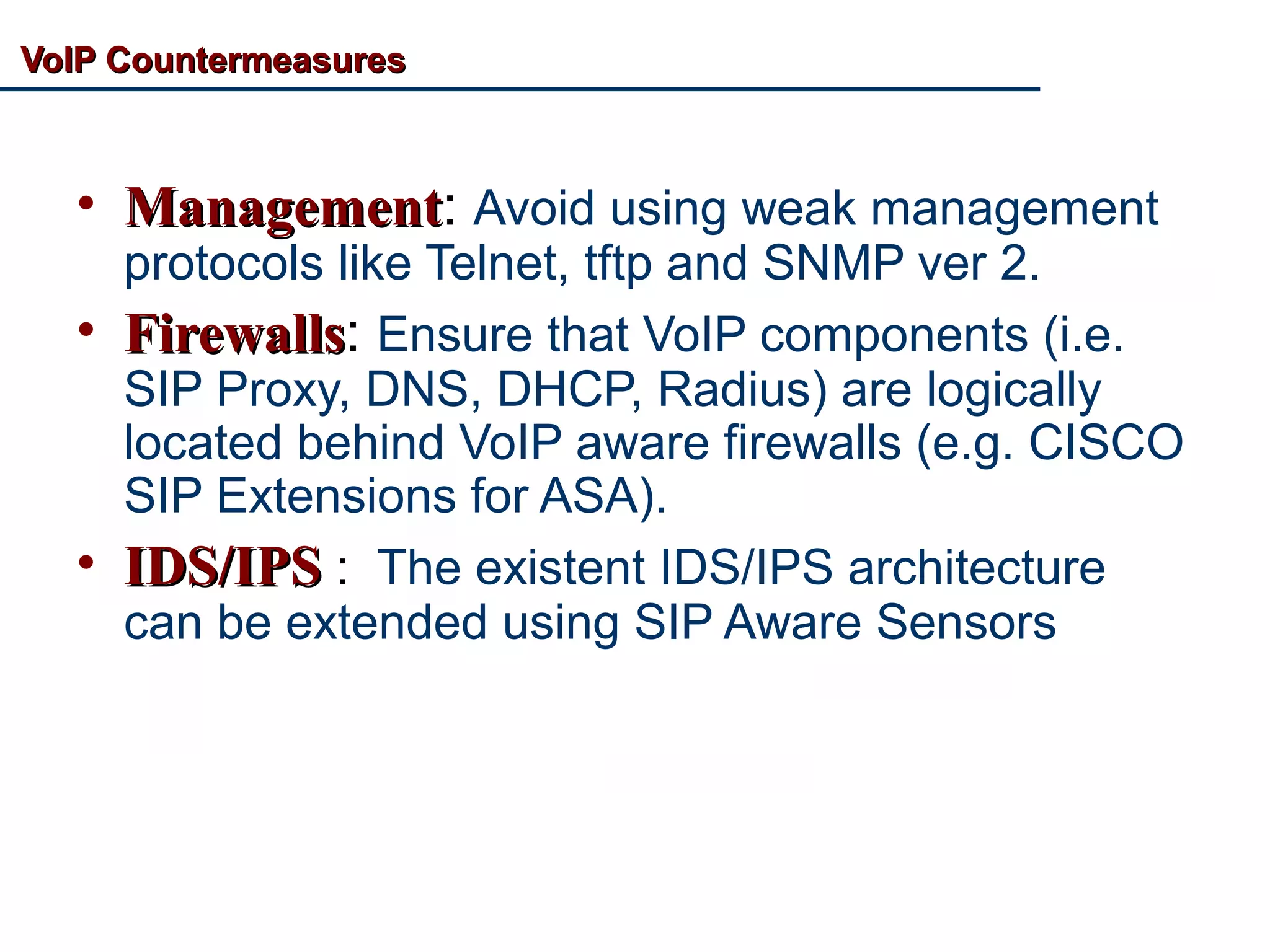
• ManagementManagement: Avoid using weak management
protocols like Telnet, tftp and SNMP ver 2.
• FirewallsFirewalls: Ensure that VoIP components (i.e.
SIP Proxy, DNS, DHCP, Radius) are logically
located behind VoIP aware firewalls (e.g. CISCO
SIP Extensions for ASA).
• IDS/IPSIDS/IPS : The existent IDS/IPS architecture
can be extended using SIP Aware Sensors
VoIP CountermeasuresVoIP Countermeasures
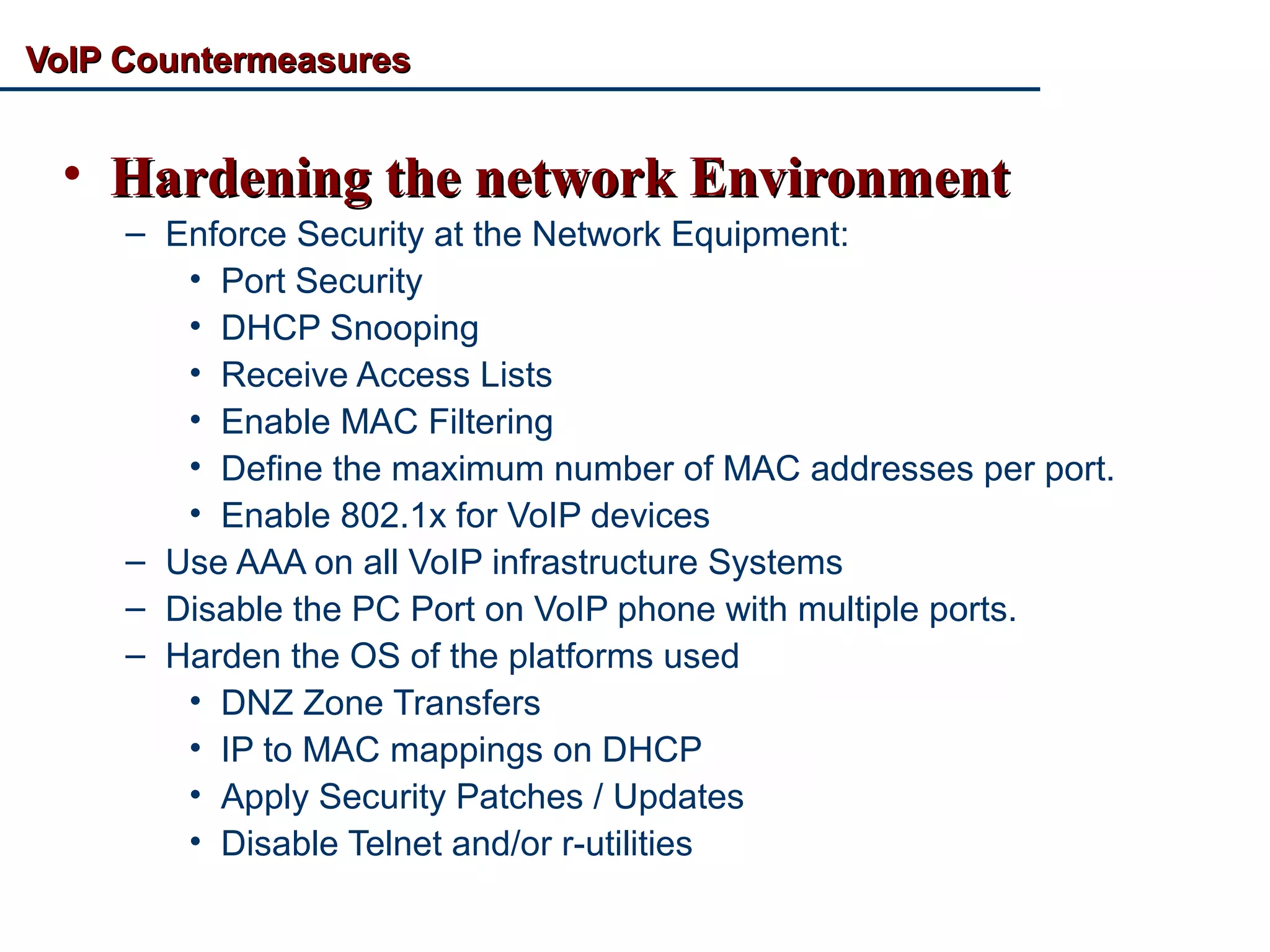
• Hardening the network EnvironmentHardening the network Environment
– Enforce Security at the Network Equipment:
• Port Security
• DHCP Snooping
• Receive Access Lists
• Enable MAC Filtering
• Define the maximum number of MAC addresses per port.
• Enable 802.1x for VoIP devices
– Use AAA on all VoIP infrastructure Systems
– Disable the PC Port on VoIP phone with multiple ports.
– Harden the OS of the platforms used
• DNZ Zone Transfers
• IP to MAC mappings on DHCP
• Apply Security Patches / Updates
• Disable Telnet and/or r-utilities
• VoIP Honeypots
– VoIP Phones
– Fake SIP Proxies (i.e.
Asterix)
VoIP CountermeasuresVoIP Countermeasures
Extra MaterialExtra Material
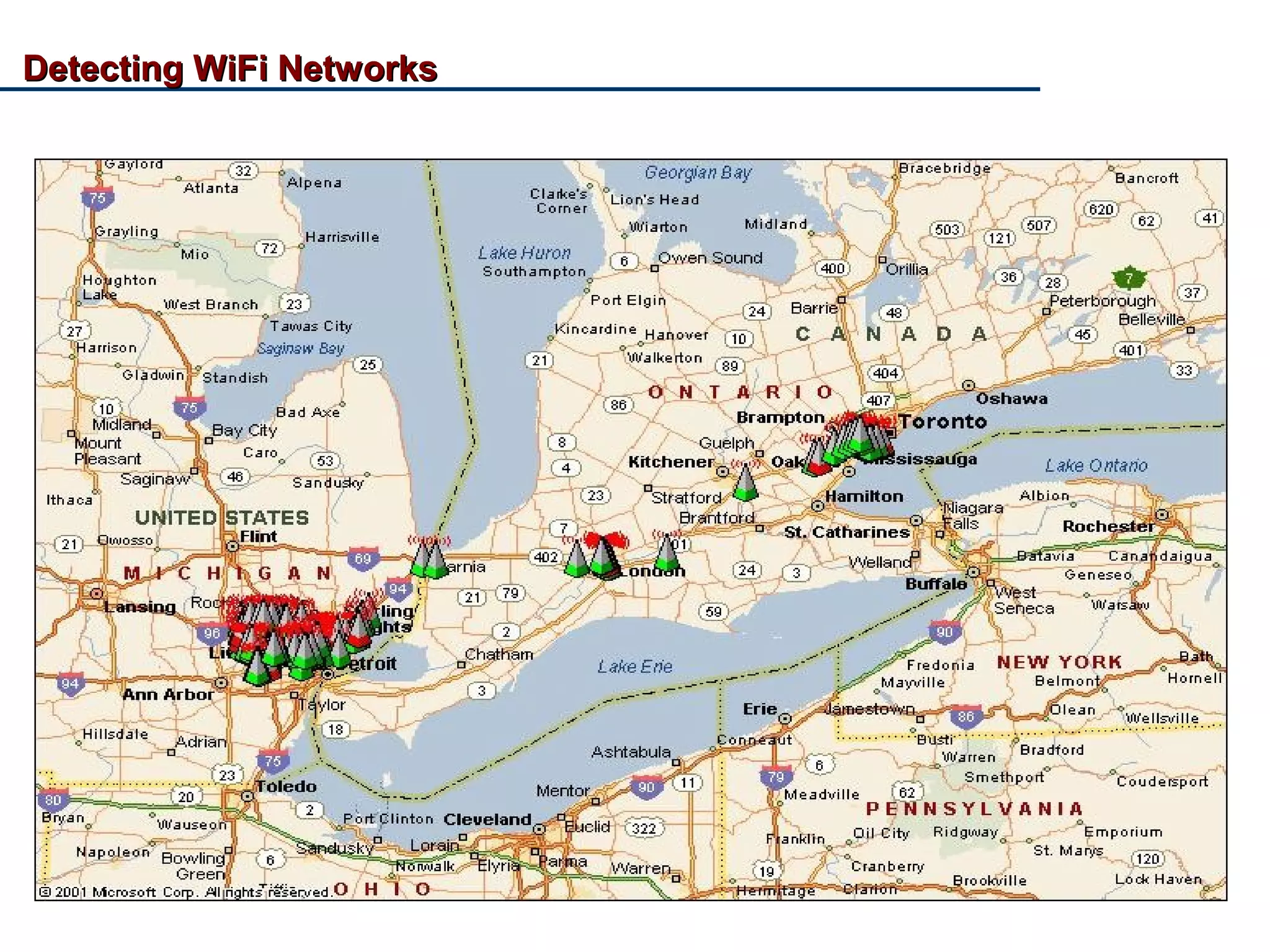
Detecting WiFi NetworksDetecting WiFi Networks
20
Detecting WiFi NetworksDetecting WiFi Networks
Bypassing MAC ACLsBypassing MAC ACLs
Being in the MiddleBeing in the Middle
• DNSDNS (modify entries to point all traffic to a hacker's
machine)
• DHCPDHCP (make all traffic go to hackers machine as
default gateway, or change DNS entry to point at
hacker's machine so all names resolve to hacker's
IP address)
• ARPARP (reply with hacker's MAC address, gratuitous
ARPs or regular ARP replies)
• Flood CAMFlood CAM tables in switches to destroy existing
MAC addr/port associations so all traffic is
broadcast out every port, and then use ARP attacks
• Routing protocolsRouting protocols (change routing such that traffic
physically passes through a router/machine
controlled by hacker)
• Spanning tree attacksSpanning tree attacks to change layer 2 forwarding
topology
• Physical insertionPhysical insertion (e.g. PC with dual NIC cards, be it
Ethernet based or WLAN-based)
Questions ?Questions ?

Meletis Belsis - Voip security

  • 1.
    VoIP Security: AnOverviewVoIP Security: An Overview (2008)(2008) Meletis BelsisMeletis Belsis Information Security ConsultantInformation Security Consultant MPhil / MSc / BScMPhil / MSc / BSc CWNA/CWSP, C|EH, CCSA, ISO27001LACWNA/CWSP, C|EH, CCSA, ISO27001LA
  • 2.
    AgendaAgenda VoIP Technology VoIP Complexity VoIPThreats Example Attacks The Hacker’s Toolbox VoIP Countermeasures The Company
  • 3.
    VoIP TechnologyVoIP Technology •VoIP is an integral part of modern Enterprises • VoIP allows the reduction of OpEx by providing PSTN like services • Based on open IETF and ITU standards • Protocols used to support VoIP include TCP/UDP/IP, DNS,TFTP, DHCP,STUN,HTTP,SIP,RTPTCP/UDP/IP, DNS,TFTP, DHCP,STUN,HTTP,SIP,RTP • VoIP components include: Routers, Switches, Firewalls, SIP Servers, Media Gateways, iPBX, WiFi
  • 4.
    VoIP SecurityVoIP Security “The flexibility of VoIP comes at a price: added complexity in securing voice and data. Because VoIP systems are connected to the data network and share many of the same hardware and software components, there are more ways for intruders to attack a VoIP system than a conventional voice telephone system or PBX “ NIST: Considerations for Voice over IP SystemsNIST: Considerations for Voice over IP Systems
  • 5.
    VoIP Security ComplexityVoIPSecurity Complexity • Securing a VoIP network is complex because: – VoIP inherits the TCP/IP Vulnerabilitiesinherits the TCP/IP Vulnerabilities. – VoIP uses the corporate networkuses the corporate network to operate. Usually there is no network separation. – Applying security may affect other attributes of VoIPaffect other attributes of VoIP (e.g. Delay, Latency, Jitter). – VoIP usually uses UDP communicationuses UDP communication and thus may not be able to operate on networks that use firewalls. Special proxy techniques like STUNSTUN need to be applied.
  • 6.
    VoIP ThreatsVoIP Threats •Denial Of ServiceDenial Of Service – Flood Attacks (i.e Controller Flooding) – BYE Tear Down – Registration Reject – Hold Attack – Call Reject • Interception AttacksInterception Attacks – Call Hijacking – Registration Hijacking – Media Session Hijacking – Server Masquerading – DNS Poisoning – Caller ID Spoofing – VoIP VLAN Hopping – ARP Spoofing • Covert ChannelsCovert Channels • WiFi AttacksWiFi Attacks SIP server SIP server Media proxy SIP signaling Media Stream Sniffing (D)DoS attack Wire tapping SPIT
  • 7.
    VoIP ThreatsVoIP Threats •VoIP Platforms Vulnerabilities – CAN-2004-0056CAN-2004-0056: Malformed H.323 packet to exploit Nortel BCM vulnerabilities – CAN-2004-0054CAN-2004-0054: Exploits CISCO IOS H.323 implementation – CVE-2007-4459CVE-2007-4459: Cisco SIP DoS vulnerabilities. – CVE-2007-6424CVE-2007-6424: Vulnerabilities on the Fonality Trixbox 2.0 PBX products – CVE-2007-5361CVE-2007-5361: Vulnerabilities on the Alcatel- Lucent OmniPCX Enterprise Communication Server. – CVE-2007-5556CVE-2007-5556: Vulnerabilities on the Avaya VoIP Handset.
  • 8.
  • 9.
    Vlan HoppingVlan Hopping SourceSource::http://www.securityfocus.com/infocus/1892
  • 10.
    SIP InjectionSIP Injection UE’sinitial Register Request looks like: REGISTER SIP: home1.de SIP/2.0 Username=”user Authorization: Digest Username user_private@home1.de”, realm=”home1.de”, nonce=” “, uri=”SIP: home1.de”, response=” “ Malicious Code infected with SQL injection looks like: REGISTER SIP: home1.de SIP/2.0 Authorization: Digest Username=”user_private@home1.de;delete table users”, realm=”home1.de”, nonce=” “, uri=”SIP: home1.de”, response=” “
  • 11.
    Hacker’s ToolboxHacker’s Toolbox •OrekaOreka : A cross-platform system for recording and retrieving audio streams • rtpBreakrtpBreak: detects, reconstructs and analyzes any RTP session through heuristics over the UDP network traffic. • SIPCrackSIPCrack : a SIP protocol login cracker • SiVusSiVus : A SIP Vulnerability Scanner. • BYE Teardown:BYE Teardown: disconnect an active VoIP conversation by spoofing the SIP BYE message from the receiving party • SipRogueSipRogue :multifunctional SIP proxy that can be inserted between two talking parties • RTPInjectRTPInject :attack tool that injects arbitrary audio into established RTP connections. • TFTP CrackerTFTP Cracker: A tool to attack VoIP endpoint and copy their configuration through tftp • ILTY(I am Listening to You)ILTY(I am Listening to You) : A multi-channel VoIP Sniffer • Registration AdderRegistration Adder: A tool to allow fake registrations to be send • VoIP HopperVoIP Hopper: Allows to hope from a normal VLAN to the VoIP Vlan
  • 12.
  • 13.
    13 WiFi VoIPWiFi VoIP NetStumblerNetStumbler Isused by WarDriversIs used by WarDrivers to detect unprotectedto detect unprotected WiFi NetworksWiFi Networks AirSnortAirSnort Is widely used to attack WEP passwords
  • 14.
    VoIP CountermeasuresVoIP Countermeasures •Network SeparationNetwork Separation : Although dedicated VoIP VLANs offer a level of security, a dedicate VoIP network will be more secure. • SIP EncryptionSIP Encryption: The TLS protocol can be used to encrypt the SIP messages exchanged between the nodes. TLS provides only Server authentication. S/MIME is another option for SIP encryption. • RTP EncryptionRTP Encryption: Secure RTP(SRTP) can be used to encrypt media in a VoIP network
  • 15.
    VoIP CountermeasuresVoIP Countermeasures •ManagementManagement: Avoid using weak management protocols like Telnet, tftp and SNMP ver 2. • FirewallsFirewalls: Ensure that VoIP components (i.e. SIP Proxy, DNS, DHCP, Radius) are logically located behind VoIP aware firewalls (e.g. CISCO SIP Extensions for ASA). • IDS/IPSIDS/IPS : The existent IDS/IPS architecture can be extended using SIP Aware Sensors
  • 16.
    VoIP CountermeasuresVoIP Countermeasures •Hardening the network EnvironmentHardening the network Environment – Enforce Security at the Network Equipment: • Port Security • DHCP Snooping • Receive Access Lists • Enable MAC Filtering • Define the maximum number of MAC addresses per port. • Enable 802.1x for VoIP devices – Use AAA on all VoIP infrastructure Systems – Disable the PC Port on VoIP phone with multiple ports. – Harden the OS of the platforms used • DNZ Zone Transfers • IP to MAC mappings on DHCP • Apply Security Patches / Updates • Disable Telnet and/or r-utilities
  • 17.
    • VoIP Honeypots –VoIP Phones – Fake SIP Proxies (i.e. Asterix) VoIP CountermeasuresVoIP Countermeasures
  • 18.
  • 19.
  • 20.
  • 21.
  • 22.
    Being in theMiddleBeing in the Middle • DNSDNS (modify entries to point all traffic to a hacker's machine) • DHCPDHCP (make all traffic go to hackers machine as default gateway, or change DNS entry to point at hacker's machine so all names resolve to hacker's IP address) • ARPARP (reply with hacker's MAC address, gratuitous ARPs or regular ARP replies) • Flood CAMFlood CAM tables in switches to destroy existing MAC addr/port associations so all traffic is broadcast out every port, and then use ARP attacks • Routing protocolsRouting protocols (change routing such that traffic physically passes through a router/machine controlled by hacker) • Spanning tree attacksSpanning tree attacks to change layer 2 forwarding topology • Physical insertionPhysical insertion (e.g. PC with dual NIC cards, be it Ethernet based or WLAN-based)
  • 23.