Plate Tectonics
• What are the “plates”
• What causes them to move
• What are the different types of
plate boundaries
• What features are associated
with plate boundaries
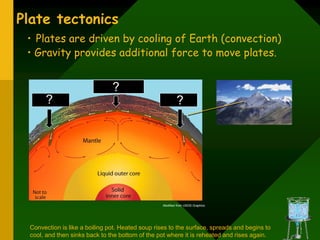
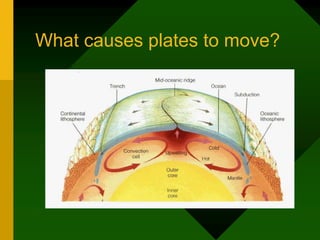
Convection is like a boiling pot. Heated soup rises to the surface, spreads and begins to
cool, and then sinks back to the bottom of the pot where it is reheated and rises again.
Plate tectonics
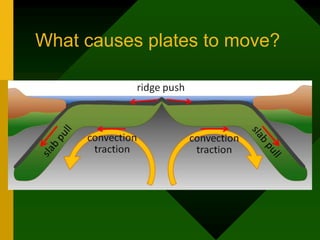
• Plates are driven by cooling of Earth (convection)
• Gravity provides additional force to move plates.
Modified from USGS Graphics
?
?
?
What are the tectonic plates?
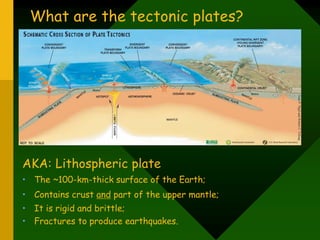
AKA: Lithospheric plate
• The ~100-km-thick surface of the Earth;
• Contains crust and part of the upper mantle;
• It is rigid and brittle;
• Fractures to produce earthquakes.
What is the asthenosphere?
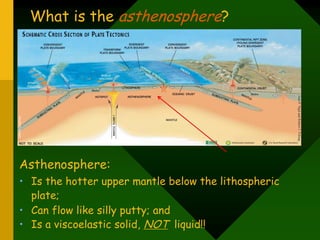
Asthenosphere:
• Is the hotter upper mantle below the lithospheric
plate;
• Can flow like silly putty; and
• Is a viscoelastic solid, NOT liquid!!
USGS
Graphics
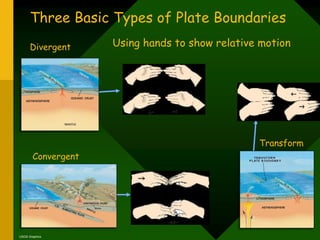
Three Basic Types of Plate Boundaries
Divergent
Convergent
Transform
USGS Graphics
Using hands to show relative motion
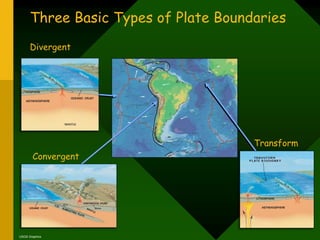
Three Basic Types of Plate Boundaries
Divergent
Convergent
Transform
USGS Graphics
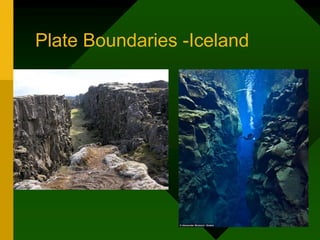
Plate Boundaries -Iceland
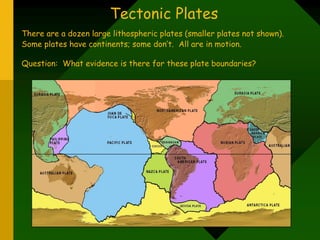
There are a dozen large lithospheric plates (smaller plates not shown).
Some plates have continents; some don’t. All are in motion.
Question: What evidence is there for these plate boundaries?
Tectonic Plates
Subduction
•http://www.tectonics.caltech
.edu/outreach/animations/su
bduction.html
Tsunami
•http://www.tectonics.cal
tech.edu/outreach/anim
ations/tsunami.html
What causes plates to move?
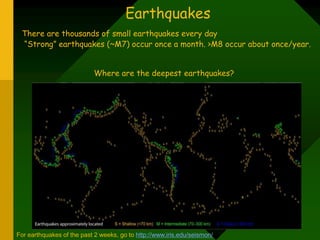
There are thousands of small earthquakes every day
“Strong” earthquakes (~M7) occur once a month. >M8 occur about once/year.
Earthquakes
Where are the deepest earthquakes?
For earthquakes of the past 2 weeks, go to http://www.iris.edu/seismon/
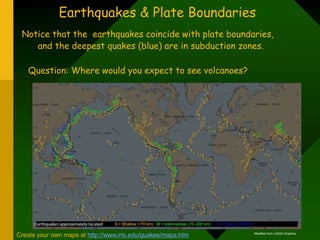
Notice that the earthquakes coincide with plate boundaries,
and the deepest quakes (blue) are in subduction zones.
Question: Where would you expect to see volcanoes?
Modified from USGS Graphics
Earthquakes & Plate Boundaries
Create your own maps at http://www.iris.edu/quakes/maps.htm
Modified from USGS Graphics
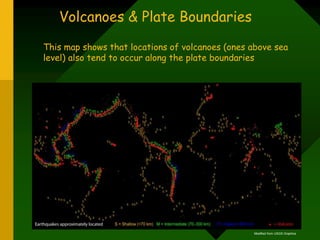
This map shows that locations of volcanoes (ones above sea
level) also tend to occur along the plate boundaries
Volcanoes & Plate Boundaries
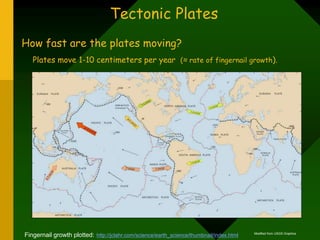
How fast are the plates moving?
Plates move 1-10 centimeters per year (≈ rate of fingernail growth).
Tectonic Plates
Modified from USGS Graphics
Fingernail growth plotted: http://jclahr.com/science/earth_science/thumbnail/index.html
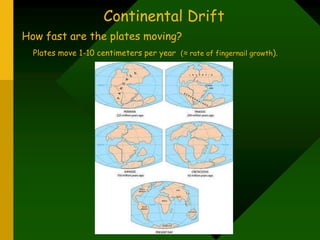
How fast are the plates moving?
Plates move 1-10 centimeters per year (≈ rate of fingernail growth).
Continental Drift
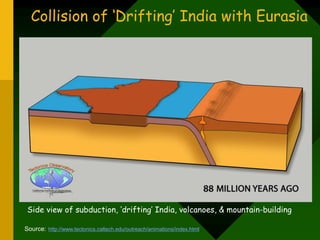
Collision of ‘Drifting’ India with Eurasia
Source: http://www.tectonics.caltech.edu/outreach/animations/index.html
Side view of subduction, ‘drifting’ India, volcanoes, & mountain-building
Note on Source: First 8 slides are modified from a slide show prepared by Dr. Robert
Butler, University of Portland, and Jenda Johnson,
…the full source of which can be found at:
http://www.iris.edu/hq/programs/education_and_outreach/videos#B

plate_tectonics.pdf

  • 1.
    Plate Tectonics • Whatare the “plates” • What causes them to move • What are the different types of plate boundaries • What features are associated with plate boundaries
  • 2.
    Convection is likea boiling pot. Heated soup rises to the surface, spreads and begins to cool, and then sinks back to the bottom of the pot where it is reheated and rises again. Plate tectonics • Plates are driven by cooling of Earth (convection) • Gravity provides additional force to move plates. Modified from USGS Graphics ? ? ?
  • 3.
    What are thetectonic plates? AKA: Lithospheric plate • The ~100-km-thick surface of the Earth; • Contains crust and part of the upper mantle; • It is rigid and brittle; • Fractures to produce earthquakes.
  • 4.
    What is theasthenosphere? Asthenosphere: • Is the hotter upper mantle below the lithospheric plate; • Can flow like silly putty; and • Is a viscoelastic solid, NOT liquid!! USGS Graphics
  • 5.
    Three Basic Typesof Plate Boundaries Divergent Convergent Transform USGS Graphics Using hands to show relative motion
  • 6.
    Three Basic Typesof Plate Boundaries Divergent Convergent Transform USGS Graphics
  • 7.
  • 8.
    There are adozen large lithospheric plates (smaller plates not shown). Some plates have continents; some don’t. All are in motion. Question: What evidence is there for these plate boundaries? Tectonic Plates
  • 9.
  • 10.
  • 11.
  • 12.
  • 13.
    There are thousandsof small earthquakes every day “Strong” earthquakes (~M7) occur once a month. >M8 occur about once/year. Earthquakes Where are the deepest earthquakes? For earthquakes of the past 2 weeks, go to http://www.iris.edu/seismon/
  • 14.
    Notice that theearthquakes coincide with plate boundaries, and the deepest quakes (blue) are in subduction zones. Question: Where would you expect to see volcanoes? Modified from USGS Graphics Earthquakes & Plate Boundaries Create your own maps at http://www.iris.edu/quakes/maps.htm
  • 15.
    Modified from USGSGraphics This map shows that locations of volcanoes (ones above sea level) also tend to occur along the plate boundaries Volcanoes & Plate Boundaries
  • 16.
    How fast arethe plates moving? Plates move 1-10 centimeters per year (≈ rate of fingernail growth). Tectonic Plates Modified from USGS Graphics Fingernail growth plotted: http://jclahr.com/science/earth_science/thumbnail/index.html
  • 17.
    How fast arethe plates moving? Plates move 1-10 centimeters per year (≈ rate of fingernail growth). Continental Drift
  • 18.
    Collision of ‘Drifting’India with Eurasia Source: http://www.tectonics.caltech.edu/outreach/animations/index.html Side view of subduction, ‘drifting’ India, volcanoes, & mountain-building
  • 19.
    Note on Source:First 8 slides are modified from a slide show prepared by Dr. Robert Butler, University of Portland, and Jenda Johnson, …the full source of which can be found at: http://www.iris.edu/hq/programs/education_and_outreach/videos#B