Planning for a
Healthy
Business
Planning for a Healthy Business 2
Pre-Test
• Locate the Pre- and Post-Test Form at
the back of your workbook.
• Complete the BEFORE Training
column to assess your knowledge on
this topic before participating in this
class.
Planning for a Healthy Business 3
Agenda
• Welcome, Pre-Test, Agenda, and
Learning Objectives
• Case Study: Sophia’s Planning Process
• Introductions: Where are you in your
planning process?
• Introduction to the 4-Step Planning
Model
• Summary, Post-Test, Evaluation
Planning for a Healthy Business 4
Learning Objectives
• Explain how an evolving planning process can help you
make key decisions as business owners.
• Describe how to convert a vague idea into a resource
plan.
• Explain the importance of a healthy personal credit score
and healthy relationships with lenders.
• Describe how a business plan helps motivate
stakeholders to understand and support your business
ideas.
• Explain the benefits of creating a day-to-day action plan
for running a small business.
Planning for a Healthy Business 5
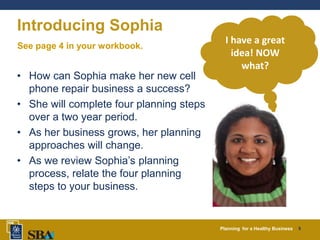
Introducing Sophia
• How can Sophia make her new cell
phone repair business a success?
• She will complete four planning steps
over a two year period.
• As her business grows, her planning
approaches will change.
• As we review Sophia’s planning
process, relate the four planning
steps to your business.
I have a great
idea! NOW
what?
See page 4 in your workbook.
Planning for a Healthy Business 6
Where Are YOU in Your Planning?
Complete the worksheet on page 5 of your workbook.
• For each planning stage, record if you have completed
it, if you are working on it, or if you have not yet started.
• There are no wrong answers.
• You will introduce yourself and share your planning
stage.
Planning for a Healthy Business 7
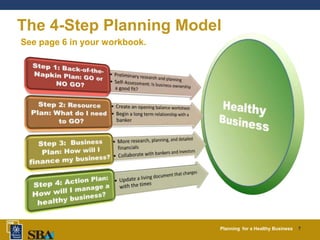
The 4-Step Planning Model
See page 6 in your workbook.
Planning for a Healthy Business 8
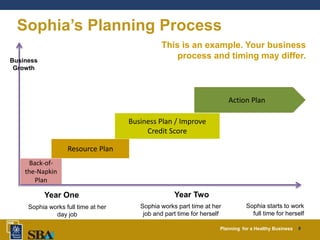
Sophia’s Planning Process
Year One Year Two
Back-of-
the-Napkin
Plan
Resource Plan
Business Plan / Improve
Credit Score
Action Plan
Business
Growth
This is an example. Your business
process and timing may differ.
Sophia works full time at her
day job
Sophia starts to work
full time for herself
Sophia works part time at her
job and part time for herself
Planning for a Healthy Business 9
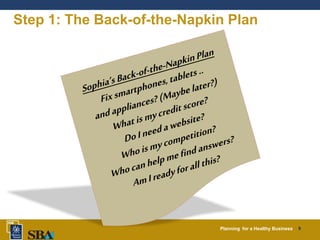
Step 1: The Back-of-the-Napkin Plan
Planning for a Healthy Business 10
Step 1: Key Questions
• What benefits (monetary and non-monetary) do I
want to get from my business?
• What size business do I need to build to achieve
those benefits?
• Have I identified a real business opportunity on
which I can capitalize?
• What assets do I need to purchase, rent, or lease?
Who will I need to hire?
See page 7 in your workbook for some
questions to answer at the beginning of the
planning process.
DO YOUR
HOMEWORK
Planning for a Healthy Business 11
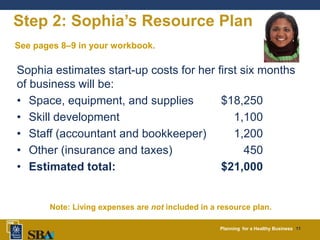
Step 2: Sophia’s Resource Plan
See pages 8–9 in your workbook.
Sophia estimates start-up costs for her first six months
of business will be:
• Space, equipment, and supplies $18,250
• Skill development 1,100
• Staff (accountant and bookkeeper) 1,200
• Other (insurance and taxes) 450
• Estimated total: $21,000
Note: Living expenses are not included in a resource plan.
Planning for a Healthy Business 12
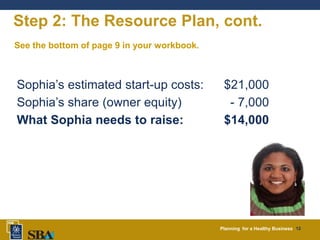
Step 2: The Resource Plan, cont.
See the bottom of page 9 in your workbook.
Sophia’s estimated start-up costs: $21,000
Sophia’s share (owner equity) - 7,000
What Sophia needs to raise: $14,000
Planning for a Healthy Business 13
Step 2: Resource Planning Ideas
Interview stakeholders, competitors, and other business
owners for ideas.
• Ideal locations
• Locating discounted equipment and supplies
• Pros and cons of buying in bulk (too much inventory affects
cash flow)
• Fair wages and benefits for employees
• Federal, state, local, and sales taxes
• Insurance
• Pay for services (such as website design and hosting)- pay
more up front or pay higher monthly installments?
• Am I ready to go on to the next step?
Planning for a Healthy Business 14
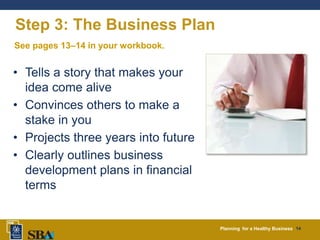
Step 3: The Business Plan
• Tells a story that makes your
idea come alive
• Convinces others to make a
stake in you
• Projects three years into future
• Clearly outlines business
development plans in financial
terms
See pages 13–14 in your workbook.
Planning for a Healthy Business 15
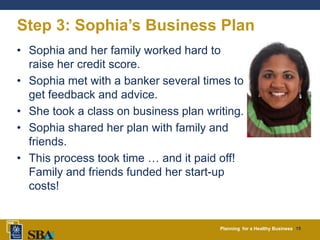
Step 3: Sophia’s Business Plan
• Sophia and her family worked hard to
raise her credit score.
• Sophia met with a banker several times to
get feedback and advice.
• She took a class on business plan writing.
• Sophia shared her plan with family and
friends.
• This process took time … and it paid off!
Family and friends funded her start-up
costs!
Planning for a Healthy Business 16
Sources of Financial Support
• Angel investors
• Bootstrapping
• Crowdsourcing
• Friends and family members
• Incubators
• Local and state economic
development organizations
• Peer-to-peer lending
• Small business loans
• Venture capital
See page 15 in your workbook.
Planning for a Healthy Business 17
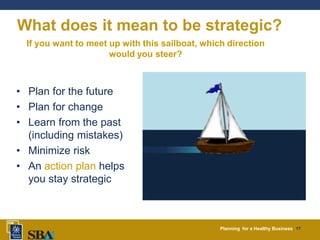
What does it mean to be strategic?
• Plan for the future
• Plan for change
• Learn from the past
(including mistakes)
• Minimize risk
• An action plan helps
you stay strategic
If you want to meet up with this sailboat, which direction
would you steer?
Planning for a Healthy Business 18
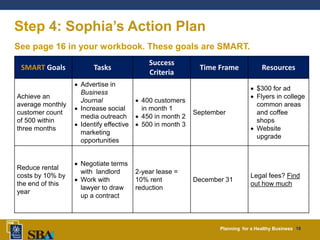
Step 4: Sophia’s Action Plan
SMART Goals Tasks
Success
Criteria
Time Frame Resources
Achieve an
average monthly
customer count
of 500 within
three months
 Advertise in
Business
Journal
 Increase social
media outreach
 Identify effective
marketing
opportunities
 400 customers
in month 1
 450 in month 2
 500 in month 3
September
 $300 for ad
 Flyers in college
common areas
and coffee
shops
 Website
upgrade
Reduce rental
costs by 10% by
the end of this
year
 Negotiate terms
with landlord
 Work with
lawyer to draw
up a contract
2-year lease =
10% rent
reduction
December 31
Legal fees? Find
out how much
See page 16 in your workbook. These goals are SMART.
Planning for a Healthy Business 19
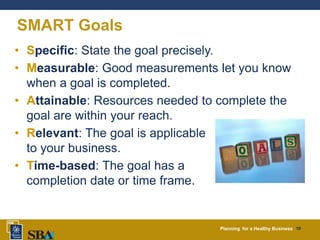
SMART Goals
• Specific: State the goal precisely.
• Measurable: Good measurements let you know
when a goal is completed.
• Attainable: Resources needed to complete the
goal are within your reach.
• Relevant: The goal is applicable
to your business.
• Time-based: The goal has a
completion date or time frame.
Planning for a Healthy Business 20
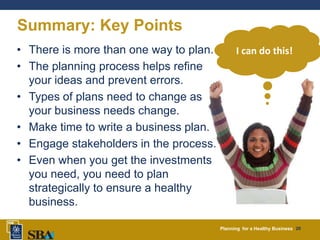
Summary: Key Points
• There is more than one way to plan.
• The planning process helps refine
your ideas and prevent errors.
• Types of plans need to change as
your business needs change.
• Make time to write a business plan.
• Engage stakeholders in the process.
• Even when you get the investments
you need, you need to plan
strategically to ensure a healthy
business.
I can do this!
Planning for a Healthy Business 21
Summary: Benefits and Risks
Benefits of Planning
• Know where you are—
and where you are going
• Save time and money
• Ask great questions
• Develop stakeholders in
the process
• Make logical decisions
• Measure progress on
tangible goals
• Focus on finances
Risks of Not Planning
• Wasted time and money
• You do too much (and
miss opportunities to
delegate)
• Risk “burn out”
• Confuse or alienate
investors
• Fail to do the math or to
quantify “success” in
practical business terms
Planning for a Healthy Business 22
Summary
• What final questions do you have?
• What have you learned?
• How would you evaluate the training?
Planning for a Healthy Business 23
Pre-Post Test and Evaluation
• If you have not already done so, assess
what your knowledge on this topic was
before you participated in this class.
• Assess your knowledge on this topic
after taking this class.
• Complete the Evaluation Form. Your
feedback is helpful!
• Return both forms to the instructor
before you leave. Thank you!

Planning for a Healthy Business

  • 1.
  • 2.
    Planning for aHealthy Business 2 Pre-Test • Locate the Pre- and Post-Test Form at the back of your workbook. • Complete the BEFORE Training column to assess your knowledge on this topic before participating in this class.
  • 3.
    Planning for aHealthy Business 3 Agenda • Welcome, Pre-Test, Agenda, and Learning Objectives • Case Study: Sophia’s Planning Process • Introductions: Where are you in your planning process? • Introduction to the 4-Step Planning Model • Summary, Post-Test, Evaluation
  • 4.
    Planning for aHealthy Business 4 Learning Objectives • Explain how an evolving planning process can help you make key decisions as business owners. • Describe how to convert a vague idea into a resource plan. • Explain the importance of a healthy personal credit score and healthy relationships with lenders. • Describe how a business plan helps motivate stakeholders to understand and support your business ideas. • Explain the benefits of creating a day-to-day action plan for running a small business.
  • 5.
    Planning for aHealthy Business 5 Introducing Sophia • How can Sophia make her new cell phone repair business a success? • She will complete four planning steps over a two year period. • As her business grows, her planning approaches will change. • As we review Sophia’s planning process, relate the four planning steps to your business. I have a great idea! NOW what? See page 4 in your workbook.
  • 6.
    Planning for aHealthy Business 6 Where Are YOU in Your Planning? Complete the worksheet on page 5 of your workbook. • For each planning stage, record if you have completed it, if you are working on it, or if you have not yet started. • There are no wrong answers. • You will introduce yourself and share your planning stage.
  • 7.
    Planning for aHealthy Business 7 The 4-Step Planning Model See page 6 in your workbook.
  • 8.
    Planning for aHealthy Business 8 Sophia’s Planning Process Year One Year Two Back-of- the-Napkin Plan Resource Plan Business Plan / Improve Credit Score Action Plan Business Growth This is an example. Your business process and timing may differ. Sophia works full time at her day job Sophia starts to work full time for herself Sophia works part time at her job and part time for herself
  • 9.
    Planning for aHealthy Business 9 Step 1: The Back-of-the-Napkin Plan
  • 10.
    Planning for aHealthy Business 10 Step 1: Key Questions • What benefits (monetary and non-monetary) do I want to get from my business? • What size business do I need to build to achieve those benefits? • Have I identified a real business opportunity on which I can capitalize? • What assets do I need to purchase, rent, or lease? Who will I need to hire? See page 7 in your workbook for some questions to answer at the beginning of the planning process. DO YOUR HOMEWORK
  • 11.
    Planning for aHealthy Business 11 Step 2: Sophia’s Resource Plan See pages 8–9 in your workbook. Sophia estimates start-up costs for her first six months of business will be: • Space, equipment, and supplies $18,250 • Skill development 1,100 • Staff (accountant and bookkeeper) 1,200 • Other (insurance and taxes) 450 • Estimated total: $21,000 Note: Living expenses are not included in a resource plan.
  • 12.
    Planning for aHealthy Business 12 Step 2: The Resource Plan, cont. See the bottom of page 9 in your workbook. Sophia’s estimated start-up costs: $21,000 Sophia’s share (owner equity) - 7,000 What Sophia needs to raise: $14,000
  • 13.
    Planning for aHealthy Business 13 Step 2: Resource Planning Ideas Interview stakeholders, competitors, and other business owners for ideas. • Ideal locations • Locating discounted equipment and supplies • Pros and cons of buying in bulk (too much inventory affects cash flow) • Fair wages and benefits for employees • Federal, state, local, and sales taxes • Insurance • Pay for services (such as website design and hosting)- pay more up front or pay higher monthly installments? • Am I ready to go on to the next step?
  • 14.
    Planning for aHealthy Business 14 Step 3: The Business Plan • Tells a story that makes your idea come alive • Convinces others to make a stake in you • Projects three years into future • Clearly outlines business development plans in financial terms See pages 13–14 in your workbook.
  • 15.
    Planning for aHealthy Business 15 Step 3: Sophia’s Business Plan • Sophia and her family worked hard to raise her credit score. • Sophia met with a banker several times to get feedback and advice. • She took a class on business plan writing. • Sophia shared her plan with family and friends. • This process took time … and it paid off! Family and friends funded her start-up costs!
  • 16.
    Planning for aHealthy Business 16 Sources of Financial Support • Angel investors • Bootstrapping • Crowdsourcing • Friends and family members • Incubators • Local and state economic development organizations • Peer-to-peer lending • Small business loans • Venture capital See page 15 in your workbook.
  • 17.
    Planning for aHealthy Business 17 What does it mean to be strategic? • Plan for the future • Plan for change • Learn from the past (including mistakes) • Minimize risk • An action plan helps you stay strategic If you want to meet up with this sailboat, which direction would you steer?
  • 18.
    Planning for aHealthy Business 18 Step 4: Sophia’s Action Plan SMART Goals Tasks Success Criteria Time Frame Resources Achieve an average monthly customer count of 500 within three months  Advertise in Business Journal  Increase social media outreach  Identify effective marketing opportunities  400 customers in month 1  450 in month 2  500 in month 3 September  $300 for ad  Flyers in college common areas and coffee shops  Website upgrade Reduce rental costs by 10% by the end of this year  Negotiate terms with landlord  Work with lawyer to draw up a contract 2-year lease = 10% rent reduction December 31 Legal fees? Find out how much See page 16 in your workbook. These goals are SMART.
  • 19.
    Planning for aHealthy Business 19 SMART Goals • Specific: State the goal precisely. • Measurable: Good measurements let you know when a goal is completed. • Attainable: Resources needed to complete the goal are within your reach. • Relevant: The goal is applicable to your business. • Time-based: The goal has a completion date or time frame.
  • 20.
    Planning for aHealthy Business 20 Summary: Key Points • There is more than one way to plan. • The planning process helps refine your ideas and prevent errors. • Types of plans need to change as your business needs change. • Make time to write a business plan. • Engage stakeholders in the process. • Even when you get the investments you need, you need to plan strategically to ensure a healthy business. I can do this!
  • 21.
    Planning for aHealthy Business 21 Summary: Benefits and Risks Benefits of Planning • Know where you are— and where you are going • Save time and money • Ask great questions • Develop stakeholders in the process • Make logical decisions • Measure progress on tangible goals • Focus on finances Risks of Not Planning • Wasted time and money • You do too much (and miss opportunities to delegate) • Risk “burn out” • Confuse or alienate investors • Fail to do the math or to quantify “success” in practical business terms
  • 22.
    Planning for aHealthy Business 22 Summary • What final questions do you have? • What have you learned? • How would you evaluate the training?
  • 23.
    Planning for aHealthy Business 23 Pre-Post Test and Evaluation • If you have not already done so, assess what your knowledge on this topic was before you participated in this class. • Assess your knowledge on this topic after taking this class. • Complete the Evaluation Form. Your feedback is helpful! • Return both forms to the instructor before you leave. Thank you!