Rohit
67
Dept. Of Community
Medicine
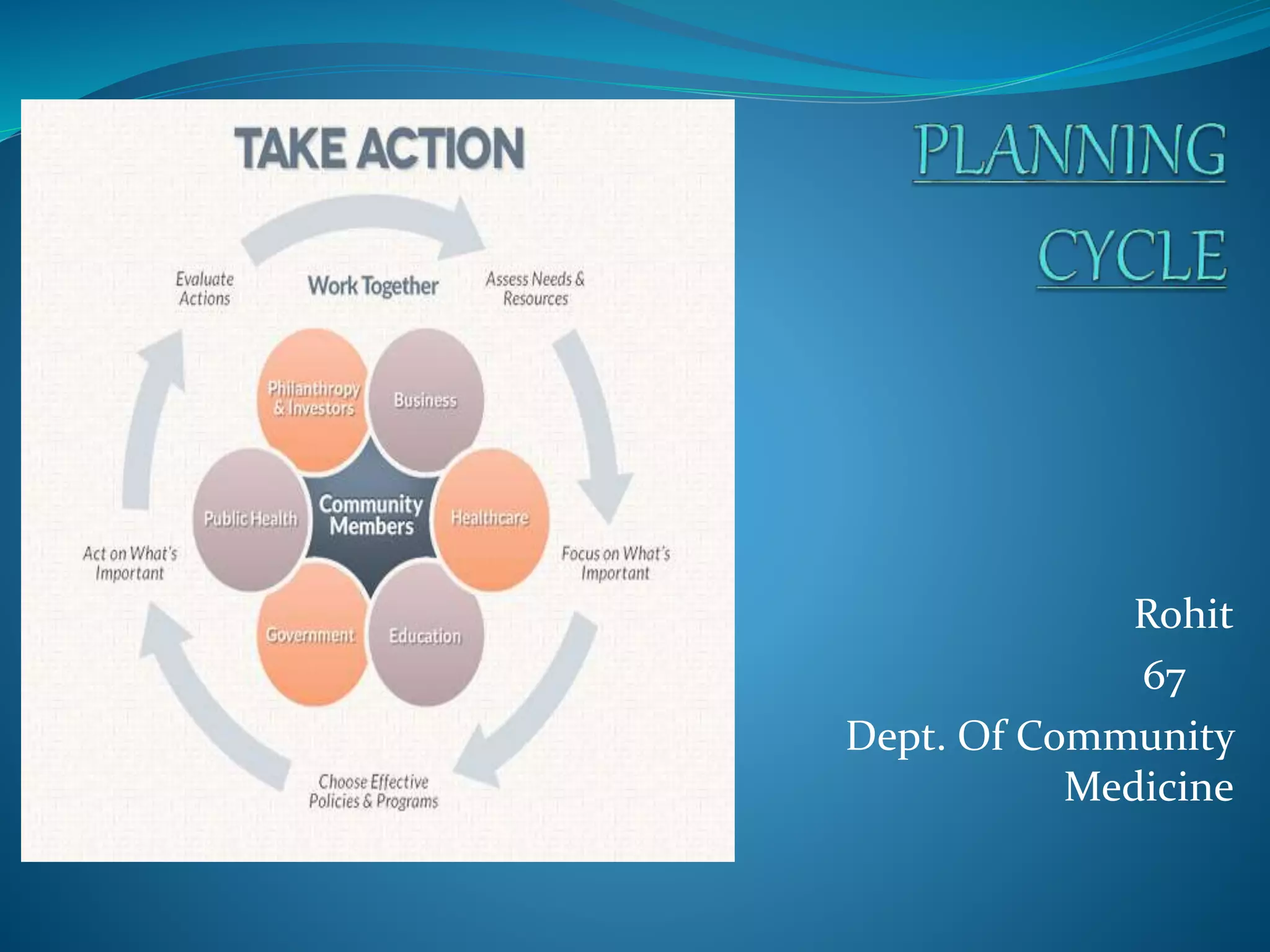
PLANNING
 It is the process of identifying a course of action
SYSTEMATICALLY in an organized manner to achieve the
objectives by utilizing the available resources skillfully in a
COST-EFFECTIVE way.
 The orderly process of defining health problems, identifying
unmet needs and surveying the resources to meet them,
establishing priority goals that are realistic and feasible, and
projecting administrative action, concerned not only with the
adequacy, efficacy and efficiency of health services but also with
those factors of ecology and of social and individual behavior
that affect the health of the individual and the community.
 Often used interchangeably with policy formation or developing
strategies and programmes
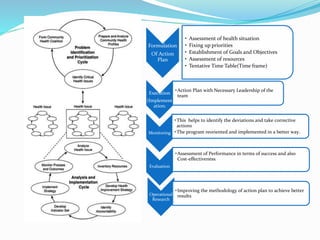
Formulation
Of Action
Plan
• Assessment of health situation
• Fixing up priorities
• Establishment of Goals and Objectives
• Assessment of resources
• Tentative Time Table(Time frame)
Execution
(Implement
ation)
•Action Plan with Necessary Leadership of the
team
Monitoring
•This helps to identify the deviations and take corrective
actions
•The program reoriented and implemented in a better way.
Evaluation
•Assessment of Performance in terms of success and also
Cost-effectiveness
Operational
Research
•Improving the methodology of action plan to achieve better
results
Analysis Of the Situation
 Step 1:Laying down the PREMISES(Scope)
This defines the general perimeters or the boundaries. This is done
in terms of place, time population and disease condition within
which the health condition is being planned.
• Step 2:Situational analysis
Relevant geographic, socioeconomic and disease data.
• Step 3:Resource Analysis
Data on available resources(Healthy manpower, money and
material is obtained and analyzed)
 Step 4:SWOT Analysis
The Strengths(S),Weaknesses(W),Opportunities(O) and
Threats(T) are identified in context of the proposed programme.
S&W i.e.,Strength and Weaknesses are the permanent phenomena,
they are intrinsic to the organization/community.Whereas,O&T
are the temporary phenomenon,which,exist in the external
Environment.
• Step 5:Ensure Community Participation
Identifying the community leaders, peers and Voluntary groups
and Involving them in the planning process
 Step 6:Enunciation of the Community Needs
The major issues that need to be addressed and can be feasibly addressed
are decided.
 Normative or “Professionally Assessed Needs” are what we, as doctors
or public healthcare managers, feel that the community requires.
 “Felt needs” of the community are what the community members feel
is their need.
 Health planning at the local level describes how all available resources
are best used to operate the local health system. These resources may
be through central government (for the health sector and for other
sectors), or through contributions, in kind and/or cash, by civil society
organizations (CSOs), non-governmental organizations (NGOs), and
not-for profit and for-profit private sectors
Working out an optimum balance between these two needs is essential.
 Step 7:Setting the Priorities
To work out the Priority areas within the proposed programme,
which are the most important requirements our available resources
can feasibly address them.
An epidemiological method for according priorities is to
consider the following
 3-High Importance
 2-Moderate Importance
 3-Low Importance
Effectiveness of the Interventions:
 If interventions are known to be very effective
 If moderately effective
 If low or non-effective
Cost of Interventions:
 3-If the cost is low
 2-if it is of Moderate cost
 1-If the cost is high
• Step 8:Identifying the “High Risk” Groups
High risk groups are those that have a higher chance of being
affected by the disease or its adverse consequences. It depends on
the disease or condition that is being addressed.Consequently,large
amounts of benefit will occur from the programme if this group is
addressed.
 Step 9:Enunciate the Goal(Aim),Objectives, Indicators and
targets of the programme.
 Aim: It is the ultimate desired state towards which objectives and
resources are dedicated.
 Objectives: Specific statements which are specific,quanitfiable
and usually relate to a time-plan.
 Indicators:These are Parameters
 Target:Discrete activity to measure the Degree of Achievement.
 Crucial step involving diligent research by expert evaluators.
 Should be Doable and Should not be too ambitious(or under-
achieving)
 Good objectives are SMART:
i. Specific(Clear and Precise),to ensure all the parties interpret
in the same way.
ii. Measurable(Amenable to Evaluation):To monitor progress or
evaluate performance.
iii. Appropriate and Relevant:To organizations Policies,goals and
its strategies.
iv. Realistic: Objectives should be realistic keeping in mind
limited resources(Money,Manpower and Material)
v. Time-Bound: The Objectives should be achieved in a time-
frame.
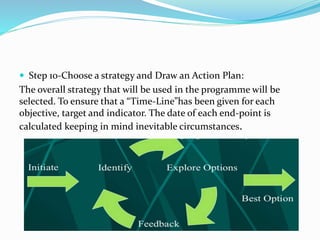
 Step 10-Choose a strategy and Draw an Action Plan:
The overall strategy that will be used in the programme will be
selected. To ensure that a “Time-Line”has been given for each
objective, target and indicator. The date of each end-point is
calculated keeping in mind inevitable circumstances.
 Step 11:Address the issues of Accessibility and Coverage
 To make detailed Hotmaps of the concerned areas and work out
the aspects of population distribution,roads.communication and
Transportation
 Many times it has been observed that the beneficiaries of a
program are in far-flung areas with improper access.
 Inability to cover this group can as much as cause the failure of
the entire program itself.Hence,special measures must be taken
to reach out to this group.
 Step 12:Organize the Manpower, Materials and Finances
 To place the required manpower,equipment,materials and
other Logistics at the required places.(and also if additional
resources will be available in the near future,make plans on
how to relocate these resources and ensure frugality.)
 “WHO WILL DO WHAT TO WHOM AND IN WHAT
MANNER?”
 To ensure Quality control of these personnel by training
them in central institutes and providing them first-hand
Practical experiences with special emphasis on the
importance of First aid,Vector borne disease control and
(recently)an ability to identify chronically mentally unwell
patients.Profeciency in medical procedures which will be
delegated to them is an absolute must.
 Step 13:Undertake a “Pilot-Run”
Practical application of these ideas can help identify
gaping loopholes and also Fine-tune our approach
towards the healthcare system.
• Step-14:Conduct the Programme:
To launch the programme in a full-fledged manner. To
ensure the presence of Deputies always at the site of
plan-delivery. Collecting data, its analysis by
experienced experts and its accurate assessment.
EVALUATION
 Step 15:Evaluate the Program
It is the process of comparing how much our results are
pre-commensurate with our pre-decided objectives.
Concurrent Evaluation >>> Terminal Evaluation
For evaluation we need reliable data in the same way like
we obtained in planning stage.
Concurrent Evaluation: Continuous process as the
program continues.
Terminal Evaluation:Evaluation after the conclusion of
an exercise.
 Six Stages of Evaluation are as follows:
❶ Evaluation Of Relevance: It requires obtaining and
reviewing the data about the data/intelligence about
situational analysis, resources and community needs.
While concurrent evaluation is more real-
time,dynamic evaluation of the program’s efficiency in
its short-term sub-goals, Terminal evaluation is it’s
passive counter-part which broadly evaluates whether or
not the program was needed.
❷ Evaluation Of Adequacy: If the required amount of
manpower,equipment,Logistics and Finances have
been provided adequately and whether they have been
suitably placed.
❸ Evaluation of Process: This essentially deals with
whether or not the services were delivered and what
was their Quality(Whether or not it reached only a few
factions or was successful in reaching all including the
marginalized)
EVALUATION OF Efficacy, Effectiveness and Efficiency:
 Effectiveness: It is the extent to which planned
outcomes,goals,or objectives are achieved as a results
of activity,strategy,intervention or initiative intended
to achieve the desired effect, under Ordinary
circumstances.
Efficiency: It is the ratio of outputs to inputs in any
system.An efficient system achieves higher levels of
performance(output) relative to the
Inputs(personnel,time,money) involved.
 A robust situation analysis might include an assessment of:
 social determinants of health and health needs, including
current and projected disease burdens and health
challenges
 expectations, including current and projected demand for
services as well as social expectations
 health system performance and of performance gaps in
responding to needs and expectations
 capacity of the health sector to respond to current and to
anticipate future challenges
 health system resources (human, physical, financial,
informational) and of resource gaps in responding to needs
and expectations
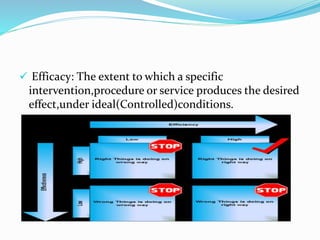
 Efficacy: The extent to which a specific
intervention,procedure or service produces the desired
effect,under ideal(Controlled)conditions.
Why Evaluate at all?
 Outcomes can be improved through increased and more focused
investment in monitoring and evaluating how national health policies,
strategies, and plans are implemented. During joint annual reviews, for
example, different actors within the health sector and beyond assess
progress and performance according to agreed benchmarks and
indicators within a single monitoring and evaluation framework.
 When properly designed, this allows for learning, continuous
improvement of the planning process and timely corrective measures.
It also contributes to documenting policy reform processes.
 Countries within and across regions can benefit from opportunities for
inter-country exchange and peer review, better documentation of
policy innovation, and support to institutions, such as networks of
observatories, that can drive and guide the development of national
health policies, strategies, and plans.
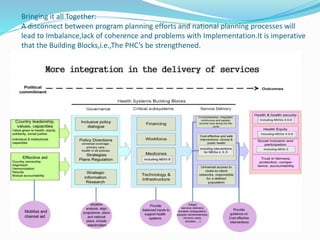
Bringing it all Together:
A disconnect between program planning efforts and national planning processes will
lead to Imbalance,lack of coherence and problems with Implementation.It is imperative
that the Building Blocks,i.e.,The PHC’s be strengthened.
Strategic Plan for the Malaria Control Programme – India -
2012-2017
• The overall objective of this 12th Five Year Plan is Effective Malaria Control,
to bring down the number of Malaria cases and Malaria deaths.(Scope Of
Exercise)
• To achieve by the end of 2017, API < 1 per 1000 Population(Objective)
The following are the salient features to achieve this Excercise:
 Malaria is particularly entrenched in low-income rural areas of eastern and
north-eastern states, but important foci are also present in the central and
more arid western parts of the country. About 95% population in the
country resides in malaria endemic areas and 80% of malaria reported in
the country is confined to areas where 20% of population reside in tribal,
hilly, hard-to-reach or inaccessible areas. (Situational Analysis)
 Strengths,Weakness,Opportunity and Threat Analysis.
Strengths:ASHAs being made available in all villages. India is a leading
manufacturer of malaria diagnostics, drugs and insecticides
Weaknesses: Deficiency of human resources at all levels from national to
block level. Poor communication of information.
Opportunities: National Urban Health Mission is expected to be
launched as part of National Health Mission in the 12th Five Year Plan
could strengthen urban malaria control. Increasing commitment for
funds from international agencies the World Bank.
Threats: Spread of fake drugs, insecticides and LLINs in the market.
Overloading of ASHAs with many programmes.
 All health facilities have a board consisting of representatives from civil
society, women’s groups, political leaders, etc. with powers to decide
budget allocation and utilization. Further, it is the community selected
health volunteer, the ASHA who provides the linkage between the
community health needs and the facility. She is incentivized with a
certain amount of money for each service she provides, for example,
under the malaria programme, for performing RDT, making blood
smears, treating confirmed malaria cases etc.(Ensuring Community
Participation)
 SETTING PRIORITIES: Category 1,2&3 have been respectively created.
Accordingly, High Risk Groups have been identified.
GOALS,OBJECTIVES,INDICATORS AND TARGETS:
The objectives are SMART
 Core interventions and target objectives: Reducing disease burden &mortality:
 Prevention: Insecticide treated mosquito nets. Objective: By March 2017, 80%
of population in high-risk areas sleep under an insecticide treated bed-net
Indoor residual spraying By March 2017, at least 80% of those suffering from
malaria get correct, affordable and appropriate diagnosis within 24 hours of
reporting to the health system.Elimination of malaria (zero indigenous case).
Indicators: Monitoring and evaluation through periodic review/field visits and
operationalization of web-based computerized National Anti-Malaria
Management Information System (NAMMIS) /integration with HMIS of NRHM.
References
 Textbook of Community Medicine,Dr.Suryakantha.
 Textbook of Community Medicine,Dr.SundarLal
 Textbook of Public Health,W.H.O AFMC Book.
 W.H.O Websites (http://www.who.int)
a) www.who.int/nationalpolicies/processes/en/
b) www.who.int/nationalpolicies/processes/priorities
• Strategic-action-plan-malaria-2012-17
www.nationalplanningcycles.org/India/strategic-action-
plan-malaria-2012-17

Planning cycle for Disaster-Managment.

  • 1.
  • 2.
    PLANNING  It isthe process of identifying a course of action SYSTEMATICALLY in an organized manner to achieve the objectives by utilizing the available resources skillfully in a COST-EFFECTIVE way.  The orderly process of defining health problems, identifying unmet needs and surveying the resources to meet them, establishing priority goals that are realistic and feasible, and projecting administrative action, concerned not only with the adequacy, efficacy and efficiency of health services but also with those factors of ecology and of social and individual behavior that affect the health of the individual and the community.  Often used interchangeably with policy formation or developing strategies and programmes
  • 3.
    Formulation Of Action Plan • Assessmentof health situation • Fixing up priorities • Establishment of Goals and Objectives • Assessment of resources • Tentative Time Table(Time frame) Execution (Implement ation) •Action Plan with Necessary Leadership of the team Monitoring •This helps to identify the deviations and take corrective actions •The program reoriented and implemented in a better way. Evaluation •Assessment of Performance in terms of success and also Cost-effectiveness Operational Research •Improving the methodology of action plan to achieve better results
  • 4.
    Analysis Of theSituation  Step 1:Laying down the PREMISES(Scope) This defines the general perimeters or the boundaries. This is done in terms of place, time population and disease condition within which the health condition is being planned. • Step 2:Situational analysis Relevant geographic, socioeconomic and disease data. • Step 3:Resource Analysis Data on available resources(Healthy manpower, money and material is obtained and analyzed)
  • 5.
     Step 4:SWOTAnalysis The Strengths(S),Weaknesses(W),Opportunities(O) and Threats(T) are identified in context of the proposed programme. S&W i.e.,Strength and Weaknesses are the permanent phenomena, they are intrinsic to the organization/community.Whereas,O&T are the temporary phenomenon,which,exist in the external Environment. • Step 5:Ensure Community Participation Identifying the community leaders, peers and Voluntary groups and Involving them in the planning process
  • 6.
     Step 6:Enunciationof the Community Needs The major issues that need to be addressed and can be feasibly addressed are decided.  Normative or “Professionally Assessed Needs” are what we, as doctors or public healthcare managers, feel that the community requires.  “Felt needs” of the community are what the community members feel is their need.  Health planning at the local level describes how all available resources are best used to operate the local health system. These resources may be through central government (for the health sector and for other sectors), or through contributions, in kind and/or cash, by civil society organizations (CSOs), non-governmental organizations (NGOs), and not-for profit and for-profit private sectors Working out an optimum balance between these two needs is essential.
  • 7.
     Step 7:Settingthe Priorities To work out the Priority areas within the proposed programme, which are the most important requirements our available resources can feasibly address them. An epidemiological method for according priorities is to consider the following  3-High Importance  2-Moderate Importance  3-Low Importance Effectiveness of the Interventions:  If interventions are known to be very effective  If moderately effective  If low or non-effective
  • 8.
    Cost of Interventions: 3-If the cost is low  2-if it is of Moderate cost  1-If the cost is high • Step 8:Identifying the “High Risk” Groups High risk groups are those that have a higher chance of being affected by the disease or its adverse consequences. It depends on the disease or condition that is being addressed.Consequently,large amounts of benefit will occur from the programme if this group is addressed.
  • 9.
     Step 9:Enunciatethe Goal(Aim),Objectives, Indicators and targets of the programme.  Aim: It is the ultimate desired state towards which objectives and resources are dedicated.  Objectives: Specific statements which are specific,quanitfiable and usually relate to a time-plan.  Indicators:These are Parameters  Target:Discrete activity to measure the Degree of Achievement.  Crucial step involving diligent research by expert evaluators.  Should be Doable and Should not be too ambitious(or under- achieving)
  • 10.
     Good objectivesare SMART: i. Specific(Clear and Precise),to ensure all the parties interpret in the same way. ii. Measurable(Amenable to Evaluation):To monitor progress or evaluate performance. iii. Appropriate and Relevant:To organizations Policies,goals and its strategies. iv. Realistic: Objectives should be realistic keeping in mind limited resources(Money,Manpower and Material) v. Time-Bound: The Objectives should be achieved in a time- frame.
  • 11.
     Step 10-Choosea strategy and Draw an Action Plan: The overall strategy that will be used in the programme will be selected. To ensure that a “Time-Line”has been given for each objective, target and indicator. The date of each end-point is calculated keeping in mind inevitable circumstances.
  • 12.
     Step 11:Addressthe issues of Accessibility and Coverage  To make detailed Hotmaps of the concerned areas and work out the aspects of population distribution,roads.communication and Transportation  Many times it has been observed that the beneficiaries of a program are in far-flung areas with improper access.  Inability to cover this group can as much as cause the failure of the entire program itself.Hence,special measures must be taken to reach out to this group.
  • 13.
     Step 12:Organizethe Manpower, Materials and Finances  To place the required manpower,equipment,materials and other Logistics at the required places.(and also if additional resources will be available in the near future,make plans on how to relocate these resources and ensure frugality.)  “WHO WILL DO WHAT TO WHOM AND IN WHAT MANNER?”  To ensure Quality control of these personnel by training them in central institutes and providing them first-hand Practical experiences with special emphasis on the importance of First aid,Vector borne disease control and (recently)an ability to identify chronically mentally unwell patients.Profeciency in medical procedures which will be delegated to them is an absolute must.
  • 14.
     Step 13:Undertakea “Pilot-Run” Practical application of these ideas can help identify gaping loopholes and also Fine-tune our approach towards the healthcare system. • Step-14:Conduct the Programme: To launch the programme in a full-fledged manner. To ensure the presence of Deputies always at the site of plan-delivery. Collecting data, its analysis by experienced experts and its accurate assessment.
  • 15.
    EVALUATION  Step 15:Evaluatethe Program It is the process of comparing how much our results are pre-commensurate with our pre-decided objectives. Concurrent Evaluation >>> Terminal Evaluation For evaluation we need reliable data in the same way like we obtained in planning stage. Concurrent Evaluation: Continuous process as the program continues. Terminal Evaluation:Evaluation after the conclusion of an exercise.
  • 16.
     Six Stagesof Evaluation are as follows: ❶ Evaluation Of Relevance: It requires obtaining and reviewing the data about the data/intelligence about situational analysis, resources and community needs. While concurrent evaluation is more real- time,dynamic evaluation of the program’s efficiency in its short-term sub-goals, Terminal evaluation is it’s passive counter-part which broadly evaluates whether or not the program was needed.
  • 17.
    ❷ Evaluation OfAdequacy: If the required amount of manpower,equipment,Logistics and Finances have been provided adequately and whether they have been suitably placed. ❸ Evaluation of Process: This essentially deals with whether or not the services were delivered and what was their Quality(Whether or not it reached only a few factions or was successful in reaching all including the marginalized)
  • 18.
    EVALUATION OF Efficacy,Effectiveness and Efficiency:  Effectiveness: It is the extent to which planned outcomes,goals,or objectives are achieved as a results of activity,strategy,intervention or initiative intended to achieve the desired effect, under Ordinary circumstances. Efficiency: It is the ratio of outputs to inputs in any system.An efficient system achieves higher levels of performance(output) relative to the Inputs(personnel,time,money) involved.
  • 19.
     A robustsituation analysis might include an assessment of:  social determinants of health and health needs, including current and projected disease burdens and health challenges  expectations, including current and projected demand for services as well as social expectations  health system performance and of performance gaps in responding to needs and expectations  capacity of the health sector to respond to current and to anticipate future challenges  health system resources (human, physical, financial, informational) and of resource gaps in responding to needs and expectations
  • 20.
     Efficacy: Theextent to which a specific intervention,procedure or service produces the desired effect,under ideal(Controlled)conditions.
  • 21.
    Why Evaluate atall?  Outcomes can be improved through increased and more focused investment in monitoring and evaluating how national health policies, strategies, and plans are implemented. During joint annual reviews, for example, different actors within the health sector and beyond assess progress and performance according to agreed benchmarks and indicators within a single monitoring and evaluation framework.  When properly designed, this allows for learning, continuous improvement of the planning process and timely corrective measures. It also contributes to documenting policy reform processes.  Countries within and across regions can benefit from opportunities for inter-country exchange and peer review, better documentation of policy innovation, and support to institutions, such as networks of observatories, that can drive and guide the development of national health policies, strategies, and plans.
  • 22.
    Bringing it allTogether: A disconnect between program planning efforts and national planning processes will lead to Imbalance,lack of coherence and problems with Implementation.It is imperative that the Building Blocks,i.e.,The PHC’s be strengthened.
  • 23.
    Strategic Plan forthe Malaria Control Programme – India - 2012-2017 • The overall objective of this 12th Five Year Plan is Effective Malaria Control, to bring down the number of Malaria cases and Malaria deaths.(Scope Of Exercise) • To achieve by the end of 2017, API < 1 per 1000 Population(Objective) The following are the salient features to achieve this Excercise:  Malaria is particularly entrenched in low-income rural areas of eastern and north-eastern states, but important foci are also present in the central and more arid western parts of the country. About 95% population in the country resides in malaria endemic areas and 80% of malaria reported in the country is confined to areas where 20% of population reside in tribal, hilly, hard-to-reach or inaccessible areas. (Situational Analysis)  Strengths,Weakness,Opportunity and Threat Analysis. Strengths:ASHAs being made available in all villages. India is a leading manufacturer of malaria diagnostics, drugs and insecticides
  • 24.
    Weaknesses: Deficiency ofhuman resources at all levels from national to block level. Poor communication of information. Opportunities: National Urban Health Mission is expected to be launched as part of National Health Mission in the 12th Five Year Plan could strengthen urban malaria control. Increasing commitment for funds from international agencies the World Bank. Threats: Spread of fake drugs, insecticides and LLINs in the market. Overloading of ASHAs with many programmes.  All health facilities have a board consisting of representatives from civil society, women’s groups, political leaders, etc. with powers to decide budget allocation and utilization. Further, it is the community selected health volunteer, the ASHA who provides the linkage between the community health needs and the facility. She is incentivized with a certain amount of money for each service she provides, for example, under the malaria programme, for performing RDT, making blood smears, treating confirmed malaria cases etc.(Ensuring Community Participation)
  • 25.
     SETTING PRIORITIES:Category 1,2&3 have been respectively created. Accordingly, High Risk Groups have been identified. GOALS,OBJECTIVES,INDICATORS AND TARGETS: The objectives are SMART  Core interventions and target objectives: Reducing disease burden &mortality:  Prevention: Insecticide treated mosquito nets. Objective: By March 2017, 80% of population in high-risk areas sleep under an insecticide treated bed-net Indoor residual spraying By March 2017, at least 80% of those suffering from malaria get correct, affordable and appropriate diagnosis within 24 hours of reporting to the health system.Elimination of malaria (zero indigenous case). Indicators: Monitoring and evaluation through periodic review/field visits and operationalization of web-based computerized National Anti-Malaria Management Information System (NAMMIS) /integration with HMIS of NRHM.
  • 26.
    References  Textbook ofCommunity Medicine,Dr.Suryakantha.  Textbook of Community Medicine,Dr.SundarLal  Textbook of Public Health,W.H.O AFMC Book.  W.H.O Websites (http://www.who.int) a) www.who.int/nationalpolicies/processes/en/ b) www.who.int/nationalpolicies/processes/priorities • Strategic-action-plan-malaria-2012-17 www.nationalplanningcycles.org/India/strategic-action- plan-malaria-2012-17

Editor's Notes