Stuart Andrews, Eversheds LLP
April 2013
The national planning framework
Practical planning
Introduction
Stuart Andrews
Head of Planning
Partner for Eversheds LLP
Direct dial: 0845 497 1272
Mobile: 07768 070453
www.eversheds.com
Content
The national planning policy framework
- the local plan
- planning by appeal
- some unforeseen consequences
Nationally significant infrastructure projects
- meeting the requirements
- managing risk
- some unforeseen issues
Legal update
- town and village greens and other cases
- community infrastructure levy
- legal challenges
PART ONE
The national planning framework
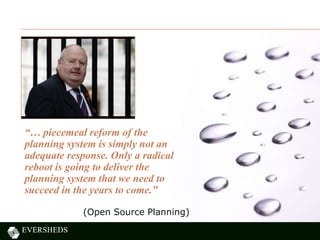
“… piecemeal reform of the
planning system is simply not an
adequate response. Only a radical
reboot is going to deliver the
planning system that we need to
succeed in the years to come.”
(Open Source Planning)
The NPPF
The role of “national policy”
Plan making
- Section 19(2)(a) Planning and Compulsory
Purchase Act 2004 - regard is to be had to
national policy
- Section 20(5)(a) 2004 Act – need for soundness (and so
consistency with national policy - NPPF para.182)
Development control
- Section 38(6) Town and Country Planning Act 1990 is retained -
the development plan retains statutory force
- National policy is an “other material consideration” (TCPA section
70(2))
What do you think will be the best way to
engage with the planning system for the
foreseeable future?
a) active engagement in the plan making process?
b) through community/parish groups in the preparation of
Neighbourhood Plans?
c) at appeal?
d) challenges through the Courts?
e) sitting it out and waiting for it all to change again?
f) don’t know.
The presumption in favour of
sustainable development
• Significant weight should be placed on
the need to support economic
growth through the planning system
(para 19)
• Economic, social and environmental
goals should be sought jointly and
simultaneously (para 8)
• Investment in business should not be
overburdened by the combined
requirements of planning policy
expectations (para 21).
Promoting local plans
They should set out strategic priorities by:
- plan positively for 15 years and keep
plans up to date based on co-operation
with neighbouring authorities;
- they should use a proportionate
evidence base with up to date and
relevant evidence about economic, social
and environmental characteristics; and
- ensure their assessments of housing and
employment are fully integrated, taking
into account market and economic
evidence (para. 158).
Will Central Government pressure force
intransient and politically motivated local
authorities to robustly plan for housing and
economic growth in their area, even if the
need for such development is generated
elsewhere?
YES or NO
Promoting local plans
• Duty to co-operate on policy issues
crossing boundaries, particularly strategic
priorities.
• Public bodies have a duty to approve
development that accord with the
development plan without delay.
• Public bodies have a duty to approve
development where the development plan
is absent, silent or out-of-date, unless
adverse impacts significantly and
demonstrably outweigh the benefits
Is the Duty to Co-operate doomed to failure
and will it mean that many Local Plan’s will
fail to be found sound because of differing
political and strategic objects between
urban and rural authorities?
YES or NO
Recent developments
• West Berkshire - Report on the Examination into
the Core Strategy dated 3 July 2012
• Rushcliffe - Examination into the Soundness of the
Core Strategy Development Plan Document
Inspector’s letter dated 27 November 2012
• Tetbury – Appeal by Fay & Son Ltd at Highfield
Farm, Tetbury, Gloucestershire dated 13 February
2013 (APP/F1610/A/11/2165778)
• Cheshire - Fox Strategic Land and Property Limited
v SoSCLG and Cheshire East Council [2012] EWHC
444 (Admin)
How do you think the system could be
improved?
a) restoring a system of Regional Planning?
b) go back to sub-regional planning/Structure Plans?
c) the publication of Central Government targets?
d) further reforms to simplify the system?
e) directives from Government making clear the risks of non-
compliance?
f) set some key national constraints and deregulate everything
else to local planning?
PART TWO
Nationally significant infrastructure projects
• Reservoirs, water transfer (10mcm or 100mcm/year) (not yet in force);
• Any sort of electricity generation (50MW onshore/100MW offshore);
• Electricity transmission lines (132kV);
• Gas storage, LNG, gas reception (43mcm or 4.5mcm/day);
• Pipelines (40km (gas), 10 miles (other));
• Roads (various);
• Railways (when expanding from the existing railway corridor);
• Harbours (5m tonnes);
• Airports (10m passengers);
• Rail freight (60ha);
• Waste water treatment (500,000 people);
• Hazardous waste (30,000 tonnes/100,000 tonnes); and
• Transfer or storage of waste water (350,000m3).
NSIPs
Planning Act 2008
• The new types of developments that could be considered
under the NSIP system include:
- Offices and research and development facilities;
- Manufacturing and processing proposals
- Warehousing, storage and distribution;
- Conference and exhibition centres;
- Leisure, tourism and sports and recreation,
including sports stadia;
- Extractive industries (mining and quarrying) including
proposals for deep mined coal and onshore oil and gas
extraction; and
- Mixed-use development including, for example, mixed-use
business parks.
NSIPs
The growth and infrastructure bill
• National policy statements (“NPSs”) establish the
case for NSIP development.
• NPSs set out the national need for infrastructure
development and set the policy framework for DCO
decisions.
• Promoters must ensure that proposals are properly
prepared and consulted on before they submit an
application.
• Decisions will be based primarily on the NPS,
through a streamlined examination process.
• Questioning at hearings will be led by Inspectors
rather than being adversarial.
NSIPs
The process
• Drift - Daventry International Rail Freight Interchange:
notification of decision not to accept application dated 28
November 2012
• HS2 bill - Decision of the High Court in R (on the
application of HS2 Action Alliance Ltd and others)
-v- Secretary of State for Transport & High Speed Two
Ltd [2013] EWHC 481 (Admin).
• Preeshall – Decision of the Secretary of State relating to
the refusal of the proposed Saltfield Underground Gas
Storage Facility in Lancashire (File Ref EN030001) dated
9 April 2013
• Milton Keynes - Decision of the High Court in R (RWE
NPower Renewables Ltd) v Milton Keynes Council [2013]
EWHC (Admin)
NSIPs
Recent developments
PART THREE
Legal update
• Town and village greens
Newhaven Port & Properties Limited v East Sussex
County Council [2012] EWHC 647 (Admin)
• Section 106 agreements
Westminster City Council –v- Secretary of State for
Communities & Local Government [2013] EWHC
690 (Admin)
• Evidence
Wainhomes (South West) Holdings Ltd v Secretary
of State for Communities & Local Government
[2013] EWHC 597 (Admin)
Legal update
• Extending the date from 2014 to 2015 for the pooling of s.106
• Allowing payment of CIL in kind with infrastructure
• Greater flexibility over payment, particularly for large schemes
• Allowing site preparation before CIL is triggered
• Scrapping the occupancy test so that all existing floorspace
is offset
• Simplifying and extending affordable housing relief
• Amending the exceptional circumstances relief
• Reinforcing the evidence tests for CIL setting and amending
rules relating to Regulation 123 infrastructure lists to provide
more clarity and commitment to delivery.
Legal update
Consultation on community infrastructure levy
• Amendments to the Civil Procedure Rules, governing cases
conducted in England and Wales, bring into force a new cost-
capping regime for litigants in environmental-related judicial
review claims.
• The rules, introduced on 1 April, cap the costs recoverable by a
defendant from a claimant in such cases at a maximum of £5,000
where a claimant is an individual, and at £10,000 in any other
circumstances.
Legal update
Legal challenges
"I mean, bluntly, there comes a question in life - do you believe
planning works, that clever people sitting in a room can plan
how people's communities should develop? Or do you believe it
can't work?
“I believe it can't work, David Cameron believes it can't, Nick
Clegg believes it can't. Chaotic therefore in our vocabulary is a
good thing.”
Conclusion
Nicholas Boles, Planning Minister
Name here, Eversheds LLP
Date here www.eversheds.com
Eversheds LLP 2013© Eversheds is a limited liability partnership.
DT02497

Shine Webinar, National Planning, 25 April

  • 1.
    Stuart Andrews, EvershedsLLP April 2013 The national planning framework Practical planning
  • 2.
    Introduction Stuart Andrews Head ofPlanning Partner for Eversheds LLP Direct dial: 0845 497 1272 Mobile: 07768 070453 www.eversheds.com
  • 3.
    Content The national planningpolicy framework - the local plan - planning by appeal - some unforeseen consequences Nationally significant infrastructure projects - meeting the requirements - managing risk - some unforeseen issues Legal update - town and village greens and other cases - community infrastructure levy - legal challenges
  • 4.
    PART ONE The nationalplanning framework
  • 5.
    “… piecemeal reformof the planning system is simply not an adequate response. Only a radical reboot is going to deliver the planning system that we need to succeed in the years to come.” (Open Source Planning)
  • 6.
    The NPPF The roleof “national policy” Plan making - Section 19(2)(a) Planning and Compulsory Purchase Act 2004 - regard is to be had to national policy - Section 20(5)(a) 2004 Act – need for soundness (and so consistency with national policy - NPPF para.182) Development control - Section 38(6) Town and Country Planning Act 1990 is retained - the development plan retains statutory force - National policy is an “other material consideration” (TCPA section 70(2))
  • 7.
    What do youthink will be the best way to engage with the planning system for the foreseeable future? a) active engagement in the plan making process? b) through community/parish groups in the preparation of Neighbourhood Plans? c) at appeal? d) challenges through the Courts? e) sitting it out and waiting for it all to change again? f) don’t know.
  • 8.
    The presumption infavour of sustainable development • Significant weight should be placed on the need to support economic growth through the planning system (para 19) • Economic, social and environmental goals should be sought jointly and simultaneously (para 8) • Investment in business should not be overburdened by the combined requirements of planning policy expectations (para 21).
  • 9.
    Promoting local plans Theyshould set out strategic priorities by: - plan positively for 15 years and keep plans up to date based on co-operation with neighbouring authorities; - they should use a proportionate evidence base with up to date and relevant evidence about economic, social and environmental characteristics; and - ensure their assessments of housing and employment are fully integrated, taking into account market and economic evidence (para. 158).
  • 10.
    Will Central Governmentpressure force intransient and politically motivated local authorities to robustly plan for housing and economic growth in their area, even if the need for such development is generated elsewhere? YES or NO
  • 11.
    Promoting local plans •Duty to co-operate on policy issues crossing boundaries, particularly strategic priorities. • Public bodies have a duty to approve development that accord with the development plan without delay. • Public bodies have a duty to approve development where the development plan is absent, silent or out-of-date, unless adverse impacts significantly and demonstrably outweigh the benefits
  • 12.
    Is the Dutyto Co-operate doomed to failure and will it mean that many Local Plan’s will fail to be found sound because of differing political and strategic objects between urban and rural authorities? YES or NO
  • 13.
    Recent developments • WestBerkshire - Report on the Examination into the Core Strategy dated 3 July 2012 • Rushcliffe - Examination into the Soundness of the Core Strategy Development Plan Document Inspector’s letter dated 27 November 2012 • Tetbury – Appeal by Fay & Son Ltd at Highfield Farm, Tetbury, Gloucestershire dated 13 February 2013 (APP/F1610/A/11/2165778) • Cheshire - Fox Strategic Land and Property Limited v SoSCLG and Cheshire East Council [2012] EWHC 444 (Admin)
  • 14.
    How do youthink the system could be improved? a) restoring a system of Regional Planning? b) go back to sub-regional planning/Structure Plans? c) the publication of Central Government targets? d) further reforms to simplify the system? e) directives from Government making clear the risks of non- compliance? f) set some key national constraints and deregulate everything else to local planning?
  • 15.
    PART TWO Nationally significantinfrastructure projects
  • 16.
    • Reservoirs, watertransfer (10mcm or 100mcm/year) (not yet in force); • Any sort of electricity generation (50MW onshore/100MW offshore); • Electricity transmission lines (132kV); • Gas storage, LNG, gas reception (43mcm or 4.5mcm/day); • Pipelines (40km (gas), 10 miles (other)); • Roads (various); • Railways (when expanding from the existing railway corridor); • Harbours (5m tonnes); • Airports (10m passengers); • Rail freight (60ha); • Waste water treatment (500,000 people); • Hazardous waste (30,000 tonnes/100,000 tonnes); and • Transfer or storage of waste water (350,000m3). NSIPs Planning Act 2008
  • 17.
    • The newtypes of developments that could be considered under the NSIP system include: - Offices and research and development facilities; - Manufacturing and processing proposals - Warehousing, storage and distribution; - Conference and exhibition centres; - Leisure, tourism and sports and recreation, including sports stadia; - Extractive industries (mining and quarrying) including proposals for deep mined coal and onshore oil and gas extraction; and - Mixed-use development including, for example, mixed-use business parks. NSIPs The growth and infrastructure bill
  • 18.
    • National policystatements (“NPSs”) establish the case for NSIP development. • NPSs set out the national need for infrastructure development and set the policy framework for DCO decisions. • Promoters must ensure that proposals are properly prepared and consulted on before they submit an application. • Decisions will be based primarily on the NPS, through a streamlined examination process. • Questioning at hearings will be led by Inspectors rather than being adversarial. NSIPs The process
  • 19.
    • Drift -Daventry International Rail Freight Interchange: notification of decision not to accept application dated 28 November 2012 • HS2 bill - Decision of the High Court in R (on the application of HS2 Action Alliance Ltd and others) -v- Secretary of State for Transport & High Speed Two Ltd [2013] EWHC 481 (Admin). • Preeshall – Decision of the Secretary of State relating to the refusal of the proposed Saltfield Underground Gas Storage Facility in Lancashire (File Ref EN030001) dated 9 April 2013 • Milton Keynes - Decision of the High Court in R (RWE NPower Renewables Ltd) v Milton Keynes Council [2013] EWHC (Admin) NSIPs Recent developments
  • 20.
  • 21.
    • Town andvillage greens Newhaven Port & Properties Limited v East Sussex County Council [2012] EWHC 647 (Admin) • Section 106 agreements Westminster City Council –v- Secretary of State for Communities & Local Government [2013] EWHC 690 (Admin) • Evidence Wainhomes (South West) Holdings Ltd v Secretary of State for Communities & Local Government [2013] EWHC 597 (Admin) Legal update
  • 22.
    • Extending thedate from 2014 to 2015 for the pooling of s.106 • Allowing payment of CIL in kind with infrastructure • Greater flexibility over payment, particularly for large schemes • Allowing site preparation before CIL is triggered • Scrapping the occupancy test so that all existing floorspace is offset • Simplifying and extending affordable housing relief • Amending the exceptional circumstances relief • Reinforcing the evidence tests for CIL setting and amending rules relating to Regulation 123 infrastructure lists to provide more clarity and commitment to delivery. Legal update Consultation on community infrastructure levy
  • 23.
    • Amendments tothe Civil Procedure Rules, governing cases conducted in England and Wales, bring into force a new cost- capping regime for litigants in environmental-related judicial review claims. • The rules, introduced on 1 April, cap the costs recoverable by a defendant from a claimant in such cases at a maximum of £5,000 where a claimant is an individual, and at £10,000 in any other circumstances. Legal update Legal challenges
  • 24.
    "I mean, bluntly,there comes a question in life - do you believe planning works, that clever people sitting in a room can plan how people's communities should develop? Or do you believe it can't work? “I believe it can't work, David Cameron believes it can't, Nick Clegg believes it can't. Chaotic therefore in our vocabulary is a good thing.” Conclusion Nicholas Boles, Planning Minister
  • 25.
    Name here, EvershedsLLP Date here www.eversheds.com Eversheds LLP 2013© Eversheds is a limited liability partnership. DT02497