• Project risk :-is an uncertain event or condition that, if it occurs, has an effect on at least
one project objective. Risk management focuses on identifying and assessing the risks to
the project and managing those risks to minimize the impact on the project.
OR The exposure to a company that arises from taking on a particular task. A project risk can be
internal to the business, it can involve external events or it can stem from any other circumstances that
can hamper the project's overall success and result in loss or embarrassment to the firm undertaking it.
• Step 1: Identify the Risk. You and your team uncover, recognize and describe risks that might affect your
project or its outcomes. There are a number of techniques you can use to find project risks. During this step you start
to prepare your Project Risk Register.
• Step 2: Analyze the risk. Once risks are identified you determine the likelihood and consequence of each risk.
You develop an understanding of the nature of the risk and its potential to affect project goals and objectives. This
information is also input to your Project Risk Register.
• Step 3: Evaluate or Rank the Risk. You evaluate or rank the risk by determining the risk magnitude, which is
the combination of likelihood and consequence. You make decisions about whether the risk is acceptable or whether
it is serious enough to warrant treatment. These risk rankings are also added to your Project Risk Register.
• Step 4: Treat the Risk. This is also referred to as Risk Response Planning. During this step you assess your
highest ranked risks and set out a plan to treat or modify these risks to achieve acceptable risk levels. How can you
minimize the probability of the negative risks as well as enhancing the opportunities? You create risk mitigation
strategies, preventive plans and contingency plans in this step. And you add the risk treatment measures for the
highest ranking or most serious risks to your Project Risk Register.
• Step 5: Monitor and Review the risk. This is the step where you take your Project Risk Register and use it
to monitor, track and review risks.
• Risk is about uncertainty. If you put a framework around that uncertainty, then you effectively de-risk your project.
And that means you can move much more confidently to achieve your project goals. 1
A work breakdown structure (WBS):-is a key project deliverable that
organizes the team's work into manageable sections. The Project Management Body of
Knowledge (PMBOK) defines the work breakdown structure as a "deliverable oriented
hierarchical decomposition of the work to be executed by the project team.“
product breakdown structure (PBS):-is a tool for analyzing,
documenting and communicating the outcomes of a project, and forms part of
the product based planning technique.
• The PBS provides "an exhaustive, hierarchical tree structure of
deliverables (physical, functional or conceptual) that make up the project,
arranged in whole-part relationship" .
2
Software Development
• The process of software development services in India goes through a series of stages in
step wise fashion that almost every developing company follows. Known as the ‘software
development life cycle,’ these six steps include planning, analysis, design, development &
implementation, testing & deployment and maintenance. Let’s study each of these steps to
know how the perfect software is developed.
Phases of Software Development
1)Planning: Without the perfect plan, calculating the strengths and weaknesses of the project, development of
software is meaningless. Planning kicks off a project flawlessly and affects its progress positively.
2) Analysis: This step is about analyzing the performance of the software at various stages and making notes on
additional requirements. Analysis is very important to proceed further to the next step.
3. Design: Once the analysis is complete, the step of designing takes over, which is basically building the
architecture of the project. This step helps remove possible flaws by setting a standard and attempting to stick to
it.
4. Development & Implementation: The actual task of developing the software starts here with data
recording going on in the background. Once the software is developed, the stage of implementation comes in
where the product goes through a pilot study to see if it’s functioning properly.
5. Testing: The testing stage assesses the software for errors and documents bugs if there are any.
6. Maintenance: Once the software passes through all the stages without any issues, it is to undergo a
maintenance process wherein it will be maintained and upgraded from time to time to adapt to changes.
Almost every software development Indian company follows all the six steps, leading to the reputation
that the country enjoys in the software market today.
3
Management:-
The organization and coordination of the activities of a business in order to achieve defined objectives.
... Management consists of the interlocking functions of creating corporate policy and organizing,
planning, controlling, and directing an organization's resources in order to achieve the objectives of that
policy.
Management involves the following activities:
1)Planning:-is concerned with the determination of the objectives to be achieved and the course of
action to be followed to achieve them. Before starting any action, one has to decide how the work will be
performed and where and how it has to be performed. Thus, planning implies decision-making as to what
is to be done, how it is to be done, when it is to be done and by whom it is to done. Planning helps in
achieving the objectives efficiently and effectively. Planning involves selecting of objectives and strategies,
policies and programmer and procedures for achieving them.----Planning function is performed by
managers at every level because planning may either be for the entire enterprise or for any section or
department thereof. Planning pervades the entire gamut of managerial activity, and also it is continuous
and never-ending.
2)Organizing:-According to Fayola, "to organize a business is to provide it with everything useful to its
functioning — raw materials, tools, capital and personnel." Thus, organizing involves bringing together the
manpower and material resources for the achievement of objectives laid down by the enterprise.
Organizing involves the following process:
(a) determining and defining the activities involved in achieving the objectives laid down by the
management.(b) grouping the activities in a logical pattern.(c) assigning the activities to specific positions
and people.(d) delegating authority to their positions and people so as to enable them to perform the
activities assigned to them.
4
3)Staffing Every enterprise is very much concerned with the quality of its people, especially its managers. The
staffing function is concerned with this aspect of management. According to Harold Koontz and Cyril O'Donnell,
"the managerial function of staffing involves manning the organizational structure through proper and effective
selection, appraisal and development of personnel to fill the roles designed into the structure." Thus, the staffing
functions involve:
4)Directing:-Directing is one of the important functions of management and is the art and process of getting
things done. While other functions like planning, organizing and staffing are merely preparations for doing the
work, the directing function actually starts the work.
• Directing is concerned with actuating the members of the organization to work efficiently and effectively for
the attainment of organization goals "Directing concerns the total manner in which a manager
influences the action of his subordinates. It is the final action of a manager in getting others to
act after all preparations have been completed.“
• 1. Communication or issuing of orders and instructions to subordinates. A manager has to instruct the
subordinates what to do, how to do it and when to do it.
• 2. Guiding, energizing and leading the subordinates to perform the work systematically and also building up
among workers confidence and zeal in the work to be performed.
5)Controlling:-Controlling is related to all other management functions. "Control is the process of checking to
determine whether or not, proper progress is being made towards the objectives and goals and acting if necessary to
correct any deviation." (a) Determination of standards for measuring work performance.
• (b) Measurement of actual performance.
• (c) Comparing actual performance with the standards.
• (d) Finding variances between the two and reasons for variances.
• (e) Taking corrective actions to ensure attainment of objectives.
• For control to be effective and fruitful, it must be based on a plan; there must be measurement of actual
performance to ascertain deviations and to take action to remedy the deviations.
5
• Major processes in developing a software system.
• Feasibility study
• Project planning
• Project execution
1) Feasibility Study:-Analyze the general requirements, costs and the functionalities and services
provided by the system to be developed
• Aimed to determine whether a system should be developed or not
• Can be viewed as a project itself
• A feasibility study is an analysis of how successfully a project can be completed, accounting for factors
that affect it such as economic, technological, legal and scheduling factors. Project managers use
feasibility studies to determine potential positive and negative outcomes of
2)Project planning:-To know the nature of the system to be developed
– A management information system or a control system
To know clearly the objectives and products of the project
– How to evaluate the objectives and products after the completion of the project
– Project planning is part of project management, which relates to the use of schedules such as
Gantt charts to plan and subsequently report progress within the project environment. Initially,
the project scope is defined and the appropriate methods for completing the project are
determined.
3)Project execution:-Project execution (or implementation) is the phase in which the
plan designed in the prior phases of the project life is put into action. The purpose
of project execution is to deliver the project expected results (deliverable and other direct
outputs).
6
Step involved in project planning?
Step 1: Identify Project Scope and Objectives.
• Step 1.1 Identify objectives and practical measures of the effectiveness in meeting those objectives
• Step 1.2 Establish a project authority
– To ensure the unity of purpose among all persons concerned.
• Step 1.3 Identify all stakeholders in the project and their interests
• Step 1.4 Modify objectives in the light of stakeholder analysis
• Step 1.5 Establish methods of communication between all parties
Step 2: Identify Project Infrastructure
• Step 2.1 Identify relationship between the project and strategic planning
– To determine the order of related projects (in the organization) being carried out
– To establish a framework within which the system fits
– To ensure the hardware and software standards are followed
• Step 2.2 Identify installation standards and procedures
– more appropriate name: “Identify standards and procedures related to the software project”
• Step 2.3 Identify project team organization
Step 3: Analyse Project Characteristics
• Step 3.1 Distinguish the project as either objective-driven or product-driven
• Step 3.2 Analyse other project characteristics (including quality-based ones)
• Step 3.3 Identify high level project risks
• Step 3.4 Take into account user requirements concerning implementation
• Step 3.5 Select general lifecycle approach in the light of the above
• Step 3.6 Review overall resource estimates
Up to this stage,
– the major risks of the project are identified
– the overall approach of the project is decided
So, it is a good place to re-estimate the required effort and other resources for the project
7
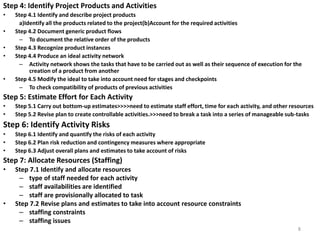
Step 4: Identify Project Products and Activities
• Step 4.1 Identify and describe project products
a)Identify all the products related to the project(b)Account for the required activities
• Step 4.2 Document generic product flows
– To document the relative order of the products
• Step 4.3 Recognize product instances
• Step 4.4 Produce an ideal activity network
– Activity network shows the tasks that have to be carried out as well as their sequence of execution for the
creation of a product from another
• Step 4.5 Modify the ideal to take into account need for stages and checkpoints
– To check compatibility of products of previous activities
Step 5: Estimate Effort for Each Activity
• Step 5.1 Carry out bottom-up estimates>>>>need to estimate staff effort, time for each activity, and other resources
• Step 5.2 Revise plan to create controllable activities.>>>need to break a task into a series of manageable sub-tasks
Step 6: Identify Activity Risks
• Step 6.1 Identify and quantify the risks of each activity
• Step 6.2 Plan risk reduction and contingency measures where appropriate
• Step 6.3 Adjust overall plans and estimates to take account of risks
Step 7: Allocate Resources (Staffing)
• Step 7.1 Identify and allocate resources
– type of staff needed for each activity
– staff availabilities are identified
– staff are provisionally allocated to task
• Step 7.2 Revise plans and estimates to take into account resource constraints
– staffing constraints
– staffing issues
8
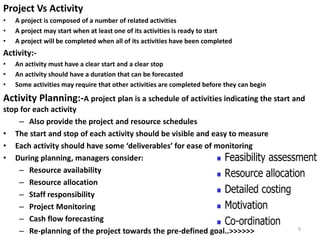
Project Vs Activity
• A project is composed of a number of related activities
• A project may start when at least one of its activities is ready to start
• A project will be completed when all of its activities have been completed
Activity:-
• An activity must have a clear start and a clear stop
• An activity should have a duration that can be forecasted
• Some activities may require that other activities are completed before they can begin
Activity Planning:-A project plan is a schedule of activities indicating the start and
stop for each activity
– Also provide the project and resource schedules
• The start and stop of each activity should be visible and easy to measure
• Each activity should have some ‘deliverables’ for ease of monitoring
• During planning, managers consider:
– Resource availability
– Resource allocation
– Staff responsibility
– Project Monitoring
– Cash flow forecasting
– Re-planning of the project towards the pre-defined goal..>>>>>> 9
Various Approaches Towards Identifying Activity,
• Activity-based approach
• Product-based approach
• Hybrid approach
1) Activity-based Approach:-Use Work Breakdown Structure (WBS) to generate a task list
• WBS involves
– identifying the main tasks
– break each main task down into subtasks
– The subtasks can further be broken down into lower level tasks.
• Advantages
– More likely to obtain a task catalogue that is complete and is composed of non-overlapping tasks
– WBS represents a structure that can be refined as the project proceeds
– The structure already suggests the dependencies among the activities
• Disadvantage
– Very likely to miss some activities if an unstructured activity list is used
10
2)Product-based Approach:-Product Breakdown Structure (PBS)
– To show how a system can be broken down into different products for development
• Product Flow Diagram (PFD)
• To indicate, for each product, which products are required as ‘inputs’
• Advantages
– Less likely to miss a product unexpectedly from a PBS
3)Hybrid Approach:-A mix of the activity-based approach and the product-based approach
• More commonly used approach
• The WBS consists of
– a list of the products of the project; and
– a list of activities for each product
IBM in its MITP methodology suggests 5 levels
– Level 1: Project
– Level 2: Deliverables (software, manuals etc)
– Level 3: Components
– Level 4: Work-packages
– Level 5: Tasks (individual responsibility)
11
Planning and Scheduling the Activities:-
Once we have a project plan (or, project schedule), we need to schedule the activities in a project taking
into account the resource constraints
Scheduling Techniques:-
There are two techniques:-
1)Simple sequencing
2)Critical Path Method (CPM)
1)Simple sequencing:-A simple sequencing of the tasks and the responsible personnel taken into
account of the resources
• Easily presented in a simple bar chart
– see figure 6.6 in Hughes book
• Suitable for allocating individuals to particular tasks at an early stage
2)Critical Path Method (CPM):-
which is loges path having no float value will be equal to zero till and of project.
• Primary objectives:
– Planning the project so that it can be completed as quickly as possible
– Identifying those activities where their delays is likely to affect the overall project completion
date
• Developed by Du Pont Chemical Company and published in 1958.
Capture the activities and their inter-relationships using a graph
– Lines are used to represent the activities
– Nodes are used to represent the start and stop of activities
12
Critical Path Method (cont’d)
Adding time dimension
The forward pass
• calculate the earliest start dates of the activities
• To calculate the project completion date
The backward pass
• calculate the latest start dates for activities
• identify the critical path from the graph
critical path and critical event
Critical event: an event that has zero slack
Critical path: a path joining those critical events
Activity Float:-Time allowed for an activity to delay
• 3 different types:
– Total float (without affecting the completion of the project)
= latest start date – earliest start date
– Free float (without affecting the next activity)
= earliest start date of next activity – latest end date of previous activity
– Interfering float (= total float - free float)
13
• During planning stage
– Shortening the critical path will reduce the overall
project duration
• During management stage
– Pay more attention to those activities which fall in the
critical path
14

SOFTWARE PROJECT MANAGEMENT SYSTEM IMPORTANT QUESTION

  • 1.
    • Project risk:-is an uncertain event or condition that, if it occurs, has an effect on at least one project objective. Risk management focuses on identifying and assessing the risks to the project and managing those risks to minimize the impact on the project. OR The exposure to a company that arises from taking on a particular task. A project risk can be internal to the business, it can involve external events or it can stem from any other circumstances that can hamper the project's overall success and result in loss or embarrassment to the firm undertaking it. • Step 1: Identify the Risk. You and your team uncover, recognize and describe risks that might affect your project or its outcomes. There are a number of techniques you can use to find project risks. During this step you start to prepare your Project Risk Register. • Step 2: Analyze the risk. Once risks are identified you determine the likelihood and consequence of each risk. You develop an understanding of the nature of the risk and its potential to affect project goals and objectives. This information is also input to your Project Risk Register. • Step 3: Evaluate or Rank the Risk. You evaluate or rank the risk by determining the risk magnitude, which is the combination of likelihood and consequence. You make decisions about whether the risk is acceptable or whether it is serious enough to warrant treatment. These risk rankings are also added to your Project Risk Register. • Step 4: Treat the Risk. This is also referred to as Risk Response Planning. During this step you assess your highest ranked risks and set out a plan to treat or modify these risks to achieve acceptable risk levels. How can you minimize the probability of the negative risks as well as enhancing the opportunities? You create risk mitigation strategies, preventive plans and contingency plans in this step. And you add the risk treatment measures for the highest ranking or most serious risks to your Project Risk Register. • Step 5: Monitor and Review the risk. This is the step where you take your Project Risk Register and use it to monitor, track and review risks. • Risk is about uncertainty. If you put a framework around that uncertainty, then you effectively de-risk your project. And that means you can move much more confidently to achieve your project goals. 1
  • 2.
    A work breakdownstructure (WBS):-is a key project deliverable that organizes the team's work into manageable sections. The Project Management Body of Knowledge (PMBOK) defines the work breakdown structure as a "deliverable oriented hierarchical decomposition of the work to be executed by the project team.“ product breakdown structure (PBS):-is a tool for analyzing, documenting and communicating the outcomes of a project, and forms part of the product based planning technique. • The PBS provides "an exhaustive, hierarchical tree structure of deliverables (physical, functional or conceptual) that make up the project, arranged in whole-part relationship" . 2
  • 3.
    Software Development • Theprocess of software development services in India goes through a series of stages in step wise fashion that almost every developing company follows. Known as the ‘software development life cycle,’ these six steps include planning, analysis, design, development & implementation, testing & deployment and maintenance. Let’s study each of these steps to know how the perfect software is developed. Phases of Software Development 1)Planning: Without the perfect plan, calculating the strengths and weaknesses of the project, development of software is meaningless. Planning kicks off a project flawlessly and affects its progress positively. 2) Analysis: This step is about analyzing the performance of the software at various stages and making notes on additional requirements. Analysis is very important to proceed further to the next step. 3. Design: Once the analysis is complete, the step of designing takes over, which is basically building the architecture of the project. This step helps remove possible flaws by setting a standard and attempting to stick to it. 4. Development & Implementation: The actual task of developing the software starts here with data recording going on in the background. Once the software is developed, the stage of implementation comes in where the product goes through a pilot study to see if it’s functioning properly. 5. Testing: The testing stage assesses the software for errors and documents bugs if there are any. 6. Maintenance: Once the software passes through all the stages without any issues, it is to undergo a maintenance process wherein it will be maintained and upgraded from time to time to adapt to changes. Almost every software development Indian company follows all the six steps, leading to the reputation that the country enjoys in the software market today. 3
  • 4.
    Management:- The organization andcoordination of the activities of a business in order to achieve defined objectives. ... Management consists of the interlocking functions of creating corporate policy and organizing, planning, controlling, and directing an organization's resources in order to achieve the objectives of that policy. Management involves the following activities: 1)Planning:-is concerned with the determination of the objectives to be achieved and the course of action to be followed to achieve them. Before starting any action, one has to decide how the work will be performed and where and how it has to be performed. Thus, planning implies decision-making as to what is to be done, how it is to be done, when it is to be done and by whom it is to done. Planning helps in achieving the objectives efficiently and effectively. Planning involves selecting of objectives and strategies, policies and programmer and procedures for achieving them.----Planning function is performed by managers at every level because planning may either be for the entire enterprise or for any section or department thereof. Planning pervades the entire gamut of managerial activity, and also it is continuous and never-ending. 2)Organizing:-According to Fayola, "to organize a business is to provide it with everything useful to its functioning — raw materials, tools, capital and personnel." Thus, organizing involves bringing together the manpower and material resources for the achievement of objectives laid down by the enterprise. Organizing involves the following process: (a) determining and defining the activities involved in achieving the objectives laid down by the management.(b) grouping the activities in a logical pattern.(c) assigning the activities to specific positions and people.(d) delegating authority to their positions and people so as to enable them to perform the activities assigned to them. 4
  • 5.
    3)Staffing Every enterpriseis very much concerned with the quality of its people, especially its managers. The staffing function is concerned with this aspect of management. According to Harold Koontz and Cyril O'Donnell, "the managerial function of staffing involves manning the organizational structure through proper and effective selection, appraisal and development of personnel to fill the roles designed into the structure." Thus, the staffing functions involve: 4)Directing:-Directing is one of the important functions of management and is the art and process of getting things done. While other functions like planning, organizing and staffing are merely preparations for doing the work, the directing function actually starts the work. • Directing is concerned with actuating the members of the organization to work efficiently and effectively for the attainment of organization goals "Directing concerns the total manner in which a manager influences the action of his subordinates. It is the final action of a manager in getting others to act after all preparations have been completed.“ • 1. Communication or issuing of orders and instructions to subordinates. A manager has to instruct the subordinates what to do, how to do it and when to do it. • 2. Guiding, energizing and leading the subordinates to perform the work systematically and also building up among workers confidence and zeal in the work to be performed. 5)Controlling:-Controlling is related to all other management functions. "Control is the process of checking to determine whether or not, proper progress is being made towards the objectives and goals and acting if necessary to correct any deviation." (a) Determination of standards for measuring work performance. • (b) Measurement of actual performance. • (c) Comparing actual performance with the standards. • (d) Finding variances between the two and reasons for variances. • (e) Taking corrective actions to ensure attainment of objectives. • For control to be effective and fruitful, it must be based on a plan; there must be measurement of actual performance to ascertain deviations and to take action to remedy the deviations. 5
  • 6.
    • Major processesin developing a software system. • Feasibility study • Project planning • Project execution 1) Feasibility Study:-Analyze the general requirements, costs and the functionalities and services provided by the system to be developed • Aimed to determine whether a system should be developed or not • Can be viewed as a project itself • A feasibility study is an analysis of how successfully a project can be completed, accounting for factors that affect it such as economic, technological, legal and scheduling factors. Project managers use feasibility studies to determine potential positive and negative outcomes of 2)Project planning:-To know the nature of the system to be developed – A management information system or a control system To know clearly the objectives and products of the project – How to evaluate the objectives and products after the completion of the project – Project planning is part of project management, which relates to the use of schedules such as Gantt charts to plan and subsequently report progress within the project environment. Initially, the project scope is defined and the appropriate methods for completing the project are determined. 3)Project execution:-Project execution (or implementation) is the phase in which the plan designed in the prior phases of the project life is put into action. The purpose of project execution is to deliver the project expected results (deliverable and other direct outputs). 6
  • 7.
    Step involved inproject planning? Step 1: Identify Project Scope and Objectives. • Step 1.1 Identify objectives and practical measures of the effectiveness in meeting those objectives • Step 1.2 Establish a project authority – To ensure the unity of purpose among all persons concerned. • Step 1.3 Identify all stakeholders in the project and their interests • Step 1.4 Modify objectives in the light of stakeholder analysis • Step 1.5 Establish methods of communication between all parties Step 2: Identify Project Infrastructure • Step 2.1 Identify relationship between the project and strategic planning – To determine the order of related projects (in the organization) being carried out – To establish a framework within which the system fits – To ensure the hardware and software standards are followed • Step 2.2 Identify installation standards and procedures – more appropriate name: “Identify standards and procedures related to the software project” • Step 2.3 Identify project team organization Step 3: Analyse Project Characteristics • Step 3.1 Distinguish the project as either objective-driven or product-driven • Step 3.2 Analyse other project characteristics (including quality-based ones) • Step 3.3 Identify high level project risks • Step 3.4 Take into account user requirements concerning implementation • Step 3.5 Select general lifecycle approach in the light of the above • Step 3.6 Review overall resource estimates Up to this stage, – the major risks of the project are identified – the overall approach of the project is decided So, it is a good place to re-estimate the required effort and other resources for the project 7
  • 8.
    Step 4: IdentifyProject Products and Activities • Step 4.1 Identify and describe project products a)Identify all the products related to the project(b)Account for the required activities • Step 4.2 Document generic product flows – To document the relative order of the products • Step 4.3 Recognize product instances • Step 4.4 Produce an ideal activity network – Activity network shows the tasks that have to be carried out as well as their sequence of execution for the creation of a product from another • Step 4.5 Modify the ideal to take into account need for stages and checkpoints – To check compatibility of products of previous activities Step 5: Estimate Effort for Each Activity • Step 5.1 Carry out bottom-up estimates>>>>need to estimate staff effort, time for each activity, and other resources • Step 5.2 Revise plan to create controllable activities.>>>need to break a task into a series of manageable sub-tasks Step 6: Identify Activity Risks • Step 6.1 Identify and quantify the risks of each activity • Step 6.2 Plan risk reduction and contingency measures where appropriate • Step 6.3 Adjust overall plans and estimates to take account of risks Step 7: Allocate Resources (Staffing) • Step 7.1 Identify and allocate resources – type of staff needed for each activity – staff availabilities are identified – staff are provisionally allocated to task • Step 7.2 Revise plans and estimates to take into account resource constraints – staffing constraints – staffing issues 8
  • 9.
    Project Vs Activity •A project is composed of a number of related activities • A project may start when at least one of its activities is ready to start • A project will be completed when all of its activities have been completed Activity:- • An activity must have a clear start and a clear stop • An activity should have a duration that can be forecasted • Some activities may require that other activities are completed before they can begin Activity Planning:-A project plan is a schedule of activities indicating the start and stop for each activity – Also provide the project and resource schedules • The start and stop of each activity should be visible and easy to measure • Each activity should have some ‘deliverables’ for ease of monitoring • During planning, managers consider: – Resource availability – Resource allocation – Staff responsibility – Project Monitoring – Cash flow forecasting – Re-planning of the project towards the pre-defined goal..>>>>>> 9
  • 10.
    Various Approaches TowardsIdentifying Activity, • Activity-based approach • Product-based approach • Hybrid approach 1) Activity-based Approach:-Use Work Breakdown Structure (WBS) to generate a task list • WBS involves – identifying the main tasks – break each main task down into subtasks – The subtasks can further be broken down into lower level tasks. • Advantages – More likely to obtain a task catalogue that is complete and is composed of non-overlapping tasks – WBS represents a structure that can be refined as the project proceeds – The structure already suggests the dependencies among the activities • Disadvantage – Very likely to miss some activities if an unstructured activity list is used 10
  • 11.
    2)Product-based Approach:-Product BreakdownStructure (PBS) – To show how a system can be broken down into different products for development • Product Flow Diagram (PFD) • To indicate, for each product, which products are required as ‘inputs’ • Advantages – Less likely to miss a product unexpectedly from a PBS 3)Hybrid Approach:-A mix of the activity-based approach and the product-based approach • More commonly used approach • The WBS consists of – a list of the products of the project; and – a list of activities for each product IBM in its MITP methodology suggests 5 levels – Level 1: Project – Level 2: Deliverables (software, manuals etc) – Level 3: Components – Level 4: Work-packages – Level 5: Tasks (individual responsibility) 11
  • 12.
    Planning and Schedulingthe Activities:- Once we have a project plan (or, project schedule), we need to schedule the activities in a project taking into account the resource constraints Scheduling Techniques:- There are two techniques:- 1)Simple sequencing 2)Critical Path Method (CPM) 1)Simple sequencing:-A simple sequencing of the tasks and the responsible personnel taken into account of the resources • Easily presented in a simple bar chart – see figure 6.6 in Hughes book • Suitable for allocating individuals to particular tasks at an early stage 2)Critical Path Method (CPM):- which is loges path having no float value will be equal to zero till and of project. • Primary objectives: – Planning the project so that it can be completed as quickly as possible – Identifying those activities where their delays is likely to affect the overall project completion date • Developed by Du Pont Chemical Company and published in 1958. Capture the activities and their inter-relationships using a graph – Lines are used to represent the activities – Nodes are used to represent the start and stop of activities 12
  • 13.
    Critical Path Method(cont’d) Adding time dimension The forward pass • calculate the earliest start dates of the activities • To calculate the project completion date The backward pass • calculate the latest start dates for activities • identify the critical path from the graph critical path and critical event Critical event: an event that has zero slack Critical path: a path joining those critical events Activity Float:-Time allowed for an activity to delay • 3 different types: – Total float (without affecting the completion of the project) = latest start date – earliest start date – Free float (without affecting the next activity) = earliest start date of next activity – latest end date of previous activity – Interfering float (= total float - free float) 13
  • 14.
    • During planningstage – Shortening the critical path will reduce the overall project duration • During management stage – Pay more attention to those activities which fall in the critical path 14