SOLIDS
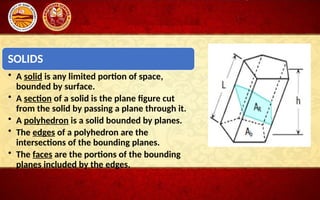
• A solidis any limited portion of space,
bounded by surface.
• A section of a solid is the plane figure cut
from the solid by passing a plane through it.
• A polyhedron is a solid bounded by planes.
• The edges of a polyhedron are the
intersections of the bounding planes.
• The faces are the portions of the bounding
planes included by the edges.
4.
Family of Solidswhose Volume () is
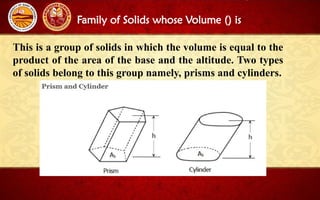
This is a group of solids in which the volume is equal to the
product of the area of the base and the altitude. Two types
of solids belong to this group namely, prisms and cylinders.
5.
Family of Solidswhose Volume () is
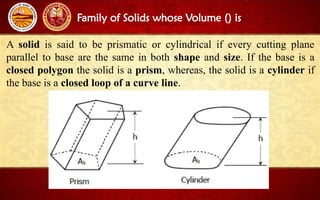
A solid is said to be prismatic or cylindrical if every cutting plane
parallel to base are the same in both shape and size. If the base is a
closed polygon the solid is a prism, whereas, the solid is a cylinder if
the base is a closed loop of a curve line.
6.
The Prism
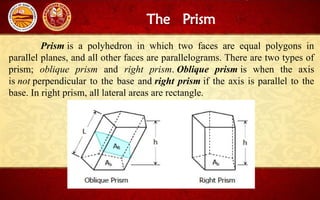
Prism isa polyhedron in which two faces are equal polygons in
parallel planes, and all other faces are parallelograms. There are two types of
prism; oblique prism and right prism. Oblique prism is when the axis
is not perpendicular to the base and right prism if the axis is parallel to the
base. In right prism, all lateral areas are rectangle.
7.
Name of aPrism
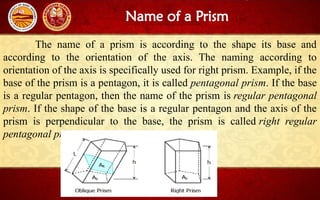
The name of a prism is according to the shape its base and
according to the orientation of the axis. The naming according to
orientation of the axis is specifically used for right prism. Example, if the
base of the prism is a pentagon, it is called pentagonal prism. If the base
is a regular pentagon, then the name of the prism is regular pentagonal
prism. If the shape of the base is a regular pentagon and the axis of the
prism is perpendicular to the base, the prism is called right regular
pentagonal prism.
8.
Elements of aPrism
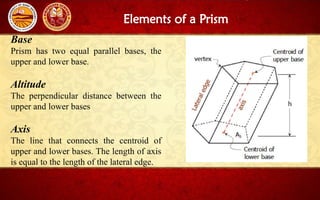
Base
Prism has two equal parallel bases, the
upper and lower base.
Altitude
The perpendicular distance between the
upper and lower bases
Axis
The line that connects the centroid of
upper and lower bases. The length of axis
is equal to the length of the lateral edge.
9.
Elements of aPrism
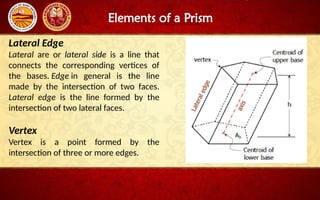
Lateral Edge
Lateral are or lateral side is a line that
connects the corresponding vertices of
the bases. Edge in general is the line
made by the intersection of two faces.
Lateral edge is the line formed by the
intersection of two lateral faces.
Vertex
Vertex is a point formed by the
intersection of three or more edges.
10.
Common Prism: Cubeand Rectangular Parallelepiped
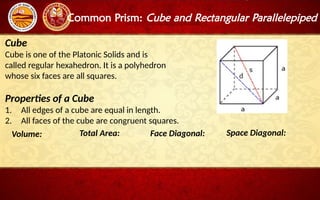
Cube
Cube is one of the Platonic Solids and is
called regular hexahedron. It is a polyhedron
whose six faces are all squares.
Properties of a Cube
1. All edges of a cube are equal in length.
2. All faces of the cube are congruent squares.
Volume: Total Area: Face Diagonal: Space Diagonal:
11.
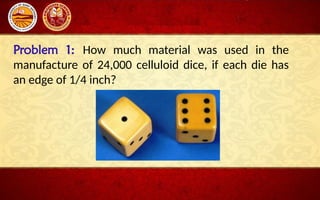
Problem 1: Howmuch material was used in the
manufacture of 24,000 celluloid dice, if each die has
an edge of 1/4 inch?
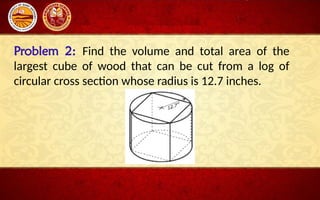
Problem 2: Findthe volume and total area of the
largest cube of wood that can be cut from a log of
circular cross section whose radius is 12.7 inches.
14.
Solution Problem no.2
Unit weight of water ()
Unit weight of ice ()
Volume of ice block ()
Weight of ice block ()
15.
Individual Task:
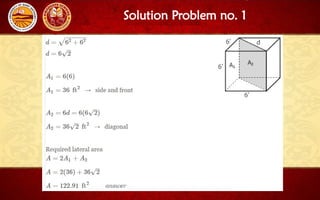
1. Avegetable bin built in the form of a cube with an
edge of 6 ft. is divided by a vertical partition which
passes through two diagonally opposite edges.
Find the lateral surface of either compartment.
2. What is the weight of a block of ice 24 in. by 24 in.
by 24 in., if ice weighs 92 per cent as much as
water, and water weighs 62.5 lb per cu. ft.?