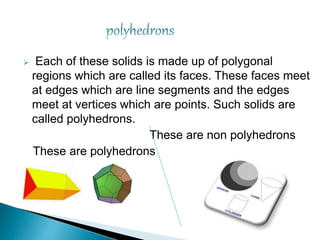
 Each of these solids is made up of polygonal 
regions which are called its faces. These faces meet 
at edges which are line segments and the edges 
meet at vertices which are points. Such solids are 
called polyhedrons. 
These are non polyhedrons 
These are polyhedrons
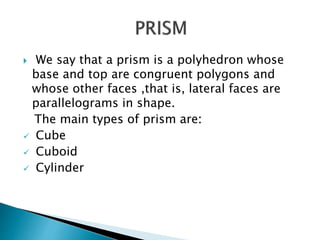
 We say that a prism is a polyhedron whose 
base and top are congruent polygons and 
whose other faces ,that is, lateral faces are 
parallelograms in shape. 
The main types of prism are: 
 Cube 
 Cuboid 
 Cylinder
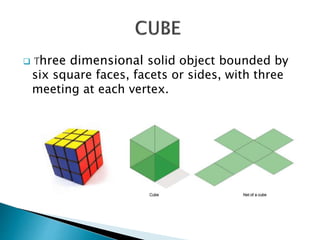
 Three dimensional solid object bounded by 
six square faces, facets or sides, with three 
meeting at each vertex.
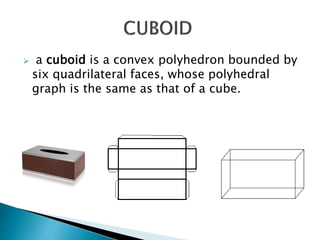
 a cuboid is a convex polyhedron bounded by 
six quadrilateral faces, whose polyhedral 
graph is the same as that of a cube.
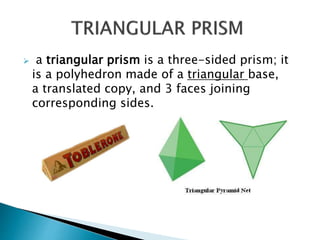
 a triangular prism is a three-sided prism; it 
is a polyhedron made of a triangular base, 
a translated copy, and 3 faces joining 
corresponding sides.

Visualising solid shapes

  • 2.
     Each ofthese solids is made up of polygonal regions which are called its faces. These faces meet at edges which are line segments and the edges meet at vertices which are points. Such solids are called polyhedrons. These are non polyhedrons These are polyhedrons
  • 3.
     We saythat a prism is a polyhedron whose base and top are congruent polygons and whose other faces ,that is, lateral faces are parallelograms in shape. The main types of prism are:  Cube  Cuboid  Cylinder
  • 4.
     Three dimensionalsolid object bounded by six square faces, facets or sides, with three meeting at each vertex.
  • 5.
     a cuboidis a convex polyhedron bounded by six quadrilateral faces, whose polyhedral graph is the same as that of a cube.
  • 6.
     a triangularprism is a three-sided prism; it is a polyhedron made of a triangular base, a translated copy, and 3 faces joining corresponding sides.